Leadership Blog: Leadership Strategies for Global Business Transitions

Verified

Added on  2022/08/27

|6
|1166
|15
Report
AI Summary
This leadership blog post examines the implications of leading in a changing global business environment, particularly for a company expanding into diverse international markets. It addresses the need for adaptability and effective strategies to overcome challenges like poor communication and lack of collaboration. The blog highlights the importance of the team leadership model in fostering collaboration and ethical practices within the new business context, emphasizing the positive impacts of diversity, gender equality, and teamwork on business performance. Furthermore, it explores the application of motivational leadership principles to engage employees from diverse cultural backgrounds, focusing on training, communication, and the role of leaders in building trust and achieving organizational goals. The conclusion underscores the necessity of a well-developed transition process to harness the collaborative efforts of a diversified workforce and achieve shared objectives.

Document Page
Running Head: LEADERSHIP 0
Innovative leadership
tabler-icon-diamond-filled.svg

Paraphrase This Document

Need a fresh take? Get an instant paraphrase of this document with our AI Paraphraser
Document Page
LEADERSHIP 1
Contents
Introduction...........................................................................................................................................2
Implications of the leading in changing global business environment...................................................2
Team leadership model and it link with the recent business practices...................................................2
Positive aspects of diversity, gender, and teamwork in improving business performance.....................3
Motivational leadership principles applications in the diversified culture.............................................3
Conclusion.............................................................................................................................................3
References.............................................................................................................................................5
Document Page
LEADERSHIP 2
Introduction
In the recent time, companies are required to position themselves effectively so that
they can easily and effectively adapt to the changing needs of the global and competitive
business environment. At the same time, some business organisations are not able to
effectively operate in the global business environment. This is usually caused the ineffective
leadership that does not ensure to effectively adapt in the changing business environment
needs. On the position of CEP at MegaGlobe business situation that is recently opened its
offices in Brazil, Sao Paulo, China and Guangdong, I need to give proper attention to the
transition process for effectively collaborating with the employees. In this leadership blog, I
will address several implications of leading in changing and culturally diversifies business
environment for adapting to the different leadership styles (Rajiah & Bhargava, 2016).
Implications of the leading in changing global business environment
It is significant to note that leading with the every changing global business
environment requires the application of proper strategies for avoiding the failures such as
poor communication, lack of collaboration, lower motivation as well as lack of teamwork. In
order to adapt the every changing business environment, it might be possible to create the
positive conditions for ensuring the effective collaboration between the workforce, allowing
them for greater responsibilities in order to meet the different needs of business. Leading in
the changing business organisation always required the enough resources (Hill & Bartol,
2016).
Team leadership model and it link with the recent business practices
Team leadership model that is required to be applied to business transition is the
integrative approach which will ensure the leader to use several factors such as aligning
properly with expectation, building effective relationship as well as recognising the stress.
“Team leadership model” is quite significant to the recent practices of business as it tends to
effectively monitor the external and internal actions. In the given scenario, new officers are
open in in Brazil and Shenzhen, Sao Paulo, China, Guangdong, China, and Brazil both have
varied cultures that out emphasis on the leaders to work collaboratively in order to achieve
the organisational objectives. At the same time, team leadership model also requires
application of ethical principles for keeping the human rights protected (Mathews, 2016).
Document Page
LEADERSHIP 3
Positive aspects of diversity, gender, and teamwork in improving business performance
Diverse business structure will prove to be effective when proper strategies will be
formed. Besides this, every team leader is also required effective prepare themselves that will
help in contributing to the collective success. It is also necessary to consider some of the
factors that might lead to the team failure such as lack of coordination. In this way, diverse
structure of organisation is required to develop in unique way that will effectively address the
diverse market demand. At the same time, authority and power distribution is also required
to be equal for avoiding misunderstanding and conflict at global level (Rahmani, Roels &
Karmarkar, 2018).
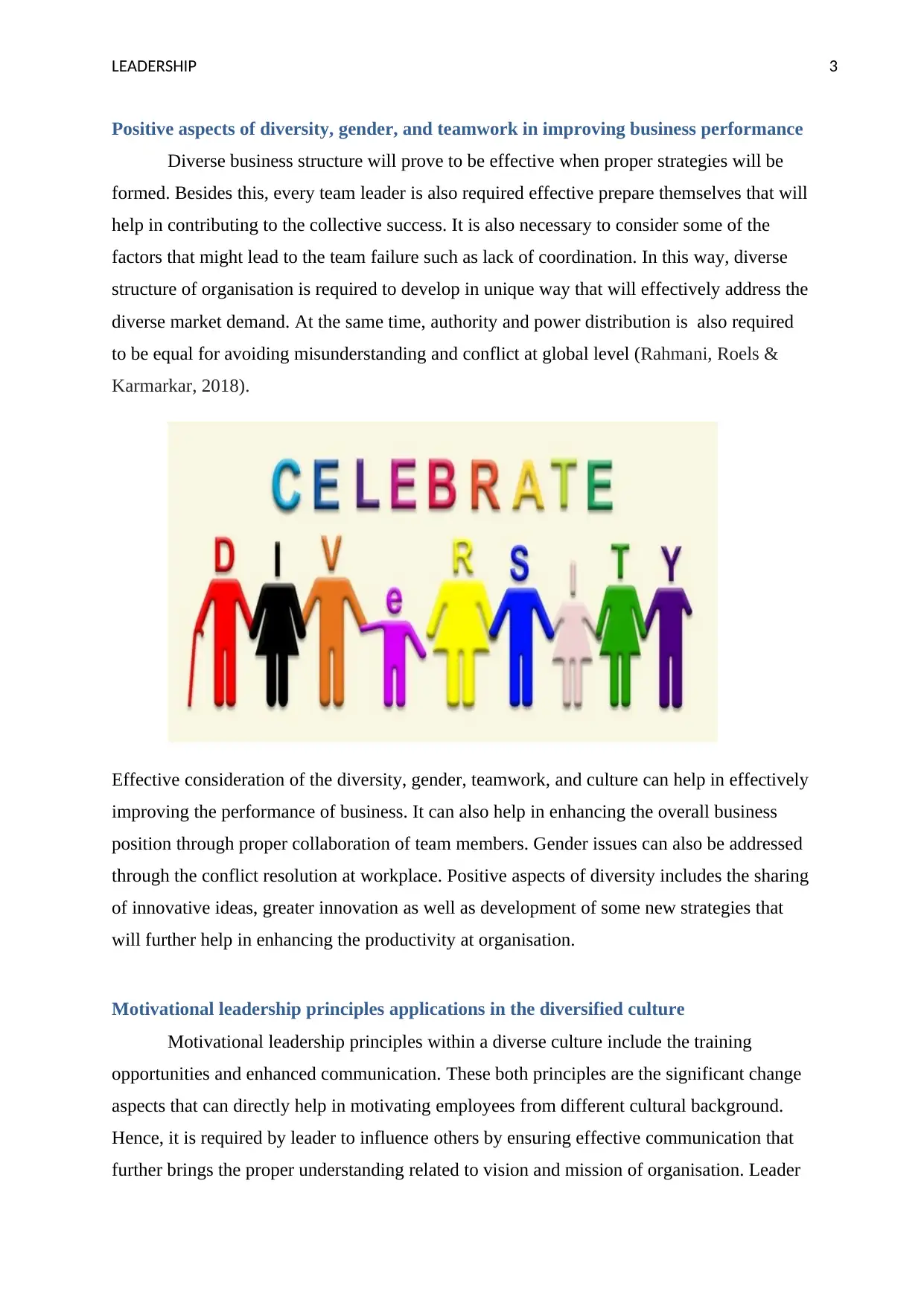
Effective consideration of the diversity, gender, teamwork, and culture can help in effectively
improving the performance of business. It can also help in enhancing the overall business
position through proper collaboration of team members. Gender issues can also be addressed
through the conflict resolution at workplace. Positive aspects of diversity includes the sharing
of innovative ideas, greater innovation as well as development of some new strategies that
will further help in enhancing the productivity at organisation.
Motivational leadership principles applications in the diversified culture
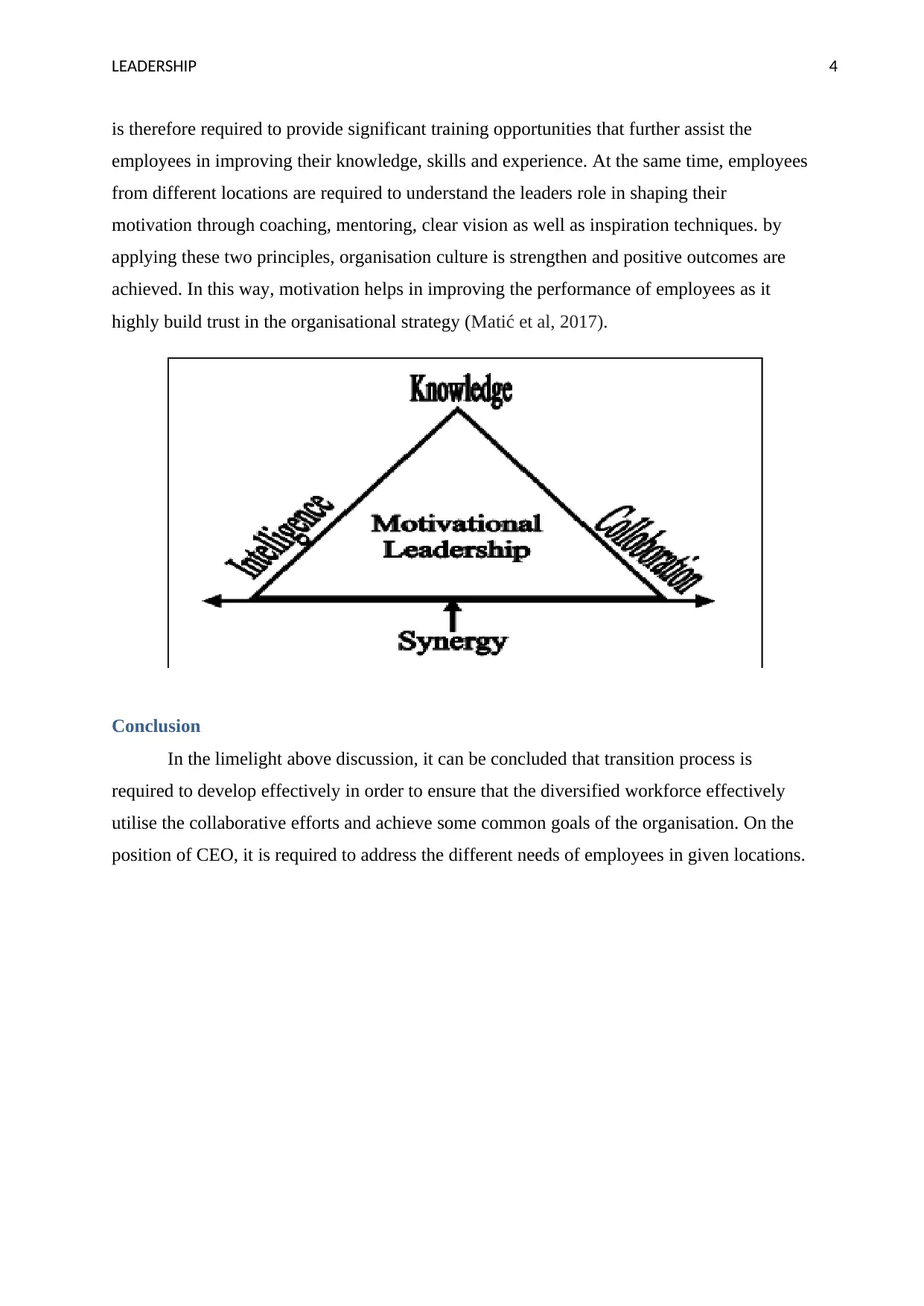
Motivational leadership principles within a diverse culture include the training
opportunities and enhanced communication. These both principles are the significant change
aspects that can directly help in motivating employees from different cultural background.
Hence, it is required by leader to influence others by ensuring effective communication that
further brings the proper understanding related to vision and mission of organisation. Leader
tabler-icon-diamond-filled.svg

Paraphrase This Document

Need a fresh take? Get an instant paraphrase of this document with our AI Paraphraser
Document Page
LEADERSHIP 4
is therefore required to provide significant training opportunities that further assist the
employees in improving their knowledge, skills and experience. At the same time, employees
from different locations are required to understand the leaders role in shaping their
motivation through coaching, mentoring, clear vision as well as inspiration techniques. by
applying these two principles, organisation culture is strengthen and positive outcomes are
achieved. In this way, motivation helps in improving the performance of employees as it
highly build trust in the organisational strategy (Matić et al, 2017).
Conclusion
In the limelight above discussion, it can be concluded that transition process is
required to develop effectively in order to ensure that the diversified workforce effectively
utilise the collaborative efforts and achieve some common goals of the organisation. On the
position of CEO, it is required to address the different needs of employees in given locations.
Document Page
LEADERSHIP 5
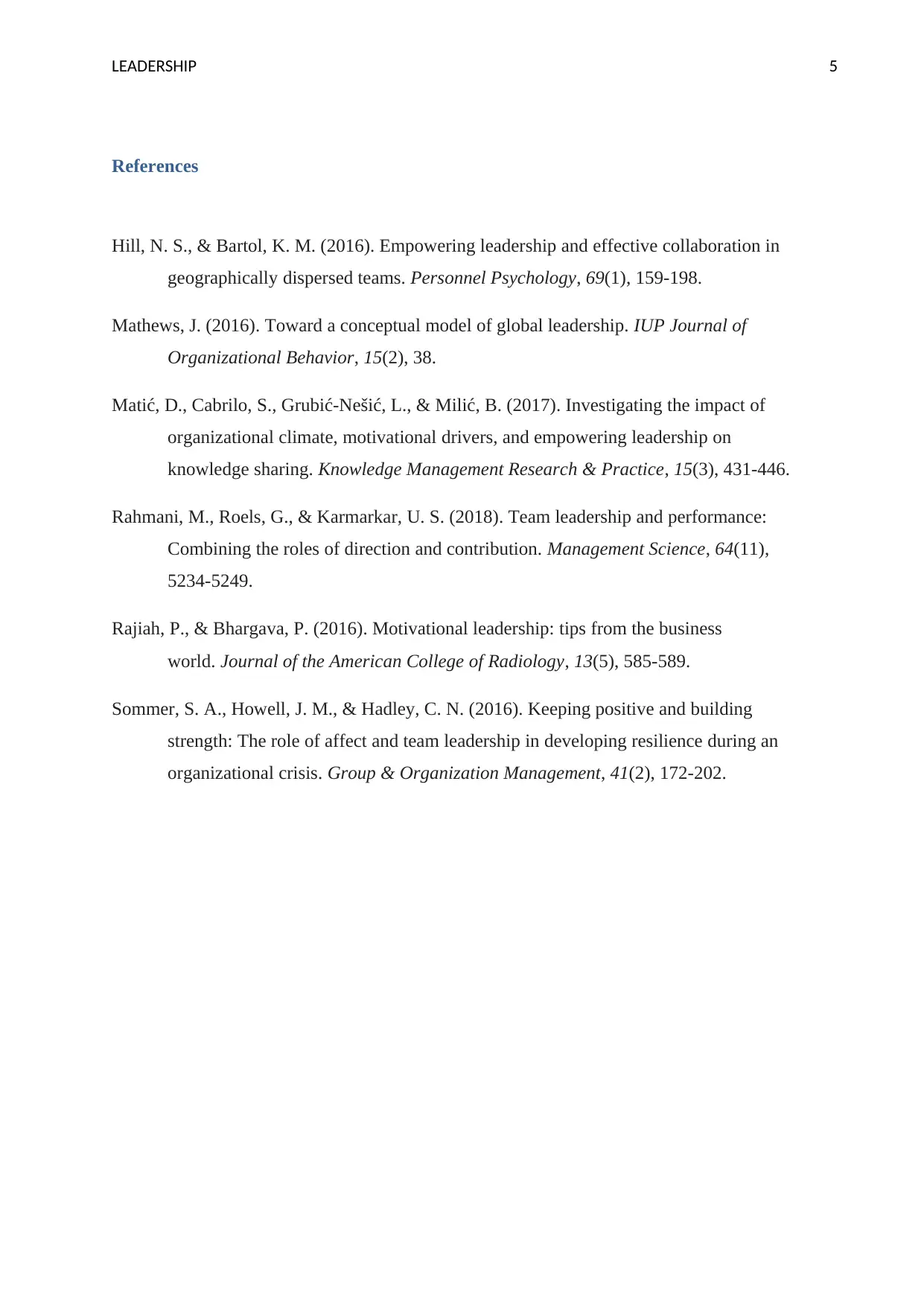
References
Hill, N. S., & Bartol, K. M. (2016). Empowering leadership and effective collaboration in
geographically dispersed teams. Personnel Psychology, 69(1), 159-198.
Mathews, J. (2016). Toward a conceptual model of global leadership. IUP Journal of
Organizational Behavior, 15(2), 38.
Matić, D., Cabrilo, S., Grubić-Nešić, L., & Milić, B. (2017). Investigating the impact of
organizational climate, motivational drivers, and empowering leadership on
knowledge sharing. Knowledge Management Research & Practice, 15(3), 431-446.
Rahmani, M., Roels, G., & Karmarkar, U. S. (2018). Team leadership and performance:
Combining the roles of direction and contribution. Management Science, 64(11),
5234-5249.
Rajiah, P., & Bhargava, P. (2016). Motivational leadership: tips from the business
world. Journal of the American College of Radiology, 13(5), 585-589.
Sommer, S. A., Howell, J. M., & Hadley, C. N. (2016). Keeping positive and building
strength: The role of affect and team leadership in developing resilience during an
organizational crisis. Group & Organization Management, 41(2), 172-202.
chevron_up_icon
1 out of 6
circle_padding
hide_on_mobile
zoom_out_icon
[object Object]