Leadership and Governance: CEO Role and Accountability Essay
VerifiedAdded on 2021/05/31
|10
|3074
|50
Essay
AI Summary
This essay delves into the critical aspects of leadership and governance, primarily focusing on the role and accountability of the Chief Executive Officer (CEO) within a corporate structure. It examines the CEO's responsibilities in maintaining ethical standards, transparency, and accountability, highlighting the importance of corporate governance frameworks like those promoted by the OECD. The essay explores various theories, including agency theory and shareholder value theory, to illustrate how the CEO is held accountable for the actions of the corporation. It also analyzes the impact of organizational climate on corporate success, discussing factors like affiliation, innovation, and teamwork. The essay emphasizes the CEO's crucial role in bridging the gap between employees, the board, and shareholders, ensuring the company's long-term growth and profitability while upholding ethical standards and adapting to the evolving corporate landscape.
Running head: LEADERSHIP AND GOVERNANCE
Leadership and Governance
Name of the Student
Name of the University
Author Note
Leadership and Governance
Name of the Student
Name of the University
Author Note

Paraphrase This Document
Need a fresh take? Get an instant paraphrase of this document with our AI Paraphraser
1
LEADERSHIP AND GOVERNANCE
1. The Organization for economic co-operation and development, that is, the OECD is a
forum that addresses the economic, social and environmental challenges that plague
globalization. The Global Corporate Governance is under the OECD that aims at implementing
the practices of proper corporate governance. The Corporate Governance Forum provides a
framework for the implementation of a framework that promotes corporate governance in a
corporate set up. The OECD works as a response to the issues that concern corporate
governance and the challenges that are faced by the corporations. The Chief Executive Officer is
in charge of the proper functioning of the company and also implements long term business
strategies that create a good value of the brand in the market. The CEO is the bridge that
connects the management and the Board and he is also responsible for the communication of the
matters of the company to the shareholders, employees etc. a good corporate governance is about
people and being at the top of the company and holding all the positions of responsibility, the
CEO is directly in charge of the corporation. By virtue of the position the CEO holds, he is
accountable to the Board. With the increasing corporate scandals, the behavior and action of the
CEO set the standards of the behavior that the company holds with the society. Whenever a
scandal occurs, no one is held more accountable than the CEO and the onus of the corporation is
on him to take care. There have been instances in the past when the CEO had to explain the
stance of the company and testify to the public clearing the name of the Company to the public.
The responsibilities of the CEO include maintaining transparency and accountability of the
company. If the corporate governance is seen as puzzle, it can be easily attributed that the CEO
fits perfectly in the puzzle and forms the missing link. The behavior and responsibilities form the
corporate governance and in cases when the corporation defrauds, it is responsibility of the CEO
to preserve the goodwill of the company. In most cases when the company is embroiled in a
LEADERSHIP AND GOVERNANCE
1. The Organization for economic co-operation and development, that is, the OECD is a
forum that addresses the economic, social and environmental challenges that plague
globalization. The Global Corporate Governance is under the OECD that aims at implementing
the practices of proper corporate governance. The Corporate Governance Forum provides a
framework for the implementation of a framework that promotes corporate governance in a
corporate set up. The OECD works as a response to the issues that concern corporate
governance and the challenges that are faced by the corporations. The Chief Executive Officer is
in charge of the proper functioning of the company and also implements long term business
strategies that create a good value of the brand in the market. The CEO is the bridge that
connects the management and the Board and he is also responsible for the communication of the
matters of the company to the shareholders, employees etc. a good corporate governance is about
people and being at the top of the company and holding all the positions of responsibility, the
CEO is directly in charge of the corporation. By virtue of the position the CEO holds, he is
accountable to the Board. With the increasing corporate scandals, the behavior and action of the
CEO set the standards of the behavior that the company holds with the society. Whenever a
scandal occurs, no one is held more accountable than the CEO and the onus of the corporation is
on him to take care. There have been instances in the past when the CEO had to explain the
stance of the company and testify to the public clearing the name of the Company to the public.
The responsibilities of the CEO include maintaining transparency and accountability of the
company. If the corporate governance is seen as puzzle, it can be easily attributed that the CEO
fits perfectly in the puzzle and forms the missing link. The behavior and responsibilities form the
corporate governance and in cases when the corporation defrauds, it is responsibility of the CEO
to preserve the goodwill of the company. In most cases when the company is embroiled in a
2
LEADERSHIP AND GOVERNANCE
dispute, the CEO is made the villain and in such cases the CEO is blamed as having the intention
to run away from his responsibilities. Whenever a company performs well, the shareholders and
the board are appreciated and the efforts of the CEO go unnoticed. The Head of the Corporate
Affairs of The Organization for economic co-operation and Development have due credit to the
role of the CEO saying that no corporate can perform of the CEO does not help and without a
good CEO, a board cannot be said to be performing well. The relation between the CEO and the
corporation is that of an agent and principal because the CEO works under the supervision of the
corporations and represents the company to the outer world. The White Paper on Governance
held that the duties of CEO include integrity, suitability and experience and transparency. This is
called the fit and proper test. The fit and proper test lays down a guideline for the Chief
Executive officers to follows. An effective model of corporate governance will give due credit to
ethics and it requires a proper and good understanding of the structure of the corporation and the
relationship of the management with the board (Kraakman & Hansmann, 2017). The board is
responsible for the election of a ethical and morally sound CEO who will ensure that the
corporations functions without any scams. It is the responsibility of the management to elect
CEO who will set the highest standards of morality and ethics. Good corporate governance is a
minimum requirement and should be seen as a high priority for the management and the CEO.
The overseeing duty of the management also includes checking the day to day activities of the
CEO. In cases when the corporation suffers a setback due to the mistakes of the CEO, it will be
the responsibility of the management to punish and penalize the CEO for its shortcomings and
mistakes. It is the duty of the management to makes sure that an ethical CEO is appointed and
that responsibility extends to taking due responsibility for the actions of the CEO and penalize
him for breach of his responsibilities to uphold corporate governance.
LEADERSHIP AND GOVERNANCE
dispute, the CEO is made the villain and in such cases the CEO is blamed as having the intention
to run away from his responsibilities. Whenever a company performs well, the shareholders and
the board are appreciated and the efforts of the CEO go unnoticed. The Head of the Corporate
Affairs of The Organization for economic co-operation and Development have due credit to the
role of the CEO saying that no corporate can perform of the CEO does not help and without a
good CEO, a board cannot be said to be performing well. The relation between the CEO and the
corporation is that of an agent and principal because the CEO works under the supervision of the
corporations and represents the company to the outer world. The White Paper on Governance
held that the duties of CEO include integrity, suitability and experience and transparency. This is
called the fit and proper test. The fit and proper test lays down a guideline for the Chief
Executive officers to follows. An effective model of corporate governance will give due credit to
ethics and it requires a proper and good understanding of the structure of the corporation and the
relationship of the management with the board (Kraakman & Hansmann, 2017). The board is
responsible for the election of a ethical and morally sound CEO who will ensure that the
corporations functions without any scams. It is the responsibility of the management to elect
CEO who will set the highest standards of morality and ethics. Good corporate governance is a
minimum requirement and should be seen as a high priority for the management and the CEO.
The overseeing duty of the management also includes checking the day to day activities of the
CEO. In cases when the corporation suffers a setback due to the mistakes of the CEO, it will be
the responsibility of the management to punish and penalize the CEO for its shortcomings and
mistakes. It is the duty of the management to makes sure that an ethical CEO is appointed and
that responsibility extends to taking due responsibility for the actions of the CEO and penalize
him for breach of his responsibilities to uphold corporate governance.
⊘ This is a preview!⊘
Do you want full access?
Subscribe today to unlock all pages.

Trusted by 1+ million students worldwide
3
LEADERSHIP AND GOVERNANCE
2. Accountability is a commonly used term in politics and governance that entail that a
board, management and the directors shall be responsible for the proper functioning of the
corporation. In cases of any trouble, the CEO shall be made responsible and held accountable.
With the rise in the importance of corporate governance, it is important for the directors to
remain accountable. This is called the theory of accountability where the CEO shall remain
accountable to the corporate and also work upholding the ethics and value of the principle of
corporate governance. This theory was pioneered by Alchian in his book ‘Production,
Information and Costs and Economic Organization.’(Stout & Blair, 2017) Another theory that
upholds the duty and integrity of the CEO is the theory of agency, which is not mostly
considered as a benchmark of accountability and does not imbibe the tenets of accountability as
fixing the interests of the CEO. The CEO shall be made accountable if he acts in breach of his
duties and they shall be held accountable if they cause any harm or misconduct that reflects on
the conduct of the company. The CEO is in a fiduciary relation with the management and the
board and if the agent fails in executing that duty, the principal shall hold him accountable
(Tricker & Tricker, 2015). The CEO exercises power in conducting the business of the company
and is also held responsible and with such supreme powers, comes accountability. This theory
was enshrined by J Davis in his article “Towards a Stewardship Theory of Management.” The
shareholder value theory held that the directors and the CEO shall act in such a way so as to
benefit the shareholders. The advantage of the shareholder theory is that the actions of the
directors can be checked and it can be seen that the directors are performing well or not. The
actions of the directors shall be to enhance the activities of the shareholders (Aguilera, Hudge &
Terjesen, 2018). The CEO therefore becomes accountable for the way a shareholder holds his
office and conducts his business. the shareholder theory also backs the agency theory that makes
LEADERSHIP AND GOVERNANCE
2. Accountability is a commonly used term in politics and governance that entail that a
board, management and the directors shall be responsible for the proper functioning of the
corporation. In cases of any trouble, the CEO shall be made responsible and held accountable.
With the rise in the importance of corporate governance, it is important for the directors to
remain accountable. This is called the theory of accountability where the CEO shall remain
accountable to the corporate and also work upholding the ethics and value of the principle of
corporate governance. This theory was pioneered by Alchian in his book ‘Production,
Information and Costs and Economic Organization.’(Stout & Blair, 2017) Another theory that
upholds the duty and integrity of the CEO is the theory of agency, which is not mostly
considered as a benchmark of accountability and does not imbibe the tenets of accountability as
fixing the interests of the CEO. The CEO shall be made accountable if he acts in breach of his
duties and they shall be held accountable if they cause any harm or misconduct that reflects on
the conduct of the company. The CEO is in a fiduciary relation with the management and the
board and if the agent fails in executing that duty, the principal shall hold him accountable
(Tricker & Tricker, 2015). The CEO exercises power in conducting the business of the company
and is also held responsible and with such supreme powers, comes accountability. This theory
was enshrined by J Davis in his article “Towards a Stewardship Theory of Management.” The
shareholder value theory held that the directors and the CEO shall act in such a way so as to
benefit the shareholders. The advantage of the shareholder theory is that the actions of the
directors can be checked and it can be seen that the directors are performing well or not. The
actions of the directors shall be to enhance the activities of the shareholders (Aguilera, Hudge &
Terjesen, 2018). The CEO therefore becomes accountable for the way a shareholder holds his
office and conducts his business. the shareholder theory also backs the agency theory that makes
Paraphrase This Document
Need a fresh take? Get an instant paraphrase of this document with our AI Paraphraser
4
LEADERSHIP AND GOVERNANCE
sure that the interests of the principal are aligned with the agent and the agent works to further
the goals of corporate governance. If the CEO is not made accountable for the way a corporate
works, the CEO shall start engaging in shirking and self dealing, thereby the interests of the
shareholders shall be maximized (Dimopoulos, Wagner, 2016). The CEO is the apex authority in
the corporation and in cases when the corporate does not function up to the mark, the CEO is
made accountable. These theories point towards the fact that the CEO shall be made responsible
for the functions of the company. Abiding by the principles of good governance, it is incumbent
on the management to ensure that the company does not indulge in any fraud and scam. The
CEO is responsible for the way the shareholders function and therefore, by law, in cases when it
is seen that the corporation is getting affected by the actions of the shareholders or the members
of the company, the CEO shall be made responsible. In common corporate theory, the CEO is
perceived as a villain who runs away from responsibilities and also situations that make sure that
he takes full responsibility. The CEO enjoys supreme authority in taking decisions of the
company and therefore in cases when the CEO tries to skirt away, the principles and theories
shall apply to keep a check on the conduct of the CEO. The CEO sets a strong standard and a
regulatory framework that is binding on the company. The CEO will be made to be responsible
for the company and also act in accordance with the principles of corporate governance
(MsCahery, Sautner & Starks, 2016).
3. It is the duty and the function of the company and the CEO to discharge his corporate duties
and to act to promote and effectuate organizational climate that is necessary for the growth and
profit of the company. The CEO is responsible for enhancing the organizational climate in the
company and bridging the gap between the employees and the board (Seo et al., 2015). By
conducting extensive research on the organizational principles of the company, it has been
LEADERSHIP AND GOVERNANCE
sure that the interests of the principal are aligned with the agent and the agent works to further
the goals of corporate governance. If the CEO is not made accountable for the way a corporate
works, the CEO shall start engaging in shirking and self dealing, thereby the interests of the
shareholders shall be maximized (Dimopoulos, Wagner, 2016). The CEO is the apex authority in
the corporation and in cases when the corporate does not function up to the mark, the CEO is
made accountable. These theories point towards the fact that the CEO shall be made responsible
for the functions of the company. Abiding by the principles of good governance, it is incumbent
on the management to ensure that the company does not indulge in any fraud and scam. The
CEO is responsible for the way the shareholders function and therefore, by law, in cases when it
is seen that the corporation is getting affected by the actions of the shareholders or the members
of the company, the CEO shall be made responsible. In common corporate theory, the CEO is
perceived as a villain who runs away from responsibilities and also situations that make sure that
he takes full responsibility. The CEO enjoys supreme authority in taking decisions of the
company and therefore in cases when the CEO tries to skirt away, the principles and theories
shall apply to keep a check on the conduct of the CEO. The CEO sets a strong standard and a
regulatory framework that is binding on the company. The CEO will be made to be responsible
for the company and also act in accordance with the principles of corporate governance
(MsCahery, Sautner & Starks, 2016).
3. It is the duty and the function of the company and the CEO to discharge his corporate duties
and to act to promote and effectuate organizational climate that is necessary for the growth and
profit of the company. The CEO is responsible for enhancing the organizational climate in the
company and bridging the gap between the employees and the board (Seo et al., 2015). By
conducting extensive research on the organizational principles of the company, it has been
5
LEADERSHIP AND GOVERNANCE
concluded that the CEO is responsible for the proper functioning of the company. The four
aspects of organizational climate are affiliation, innovation, resource adequacy and professional
interest (Davies, 2016). The concept of organizational climate is to make sure that business is
processed in a way that is beneficial for the company and the interests of the board
Organizational community: the corporate community is a very well connected and strongly
knit community that works towards the betterment of the company and make sure that all the
interests of the company are aligned with that of the members (Lehn, 2018). By virtue of being a
CEO is has to look after the wellbeing of the company and also uplift the interests of the
employees. The organization community works in a cluster and as a group to uplift community
goal. Corporate governance aims to effectively implements the codes of professionalism and
ethics and ensure that there is transparency in the way a company functions. To take care of the
interests of the members, the CEO has to act in all fairness and give due credit to the people who
are employed in the company. Fairness mandates that all the members are accorded equal
treatment and that all the shareholders are treated equally in accordance with the principles of the
Company Act (Bovens, 2014).
Flexibility: There is a rising competition in the corporate sector and it is fuelled by the
increasing number of companies that have started to function. Flexibility is a term that denotes
adaptability with the changing growth and the needs and requirements of the company
(Vandekerckhove, 2016). A company is an independent authority that changes with the growth
of the company. Corporate governance ensures that higher the flexibility of the company, higher
is the growth. There is always a need to grow and change and this is done to ensure that the
members adapt with the changing scenario. Different principles apply to different companies and
there cannot be a universal law or regulations that govern all the companies. In cases of
LEADERSHIP AND GOVERNANCE
concluded that the CEO is responsible for the proper functioning of the company. The four
aspects of organizational climate are affiliation, innovation, resource adequacy and professional
interest (Davies, 2016). The concept of organizational climate is to make sure that business is
processed in a way that is beneficial for the company and the interests of the board
Organizational community: the corporate community is a very well connected and strongly
knit community that works towards the betterment of the company and make sure that all the
interests of the company are aligned with that of the members (Lehn, 2018). By virtue of being a
CEO is has to look after the wellbeing of the company and also uplift the interests of the
employees. The organization community works in a cluster and as a group to uplift community
goal. Corporate governance aims to effectively implements the codes of professionalism and
ethics and ensure that there is transparency in the way a company functions. To take care of the
interests of the members, the CEO has to act in all fairness and give due credit to the people who
are employed in the company. Fairness mandates that all the members are accorded equal
treatment and that all the shareholders are treated equally in accordance with the principles of the
Company Act (Bovens, 2014).
Flexibility: There is a rising competition in the corporate sector and it is fuelled by the
increasing number of companies that have started to function. Flexibility is a term that denotes
adaptability with the changing growth and the needs and requirements of the company
(Vandekerckhove, 2016). A company is an independent authority that changes with the growth
of the company. Corporate governance ensures that higher the flexibility of the company, higher
is the growth. There is always a need to grow and change and this is done to ensure that the
members adapt with the changing scenario. Different principles apply to different companies and
there cannot be a universal law or regulations that govern all the companies. In cases of
⊘ This is a preview!⊘
Do you want full access?
Subscribe today to unlock all pages.
Trusted by 1+ million students worldwide
6
LEADERSHIP AND GOVERNANCE
noncompliance with the company regulations, it is important for the CEO to note the reason
behind not complying with the changing scenario (Chen, Harford & Lin, 2017). Corporate
governance tries to strike a balance between flexibility, compliance and stakeholder interest.
Specific interests of the company need to be addressed by the CEO and these are done keeping in
mind the flexibility of the company. The purpose of having rules is that the interests of the
stakeholders need to be addressed. Companies need to respond to the expectations of the markets
and also foster rules that make it obligatory on the company to make amends to their existing
rules (Larcker & Tayan, 2015).
Teamwork- great teams are built when great minds come together and this can only happen if
the members and the shareholders come together to work and meet the requirements of the
company. A team works together to enhance their common goal and they are supervised by the
CEO. The CEO make the teams work together under a common intention of bettering the goals
and interests of the company (Arjoon, 2017). A team has people from different cultures and has
different ways of life and it is the duty of the CEO to makes sure that a unified team is formed
where all the members work in unison to meet the targets of the company (Aras, 2016).
Diversity- the best way to promote diversity and heterogeneity in the company is to include
members of different culture, ethnicity, and language in the board. If a board has members who
have different attributes and come from varying demography, the diversity of the board
improves. If a board is made gender diverse, that is, females are also included in the board, it will
set a prime example of gender diversity and enhance and uphold the principles of corporate
governance (Iren & Tee, 2017). With increasing diversity more perspectives and opinions will
come that will help in enhancing the working of the board. To have a diverse board, it is
important to have a comprehensive structure that will have a culmination of gender, racial,
LEADERSHIP AND GOVERNANCE
noncompliance with the company regulations, it is important for the CEO to note the reason
behind not complying with the changing scenario (Chen, Harford & Lin, 2017). Corporate
governance tries to strike a balance between flexibility, compliance and stakeholder interest.
Specific interests of the company need to be addressed by the CEO and these are done keeping in
mind the flexibility of the company. The purpose of having rules is that the interests of the
stakeholders need to be addressed. Companies need to respond to the expectations of the markets
and also foster rules that make it obligatory on the company to make amends to their existing
rules (Larcker & Tayan, 2015).
Teamwork- great teams are built when great minds come together and this can only happen if
the members and the shareholders come together to work and meet the requirements of the
company. A team works together to enhance their common goal and they are supervised by the
CEO. The CEO make the teams work together under a common intention of bettering the goals
and interests of the company (Arjoon, 2017). A team has people from different cultures and has
different ways of life and it is the duty of the CEO to makes sure that a unified team is formed
where all the members work in unison to meet the targets of the company (Aras, 2016).
Diversity- the best way to promote diversity and heterogeneity in the company is to include
members of different culture, ethnicity, and language in the board. If a board has members who
have different attributes and come from varying demography, the diversity of the board
improves. If a board is made gender diverse, that is, females are also included in the board, it will
set a prime example of gender diversity and enhance and uphold the principles of corporate
governance (Iren & Tee, 2017). With increasing diversity more perspectives and opinions will
come that will help in enhancing the working of the board. To have a diverse board, it is
important to have a comprehensive structure that will have a culmination of gender, racial,
Paraphrase This Document
Need a fresh take? Get an instant paraphrase of this document with our AI Paraphraser
7
LEADERSHIP AND GOVERNANCE
cultural and composition of board of directors (Adams et al., 2015). The board shall have
members who have qualification and can issue statements and order that will benefit the
company.
Organizational culture and organizational change- organizations are subject to change and
the functioning of a corporate is dependent on the way the shareholders, employees are managed
and organized. To preserve the shareholder value, it is important to regulate the principles of the
company and make an organized structure that will regulate shareholder behavior and also
preserve shareholder value. In legal parlance and in terms of corporate governance,
organizational behavior can be seen as a system that helps and organizes, manages and
administers corporate behaviour to maximize their utility and economic resources. The role of
corporate governance is to make sure that stakeholder’s interests are preserved and the
investments made by the company are in the interest of the company (Feils, Rahman & Sabac,
2016).
LEADERSHIP AND GOVERNANCE
cultural and composition of board of directors (Adams et al., 2015). The board shall have
members who have qualification and can issue statements and order that will benefit the
company.
Organizational culture and organizational change- organizations are subject to change and
the functioning of a corporate is dependent on the way the shareholders, employees are managed
and organized. To preserve the shareholder value, it is important to regulate the principles of the
company and make an organized structure that will regulate shareholder behavior and also
preserve shareholder value. In legal parlance and in terms of corporate governance,
organizational behavior can be seen as a system that helps and organizes, manages and
administers corporate behaviour to maximize their utility and economic resources. The role of
corporate governance is to make sure that stakeholder’s interests are preserved and the
investments made by the company are in the interest of the company (Feils, Rahman & Sabac,
2016).
8
LEADERSHIP AND GOVERNANCE
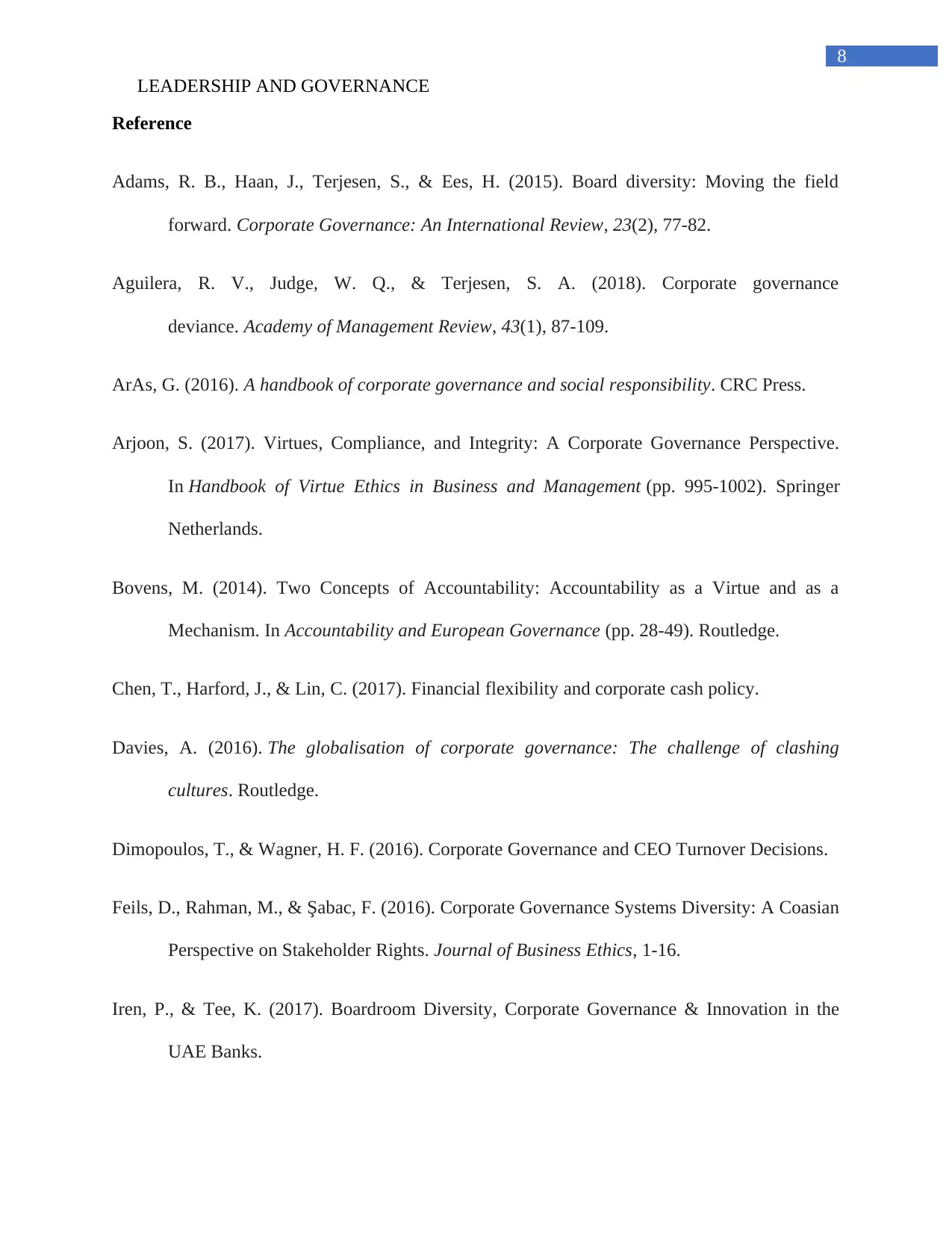
Reference
Adams, R. B., Haan, J., Terjesen, S., & Ees, H. (2015). Board diversity: Moving the field
forward. Corporate Governance: An International Review, 23(2), 77-82.
Aguilera, R. V., Judge, W. Q., & Terjesen, S. A. (2018). Corporate governance
deviance. Academy of Management Review, 43(1), 87-109.
ArAs, G. (2016). A handbook of corporate governance and social responsibility. CRC Press.
Arjoon, S. (2017). Virtues, Compliance, and Integrity: A Corporate Governance Perspective.
In Handbook of Virtue Ethics in Business and Management (pp. 995-1002). Springer
Netherlands.
Bovens, M. (2014). Two Concepts of Accountability: Accountability as a Virtue and as a
Mechanism. In Accountability and European Governance (pp. 28-49). Routledge.
Chen, T., Harford, J., & Lin, C. (2017). Financial flexibility and corporate cash policy.
Davies, A. (2016). The globalisation of corporate governance: The challenge of clashing
cultures. Routledge.
Dimopoulos, T., & Wagner, H. F. (2016). Corporate Governance and CEO Turnover Decisions.
Feils, D., Rahman, M., & Şabac, F. (2016). Corporate Governance Systems Diversity: A Coasian
Perspective on Stakeholder Rights. Journal of Business Ethics, 1-16.
Iren, P., & Tee, K. (2017). Boardroom Diversity, Corporate Governance & Innovation in the
UAE Banks.
LEADERSHIP AND GOVERNANCE
Reference
Adams, R. B., Haan, J., Terjesen, S., & Ees, H. (2015). Board diversity: Moving the field
forward. Corporate Governance: An International Review, 23(2), 77-82.
Aguilera, R. V., Judge, W. Q., & Terjesen, S. A. (2018). Corporate governance
deviance. Academy of Management Review, 43(1), 87-109.
ArAs, G. (2016). A handbook of corporate governance and social responsibility. CRC Press.
Arjoon, S. (2017). Virtues, Compliance, and Integrity: A Corporate Governance Perspective.
In Handbook of Virtue Ethics in Business and Management (pp. 995-1002). Springer
Netherlands.
Bovens, M. (2014). Two Concepts of Accountability: Accountability as a Virtue and as a
Mechanism. In Accountability and European Governance (pp. 28-49). Routledge.
Chen, T., Harford, J., & Lin, C. (2017). Financial flexibility and corporate cash policy.
Davies, A. (2016). The globalisation of corporate governance: The challenge of clashing
cultures. Routledge.
Dimopoulos, T., & Wagner, H. F. (2016). Corporate Governance and CEO Turnover Decisions.
Feils, D., Rahman, M., & Şabac, F. (2016). Corporate Governance Systems Diversity: A Coasian
Perspective on Stakeholder Rights. Journal of Business Ethics, 1-16.
Iren, P., & Tee, K. (2017). Boardroom Diversity, Corporate Governance & Innovation in the
UAE Banks.
⊘ This is a preview!⊘
Do you want full access?
Subscribe today to unlock all pages.
Trusted by 1+ million students worldwide
9
LEADERSHIP AND GOVERNANCE
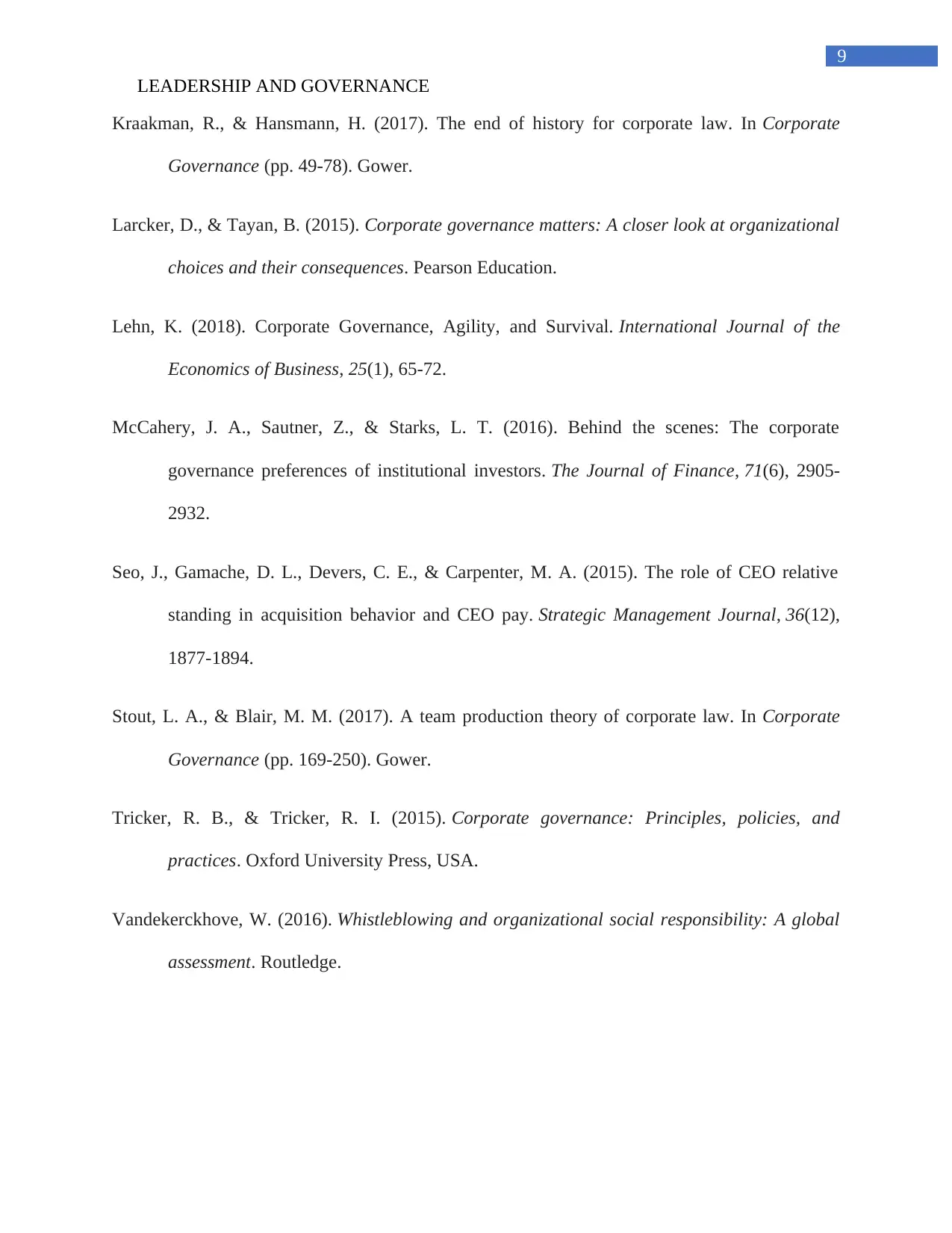
Kraakman, R., & Hansmann, H. (2017). The end of history for corporate law. In Corporate
Governance (pp. 49-78). Gower.
Larcker, D., & Tayan, B. (2015). Corporate governance matters: A closer look at organizational
choices and their consequences. Pearson Education.
Lehn, K. (2018). Corporate Governance, Agility, and Survival. International Journal of the
Economics of Business, 25(1), 65-72.
McCahery, J. A., Sautner, Z., & Starks, L. T. (2016). Behind the scenes: The corporate
governance preferences of institutional investors. The Journal of Finance, 71(6), 2905-
2932.
Seo, J., Gamache, D. L., Devers, C. E., & Carpenter, M. A. (2015). The role of CEO relative
standing in acquisition behavior and CEO pay. Strategic Management Journal, 36(12),
1877-1894.
Stout, L. A., & Blair, M. M. (2017). A team production theory of corporate law. In Corporate
Governance (pp. 169-250). Gower.
Tricker, R. B., & Tricker, R. I. (2015). Corporate governance: Principles, policies, and
practices. Oxford University Press, USA.
Vandekerckhove, W. (2016). Whistleblowing and organizational social responsibility: A global
assessment. Routledge.
LEADERSHIP AND GOVERNANCE
Kraakman, R., & Hansmann, H. (2017). The end of history for corporate law. In Corporate
Governance (pp. 49-78). Gower.
Larcker, D., & Tayan, B. (2015). Corporate governance matters: A closer look at organizational
choices and their consequences. Pearson Education.
Lehn, K. (2018). Corporate Governance, Agility, and Survival. International Journal of the
Economics of Business, 25(1), 65-72.
McCahery, J. A., Sautner, Z., & Starks, L. T. (2016). Behind the scenes: The corporate
governance preferences of institutional investors. The Journal of Finance, 71(6), 2905-
2932.
Seo, J., Gamache, D. L., Devers, C. E., & Carpenter, M. A. (2015). The role of CEO relative
standing in acquisition behavior and CEO pay. Strategic Management Journal, 36(12),
1877-1894.
Stout, L. A., & Blair, M. M. (2017). A team production theory of corporate law. In Corporate
Governance (pp. 169-250). Gower.
Tricker, R. B., & Tricker, R. I. (2015). Corporate governance: Principles, policies, and
practices. Oxford University Press, USA.
Vandekerckhove, W. (2016). Whistleblowing and organizational social responsibility: A global
assessment. Routledge.

1 out of 10


Related Documents


Your All-in-One AI-Powered Toolkit for Academic Success.
+13062052269
info@desklib.com
Available 24*7 on WhatsApp / Email
![[object Object]](/_next/static/media/star-bottom.7253800d.svg)
Unlock your academic potential
Copyright © 2020–2026 A2Z Services. All Rights Reserved. Developed and managed by ZUCOL.