Talent Acquisition: Comparing Internal and External Hiring Strategies
VerifiedAdded on 2019/10/18
|3
|1059
|299
Homework Assignment
AI Summary
This assignment explores the contrasting strategies of internal promotion versus external hiring within organizations. Part 1 analyzes the benefits and pitfalls of each approach, examining factors like competition, employee familiarity, integrity, idea diversity, and acceptance. Part 2 focuses on measuring sourcing techniques for filling assembly line worker positions, comparing newspaper ads, employee referrals, and social media. It calculates yield ratios, cycle times, and retention rates for each method, and discusses the relative effectiveness of each method, the reasons behind the differences, and suggestions for future recruitment strategies. The analysis emphasizes the importance of employee referrals and social media in optimizing recruitment efforts.
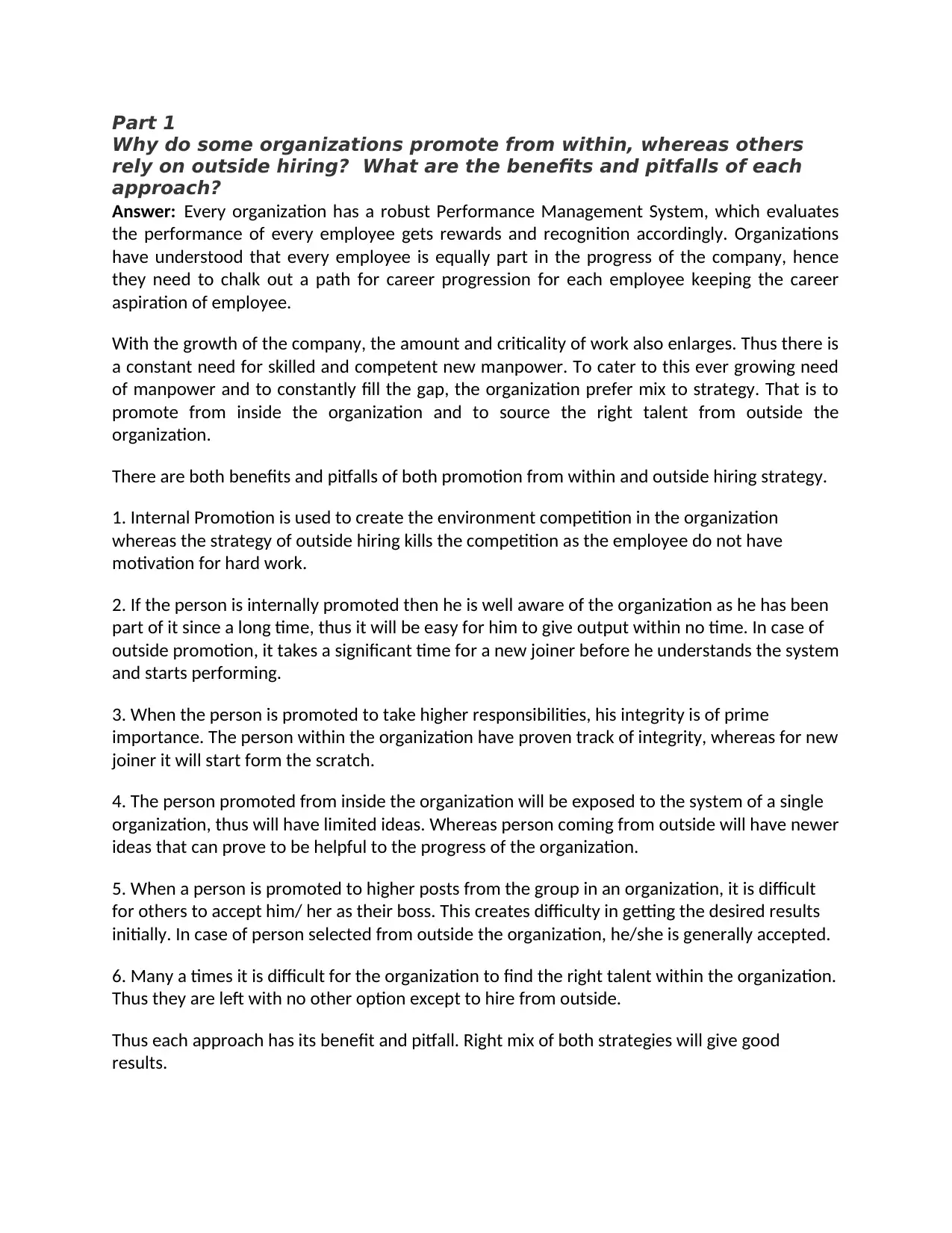
Part 1
Why do some organizations promote from within, whereas others
rely on outside hiring? What are the benefits and pitfalls of each
approach?
Answer: Every organization has a robust Performance Management System, which evaluates
the performance of every employee gets rewards and recognition accordingly. Organizations
have understood that every employee is equally part in the progress of the company, hence
they need to chalk out a path for career progression for each employee keeping the career
aspiration of employee.
With the growth of the company, the amount and criticality of work also enlarges. Thus there is
a constant need for skilled and competent new manpower. To cater to this ever growing need
of manpower and to constantly fill the gap, the organization prefer mix to strategy. That is to
promote from inside the organization and to source the right talent from outside the
organization.
There are both benefits and pitfalls of both promotion from within and outside hiring strategy.
1. Internal Promotion is used to create the environment competition in the organization
whereas the strategy of outside hiring kills the competition as the employee do not have
motivation for hard work.
2. If the person is internally promoted then he is well aware of the organization as he has been
part of it since a long time, thus it will be easy for him to give output within no time. In case of
outside promotion, it takes a significant time for a new joiner before he understands the system
and starts performing.
3. When the person is promoted to take higher responsibilities, his integrity is of prime
importance. The person within the organization have proven track of integrity, whereas for new
joiner it will start form the scratch.
4. The person promoted from inside the organization will be exposed to the system of a single
organization, thus will have limited ideas. Whereas person coming from outside will have newer
ideas that can prove to be helpful to the progress of the organization.
5. When a person is promoted to higher posts from the group in an organization, it is difficult
for others to accept him/ her as their boss. This creates difficulty in getting the desired results
initially. In case of person selected from outside the organization, he/she is generally accepted.
6. Many a times it is difficult for the organization to find the right talent within the organization.
Thus they are left with no other option except to hire from outside.
Thus each approach has its benefit and pitfall. Right mix of both strategies will give good
results.
Why do some organizations promote from within, whereas others
rely on outside hiring? What are the benefits and pitfalls of each
approach?
Answer: Every organization has a robust Performance Management System, which evaluates
the performance of every employee gets rewards and recognition accordingly. Organizations
have understood that every employee is equally part in the progress of the company, hence
they need to chalk out a path for career progression for each employee keeping the career
aspiration of employee.
With the growth of the company, the amount and criticality of work also enlarges. Thus there is
a constant need for skilled and competent new manpower. To cater to this ever growing need
of manpower and to constantly fill the gap, the organization prefer mix to strategy. That is to
promote from inside the organization and to source the right talent from outside the
organization.
There are both benefits and pitfalls of both promotion from within and outside hiring strategy.
1. Internal Promotion is used to create the environment competition in the organization
whereas the strategy of outside hiring kills the competition as the employee do not have
motivation for hard work.
2. If the person is internally promoted then he is well aware of the organization as he has been
part of it since a long time, thus it will be easy for him to give output within no time. In case of
outside promotion, it takes a significant time for a new joiner before he understands the system
and starts performing.
3. When the person is promoted to take higher responsibilities, his integrity is of prime
importance. The person within the organization have proven track of integrity, whereas for new
joiner it will start form the scratch.
4. The person promoted from inside the organization will be exposed to the system of a single
organization, thus will have limited ideas. Whereas person coming from outside will have newer
ideas that can prove to be helpful to the progress of the organization.
5. When a person is promoted to higher posts from the group in an organization, it is difficult
for others to accept him/ her as their boss. This creates difficulty in getting the desired results
initially. In case of person selected from outside the organization, he/she is generally accepted.
6. Many a times it is difficult for the organization to find the right talent within the organization.
Thus they are left with no other option except to hire from outside.
Thus each approach has its benefit and pitfall. Right mix of both strategies will give good
results.
Paraphrase This Document
Need a fresh take? Get an instant paraphrase of this document with our AI Paraphraser

Part 2
Measuring Sourcing Techniques
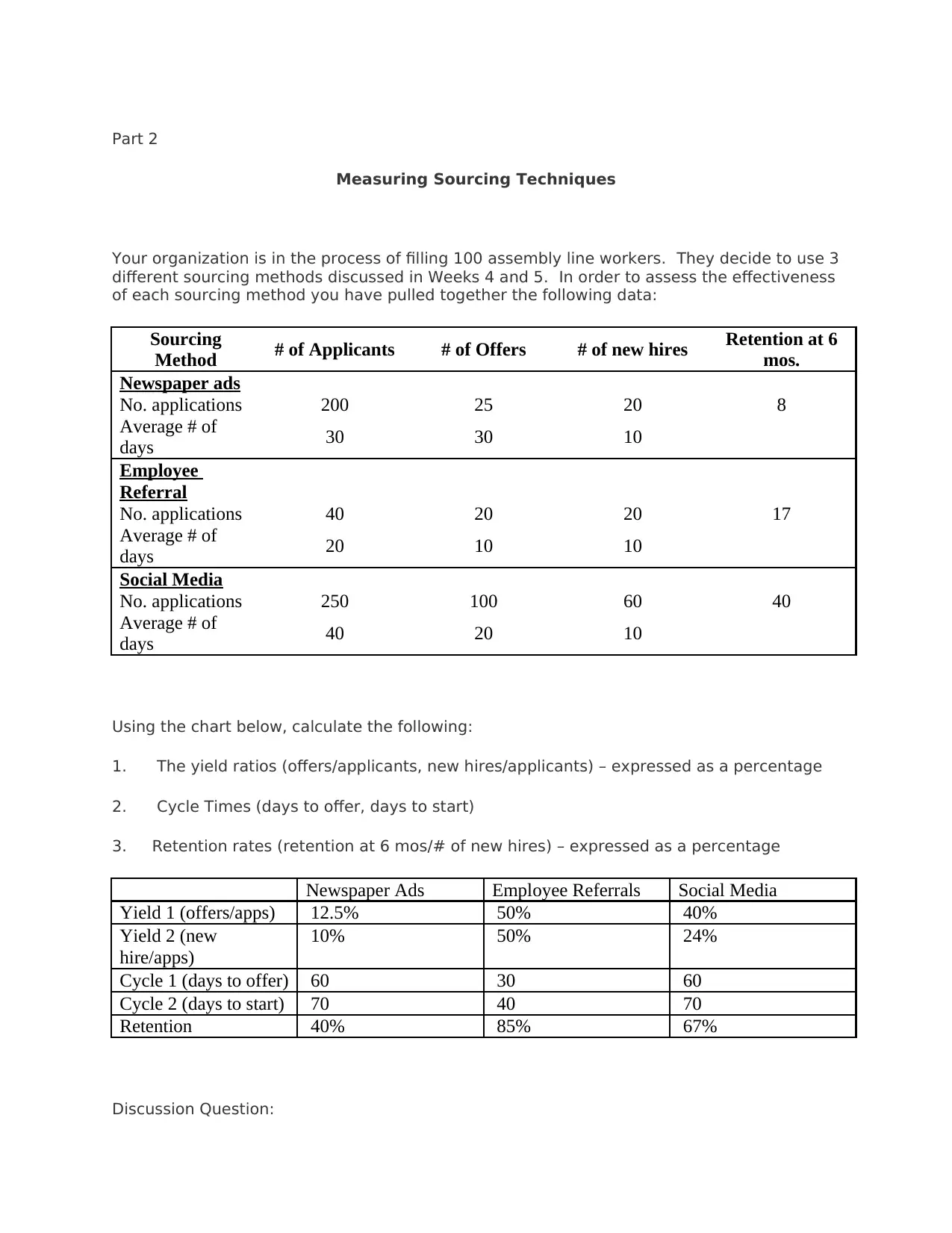
Your organization is in the process of filling 100 assembly line workers. They decide to use 3
different sourcing methods discussed in Weeks 4 and 5. In order to assess the effectiveness
of each sourcing method you have pulled together the following data:
Sourcing
Method # of Applicants # of Offers # of new hires Retention at 6
mos.
Newspaper ads
No. applications 200 25 20 8
Average # of
days 30 30 10
Employee
Referral
No. applications 40 20 20 17
Average # of
days 20 10 10
Social Media
No. applications 250 100 60 40
Average # of
days 40 20 10
Using the chart below, calculate the following:
1. The yield ratios (offers/applicants, new hires/applicants) – expressed as a percentage
2. Cycle Times (days to offer, days to start)
3. Retention rates (retention at 6 mos/# of new hires) – expressed as a percentage
Newspaper Ads Employee Referrals Social Media
Yield 1 (offers/apps) 12.5% 50% 40%
Yield 2 (new
hire/apps)
10% 50% 24%
Cycle 1 (days to offer) 60 30 60
Cycle 2 (days to start) 70 40 70
Retention 40% 85% 67%
Discussion Question:
Measuring Sourcing Techniques
Your organization is in the process of filling 100 assembly line workers. They decide to use 3
different sourcing methods discussed in Weeks 4 and 5. In order to assess the effectiveness
of each sourcing method you have pulled together the following data:
Sourcing
Method # of Applicants # of Offers # of new hires Retention at 6
mos.
Newspaper ads
No. applications 200 25 20 8
Average # of
days 30 30 10
Employee
Referral
No. applications 40 20 20 17
Average # of
days 20 10 10
Social Media
No. applications 250 100 60 40
Average # of
days 40 20 10
Using the chart below, calculate the following:
1. The yield ratios (offers/applicants, new hires/applicants) – expressed as a percentage
2. Cycle Times (days to offer, days to start)
3. Retention rates (retention at 6 mos/# of new hires) – expressed as a percentage
Newspaper Ads Employee Referrals Social Media
Yield 1 (offers/apps) 12.5% 50% 40%
Yield 2 (new
hire/apps)
10% 50% 24%
Cycle 1 (days to offer) 60 30 60
Cycle 2 (days to start) 70 40 70
Retention 40% 85% 67%
Discussion Question:

1. What is the relative effectiveness of each of the methods based on the above
metrics?
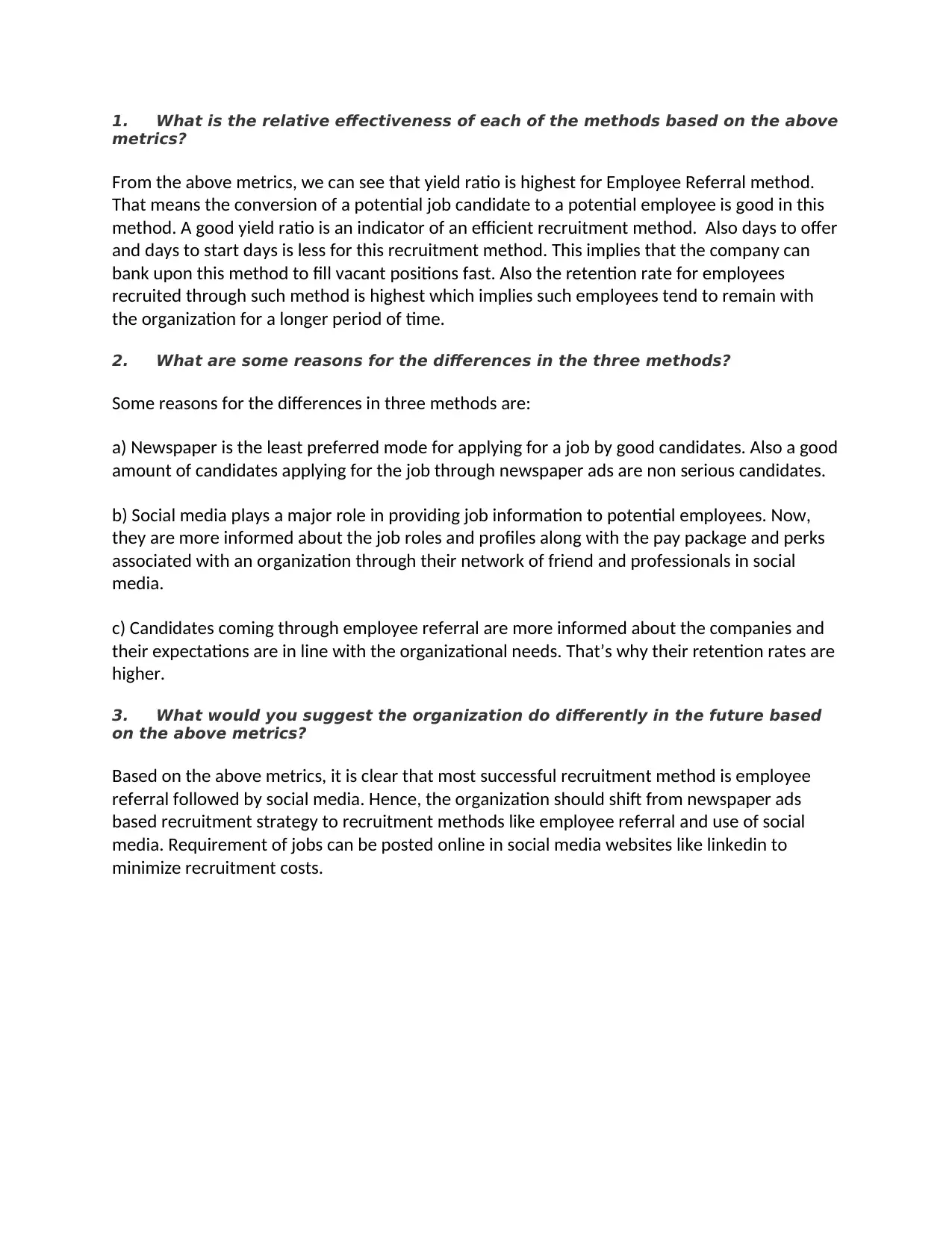
From the above metrics, we can see that yield ratio is highest for Employee Referral method.
That means the conversion of a potential job candidate to a potential employee is good in this
method. A good yield ratio is an indicator of an efficient recruitment method. Also days to offer
and days to start days is less for this recruitment method. This implies that the company can
bank upon this method to fill vacant positions fast. Also the retention rate for employees
recruited through such method is highest which implies such employees tend to remain with
the organization for a longer period of time.
2. What are some reasons for the differences in the three methods?
Some reasons for the differences in three methods are:
a) Newspaper is the least preferred mode for applying for a job by good candidates. Also a good
amount of candidates applying for the job through newspaper ads are non serious candidates.
b) Social media plays a major role in providing job information to potential employees. Now,
they are more informed about the job roles and profiles along with the pay package and perks
associated with an organization through their network of friend and professionals in social
media.
c) Candidates coming through employee referral are more informed about the companies and
their expectations are in line with the organizational needs. That’s why their retention rates are
higher.
3. What would you suggest the organization do differently in the future based
on the above metrics?
Based on the above metrics, it is clear that most successful recruitment method is employee
referral followed by social media. Hence, the organization should shift from newspaper ads
based recruitment strategy to recruitment methods like employee referral and use of social
media. Requirement of jobs can be posted online in social media websites like linkedin to
minimize recruitment costs.
metrics?
From the above metrics, we can see that yield ratio is highest for Employee Referral method.
That means the conversion of a potential job candidate to a potential employee is good in this
method. A good yield ratio is an indicator of an efficient recruitment method. Also days to offer
and days to start days is less for this recruitment method. This implies that the company can
bank upon this method to fill vacant positions fast. Also the retention rate for employees
recruited through such method is highest which implies such employees tend to remain with
the organization for a longer period of time.
2. What are some reasons for the differences in the three methods?
Some reasons for the differences in three methods are:
a) Newspaper is the least preferred mode for applying for a job by good candidates. Also a good
amount of candidates applying for the job through newspaper ads are non serious candidates.
b) Social media plays a major role in providing job information to potential employees. Now,
they are more informed about the job roles and profiles along with the pay package and perks
associated with an organization through their network of friend and professionals in social
media.
c) Candidates coming through employee referral are more informed about the companies and
their expectations are in line with the organizational needs. That’s why their retention rates are
higher.
3. What would you suggest the organization do differently in the future based
on the above metrics?
Based on the above metrics, it is clear that most successful recruitment method is employee
referral followed by social media. Hence, the organization should shift from newspaper ads
based recruitment strategy to recruitment methods like employee referral and use of social
media. Requirement of jobs can be posted online in social media websites like linkedin to
minimize recruitment costs.
⊘ This is a preview!⊘
Do you want full access?
Subscribe today to unlock all pages.

Trusted by 1+ million students worldwide
1 out of 3
Related Documents
Your All-in-One AI-Powered Toolkit for Academic Success.
+13062052269
info@desklib.com
Available 24*7 on WhatsApp / Email
Unlock your academic potential
Copyright © 2020–2025 A2Z Services. All Rights Reserved. Developed and managed by ZUCOL.