Evaluation of Leadership Models at Wexford General Hospital
VerifiedAdded on 2020/03/23
|14
|3908
|134
Report
AI Summary
This report provides a detailed evaluation of three prominent leadership models: the Managerial or Leadership Grid, the 5S Uncommon Leadership Model, and the Situational Leadership Model. The report begins with an introduction to leadership and its significance in organizations, emphasizing the importance of leadership skills. The Managerial Grid model, focusing on concern for tasks and people, is discussed, and its relevance to healthcare organizations is highlighted, particularly in the context of Wexford General Hospital. The 5S Uncommon Leadership Model, developed by Higson and Sturgess, is then explored, outlining its five key themes: Seeing, Shaping, Showing, Serving, and Sharing. Finally, the Situational Leadership Model, developed by Ken Blanchard and Paul Hersey, is examined, emphasizing its adaptability based on employee development levels. The report concludes by evaluating the suitability of each model for Wexford General Hospital, ultimately identifying the Situational Leadership Model as the most resonant approach for the organization.
Evaluation of Leadership Models
Evaluation of Leadership Models
Student Name:
Student ID:
University:
Date:
1
Evaluation of Leadership Models
Student Name:
Student ID:
University:
Date:
1

Paraphrase This Document
Need a fresh take? Get an instant paraphrase of this document with our AI Paraphraser
Evaluation of Leadership Models
Contents
1. Introduction.........................................................................................................................3
2. Discussion and Evaluation of three Leadership Models.....................................................3
2.1 Managerial or Leadership Grid........................................................................................3
2.2 5S Uncommon Leadership Model....................................................................................6
2.3 Situational Leadership Model...........................................................................................8
3. Conclusion........................................................................................................................10
4. References.........................................................................................................................11
2
Contents
1. Introduction.........................................................................................................................3
2. Discussion and Evaluation of three Leadership Models.....................................................3
2.1 Managerial or Leadership Grid........................................................................................3
2.2 5S Uncommon Leadership Model....................................................................................6
2.3 Situational Leadership Model...........................................................................................8
3. Conclusion........................................................................................................................10
4. References.........................................................................................................................11
2
Evaluation of Leadership Models
Executive Summary
This report intends to study three most commonly used Leadership models in various
organizational domains in detail. In order to discuss the leadership models and their features
and elements, one of the well – known health care organization under HSE has been chosen.
The chosen organization is Wexford General Hospital. The three different leadership models
studied in this report are leadership grid or managerial grid, 5S Uncommon leadership model
and Situational leadership model. All the three models have been studied in detail and
considering their functionalities as well as pros and cons, the best suited or resonant
leadership model has been evaluated for the chosen organization. The most suited leadership
model for the Wexford General Hospital has been identified to be Situational Leadership
Model.
3
Executive Summary
This report intends to study three most commonly used Leadership models in various
organizational domains in detail. In order to discuss the leadership models and their features
and elements, one of the well – known health care organization under HSE has been chosen.
The chosen organization is Wexford General Hospital. The three different leadership models
studied in this report are leadership grid or managerial grid, 5S Uncommon leadership model
and Situational leadership model. All the three models have been studied in detail and
considering their functionalities as well as pros and cons, the best suited or resonant
leadership model has been evaluated for the chosen organization. The most suited leadership
model for the Wexford General Hospital has been identified to be Situational Leadership
Model.
3
⊘ This is a preview!⊘
Do you want full access?
Subscribe today to unlock all pages.

Trusted by 1+ million students worldwide
Evaluation of Leadership Models
1. Introduction
Leadership and management are two of the most significant aspects associated with
every organization. Leading a group or a team in an organization is the most efficient skill
that requires a lot of time, effort, dedication and thought. Thus, leadership is the most
important element of any organization and business because this aspect clearly decides on the
success and failure of the organization. Leadership traits span a wider remit that involve
inspiring and influencing others, idea generation and defining vision and strategy for the
organization (Leadership skills, 2009). The leadership is more focused on the leader’s
individual ability and thus, it can be defined as the process of motivating people or a team or
group in an organization to work towards reaching a common identified goal. The
organizational leader completes his / her roles in the organization by effectively
communicating the organizational values that are represented by the leader. Every manager in
an organization must possess certain leadership skills in order to operate at the strategic level
effectively (Leatherman, 2008).
There are several theories and models associated with the concept of leadership. In
this report, three important leadership models have been identified and discussed that are
relevant to one of the hospitals run by HSE (Health and Safety Executive). The chosen
hospital for discussion is Wexford General Hospital. In this report, all the three leadership
models are discussed and the model that is resonant to health care organization is evaluated. .
The three models of leadership discussed in the report are named as follows:
Managerial or Leadership Grid
5S Uncommon Leadership Model
Situational Leadership Model developed by Hershey and Blanchard.
2. Discussion of three Leadership Models
2.1 Managerial or Leadership Grid
The Leadership or Managerial Grid clearly focuses on the concern of a leader for a
task and also concerns for the people in order to predict the outcomes of leadership.
Researches carried out in this regard showed that there are two main concepts under the
leadership skills (Leatherman, 2008). Thus, the leadership concept in this model is
categorized as concern for tasks and concern for people. The leadership or managerial grid is
highly relatable to a health care organization (hospitals) as the two identified factors -
4
1. Introduction
Leadership and management are two of the most significant aspects associated with
every organization. Leading a group or a team in an organization is the most efficient skill
that requires a lot of time, effort, dedication and thought. Thus, leadership is the most
important element of any organization and business because this aspect clearly decides on the
success and failure of the organization. Leadership traits span a wider remit that involve
inspiring and influencing others, idea generation and defining vision and strategy for the
organization (Leadership skills, 2009). The leadership is more focused on the leader’s
individual ability and thus, it can be defined as the process of motivating people or a team or
group in an organization to work towards reaching a common identified goal. The
organizational leader completes his / her roles in the organization by effectively
communicating the organizational values that are represented by the leader. Every manager in
an organization must possess certain leadership skills in order to operate at the strategic level
effectively (Leatherman, 2008).
There are several theories and models associated with the concept of leadership. In
this report, three important leadership models have been identified and discussed that are
relevant to one of the hospitals run by HSE (Health and Safety Executive). The chosen
hospital for discussion is Wexford General Hospital. In this report, all the three leadership
models are discussed and the model that is resonant to health care organization is evaluated. .
The three models of leadership discussed in the report are named as follows:
Managerial or Leadership Grid
5S Uncommon Leadership Model
Situational Leadership Model developed by Hershey and Blanchard.
2. Discussion of three Leadership Models
2.1 Managerial or Leadership Grid
The Leadership or Managerial Grid clearly focuses on the concern of a leader for a
task and also concerns for the people in order to predict the outcomes of leadership.
Researches carried out in this regard showed that there are two main concepts under the
leadership skills (Leatherman, 2008). Thus, the leadership concept in this model is
categorized as concern for tasks and concern for people. The leadership or managerial grid is
highly relatable to a health care organization (hospitals) as the two identified factors -
4
Paraphrase This Document
Need a fresh take? Get an instant paraphrase of this document with our AI Paraphraser
Evaluation of Leadership Models
concern for tasks and concern for people, are entirely associated with the functionality of a
health care organization (Gill, 2013).
Basically, the concern for tasks and concern for people are considered as two different
behaviour types under the leadership grid model. According to a research conducted at Ohio
University, the two behaviours are categorized as – consideration and initiating structure,
where, the consideration behaviour refers to relationship – based behaviours (concern for
people) such as trust and respect, and, on the other hand, initiating structure refers to the task
– based behaviour, that include scheduling, organizing, and checking the completion of work
(Northouse, 2007). It is clear that the two behaviours are viewed as independent and distinct
and according to this model, the leader can be low or high on any one or both the types of
behaviours.
The dimension of motivation in the leadership grid model provides a clear – cut idea
about the leader’s underlying motive behind the successful style of leadership. It can be seen
that the two different dimensions can clearly define the behaviour of leadership as the
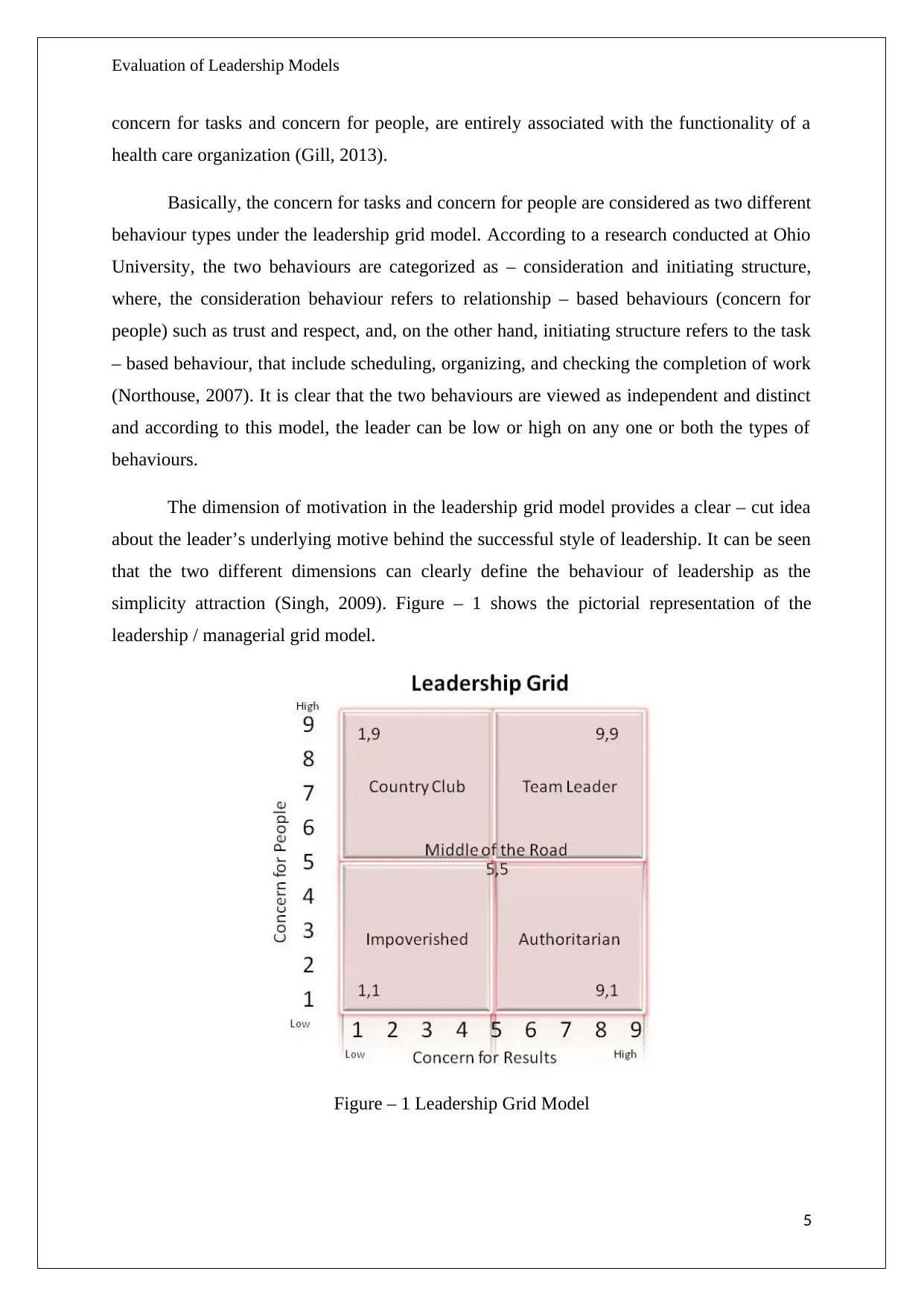
simplicity attraction (Singh, 2009). Figure – 1 shows the pictorial representation of the
leadership / managerial grid model.
Figure – 1 Leadership Grid Model
5
concern for tasks and concern for people, are entirely associated with the functionality of a
health care organization (Gill, 2013).
Basically, the concern for tasks and concern for people are considered as two different
behaviour types under the leadership grid model. According to a research conducted at Ohio
University, the two behaviours are categorized as – consideration and initiating structure,
where, the consideration behaviour refers to relationship – based behaviours (concern for
people) such as trust and respect, and, on the other hand, initiating structure refers to the task
– based behaviour, that include scheduling, organizing, and checking the completion of work
(Northouse, 2007). It is clear that the two behaviours are viewed as independent and distinct
and according to this model, the leader can be low or high on any one or both the types of
behaviours.
The dimension of motivation in the leadership grid model provides a clear – cut idea
about the leader’s underlying motive behind the successful style of leadership. It can be seen
that the two different dimensions can clearly define the behaviour of leadership as the
simplicity attraction (Singh, 2009). Figure – 1 shows the pictorial representation of the
leadership / managerial grid model.
Figure – 1 Leadership Grid Model
5
Evaluation of Leadership Models
Referring to Figure – 1, it is clear that all the four quadrants in the model represent the
strength levels of the two identified behaviours – concern for tasks and the concern for
people.
Team leader – strong on the skills of people as well as on the tasks in organization.
Leaders coming under this category are highly positive and develop a team
environment, in which all the team members are motivated in such a way to reach
their high productivity state and potential, both as an individual and as a team member
by making use of collaboration and cooperation.
Impact on employees – highly satisfied employees, develop a cohesive team and are
motivated to work as a team
Impact on Organization – employee turnover is less, efficient organization and attracts
employees who are highly skilled (Nwlink.com, 2017)
Authoritarian – leader here is strong on tasks, but, is weak on people skills
Leaders under this category are highly focused on the productivity or the tasks, and
are not focused on their employees. Thus, there is hardly any scope for collaboration
or cooperation. Leaders coming under this category are thus very dominating.
Impact on employees – employees tend to get highly dissatisfied at workplace and
also there are chances of high – level of issues or conflicts in team
Impact on organization – employee turnover is high and peak performance is for short
period of time.
Impoverished – leader here is weak on both the behaviours – tasks and people.
Management style acquired by leaders coming under this category is of “delegate and
disappear” type. Leaders in this category are not committed to both productivity or
people.
Impact on employees – high turnover, dissatisfied employees
Impact on organization – inefficient operation (Nwlink.com, 2017)
Country Club – leader here is weak on tasks, but is strong on people skills.
Leaders included in this category make use of their skills and power to effectively
maintain discipline in the organization and motivate the team or group to achieve their
high productivity level but, are not focused about the tasks and their deadlines.
Impact on employees – satisfied employees, cooperative team and good harmony
Impact on organization – productivity is less.
6
Referring to Figure – 1, it is clear that all the four quadrants in the model represent the
strength levels of the two identified behaviours – concern for tasks and the concern for
people.
Team leader – strong on the skills of people as well as on the tasks in organization.
Leaders coming under this category are highly positive and develop a team
environment, in which all the team members are motivated in such a way to reach
their high productivity state and potential, both as an individual and as a team member
by making use of collaboration and cooperation.
Impact on employees – highly satisfied employees, develop a cohesive team and are
motivated to work as a team
Impact on Organization – employee turnover is less, efficient organization and attracts
employees who are highly skilled (Nwlink.com, 2017)
Authoritarian – leader here is strong on tasks, but, is weak on people skills
Leaders under this category are highly focused on the productivity or the tasks, and
are not focused on their employees. Thus, there is hardly any scope for collaboration
or cooperation. Leaders coming under this category are thus very dominating.
Impact on employees – employees tend to get highly dissatisfied at workplace and
also there are chances of high – level of issues or conflicts in team
Impact on organization – employee turnover is high and peak performance is for short
period of time.
Impoverished – leader here is weak on both the behaviours – tasks and people.
Management style acquired by leaders coming under this category is of “delegate and
disappear” type. Leaders in this category are not committed to both productivity or
people.
Impact on employees – high turnover, dissatisfied employees
Impact on organization – inefficient operation (Nwlink.com, 2017)
Country Club – leader here is weak on tasks, but is strong on people skills.
Leaders included in this category make use of their skills and power to effectively
maintain discipline in the organization and motivate the team or group to achieve their
high productivity level but, are not focused about the tasks and their deadlines.
Impact on employees – satisfied employees, cooperative team and good harmony
Impact on organization – productivity is less.
6
⊘ This is a preview!⊘
Do you want full access?
Subscribe today to unlock all pages.
Trusted by 1+ million students worldwide
Evaluation of Leadership Models
Thus, this model is very helpful to identify the beneficial traits of the good leader and
is very efficient and effective to identify the skills. It is quite clear that the quadrant of team
leader is the most efficient behaviour of the leader and one has to score at least six points in
each of the behaviours to get categorized in the quadrant of team leader. This model highly
resonate the health care organization as the behaviours and traits identified in the leadership
grid model are relevant to the chosen organization (Nwlink.com, 2017).
Pros of Leadership grid model: effective to measure performance of a leader, highly
utilized leadership model, self analysis is possible
Cons of Leadership grid model: empirical data available to support the effectiveness
of traits and behaviours is minimal, self – assessments can be flawed, work
environment is not considered to a greater extent and also external and internal
organizational variables are not considered here (Gill, 2013).
2.2 5S Uncommon Leadership Model
The 5S Uncommon Leadership Model was developed by Higson and Sturgess in the
year 2014 and provided a clear – cut idea about the traits of uncommon leadership. According
to this model, the leaders must be very much conscious about their task requirements and
thus, a leadership holistic view is very important. Leadership is not only about application of
styles to organizational situations and carrying out organizational functions, but is also about
high motivation and matching the ideas and views to the organization’s vision. To achieve
this, the leaders must be capable of developing and making use of compelling vision to carry
out business functions and processes (Ganapathy, 2013). According to this model, the leaders
have to be highly influential to shape the firm in accordance with the organizational vision.
Thus, modelling appropriate skills and behaviours is very important to set standards. Also,
the 5S Uncommon Model focus to develop strong networks as well as effective relationships
with external and internal customers. Thus, collective leadership is fostered in the model.
The 5S Uncommon Leadership Model was developed to acquire significant impact as
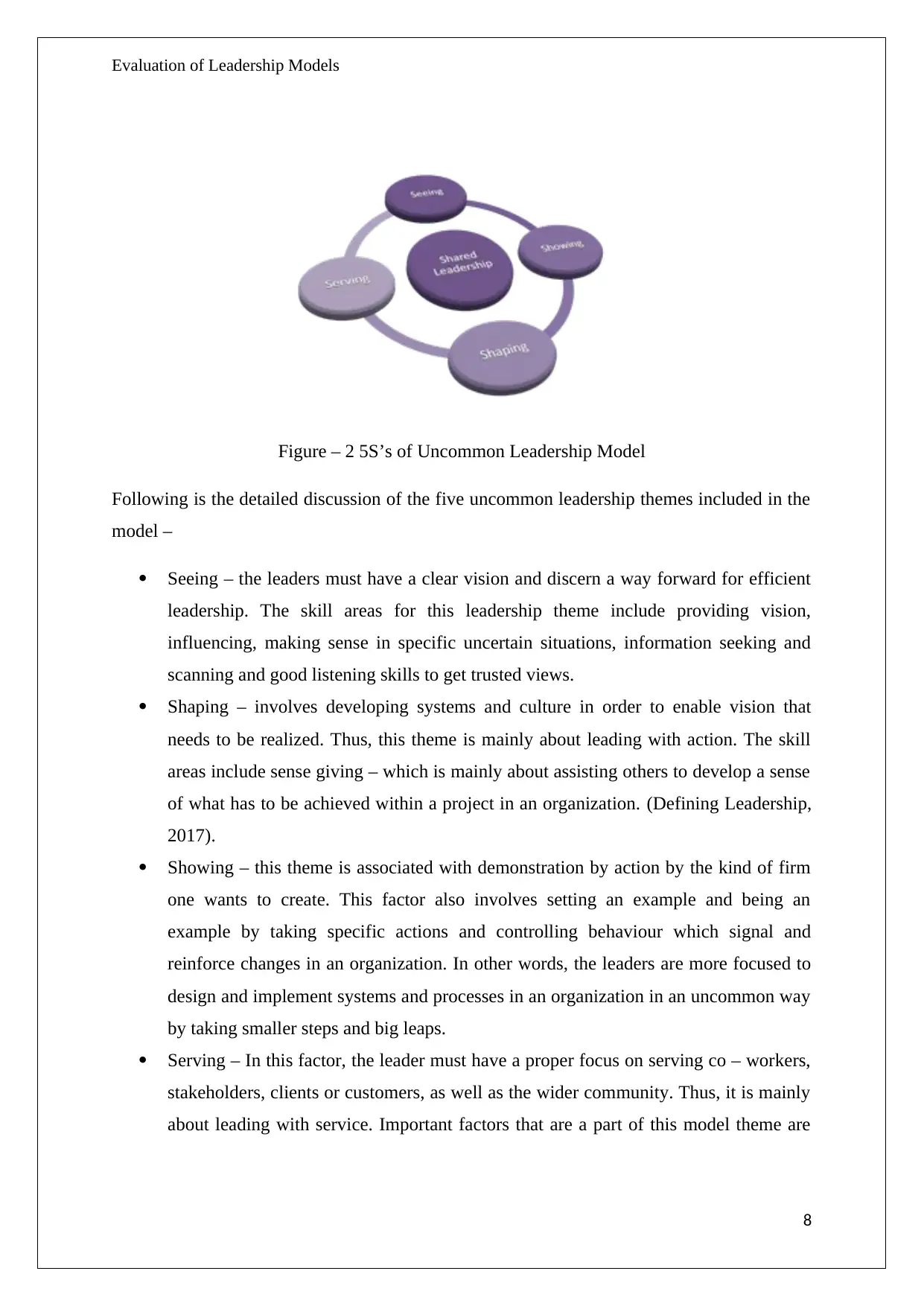
well as wider perspective of leadership traits (Defining Leadership, 2017). Figure – 2 shows
the 5S’s of the Uncommon Leadership Model.
7
Thus, this model is very helpful to identify the beneficial traits of the good leader and
is very efficient and effective to identify the skills. It is quite clear that the quadrant of team
leader is the most efficient behaviour of the leader and one has to score at least six points in
each of the behaviours to get categorized in the quadrant of team leader. This model highly
resonate the health care organization as the behaviours and traits identified in the leadership
grid model are relevant to the chosen organization (Nwlink.com, 2017).
Pros of Leadership grid model: effective to measure performance of a leader, highly
utilized leadership model, self analysis is possible
Cons of Leadership grid model: empirical data available to support the effectiveness
of traits and behaviours is minimal, self – assessments can be flawed, work
environment is not considered to a greater extent and also external and internal
organizational variables are not considered here (Gill, 2013).
2.2 5S Uncommon Leadership Model
The 5S Uncommon Leadership Model was developed by Higson and Sturgess in the
year 2014 and provided a clear – cut idea about the traits of uncommon leadership. According
to this model, the leaders must be very much conscious about their task requirements and
thus, a leadership holistic view is very important. Leadership is not only about application of
styles to organizational situations and carrying out organizational functions, but is also about
high motivation and matching the ideas and views to the organization’s vision. To achieve
this, the leaders must be capable of developing and making use of compelling vision to carry
out business functions and processes (Ganapathy, 2013). According to this model, the leaders
have to be highly influential to shape the firm in accordance with the organizational vision.
Thus, modelling appropriate skills and behaviours is very important to set standards. Also,
the 5S Uncommon Model focus to develop strong networks as well as effective relationships
with external and internal customers. Thus, collective leadership is fostered in the model.
The 5S Uncommon Leadership Model was developed to acquire significant impact as
well as wider perspective of leadership traits (Defining Leadership, 2017). Figure – 2 shows
the 5S’s of the Uncommon Leadership Model.
7
Paraphrase This Document
Need a fresh take? Get an instant paraphrase of this document with our AI Paraphraser
Evaluation of Leadership Models
Figure – 2 5S’s of Uncommon Leadership Model
Following is the detailed discussion of the five uncommon leadership themes included in the
model –
Seeing – the leaders must have a clear vision and discern a way forward for efficient
leadership. The skill areas for this leadership theme include providing vision,
influencing, making sense in specific uncertain situations, information seeking and
scanning and good listening skills to get trusted views.
Shaping – involves developing systems and culture in order to enable vision that
needs to be realized. Thus, this theme is mainly about leading with action. The skill
areas include sense giving – which is mainly about assisting others to develop a sense
of what has to be achieved within a project in an organization. (Defining Leadership,
2017).
Showing – this theme is associated with demonstration by action by the kind of firm
one wants to create. This factor also involves setting an example and being an
example by taking specific actions and controlling behaviour which signal and
reinforce changes in an organization. In other words, the leaders are more focused to
design and implement systems and processes in an organization in an uncommon way
by taking smaller steps and big leaps.
Serving – In this factor, the leader must have a proper focus on serving co – workers,
stakeholders, clients or customers, as well as the wider community. Thus, it is mainly
about leading with service. Important factors that are a part of this model theme are
8
Figure – 2 5S’s of Uncommon Leadership Model
Following is the detailed discussion of the five uncommon leadership themes included in the
model –
Seeing – the leaders must have a clear vision and discern a way forward for efficient
leadership. The skill areas for this leadership theme include providing vision,
influencing, making sense in specific uncertain situations, information seeking and
scanning and good listening skills to get trusted views.
Shaping – involves developing systems and culture in order to enable vision that
needs to be realized. Thus, this theme is mainly about leading with action. The skill
areas include sense giving – which is mainly about assisting others to develop a sense
of what has to be achieved within a project in an organization. (Defining Leadership,
2017).
Showing – this theme is associated with demonstration by action by the kind of firm
one wants to create. This factor also involves setting an example and being an
example by taking specific actions and controlling behaviour which signal and
reinforce changes in an organization. In other words, the leaders are more focused to
design and implement systems and processes in an organization in an uncommon way
by taking smaller steps and big leaps.
Serving – In this factor, the leader must have a proper focus on serving co – workers,
stakeholders, clients or customers, as well as the wider community. Thus, it is mainly
about leading with service. Important factors that are a part of this model theme are
8
Evaluation of Leadership Models
effective use of resources, providing support, connecting teams and people, emotional
intelligence and empathy, and supporting others etc.
Sharing – this factor involves encouraging people and developing teams to build
effective leadership capability in the organization. In other words, uncommon
leadership is made more common by the leader by implementing effective and
efficient methods and systems. The leader must possess the traits of coaching,
collaborating, delegation of responsibilities, and motivating people for increasing
productivity (Zaccaro, 2012).
2.3 Situational Leadership Model
This model is very helpful to guide a leader based on the kind of coaching necessary
to build an employee in specific organizational situations. The Situational Leadership Model
is one of the oldest and widely used models in organizations and was developed by Ken
Blanchard and Paul Hersey in the year 1977. The situational leadership model is mainly
based on two factors – the appropriate level of arousal and supervision that are necessary to
train employees in certain circumstances and develop efficient performers. In this model,
supervision refers to directing behaviour and arousal refers to supportive behaviour (Sharma
and Jain, 2017). Thus, in this way, best developmental and learning environment is produced
in an organization.
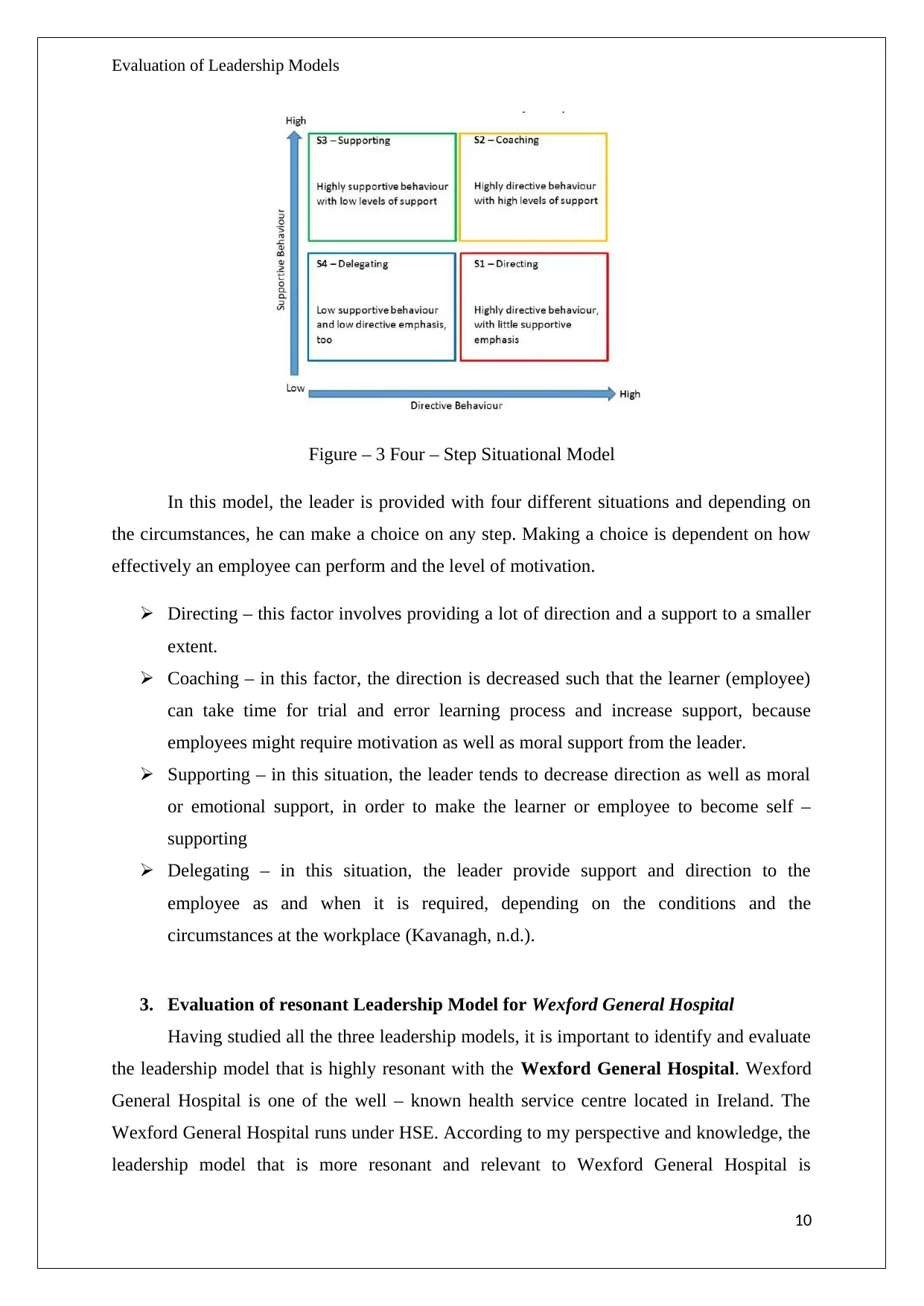
Figure – 3 shows the four – step model of Situational Leadership. From the
Situational Leadership Model it can be considered that dynamic decision making skills,
experience and high – level knowledge is very much required to effectively utilize this
leadership model. The leaders who are held responsible to make decisions in the organization
should consider the situation and its criticality of the client / patient requirements or condition
as a very high priority and take actions accordingly.
9
effective use of resources, providing support, connecting teams and people, emotional
intelligence and empathy, and supporting others etc.
Sharing – this factor involves encouraging people and developing teams to build
effective leadership capability in the organization. In other words, uncommon
leadership is made more common by the leader by implementing effective and
efficient methods and systems. The leader must possess the traits of coaching,
collaborating, delegation of responsibilities, and motivating people for increasing
productivity (Zaccaro, 2012).
2.3 Situational Leadership Model
This model is very helpful to guide a leader based on the kind of coaching necessary
to build an employee in specific organizational situations. The Situational Leadership Model
is one of the oldest and widely used models in organizations and was developed by Ken
Blanchard and Paul Hersey in the year 1977. The situational leadership model is mainly
based on two factors – the appropriate level of arousal and supervision that are necessary to
train employees in certain circumstances and develop efficient performers. In this model,
supervision refers to directing behaviour and arousal refers to supportive behaviour (Sharma
and Jain, 2017). Thus, in this way, best developmental and learning environment is produced
in an organization.
Figure – 3 shows the four – step model of Situational Leadership. From the
Situational Leadership Model it can be considered that dynamic decision making skills,
experience and high – level knowledge is very much required to effectively utilize this
leadership model. The leaders who are held responsible to make decisions in the organization
should consider the situation and its criticality of the client / patient requirements or condition
as a very high priority and take actions accordingly.
9
⊘ This is a preview!⊘
Do you want full access?
Subscribe today to unlock all pages.
Trusted by 1+ million students worldwide
Evaluation of Leadership Models
Figure – 3 Four – Step Situational Model
In this model, the leader is provided with four different situations and depending on
the circumstances, he can make a choice on any step. Making a choice is dependent on how
effectively an employee can perform and the level of motivation.
Directing – this factor involves providing a lot of direction and a support to a smaller
extent.
Coaching – in this factor, the direction is decreased such that the learner (employee)
can take time for trial and error learning process and increase support, because
employees might require motivation as well as moral support from the leader.
Supporting – in this situation, the leader tends to decrease direction as well as moral
or emotional support, in order to make the learner or employee to become self –
supporting
Delegating – in this situation, the leader provide support and direction to the
employee as and when it is required, depending on the conditions and the
circumstances at the workplace (Kavanagh, n.d.).
3. Evaluation of resonant Leadership Model for Wexford General Hospital
Having studied all the three leadership models, it is important to identify and evaluate
the leadership model that is highly resonant with the Wexford General Hospital. Wexford
General Hospital is one of the well – known health service centre located in Ireland. The
Wexford General Hospital runs under HSE. According to my perspective and knowledge, the
leadership model that is more resonant and relevant to Wexford General Hospital is
10
Figure – 3 Four – Step Situational Model
In this model, the leader is provided with four different situations and depending on
the circumstances, he can make a choice on any step. Making a choice is dependent on how
effectively an employee can perform and the level of motivation.
Directing – this factor involves providing a lot of direction and a support to a smaller
extent.
Coaching – in this factor, the direction is decreased such that the learner (employee)
can take time for trial and error learning process and increase support, because
employees might require motivation as well as moral support from the leader.
Supporting – in this situation, the leader tends to decrease direction as well as moral
or emotional support, in order to make the learner or employee to become self –
supporting
Delegating – in this situation, the leader provide support and direction to the
employee as and when it is required, depending on the conditions and the
circumstances at the workplace (Kavanagh, n.d.).
3. Evaluation of resonant Leadership Model for Wexford General Hospital
Having studied all the three leadership models, it is important to identify and evaluate
the leadership model that is highly resonant with the Wexford General Hospital. Wexford
General Hospital is one of the well – known health service centre located in Ireland. The
Wexford General Hospital runs under HSE. According to my perspective and knowledge, the
leadership model that is more resonant and relevant to Wexford General Hospital is
10
Paraphrase This Document
Need a fresh take? Get an instant paraphrase of this document with our AI Paraphraser
Evaluation of Leadership Models
Situational Leadership Model. The main purpose of Wexford General Hospital is to
ensure acute and high quality hospital services and thus, help people to live healthier with
fulfilled lives. Thus, situational leadership model can be applied to the chosen healthcare
organization as the leader can take up actions or decisions depending on the current
circumstances and ensure motivated employees and provide high quality health services to
clients.
Wexford General Hospital will have to make certain changes in their organizational
culture as well as their organizational structure in order to effectively apply the Situational
Leadership model in their health care organization. Each vertical or domain within the
Wexford General Hospital must have a manager and a leader to look after the activities that
are carried out in the health care organization on the day – to – day basis (Mumford et al.,
2017). Also, these activities are generally based on the customer requirements and situations.
Thus, the effective decision making within the organization becomes a priority for the
organization. These decision making processes must be clearly taken as per the situation of
the patient / customer case and the criticality of the situation. The leader who is responsible
for the specific task must have the responsibility to critically analyse the situation and train
their sub – ordinates to come up with an effective decision that benefits the customer on the
priority basis (Hudak et al., 2015). It is quite clear that decision making in situational
leadership model is very important and critical. Thus, the leaders / managers in Wexford
General Hospital should have good knowledge and experience in their domain of work. Thus,
the leaders who opt for situational leadership model must ensure high flexibility at work and
also must train their employees and other sub – ordinates to take actions and steps as per the
decisions made for each specific situation in the health care organization (F. Dye, 2010).
Also, the situational leadership model is very helpful for Wexford General Hospital to
monitor and analyse the performance of each of their employees and sub – ordinates based on
the quick actions and minor decisions taken by them in all the situations. Leaders in Wexford
General Hospital must carefully consider the cons of Situational Leadership Model and must
delegate duties to their employees and sub – ordinates based on their experience and
knowledge and avoid any kind of major issues within organization as well as for the
customers / patients.
From the Situational Leadership Model, it is quite clear that this model is highly
dependent on the workplace situations and depending on the learner’s circumstance, the
leader has to change his behaviour and act accordingly (Leadership skills lead to leap in
11
Situational Leadership Model. The main purpose of Wexford General Hospital is to
ensure acute and high quality hospital services and thus, help people to live healthier with
fulfilled lives. Thus, situational leadership model can be applied to the chosen healthcare
organization as the leader can take up actions or decisions depending on the current
circumstances and ensure motivated employees and provide high quality health services to
clients.
Wexford General Hospital will have to make certain changes in their organizational
culture as well as their organizational structure in order to effectively apply the Situational
Leadership model in their health care organization. Each vertical or domain within the
Wexford General Hospital must have a manager and a leader to look after the activities that
are carried out in the health care organization on the day – to – day basis (Mumford et al.,
2017). Also, these activities are generally based on the customer requirements and situations.
Thus, the effective decision making within the organization becomes a priority for the
organization. These decision making processes must be clearly taken as per the situation of
the patient / customer case and the criticality of the situation. The leader who is responsible
for the specific task must have the responsibility to critically analyse the situation and train
their sub – ordinates to come up with an effective decision that benefits the customer on the
priority basis (Hudak et al., 2015). It is quite clear that decision making in situational
leadership model is very important and critical. Thus, the leaders / managers in Wexford
General Hospital should have good knowledge and experience in their domain of work. Thus,
the leaders who opt for situational leadership model must ensure high flexibility at work and
also must train their employees and other sub – ordinates to take actions and steps as per the
decisions made for each specific situation in the health care organization (F. Dye, 2010).
Also, the situational leadership model is very helpful for Wexford General Hospital to
monitor and analyse the performance of each of their employees and sub – ordinates based on
the quick actions and minor decisions taken by them in all the situations. Leaders in Wexford
General Hospital must carefully consider the cons of Situational Leadership Model and must
delegate duties to their employees and sub – ordinates based on their experience and
knowledge and avoid any kind of major issues within organization as well as for the
customers / patients.
From the Situational Leadership Model, it is quite clear that this model is highly
dependent on the workplace situations and depending on the learner’s circumstance, the
leader has to change his behaviour and act accordingly (Leadership skills lead to leap in
11
Evaluation of Leadership Models
medication reviews, 2009). Thus, this model has several benefits for the Wexford General
Hospital in comparison with other leadership models that are currently in use. It is an applied
model which tends to match the leader’s behaviour with followers maturity. Thus, this makes
the model to be highly relational approach to the concept of leadership. Also, application of
this model in Wexford General Hospital is relatively easy (MANEPATIL, 2013). On the
other hand, once the leader start to follow this model, there is high scope of developing
greater level of understanding by researching the areas of strengths and weakness and
develops strategies towards further growth in Wexford General Hospital. Also, this model
provides certain choices or circumstances to the leader and this helps the leader to bring the
significance of assessing the maturity level of followers with whom the leader is working. As
per the evaluation, the model also possesses certain limitations that must be considered by
Wexford General Hospital. One of the significant limitations of this model is that it is very
prescriptive and simplistic. But, considering the choices and flexibility presented by the
situational leadership model, this model is one of the widely used models in majority of
organizations to ensure effective leadership among their leaders (Thompson and Vecchio,
2009).
4. Conclusion
This report focus to understand the significance of leadership in organizations and
having understood the leadership traits and factors, the report has covered three widely used
leadership models. The three leadership models discussed in the report are situational
leadership model, 5S Uncommon Leadership model and the Leadership or Managerial Grid
model. From the discussion and evaluation of the three leadership models, it can be
concluded that each leadership model has its own elements and traits and the leader should
identify the best suited model for the organization. From the discussion of all the three
leadership models it can be said that the leader should have traits of motivating, discussing
and developing ideas to accomplish project tasks as per the scheduled timeline and line the
organizational resources in accordance with the vision and mission of organization. The
model that is more resonant with Wexford General Hospital is Situational Leadership Model
as the leader in hospital can consider the current circumstance and choose actions or solutions
accordingly. This helps the employees as well as the leader to cooperate in a situation and
take effective actions that can serve the customers.
12
medication reviews, 2009). Thus, this model has several benefits for the Wexford General
Hospital in comparison with other leadership models that are currently in use. It is an applied
model which tends to match the leader’s behaviour with followers maturity. Thus, this makes
the model to be highly relational approach to the concept of leadership. Also, application of
this model in Wexford General Hospital is relatively easy (MANEPATIL, 2013). On the
other hand, once the leader start to follow this model, there is high scope of developing
greater level of understanding by researching the areas of strengths and weakness and
develops strategies towards further growth in Wexford General Hospital. Also, this model
provides certain choices or circumstances to the leader and this helps the leader to bring the
significance of assessing the maturity level of followers with whom the leader is working. As
per the evaluation, the model also possesses certain limitations that must be considered by
Wexford General Hospital. One of the significant limitations of this model is that it is very
prescriptive and simplistic. But, considering the choices and flexibility presented by the
situational leadership model, this model is one of the widely used models in majority of
organizations to ensure effective leadership among their leaders (Thompson and Vecchio,
2009).
4. Conclusion
This report focus to understand the significance of leadership in organizations and
having understood the leadership traits and factors, the report has covered three widely used
leadership models. The three leadership models discussed in the report are situational
leadership model, 5S Uncommon Leadership model and the Leadership or Managerial Grid
model. From the discussion and evaluation of the three leadership models, it can be
concluded that each leadership model has its own elements and traits and the leader should
identify the best suited model for the organization. From the discussion of all the three
leadership models it can be said that the leader should have traits of motivating, discussing
and developing ideas to accomplish project tasks as per the scheduled timeline and line the
organizational resources in accordance with the vision and mission of organization. The
model that is more resonant with Wexford General Hospital is Situational Leadership Model
as the leader in hospital can consider the current circumstance and choose actions or solutions
accordingly. This helps the employees as well as the leader to cooperate in a situation and
take effective actions that can serve the customers.
12
⊘ This is a preview!⊘
Do you want full access?
Subscribe today to unlock all pages.
Trusted by 1+ million students worldwide

1 out of 14


Related Documents


Your All-in-One AI-Powered Toolkit for Academic Success.
+13062052269
info@desklib.com
Available 24*7 on WhatsApp / Email
![[object Object]](/_next/static/media/star-bottom.7253800d.svg)
Unlock your academic potential
Copyright © 2020–2026 A2Z Services. All Rights Reserved. Developed and managed by ZUCOL.