The Importance of Leadership and Motivation in the Hotel Industry

Verified

Added on  2020/04/15

|6
|2323
|223
Report
AI Summary
This report investigates the critical relationship between leadership and employee motivation within the hotel industry. It explores the impact of leadership styles on job satisfaction, performance, and organizational commitment. The research employs a descriptive cross-sectional survey design, utilizing both primary and secondary data collection methods, including questionnaires and observations. The study examines the influence of various leadership approaches on employee motivation, considering both attitudinal and behavioral measures. The analysis includes descriptive statistics, such as mean, median, and mode, along with inferential analysis using a binary logistic model. Ethical considerations, including integrity, trust, and adherence to codes of conduct, are also addressed. The report highlights the significance of ethical practices and the importance of adapting to changing conditions within the industry. The findings provide insights into how effective leadership can enhance employee motivation and contribute to the overall success of hotel operations.
Document Page
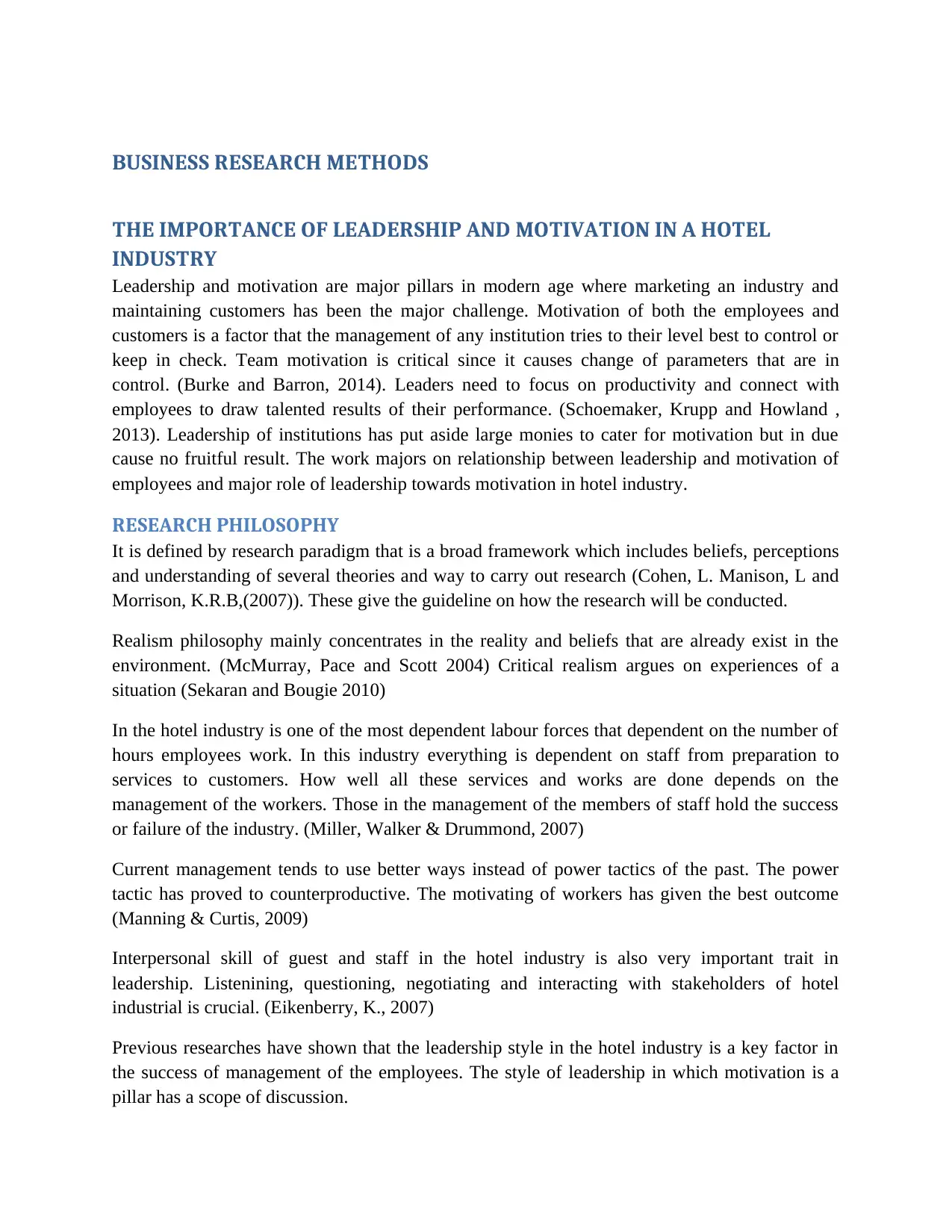
BUSINESS RESEARCH METHODS
THE IMPORTANCE OF LEADERSHIP AND MOTIVATION IN A HOTEL
INDUSTRY
Leadership and motivation are major pillars in modern age where marketing an industry and
maintaining customers has been the major challenge. Motivation of both the employees and
customers is a factor that the management of any institution tries to their level best to control or
keep in check. Team motivation is critical since it causes change of parameters that are in
control. (Burke and Barron, 2014). Leaders need to focus on productivity and connect with
employees to draw talented results of their performance. (Schoemaker, Krupp and Howland ,
2013). Leadership of institutions has put aside large monies to cater for motivation but in due
cause no fruitful result. The work majors on relationship between leadership and motivation of
employees and major role of leadership towards motivation in hotel industry.
RESEARCH PHILOSOPHY
It is defined by research paradigm that is a broad framework which includes beliefs, perceptions
and understanding of several theories and way to carry out research (Cohen, L. Manison, L and
Morrison, K.R.B,(2007)). These give the guideline on how the research will be conducted.
Realism philosophy mainly concentrates in the reality and beliefs that are already exist in the
environment. (McMurray, Pace and Scott 2004) Critical realism argues on experiences of a
situation (Sekaran and Bougie 2010)
In the hotel industry is one of the most dependent labour forces that dependent on the number of
hours employees work. In this industry everything is dependent on staff from preparation to
services to customers. How well all these services and works are done depends on the
management of the workers. Those in the management of the members of staff hold the success
or failure of the industry. (Miller, Walker & Drummond, 2007)
Current management tends to use better ways instead of power tactics of the past. The power
tactic has proved to counterproductive. The motivating of workers has given the best outcome
(Manning & Curtis, 2009)
Interpersonal skill of guest and staff in the hotel industry is also very important trait in
leadership. Listenining, questioning, negotiating and interacting with stakeholders of hotel
industrial is crucial. (Eikenberry, K., 2007)
Previous researches have shown that the leadership style in the hotel industry is a key factor in
the success of management of the employees. The style of leadership in which motivation is a
pillar has a scope of discussion.
tabler-icon-diamond-filled.svg

Paraphrase This Document

Need a fresh take? Get an instant paraphrase of this document with our AI Paraphraser
Document Page
Ambrose and Kulik (1999: 232) describe how work motivation can be measured using both
attitudinal (e.g. job satisfaction) and behavioural (e.g. job performance) measures. This research
employs both attitudinal (job satisfaction, affective organizational commitment and work
meaning) and behavioural measures of work motivation
DATA COLLECTION METHODS
The study adopted a descriptive cross-sectional survey research design. According to Polit and
Beck (2010), this design necessitates a more economical collection of data at one point in time
and is fundamental in objective analysis due to timing similarity.
In the hotel industry, the research uses experimental methods to test the influence of motivation
among the employees in the industry. All the data used included primary. Direct observation is
used to collect primary data. Data collection was based on the research questions (Sekaran &
Bougie, 2013.) In the research topic depends on who, how, when thus is finding out the role of
leadership and the management then the study is descriptive (Cooper and Schindler, 2011)
According to Sekaran and Bougie (2013) the descriptive studies help the researcher to: 1)have
enough understand the characteristics of a group under study which are employees and leaders in
the hotel industry 2) In a given order think about aspects in a given situation 3) forecast on
future scope of research to be undertaken and 4) critical in making decision.
The study undertakes survey with the objectives of measuring the attitudes, opinions, knowledge,
behaviours and awareness both inside and outside the organization (Zikmund, Babin, Carr &
Griffin, 2010). In the process of data collection and making use of survey gives control over the
whole research process and after the sampling process the outcomes serve as the representative
of population, (Neuman, W. L., 2014).
Population is defined as a group of objects or persons that are under study for statistical purpose
(Collis & Hussey, 2009). The population consists of both managerial and non-managerial staffs.
Departments including finance, human resources, housekeeping and food and beverages (kitchen
& service). The population is heterogeneous in nature that is it involves different groups.
The nature of population being heterogeneous in nature in order to apply single random
sampling, the data first is divided into homogeneous groups of managerial and non-managerial
using stratified sampling method. A simple random sampling technique was used since all the
elements in the population have equal chances of being selected (Cooper & Schindler, 2011).
The population under study includes different departments and thus considered as strata. Simple
random sampling involves one selecting a sample at random in the sampling frame using random
tables, a computer random number generator (Saunders et. al., 2009).
Document Page
A questionnaire is the data collection technique that survey uses (Quinlan, 2011). The descriptive
design serves the research as it investigates the role of leadership and motivation and
performance.
A principle about a sample is that the smaller the population is that larger the sample should be
to give more accurate outcomes (Quinlan, 2011). According to Zikmund et. al ( 2010) the sample
should consider the variance of the population that is heterogeneity, the acceptable error of study
and finally the confidence interval.
DATA ANALYSIS TECHNIQUE
The data that will be collected will be analyzed using the descriptive methodology since the most
prevailing question how the management and motivation affects job outcome. In the analysis the
data is prepared by editing, coding and entry in the statistical software to ensure the
appropriateness for the analysis (Cooper and Schindler, 2011).
Data coding is the process of assigning a particular response with number with a given database
(Sekaran & Bougie, 2013). Descriptive statistics catered measures of tendency including the
mean, median and mode. Frequencies were obtained and presentation made on chart, tables, and
graphs and cross tabulation. Inferential analysis was used to make conclusions of the sample that
forecasted the population (Quinlan, 2011).
The binary logistic model was used to give the leadership styles and motivation of the workers.
Motivation can be discussed in three dimensions of due to how rewarding will be done, efforts
will result by rewarding and profitability of rewarding (Newstrom, 2011). Sekaran and Bougie
(2013) notes the challenges that can be faced by researchers attempting to administer respondent-
completed surveys within organizations as opposed to surveys of individuals or households. The
software for analysis that coding was coded in and analysis was done in statistical software for
social sciences (SPSS).
ETHIC ISSUES
The fundamental issues that any business must face are integrity and trust. The hotel industry
have the responsibility to develop codes of conduct and ethics that ever member of any
organization should follow to the letter. In the research consist of three levels of ethics which can
be review as self, group and future ethics. The members of staff that include all workers and the
leadership departments, the discipline of time management, etiquette to other workers and
customers is very essential for growth and development of industry. The services provided by the
workers in the hotel industry should ensure that acceptable to customers and also ethical. Dress
code should be neat and acceptable, (Tashakkori & C. Teddlie, 2003).
These are the ethics that govern even the management in the organization. The leaders should
observe them to the letter. These ethics are important in decision making in the industry. The
Document Page
society also has the role it majors in the ethics of the industry. In the hotel industry some of the
beverages that are in use should be designated for certain groups, (Metz, E. C., & Youniss, J,
2004).
Due to ethical factors leaders and workers must be prepared to work under changing conditions.
They should also learn to acquire adaptation and work in changing conditions (Eikenberry,
2007).
tabler-icon-diamond-filled.svg

Paraphrase This Document

Need a fresh take? Get an instant paraphrase of this document with our AI Paraphraser
Document Page
Reference:
Ambrose, M.L., & Kulik, C.T. (1999). Old friends, new faces: Motivation research in the 1990s.
Journal of Management, 25, 231-292
Burke, R. and Barron, S. (n.d.). Project management leadership
Brooks, I. (2009). Organisational Behaviour, Individuals, Groups and Organisation. 4thed.
Essex, ENG: Pearson Education Limited.
Borghans, L., Duckworth, A. L., Heckman, J. J., & Ter Weel, B. (2008). The economics and
psychology of personality traits. Journal of Human Resources, 43(4), 972-1059
Campbell, J.L. (2007) ‘Why would corporations behave in socially responsible ways? An
institutional theory of corporate social responsibility’, Academy of Management Review,
Vol. 32, No. 3, pp.946–967.
Cooper, R. D. & Schindler, S. P. (2011). Business Research Methods. 11th ed. New York, NY:
McGraw-Hill/Irwin.
Collis, J. and Hussey, R. (2009) Business research: a practical guide for undergraduate and
postgraduate students 3rd edn. Basingstoke: Palgrave Macmillan.
Cooper, C. L. & Starbuck, W. H. (2005). Work and Workers. Vol.1. London, UK: Sage
Publications Ltd.
Quinlan, C. (2011). Business Research Methods. Hampshire, UK: Cengage Learning EMEA.
Ethridge, D. (2004). Research Methodology in Applied Economics. Chicago:John Wiley &
Sons, pg 24.
Eikenberry, K. (2007). Remarkable Leadership, Unleashing Your Leadership Potential One Skill
at a Time. San Francisco, CA: Jossey-Bass
LoBiondo-Wood G. & Haber J (2002). Nursing Research: Methods, Critical Appraisal and
Utilization. 5th edn. Mosby. St Louis, USA.
Metz, E. C., & Youniss, J. (2005). Longitudinal gains in civic development through school-based
required service. Political Psychology, 25, 494-511.
Miller, J., Walker, J., Drummond, K. (2007) Supervision in the Hospitality Industry. (4th
ed.) New Jersey: John Wiley and Sons, Inc
Manning G., Curtis K. ( 2005) The Art of Leadership. London: McGraw-Hill
Document Page
McMurray, A. J., Scott, D. R., Pace, R. W. (2004) The relationship between organizational
commitment and organizational climate in manufacturing. Human Resource Development
Quarterly, 15(4), 473–488.
Newstrom J. (2011). Organizational Behavior: Human Behavior at Work. McGraw-Hill/Irwin
Neuman, W. L. (2014). Social Research Methods: Qualitative and Quantitative Approaches, 7th
Edition. Pearson Education Limited: UK.
Oso, W. Y. and Onen, D. (2015). A general guide to writing research proposal and reports.
Makerere University Press. Kampala, Uganda.
Polit D.F. and Beck C.T. (2010). Essentials of Nursing Research, 7th ed. Wolters Kluwer Health
Lippincott Williams & Wilkins, Philadelphia.
Park, H., Russell, C. & Lee, J. 2007, "National culture and environmental sustainability: A cross-
national analysis", Journal of Economics and Finance, vol. 31, no. 1, pp. 104-121.
Sekaran, U., & Bougie, R. (2010). Research methods for business: A skill building approach.
UK: John Wiley & Sons Ltd
Sekaran, U. and Bougie, R. (2013) Research Methods for Business: A Skill-Building Approach.
6th Edition, Wiley, New York.
Saunders, M., Lewis, P. & Thornhill, A. (2009). Research Methods for Business Students. 5th
ed. Essex, ENG: Pearson Education Limited.
Schoemaker, P., Krupp, S. and Howland, S., 2013. Strategic Leadership: The Essential Skills.
Harvard Business Review, pp.3-5
Tashakkori & C. Teddlie (2003). Handbook of mixed methods in social & research (pg 273-
296). Thousands Oaks, CA: Sage.
Zikmund, W.G., B.J. Babin, J.C. Carr, M. Griffin, (2010), Business Research Methods,
8th Edition, International Edition.
chevron_up_icon
1 out of 6
circle_padding
hide_on_mobile
zoom_out_icon
[object Object]