Managing People: Leadership, HRM, and Organizational Success
VerifiedAdded on 2023/06/18
|9
|2541
|486
Report
AI Summary
This report provides a self-reflection on management, leadership, and Human Resource Management (HRM). It emphasizes the importance of effective management and leadership in promoting employee satisfaction and achieving organizational objectives. The report highlights the duties and responsibilities of effective leaders, including making time for employees, promoting two-way communication, managing conflicts, setting a clear vision, and inspiring motivation. It also explores the critical role of HRM in enhancing the quality of work life, fostering new ideas, ensuring employee satisfaction, and contributing to strategic management. Key HRM functions such as recruitment, learning and development, compensation and benefits, and building employee relations are discussed. Furthermore, the report delves into essential HR policies like employee contracts, health and safety contracts, and leave policies, emphasizing their significance in employee retention and organizational success.
Managing People

Paraphrase This Document
Need a fresh take? Get an instant paraphrase of this document with our AI Paraphraser
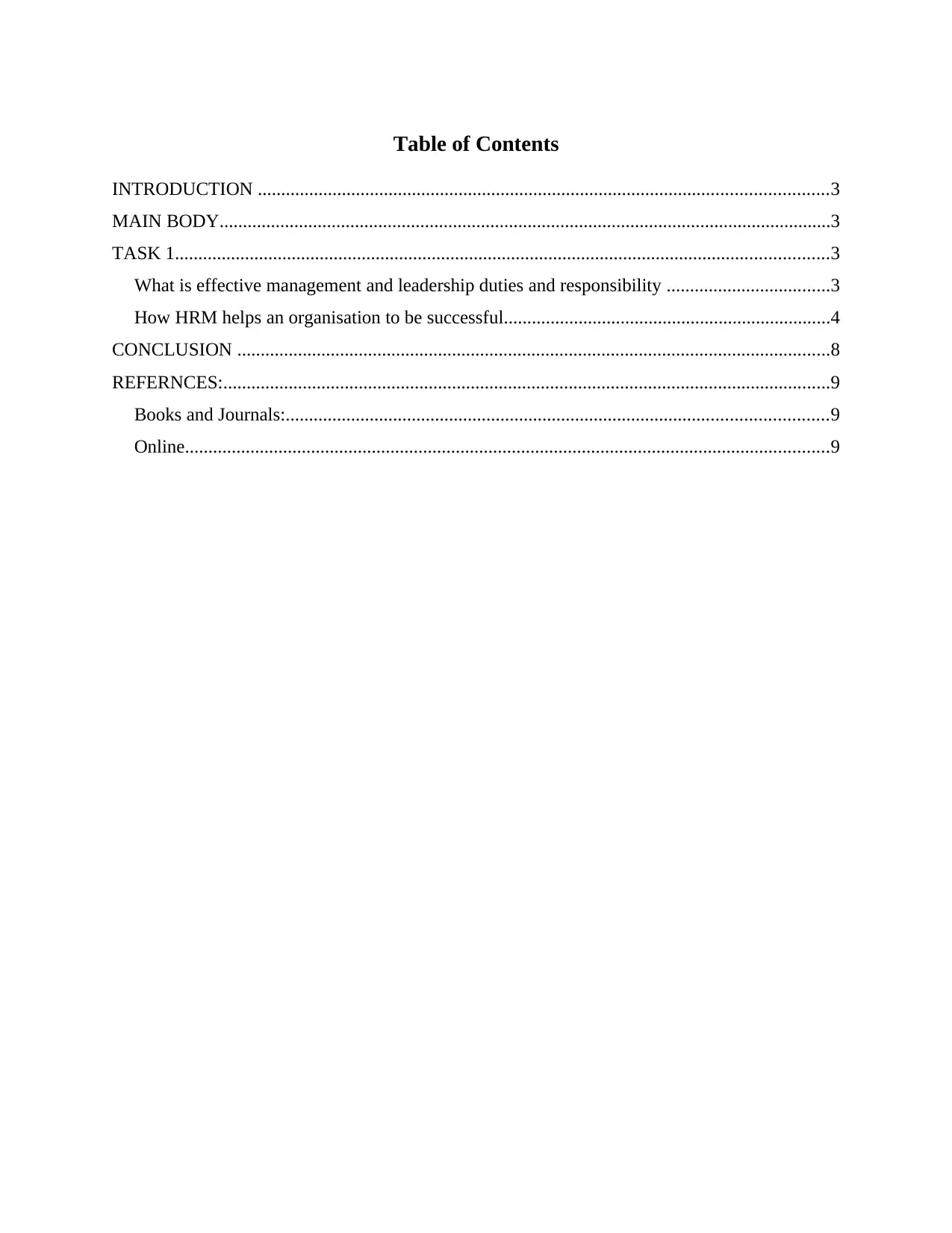
Table of Contents
INTRODUCTION ..........................................................................................................................3
MAIN BODY...................................................................................................................................3
TASK 1............................................................................................................................................3
What is effective management and leadership duties and responsibility ...................................3
How HRM helps an organisation to be successful......................................................................4
CONCLUSION ...............................................................................................................................8
REFERNCES:..................................................................................................................................9
Books and Journals:....................................................................................................................9
Online..........................................................................................................................................9
INTRODUCTION ..........................................................................................................................3
MAIN BODY...................................................................................................................................3
TASK 1............................................................................................................................................3
What is effective management and leadership duties and responsibility ...................................3
How HRM helps an organisation to be successful......................................................................4
CONCLUSION ...............................................................................................................................8
REFERNCES:..................................................................................................................................9
Books and Journals:....................................................................................................................9
Online..........................................................................................................................................9
INTRODUCTION
The report aims to deliver self reflection on the learned aspect in the area of management,
Leadership and HRM. Human resource management refers to those practices which circulate in
welfare of employees and key people of organisation. An HR manager is responsible for
undertaking responsibility each employee satisfaction in terms of payroll, salaries, incentives,
conduct recruitment and trainings. Managing people require effective leadership traits that are
necessary to prepare employees according to the objective of organisation(Prasad, 2020)
(Anderson, 2017). This report is going to present effectiveness of HRM policies and procedures
by undertaking various examples of organisation. Also, there will be evaluation of activities and
responsibilities associated with effective management.
MAIN BODY
TASK 1
What is effective management and leadership duties and responsibility
An effective management is all about taking best decision which bind all employees,
managers and leaders together. Management is all about planning the strategy for people,
gathering resources and maintain control over them. I have analysed from this concept that,
effective management is necessary for all the activities carries out in day to day life. As it
synthesise and build the plans and capabilities to perform particular task (Myende, Samuel, and
Pillay, 2018). Hence, in people management, leaders and managers plays vital role to promote
employee satisfaction which carries out smooth functioning. There are many responsibilities
which must be fulfil by an effective leaders that are discussed below:
Make time for employees: This strategy shows that, making time for employees will
understand them in a better way. A leader must be a good listener to listen their thoughts,
problem and ideas so that they will feel valued. It promotes effective management in which
employees does not Crete chaos or disputes and maintain healthy environment.
Two way communication: I analysed that, in many organisation managers believe in
one way communication in which they present the thoughts and employees needs to accept it.
But an effective manager and leaders will not so so. They must enable two way interaction in
which employees give feedback and review to present clear thoughts. It will ascertain less time
and clear the doubts instantly.
The report aims to deliver self reflection on the learned aspect in the area of management,
Leadership and HRM. Human resource management refers to those practices which circulate in
welfare of employees and key people of organisation. An HR manager is responsible for
undertaking responsibility each employee satisfaction in terms of payroll, salaries, incentives,
conduct recruitment and trainings. Managing people require effective leadership traits that are
necessary to prepare employees according to the objective of organisation(Prasad, 2020)
(Anderson, 2017). This report is going to present effectiveness of HRM policies and procedures
by undertaking various examples of organisation. Also, there will be evaluation of activities and
responsibilities associated with effective management.
MAIN BODY
TASK 1
What is effective management and leadership duties and responsibility
An effective management is all about taking best decision which bind all employees,
managers and leaders together. Management is all about planning the strategy for people,
gathering resources and maintain control over them. I have analysed from this concept that,
effective management is necessary for all the activities carries out in day to day life. As it
synthesise and build the plans and capabilities to perform particular task (Myende, Samuel, and
Pillay, 2018). Hence, in people management, leaders and managers plays vital role to promote
employee satisfaction which carries out smooth functioning. There are many responsibilities
which must be fulfil by an effective leaders that are discussed below:
Make time for employees: This strategy shows that, making time for employees will
understand them in a better way. A leader must be a good listener to listen their thoughts,
problem and ideas so that they will feel valued. It promotes effective management in which
employees does not Crete chaos or disputes and maintain healthy environment.
Two way communication: I analysed that, in many organisation managers believe in
one way communication in which they present the thoughts and employees needs to accept it.
But an effective manager and leaders will not so so. They must enable two way interaction in
which employees give feedback and review to present clear thoughts. It will ascertain less time
and clear the doubts instantly.
⊘ This is a preview!⊘
Do you want full access?
Subscribe today to unlock all pages.

Trusted by 1+ million students worldwide
Conflict management: it is also a duty of leader to manage workplace conflict and
provide effective solution to the problems. conflicts are the weakness of organisation which
impact on their profitability and coordination (O’Donovan, 2019). Leaders must be calm and
polite while engaging in disputes and analyse the actual problems to support rights decision.
Set a vision: An effective leader is enough to manage a team. They are entitled with the
responsibility to set a vision and regulate it among employees. Providing clear vision eliminate
confusion and employees will get prepare to perform job roles according to set targets. It helps
them to work on right track. When they understand the job roles clearly, organisation success
could not be missed.
Inspire and motivate: the leaders must be inspirational to influence others. An
employees learn from their leaders as their behaviours, traits and inspirational personality
motivate others to be the same. It is necessary to manage people by effective communication
which make them motivated. An employees require positive inspiration to work with full
capabilities.
In order to make organisational change, all the responsibilities are essential for leaders to
perform in this competitive market. Change is mandatory as per the society to fulfil their
requirement. Therefore, leaders have to be supportive and dedicated to make employees
understand how to cope up with changes(Reddy, and Lakshmikeerthi, 2019). As there are new
technologies and new trends in market, organisation are required to make them comfortable
with the new environment and technologies. Therefore, leaders have to be patient and calm
while delivering information and guidance. It will formulate the strategies to carry out work
activities and employees adopt what they have taught. It is the duty of leaders to make employee
feel free to contact in any doubtful decisions and maintain a chain of command.
How HRM helps an organisation to be successful
Human resource management is crucial part for organisation. Business is working in a
competitive market where technology is rapidly rising, arrival of new players and availability of
many opportunities. These uncertain environment impact on employee retention and potential of
organisation. an effective HRM policies contains planning for recruitment and selection,
providing trainings and guidance, employee satisfy and keep performance records for future
growth (What is HR management in an organisation, 2019). HRM management is important to
provide effective solution to the problems. conflicts are the weakness of organisation which
impact on their profitability and coordination (O’Donovan, 2019). Leaders must be calm and
polite while engaging in disputes and analyse the actual problems to support rights decision.
Set a vision: An effective leader is enough to manage a team. They are entitled with the
responsibility to set a vision and regulate it among employees. Providing clear vision eliminate
confusion and employees will get prepare to perform job roles according to set targets. It helps
them to work on right track. When they understand the job roles clearly, organisation success
could not be missed.
Inspire and motivate: the leaders must be inspirational to influence others. An
employees learn from their leaders as their behaviours, traits and inspirational personality
motivate others to be the same. It is necessary to manage people by effective communication
which make them motivated. An employees require positive inspiration to work with full
capabilities.
In order to make organisational change, all the responsibilities are essential for leaders to
perform in this competitive market. Change is mandatory as per the society to fulfil their
requirement. Therefore, leaders have to be supportive and dedicated to make employees
understand how to cope up with changes(Reddy, and Lakshmikeerthi, 2019). As there are new
technologies and new trends in market, organisation are required to make them comfortable
with the new environment and technologies. Therefore, leaders have to be patient and calm
while delivering information and guidance. It will formulate the strategies to carry out work
activities and employees adopt what they have taught. It is the duty of leaders to make employee
feel free to contact in any doubtful decisions and maintain a chain of command.
How HRM helps an organisation to be successful
Human resource management is crucial part for organisation. Business is working in a
competitive market where technology is rapidly rising, arrival of new players and availability of
many opportunities. These uncertain environment impact on employee retention and potential of
organisation. an effective HRM policies contains planning for recruitment and selection,
providing trainings and guidance, employee satisfy and keep performance records for future
growth (What is HR management in an organisation, 2019). HRM management is important to
Paraphrase This Document
Need a fresh take? Get an instant paraphrase of this document with our AI Paraphraser
increase employee engagement as it keeps the employee stick to the aims and objectives of
organisation. HR managers perform many functions related to human resource. These
importance are defined below:
Importance of HRM
Quality of work life: HRM is the main function of organisation that ascertained quality
of work life. As HR manage Is responsible to maintain healthy, clean and pleasant environment
of working. Work quality matter allot in order to get desirable result in productivity and
outcomes (McDonald, Fisher, and Connelly, 2017). There must be proper clean working
environment that will not harm quality of employees living.
New ideas: Good HRM practices will attract new employees and promote new ideas. The
organisation will be beneficial to take innovate decisions. New ideas and unique solutions are
necessary which will get through good HRM practices. When employees enable participation
they will surely indulge in giving new ideas for organisation success.
Employee satisfaction: This practice is also important in HRM practices. Workforce
satisfaction is essential to retain employees for the long term within organisation. The more
employee gets satisfied the more they will work hard to accomplish gaols. A satisfied employee
will keep others motivated and understand what their team wants.
Strategic management: Strategic decisions are vital for organisation. As management
requires effective plans which would carry out work activities in systematic manner. Managers
has their responsibility to make strategies appropriate for workplace in favour of organisational
goals. For example, a manager creates policies regarding payrolls and regulate no
discrimination within organisation. These strategies helps in managing workplace in a better
way.
Recruitment: it is one the crucial function of HR manger in order to gain success of
organisation. Employees efforts and their contribution are essential for achieving objectives.
Therefore, the manger must look for employees with great skills and capabilities suitable for job
required job role. Great employees promote great success in the competitive market. The
managers needs to be aware about vacant position to fill enough positions that are required. It
will minimise wastage of time and cost in taking interviews and selection.
Learning and development: An HR manager is responsible to make employees familiar
with organisation objectives. Therefore, learning should be constant throughout all business
organisation. HR managers perform many functions related to human resource. These
importance are defined below:
Importance of HRM
Quality of work life: HRM is the main function of organisation that ascertained quality
of work life. As HR manage Is responsible to maintain healthy, clean and pleasant environment
of working. Work quality matter allot in order to get desirable result in productivity and
outcomes (McDonald, Fisher, and Connelly, 2017). There must be proper clean working
environment that will not harm quality of employees living.
New ideas: Good HRM practices will attract new employees and promote new ideas. The
organisation will be beneficial to take innovate decisions. New ideas and unique solutions are
necessary which will get through good HRM practices. When employees enable participation
they will surely indulge in giving new ideas for organisation success.
Employee satisfaction: This practice is also important in HRM practices. Workforce
satisfaction is essential to retain employees for the long term within organisation. The more
employee gets satisfied the more they will work hard to accomplish gaols. A satisfied employee
will keep others motivated and understand what their team wants.
Strategic management: Strategic decisions are vital for organisation. As management
requires effective plans which would carry out work activities in systematic manner. Managers
has their responsibility to make strategies appropriate for workplace in favour of organisational
goals. For example, a manager creates policies regarding payrolls and regulate no
discrimination within organisation. These strategies helps in managing workplace in a better
way.
Recruitment: it is one the crucial function of HR manger in order to gain success of
organisation. Employees efforts and their contribution are essential for achieving objectives.
Therefore, the manger must look for employees with great skills and capabilities suitable for job
required job role. Great employees promote great success in the competitive market. The
managers needs to be aware about vacant position to fill enough positions that are required. It
will minimise wastage of time and cost in taking interviews and selection.
Learning and development: An HR manager is responsible to make employees familiar
with organisation objectives. Therefore, learning should be constant throughout all business
working. The leaders will analyse the capabilities of employees and guide them as per the need.
It is necessary to conduct many learning and development programmes so that, employees will
look at building career within organisation. It is beneficial for company as employees will
acquire new knowledge that they have learned with their creative mind which is required by
current business market.
Compensation and benefits: A HR manager must formulate balance between giving
compensation and regrading employees. They need to make sure about not creating and
differentiation so that, others will feel equality and fair treatment (Akunda, Chen, and Gikiri,
2018). These compensations and rewards must be distribute in a fair way as per the performance
and employee contribution. This will promote organisation success as employees will work even
more hard than the normal capability. It is the major motivating drivers which attract employee
engagement in taking risks and complexities to show their talent and present something different
from others.
Building employee relations: Maintaining relations is one of the important factor for
organisation. As team work is necessary to achieve goals and objective. So that, an effective
management would only be possible when employees are maintaining relations. Social
interaction and regular communication is necessary. So that, HRM practices could develop this
insight among them by conducting events, groups activities, games and parties. This will
improve work relations and build trust and loyalty towards each of them.
These are the crucial HRM practices which ascertain good growth of organisation. These
practices build a confidence among employees as well as manager that both are performing their
duties and responsibilities in a well manner.
There are various importance of HRM practices which lead to promote organisational
growth at both domestic and international level. The procedures involves strategic planning,
implementing control, regular training and learning and enable fair treatment for all working in
organisation. All the HRM practices must be compliance with companies laws and legal
provision. As there are many rules regrading working hours, minimum payroll, insurance
policies, rewards and compensation, leave payrolls and many more. All must be assure by HR
manager to keep the employees retain. An organisation maintain its well brand image with
employees retention. The much they have high termination rate, the more organisation will face
negative role into market. These practices are in the hands of HR manager to create a positive
It is necessary to conduct many learning and development programmes so that, employees will
look at building career within organisation. It is beneficial for company as employees will
acquire new knowledge that they have learned with their creative mind which is required by
current business market.
Compensation and benefits: A HR manager must formulate balance between giving
compensation and regrading employees. They need to make sure about not creating and
differentiation so that, others will feel equality and fair treatment (Akunda, Chen, and Gikiri,
2018). These compensations and rewards must be distribute in a fair way as per the performance
and employee contribution. This will promote organisation success as employees will work even
more hard than the normal capability. It is the major motivating drivers which attract employee
engagement in taking risks and complexities to show their talent and present something different
from others.
Building employee relations: Maintaining relations is one of the important factor for
organisation. As team work is necessary to achieve goals and objective. So that, an effective
management would only be possible when employees are maintaining relations. Social
interaction and regular communication is necessary. So that, HRM practices could develop this
insight among them by conducting events, groups activities, games and parties. This will
improve work relations and build trust and loyalty towards each of them.
These are the crucial HRM practices which ascertain good growth of organisation. These
practices build a confidence among employees as well as manager that both are performing their
duties and responsibilities in a well manner.
There are various importance of HRM practices which lead to promote organisational
growth at both domestic and international level. The procedures involves strategic planning,
implementing control, regular training and learning and enable fair treatment for all working in
organisation. All the HRM practices must be compliance with companies laws and legal
provision. As there are many rules regrading working hours, minimum payroll, insurance
policies, rewards and compensation, leave payrolls and many more. All must be assure by HR
manager to keep the employees retain. An organisation maintain its well brand image with
employees retention. The much they have high termination rate, the more organisation will face
negative role into market. These practices are in the hands of HR manager to create a positive
⊘ This is a preview!⊘
Do you want full access?
Subscribe today to unlock all pages.
Trusted by 1+ million students worldwide
workplace environment with utmost fairness and dignity. There are many HR polices that
contribute in organisation success which are discussed below:
Employee contracts: An HR manager is responsible to develop employee contract in
which all the essential details like employees joining data, work position, salary and wages,
leaves and all the information related to its job must be present. It is an official work document
that act a proof of working in an organisation. It must be signed by both employee and employer
to agree upon all the provision and information provided.
Health and safety contracts: AS per UK provision of laws, every organisation must
provide health and safety insurance to the employees. It is necessary for attain workplace
satisfaction for employees for which HR manger is responsible to provide compensation or claim
for cause or miss happening (Singh, 2019). These policies are for limited period of time which
helps employees to feel safe and secure while working. The main purpose behind these
compensatory regulation is to promote employee welfare. As anything could be happened during
working with heavy machinery and uncertainties arises. So that, employee would not have to
bear the loss and organisation will provide immense support.
Leave: An employee wants to work in organisation which provide all the benefits
regrading leave. As there may be emergency and leave required, HR manager would enable a
beneficial policy through which employees take leave without deducting salary. This is a great
policy to keep them retained. Every organisation have different leave payroll as per the potential
of company. But it is a mandatory policy that must be performed and looked by every HR
manager.
Employee benefits: There are many other benefits in respect of employee performance.
Not every employee will be entitled for It as it provide as per their contribution. HR manager
must make fair policies regarding giving compensation so that, no employees feel disappointed
and get fair value in return. These benefits could be rewards, incentives, compensation, holiday
packages, bonus and many more. A manager could make employees motivated by giving these
rewards through which new employees get attracted to be a part of organisation.
contribute in organisation success which are discussed below:
Employee contracts: An HR manager is responsible to develop employee contract in
which all the essential details like employees joining data, work position, salary and wages,
leaves and all the information related to its job must be present. It is an official work document
that act a proof of working in an organisation. It must be signed by both employee and employer
to agree upon all the provision and information provided.
Health and safety contracts: AS per UK provision of laws, every organisation must
provide health and safety insurance to the employees. It is necessary for attain workplace
satisfaction for employees for which HR manger is responsible to provide compensation or claim
for cause or miss happening (Singh, 2019). These policies are for limited period of time which
helps employees to feel safe and secure while working. The main purpose behind these
compensatory regulation is to promote employee welfare. As anything could be happened during
working with heavy machinery and uncertainties arises. So that, employee would not have to
bear the loss and organisation will provide immense support.
Leave: An employee wants to work in organisation which provide all the benefits
regrading leave. As there may be emergency and leave required, HR manager would enable a
beneficial policy through which employees take leave without deducting salary. This is a great
policy to keep them retained. Every organisation have different leave payroll as per the potential
of company. But it is a mandatory policy that must be performed and looked by every HR
manager.
Employee benefits: There are many other benefits in respect of employee performance.
Not every employee will be entitled for It as it provide as per their contribution. HR manager
must make fair policies regarding giving compensation so that, no employees feel disappointed
and get fair value in return. These benefits could be rewards, incentives, compensation, holiday
packages, bonus and many more. A manager could make employees motivated by giving these
rewards through which new employees get attracted to be a part of organisation.
Paraphrase This Document
Need a fresh take? Get an instant paraphrase of this document with our AI Paraphraser
CONCLUSION
The report has concluded that, there are many key roles and responsibilities perform by
mangers and leaders. As they are both potential assets for company. They hold responsibility of
making plans and implement it in practical circumstances. Therefore, all the management of
people depends on how managers behave, act and response to employee problems. So that, the
report has presented all the duties and roles of leader which must be there. Also, there are many
importance of HRM policies like employee satisfaction, strategic management and many more.
Policies and procedures are discussed which also a part of good HRM policies. It has analysed
that there are many policies and factors that plays crucial part in managing people.
The report has concluded that, there are many key roles and responsibilities perform by
mangers and leaders. As they are both potential assets for company. They hold responsibility of
making plans and implement it in practical circumstances. Therefore, all the management of
people depends on how managers behave, act and response to employee problems. So that, the
report has presented all the duties and roles of leader which must be there. Also, there are many
importance of HRM policies like employee satisfaction, strategic management and many more.
Policies and procedures are discussed which also a part of good HRM policies. It has analysed
that there are many policies and factors that plays crucial part in managing people.
REFERNCES:
Books and Journals:
Akunda, D., Chen, Z. and Gikiri, S.N., 2018. Role of HRM in talent retention with
evidence. Journal of Management and Strategy, 9(2), pp.8-19.
Anderson, M., 2017. Transformational leadership in education: A review of existing
literature. International Social Science Review, 93(1), p.4.
McDonald, K., Fisher, S. and Connelly, C.E., 2017. e-HRM systems in support of “smart”
workforce management: An exploratory case study of system success. In Electronic
HRM in the smart era. Emerald Publishing Limited.
Myende, P.E., Samuel, M.A. and Pillay, A., 2018. Novice rural principals’ successful leadership
practices in financial management: Multiple accountabilities. South African Journal of
Education, 38(2), pp.1-11.
O’Donovan, D., 2019. HRM in the organization: An overview. Management Science, pp.75-110.
Prasad, L.M., 2020. Principles and practice of management. Sultan Chand & Sons.
Reddy, P.R. and Lakshmikeerthi, P., 2017. HR analytics-An effective evidence based HRM
tool. International Journal of Business and Management Invention, 6(7), pp.23-34.
Singh, Y., 2019. Employee engagement as a contemporary issue in HRM. In Management
Techniques for Employee Engagement in Contemporary Organizations (pp. 20-45). IGI
Global.
Online
What is HR management in an organisation, 2019. [online] Available through:
<https://www.hrdconnect.com/2019/05/22/what-is-hr-management-in-an-organisation/>
Books and Journals:
Akunda, D., Chen, Z. and Gikiri, S.N., 2018. Role of HRM in talent retention with
evidence. Journal of Management and Strategy, 9(2), pp.8-19.
Anderson, M., 2017. Transformational leadership in education: A review of existing
literature. International Social Science Review, 93(1), p.4.
McDonald, K., Fisher, S. and Connelly, C.E., 2017. e-HRM systems in support of “smart”
workforce management: An exploratory case study of system success. In Electronic
HRM in the smart era. Emerald Publishing Limited.
Myende, P.E., Samuel, M.A. and Pillay, A., 2018. Novice rural principals’ successful leadership
practices in financial management: Multiple accountabilities. South African Journal of
Education, 38(2), pp.1-11.
O’Donovan, D., 2019. HRM in the organization: An overview. Management Science, pp.75-110.
Prasad, L.M., 2020. Principles and practice of management. Sultan Chand & Sons.
Reddy, P.R. and Lakshmikeerthi, P., 2017. HR analytics-An effective evidence based HRM
tool. International Journal of Business and Management Invention, 6(7), pp.23-34.
Singh, Y., 2019. Employee engagement as a contemporary issue in HRM. In Management
Techniques for Employee Engagement in Contemporary Organizations (pp. 20-45). IGI
Global.
Online
What is HR management in an organisation, 2019. [online] Available through:
<https://www.hrdconnect.com/2019/05/22/what-is-hr-management-in-an-organisation/>
⊘ This is a preview!⊘
Do you want full access?
Subscribe today to unlock all pages.
Trusted by 1+ million students worldwide

1 out of 9


Related Documents


Your All-in-One AI-Powered Toolkit for Academic Success.
+13062052269
info@desklib.com
Available 24*7 on WhatsApp / Email
![[object Object]](/_next/static/media/star-bottom.7253800d.svg)
Unlock your academic potential
Copyright © 2020–2026 A2Z Services. All Rights Reserved. Developed and managed by ZUCOL.