Leadership and Management for Service Industry - Hyatt Report
VerifiedAdded on 2022/12/15
|13
|3875
|471
Report
AI Summary
This report examines leadership and management principles within the service industry, using Hyatt Hotel as a case study. It begins by differentiating between management and leadership, then explores classical management theories, specifically Henry Fayol's administrative management theory, and its application to Hyatt. The report analyzes leadership styles, particularly authoritarian leadership, and its relevance in the hospitality sector. It also discusses talent management strategies within the context of the service industry. Furthermore, the report investigates the impact of internal and external environmental factors, such as human resources, finance, climate, economy, and regulations, on the industry and management approaches. The conclusion summarizes the key findings and implications for effective leadership and management in the service industry.
Leadership and
Management for Service
Industry
Management for Service
Industry

Paraphrase This Document
Need a fresh take? Get an instant paraphrase of this document with our AI Paraphraser
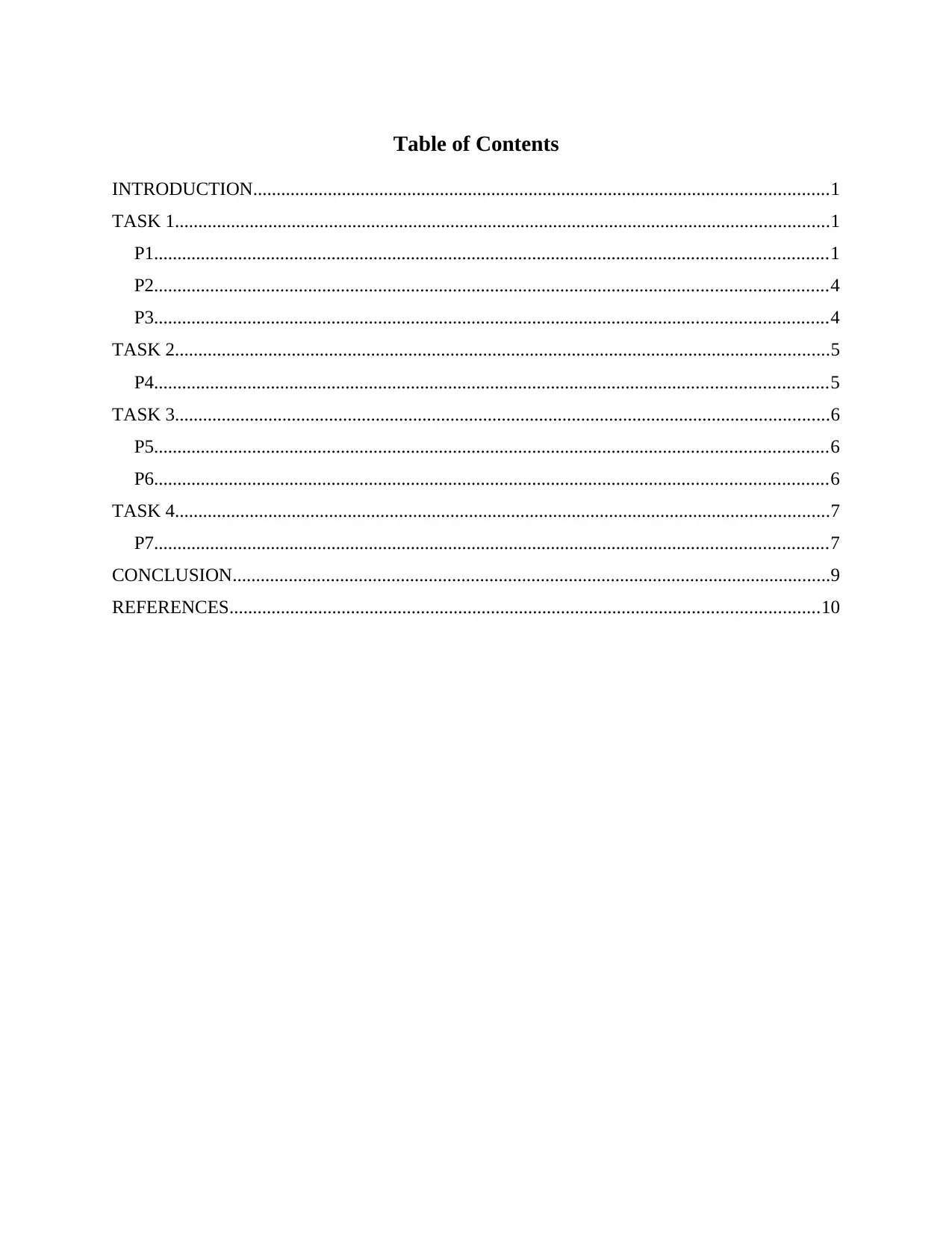
Table of Contents
INTRODUCTION...........................................................................................................................1
TASK 1............................................................................................................................................1
P1................................................................................................................................................1
P2................................................................................................................................................4
P3................................................................................................................................................4
TASK 2............................................................................................................................................5
P4................................................................................................................................................5
TASK 3............................................................................................................................................6
P5................................................................................................................................................6
P6................................................................................................................................................6
TASK 4............................................................................................................................................7
P7................................................................................................................................................7
CONCLUSION................................................................................................................................9
REFERENCES..............................................................................................................................10
INTRODUCTION...........................................................................................................................1
TASK 1............................................................................................................................................1
P1................................................................................................................................................1
P2................................................................................................................................................4
P3................................................................................................................................................4
TASK 2............................................................................................................................................5
P4................................................................................................................................................5
TASK 3............................................................................................................................................6
P5................................................................................................................................................6
P6................................................................................................................................................6
TASK 4............................................................................................................................................7
P7................................................................................................................................................7
CONCLUSION................................................................................................................................9
REFERENCES..............................................................................................................................10
INTRODUCTION
Management is the most primary function of a business organisation to achieve the all the
goals and objectives with the help of people who work in an organisation. Simply put, it is an act
of getting work done by others with available resources effectively and efficiently (Robbins,
Coulter and DeCenzo, 2017). A management is pervasive in nature, which means it is a
continuous or never ending process. As organisation viewed as system where it include all types
of resources that is, tangible and intangible as well. Therefore it is important to manage all the
efforts of people at one place for fulfilment of the objectives. Management functions include;
planning, organising, directing and controlling. Leadership in business organisation refers to the
capacity of an individual in managing up of overall business operation in order to achieve
business objectives.
A leader who are in position of responsibility of all the functions of an organisation and
can be held responsible for any irresponsive behaviour on behalf of the organisation. In business,
an individual with strong leadership skill such as; CEO, Chairman, CFO, President etc. position
are made for them. A leader with his/ her leadership provide guidance and direction to the
company and its employees to achieve desired direction (Antonakis, and Day, 2018). For report
purpose, our chosen organisation is Hyatt Hotel Co. a global leading hospitality company. Under
the parent company Hyatt, it offer other 20 different brands. The purpose of the company is to
care for people so that company can be best in their business decision and growth strategy which
intend to attract and retain its employees, build relationship with all other guests and create value
for the shareholders (Hyatt. 2019).
TASK 1
Difference between Management and Leadership
Both term are often create confusion as both management and leadership is
complementary to each other. Management deals with planning, organising, directing and
controlling and coordinating the tasks assigned individual whereas, in leadership, a leader is
responsible for motivating and give inspiration to other people (Bârgău, 2015).
P1.
There are three classical theories are commonly buzz in management. Namely; Scientific
management theory, Administrative theory and Bureaucratic theory. The classical management
1
Management is the most primary function of a business organisation to achieve the all the
goals and objectives with the help of people who work in an organisation. Simply put, it is an act
of getting work done by others with available resources effectively and efficiently (Robbins,
Coulter and DeCenzo, 2017). A management is pervasive in nature, which means it is a
continuous or never ending process. As organisation viewed as system where it include all types
of resources that is, tangible and intangible as well. Therefore it is important to manage all the
efforts of people at one place for fulfilment of the objectives. Management functions include;
planning, organising, directing and controlling. Leadership in business organisation refers to the
capacity of an individual in managing up of overall business operation in order to achieve
business objectives.
A leader who are in position of responsibility of all the functions of an organisation and
can be held responsible for any irresponsive behaviour on behalf of the organisation. In business,
an individual with strong leadership skill such as; CEO, Chairman, CFO, President etc. position
are made for them. A leader with his/ her leadership provide guidance and direction to the
company and its employees to achieve desired direction (Antonakis, and Day, 2018). For report
purpose, our chosen organisation is Hyatt Hotel Co. a global leading hospitality company. Under
the parent company Hyatt, it offer other 20 different brands. The purpose of the company is to
care for people so that company can be best in their business decision and growth strategy which
intend to attract and retain its employees, build relationship with all other guests and create value
for the shareholders (Hyatt. 2019).
TASK 1
Difference between Management and Leadership
Both term are often create confusion as both management and leadership is
complementary to each other. Management deals with planning, organising, directing and
controlling and coordinating the tasks assigned individual whereas, in leadership, a leader is
responsible for motivating and give inspiration to other people (Bârgău, 2015).
P1.
There are three classical theories are commonly buzz in management. Namely; Scientific
management theory, Administrative theory and Bureaucratic theory. The classical management
1
⊘ This is a preview!⊘
Do you want full access?
Subscribe today to unlock all pages.

Trusted by 1+ million students worldwide
theory are developed in order to predict and control the overall functions and behaviours within
the organisation. To understand how classical management theory define task to each individual
and their duties to fulfil the delegated tasks, it is imperative to understand one of them which
nearly apply on company Hyatt for the report purpose.
Administrative Management Theory
The theory was developed by Henry Fayol. He developed the theory on his own personal
experience at workplace (Ferdous, 2016). He developed fourteen principles of management.
These are discussed below:
1. Division of Work: The principle focus on division of work by creating department.
These divisions lead to specialisation of work Which further improve the productivity
and profitability of the organisation.
2. Authority and Responsibility: This principle focus on balance on authority and
responsibility. Authority must come with responsibility, without proper balance among
two can create monopoly of power of individual in the organisation.
3. Discipline: It refers to respect for all the rules and regulation of the organisation.
Discipline create an environment where every individual realise their duties with proper
rules which help in reducing chaos.
4. Unity of Command: The principle focus on leading of one boss or manager to avoid
any dualism of assigned work. It states that employees must receive orders from their one
boss only.
5. Unity of Direction: To be successful organisation must follow unity of direction. The
principle focus on one head, one plan for group of objectives. All activities which have
same objective must be under one manager. Therefore he/ she must use one plan.
6. Subordination of Individual Interest to General Interest: It refers to individual
interest must given less importance over general interests. To avoid sabotage of
organisational goal due to interest of an individual.
7. Remuneration: It means the price of the service. The principle believe in fair to both
employees and the firm. Compensation must be based on systematic attempt of
performance. This should provide maximum satisfaction both employees and employers.
8. Centralisation: This principle focus on centralisation of power only few hands of the
authority. However it largely depend on the company; its management, size, people etc.
2
the organisation. To understand how classical management theory define task to each individual
and their duties to fulfil the delegated tasks, it is imperative to understand one of them which
nearly apply on company Hyatt for the report purpose.
Administrative Management Theory
The theory was developed by Henry Fayol. He developed the theory on his own personal
experience at workplace (Ferdous, 2016). He developed fourteen principles of management.
These are discussed below:
1. Division of Work: The principle focus on division of work by creating department.
These divisions lead to specialisation of work Which further improve the productivity
and profitability of the organisation.
2. Authority and Responsibility: This principle focus on balance on authority and
responsibility. Authority must come with responsibility, without proper balance among
two can create monopoly of power of individual in the organisation.
3. Discipline: It refers to respect for all the rules and regulation of the organisation.
Discipline create an environment where every individual realise their duties with proper
rules which help in reducing chaos.
4. Unity of Command: The principle focus on leading of one boss or manager to avoid
any dualism of assigned work. It states that employees must receive orders from their one
boss only.
5. Unity of Direction: To be successful organisation must follow unity of direction. The
principle focus on one head, one plan for group of objectives. All activities which have
same objective must be under one manager. Therefore he/ she must use one plan.
6. Subordination of Individual Interest to General Interest: It refers to individual
interest must given less importance over general interests. To avoid sabotage of
organisational goal due to interest of an individual.
7. Remuneration: It means the price of the service. The principle believe in fair to both
employees and the firm. Compensation must be based on systematic attempt of
performance. This should provide maximum satisfaction both employees and employers.
8. Centralisation: This principle focus on centralisation of power only few hands of the
authority. However it largely depend on the company; its management, size, people etc.
2
Paraphrase This Document
Need a fresh take? Get an instant paraphrase of this document with our AI Paraphraser
Centralisation of power give either very less authority or no authority in the hands of the
employees in decision making.
9. Scalar Chain: Usually the chain of command also known as scalar chain. It follows a
formal line designed from top to bottom of the organisation. It include, Authority,
Communication, responsibilities in organisation. It establishes the superior and
subordinate relationship. It follows a downward direction alon with chain of command
and follows upward in terms of accountability.
10. Order: Under this principle, it states that every thing have its assigned place. There
should be proper order maintenance in terms of people, material or anything. It must
follow 'a place for everything and everything in its place'. Misplace of anything whether
man or material can lead to delay in fulfilment of objective.
11. Equity: Equity sum up the combination of kindness and justice. Employers or managers
must keep this in mind while dealing with their employees of the organisation. Equity
create loyalty and dedication for work and towards organisation. Simply put, equity
defines That managers must be just and fair to its subordinates.
12. Stability: This refers to employees stability in his/ her job. The employers must provide
fair time to individual to be stable at their job. Thus employers must provide job security
so that frequent retention 0of employees can be reduce.
13. Initiative: It is the responsibility of the manager to encourage initiative. Where
employees are encourage to take their own decisions and plans. Initiative give freedom
and thus provide job satisfaction to the employees.
14. Esprit De Corps: It means Team spirit. The management must create unity, cooperation
and build team spirit within individuals. Harmonising relationship with each other are the
major internal strength of an organisation. Therefore managers must promote them to
successful in its business.
In service industry such as in Hospitality industry which deals with people from
worldwide as in their customers and employees. This classical management theory help in realise
their managerial power as well as explore them in different extent. Since this management
widely accepted in organisation to be successful in management. Same way at Hyatt, the
company also accept this management theory at their organisation. The company operate on a
3
employees in decision making.
9. Scalar Chain: Usually the chain of command also known as scalar chain. It follows a
formal line designed from top to bottom of the organisation. It include, Authority,
Communication, responsibilities in organisation. It establishes the superior and
subordinate relationship. It follows a downward direction alon with chain of command
and follows upward in terms of accountability.
10. Order: Under this principle, it states that every thing have its assigned place. There
should be proper order maintenance in terms of people, material or anything. It must
follow 'a place for everything and everything in its place'. Misplace of anything whether
man or material can lead to delay in fulfilment of objective.
11. Equity: Equity sum up the combination of kindness and justice. Employers or managers
must keep this in mind while dealing with their employees of the organisation. Equity
create loyalty and dedication for work and towards organisation. Simply put, equity
defines That managers must be just and fair to its subordinates.
12. Stability: This refers to employees stability in his/ her job. The employers must provide
fair time to individual to be stable at their job. Thus employers must provide job security
so that frequent retention 0of employees can be reduce.
13. Initiative: It is the responsibility of the manager to encourage initiative. Where
employees are encourage to take their own decisions and plans. Initiative give freedom
and thus provide job satisfaction to the employees.
14. Esprit De Corps: It means Team spirit. The management must create unity, cooperation
and build team spirit within individuals. Harmonising relationship with each other are the
major internal strength of an organisation. Therefore managers must promote them to
successful in its business.
In service industry such as in Hospitality industry which deals with people from
worldwide as in their customers and employees. This classical management theory help in realise
their managerial power as well as explore them in different extent. Since this management
widely accepted in organisation to be successful in management. Same way at Hyatt, the
company also accept this management theory at their organisation. The company operate on a
3
global level therefore to maintain such diverse, this classical management approach help them to
do so.
P2.
A leader play critical role in who guide its employees and team towards success. A leader
help in provide vision of the company. Since the company is deal with hospitality in Service
sector, the leaders are with natural talent and excellent leadership qualities, skill and practices
make them better leader (Huang and et. al., 2016). On close look it is observed that at hospitality
industry, the leaders usually follow Authoritarian leadership which also known as Autocratic or
Directive style. The reason behind adopting this style of leadership is the unpredictable future in
this sector. Considering the current scenario of Global pandemic, it have affected largely in this
industry. Therefore to have proper control over the business the leader must follow such a
leadership style that can have full control over the company to bring such uncertainties. In
upcoming section it discuss about the Authoritarian Leadership style.
This leadership style clearly define clear control and direction . Here, the leader assert
his/ her authority and limit the decision making power to himself. The style expect
unquestionable obedience. This type of leadership clearly defines roles and follow strict
hierarchy. An authoritarian leader posses strong will and able to stay consistently up to date on
its team's work and taker all the decisions. The organisational structure also decide the degree of
influence of the authoritarian leadership style (The three essential elements of Leadership. 2012).
At Hyatt, the Chairman and CEO have positive authoritarian leadership style. Where they have
clear plan for their company. To have right environment and proper work culture at organisation,
authoritarian style of leadership have been effective on the performance of the employees.
P3.
As it is discussed above that management and leadership have its own specific role in
order proper management, directing, motivating and influence individual in the organisation.
Similar way talent management also play a vital role (Nieves and Segarra-Ciprés, 2015). It is the
process through which organisation identify and develop talents within company who can bring
positive impact in the organisation. At Hyatt, it is the responsibility of the HR to use different
use appropriate TM strategies to have fully develop work force with the organisation. The role of
TM have been widely recognised now more than ever after post COVID situation. The situation
demand for change due to change in the pattern of employment and the way used jobs are
4
do so.
P2.
A leader play critical role in who guide its employees and team towards success. A leader
help in provide vision of the company. Since the company is deal with hospitality in Service
sector, the leaders are with natural talent and excellent leadership qualities, skill and practices
make them better leader (Huang and et. al., 2016). On close look it is observed that at hospitality
industry, the leaders usually follow Authoritarian leadership which also known as Autocratic or
Directive style. The reason behind adopting this style of leadership is the unpredictable future in
this sector. Considering the current scenario of Global pandemic, it have affected largely in this
industry. Therefore to have proper control over the business the leader must follow such a
leadership style that can have full control over the company to bring such uncertainties. In
upcoming section it discuss about the Authoritarian Leadership style.
This leadership style clearly define clear control and direction . Here, the leader assert
his/ her authority and limit the decision making power to himself. The style expect
unquestionable obedience. This type of leadership clearly defines roles and follow strict
hierarchy. An authoritarian leader posses strong will and able to stay consistently up to date on
its team's work and taker all the decisions. The organisational structure also decide the degree of
influence of the authoritarian leadership style (The three essential elements of Leadership. 2012).
At Hyatt, the Chairman and CEO have positive authoritarian leadership style. Where they have
clear plan for their company. To have right environment and proper work culture at organisation,
authoritarian style of leadership have been effective on the performance of the employees.
P3.
As it is discussed above that management and leadership have its own specific role in
order proper management, directing, motivating and influence individual in the organisation.
Similar way talent management also play a vital role (Nieves and Segarra-Ciprés, 2015). It is the
process through which organisation identify and develop talents within company who can bring
positive impact in the organisation. At Hyatt, it is the responsibility of the HR to use different
use appropriate TM strategies to have fully develop work force with the organisation. The role of
TM have been widely recognised now more than ever after post COVID situation. The situation
demand for change due to change in the pattern of employment and the way used jobs are
4
⊘ This is a preview!⊘
Do you want full access?
Subscribe today to unlock all pages.
Trusted by 1+ million students worldwide
performed. Proper management of human capital within organisation helps leaders and mangers
to utilise their strength in right direction. This saves lot of time, energy and create a productive
environment. Since hospitality sector is one the most frequent changing industry. Any change in
external environment lead to change in internal and so in the overall strategies of the company.
TASK 2
P4.
In hospitality industry both factors of the environment can bring large impact in the
organisation as well it can affect the management styles. Sometimes they forced organisation to
bring certain changes to meet the organisational objectives (Camisón and Forés, 2015). To know
what the internal and external forces, the next section will going to discuss about some major
factors of the both environment. It demand environmental analysis which help both inside and
outside of the organisation to develop organisational strategies that will reflect organisational
environment.
Internal Factors
Human Resources: It refers to the employees of the organisation. Which include
managers and employees. An organisation get large impact from the performance of the its
human capital which determine ultimate quality of the service that an organisation is producing.
Such as an individual at management position of the Hyatt hotel, can influence effective decision
making, policy implementing, designing budget for different costs, hiring of right candidates
with suitable task, delegation etc. are determined by the manager of the company.
Finance: A business in its smooth functioning need adequate funds in order survive
different costs and grow with growing opportunities. Sufficient funds are important as this ensure
fulfil demands of customers such as, developing any new service, hiring new staffs, buying any
equipment, upgrading software etc. Therefore without sound finance company and management
delay in their decisions or may impact business in its performance as well.
External Factors
Climate and Weather: In hospitality sector since it deals with customer around the
world and visitor who come to spent their leisure time of their choice and visitors stay at hotels.
Therefore climate and weather become the main factor that determine a tourist's plan according
to them. Since the closing motive of a holiday is enjoyment and relaxation, the neighborhood
5
to utilise their strength in right direction. This saves lot of time, energy and create a productive
environment. Since hospitality sector is one the most frequent changing industry. Any change in
external environment lead to change in internal and so in the overall strategies of the company.
TASK 2
P4.
In hospitality industry both factors of the environment can bring large impact in the
organisation as well it can affect the management styles. Sometimes they forced organisation to
bring certain changes to meet the organisational objectives (Camisón and Forés, 2015). To know
what the internal and external forces, the next section will going to discuss about some major
factors of the both environment. It demand environmental analysis which help both inside and
outside of the organisation to develop organisational strategies that will reflect organisational
environment.
Internal Factors
Human Resources: It refers to the employees of the organisation. Which include
managers and employees. An organisation get large impact from the performance of the its
human capital which determine ultimate quality of the service that an organisation is producing.
Such as an individual at management position of the Hyatt hotel, can influence effective decision
making, policy implementing, designing budget for different costs, hiring of right candidates
with suitable task, delegation etc. are determined by the manager of the company.
Finance: A business in its smooth functioning need adequate funds in order survive
different costs and grow with growing opportunities. Sufficient funds are important as this ensure
fulfil demands of customers such as, developing any new service, hiring new staffs, buying any
equipment, upgrading software etc. Therefore without sound finance company and management
delay in their decisions or may impact business in its performance as well.
External Factors
Climate and Weather: In hospitality sector since it deals with customer around the
world and visitor who come to spent their leisure time of their choice and visitors stay at hotels.
Therefore climate and weather become the main factor that determine a tourist's plan according
to them. Since the closing motive of a holiday is enjoyment and relaxation, the neighborhood
5
Paraphrase This Document
Need a fresh take? Get an instant paraphrase of this document with our AI Paraphraser
weather and climate is usually a significant attention whilst deciding on a destination. In
comparable way, environmental elements can also have an effect on the hospitality industry. For
example, air pollution may be an extreme challenge in a few areas. Traveller’s scientific
condition, such as any breathing troubles can also additionally choose to keep away from the
ones places completely for health reason.
Economy: Individual or family and even businesses budget get affect from travel plans.
Such as in poor economy, businesses are less likely to approve unnecessary travel. Because
approvals may also involve cost-cutting, such as requiring employees to take cheaper flights or
to stay at less expensive hotels.
Laws and regulation: Every businesses are subject to federal, state and local laws and
regulations. Hospitality sector are responsible for tracking legal and regulatory changes and
making sure that they operate in compliance with existing law of the country.
TASK 3
P5.
In Hospitality industry, while managing the all the functions at organisation a leader must
posses both hard and soft skills. Since leadership is matter of courage, discipline and intelligence
(Moldoveanu and Narayandas, 2019). Therefore in order to be successful in managing of overall
functions, resources and relations a leader must be an exemplary. Hard- skills are like concrete
abilities that a leader brings on the table of its employees. These are some specific skill set that
learned through any trainings or school which clearly define the business objectives, for
example; Training degree, language proficiency, It proficiency, Industry training etc. These skills
focus on nature of job which an individual entail. Whereas soft- skills are the abilities or talent
that acquire from experience rather from learning institutions. These are skill one can offer as
employee of the organisation. For example, problem solving, time management, communication,
team spirit etc.
P6.
To be effective, it is important for managers and leaders to be ready for future of
management and leadership as well (Vinichenko and et. al., 2017). The changes are becoming
more visible than ever. The future of business is assume to be more technological advanced,
more importance are going to give on hard skills as these are going to be future of every
6
comparable way, environmental elements can also have an effect on the hospitality industry. For
example, air pollution may be an extreme challenge in a few areas. Traveller’s scientific
condition, such as any breathing troubles can also additionally choose to keep away from the
ones places completely for health reason.
Economy: Individual or family and even businesses budget get affect from travel plans.
Such as in poor economy, businesses are less likely to approve unnecessary travel. Because
approvals may also involve cost-cutting, such as requiring employees to take cheaper flights or
to stay at less expensive hotels.
Laws and regulation: Every businesses are subject to federal, state and local laws and
regulations. Hospitality sector are responsible for tracking legal and regulatory changes and
making sure that they operate in compliance with existing law of the country.
TASK 3
P5.
In Hospitality industry, while managing the all the functions at organisation a leader must
posses both hard and soft skills. Since leadership is matter of courage, discipline and intelligence
(Moldoveanu and Narayandas, 2019). Therefore in order to be successful in managing of overall
functions, resources and relations a leader must be an exemplary. Hard- skills are like concrete
abilities that a leader brings on the table of its employees. These are some specific skill set that
learned through any trainings or school which clearly define the business objectives, for
example; Training degree, language proficiency, It proficiency, Industry training etc. These skills
focus on nature of job which an individual entail. Whereas soft- skills are the abilities or talent
that acquire from experience rather from learning institutions. These are skill one can offer as
employee of the organisation. For example, problem solving, time management, communication,
team spirit etc.
P6.
To be effective, it is important for managers and leaders to be ready for future of
management and leadership as well (Vinichenko and et. al., 2017). The changes are becoming
more visible than ever. The future of business is assume to be more technological advanced,
more importance are going to give on hard skills as these are going to be future of every
6
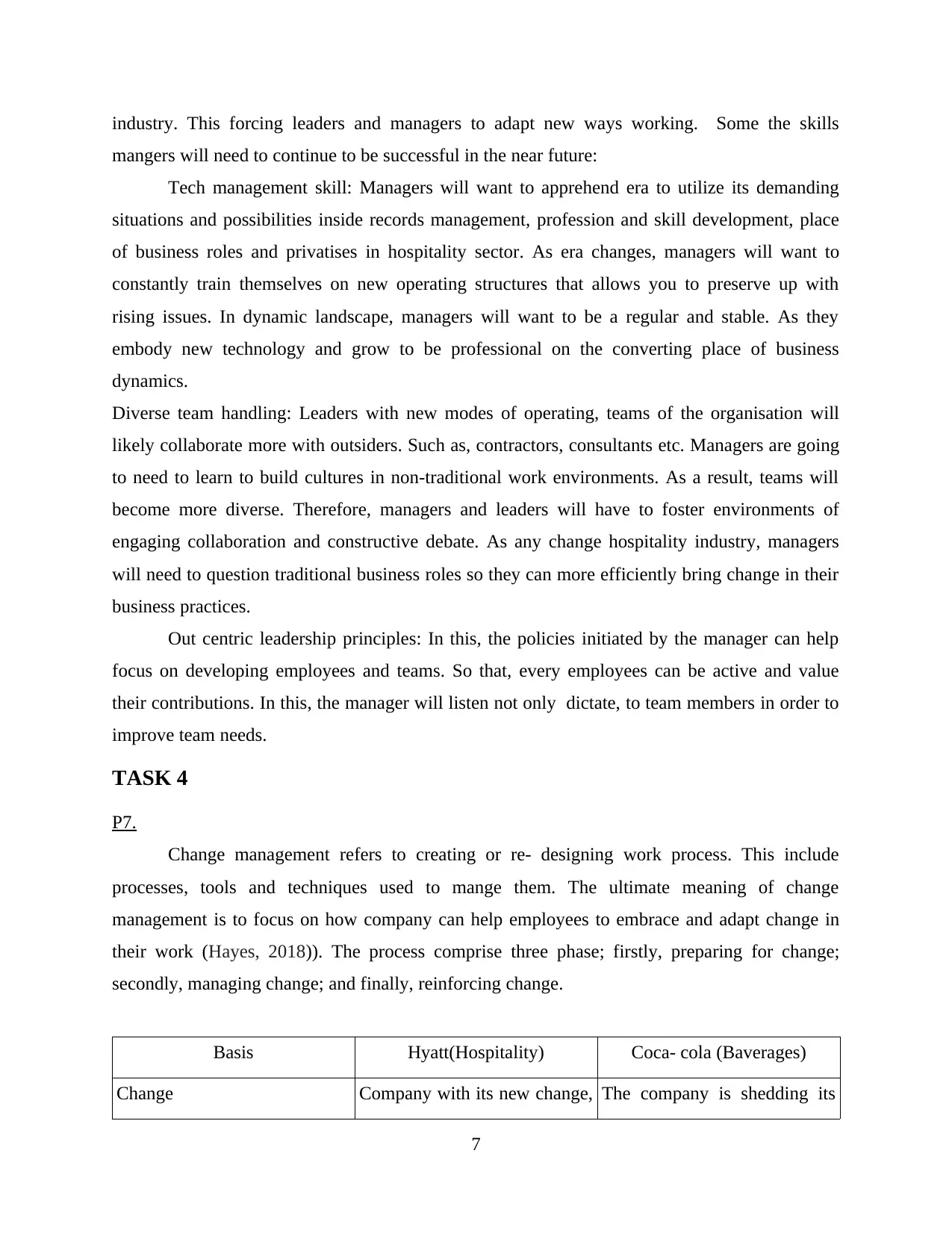
industry. This forcing leaders and managers to adapt new ways working. Some the skills
mangers will need to continue to be successful in the near future:
Tech management skill: Managers will want to apprehend era to utilize its demanding
situations and possibilities inside records management, profession and skill development, place
of business roles and privatises in hospitality sector. As era changes, managers will want to
constantly train themselves on new operating structures that allows you to preserve up with
rising issues. In dynamic landscape, managers will want to be a regular and stable. As they
embody new technology and grow to be professional on the converting place of business
dynamics.
Diverse team handling: Leaders with new modes of operating, teams of the organisation will
likely collaborate more with outsiders. Such as, contractors, consultants etc. Managers are going
to need to learn to build cultures in non-traditional work environments. As a result, teams will
become more diverse. Therefore, managers and leaders will have to foster environments of
engaging collaboration and constructive debate. As any change hospitality industry, managers
will need to question traditional business roles so they can more efficiently bring change in their
business practices.
Out centric leadership principles: In this, the policies initiated by the manager can help
focus on developing employees and teams. So that, every employees can be active and value
their contributions. In this, the manager will listen not only dictate, to team members in order to
improve team needs.
TASK 4
P7.
Change management refers to creating or re- designing work process. This include
processes, tools and techniques used to mange them. The ultimate meaning of change
management is to focus on how company can help employees to embrace and adapt change in
their work (Hayes, 2018)). The process comprise three phase; firstly, preparing for change;
secondly, managing change; and finally, reinforcing change.
Basis Hyatt(Hospitality) Coca- cola (Baverages)
Change Company with its new change, The company is shedding its
7
mangers will need to continue to be successful in the near future:
Tech management skill: Managers will want to apprehend era to utilize its demanding
situations and possibilities inside records management, profession and skill development, place
of business roles and privatises in hospitality sector. As era changes, managers will want to
constantly train themselves on new operating structures that allows you to preserve up with
rising issues. In dynamic landscape, managers will want to be a regular and stable. As they
embody new technology and grow to be professional on the converting place of business
dynamics.
Diverse team handling: Leaders with new modes of operating, teams of the organisation will
likely collaborate more with outsiders. Such as, contractors, consultants etc. Managers are going
to need to learn to build cultures in non-traditional work environments. As a result, teams will
become more diverse. Therefore, managers and leaders will have to foster environments of
engaging collaboration and constructive debate. As any change hospitality industry, managers
will need to question traditional business roles so they can more efficiently bring change in their
business practices.
Out centric leadership principles: In this, the policies initiated by the manager can help
focus on developing employees and teams. So that, every employees can be active and value
their contributions. In this, the manager will listen not only dictate, to team members in order to
improve team needs.
TASK 4
P7.
Change management refers to creating or re- designing work process. This include
processes, tools and techniques used to mange them. The ultimate meaning of change
management is to focus on how company can help employees to embrace and adapt change in
their work (Hayes, 2018)). The process comprise three phase; firstly, preparing for change;
secondly, managing change; and finally, reinforcing change.
Basis Hyatt(Hospitality) Coca- cola (Baverages)
Change Company with its new change, The company is shedding its
7
⊘ This is a preview!⊘
Do you want full access?
Subscribe today to unlock all pages.
Trusted by 1+ million students worldwide
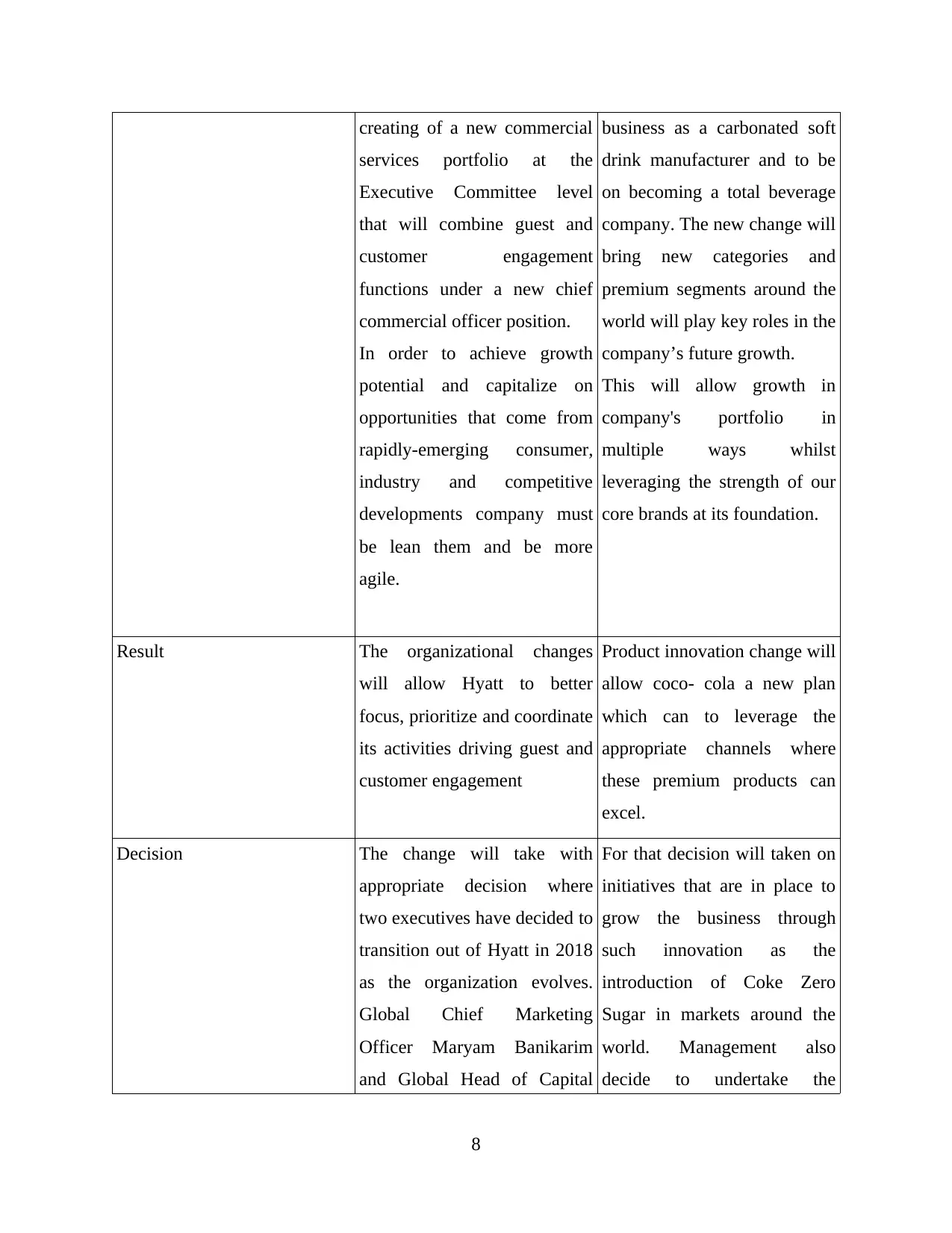
creating of a new commercial
services portfolio at the
Executive Committee level
that will combine guest and
customer engagement
functions under a new chief
commercial officer position.
In order to achieve growth
potential and capitalize on
opportunities that come from
rapidly-emerging consumer,
industry and competitive
developments company must
be lean them and be more
agile.
business as a carbonated soft
drink manufacturer and to be
on becoming a total beverage
company. The new change will
bring new categories and
premium segments around the
world will play key roles in the
company’s future growth.
This will allow growth in
company's portfolio in
multiple ways whilst
leveraging the strength of our
core brands at its foundation.
Result The organizational changes
will allow Hyatt to better
focus, prioritize and coordinate
its activities driving guest and
customer engagement
Product innovation change will
allow coco- cola a new plan
which can to leverage the
appropriate channels where
these premium products can
excel.
Decision The change will take with
appropriate decision where
two executives have decided to
transition out of Hyatt in 2018
as the organization evolves.
Global Chief Marketing
Officer Maryam Banikarim
and Global Head of Capital
For that decision will taken on
initiatives that are in place to
grow the business through
such innovation as the
introduction of Coke Zero
Sugar in markets around the
world. Management also
decide to undertake the
8
services portfolio at the
Executive Committee level
that will combine guest and
customer engagement
functions under a new chief
commercial officer position.
In order to achieve growth
potential and capitalize on
opportunities that come from
rapidly-emerging consumer,
industry and competitive
developments company must
be lean them and be more
agile.
business as a carbonated soft
drink manufacturer and to be
on becoming a total beverage
company. The new change will
bring new categories and
premium segments around the
world will play key roles in the
company’s future growth.
This will allow growth in
company's portfolio in
multiple ways whilst
leveraging the strength of our
core brands at its foundation.
Result The organizational changes
will allow Hyatt to better
focus, prioritize and coordinate
its activities driving guest and
customer engagement
Product innovation change will
allow coco- cola a new plan
which can to leverage the
appropriate channels where
these premium products can
excel.
Decision The change will take with
appropriate decision where
two executives have decided to
transition out of Hyatt in 2018
as the organization evolves.
Global Chief Marketing
Officer Maryam Banikarim
and Global Head of Capital
For that decision will taken on
initiatives that are in place to
grow the business through
such innovation as the
introduction of Coke Zero
Sugar in markets around the
world. Management also
decide to undertake the
8
Paraphrase This Document
Need a fresh take? Get an instant paraphrase of this document with our AI Paraphraser
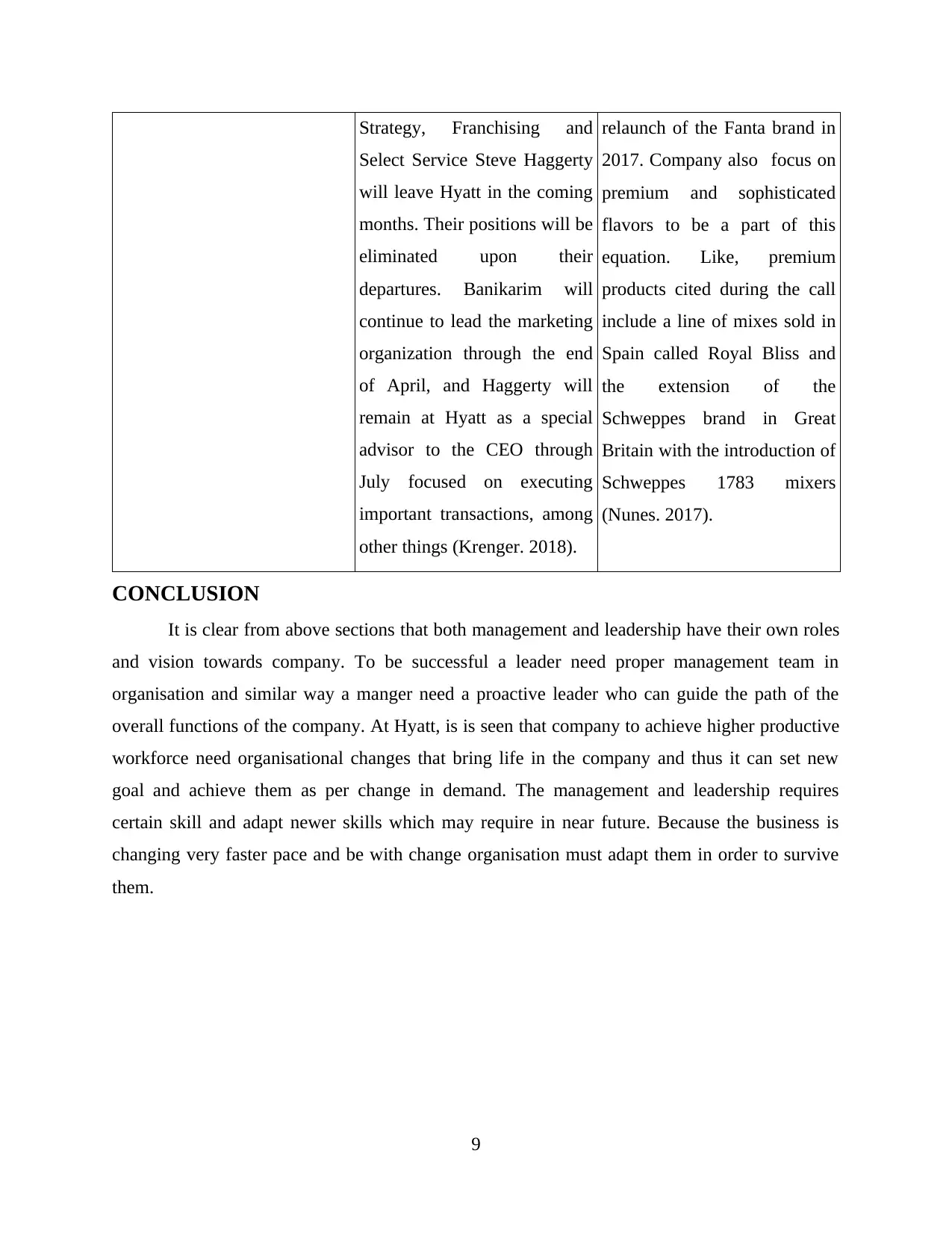
Strategy, Franchising and
Select Service Steve Haggerty
will leave Hyatt in the coming
months. Their positions will be
eliminated upon their
departures. Banikarim will
continue to lead the marketing
organization through the end
of April, and Haggerty will
remain at Hyatt as a special
advisor to the CEO through
July focused on executing
important transactions, among
other things (Krenger. 2018).
relaunch of the Fanta brand in
2017. Company also focus on
premium and sophisticated
flavors to be a part of this
equation. Like, premium
products cited during the call
include a line of mixes sold in
Spain called Royal Bliss and
the extension of the
Schweppes brand in Great
Britain with the introduction of
Schweppes 1783 mixers
(Nunes. 2017).
CONCLUSION
It is clear from above sections that both management and leadership have their own roles
and vision towards company. To be successful a leader need proper management team in
organisation and similar way a manger need a proactive leader who can guide the path of the
overall functions of the company. At Hyatt, is is seen that company to achieve higher productive
workforce need organisational changes that bring life in the company and thus it can set new
goal and achieve them as per change in demand. The management and leadership requires
certain skill and adapt newer skills which may require in near future. Because the business is
changing very faster pace and be with change organisation must adapt them in order to survive
them.
9
Select Service Steve Haggerty
will leave Hyatt in the coming
months. Their positions will be
eliminated upon their
departures. Banikarim will
continue to lead the marketing
organization through the end
of April, and Haggerty will
remain at Hyatt as a special
advisor to the CEO through
July focused on executing
important transactions, among
other things (Krenger. 2018).
relaunch of the Fanta brand in
2017. Company also focus on
premium and sophisticated
flavors to be a part of this
equation. Like, premium
products cited during the call
include a line of mixes sold in
Spain called Royal Bliss and
the extension of the
Schweppes brand in Great
Britain with the introduction of
Schweppes 1783 mixers
(Nunes. 2017).
CONCLUSION
It is clear from above sections that both management and leadership have their own roles
and vision towards company. To be successful a leader need proper management team in
organisation and similar way a manger need a proactive leader who can guide the path of the
overall functions of the company. At Hyatt, is is seen that company to achieve higher productive
workforce need organisational changes that bring life in the company and thus it can set new
goal and achieve them as per change in demand. The management and leadership requires
certain skill and adapt newer skills which may require in near future. Because the business is
changing very faster pace and be with change organisation must adapt them in order to survive
them.
9
REFERENCES
Books and Journals
Robbins, S. P., Coulter, M. K. and DeCenzo, D. A., 2017. Fundamentals of management.
Antonakis, J. and Day, D. V., 2018. Leadership: Past, present, and future.
Bârgău, M. A., 2015. Leadership versus management. Romanian Economic and Business
Review. 10(2),. pp. 112-135.
Ferdous, J., 2016. Organization theories: from classical perspective. International Journal of
Business, Economics and Law. 9(2). pp. 1-6.
Huang, J., and et. al., J., 2016. The impact of CEO servant leadership on firm performance in the
hospitality industry. International Journal of Contemporary Hospitality Management.
Nieves, J. and Segarra-Ciprés, M., 2015. Management innovation in the hotel industry. Tourism
Management. 46. pp. 51-58.
Camisón, C. and Forés, B., 2015. Is tourism firm competitiveness driven by different internal or
external specific factors?: New empirical evidence from Spain. Tourism Management.
48. pp. 477-499.
Moldoveanu, M. and Narayandas, D., 2019. The future of leadership development. Harvard
Business Review. 97(2). pp. 40-48.
Vinichenko, M. V., and et. al., 2017. Development of skills management in the system
management of talents. Modern journal of language teaching methods. 7(9). pp. 50-57.
Hayes, J., 2018. The theory and practice of change management. Palgrave.
Online
The three essential elements of Leadership. 2012. [Online] Available through:<
https://magazine.wharton.upenn.edu/digital/the-three-essential-elements-of-leadership/ >
Hyatt. 2019. [Online] Available
through:<http://investors.hyatt.com/investor-relations/corporate-governance/
management-team/default.aspx >
Nunes. K., 2017. Change is the key component of coca- cola's growth strategy. [Online]
Available through:< https://www.foodbusinessnews.net/articles/10784-change-is-a-key-
component-of-coca-cola-s-growth-strategy >
Krenger. K., 2018. HYATT CONFIGURES ORGANIZATION TO ACCELERATE GROWTH.
[Online] Available through:< http://investors.hyatt.com/investor-relations/news-and-
10
Books and Journals
Robbins, S. P., Coulter, M. K. and DeCenzo, D. A., 2017. Fundamentals of management.
Antonakis, J. and Day, D. V., 2018. Leadership: Past, present, and future.
Bârgău, M. A., 2015. Leadership versus management. Romanian Economic and Business
Review. 10(2),. pp. 112-135.
Ferdous, J., 2016. Organization theories: from classical perspective. International Journal of
Business, Economics and Law. 9(2). pp. 1-6.
Huang, J., and et. al., J., 2016. The impact of CEO servant leadership on firm performance in the
hospitality industry. International Journal of Contemporary Hospitality Management.
Nieves, J. and Segarra-Ciprés, M., 2015. Management innovation in the hotel industry. Tourism
Management. 46. pp. 51-58.
Camisón, C. and Forés, B., 2015. Is tourism firm competitiveness driven by different internal or
external specific factors?: New empirical evidence from Spain. Tourism Management.
48. pp. 477-499.
Moldoveanu, M. and Narayandas, D., 2019. The future of leadership development. Harvard
Business Review. 97(2). pp. 40-48.
Vinichenko, M. V., and et. al., 2017. Development of skills management in the system
management of talents. Modern journal of language teaching methods. 7(9). pp. 50-57.
Hayes, J., 2018. The theory and practice of change management. Palgrave.
Online
The three essential elements of Leadership. 2012. [Online] Available through:<
https://magazine.wharton.upenn.edu/digital/the-three-essential-elements-of-leadership/ >
Hyatt. 2019. [Online] Available
through:<http://investors.hyatt.com/investor-relations/corporate-governance/
management-team/default.aspx >
Nunes. K., 2017. Change is the key component of coca- cola's growth strategy. [Online]
Available through:< https://www.foodbusinessnews.net/articles/10784-change-is-a-key-
component-of-coca-cola-s-growth-strategy >
Krenger. K., 2018. HYATT CONFIGURES ORGANIZATION TO ACCELERATE GROWTH.
[Online] Available through:< http://investors.hyatt.com/investor-relations/news-and-
10
⊘ This is a preview!⊘
Do you want full access?
Subscribe today to unlock all pages.
Trusted by 1+ million students worldwide

1 out of 13


Related Documents


Your All-in-One AI-Powered Toolkit for Academic Success.
+13062052269
info@desklib.com
Available 24*7 on WhatsApp / Email
![[object Object]](/_next/static/media/star-bottom.7253800d.svg)
Unlock your academic potential
Copyright © 2020–2026 A2Z Services. All Rights Reserved. Developed and managed by ZUCOL.