Leadership's Impact on Organizational Culture: BUSN 20016, CQU Report
VerifiedAdded on 2023/06/11
|19
|4476
|150
Report
AI Summary
This report investigates the impact of leadership on organizational culture, particularly within Turing Pharmaceuticals, addressing leadership challenges and their effects on organizational performance. It explores the role of leadership in enhancing employee performance, team cohesion, and overall organizational success. The report reviews existing literature on leadership theories and organizational culture, emphasizing the importance of leadership in shaping organizational values and philosophies. It also examines how leadership influences employee motivation and operational efficiency, aiming to provide recommendations for improving organizational leadership and mitigating conflicts. The research methodology includes data collection and analysis to support the findings and recommendations for Turing Pharmaceuticals.
Impact of Leadership in Organizational Culture
BUSN (20016)
Prepared by: Sai Manoj Chitipotu
Student ID: 12047206
Name of the University: Central Queens Land University, Melbourne
BUSN (20016)
Prepared by: Sai Manoj Chitipotu
Student ID: 12047206
Name of the University: Central Queens Land University, Melbourne

Paraphrase This Document
Need a fresh take? Get an instant paraphrase of this document with our AI Paraphraser
Executive Summary
This project proposal is aimed at identifying the impact of leadership on organizational culture in
Turing Pharmaceuticals. The proposal will begin by giving a brief overview of the current
situation and the organization background. The research will also elaborate on the problem
statement showing justification of why the proposal is written. Various literature will be
scrutinized and an analysis done to provide basis of the research findings. The proposal will then
describe the methodology of research used, and give the recommendations to Turing
Pharmaceuticals based on the data collected. the research budget only covered the activities
pertaining to preparation of this document and a project guideline will also be attached to show
the sequence of events leading to the conclusion of this project.
This project proposal is aimed at identifying the impact of leadership on organizational culture in
Turing Pharmaceuticals. The proposal will begin by giving a brief overview of the current
situation and the organization background. The research will also elaborate on the problem
statement showing justification of why the proposal is written. Various literature will be
scrutinized and an analysis done to provide basis of the research findings. The proposal will then
describe the methodology of research used, and give the recommendations to Turing
Pharmaceuticals based on the data collected. the research budget only covered the activities
pertaining to preparation of this document and a project guideline will also be attached to show
the sequence of events leading to the conclusion of this project.
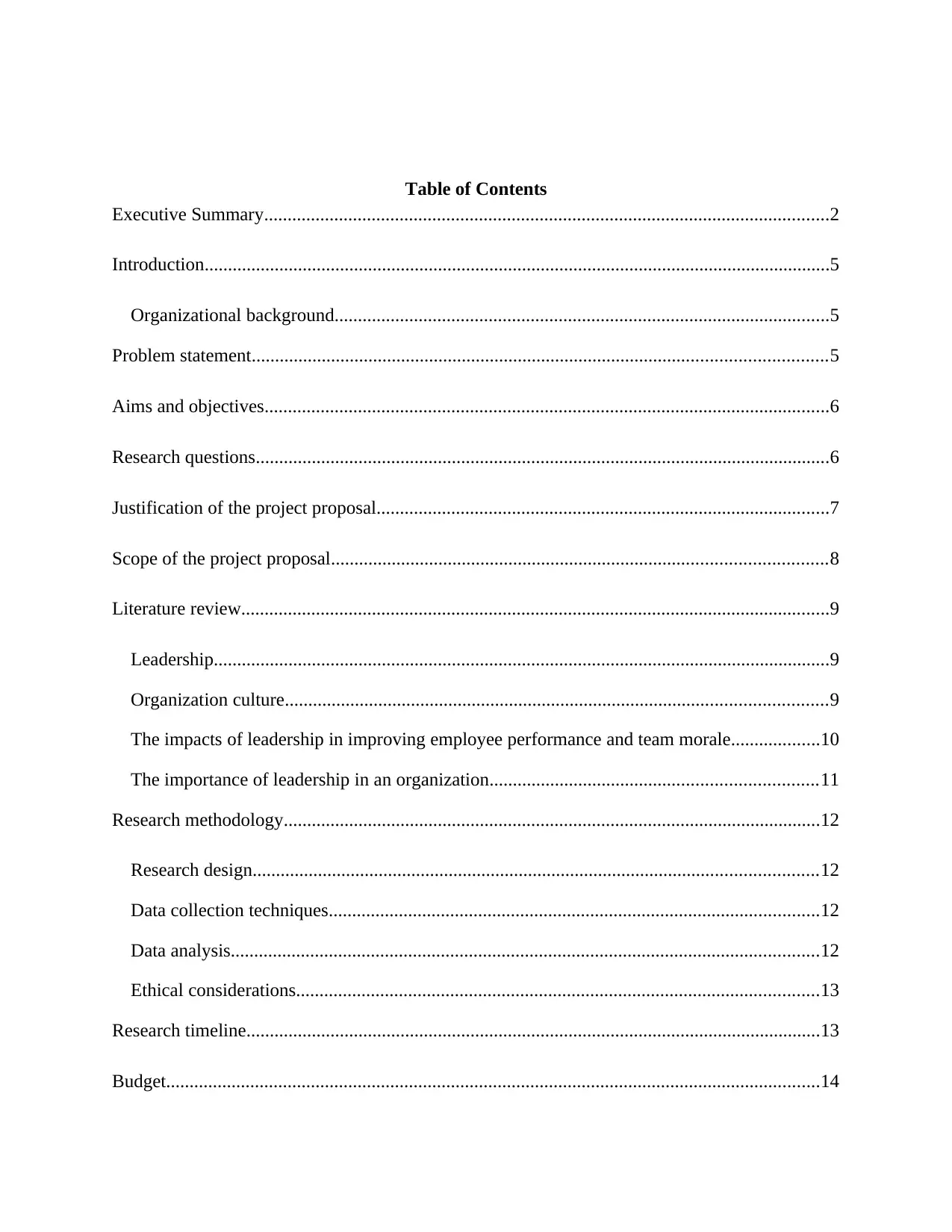
Table of Contents
Executive Summary.........................................................................................................................2
Introduction......................................................................................................................................5
Organizational background..........................................................................................................5
Problem statement...........................................................................................................................5
Aims and objectives.........................................................................................................................6
Research questions...........................................................................................................................6
Justification of the project proposal.................................................................................................7
Scope of the project proposal..........................................................................................................8
Literature review..............................................................................................................................9
Leadership....................................................................................................................................9
Organization culture....................................................................................................................9
The impacts of leadership in improving employee performance and team morale...................10
The importance of leadership in an organization......................................................................11
Research methodology...................................................................................................................12
Research design.........................................................................................................................12
Data collection techniques.........................................................................................................12
Data analysis..............................................................................................................................12
Ethical considerations................................................................................................................13
Research timeline...........................................................................................................................13
Budget............................................................................................................................................14
Executive Summary.........................................................................................................................2
Introduction......................................................................................................................................5
Organizational background..........................................................................................................5
Problem statement...........................................................................................................................5
Aims and objectives.........................................................................................................................6
Research questions...........................................................................................................................6
Justification of the project proposal.................................................................................................7
Scope of the project proposal..........................................................................................................8
Literature review..............................................................................................................................9
Leadership....................................................................................................................................9
Organization culture....................................................................................................................9
The impacts of leadership in improving employee performance and team morale...................10
The importance of leadership in an organization......................................................................11
Research methodology...................................................................................................................12
Research design.........................................................................................................................12
Data collection techniques.........................................................................................................12
Data analysis..............................................................................................................................12
Ethical considerations................................................................................................................13
Research timeline...........................................................................................................................13
Budget............................................................................................................................................14
⊘ This is a preview!⊘
Do you want full access?
Subscribe today to unlock all pages.

Trusted by 1+ million students worldwide
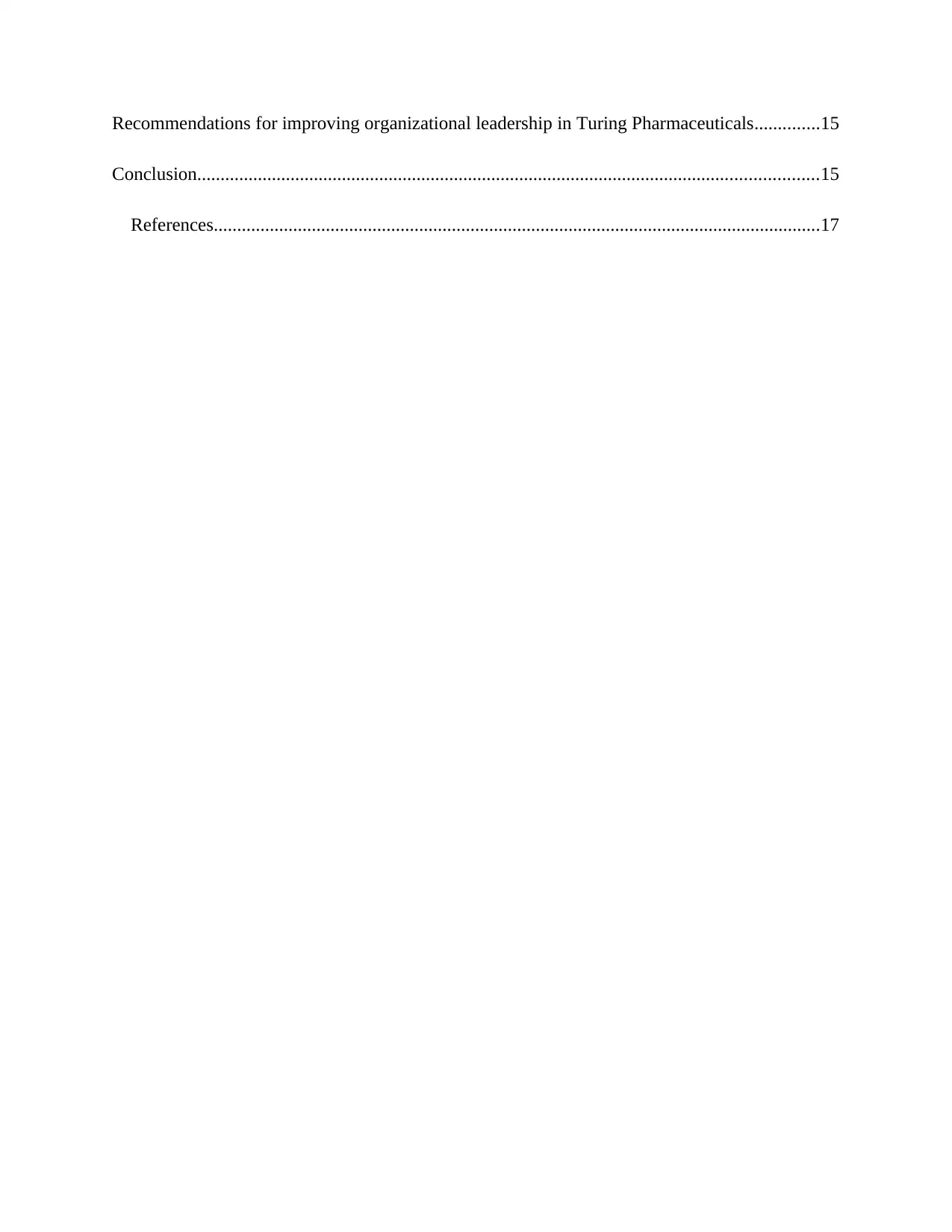
Recommendations for improving organizational leadership in Turing Pharmaceuticals..............15
Conclusion.....................................................................................................................................15
References..................................................................................................................................17
Conclusion.....................................................................................................................................15
References..................................................................................................................................17
Paraphrase This Document
Need a fresh take? Get an instant paraphrase of this document with our AI Paraphraser
Impact of leadership on organizational culture
Introduction
An organizations success is hinged on its leadership (Institute of Leadership &
Management., 2016). It is the leadership that is supposed to come up with a balancing formula
that aims to satisfy the expectations of the stakeholders; both internal and external stakeholders
(Bridoux & Stoelhorst, 2013). A failure in the leadership of any organization can cascade into
multiple issues, which can have a negative impact on the overall performance of that particular
organization (Chiu, 2010). This project proposal will try to dig deep, and bring into light the
impact of leadership in organizational culture in Turing pharmaceuticals. This is aimed at
helping the organization use the recommended strategies of improving its leadership, and propel
it to a more successful path.
Organizational background
Turing pharmaceuticals, is a New York based pharmaceutical company, incorporated in
Switzerland. The Company is primarily focused on the development of innovative treatments for
those patients with unfulfilled medical needs ("Vyera Pharmaceuticals LLC: Company Profile -
Bloomberg", 2018). Recently the company started operating in the United States under the name
of Vyera Pharmaceuticals. The company was founded in 2015 by Martin Shkreli who was later
convicted of fraud. It was alleged that, the organization substantially hiked the prices of drugs,
which resulted to widespread criticism from various stakeholders, including, a number of players
from the pharmaceutical sector. This had a denting image on the company, a problem that can be
equated to its leadership. This project proposal will therefore try to look into various aspects of
leadership, and ways the Turing pharmaceuticals can work towards improving its organizational
leadership.
Problem statement
Leadership is a aspect in management that dictates the overall well being of an
organization. The importance of leadership is so much so, that the image and existence of the
organization can be broken in an instant if there is a substantial failure in the aspect of
leadership. How the stakeholders relate with the organization will also depend with how much
interest the leadership has invested into forming a mutual relationship with them (Bridoux &
Stoelhorst, 2013). That notwithstanding, it can also be said that an organizations success is
Introduction
An organizations success is hinged on its leadership (Institute of Leadership &
Management., 2016). It is the leadership that is supposed to come up with a balancing formula
that aims to satisfy the expectations of the stakeholders; both internal and external stakeholders
(Bridoux & Stoelhorst, 2013). A failure in the leadership of any organization can cascade into
multiple issues, which can have a negative impact on the overall performance of that particular
organization (Chiu, 2010). This project proposal will try to dig deep, and bring into light the
impact of leadership in organizational culture in Turing pharmaceuticals. This is aimed at
helping the organization use the recommended strategies of improving its leadership, and propel
it to a more successful path.
Organizational background
Turing pharmaceuticals, is a New York based pharmaceutical company, incorporated in
Switzerland. The Company is primarily focused on the development of innovative treatments for
those patients with unfulfilled medical needs ("Vyera Pharmaceuticals LLC: Company Profile -
Bloomberg", 2018). Recently the company started operating in the United States under the name
of Vyera Pharmaceuticals. The company was founded in 2015 by Martin Shkreli who was later
convicted of fraud. It was alleged that, the organization substantially hiked the prices of drugs,
which resulted to widespread criticism from various stakeholders, including, a number of players
from the pharmaceutical sector. This had a denting image on the company, a problem that can be
equated to its leadership. This project proposal will therefore try to look into various aspects of
leadership, and ways the Turing pharmaceuticals can work towards improving its organizational
leadership.
Problem statement
Leadership is a aspect in management that dictates the overall well being of an
organization. The importance of leadership is so much so, that the image and existence of the
organization can be broken in an instant if there is a substantial failure in the aspect of
leadership. How the stakeholders relate with the organization will also depend with how much
interest the leadership has invested into forming a mutual relationship with them (Bridoux &
Stoelhorst, 2013). That notwithstanding, it can also be said that an organizations success is
hinged on the ability of its leadership to maximize the potential of their employees (Schmidle,
2011). Ultimately, the entire culture of the organization is directly hinged on its leadership
(Braun et al., 2013). Just as mentioned by Bukhari & Sharma (2014), the culture of the
organization is directly influenced by the norms, characters and behaviors of its leadership.
From the mentioned examples of how leadership affects an organization, it can be
established that, an organization is only as good as its leadership. This research will look at
Turing Pharmaceuticals, a reputable global organization, which recently faced some leadership
challenges that drastically affected its performance. The research project will shed more light on
the role of leadership and how it affects not only the culture, but the overall performance of an
organization.
Aims and objectives
Turing Pharmaceuticals has been facing various challenges related to leadership; this
research will be aimed at investigating how leadership affects organizational culture, and how it
be used as a tool in enhancing the overall performance of the organization. The main objective of
this research is to establish the impact of leadership in organizational performance. The research
will look with a keen eye at how the culture of an organization is affected by its leadership.
The specific objectives of this research are,
To analyze the role of leadership in an organizational setting.
To examine the impact of leadership in enhancing employee performance and team
cohesion in Turing Pharmaceuticals.
To identify some of the benefits that leadership provides in realizing organizational
success.
Research questions
Following the established research objectives, this proposal will use the following questions
to evaluate the subject under investigation.
The main research question for this proposal will be;
Does leadership affect organizational culture in Turing Pharmaceuticals?
2011). Ultimately, the entire culture of the organization is directly hinged on its leadership
(Braun et al., 2013). Just as mentioned by Bukhari & Sharma (2014), the culture of the
organization is directly influenced by the norms, characters and behaviors of its leadership.
From the mentioned examples of how leadership affects an organization, it can be
established that, an organization is only as good as its leadership. This research will look at
Turing Pharmaceuticals, a reputable global organization, which recently faced some leadership
challenges that drastically affected its performance. The research project will shed more light on
the role of leadership and how it affects not only the culture, but the overall performance of an
organization.
Aims and objectives
Turing Pharmaceuticals has been facing various challenges related to leadership; this
research will be aimed at investigating how leadership affects organizational culture, and how it
be used as a tool in enhancing the overall performance of the organization. The main objective of
this research is to establish the impact of leadership in organizational performance. The research
will look with a keen eye at how the culture of an organization is affected by its leadership.
The specific objectives of this research are,
To analyze the role of leadership in an organizational setting.
To examine the impact of leadership in enhancing employee performance and team
cohesion in Turing Pharmaceuticals.
To identify some of the benefits that leadership provides in realizing organizational
success.
Research questions
Following the established research objectives, this proposal will use the following questions
to evaluate the subject under investigation.
The main research question for this proposal will be;
Does leadership affect organizational culture in Turing Pharmaceuticals?
⊘ This is a preview!⊘
Do you want full access?
Subscribe today to unlock all pages.
Trusted by 1+ million students worldwide
Sub questions;
Does leadership have an important role to play in an organizational setting?
Can leadership help to improve employee performance and team morale in Turing
Pharmaceuticals?
What are the potential benefits to be gained from good leadership, by Turing
Pharmaceuticals to improve its organizational success?
Justification of the project proposal
The main reason for undertaking this proposal is to do a thorough analysis of how
leadership impacts the success of an organization. The issue of leadership has multiple
repercussions on the overall success of an organization (Leadership Management, 2017). Turing
pharmaceutical is highlighted to be facing various leadership challenges and this proposal will be
aimed at trying to solve these challenges.
From a theoretical perspective, this research proposal will be aimed at providing evidence
based literature, on the aspect of leadership, and organizational culture. The impact of leadership
on various aspects of the organization, from stakeholder management, organizational
performance, and employee motivation, is an issue that is under constant research (Burnes,
Hughes & By, 2016). This proposal will therefore, add to the existing literature on the various
ways leadership affects the mentioned parameters within, and even outside an organization.
From the findings of this research, the Turing Pharmaceuticals is expected to have the
following changes;
The organization will have a clear focus on its vision, goals, and set objectives. It is
through good leadership that an organization can be steered into the right direction it has set.
From the very definition of leadership as put forth by Chiu (2010), it can be established that,
only by having the right leadership in place, can the organization be able to meet its objectives.
An organization with a disoriented or poor leadership tends to have unfulfilled objectives and
targets, which not only affects its performance, but also employee and shareholders’ morale
(Schmidle, 2011).
Does leadership have an important role to play in an organizational setting?
Can leadership help to improve employee performance and team morale in Turing
Pharmaceuticals?
What are the potential benefits to be gained from good leadership, by Turing
Pharmaceuticals to improve its organizational success?
Justification of the project proposal
The main reason for undertaking this proposal is to do a thorough analysis of how
leadership impacts the success of an organization. The issue of leadership has multiple
repercussions on the overall success of an organization (Leadership Management, 2017). Turing
pharmaceutical is highlighted to be facing various leadership challenges and this proposal will be
aimed at trying to solve these challenges.
From a theoretical perspective, this research proposal will be aimed at providing evidence
based literature, on the aspect of leadership, and organizational culture. The impact of leadership
on various aspects of the organization, from stakeholder management, organizational
performance, and employee motivation, is an issue that is under constant research (Burnes,
Hughes & By, 2016). This proposal will therefore, add to the existing literature on the various
ways leadership affects the mentioned parameters within, and even outside an organization.
From the findings of this research, the Turing Pharmaceuticals is expected to have the
following changes;
The organization will have a clear focus on its vision, goals, and set objectives. It is
through good leadership that an organization can be steered into the right direction it has set.
From the very definition of leadership as put forth by Chiu (2010), it can be established that,
only by having the right leadership in place, can the organization be able to meet its objectives.
An organization with a disoriented or poor leadership tends to have unfulfilled objectives and
targets, which not only affects its performance, but also employee and shareholders’ morale
(Schmidle, 2011).
Paraphrase This Document
Need a fresh take? Get an instant paraphrase of this document with our AI Paraphraser
Reduction of conflicts; Good leadership in and by itself can be a good tool in reducing
conflict within the organization (Samantara & Sharma, 2016). This research will provide the
organization with enough evidence to show how the organization can be able to mitigate
conflicts with its stakeholders and employees by encouraging good leadership. Through selection
of capable team leaders, there is also a high likelihood that there will be an increase in team
cohesion (Yanovsky, Osatuke, Shoda & Ramsel, 2014).
This proposal will also advice the management of Turing Pharmaceuticals, on the various
ways that leadership can be used, to not only motivate employees, but also to streamline the
efficiency of operations in the organization. All these aimed at improving the performance of the
organization
Scope of the project proposal
This proposal will be limited at establishing the various causal effects of leadership in
Turing pharmaceuticals. The scope will cover; the challenges emanating from poor leadership,
ways those challenges can be combated, and the benefits to be gained from instituting proper
leadership. The research will give specific emphasis on how leadership affects the organization
culture.
conflict within the organization (Samantara & Sharma, 2016). This research will provide the
organization with enough evidence to show how the organization can be able to mitigate
conflicts with its stakeholders and employees by encouraging good leadership. Through selection
of capable team leaders, there is also a high likelihood that there will be an increase in team
cohesion (Yanovsky, Osatuke, Shoda & Ramsel, 2014).
This proposal will also advice the management of Turing Pharmaceuticals, on the various
ways that leadership can be used, to not only motivate employees, but also to streamline the
efficiency of operations in the organization. All these aimed at improving the performance of the
organization
Scope of the project proposal
This proposal will be limited at establishing the various causal effects of leadership in
Turing pharmaceuticals. The scope will cover; the challenges emanating from poor leadership,
ways those challenges can be combated, and the benefits to be gained from instituting proper
leadership. The research will give specific emphasis on how leadership affects the organization
culture.
Literature review
The main aim of this research proposal is to investigate the impact of leadership in
organizational culture. This section will try to analyze the various past literature that have been
done on the subject under investigation, painting a clear picture on how the various variables
relate with one another, and how they are going to be used to base the findings.
Leadership
The whole concept of leadership and how it affects organization is a matter that has been
in research for quite some time. Leadership is considered to be one of the major functions of
management (Tripathi & Reddy, 2012). Leadership can be described as the art of directing or
guiding people to achieve a common objective. A leader is supposed to posses the prerequisite
skills to motivate people enough to follow and accomplish the said objective (Ojo, 2011).
Many theories have been forged on leadership and what it entails (Allio, 2012). These
theories come with various characteristics and features that a true leader should posses. One
thing that the said theories agree on is that; leadership not only in organizational setup, but in any
other environment for that matter, where people are assembled, is an important aspect in moving
the masses to accomplish a common task (Institute of Leadership & Management., 2016). In an
organization, each employee or stakeholder has his or her own interest; it is only through
leadership that all these interest can be aligned to forge towards a common purpose.
The top management of any organization is supposed to display some semblance of
leadership skills in order for that organization to function (Panait, 2017). The importance of
leadership is so vital that it can be considered to be the foundation of an organization. The
longevity of an organization culture can be said to be as good as how long the leadership
embraces it.
Organization culture
According to Bukhari & Sharma (2014), organization culture is an important aspect that
helps the organization maintains its focus towards its vision and mission. Organization culture
can be defined as the values and philosophies that an organization stands for (Tripathi & Reddy,
The main aim of this research proposal is to investigate the impact of leadership in
organizational culture. This section will try to analyze the various past literature that have been
done on the subject under investigation, painting a clear picture on how the various variables
relate with one another, and how they are going to be used to base the findings.
Leadership
The whole concept of leadership and how it affects organization is a matter that has been
in research for quite some time. Leadership is considered to be one of the major functions of
management (Tripathi & Reddy, 2012). Leadership can be described as the art of directing or
guiding people to achieve a common objective. A leader is supposed to posses the prerequisite
skills to motivate people enough to follow and accomplish the said objective (Ojo, 2011).
Many theories have been forged on leadership and what it entails (Allio, 2012). These
theories come with various characteristics and features that a true leader should posses. One
thing that the said theories agree on is that; leadership not only in organizational setup, but in any
other environment for that matter, where people are assembled, is an important aspect in moving
the masses to accomplish a common task (Institute of Leadership & Management., 2016). In an
organization, each employee or stakeholder has his or her own interest; it is only through
leadership that all these interest can be aligned to forge towards a common purpose.
The top management of any organization is supposed to display some semblance of
leadership skills in order for that organization to function (Panait, 2017). The importance of
leadership is so vital that it can be considered to be the foundation of an organization. The
longevity of an organization culture can be said to be as good as how long the leadership
embraces it.
Organization culture
According to Bukhari & Sharma (2014), organization culture is an important aspect that
helps the organization maintains its focus towards its vision and mission. Organization culture
can be defined as the values and philosophies that an organization stands for (Tripathi & Reddy,
⊘ This is a preview!⊘
Do you want full access?
Subscribe today to unlock all pages.
Trusted by 1+ million students worldwide
2012). It is what the organization stands for and how the public sees it, including how it
operates.
It can be said that culture describes how employees relate with one another within the
workplace (Rodriguez & Stewart, 2017). It can also dictate the overall performance of the
organization hence should be give extreme importance. Leadership plays an important role in
driving the culture of a particular organization. Leaders have the powers to influence how people
behave, and through time, the imitated behavior becomes a habit which later develops into an
established culture (Norbom & Lopez, 2016). The leadership therefore has to be very keen in the
type of culture they advocate for. The culture has to be aimed at fostering the mission and vision
of the organization.
The impacts of leadership in improving employee performance and team morale
Leadership is about handling people and in a manner that brings about their utmost
potential. The leadership of an organization is supposed to stem from the top management and
trickle down to individual employees. The leadership of an organization has the sole duty of,
ensuring their employees are motivated to perform efficiently and in accordance to the set
organization policies and regulations (Beakana, 2017). When the leadership is seen to be acting
contrary to how they expect their employees to act, then the employees are also bound to slacken
on their end. Good leadership has to be by example, and seen by deeds (Choudhary, Akhtar,
Zaheer, 2013).
According to Bush (2012), leadership is the glue that makes a team to function and in a
cohesive manner. An organization is a structure made up of several teams functioning together in
order to meet a given set of objectives. The teams can be departmental or project teams. As
described earlier,
Almost all teams are made up of members with different ideologies, characteristics, and
goals. At times, handling such a team can be a difficult affair, especially aligning the ideologies
and goals of the team members to match a common unified goal. In such heterogeneous teams,
conflicts are also bound to occur (Liang, Shih & Chiang, 2015). In such circumstances, true
leadership is supposed to be portrayed by the team leader, lest the team ceases to function. It is
operates.
It can be said that culture describes how employees relate with one another within the
workplace (Rodriguez & Stewart, 2017). It can also dictate the overall performance of the
organization hence should be give extreme importance. Leadership plays an important role in
driving the culture of a particular organization. Leaders have the powers to influence how people
behave, and through time, the imitated behavior becomes a habit which later develops into an
established culture (Norbom & Lopez, 2016). The leadership therefore has to be very keen in the
type of culture they advocate for. The culture has to be aimed at fostering the mission and vision
of the organization.
The impacts of leadership in improving employee performance and team morale
Leadership is about handling people and in a manner that brings about their utmost
potential. The leadership of an organization is supposed to stem from the top management and
trickle down to individual employees. The leadership of an organization has the sole duty of,
ensuring their employees are motivated to perform efficiently and in accordance to the set
organization policies and regulations (Beakana, 2017). When the leadership is seen to be acting
contrary to how they expect their employees to act, then the employees are also bound to slacken
on their end. Good leadership has to be by example, and seen by deeds (Choudhary, Akhtar,
Zaheer, 2013).
According to Bush (2012), leadership is the glue that makes a team to function and in a
cohesive manner. An organization is a structure made up of several teams functioning together in
order to meet a given set of objectives. The teams can be departmental or project teams. As
described earlier,
Almost all teams are made up of members with different ideologies, characteristics, and
goals. At times, handling such a team can be a difficult affair, especially aligning the ideologies
and goals of the team members to match a common unified goal. In such heterogeneous teams,
conflicts are also bound to occur (Liang, Shih & Chiang, 2015). In such circumstances, true
leadership is supposed to be portrayed by the team leader, lest the team ceases to function. It is
Paraphrase This Document
Need a fresh take? Get an instant paraphrase of this document with our AI Paraphraser
the team leaders who are supposed to inspire, and direct the team members, towards the
accomplishment of the tasks at hand.
The leaders are supposed to build trust amongst team members as cited by Dumitru &
Schoop (2016). A leader is supposed to be empathetic to his subordinates, listen to their concerns
and I possible provide a solution. They can also build trust by encouraging inclusivity and
utilizing the abilities of all the team members to accomplish the task at hand. This will give the
members a sense of satisfaction of having played a part in the activities of the organization.
The importance of leadership in an organization
From previous literature, it can be established that leadership plays an important role in
various aspects of the organization. The previous section highlighted how leadership impacts
employee performance. Another major importance of leadership as stated by Bridoux &
Stoelhorst (2013) is that it helps the organization form good relationship with their stakeholders.
Leadership is also supposed to play a big part in promoting a culture of integrity,
transparency and accountability (Ojo, 2011). Turing Pharmaceuticals has been a major victim of
poor leadership when it was seen to be participating in unfair market practices. This resonated
poorly with their customers which in turn affected their performance.
Leadership within the organization is also supposed to steer the organization towards
realization of its goals. A leader is supposed to initiate action, by communicating the plans he has
to his subordinates. He is supposed to coordinate the various tasks and ensure that the
subordinates have the necessary tools to accomplish the task.
accomplishment of the tasks at hand.
The leaders are supposed to build trust amongst team members as cited by Dumitru &
Schoop (2016). A leader is supposed to be empathetic to his subordinates, listen to their concerns
and I possible provide a solution. They can also build trust by encouraging inclusivity and
utilizing the abilities of all the team members to accomplish the task at hand. This will give the
members a sense of satisfaction of having played a part in the activities of the organization.
The importance of leadership in an organization
From previous literature, it can be established that leadership plays an important role in
various aspects of the organization. The previous section highlighted how leadership impacts
employee performance. Another major importance of leadership as stated by Bridoux &
Stoelhorst (2013) is that it helps the organization form good relationship with their stakeholders.
Leadership is also supposed to play a big part in promoting a culture of integrity,
transparency and accountability (Ojo, 2011). Turing Pharmaceuticals has been a major victim of
poor leadership when it was seen to be participating in unfair market practices. This resonated
poorly with their customers which in turn affected their performance.
Leadership within the organization is also supposed to steer the organization towards
realization of its goals. A leader is supposed to initiate action, by communicating the plans he has
to his subordinates. He is supposed to coordinate the various tasks and ensure that the
subordinates have the necessary tools to accomplish the task.
Research methodology
This research employed a number of methodologies to analyze, interpret and present the
data provided so as to make sense of the issue under study.
Research design
The research employed a descriptive research design. This was due to the nature of
research being conducted that aimed at describing the impact of leadership on organization
culture. The research used Turing Pharmaceuticals as the case study where it was expected that
the results collected will help the organization in dealing with the leadership challenges it is
currently facing.
Data collection techniques
Most of the data collected in this research was secondary data. The data was collected from
various journals, books, and web articles. Data pertaining to Turning Pharmaceuticals was
collected from their website and other subsequent websites with relevant data. Reports pertaining
to the company were also considered while compiling literature for this study. The data collected
was sorted and checked for relevance and properly arranged in order to make sense of the topic
under study.
Data analysis
Given the nature of the data collected which is primarily secondary data, the research
mainly analyzed the data that was majorly relevant for this research. The collected the data was
used as an inference to measure the phenomenon under study. The research used the data
collected from secondary sources like reports, journals and articles pertaining to the performance
of Turing Pharmaceuticals, which helped to determine whether the organization was being
affected by it leadership challenges. Data from similar companies and articles was also used to
reach the findings obtained by this research
This research employed a number of methodologies to analyze, interpret and present the
data provided so as to make sense of the issue under study.
Research design
The research employed a descriptive research design. This was due to the nature of
research being conducted that aimed at describing the impact of leadership on organization
culture. The research used Turing Pharmaceuticals as the case study where it was expected that
the results collected will help the organization in dealing with the leadership challenges it is
currently facing.
Data collection techniques
Most of the data collected in this research was secondary data. The data was collected from
various journals, books, and web articles. Data pertaining to Turning Pharmaceuticals was
collected from their website and other subsequent websites with relevant data. Reports pertaining
to the company were also considered while compiling literature for this study. The data collected
was sorted and checked for relevance and properly arranged in order to make sense of the topic
under study.
Data analysis
Given the nature of the data collected which is primarily secondary data, the research
mainly analyzed the data that was majorly relevant for this research. The collected the data was
used as an inference to measure the phenomenon under study. The research used the data
collected from secondary sources like reports, journals and articles pertaining to the performance
of Turing Pharmaceuticals, which helped to determine whether the organization was being
affected by it leadership challenges. Data from similar companies and articles was also used to
reach the findings obtained by this research
⊘ This is a preview!⊘
Do you want full access?
Subscribe today to unlock all pages.
Trusted by 1+ million students worldwide

1 out of 19


Related Documents


Your All-in-One AI-Powered Toolkit for Academic Success.
+13062052269
info@desklib.com
Available 24*7 on WhatsApp / Email
![[object Object]](/_next/static/media/star-bottom.7253800d.svg)
Unlock your academic potential
Copyright © 2020–2026 A2Z Services. All Rights Reserved. Developed and managed by ZUCOL.