Leadership and Importance of Leadership in SMEs Literature Review
VerifiedAdded on 2020/02/05
|14
|3696
|47
Report
AI Summary
This report provides a comprehensive literature review on the importance of leadership within Small and Medium Enterprises (SMEs). It explores the multifaceted definitions of leadership, highlighting its crucial role in organizational performance and success. The report delves into various leadership styles, including transactional and transformational approaches, examining their impact on employee commitment, job satisfaction, and overall organizational efficiency. It emphasizes the need for effective leadership in SMEs to foster competitiveness, innovation, and sustainable growth. The review also addresses the challenges and opportunities in SME leadership, advocating for tailored leadership development programs to enhance delegation, time management, and teamwork skills. The critical reflection section offers a personal perspective on the application of leadership styles in a small business setting, highlighting the importance of adaptive leadership and the impact of different management frameworks on employee engagement and organizational outcomes. The report concludes by underscoring the significance of leadership in shaping strategic outlooks and facilitating organizational adaptation to change.
Running Head:LEADERSHIP AND IMPORTANCE OF LEADERSHIP IN SMEs
LITERATURE REVIEW ON LEADERSHIP AND IMPORTANCE OF LEADERSHIP IN
SMEs
Student’s Name:
Professor’s Name:
Course Title:
Date:
LITERATURE REVIEW ON LEADERSHIP AND IMPORTANCE OF LEADERSHIP IN
SMEs
Student’s Name:
Professor’s Name:
Course Title:
Date:

Paraphrase This Document
Need a fresh take? Get an instant paraphrase of this document with our AI Paraphraser
LEADERSHIP AND IMPORTANCE OF LEADERSHIP IN SMEs
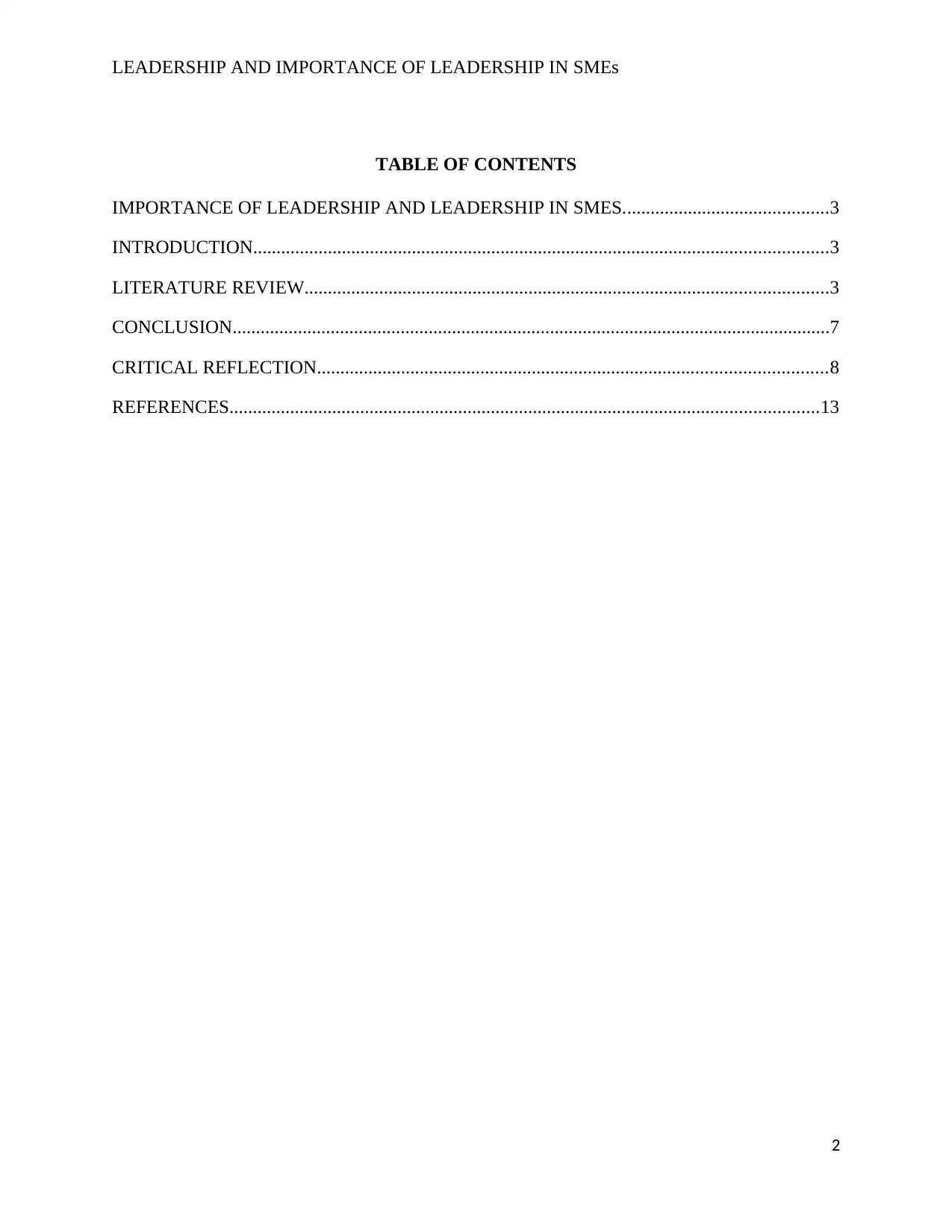
TABLE OF CONTENTS
IMPORTANCE OF LEADERSHIP AND LEADERSHIP IN SMES............................................3
INTRODUCTION...........................................................................................................................3
LITERATURE REVIEW................................................................................................................3
CONCLUSION................................................................................................................................7
CRITICAL REFLECTION.............................................................................................................8
REFERENCES..............................................................................................................................13
2
TABLE OF CONTENTS
IMPORTANCE OF LEADERSHIP AND LEADERSHIP IN SMES............................................3
INTRODUCTION...........................................................................................................................3
LITERATURE REVIEW................................................................................................................3
CONCLUSION................................................................................................................................7
CRITICAL REFLECTION.............................................................................................................8
REFERENCES..............................................................................................................................13
2
LEADERSHIP AND IMPORTANCE OF LEADERSHIP IN SMEs
IMPORTANCE OF LEADERSHIP AND LEADERSHIP IN SMES.
INTRODUCTION
Leadership is an important phenomenon which has been researched on very extensively by
scholars. Leadership is a very crucial aspect in an organization which influences how an
organization performs and its reputation to the society. This report will critically analyze the
concept of leadership in Small and medium-sized enterprises. The literature will emphasize the
leadership and importance of leadership in SMEs. It will also discuss the leadership styles which
have been used by different leaders in the small and medium-sized enterprises to ensure that they
perform well.
LITERATURE REVIEW
Over the years it has been difficult for researchers and scholars to define the term leadership.
Leadership can be defined according to the situation, the perspective of the researcher and the
phenomenon of their interest. Beck, Demirguc-Kunt and Levine(2005), stated that the definitions
of leadership are as many as the people who have tried to define the concept.One of the
definitions of leadership is that it is the process of influencing and facilitating the process of
knowledge implementation in an organization in a manner that will lead to the achievement of
set goals and objectives of the organization. It can also be defined as group processes,
compliance, personality, influences, power, persuasion, particular behaviors, goal achievement,
and interaction role differentiation (Baum, Locke and Kirkpatrick, 1998).
In establishing leadership, the significant difference occurs in identifying the source of influence
and the outcome of the impact, and this is what has made it difficult for researchers to come up
with a standard definition of the term. For instance, Burns (1978 p. 2) defined leadership as the
3
IMPORTANCE OF LEADERSHIP AND LEADERSHIP IN SMES.
INTRODUCTION
Leadership is an important phenomenon which has been researched on very extensively by
scholars. Leadership is a very crucial aspect in an organization which influences how an
organization performs and its reputation to the society. This report will critically analyze the
concept of leadership in Small and medium-sized enterprises. The literature will emphasize the
leadership and importance of leadership in SMEs. It will also discuss the leadership styles which
have been used by different leaders in the small and medium-sized enterprises to ensure that they
perform well.
LITERATURE REVIEW
Over the years it has been difficult for researchers and scholars to define the term leadership.
Leadership can be defined according to the situation, the perspective of the researcher and the
phenomenon of their interest. Beck, Demirguc-Kunt and Levine(2005), stated that the definitions
of leadership are as many as the people who have tried to define the concept.One of the
definitions of leadership is that it is the process of influencing and facilitating the process of
knowledge implementation in an organization in a manner that will lead to the achievement of
set goals and objectives of the organization. It can also be defined as group processes,
compliance, personality, influences, power, persuasion, particular behaviors, goal achievement,
and interaction role differentiation (Baum, Locke and Kirkpatrick, 1998).
In establishing leadership, the significant difference occurs in identifying the source of influence
and the outcome of the impact, and this is what has made it difficult for researchers to come up
with a standard definition of the term. For instance, Burns (1978 p. 2) defined leadership as the
3
⊘ This is a preview!⊘
Do you want full access?
Subscribe today to unlock all pages.

Trusted by 1+ million students worldwide
LEADERSHIP AND IMPORTANCE OF LEADERSHIP IN SMEs
manner in which a person behaves when he or she is directing the different activities towards a
particular set goal. Robbins (2001) on the other hand states that leadership is the ability to
influence other people towards a goal. It is also the “influence which one person gains
compliance from other people in the direction of the goals they desire.
Yukl(2002) defines leadership as a process of structuring, guiding, inspiring and facilitating
relationships and activities in a given organization.Armstrong is a great management scholar
who defined the term leadership as the process of getting things done through other people. He
emphasized that in leadership there must be set objectives which need to be achieved in a
specific period. It is all about encouraging and inspiring people to try their best in ensuring that
they achieve the firm's goals.
All organizations require leadership and the leaders have different roles, and they perform
different functions for an organization to achieve its goals. Leaders are different regarding their
leadership styles, talents, competence, knowledge skill, and training(Bouchard and Basso, 2011).
A good leader is effective and works towards achieving the goals and objectives of the
organization. SMEs need good leadership which can offer direction and strive to achieve the
visions, mission, and objectives of the organization(Bell andMjoli, 2014). Effective leadership is
crucial in the small and medium-sized organizations because it can recognize people’s abilities,
talents, knowledge, skills and attitudes efficiently and help the whole organization in
accomplishing the goals they set(Bass andAvolio,1994).
Leadership in SMEs has a direct relationship with the organization performance. This means that
good leadership will result to good performance while poor leadership will result in poor
performance (Bouchard and Basso, 2011). With this in mind, SMEs have begun to put much
emphasis on the need of having effective leadership in the organizations so that the organizations
4
manner in which a person behaves when he or she is directing the different activities towards a
particular set goal. Robbins (2001) on the other hand states that leadership is the ability to
influence other people towards a goal. It is also the “influence which one person gains
compliance from other people in the direction of the goals they desire.
Yukl(2002) defines leadership as a process of structuring, guiding, inspiring and facilitating
relationships and activities in a given organization.Armstrong is a great management scholar
who defined the term leadership as the process of getting things done through other people. He
emphasized that in leadership there must be set objectives which need to be achieved in a
specific period. It is all about encouraging and inspiring people to try their best in ensuring that
they achieve the firm's goals.
All organizations require leadership and the leaders have different roles, and they perform
different functions for an organization to achieve its goals. Leaders are different regarding their
leadership styles, talents, competence, knowledge skill, and training(Bouchard and Basso, 2011).
A good leader is effective and works towards achieving the goals and objectives of the
organization. SMEs need good leadership which can offer direction and strive to achieve the
visions, mission, and objectives of the organization(Bell andMjoli, 2014). Effective leadership is
crucial in the small and medium-sized organizations because it can recognize people’s abilities,
talents, knowledge, skills and attitudes efficiently and help the whole organization in
accomplishing the goals they set(Bass andAvolio,1994).
Leadership in SMEs has a direct relationship with the organization performance. This means that
good leadership will result to good performance while poor leadership will result in poor
performance (Bouchard and Basso, 2011). With this in mind, SMEs have begun to put much
emphasis on the need of having effective leadership in the organizations so that the organizations
4
Paraphrase This Document
Need a fresh take? Get an instant paraphrase of this document with our AI Paraphraser
LEADERSHIP AND IMPORTANCE OF LEADERSHIP IN SMEs
can be able to maintain profitability and growth through leaders who can rise above challenges.
With poor leadership, an SME will have a threat of failure and closure in the future because the
innovation, productivity, and profits would be adversely affected(Bass and Avolio,1994).
According to research, it is unfortunate that, leadership in small and medium sized organizations
has not been much emphasized, and there have not been many efforts to do an examination of the
leadership styles and the type of leaders which have been adopted by the SMEs…… Leadership
is essential, and there is increased knowledge about leadership in organizations, but there has not
been enough knowledge about leading small organizations effectively. Leadership in SMEs is,
therefore, a field of study that researchers have started to research on especially identifying the
leadership styles and the importance of leadership in the SMEs.
Henry, Hill and Leitch (2005),clearly states that leadership is a very key concept that greatly
contributes to the success of SMEs. According to him, good small and medium-sized enterprises
become great and more productive when they have level five leaders in their top management.
The outcome of the study showed that level 5 leaders could make SMEs great because such
leaders create enduring greatness through blending professional will and personal humility
Leadership in SMEs is viewed as a lifetime process Burns (1978) attempted to develop a good
leadership model and they were able to propose a model that allows a person to undergo some
testing and come out stronger and also to be well equipped with the required tools required for
learning and leading other people. According to their model, the competencies in leadership
depend on certain factors such as the ear experiences and the different individual factors or
value.
5
can be able to maintain profitability and growth through leaders who can rise above challenges.
With poor leadership, an SME will have a threat of failure and closure in the future because the
innovation, productivity, and profits would be adversely affected(Bass and Avolio,1994).
According to research, it is unfortunate that, leadership in small and medium sized organizations
has not been much emphasized, and there have not been many efforts to do an examination of the
leadership styles and the type of leaders which have been adopted by the SMEs…… Leadership
is essential, and there is increased knowledge about leadership in organizations, but there has not
been enough knowledge about leading small organizations effectively. Leadership in SMEs is,
therefore, a field of study that researchers have started to research on especially identifying the
leadership styles and the importance of leadership in the SMEs.
Henry, Hill and Leitch (2005),clearly states that leadership is a very key concept that greatly
contributes to the success of SMEs. According to him, good small and medium-sized enterprises
become great and more productive when they have level five leaders in their top management.
The outcome of the study showed that level 5 leaders could make SMEs great because such
leaders create enduring greatness through blending professional will and personal humility
Leadership in SMEs is viewed as a lifetime process Burns (1978) attempted to develop a good
leadership model and they were able to propose a model that allows a person to undergo some
testing and come out stronger and also to be well equipped with the required tools required for
learning and leading other people. According to their model, the competencies in leadership
depend on certain factors such as the ear experiences and the different individual factors or
value.
5
LEADERSHIP AND IMPORTANCE OF LEADERSHIP IN SMEs
Leadership in SMEs is not only viewed as a process, but it is also viewed regarding the
leadership styles which are applied by leaders to exercise their leadership roles. Recent studies
have attempted to examine the styles of effective leadership and they have done an in-depth
analysis of styles such as charismatic, transformational and transactional leadership styles which
are the most applicable techniques to SMEs. A study done by Chen (2004) showed that
transactional leadership in a small and medium sized SME could lead to organizational
commitment, performance and job satisfaction. The study also concluded that transformational
leadership in SMEs helps in improving the employee commitment. Other studies did earlier also
show that transactional and transformational leadership styles have a significant influence on the
production efficiency and job satisfaction to the employees (Bass, 1985; Medley and Larochelle,
1995; and Yammarino & Bass, 1990).
Additionally, there are studies which have been carried out to investigate how leadership can
motivate and influence employees especially in SMEs while others studies have researched on
the ability of leaders to cope with change in the SMEs. The studies result to four leadership
styles which are directly linked to the different stages of change which include; planning,
enabling, launching, catalyzing and maintaining. The phases of change are related to supportive,
inspirational, logical and commanding leadership styles.
In a study of small organizations by a scholar in Israel, it was found out that skills which are
people related are in most cases associated with the organization's performance across different
context. The general competencies of SME CEOs are indirectly related to growth especially
through the impact they have on the goals which the organization sets.For an SME its growth is
much dependent on the capabilities of the leaders, and this includes the control they have,
continuous improvement, market development and how innovative they are. The leaders are
6
Leadership in SMEs is not only viewed as a process, but it is also viewed regarding the
leadership styles which are applied by leaders to exercise their leadership roles. Recent studies
have attempted to examine the styles of effective leadership and they have done an in-depth
analysis of styles such as charismatic, transformational and transactional leadership styles which
are the most applicable techniques to SMEs. A study done by Chen (2004) showed that
transactional leadership in a small and medium sized SME could lead to organizational
commitment, performance and job satisfaction. The study also concluded that transformational
leadership in SMEs helps in improving the employee commitment. Other studies did earlier also
show that transactional and transformational leadership styles have a significant influence on the
production efficiency and job satisfaction to the employees (Bass, 1985; Medley and Larochelle,
1995; and Yammarino & Bass, 1990).
Additionally, there are studies which have been carried out to investigate how leadership can
motivate and influence employees especially in SMEs while others studies have researched on
the ability of leaders to cope with change in the SMEs. The studies result to four leadership
styles which are directly linked to the different stages of change which include; planning,
enabling, launching, catalyzing and maintaining. The phases of change are related to supportive,
inspirational, logical and commanding leadership styles.
In a study of small organizations by a scholar in Israel, it was found out that skills which are
people related are in most cases associated with the organization's performance across different
context. The general competencies of SME CEOs are indirectly related to growth especially
through the impact they have on the goals which the organization sets.For an SME its growth is
much dependent on the capabilities of the leaders, and this includes the control they have,
continuous improvement, market development and how innovative they are. The leaders are
6
⊘ This is a preview!⊘
Do you want full access?
Subscribe today to unlock all pages.
Trusted by 1+ million students worldwide
LEADERSHIP AND IMPORTANCE OF LEADERSHIP IN SMEs
expected to make investment decisions which will benefit the SMEs and result in profits and
ongoing growth.
Effective leadership is essential because it makes the SMEs competitive because the leaders can
develop a new set of directions and visions which will lead to competitiveness and sustenance to
their businesses. Bass (1985) proposed that leaders should be both transformational and
transactional, but it was noted that transformational leaders end up being more efficient and
productive as compared to the transactional leaders. Transformational leaders have the ability to
influence followers such that they can do what is expected of them and even perform beyond the
set expectations.
Leadership in SMEs is associated with positive outcomes in the organization. This can be proved
from research which was carried out by Ramachandran & Shah (1999) who suggested that the
different leadership constructs which include the transformational leadership, entrepreneurial
leadership, shared leadership and the leader-member exchange are the major characteristics of a
successful small and medium sized enterprises especially in the context of developing countries.
CONCLUSION
From the literature review on SMEs, it can be concluded that the importance of leadership in
SMEs is recognized mainly about coming up with a strategic outlook and the capacity to cope
with change when it occurs. The SME directors, therefore, need to combine both their leadership
and management roles and ensure that they delegate, as they free themselves from the daily
operational activities and focus on strategic concerns about the organization (Bell
andMjoli,2014).
7
expected to make investment decisions which will benefit the SMEs and result in profits and
ongoing growth.
Effective leadership is essential because it makes the SMEs competitive because the leaders can
develop a new set of directions and visions which will lead to competitiveness and sustenance to
their businesses. Bass (1985) proposed that leaders should be both transformational and
transactional, but it was noted that transformational leaders end up being more efficient and
productive as compared to the transactional leaders. Transformational leaders have the ability to
influence followers such that they can do what is expected of them and even perform beyond the
set expectations.
Leadership in SMEs is associated with positive outcomes in the organization. This can be proved
from research which was carried out by Ramachandran & Shah (1999) who suggested that the
different leadership constructs which include the transformational leadership, entrepreneurial
leadership, shared leadership and the leader-member exchange are the major characteristics of a
successful small and medium sized enterprises especially in the context of developing countries.
CONCLUSION
From the literature review on SMEs, it can be concluded that the importance of leadership in
SMEs is recognized mainly about coming up with a strategic outlook and the capacity to cope
with change when it occurs. The SME directors, therefore, need to combine both their leadership
and management roles and ensure that they delegate, as they free themselves from the daily
operational activities and focus on strategic concerns about the organization (Bell
andMjoli,2014).
7
Paraphrase This Document
Need a fresh take? Get an instant paraphrase of this document with our AI Paraphraser
LEADERSHIP AND IMPORTANCE OF LEADERSHIP IN SMEs
The key issue in SMEs leadership is that the leaders are not ready to hand over the operational
responsibilities and concentrate on the strategic or long-term issues about the organization. There
is, therefore, a great need for leadership development opportunities which are specifically
tailored for the SMEs, and it should also be inclusive of a variety of elements which need to be
selected according to the specific requirements of the organization.
The SMEs should ensure that there is further learning to the leaders so that they can improve
their delegation skills, time management, and teamwork. Well-informed leaders can direct the
SMEs well and help the organization to be competitive in the market through its efficiency and
effectiveness in achieving their goals and set objectives.
CRITICAL REFLECTION
The success of the business is depending over the effective leadership style of its
manager. Such kind of a manager able to guide its team members in the right direction and takes
the decisions in the favor of organization. With the help of the right leadership style of managers,
a company can able to attain its business objectives and other outcomes in more effective
manner. It has helped in establishing an effective organizational structure that has leaded the
relationship between employees and employer. Without this, it is not possible for the enterprises
to survive in the in tough competition. On the other hand, in order to achieve the sustainability in
the business, it becomes important for an organization to adopt the right management styles. It
develops a strong base for the firm to deal with external and internal environment issues. By
considering my experience in small business organization as a senior manager, I have learned
that a right leadership and management style as per the situation has ensured the success of a
firm. I have analyzed that these are two most important aspects and success factors of small
business enterprises.
8
The key issue in SMEs leadership is that the leaders are not ready to hand over the operational
responsibilities and concentrate on the strategic or long-term issues about the organization. There
is, therefore, a great need for leadership development opportunities which are specifically
tailored for the SMEs, and it should also be inclusive of a variety of elements which need to be
selected according to the specific requirements of the organization.
The SMEs should ensure that there is further learning to the leaders so that they can improve
their delegation skills, time management, and teamwork. Well-informed leaders can direct the
SMEs well and help the organization to be competitive in the market through its efficiency and
effectiveness in achieving their goals and set objectives.
CRITICAL REFLECTION
The success of the business is depending over the effective leadership style of its
manager. Such kind of a manager able to guide its team members in the right direction and takes
the decisions in the favor of organization. With the help of the right leadership style of managers,
a company can able to attain its business objectives and other outcomes in more effective
manner. It has helped in establishing an effective organizational structure that has leaded the
relationship between employees and employer. Without this, it is not possible for the enterprises
to survive in the in tough competition. On the other hand, in order to achieve the sustainability in
the business, it becomes important for an organization to adopt the right management styles. It
develops a strong base for the firm to deal with external and internal environment issues. By
considering my experience in small business organization as a senior manager, I have learned
that a right leadership and management style as per the situation has ensured the success of a
firm. I have analyzed that these are two most important aspects and success factors of small
business enterprises.
8
LEADERSHIP AND IMPORTANCE OF LEADERSHIP IN SMEs
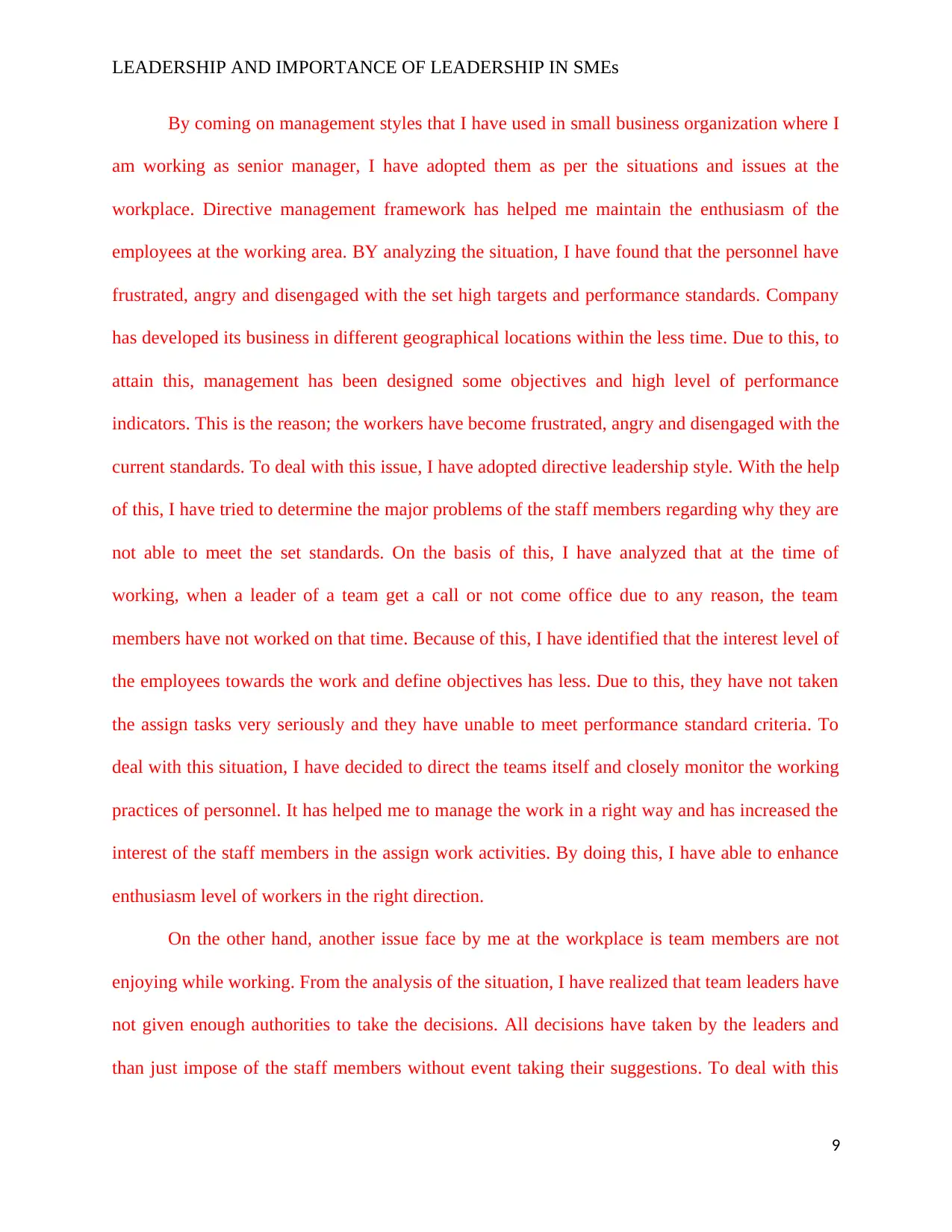
By coming on management styles that I have used in small business organization where I
am working as senior manager, I have adopted them as per the situations and issues at the
workplace. Directive management framework has helped me maintain the enthusiasm of the
employees at the working area. BY analyzing the situation, I have found that the personnel have
frustrated, angry and disengaged with the set high targets and performance standards. Company
has developed its business in different geographical locations within the less time. Due to this, to
attain this, management has been designed some objectives and high level of performance
indicators. This is the reason; the workers have become frustrated, angry and disengaged with the
current standards. To deal with this issue, I have adopted directive leadership style. With the help
of this, I have tried to determine the major problems of the staff members regarding why they are
not able to meet the set standards. On the basis of this, I have analyzed that at the time of
working, when a leader of a team get a call or not come office due to any reason, the team
members have not worked on that time. Because of this, I have identified that the interest level of
the employees towards the work and define objectives has less. Due to this, they have not taken
the assign tasks very seriously and they have unable to meet performance standard criteria. To
deal with this situation, I have decided to direct the teams itself and closely monitor the working
practices of personnel. It has helped me to manage the work in a right way and has increased the
interest of the staff members in the assign work activities. By doing this, I have able to enhance
enthusiasm level of workers in the right direction.
On the other hand, another issue face by me at the workplace is team members are not
enjoying while working. From the analysis of the situation, I have realized that team leaders have
not given enough authorities to take the decisions. All decisions have taken by the leaders and
than just impose of the staff members without event taking their suggestions. To deal with this
9
By coming on management styles that I have used in small business organization where I
am working as senior manager, I have adopted them as per the situations and issues at the
workplace. Directive management framework has helped me maintain the enthusiasm of the
employees at the working area. BY analyzing the situation, I have found that the personnel have
frustrated, angry and disengaged with the set high targets and performance standards. Company
has developed its business in different geographical locations within the less time. Due to this, to
attain this, management has been designed some objectives and high level of performance
indicators. This is the reason; the workers have become frustrated, angry and disengaged with the
current standards. To deal with this issue, I have adopted directive leadership style. With the help
of this, I have tried to determine the major problems of the staff members regarding why they are
not able to meet the set standards. On the basis of this, I have analyzed that at the time of
working, when a leader of a team get a call or not come office due to any reason, the team
members have not worked on that time. Because of this, I have identified that the interest level of
the employees towards the work and define objectives has less. Due to this, they have not taken
the assign tasks very seriously and they have unable to meet performance standard criteria. To
deal with this situation, I have decided to direct the teams itself and closely monitor the working
practices of personnel. It has helped me to manage the work in a right way and has increased the
interest of the staff members in the assign work activities. By doing this, I have able to enhance
enthusiasm level of workers in the right direction.
On the other hand, another issue face by me at the workplace is team members are not
enjoying while working. From the analysis of the situation, I have realized that team leaders have
not given enough authorities to take the decisions. All decisions have taken by the leaders and
than just impose of the staff members without event taking their suggestions. To deal with this
9
⊘ This is a preview!⊘
Do you want full access?
Subscribe today to unlock all pages.
Trusted by 1+ million students worldwide
LEADERSHIP AND IMPORTANCE OF LEADERSHIP IN SMEs
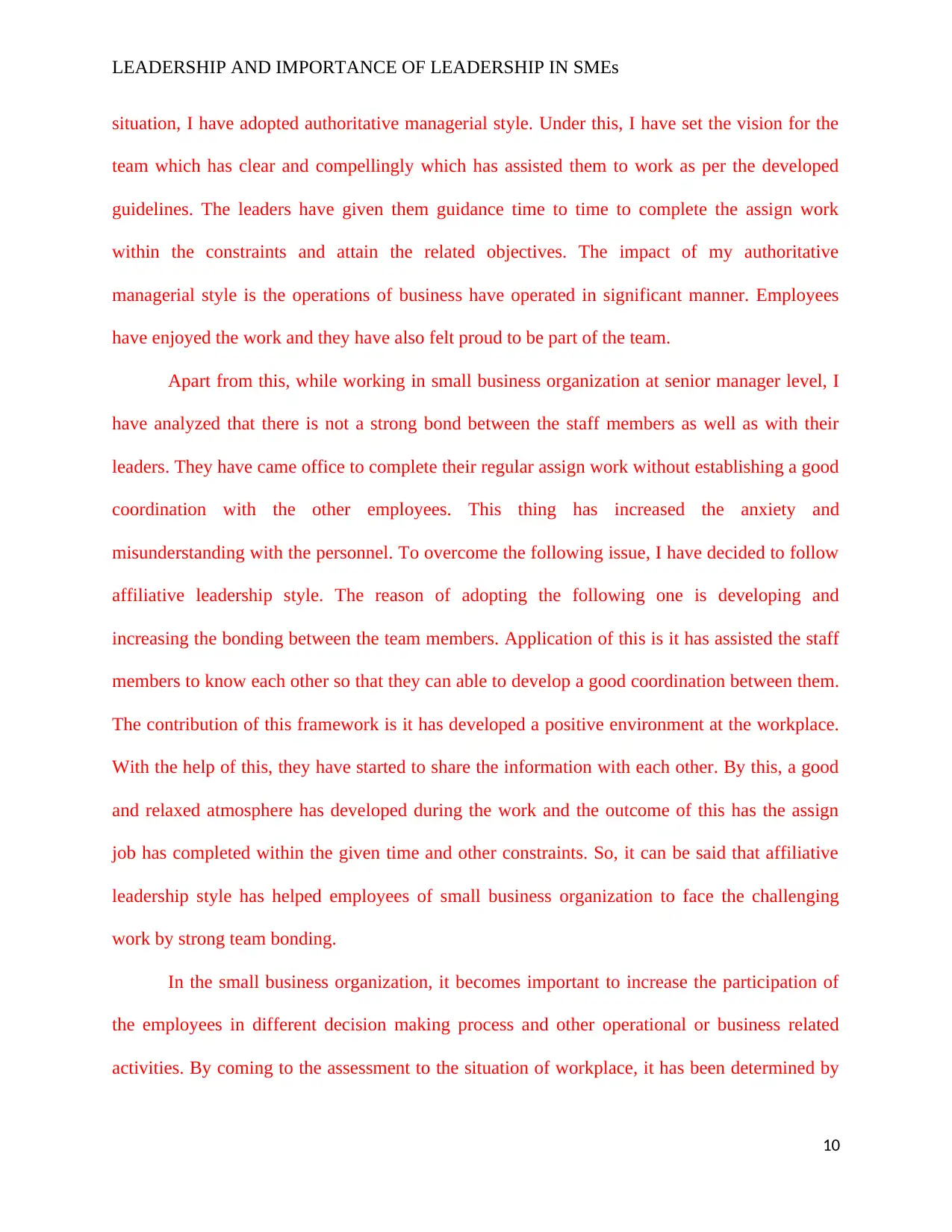
situation, I have adopted authoritative managerial style. Under this, I have set the vision for the
team which has clear and compellingly which has assisted them to work as per the developed
guidelines. The leaders have given them guidance time to time to complete the assign work
within the constraints and attain the related objectives. The impact of my authoritative
managerial style is the operations of business have operated in significant manner. Employees
have enjoyed the work and they have also felt proud to be part of the team.
Apart from this, while working in small business organization at senior manager level, I
have analyzed that there is not a strong bond between the staff members as well as with their
leaders. They have came office to complete their regular assign work without establishing a good
coordination with the other employees. This thing has increased the anxiety and
misunderstanding with the personnel. To overcome the following issue, I have decided to follow
affiliative leadership style. The reason of adopting the following one is developing and
increasing the bonding between the team members. Application of this is it has assisted the staff
members to know each other so that they can able to develop a good coordination between them.
The contribution of this framework is it has developed a positive environment at the workplace.
With the help of this, they have started to share the information with each other. By this, a good
and relaxed atmosphere has developed during the work and the outcome of this has the assign
job has completed within the given time and other constraints. So, it can be said that affiliative
leadership style has helped employees of small business organization to face the challenging
work by strong team bonding.
In the small business organization, it becomes important to increase the participation of
the employees in different decision making process and other operational or business related
activities. By coming to the assessment to the situation of workplace, it has been determined by
10
situation, I have adopted authoritative managerial style. Under this, I have set the vision for the
team which has clear and compellingly which has assisted them to work as per the developed
guidelines. The leaders have given them guidance time to time to complete the assign work
within the constraints and attain the related objectives. The impact of my authoritative
managerial style is the operations of business have operated in significant manner. Employees
have enjoyed the work and they have also felt proud to be part of the team.
Apart from this, while working in small business organization at senior manager level, I
have analyzed that there is not a strong bond between the staff members as well as with their
leaders. They have came office to complete their regular assign work without establishing a good
coordination with the other employees. This thing has increased the anxiety and
misunderstanding with the personnel. To overcome the following issue, I have decided to follow
affiliative leadership style. The reason of adopting the following one is developing and
increasing the bonding between the team members. Application of this is it has assisted the staff
members to know each other so that they can able to develop a good coordination between them.
The contribution of this framework is it has developed a positive environment at the workplace.
With the help of this, they have started to share the information with each other. By this, a good
and relaxed atmosphere has developed during the work and the outcome of this has the assign
job has completed within the given time and other constraints. So, it can be said that affiliative
leadership style has helped employees of small business organization to face the challenging
work by strong team bonding.
In the small business organization, it becomes important to increase the participation of
the employees in different decision making process and other operational or business related
activities. By coming to the assessment to the situation of workplace, it has been determined by
10
Paraphrase This Document
Need a fresh take? Get an instant paraphrase of this document with our AI Paraphraser
LEADERSHIP AND IMPORTANCE OF LEADERSHIP IN SMEs
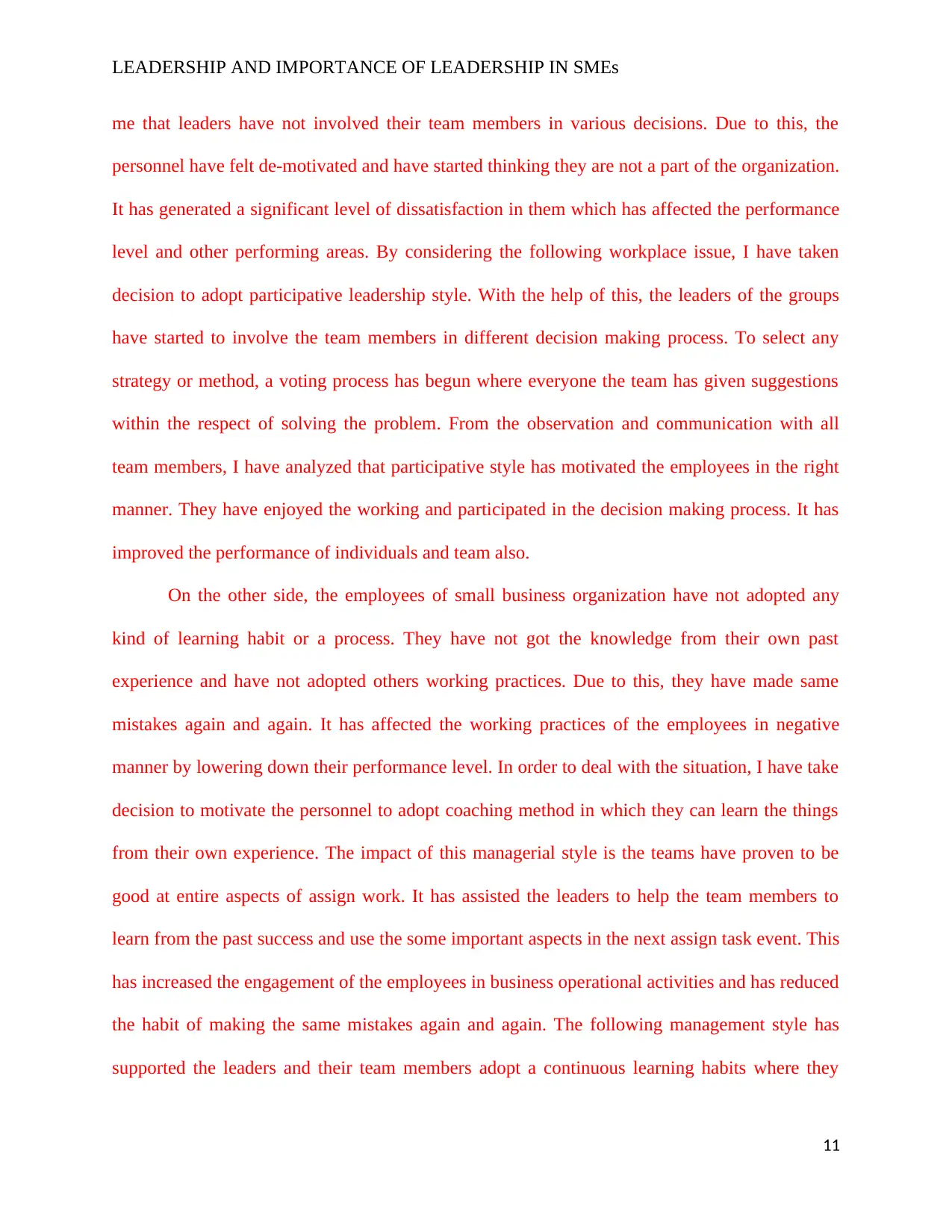
me that leaders have not involved their team members in various decisions. Due to this, the
personnel have felt de-motivated and have started thinking they are not a part of the organization.
It has generated a significant level of dissatisfaction in them which has affected the performance
level and other performing areas. By considering the following workplace issue, I have taken
decision to adopt participative leadership style. With the help of this, the leaders of the groups
have started to involve the team members in different decision making process. To select any
strategy or method, a voting process has begun where everyone the team has given suggestions
within the respect of solving the problem. From the observation and communication with all
team members, I have analyzed that participative style has motivated the employees in the right
manner. They have enjoyed the working and participated in the decision making process. It has
improved the performance of individuals and team also.
On the other side, the employees of small business organization have not adopted any
kind of learning habit or a process. They have not got the knowledge from their own past
experience and have not adopted others working practices. Due to this, they have made same
mistakes again and again. It has affected the working practices of the employees in negative
manner by lowering down their performance level. In order to deal with the situation, I have take
decision to motivate the personnel to adopt coaching method in which they can learn the things
from their own experience. The impact of this managerial style is the teams have proven to be
good at entire aspects of assign work. It has assisted the leaders to help the team members to
learn from the past success and use the some important aspects in the next assign task event. This
has increased the engagement of the employees in business operational activities and has reduced
the habit of making the same mistakes again and again. The following management style has
supported the leaders and their team members adopt a continuous learning habits where they
11
me that leaders have not involved their team members in various decisions. Due to this, the
personnel have felt de-motivated and have started thinking they are not a part of the organization.
It has generated a significant level of dissatisfaction in them which has affected the performance
level and other performing areas. By considering the following workplace issue, I have taken
decision to adopt participative leadership style. With the help of this, the leaders of the groups
have started to involve the team members in different decision making process. To select any
strategy or method, a voting process has begun where everyone the team has given suggestions
within the respect of solving the problem. From the observation and communication with all
team members, I have analyzed that participative style has motivated the employees in the right
manner. They have enjoyed the working and participated in the decision making process. It has
improved the performance of individuals and team also.
On the other side, the employees of small business organization have not adopted any
kind of learning habit or a process. They have not got the knowledge from their own past
experience and have not adopted others working practices. Due to this, they have made same
mistakes again and again. It has affected the working practices of the employees in negative
manner by lowering down their performance level. In order to deal with the situation, I have take
decision to motivate the personnel to adopt coaching method in which they can learn the things
from their own experience. The impact of this managerial style is the teams have proven to be
good at entire aspects of assign work. It has assisted the leaders to help the team members to
learn from the past success and use the some important aspects in the next assign task event. This
has increased the engagement of the employees in business operational activities and has reduced
the habit of making the same mistakes again and again. The following management style has
supported the leaders and their team members adopt a continuous learning habits where they
11
LEADERSHIP AND IMPORTANCE OF LEADERSHIP IN SMEs
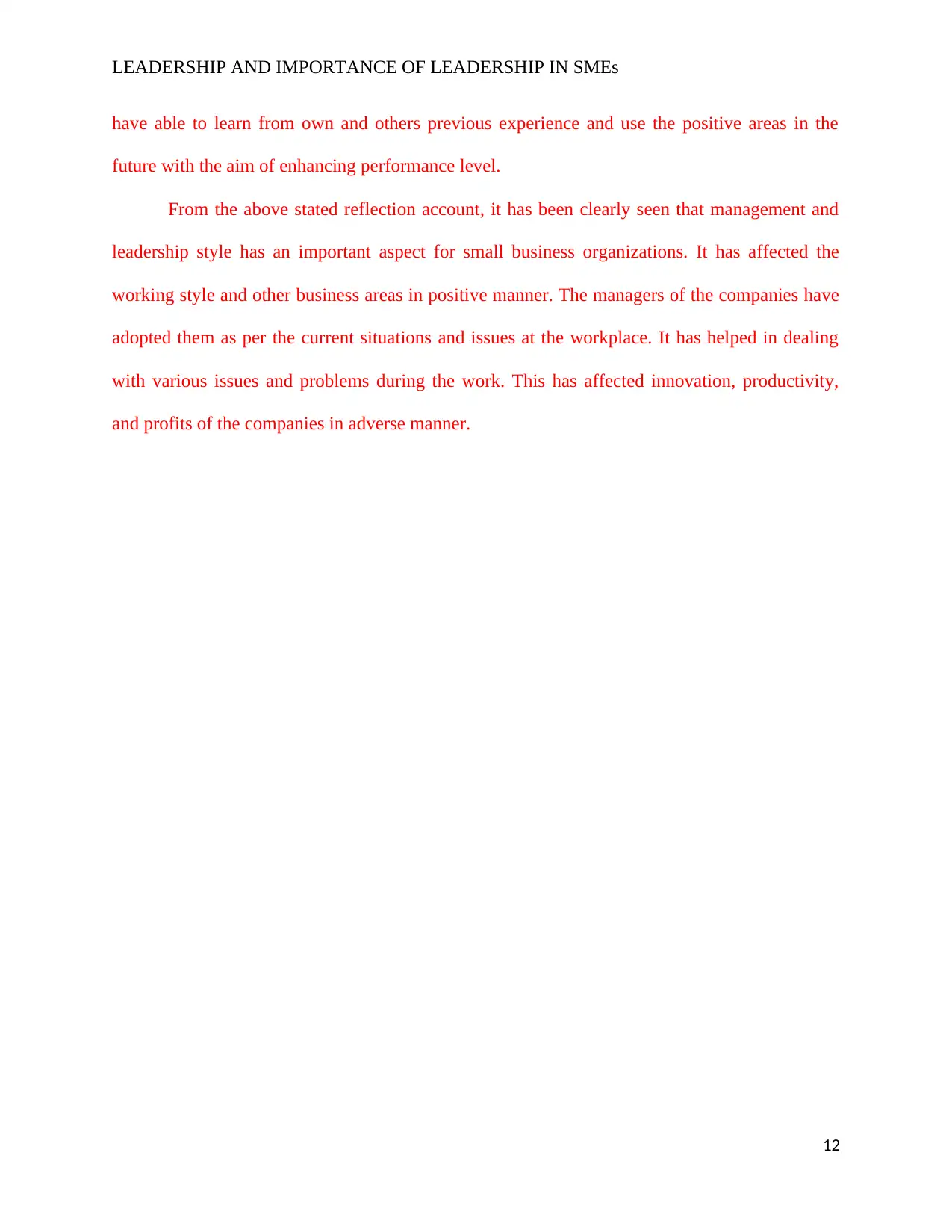
have able to learn from own and others previous experience and use the positive areas in the
future with the aim of enhancing performance level.
From the above stated reflection account, it has been clearly seen that management and
leadership style has an important aspect for small business organizations. It has affected the
working style and other business areas in positive manner. The managers of the companies have
adopted them as per the current situations and issues at the workplace. It has helped in dealing
with various issues and problems during the work. This has affected innovation, productivity,
and profits of the companies in adverse manner.
12
have able to learn from own and others previous experience and use the positive areas in the
future with the aim of enhancing performance level.
From the above stated reflection account, it has been clearly seen that management and
leadership style has an important aspect for small business organizations. It has affected the
working style and other business areas in positive manner. The managers of the companies have
adopted them as per the current situations and issues at the workplace. It has helped in dealing
with various issues and problems during the work. This has affected innovation, productivity,
and profits of the companies in adverse manner.
12
⊘ This is a preview!⊘
Do you want full access?
Subscribe today to unlock all pages.
Trusted by 1+ million students worldwide

1 out of 14


Related Documents


Your All-in-One AI-Powered Toolkit for Academic Success.
+13062052269
info@desklib.com
Available 24*7 on WhatsApp / Email
![[object Object]](/_next/static/media/star-bottom.7253800d.svg)
Unlock your academic potential
Copyright © 2020–2026 A2Z Services. All Rights Reserved. Developed and managed by ZUCOL.