Leadership in an Organization: A Detailed Bibliography Review

Verified

Added on  2022/10/19

|6
|1170
|52
Report
AI Summary
This report provides a comprehensive bibliography on the concept of leadership within organizations. It references key academic sources that define leadership as the ability to influence others and motivate employees. The report explores various leadership styles, including transformational, transactional, servant, and entrepreneurial leadership, and their impact on organizational change, employee motivation, and the development of learning organizations. It also highlights the importance of emotional intelligence and the application of leadership principles in diverse sectors like education and medicine. The bibliography includes sources that discuss the multifaceted nature of leadership, emphasizing the importance of both managerial skills and the ability to foster a community working towards common goals. The report concludes by underscoring the need for leadership skills that are adapted to the specific requirements of different industries and organizational contexts.
Document Page
Running head: BIBILIOGRAPHY ON LEADERSHIP
Leadership in an Organization
Name of the Student
Name of the University
Author note
tabler-icon-diamond-filled.svg

Paraphrase This Document

Need a fresh take? Get an instant paraphrase of this document with our AI Paraphraser
Document Page
1Leadership in an Organization
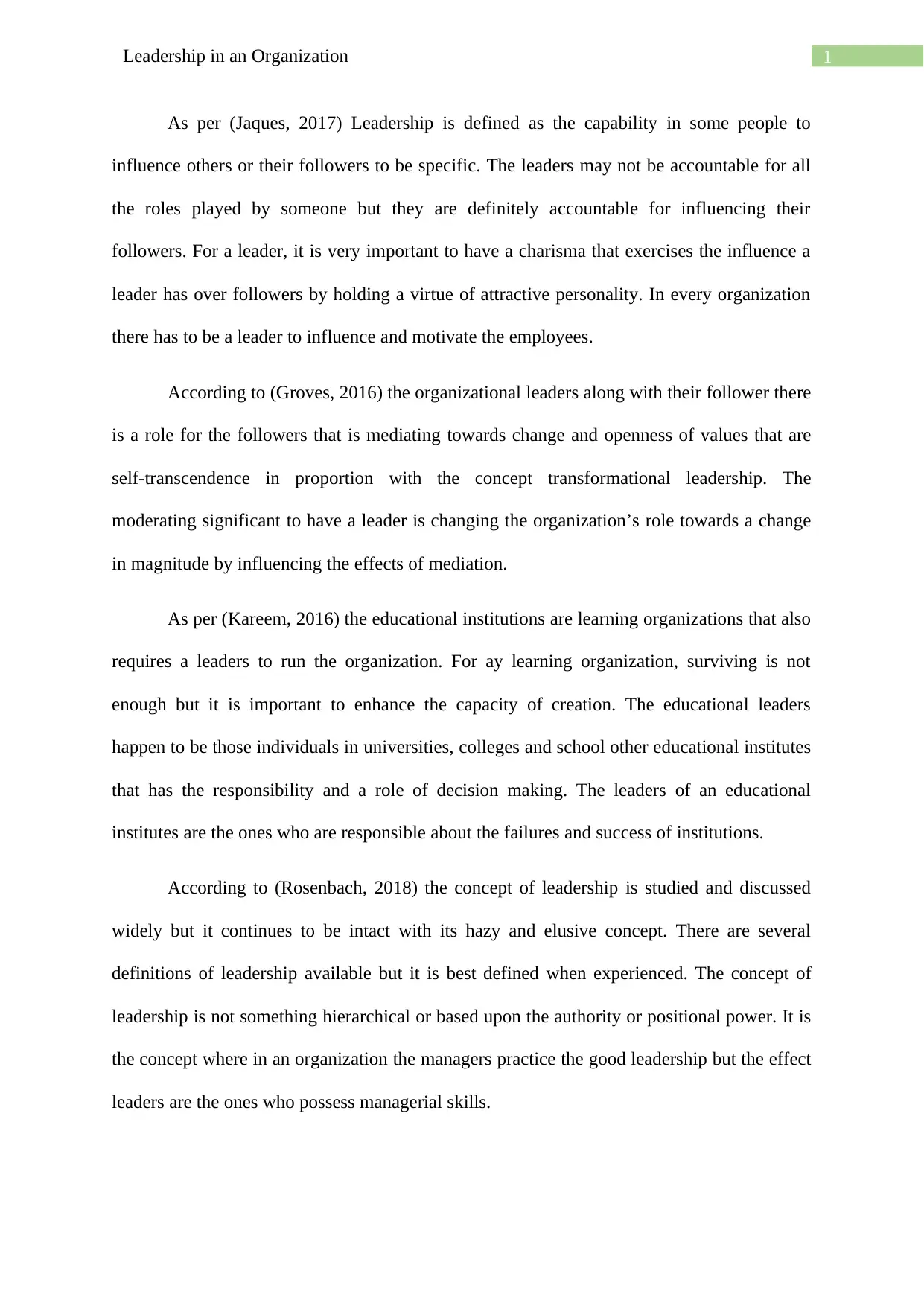
As per (Jaques, 2017) Leadership is defined as the capability in some people to
influence others or their followers to be specific. The leaders may not be accountable for all
the roles played by someone but they are definitely accountable for influencing their
followers. For a leader, it is very important to have a charisma that exercises the influence a
leader has over followers by holding a virtue of attractive personality. In every organization
there has to be a leader to influence and motivate the employees.
According to (Groves, 2016) the organizational leaders along with their follower there
is a role for the followers that is mediating towards change and openness of values that are
self-transcendence in proportion with the concept transformational leadership. The
moderating significant to have a leader is changing the organization’s role towards a change
in magnitude by influencing the effects of mediation.
As per (Kareem, 2016) the educational institutions are learning organizations that also
requires a leaders to run the organization. For ay learning organization, surviving is not
enough but it is important to enhance the capacity of creation. The educational leaders
happen to be those individuals in universities, colleges and school other educational institutes
that has the responsibility and a role of decision making. The leaders of an educational
institutes are the ones who are responsible about the failures and success of institutions.
According to (Rosenbach, 2018) the concept of leadership is studied and discussed
widely but it continues to be intact with its hazy and elusive concept. There are several
definitions of leadership available but it is best defined when experienced. The concept of
leadership is not something hierarchical or based upon the authority or positional power. It is
the concept where in an organization the managers practice the good leadership but the effect
leaders are the ones who possess managerial skills.
Document Page
2Leadership in an Organization
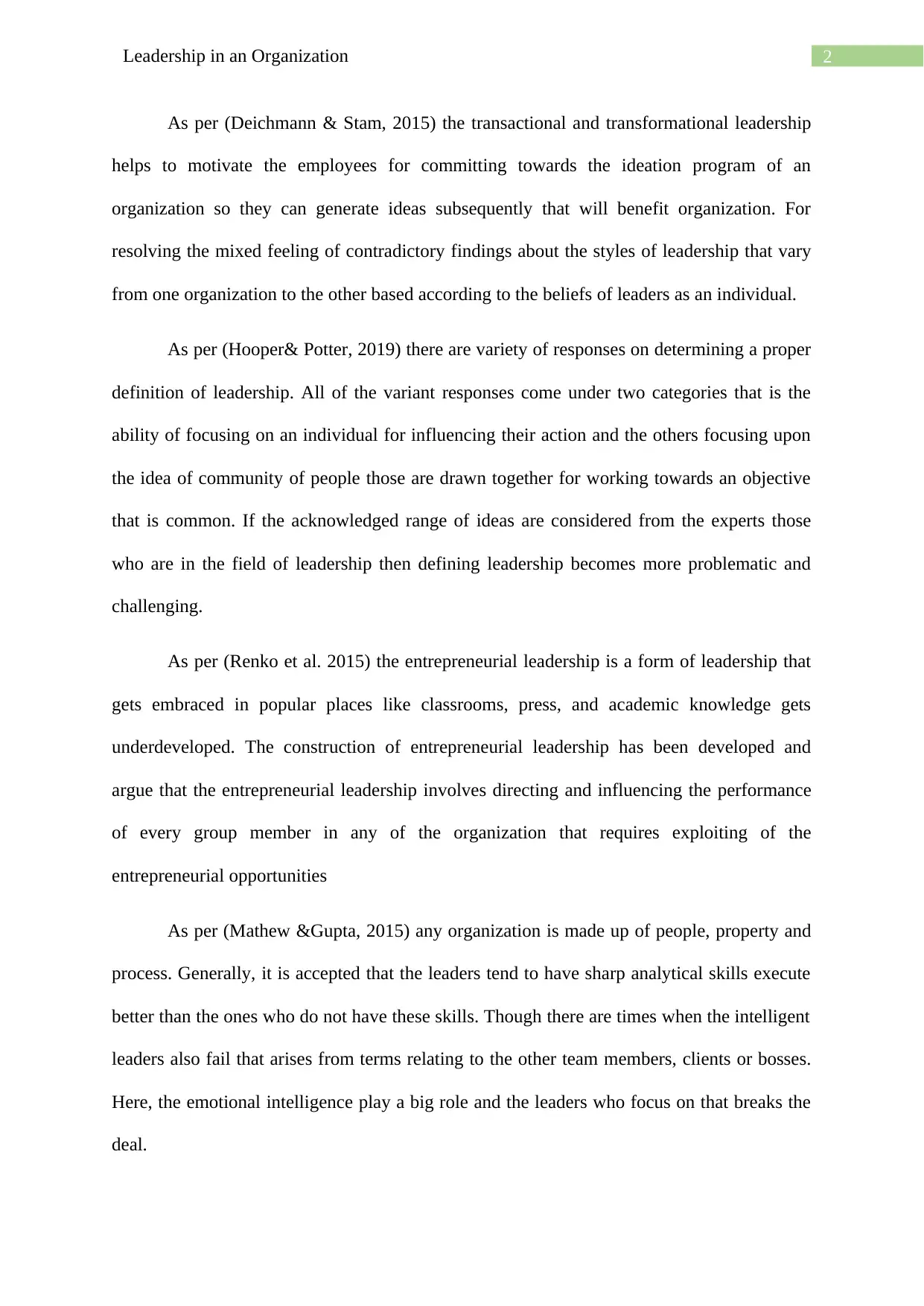
As per (Deichmann & Stam, 2015) the transactional and transformational leadership
helps to motivate the employees for committing towards the ideation program of an
organization so they can generate ideas subsequently that will benefit organization. For
resolving the mixed feeling of contradictory findings about the styles of leadership that vary
from one organization to the other based according to the beliefs of leaders as an individual.
As per (Hooper& Potter, 2019) there are variety of responses on determining a proper
definition of leadership. All of the variant responses come under two categories that is the
ability of focusing on an individual for influencing their action and the others focusing upon
the idea of community of people those are drawn together for working towards an objective
that is common. If the acknowledged range of ideas are considered from the experts those
who are in the field of leadership then defining leadership becomes more problematic and
challenging.
As per (Renko et al. 2015) the entrepreneurial leadership is a form of leadership that
gets embraced in popular places like classrooms, press, and academic knowledge gets
underdeveloped. The construction of entrepreneurial leadership has been developed and
argue that the entrepreneurial leadership involves directing and influencing the performance
of every group member in any of the organization that requires exploiting of the
entrepreneurial opportunities
As per (Mathew &Gupta, 2015) any organization is made up of people, property and
process. Generally, it is accepted that the leaders tend to have sharp analytical skills execute
better than the ones who do not have these skills. Though there are times when the intelligent
leaders also fail that arises from terms relating to the other team members, clients or bosses.
Here, the emotional intelligence play a big role and the leaders who focus on that breaks the
deal.
Document Page
3Leadership in an Organization
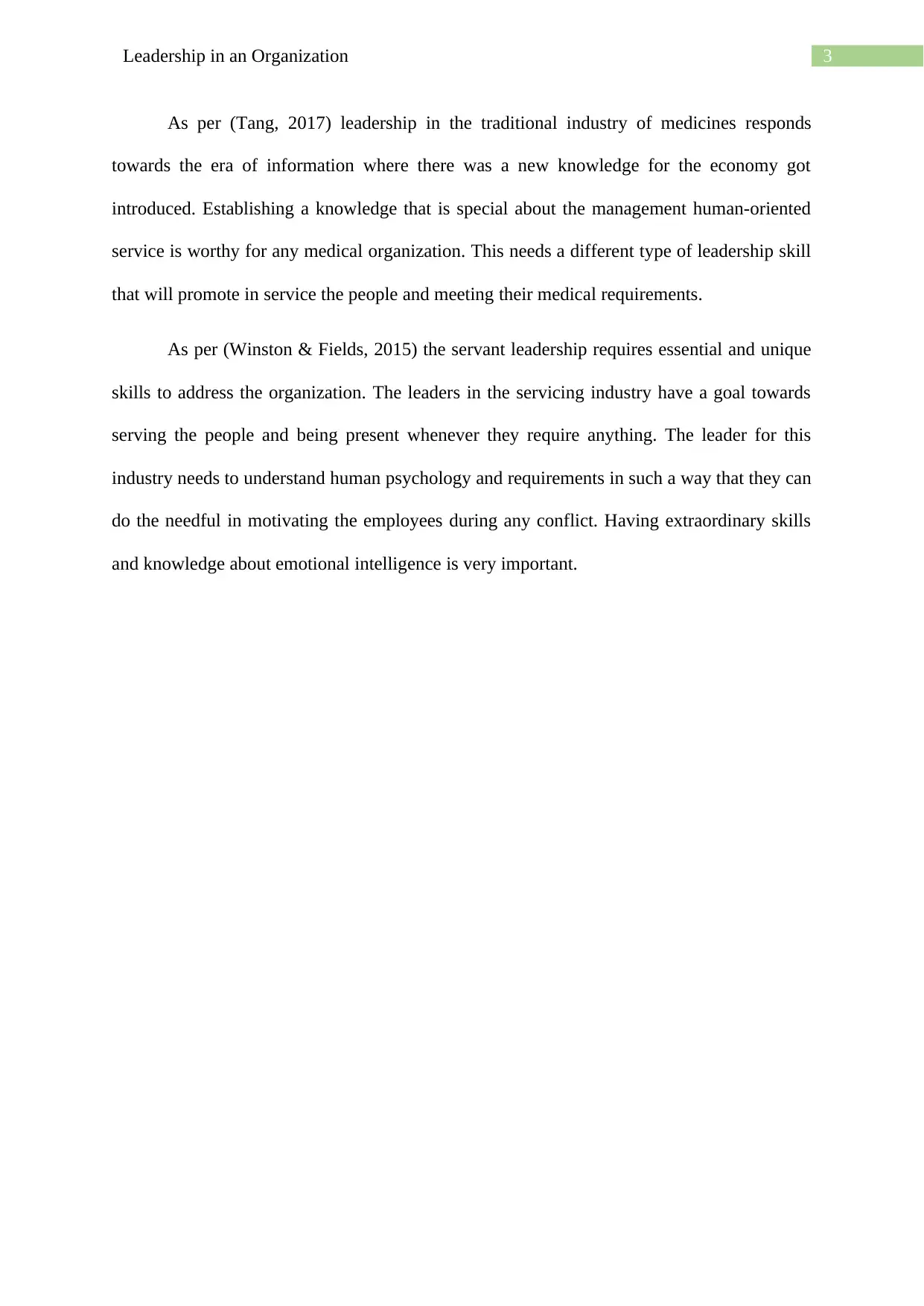
As per (Tang, 2017) leadership in the traditional industry of medicines responds
towards the era of information where there was a new knowledge for the economy got
introduced. Establishing a knowledge that is special about the management human-oriented
service is worthy for any medical organization. This needs a different type of leadership skill
that will promote in service the people and meeting their medical requirements.
As per (Winston & Fields, 2015) the servant leadership requires essential and unique
skills to address the organization. The leaders in the servicing industry have a goal towards
serving the people and being present whenever they require anything. The leader for this
industry needs to understand human psychology and requirements in such a way that they can
do the needful in motivating the employees during any conflict. Having extraordinary skills
and knowledge about emotional intelligence is very important.
tabler-icon-diamond-filled.svg

Paraphrase This Document

Need a fresh take? Get an instant paraphrase of this document with our AI Paraphraser
Document Page
4Leadership in an Organization
References
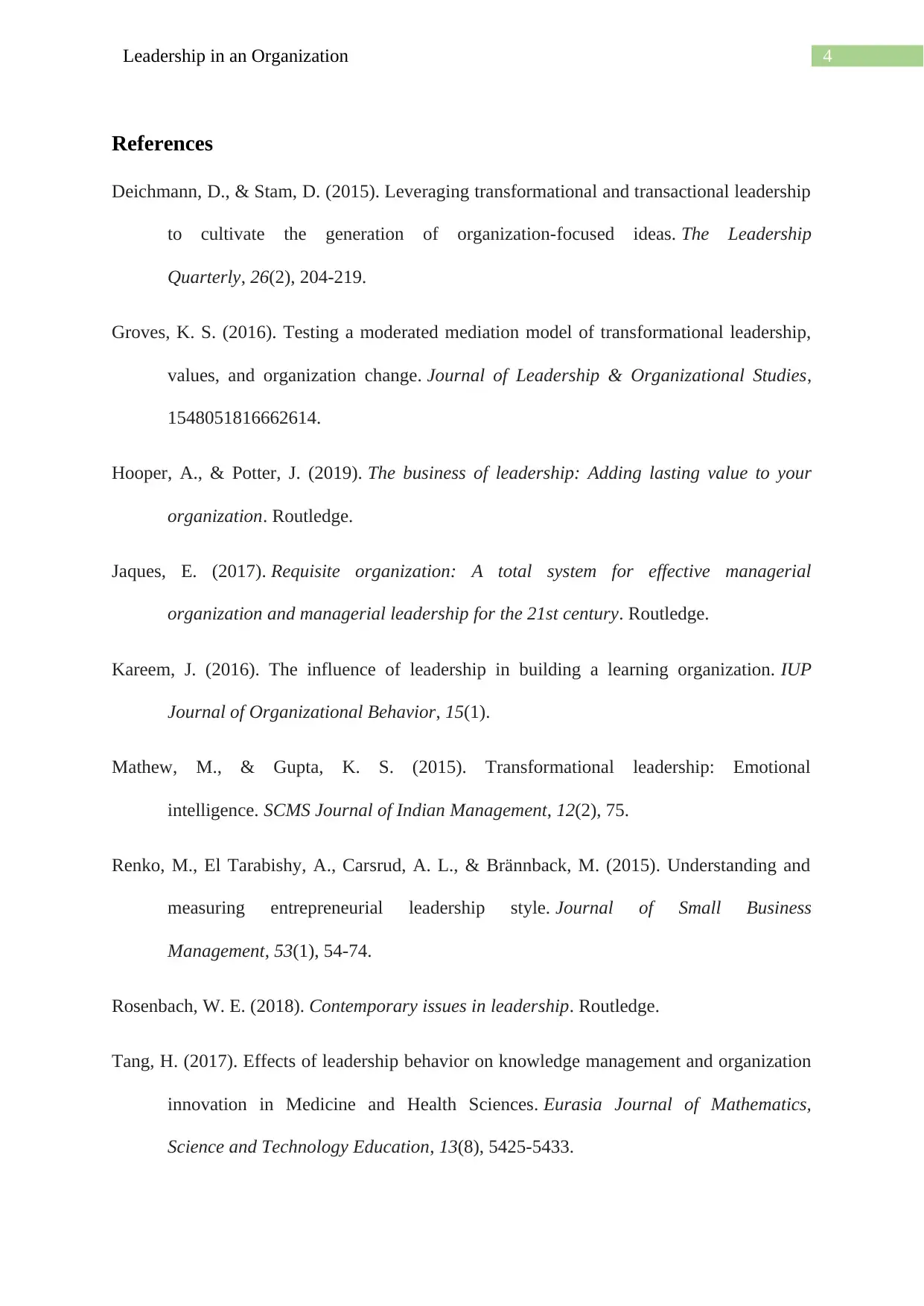
Deichmann, D., & Stam, D. (2015). Leveraging transformational and transactional leadership
to cultivate the generation of organization-focused ideas. The Leadership
Quarterly, 26(2), 204-219.
Groves, K. S. (2016). Testing a moderated mediation model of transformational leadership,
values, and organization change. Journal of Leadership & Organizational Studies,
1548051816662614.
Hooper, A., & Potter, J. (2019). The business of leadership: Adding lasting value to your
organization. Routledge.
Jaques, E. (2017). Requisite organization: A total system for effective managerial
organization and managerial leadership for the 21st century. Routledge.
Kareem, J. (2016). The influence of leadership in building a learning organization. IUP
Journal of Organizational Behavior, 15(1).
Mathew, M., & Gupta, K. S. (2015). Transformational leadership: Emotional
intelligence. SCMS Journal of Indian Management, 12(2), 75.
Renko, M., El Tarabishy, A., Carsrud, A. L., & Brännback, M. (2015). Understanding and
measuring entrepreneurial leadership style. Journal of Small Business
Management, 53(1), 54-74.
Rosenbach, W. E. (2018). Contemporary issues in leadership. Routledge.
Tang, H. (2017). Effects of leadership behavior on knowledge management and organization
innovation in Medicine and Health Sciences. Eurasia Journal of Mathematics,
Science and Technology Education, 13(8), 5425-5433.
Document Page
5Leadership in an Organization
Winston, B., & Fields, D. (2015). Seeking and measuring the essential behaviors of servant
leadership. Leadership & Organization Development Journal, 36(4), 413-434.
chevron_up_icon
1 out of 6
circle_padding
hide_on_mobile
zoom_out_icon
[object Object]