Comprehensive Report: Analyzing Inequality in Organizations
VerifiedAdded on 2023/06/06
|10
|2845
|186
Report
AI Summary
This report provides a comprehensive analysis of inequality in organizations, focusing on gender and income disparities. It summarizes three articles that explore various aspects of inequality, including its causes, consequences, and potential solutions. The first article discusses the general understanding of inequity, highlighting issues such as wage distribution and employment dissatisfaction. The second article examines gender disparity in C-suite positions, drawing on interviews with male and female CEOs to identify challenges women face in reaching top leadership roles. The third article investigates how changes in employment practices reshape rewards and contribute to inequality within organizations. The analysis section critically evaluates each article, comparing their methodologies, theoretical frameworks, and findings. The report concludes with recommendations for organizations to address inequality, such as promoting equal opportunities, improving communication, and implementing fair human resources policies. Ultimately, the report emphasizes the importance of creating a more equitable and inclusive workplace.
Organizational Behavior

Paraphrase This Document
Need a fresh take? Get an instant paraphrase of this document with our AI Paraphraser
INEQUALITY 1
Introduction
In the twenty first century, Inequality is the major issue faced by employees in the
organisations. Inequality refers the unequal treatment with the individual on the basis of
gender or relation with the employee (Bapuji, 2015). Gender, and income inequality has
become the major issues in the organisation. Inequality in the organisation leads to weak
relation of employees with the employers. In this paper the discussion will be made on
“Inequality in organisation”. Inequality increases the unemployment in the economy and it
affects the productivity of the company due to decrease in the efficiency of employees
(Freeman, 2016). The report is based on the three articles which are on inequality of gender
and income. In the first phase of this report, articles are summarised and after that critical
analysis will be done. In the context of inequality, the recommendations will also be provided
in the last phase of the report.
Summary
Article 1: Toward an understanding of inequity
The first article is written by Admas, J. with the name of “Toward an understanding
of inequity”. The article is focuses on “Inequality in the organisation”. According to the
authors, there are many problems raised due inequality raise in the organisation. Distribution
of wages is the first major issue according to this article which increases the problem of
employment dissatisfaction (Durkheim, 2018). Inequality at the time of no work situation is
the second phenomena that affect the employee’s relation with the employers that raises the
conflicts. The article talks about Homans theory; a person who feels inequality with others is
always dissatisfied with the employer’s decision. But Frestinger theory said that the wrong
thought encourage the person to find many ways to reduce the imbalance (O'rand, 2018).
Introduction
In the twenty first century, Inequality is the major issue faced by employees in the
organisations. Inequality refers the unequal treatment with the individual on the basis of
gender or relation with the employee (Bapuji, 2015). Gender, and income inequality has
become the major issues in the organisation. Inequality in the organisation leads to weak
relation of employees with the employers. In this paper the discussion will be made on
“Inequality in organisation”. Inequality increases the unemployment in the economy and it
affects the productivity of the company due to decrease in the efficiency of employees
(Freeman, 2016). The report is based on the three articles which are on inequality of gender
and income. In the first phase of this report, articles are summarised and after that critical
analysis will be done. In the context of inequality, the recommendations will also be provided
in the last phase of the report.
Summary
Article 1: Toward an understanding of inequity
The first article is written by Admas, J. with the name of “Toward an understanding
of inequity”. The article is focuses on “Inequality in the organisation”. According to the
authors, there are many problems raised due inequality raise in the organisation. Distribution
of wages is the first major issue according to this article which increases the problem of
employment dissatisfaction (Durkheim, 2018). Inequality at the time of no work situation is
the second phenomena that affect the employee’s relation with the employers that raises the
conflicts. The article talks about Homans theory; a person who feels inequality with others is
always dissatisfied with the employer’s decision. But Frestinger theory said that the wrong
thought encourage the person to find many ways to reduce the imbalance (O'rand, 2018).
INEQUALITY 2
This article provides the theoretical structure which defines the different ways of occurrence
of inequality. The authors have also discussed how inequality can be reduced. This article is
divided into four theories such as annual growth rate, second is increasing researchers, and
third is inequality in salary and wages and the last theory is modified in parts (Admas, 1963).
Article 2: Gender disparity in the C-suite: Do male and Female CEOs differ in how they
reached the top?
In the second article, the authors took examples of organisations to define the
inequality in gender in the workplace. The gender inequality is explained by Fitzsimmons,
W., Callan, V., Paulsen, N. with the name “Gender disparity in the C-suite: Do male and
female CEOs differ in how they reached the top?” The authors took thirty males and thirty
female CEOs of the large organisations and interviewed them in order to explain the gender
disparity in the organisation. In this article, authors have defined many reasons for inequality
within the organizations. First reason which is used by authors to explain the difference in
gender is early life experience. It states the difference between male and female from their
birth to working in an organisation. Authors have proved that early life experience plays an
important role in developing leadership qualities in an individual. The second reason
explained by authors is “Acquire career capital” and the last reason is culture of an
individual. In this article, different methods are applied to research the causes of inequality
with the appropriate logics. The article summarises that women face a lot of challenges in
reaching to the top of an organization due to gender inequality (Fitzsimmons, Callan,
Paulsen, 2013).
Article 3: The employment relationship and inequality: How and why changes in
Employment Practices and reshaping rewards in organisations
This article provides the theoretical structure which defines the different ways of occurrence
of inequality. The authors have also discussed how inequality can be reduced. This article is
divided into four theories such as annual growth rate, second is increasing researchers, and
third is inequality in salary and wages and the last theory is modified in parts (Admas, 1963).
Article 2: Gender disparity in the C-suite: Do male and Female CEOs differ in how they
reached the top?
In the second article, the authors took examples of organisations to define the
inequality in gender in the workplace. The gender inequality is explained by Fitzsimmons,
W., Callan, V., Paulsen, N. with the name “Gender disparity in the C-suite: Do male and
female CEOs differ in how they reached the top?” The authors took thirty males and thirty
female CEOs of the large organisations and interviewed them in order to explain the gender
disparity in the organisation. In this article, authors have defined many reasons for inequality
within the organizations. First reason which is used by authors to explain the difference in
gender is early life experience. It states the difference between male and female from their
birth to working in an organisation. Authors have proved that early life experience plays an
important role in developing leadership qualities in an individual. The second reason
explained by authors is “Acquire career capital” and the last reason is culture of an
individual. In this article, different methods are applied to research the causes of inequality
with the appropriate logics. The article summarises that women face a lot of challenges in
reaching to the top of an organization due to gender inequality (Fitzsimmons, Callan,
Paulsen, 2013).
Article 3: The employment relationship and inequality: How and why changes in
Employment Practices and reshaping rewards in organisations
⊘ This is a preview!⊘
Do you want full access?
Subscribe today to unlock all pages.

Trusted by 1+ million students worldwide
INEQUALITY 3
The third article is with the name of “employment relationship and inequality: how
and why changes in employment practices are reshaping rewards in organisation” which is
written by Bidwell, M., Briscoe, F., Mateo, I. and Sterling, A. The article focuses on the
causes and consequence of inequality. The authors defined that the changes affected the
inequality. It explains the changes which affect the inequality that is distribution of rewards
within the organisation. The second is distribution of rewards at the macro level that is
distributed among the stakeholders. In the end of the article, the author explains the areas
which are required by an organisation to work on. The article is written on the basis of past,
present and future which tell that from where this inequality came, what has changed and
what will be in the future. The authors found different causes where they also explained about
the changes in the workplace that affect the inequality. Such as new rights affects the
employment relationship, sorting into contingent work and others. The author’s main focus is
on the causes of inequality in an organisation (Bidwell, Briscoe, Mateo, and Sterling, 2013).
Analysis
Article 1: Toward an understanding of inequity
In the First article author describes the conditions under which inequity rises and
reduces. This article is based on research on the many areas like rights and justice of an
employee. According to author, there are many reasons of inequality in which the first reason
define by the author is employment dissatisfaction. The second article is focused mainly on
inequity due to gender disparity but the first article talks about many reasons of inequity. The
second and third article is based on the US employment and Australian employment.
According to the author, the external factors affect the inequality in organisation like social
relationship in the non-working situations. Author has applied Homans theory to find the
The third article is with the name of “employment relationship and inequality: how
and why changes in employment practices are reshaping rewards in organisation” which is
written by Bidwell, M., Briscoe, F., Mateo, I. and Sterling, A. The article focuses on the
causes and consequence of inequality. The authors defined that the changes affected the
inequality. It explains the changes which affect the inequality that is distribution of rewards
within the organisation. The second is distribution of rewards at the macro level that is
distributed among the stakeholders. In the end of the article, the author explains the areas
which are required by an organisation to work on. The article is written on the basis of past,
present and future which tell that from where this inequality came, what has changed and
what will be in the future. The authors found different causes where they also explained about
the changes in the workplace that affect the inequality. Such as new rights affects the
employment relationship, sorting into contingent work and others. The author’s main focus is
on the causes of inequality in an organisation (Bidwell, Briscoe, Mateo, and Sterling, 2013).
Analysis
Article 1: Toward an understanding of inequity
In the First article author describes the conditions under which inequity rises and
reduces. This article is based on research on the many areas like rights and justice of an
employee. According to author, there are many reasons of inequality in which the first reason
define by the author is employment dissatisfaction. The second article is focused mainly on
inequity due to gender disparity but the first article talks about many reasons of inequity. The
second and third article is based on the US employment and Australian employment.
According to the author, the external factors affect the inequality in organisation like social
relationship in the non-working situations. Author has applied Homans theory to find the
Paraphrase This Document
Need a fresh take? Get an instant paraphrase of this document with our AI Paraphraser
INEQUALITY 4
reasons of inequality which describes the human behaviour. The author also uses the
Festinger theory which describes the thoughts of an individual which encourages him/her to
do things in several ways. In this article, authors used the theories to find the reasons but the
third article did not apply any theory. First article is highly dependent on the qualitative
theory as same as the second article. The third article uses statistics to explain the statements;
it includes quantitative analysis as well unlike first and second article. This article provides
the theoretical structure which defines the reasons of inequality. It also defines the different
modes that reduce the inequality. In this article, 170 different researcher views are taken to
analyse the topic of inequality. The original theory is tested under the consequence and which
is modified in different parts. This article did not use the pictures and graphs like the second
article. Authors could have presented their ideas in a better way if they could have used
diagrams or tables (Schmidt, Burroughs, Zoido, & Houang, 2015).
Article 2: Gender disparity in the C-suite: Do male and Female CEOs differ in how they
reached the top?
The second article is on Gender disparity; this article states the challenges which are
faced by women to attain the CEO level position. In this article, authors discussed about the
challenges which are faced by women from their births till working in organisation.
According the authors, Women live in an environment which affects their personality from
their birth. It has been seen that the article has limited scope because the authors only
mentioned the challenges faced by women for CEO position. The authors conducted the
research on 30 male and 30 female CEOs of large organisation of Australia. Thus, it can be
said that the research is conducted at the limited boundaries which contain the limited
content. Authors have not talked about small organizations. Also, they have considered
specific types of organizations. They have not considered CEOs from government or non for
profit organizations. This certainly affects the future scope of the research. In this article,
reasons of inequality which describes the human behaviour. The author also uses the
Festinger theory which describes the thoughts of an individual which encourages him/her to
do things in several ways. In this article, authors used the theories to find the reasons but the
third article did not apply any theory. First article is highly dependent on the qualitative
theory as same as the second article. The third article uses statistics to explain the statements;
it includes quantitative analysis as well unlike first and second article. This article provides
the theoretical structure which defines the reasons of inequality. It also defines the different
modes that reduce the inequality. In this article, 170 different researcher views are taken to
analyse the topic of inequality. The original theory is tested under the consequence and which
is modified in different parts. This article did not use the pictures and graphs like the second
article. Authors could have presented their ideas in a better way if they could have used
diagrams or tables (Schmidt, Burroughs, Zoido, & Houang, 2015).
Article 2: Gender disparity in the C-suite: Do male and Female CEOs differ in how they
reached the top?
The second article is on Gender disparity; this article states the challenges which are
faced by women to attain the CEO level position. In this article, authors discussed about the
challenges which are faced by women from their births till working in organisation.
According the authors, Women live in an environment which affects their personality from
their birth. It has been seen that the article has limited scope because the authors only
mentioned the challenges faced by women for CEO position. The authors conducted the
research on 30 male and 30 female CEOs of large organisation of Australia. Thus, it can be
said that the research is conducted at the limited boundaries which contain the limited
content. Authors have not talked about small organizations. Also, they have considered
specific types of organizations. They have not considered CEOs from government or non for
profit organizations. This certainly affects the future scope of the research. In this article,
INEQUALITY 5
diagrams and pictures are used to explain the causes and timing of gender disparity in CEO
roles (Nicolson, 2015). This makes the article easily understandable for readers unlike the
first article. Although the article contains the qualitative and quantity research but it is mainly
dependent on qualitative research only. The research is conducted on the basis of Bourdieu’s
conceptual framework on the big organisations. The analysis has been done on the big
organisation which is not enough to find the right result because small organisations also
appoint CEO (Lutter, 2015). According to the authors, the CEO is selected on the decision
taken by the board of director and generally this decision is biased. Male Board of Directors
prefers Male CEOs; is one outcome of the article (Fitzsimmons, Callan, Paulsen, 2013).
Article 3: The employment relationship and inequality: How and why changes in
Employment Practices and reshaping rewards in organisations
The previous article was mainly about the gender inequality but this article conduct
the research on the many factors of inequality such as rewards, payments, social relations and
others. The authors conducted the research on the US employment relationships. According
to the authors, US adopt the open system of employment where external factors affect the
employment. Earlier, the country followed the closed system where internal factors were
being considered while giving employment (Denk, 2015). Change in employment
relationship affects the distribution of rewards, payments and benefit. The changes affect the
distribution of income to employees; it creates an inequality within the organisation
(Abraham, 2017). The authors discussed inequality among workers and the different
stakeholders of firm. The authors have explained the changes in employment relationship
such as what has changed and reason of the change. This article explains the inequality in
many areas but second article is based in gender inequality in position. This article conducts
the research on the US employment but the second article is based mainly on Australia
employment (Bidwell, Briscoe, Mateo, and Sterling, 2013).
diagrams and pictures are used to explain the causes and timing of gender disparity in CEO
roles (Nicolson, 2015). This makes the article easily understandable for readers unlike the
first article. Although the article contains the qualitative and quantity research but it is mainly
dependent on qualitative research only. The research is conducted on the basis of Bourdieu’s
conceptual framework on the big organisations. The analysis has been done on the big
organisation which is not enough to find the right result because small organisations also
appoint CEO (Lutter, 2015). According to the authors, the CEO is selected on the decision
taken by the board of director and generally this decision is biased. Male Board of Directors
prefers Male CEOs; is one outcome of the article (Fitzsimmons, Callan, Paulsen, 2013).
Article 3: The employment relationship and inequality: How and why changes in
Employment Practices and reshaping rewards in organisations
The previous article was mainly about the gender inequality but this article conduct
the research on the many factors of inequality such as rewards, payments, social relations and
others. The authors conducted the research on the US employment relationships. According
to the authors, US adopt the open system of employment where external factors affect the
employment. Earlier, the country followed the closed system where internal factors were
being considered while giving employment (Denk, 2015). Change in employment
relationship affects the distribution of rewards, payments and benefit. The changes affect the
distribution of income to employees; it creates an inequality within the organisation
(Abraham, 2017). The authors discussed inequality among workers and the different
stakeholders of firm. The authors have explained the changes in employment relationship
such as what has changed and reason of the change. This article explains the inequality in
many areas but second article is based in gender inequality in position. This article conducts
the research on the US employment but the second article is based mainly on Australia
employment (Bidwell, Briscoe, Mateo, and Sterling, 2013).
⊘ This is a preview!⊘
Do you want full access?
Subscribe today to unlock all pages.
Trusted by 1+ million students worldwide
INEQUALITY 6
Recommendations
Inequality is a serious concern for every organization and it needs to be resolved. The
organization should take care of the partiality. It is the responsibility of the manager to
maintain their personal relation with the employees outside the workplace. The organizations
have to maintain the percentage of women vacancy too (Entwisle, 2018). The companies
should maintain equal seats for women and it should maintain the equal responsibility of
women as compare to the men. This will certainly lead to less disparity. Communication is
the source to reduce the inequality in the organisation. By organising conferences and
meetings; the misunderstandings for the employers is reduced. The managers have to build
the relationship with the employee so that they can easily discuss their issues. The managers
have to recruit the employees without any biasness. It can be said that by adopting
appropriate human resources policies; inequality will be reduced in an organisation. The
managers should allocate the authorities and responsibilities to women employees so that
their personality is developed (Stainback, Kleiner, & Skaggs, 2016). This will further lead to
less gender discrimination.
To remove the payment inequality, an organisation has to appoint the experts and pay
fairly to an employee (Tumin, 2018). It has been seen that the organisations provide the
incentive to the people for extra efforts or extra work hour to male employees (Lewis,
Benschop, & Simpson, 2017). Thus, it becomes the responsibility of an organisation to take
care about these things and provide an opportunity to women employees so that the women
can also take the benefits and rewards (Hacker, 2017). It is observed that the civil rights
affect the employee’s relation and raise the inequality. The government has the responsibility
to give the equal rights to all the employees.
Recommendations
Inequality is a serious concern for every organization and it needs to be resolved. The
organization should take care of the partiality. It is the responsibility of the manager to
maintain their personal relation with the employees outside the workplace. The organizations
have to maintain the percentage of women vacancy too (Entwisle, 2018). The companies
should maintain equal seats for women and it should maintain the equal responsibility of
women as compare to the men. This will certainly lead to less disparity. Communication is
the source to reduce the inequality in the organisation. By organising conferences and
meetings; the misunderstandings for the employers is reduced. The managers have to build
the relationship with the employee so that they can easily discuss their issues. The managers
have to recruit the employees without any biasness. It can be said that by adopting
appropriate human resources policies; inequality will be reduced in an organisation. The
managers should allocate the authorities and responsibilities to women employees so that
their personality is developed (Stainback, Kleiner, & Skaggs, 2016). This will further lead to
less gender discrimination.
To remove the payment inequality, an organisation has to appoint the experts and pay
fairly to an employee (Tumin, 2018). It has been seen that the organisations provide the
incentive to the people for extra efforts or extra work hour to male employees (Lewis,
Benschop, & Simpson, 2017). Thus, it becomes the responsibility of an organisation to take
care about these things and provide an opportunity to women employees so that the women
can also take the benefits and rewards (Hacker, 2017). It is observed that the civil rights
affect the employee’s relation and raise the inequality. The government has the responsibility
to give the equal rights to all the employees.
Paraphrase This Document
Need a fresh take? Get an instant paraphrase of this document with our AI Paraphraser
INEQUALITY 7
Conclusion
From the above analysis, it has been concluded that the articles focused on the topic
of inequality, its reasons and its impact. All three articles focused on inequality but in
different areas. It has been seen that the topic is briefly defined in all the three articles by
applying the theories. The first article is focused on the consequences of rising and reducing
the inequalities in the workplace. The second article defined the challenges which are faced
by women in reaching to CEO position in an organisation. The third article talked about
inequality in US employment and their rewards and payments. All three articles have same
topic but with the different content, the second article mainly focused on gender inequality
but the third article focused on inequality in different areas. It has been seen that there are
many differences in the articles; different authors have different point of views. Overall, they
all have discussed the same issue of inequality and have provided suggestions as well.
Conclusion
From the above analysis, it has been concluded that the articles focused on the topic
of inequality, its reasons and its impact. All three articles focused on inequality but in
different areas. It has been seen that the topic is briefly defined in all the three articles by
applying the theories. The first article is focused on the consequences of rising and reducing
the inequalities in the workplace. The second article defined the challenges which are faced
by women in reaching to CEO position in an organisation. The third article talked about
inequality in US employment and their rewards and payments. All three articles have same
topic but with the different content, the second article mainly focused on gender inequality
but the third article focused on inequality in different areas. It has been seen that there are
many differences in the articles; different authors have different point of views. Overall, they
all have discussed the same issue of inequality and have provided suggestions as well.
INEQUALITY 8
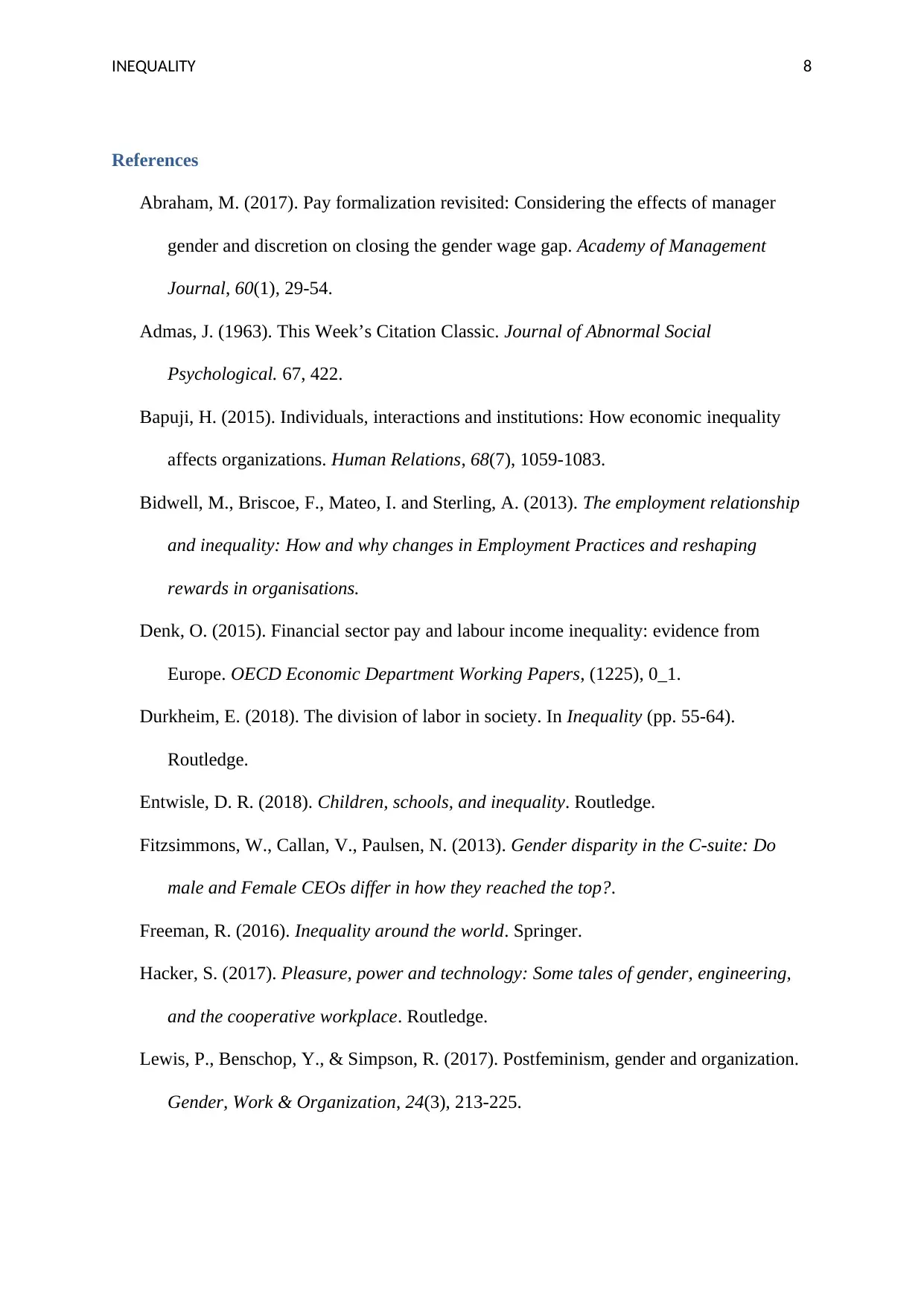
References
Abraham, M. (2017). Pay formalization revisited: Considering the effects of manager
gender and discretion on closing the gender wage gap. Academy of Management
Journal, 60(1), 29-54.
Admas, J. (1963). This Week’s Citation Classic. Journal of Abnormal Social
Psychological. 67, 422.
Bapuji, H. (2015). Individuals, interactions and institutions: How economic inequality
affects organizations. Human Relations, 68(7), 1059-1083.
Bidwell, M., Briscoe, F., Mateo, I. and Sterling, A. (2013). The employment relationship
and inequality: How and why changes in Employment Practices and reshaping
rewards in organisations.
Denk, O. (2015). Financial sector pay and labour income inequality: evidence from
Europe. OECD Economic Department Working Papers, (1225), 0_1.
Durkheim, E. (2018). The division of labor in society. In Inequality (pp. 55-64).
Routledge.
Entwisle, D. R. (2018). Children, schools, and inequality. Routledge.
Fitzsimmons, W., Callan, V., Paulsen, N. (2013). Gender disparity in the C-suite: Do
male and Female CEOs differ in how they reached the top?.
Freeman, R. (2016). Inequality around the world. Springer.
Hacker, S. (2017). Pleasure, power and technology: Some tales of gender, engineering,
and the cooperative workplace. Routledge.
Lewis, P., Benschop, Y., & Simpson, R. (2017). Postfeminism, gender and organization.
Gender, Work & Organization, 24(3), 213-225.
References
Abraham, M. (2017). Pay formalization revisited: Considering the effects of manager
gender and discretion on closing the gender wage gap. Academy of Management
Journal, 60(1), 29-54.
Admas, J. (1963). This Week’s Citation Classic. Journal of Abnormal Social
Psychological. 67, 422.
Bapuji, H. (2015). Individuals, interactions and institutions: How economic inequality
affects organizations. Human Relations, 68(7), 1059-1083.
Bidwell, M., Briscoe, F., Mateo, I. and Sterling, A. (2013). The employment relationship
and inequality: How and why changes in Employment Practices and reshaping
rewards in organisations.
Denk, O. (2015). Financial sector pay and labour income inequality: evidence from
Europe. OECD Economic Department Working Papers, (1225), 0_1.
Durkheim, E. (2018). The division of labor in society. In Inequality (pp. 55-64).
Routledge.
Entwisle, D. R. (2018). Children, schools, and inequality. Routledge.
Fitzsimmons, W., Callan, V., Paulsen, N. (2013). Gender disparity in the C-suite: Do
male and Female CEOs differ in how they reached the top?.
Freeman, R. (2016). Inequality around the world. Springer.
Hacker, S. (2017). Pleasure, power and technology: Some tales of gender, engineering,
and the cooperative workplace. Routledge.
Lewis, P., Benschop, Y., & Simpson, R. (2017). Postfeminism, gender and organization.
Gender, Work & Organization, 24(3), 213-225.
⊘ This is a preview!⊘
Do you want full access?
Subscribe today to unlock all pages.
Trusted by 1+ million students worldwide
INEQUALITY 9
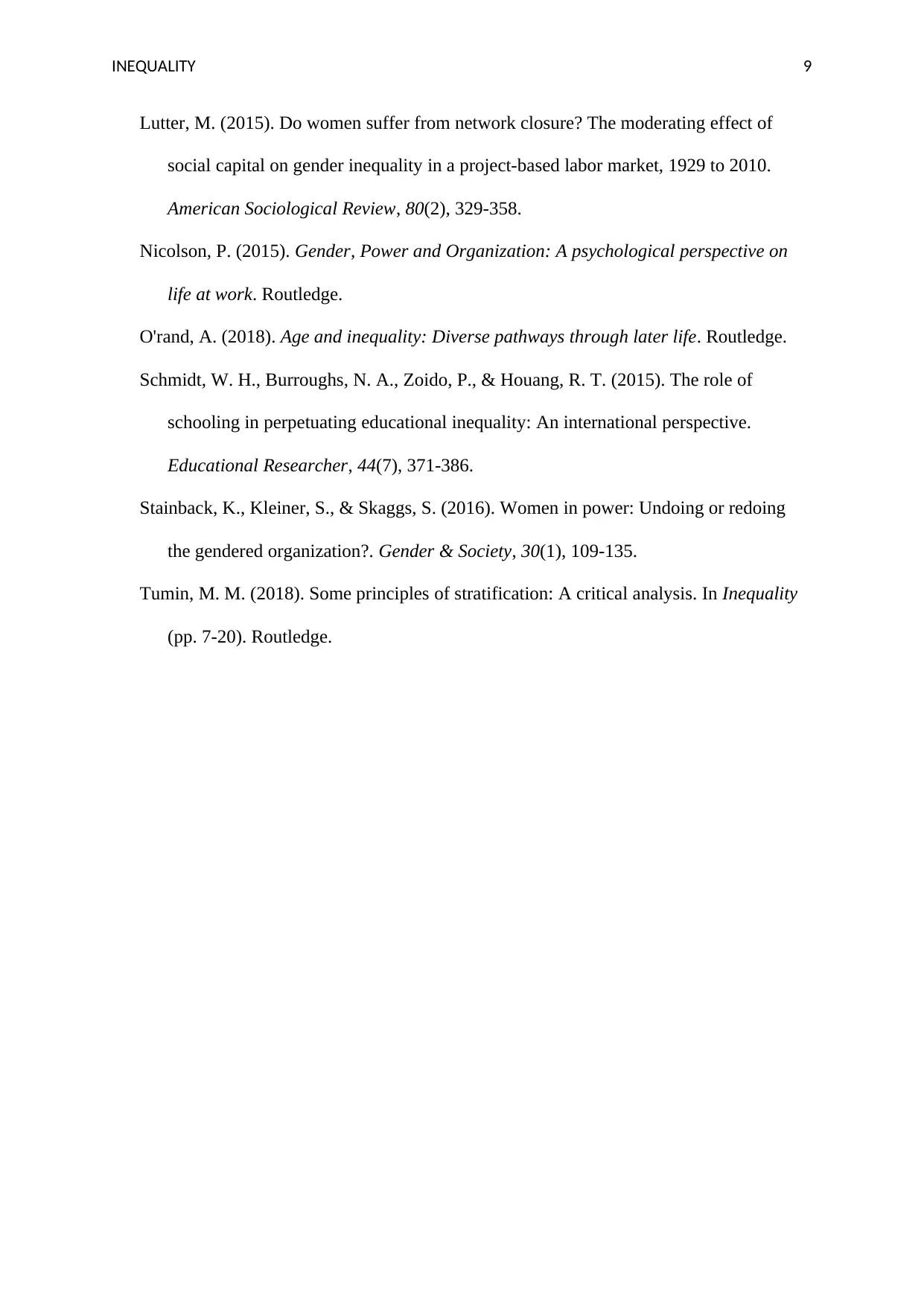
Lutter, M. (2015). Do women suffer from network closure? The moderating effect of
social capital on gender inequality in a project-based labor market, 1929 to 2010.
American Sociological Review, 80(2), 329-358.
Nicolson, P. (2015). Gender, Power and Organization: A psychological perspective on
life at work. Routledge.
O'rand, A. (2018). Age and inequality: Diverse pathways through later life. Routledge.
Schmidt, W. H., Burroughs, N. A., Zoido, P., & Houang, R. T. (2015). The role of
schooling in perpetuating educational inequality: An international perspective.
Educational Researcher, 44(7), 371-386.
Stainback, K., Kleiner, S., & Skaggs, S. (2016). Women in power: Undoing or redoing
the gendered organization?. Gender & Society, 30(1), 109-135.
Tumin, M. M. (2018). Some principles of stratification: A critical analysis. In Inequality
(pp. 7-20). Routledge.
Lutter, M. (2015). Do women suffer from network closure? The moderating effect of
social capital on gender inequality in a project-based labor market, 1929 to 2010.
American Sociological Review, 80(2), 329-358.
Nicolson, P. (2015). Gender, Power and Organization: A psychological perspective on
life at work. Routledge.
O'rand, A. (2018). Age and inequality: Diverse pathways through later life. Routledge.
Schmidt, W. H., Burroughs, N. A., Zoido, P., & Houang, R. T. (2015). The role of
schooling in perpetuating educational inequality: An international perspective.
Educational Researcher, 44(7), 371-386.
Stainback, K., Kleiner, S., & Skaggs, S. (2016). Women in power: Undoing or redoing
the gendered organization?. Gender & Society, 30(1), 109-135.
Tumin, M. M. (2018). Some principles of stratification: A critical analysis. In Inequality
(pp. 7-20). Routledge.

1 out of 10


Related Documents


Your All-in-One AI-Powered Toolkit for Academic Success.
+13062052269
info@desklib.com
Available 24*7 on WhatsApp / Email
![[object Object]](/_next/static/media/star-bottom.7253800d.svg)
Unlock your academic potential
Copyright © 2020–2025 A2Z Services. All Rights Reserved. Developed and managed by ZUCOL.