Impact of Leadership Styles on Integrity Violations in HRM (Police)
VerifiedAdded on 2022/11/24
|7
|1618
|191
Essay
AI Summary
This essay analyzes the impact of leadership styles – strictness, role modeling, and openness – on integrity violations within a police force. It discusses the importance of integrity in organizations, highlighting how violations can lead to reputational and financial damage. The essay explores the roles of managers, arguing for the need for approachability and openness while acknowledging the potential downsides of excessive openness. It examines the effects of different leadership qualities, such as setting good examples, being strict, and fostering openness, on various types of integrity violations. The research finds that strictness can lead to external corruption, while role modeling and openness are more effective. The essay concludes that a balanced approach to leadership is essential for promoting ethical behavior and preventing misconduct within the organization.

Running Head: ETHICS 0
HRM
HRM
Paraphrase This Document
Need a fresh take? Get an instant paraphrase of this document with our AI Paraphraser

ETHICS 1
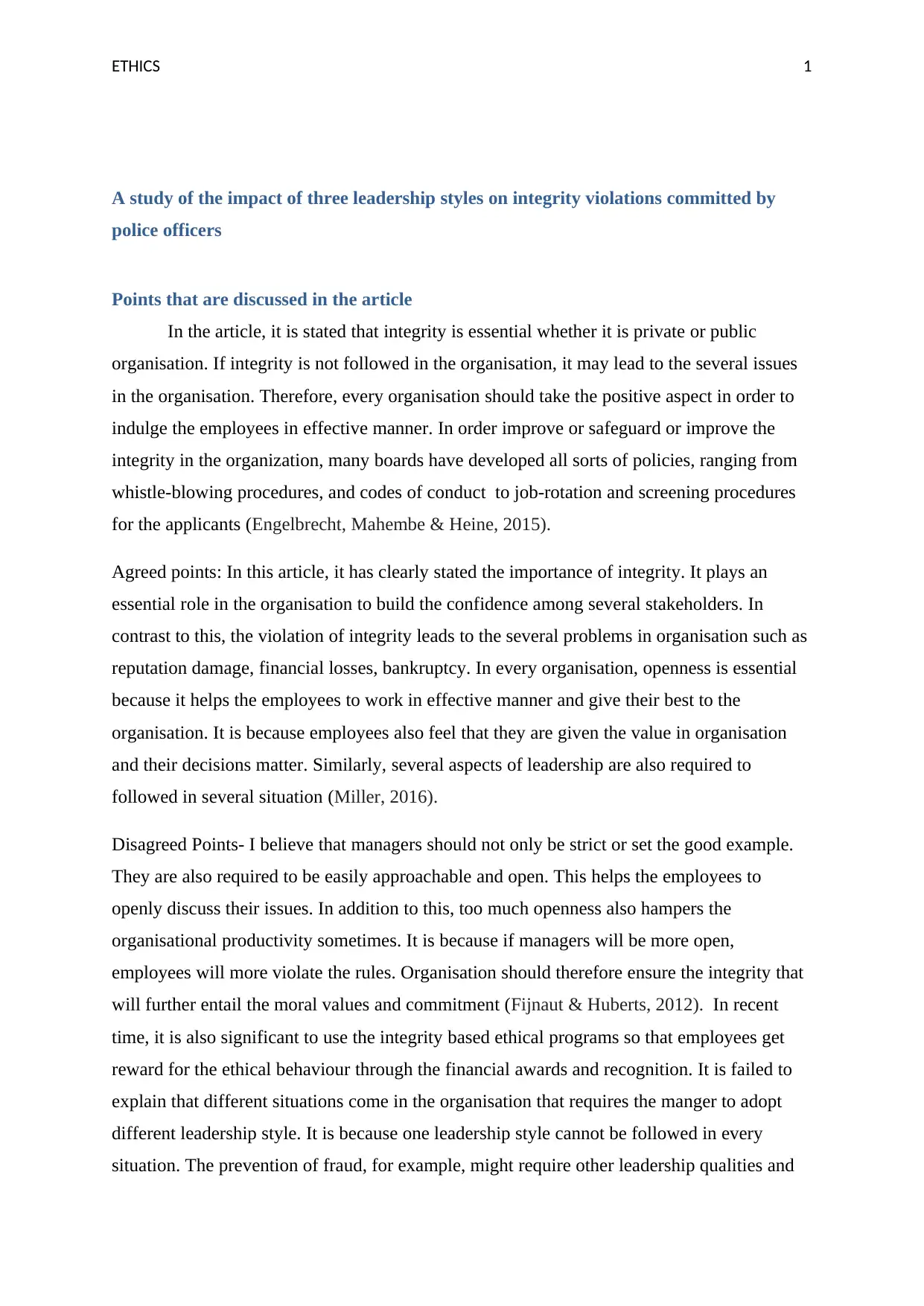
A study of the impact of three leadership styles on integrity violations committed by
police officers
Points that are discussed in the article
In the article, it is stated that integrity is essential whether it is private or public
organisation. If integrity is not followed in the organisation, it may lead to the several issues
in the organisation. Therefore, every organisation should take the positive aspect in order to
indulge the employees in effective manner. In order improve or safeguard or improve the
integrity in the organization, many boards have developed all sorts of policies, ranging from
whistle-blowing procedures, and codes of conduct to job-rotation and screening procedures
for the applicants (Engelbrecht, Mahembe & Heine, 2015).
Agreed points: In this article, it has clearly stated the importance of integrity. It plays an
essential role in the organisation to build the confidence among several stakeholders. In
contrast to this, the violation of integrity leads to the several problems in organisation such as
reputation damage, financial losses, bankruptcy. In every organisation, openness is essential
because it helps the employees to work in effective manner and give their best to the
organisation. It is because employees also feel that they are given the value in organisation
and their decisions matter. Similarly, several aspects of leadership are also required to
followed in several situation (Miller, 2016).
Disagreed Points- I believe that managers should not only be strict or set the good example.
They are also required to be easily approachable and open. This helps the employees to
openly discuss their issues. In addition to this, too much openness also hampers the
organisational productivity sometimes. It is because if managers will be more open,
employees will more violate the rules. Organisation should therefore ensure the integrity that
will further entail the moral values and commitment (Fijnaut & Huberts, 2012). In recent
time, it is also significant to use the integrity based ethical programs so that employees get
reward for the ethical behaviour through the financial awards and recognition. It is failed to
explain that different situations come in the organisation that requires the manger to adopt
different leadership style. It is because one leadership style cannot be followed in every
situation. The prevention of fraud, for example, might require other leadership qualities and
A study of the impact of three leadership styles on integrity violations committed by
police officers
Points that are discussed in the article
In the article, it is stated that integrity is essential whether it is private or public
organisation. If integrity is not followed in the organisation, it may lead to the several issues
in the organisation. Therefore, every organisation should take the positive aspect in order to
indulge the employees in effective manner. In order improve or safeguard or improve the
integrity in the organization, many boards have developed all sorts of policies, ranging from
whistle-blowing procedures, and codes of conduct to job-rotation and screening procedures
for the applicants (Engelbrecht, Mahembe & Heine, 2015).
Agreed points: In this article, it has clearly stated the importance of integrity. It plays an
essential role in the organisation to build the confidence among several stakeholders. In
contrast to this, the violation of integrity leads to the several problems in organisation such as
reputation damage, financial losses, bankruptcy. In every organisation, openness is essential
because it helps the employees to work in effective manner and give their best to the
organisation. It is because employees also feel that they are given the value in organisation
and their decisions matter. Similarly, several aspects of leadership are also required to
followed in several situation (Miller, 2016).
Disagreed Points- I believe that managers should not only be strict or set the good example.
They are also required to be easily approachable and open. This helps the employees to
openly discuss their issues. In addition to this, too much openness also hampers the
organisational productivity sometimes. It is because if managers will be more open,
employees will more violate the rules. Organisation should therefore ensure the integrity that
will further entail the moral values and commitment (Fijnaut & Huberts, 2012). In recent
time, it is also significant to use the integrity based ethical programs so that employees get
reward for the ethical behaviour through the financial awards and recognition. It is failed to
explain that different situations come in the organisation that requires the manger to adopt
different leadership style. It is because one leadership style cannot be followed in every
situation. The prevention of fraud, for example, might require other leadership qualities and

ETHICS 2
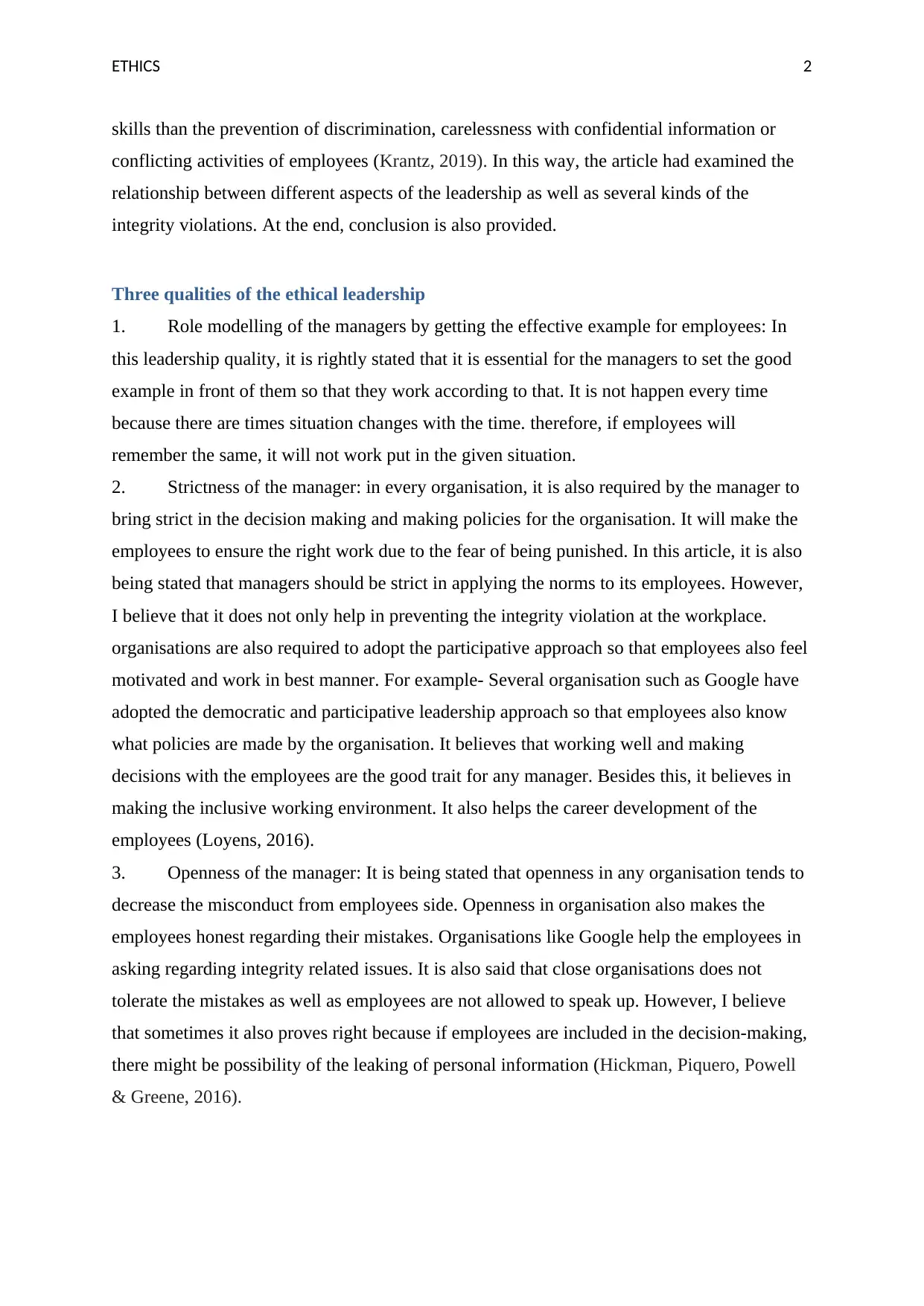
skills than the prevention of discrimination, carelessness with confidential information or
conflicting activities of employees (Krantz, 2019). In this way, the article had examined the
relationship between different aspects of the leadership as well as several kinds of the
integrity violations. At the end, conclusion is also provided.
Three qualities of the ethical leadership
1. Role modelling of the managers by getting the effective example for employees: In
this leadership quality, it is rightly stated that it is essential for the managers to set the good
example in front of them so that they work according to that. It is not happen every time
because there are times situation changes with the time. therefore, if employees will
remember the same, it will not work put in the given situation.
2. Strictness of the manager: in every organisation, it is also required by the manager to
bring strict in the decision making and making policies for the organisation. It will make the
employees to ensure the right work due to the fear of being punished. In this article, it is also
being stated that managers should be strict in applying the norms to its employees. However,
I believe that it does not only help in preventing the integrity violation at the workplace.
organisations are also required to adopt the participative approach so that employees also feel
motivated and work in best manner. For example- Several organisation such as Google have
adopted the democratic and participative leadership approach so that employees also know
what policies are made by the organisation. It believes that working well and making
decisions with the employees are the good trait for any manager. Besides this, it believes in
making the inclusive working environment. It also helps the career development of the
employees (Loyens, 2016).
3. Openness of the manager: It is being stated that openness in any organisation tends to
decrease the misconduct from employees side. Openness in organisation also makes the
employees honest regarding their mistakes. Organisations like Google help the employees in
asking regarding integrity related issues. It is also said that close organisations does not
tolerate the mistakes as well as employees are not allowed to speak up. However, I believe
that sometimes it also proves right because if employees are included in the decision-making,
there might be possibility of the leaking of personal information (Hickman, Piquero, Powell
& Greene, 2016).
skills than the prevention of discrimination, carelessness with confidential information or
conflicting activities of employees (Krantz, 2019). In this way, the article had examined the
relationship between different aspects of the leadership as well as several kinds of the
integrity violations. At the end, conclusion is also provided.
Three qualities of the ethical leadership
1. Role modelling of the managers by getting the effective example for employees: In
this leadership quality, it is rightly stated that it is essential for the managers to set the good
example in front of them so that they work according to that. It is not happen every time
because there are times situation changes with the time. therefore, if employees will
remember the same, it will not work put in the given situation.
2. Strictness of the manager: in every organisation, it is also required by the manager to
bring strict in the decision making and making policies for the organisation. It will make the
employees to ensure the right work due to the fear of being punished. In this article, it is also
being stated that managers should be strict in applying the norms to its employees. However,
I believe that it does not only help in preventing the integrity violation at the workplace.
organisations are also required to adopt the participative approach so that employees also feel
motivated and work in best manner. For example- Several organisation such as Google have
adopted the democratic and participative leadership approach so that employees also know
what policies are made by the organisation. It believes that working well and making
decisions with the employees are the good trait for any manager. Besides this, it believes in
making the inclusive working environment. It also helps the career development of the
employees (Loyens, 2016).
3. Openness of the manager: It is being stated that openness in any organisation tends to
decrease the misconduct from employees side. Openness in organisation also makes the
employees honest regarding their mistakes. Organisations like Google help the employees in
asking regarding integrity related issues. It is also said that close organisations does not
tolerate the mistakes as well as employees are not allowed to speak up. However, I believe
that sometimes it also proves right because if employees are included in the decision-making,
there might be possibility of the leaking of personal information (Hickman, Piquero, Powell
& Greene, 2016).
⊘ This is a preview!⊘
Do you want full access?
Subscribe today to unlock all pages.

Trusted by 1+ million students worldwide

ETHICS 3
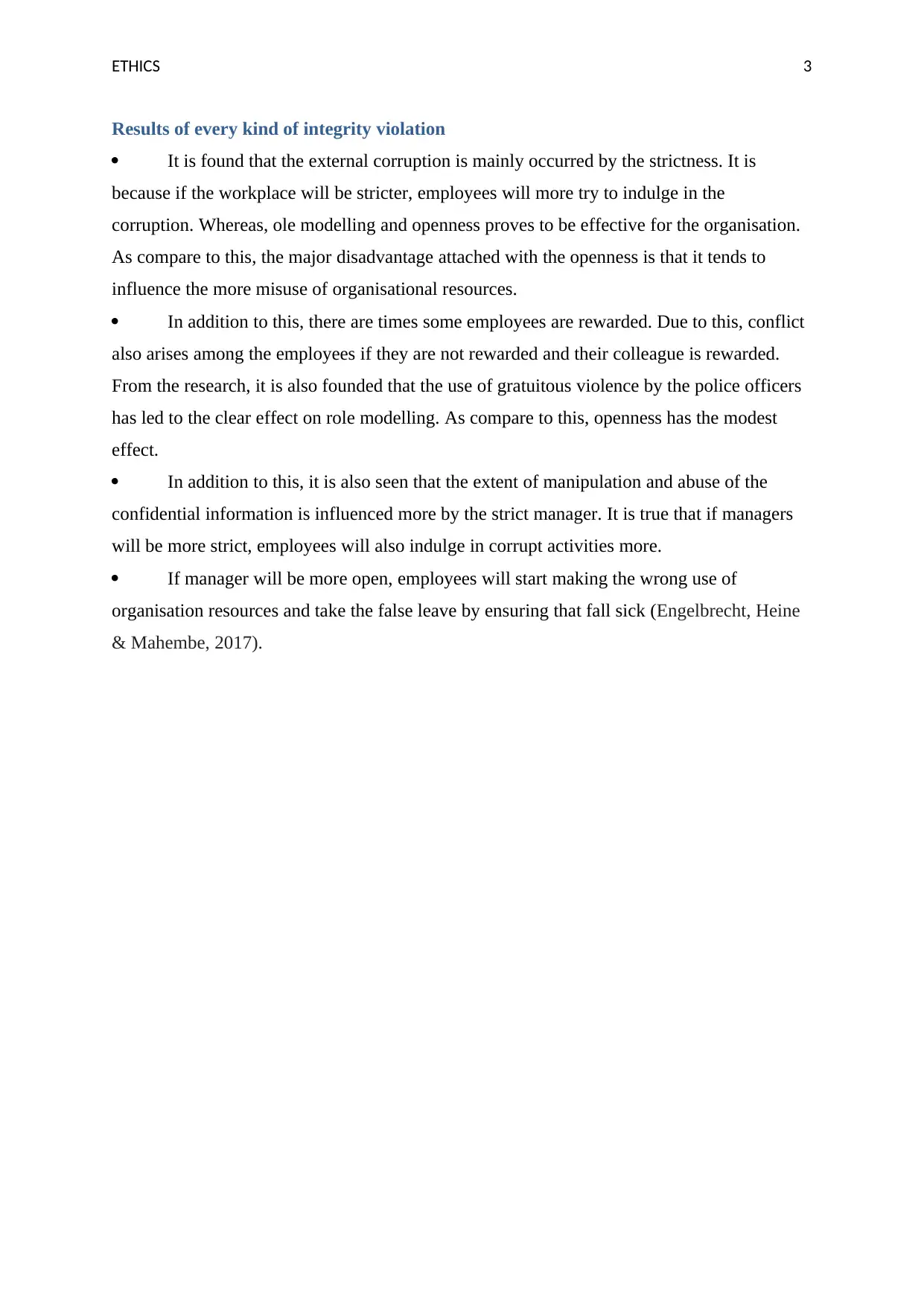
Results of every kind of integrity violation
It is found that the external corruption is mainly occurred by the strictness. It is
because if the workplace will be stricter, employees will more try to indulge in the
corruption. Whereas, ole modelling and openness proves to be effective for the organisation.
As compare to this, the major disadvantage attached with the openness is that it tends to
influence the more misuse of organisational resources.
In addition to this, there are times some employees are rewarded. Due to this, conflict
also arises among the employees if they are not rewarded and their colleague is rewarded.
From the research, it is also founded that the use of gratuitous violence by the police officers
has led to the clear effect on role modelling. As compare to this, openness has the modest
effect.
In addition to this, it is also seen that the extent of manipulation and abuse of the
confidential information is influenced more by the strict manager. It is true that if managers
will be more strict, employees will also indulge in corrupt activities more.
If manager will be more open, employees will start making the wrong use of
organisation resources and take the false leave by ensuring that fall sick (Engelbrecht, Heine
& Mahembe, 2017).
Results of every kind of integrity violation
It is found that the external corruption is mainly occurred by the strictness. It is
because if the workplace will be stricter, employees will more try to indulge in the
corruption. Whereas, ole modelling and openness proves to be effective for the organisation.
As compare to this, the major disadvantage attached with the openness is that it tends to
influence the more misuse of organisational resources.
In addition to this, there are times some employees are rewarded. Due to this, conflict
also arises among the employees if they are not rewarded and their colleague is rewarded.
From the research, it is also founded that the use of gratuitous violence by the police officers
has led to the clear effect on role modelling. As compare to this, openness has the modest
effect.
In addition to this, it is also seen that the extent of manipulation and abuse of the
confidential information is influenced more by the strict manager. It is true that if managers
will be more strict, employees will also indulge in corrupt activities more.
If manager will be more open, employees will start making the wrong use of
organisation resources and take the false leave by ensuring that fall sick (Engelbrecht, Heine
& Mahembe, 2017).
Paraphrase This Document
Need a fresh take? Get an instant paraphrase of this document with our AI Paraphraser

ETHICS 4
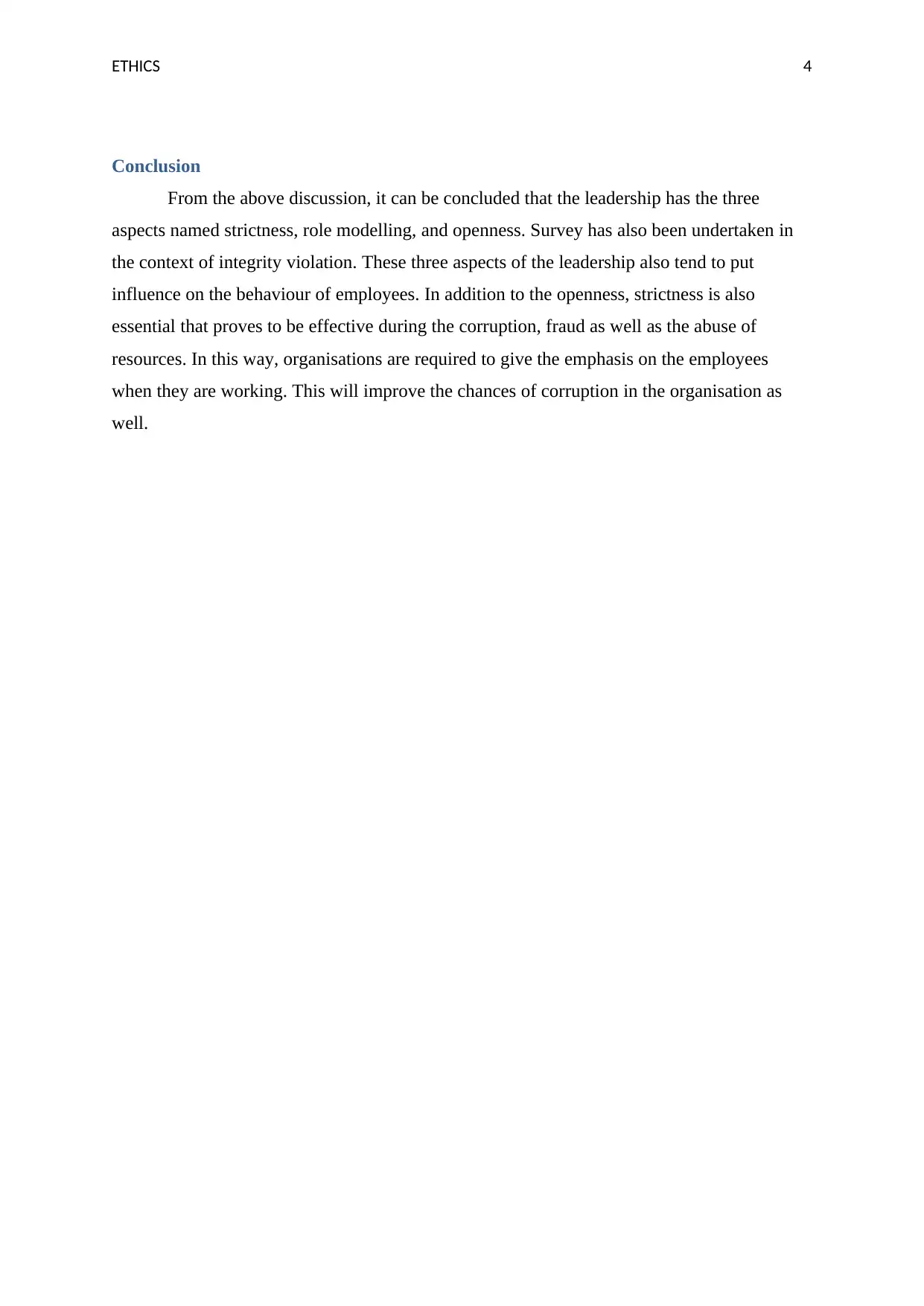
Conclusion
From the above discussion, it can be concluded that the leadership has the three
aspects named strictness, role modelling, and openness. Survey has also been undertaken in
the context of integrity violation. These three aspects of the leadership also tend to put
influence on the behaviour of employees. In addition to the openness, strictness is also
essential that proves to be effective during the corruption, fraud as well as the abuse of
resources. In this way, organisations are required to give the emphasis on the employees
when they are working. This will improve the chances of corruption in the organisation as
well.
Conclusion
From the above discussion, it can be concluded that the leadership has the three
aspects named strictness, role modelling, and openness. Survey has also been undertaken in
the context of integrity violation. These three aspects of the leadership also tend to put
influence on the behaviour of employees. In addition to the openness, strictness is also
essential that proves to be effective during the corruption, fraud as well as the abuse of
resources. In this way, organisations are required to give the emphasis on the employees
when they are working. This will improve the chances of corruption in the organisation as
well.

ETHICS 5
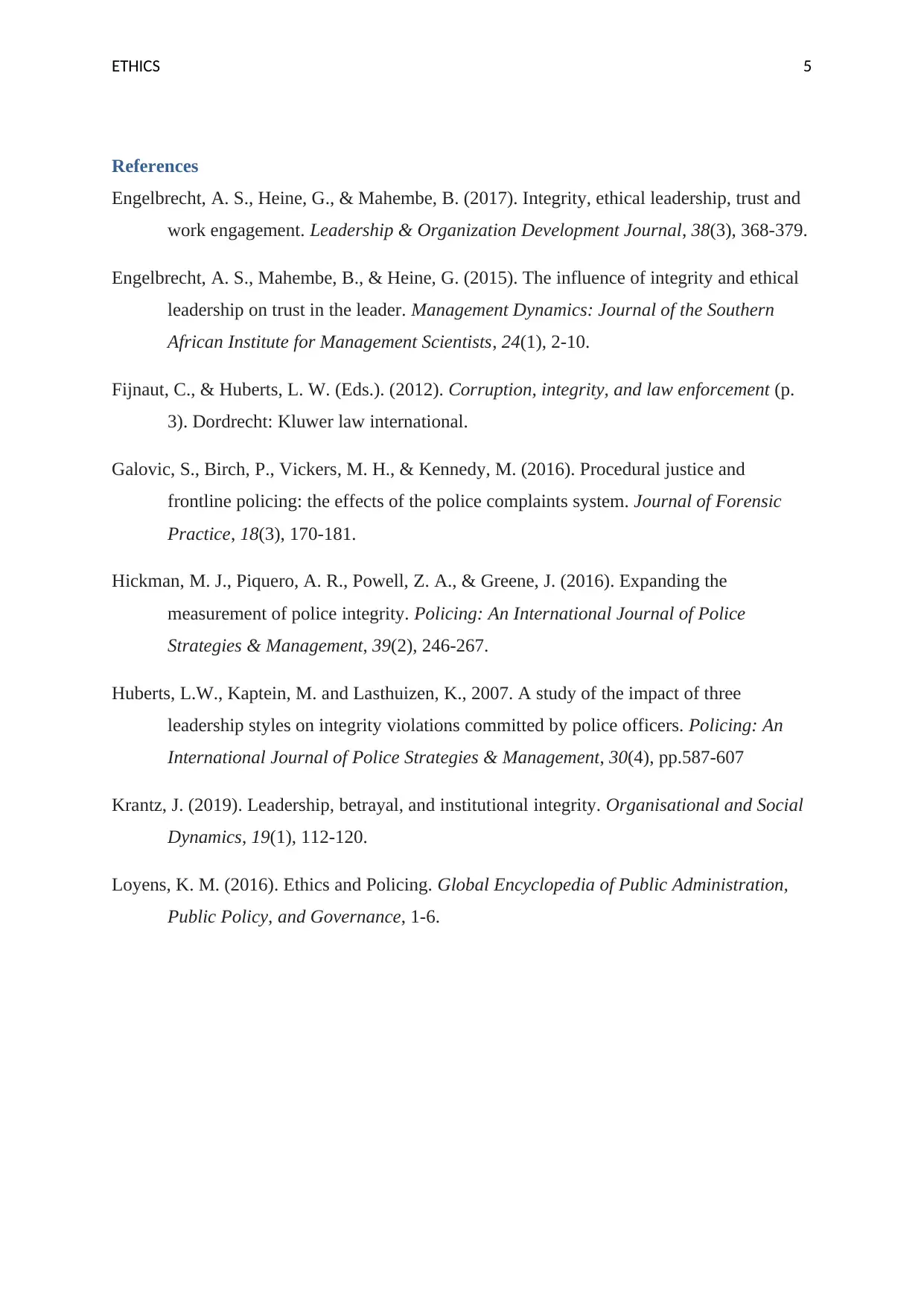
References
Engelbrecht, A. S., Heine, G., & Mahembe, B. (2017). Integrity, ethical leadership, trust and
work engagement. Leadership & Organization Development Journal, 38(3), 368-379.
Engelbrecht, A. S., Mahembe, B., & Heine, G. (2015). The influence of integrity and ethical
leadership on trust in the leader. Management Dynamics: Journal of the Southern
African Institute for Management Scientists, 24(1), 2-10.
Fijnaut, C., & Huberts, L. W. (Eds.). (2012). Corruption, integrity, and law enforcement (p.
3). Dordrecht: Kluwer law international.
Galovic, S., Birch, P., Vickers, M. H., & Kennedy, M. (2016). Procedural justice and
frontline policing: the effects of the police complaints system. Journal of Forensic
Practice, 18(3), 170-181.
Hickman, M. J., Piquero, A. R., Powell, Z. A., & Greene, J. (2016). Expanding the
measurement of police integrity. Policing: An International Journal of Police
Strategies & Management, 39(2), 246-267.
Huberts, L.W., Kaptein, M. and Lasthuizen, K., 2007. A study of the impact of three
leadership styles on integrity violations committed by police officers. Policing: An
International Journal of Police Strategies & Management, 30(4), pp.587-607
Krantz, J. (2019). Leadership, betrayal, and institutional integrity. Organisational and Social
Dynamics, 19(1), 112-120.
Loyens, K. M. (2016). Ethics and Policing. Global Encyclopedia of Public Administration,
Public Policy, and Governance, 1-6.
References
Engelbrecht, A. S., Heine, G., & Mahembe, B. (2017). Integrity, ethical leadership, trust and
work engagement. Leadership & Organization Development Journal, 38(3), 368-379.
Engelbrecht, A. S., Mahembe, B., & Heine, G. (2015). The influence of integrity and ethical
leadership on trust in the leader. Management Dynamics: Journal of the Southern
African Institute for Management Scientists, 24(1), 2-10.
Fijnaut, C., & Huberts, L. W. (Eds.). (2012). Corruption, integrity, and law enforcement (p.
3). Dordrecht: Kluwer law international.
Galovic, S., Birch, P., Vickers, M. H., & Kennedy, M. (2016). Procedural justice and
frontline policing: the effects of the police complaints system. Journal of Forensic
Practice, 18(3), 170-181.
Hickman, M. J., Piquero, A. R., Powell, Z. A., & Greene, J. (2016). Expanding the
measurement of police integrity. Policing: An International Journal of Police
Strategies & Management, 39(2), 246-267.
Huberts, L.W., Kaptein, M. and Lasthuizen, K., 2007. A study of the impact of three
leadership styles on integrity violations committed by police officers. Policing: An
International Journal of Police Strategies & Management, 30(4), pp.587-607
Krantz, J. (2019). Leadership, betrayal, and institutional integrity. Organisational and Social
Dynamics, 19(1), 112-120.
Loyens, K. M. (2016). Ethics and Policing. Global Encyclopedia of Public Administration,
Public Policy, and Governance, 1-6.
⊘ This is a preview!⊘
Do you want full access?
Subscribe today to unlock all pages.

Trusted by 1+ million students worldwide

ETHICS 6
Miller, S. (2016). Integrity Systems for Police Organisations. In Corruption and Anti-
Corruption in Policing—Philosophical and Ethical Issues (pp. 53-67). Springer,
Cham.
Miller, S. (2016). Professional reporting and police culture. In Corruption and Anti-
Corruption in Policing—Philosophical and Ethical Issues (pp. 69-79). Springer,
Cham.
Miller, S. (2016). Integrity Systems for Police Organisations. In Corruption and Anti-
Corruption in Policing—Philosophical and Ethical Issues (pp. 53-67). Springer,
Cham.
Miller, S. (2016). Professional reporting and police culture. In Corruption and Anti-
Corruption in Policing—Philosophical and Ethical Issues (pp. 69-79). Springer,
Cham.
1 out of 7
Related Documents
Your All-in-One AI-Powered Toolkit for Academic Success.
+13062052269
info@desklib.com
Available 24*7 on WhatsApp / Email
Unlock your academic potential
Copyright © 2020–2025 A2Z Services. All Rights Reserved. Developed and managed by ZUCOL.