Leadership Interview Analysis Report
VerifiedAdded on 2020/02/05
|10
|2420
|98
Report
AI Summary
This report compares and contrasts information gathered from two biographical interviews focusing on leadership. The analysis explores the interviewees' understanding of leadership, their perspectives on effective leadership theories (Behavioral and Trait theories are discussed), and the importance of leadership in organizational success. The report uses a structured approach, presenting findings in a clear and organized manner. Similarities and differences in the interviewees' responses are highlighted, providing insights into diverse perspectives on leadership. The report concludes by emphasizing the importance of thorough preparation and self-evaluation before interviews, highlighting the value of understanding one's own skills and capabilities in relation to leadership roles.

Compare and contrast the
information from two biographies
information from two biographies

Paraphrase This Document
Need a fresh take? Get an instant paraphrase of this document with our AI Paraphraser
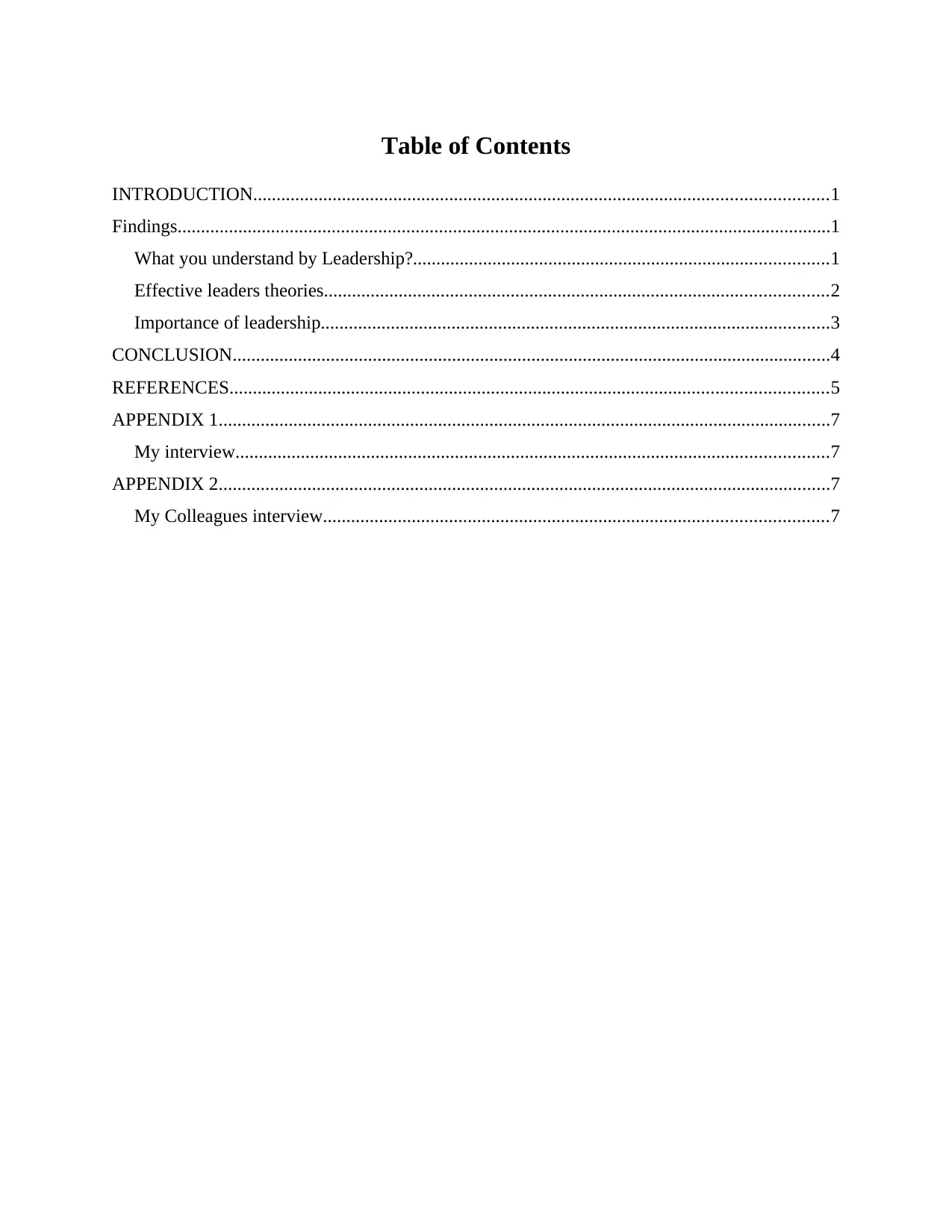
Table of Contents
INTRODUCTION...........................................................................................................................1
Findings............................................................................................................................................1
What you understand by Leadership?.........................................................................................1
Effective leaders theories............................................................................................................2
Importance of leadership.............................................................................................................3
CONCLUSION................................................................................................................................4
REFERENCES................................................................................................................................5
APPENDIX 1...................................................................................................................................7
My interview...............................................................................................................................7
APPENDIX 2...................................................................................................................................7
My Colleagues interview............................................................................................................7
INTRODUCTION...........................................................................................................................1
Findings............................................................................................................................................1
What you understand by Leadership?.........................................................................................1
Effective leaders theories............................................................................................................2
Importance of leadership.............................................................................................................3
CONCLUSION................................................................................................................................4
REFERENCES................................................................................................................................5
APPENDIX 1...................................................................................................................................7
My interview...............................................................................................................................7
APPENDIX 2...................................................................................................................................7
My Colleagues interview............................................................................................................7
INTRODUCTION
Before attending an interview, it is important for individuals to make sure that they have
proper information about the firm (Bolman and Deal, 2017). In order words, background study
should be done so that interviewer will develop interest for the answers that are given by the
interviewee. Present report is about make evaluation of similarities and differences of two
biographies and that is for the interview that was attended by me and my colleague. The
interview is conducted by my colleague and me. First, I will be the interviewer and will ask
questions related to preference that interviewee has and other general things. Then I will be the
interviewee and same questions will be asked by the colleague as interviewer. Lastly, it also
includes relevant theories and frameworks that will be helpful enough to explain the differences
and similarities.
Findings
During the interview, similar questions were asked and this was helpful enough to make
similarities and differences on the basis of answers that were given. With this respect, analysis
can be conducted with the help of models and frameworks (Tourish, 2014). Different type of
questions were asked related with leadership. With this respect, below given are the differences
and similarities that are given by each of us:
What you understand by Leadership?
In accordance with the responses given by my colleague, it was identified that leadership
depend upon the type of attitude that an individual carries. There are different type of attitude
that is shown by people (Goleman, Boyatzis and McKee, 2013). In this context, it includes
curiosity, discovery and openness. Both curiosity and openness can be determined as the willing
of a person to take risk. When compared with me and my colleague, we both think that taking up
risk and to work beyond one's comfort zone is leadership. Further, it also included the
willingness to show their interest in development of the skills and capabilities. For this aspect,
my colleague is not much comfortable. He will perform the type of role that he already possess
and for the areas in which skills are required, efforts are not put for the same. According to him
leaders is done effectively when the type of role that is performed effectively is considered to be
more preferable when leaders perform (Fairhurst and Connaughton, 2014). When compared
with me, leaders should be able to develop their understanding towards different type of skills
that will be helpful enough to make sure that the given job is performed effectively and
1
Before attending an interview, it is important for individuals to make sure that they have
proper information about the firm (Bolman and Deal, 2017). In order words, background study
should be done so that interviewer will develop interest for the answers that are given by the
interviewee. Present report is about make evaluation of similarities and differences of two
biographies and that is for the interview that was attended by me and my colleague. The
interview is conducted by my colleague and me. First, I will be the interviewer and will ask
questions related to preference that interviewee has and other general things. Then I will be the
interviewee and same questions will be asked by the colleague as interviewer. Lastly, it also
includes relevant theories and frameworks that will be helpful enough to explain the differences
and similarities.
Findings
During the interview, similar questions were asked and this was helpful enough to make
similarities and differences on the basis of answers that were given. With this respect, analysis
can be conducted with the help of models and frameworks (Tourish, 2014). Different type of
questions were asked related with leadership. With this respect, below given are the differences
and similarities that are given by each of us:
What you understand by Leadership?
In accordance with the responses given by my colleague, it was identified that leadership
depend upon the type of attitude that an individual carries. There are different type of attitude
that is shown by people (Goleman, Boyatzis and McKee, 2013). In this context, it includes
curiosity, discovery and openness. Both curiosity and openness can be determined as the willing
of a person to take risk. When compared with me and my colleague, we both think that taking up
risk and to work beyond one's comfort zone is leadership. Further, it also included the
willingness to show their interest in development of the skills and capabilities. For this aspect,
my colleague is not much comfortable. He will perform the type of role that he already possess
and for the areas in which skills are required, efforts are not put for the same. According to him
leaders is done effectively when the type of role that is performed effectively is considered to be
more preferable when leaders perform (Fairhurst and Connaughton, 2014). When compared
with me, leaders should be able to develop their understanding towards different type of skills
that will be helpful enough to make sure that the given job is performed effectively and
1
⊘ This is a preview!⊘
Do you want full access?
Subscribe today to unlock all pages.

Trusted by 1+ million students worldwide
efficiently. This type of attitude is favourable enough to develop positive perception within the
mind of interviewer. On the other hand, through curiosity and openness, it enables to develop
positive understanding within the mind of interviewer. As per the views of my colleague, leaders
are one who are able to guide and direct employees so that they are able to develop motivation
through which the type of work that is provided to them are performed with their full efficiency
(Beck and Cowan, 2014). Further, there are different type of areas in which one as a leader need
to have proper knowledge so that all the doubts and issues can be solved by them effectively.
With this respect, the leaders should be able to understand the perspective of other employees
and should provide them guidance accordingly. As per the view that me and by colleague have
on leadership, it can be stated that a person is born leaders and there are conditions in which
situations that are faced by them also enables to them to become leaders (Garrow, 2015).
Workers get highly motivated and encouraged with the type of strategies that are applied by
leaders with the help of which they put on their full efforts to support the organization.
Effective leaders theories
From own knowledge and understanding, it is identified that there are different type of
leadership styles that can be implemented. In accordance with the questions asked from me for
the type of leadership theory (Frohlich and Oppenheimer, 2015). The type of theory that was
selected by me was Behavioural theory. It is a type of theory in which there are diverse set of
preference that are provided to employees. In this context, it includes three different type of
leadership styles and each of them have different set of impact over employees. Below given are
the three leadership styles:
Autocratic leaders: This can be determined as the type of leadership in which all the
decisions related to business operations are taken by top managers. On the other hand, workers
are involved in decision making (Chhokar, Brodbeck and House, 2013). This has negative
impact over workers as they feel neglected and they develop a feeling that they are not important
for the firm.
Democratic leadership: As per this type of leadership, both employees and managers
together take decision for the business operation. Management understands the importance of
workers, this is because, employees have direct interaction with customers and they know better
about the type of issues or problems that are faced by them (Shapiro and Stefkovich, 2016). In
2
mind of interviewer. On the other hand, through curiosity and openness, it enables to develop
positive understanding within the mind of interviewer. As per the views of my colleague, leaders
are one who are able to guide and direct employees so that they are able to develop motivation
through which the type of work that is provided to them are performed with their full efficiency
(Beck and Cowan, 2014). Further, there are different type of areas in which one as a leader need
to have proper knowledge so that all the doubts and issues can be solved by them effectively.
With this respect, the leaders should be able to understand the perspective of other employees
and should provide them guidance accordingly. As per the view that me and by colleague have
on leadership, it can be stated that a person is born leaders and there are conditions in which
situations that are faced by them also enables to them to become leaders (Garrow, 2015).
Workers get highly motivated and encouraged with the type of strategies that are applied by
leaders with the help of which they put on their full efforts to support the organization.
Effective leaders theories
From own knowledge and understanding, it is identified that there are different type of
leadership styles that can be implemented. In accordance with the questions asked from me for
the type of leadership theory (Frohlich and Oppenheimer, 2015). The type of theory that was
selected by me was Behavioural theory. It is a type of theory in which there are diverse set of
preference that are provided to employees. In this context, it includes three different type of
leadership styles and each of them have different set of impact over employees. Below given are
the three leadership styles:
Autocratic leaders: This can be determined as the type of leadership in which all the
decisions related to business operations are taken by top managers. On the other hand, workers
are involved in decision making (Chhokar, Brodbeck and House, 2013). This has negative
impact over workers as they feel neglected and they develop a feeling that they are not important
for the firm.
Democratic leadership: As per this type of leadership, both employees and managers
together take decision for the business operation. Management understands the importance of
workers, this is because, employees have direct interaction with customers and they know better
about the type of issues or problems that are faced by them (Shapiro and Stefkovich, 2016). In
2
Paraphrase This Document
Need a fresh take? Get an instant paraphrase of this document with our AI Paraphraser
this context, when employees are involved in decision making, then it boosts up the moral and
encourage them to support the firm in achieving the organizational goals and objectives.
Laissez-faire leaders: This type of leadership is effective when the team is highly
capable, individuals take initiatives and motivated. It allows individuals with the group to make
decision (Kim and Kim, 2015). It occurs when leaders are not skilled or do not take up initiative
to support the team.
As per the response given by my colleague, he has idea about Trait Theory. This is a type
of theory which states that leaders are made or they are born (Bolman and Deal, 2017). There are
certain set of characteristics which individuals need to have in order to be a leader. In this
context, it includes creativity, sense of responsibility, intelligence, etc. When one does not
possess these skills, then it becomes difficult to make sure that they have the capability and
effectiveness to perform the roles and responsibilities of a leader. On the other hand, there are
situation in which one possess these skills in-born. In order to be a leader when these
characteristics that are required are identified and proper steps are considered with the help of
which skills can be developed (Tourish, 2014).
Importance of leadership
Leadership is considered as an important function of management that helps in
maximizing the efficiency so that organizational goals could be attained. As per own
understanding, it plays a crucial role such as- Initiates action- Leaders are the individual who starts the work by communicating the
policies and thus helps subordinates from where the work actually starts. Motivation- As per my experience, leaders helps in motivating individual through various
ways i.e. by providing them incentive and recognition so that work could be
accomplished effectively and efficiently (Bolman and Deal, 2017). Builds morale- As per my view, leaders helps in building morale of individual through
co-operating with employees to accomplish their work. Thus, leader is supposed to be a
morale booster and performs all the actions with best of their abilities so that set goals
could be attained. Creating confidence- Leaders also helps in creating confidence that helps in expressing
the work efforts of subordinates and thus provide them guidance so that goals could be
3
encourage them to support the firm in achieving the organizational goals and objectives.
Laissez-faire leaders: This type of leadership is effective when the team is highly
capable, individuals take initiatives and motivated. It allows individuals with the group to make
decision (Kim and Kim, 2015). It occurs when leaders are not skilled or do not take up initiative
to support the team.
As per the response given by my colleague, he has idea about Trait Theory. This is a type
of theory which states that leaders are made or they are born (Bolman and Deal, 2017). There are
certain set of characteristics which individuals need to have in order to be a leader. In this
context, it includes creativity, sense of responsibility, intelligence, etc. When one does not
possess these skills, then it becomes difficult to make sure that they have the capability and
effectiveness to perform the roles and responsibilities of a leader. On the other hand, there are
situation in which one possess these skills in-born. In order to be a leader when these
characteristics that are required are identified and proper steps are considered with the help of
which skills can be developed (Tourish, 2014).
Importance of leadership
Leadership is considered as an important function of management that helps in
maximizing the efficiency so that organizational goals could be attained. As per own
understanding, it plays a crucial role such as- Initiates action- Leaders are the individual who starts the work by communicating the
policies and thus helps subordinates from where the work actually starts. Motivation- As per my experience, leaders helps in motivating individual through various
ways i.e. by providing them incentive and recognition so that work could be
accomplished effectively and efficiently (Bolman and Deal, 2017). Builds morale- As per my view, leaders helps in building morale of individual through
co-operating with employees to accomplish their work. Thus, leader is supposed to be a
morale booster and performs all the actions with best of their abilities so that set goals
could be attained. Creating confidence- Leaders also helps in creating confidence that helps in expressing
the work efforts of subordinates and thus provide them guidance so that goals could be
3
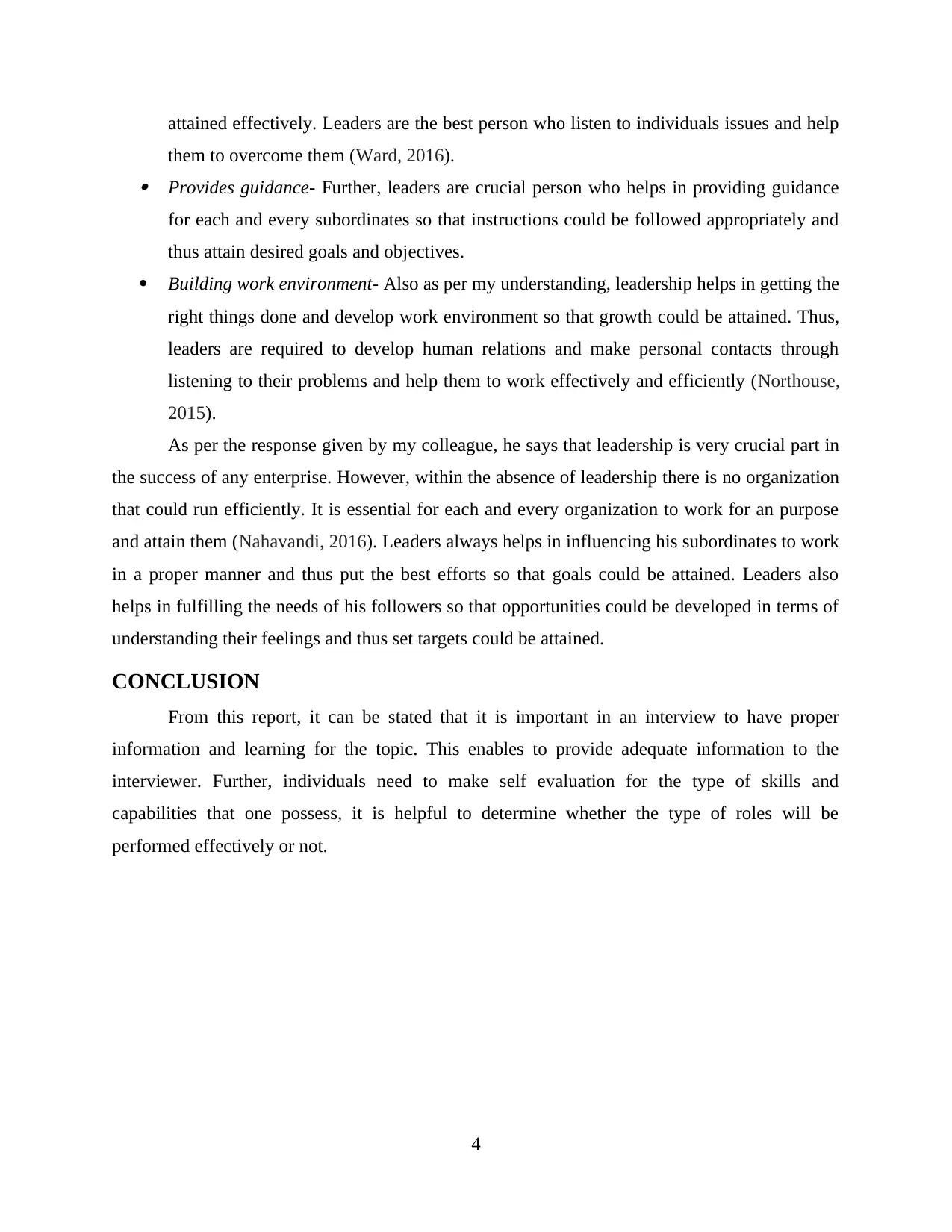
attained effectively. Leaders are the best person who listen to individuals issues and help
them to overcome them (Ward, 2016). Provides guidance- Further, leaders are crucial person who helps in providing guidance
for each and every subordinates so that instructions could be followed appropriately and
thus attain desired goals and objectives.
Building work environment- Also as per my understanding, leadership helps in getting the
right things done and develop work environment so that growth could be attained. Thus,
leaders are required to develop human relations and make personal contacts through
listening to their problems and help them to work effectively and efficiently (Northouse,
2015).
As per the response given by my colleague, he says that leadership is very crucial part in
the success of any enterprise. However, within the absence of leadership there is no organization
that could run efficiently. It is essential for each and every organization to work for an purpose
and attain them (Nahavandi, 2016). Leaders always helps in influencing his subordinates to work
in a proper manner and thus put the best efforts so that goals could be attained. Leaders also
helps in fulfilling the needs of his followers so that opportunities could be developed in terms of
understanding their feelings and thus set targets could be attained.
CONCLUSION
From this report, it can be stated that it is important in an interview to have proper
information and learning for the topic. This enables to provide adequate information to the
interviewer. Further, individuals need to make self evaluation for the type of skills and
capabilities that one possess, it is helpful to determine whether the type of roles will be
performed effectively or not.
4
them to overcome them (Ward, 2016). Provides guidance- Further, leaders are crucial person who helps in providing guidance
for each and every subordinates so that instructions could be followed appropriately and
thus attain desired goals and objectives.
Building work environment- Also as per my understanding, leadership helps in getting the
right things done and develop work environment so that growth could be attained. Thus,
leaders are required to develop human relations and make personal contacts through
listening to their problems and help them to work effectively and efficiently (Northouse,
2015).
As per the response given by my colleague, he says that leadership is very crucial part in
the success of any enterprise. However, within the absence of leadership there is no organization
that could run efficiently. It is essential for each and every organization to work for an purpose
and attain them (Nahavandi, 2016). Leaders always helps in influencing his subordinates to work
in a proper manner and thus put the best efforts so that goals could be attained. Leaders also
helps in fulfilling the needs of his followers so that opportunities could be developed in terms of
understanding their feelings and thus set targets could be attained.
CONCLUSION
From this report, it can be stated that it is important in an interview to have proper
information and learning for the topic. This enables to provide adequate information to the
interviewer. Further, individuals need to make self evaluation for the type of skills and
capabilities that one possess, it is helpful to determine whether the type of roles will be
performed effectively or not.
4
⊘ This is a preview!⊘
Do you want full access?
Subscribe today to unlock all pages.
Trusted by 1+ million students worldwide
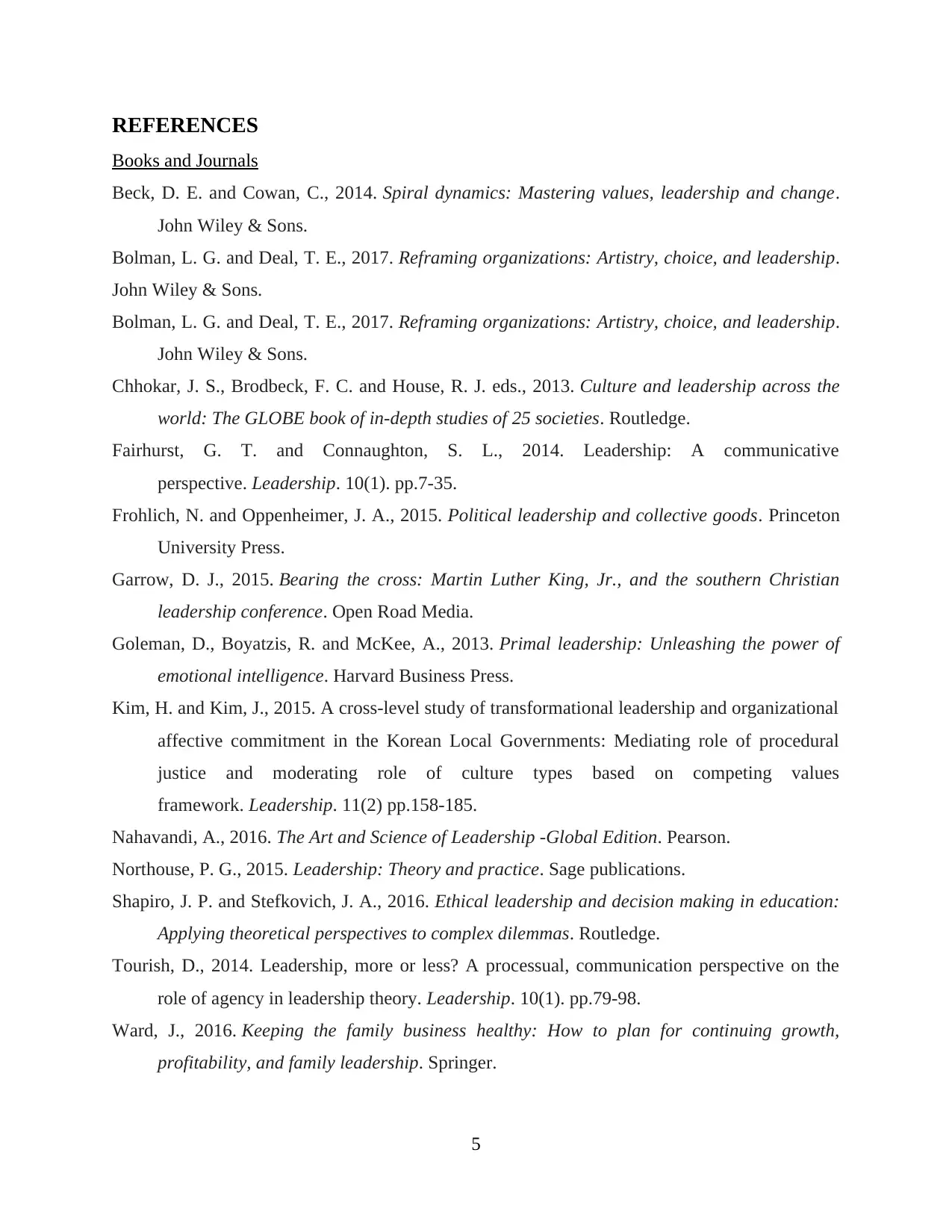
REFERENCES
Books and Journals
Beck, D. E. and Cowan, C., 2014. Spiral dynamics: Mastering values, leadership and change.
John Wiley & Sons.
Bolman, L. G. and Deal, T. E., 2017. Reframing organizations: Artistry, choice, and leadership.
John Wiley & Sons.
Bolman, L. G. and Deal, T. E., 2017. Reframing organizations: Artistry, choice, and leadership.
John Wiley & Sons.
Chhokar, J. S., Brodbeck, F. C. and House, R. J. eds., 2013. Culture and leadership across the
world: The GLOBE book of in-depth studies of 25 societies. Routledge.
Fairhurst, G. T. and Connaughton, S. L., 2014. Leadership: A communicative
perspective. Leadership. 10(1). pp.7-35.
Frohlich, N. and Oppenheimer, J. A., 2015. Political leadership and collective goods. Princeton
University Press.
Garrow, D. J., 2015. Bearing the cross: Martin Luther King, Jr., and the southern Christian
leadership conference. Open Road Media.
Goleman, D., Boyatzis, R. and McKee, A., 2013. Primal leadership: Unleashing the power of
emotional intelligence. Harvard Business Press.
Kim, H. and Kim, J., 2015. A cross-level study of transformational leadership and organizational
affective commitment in the Korean Local Governments: Mediating role of procedural
justice and moderating role of culture types based on competing values
framework. Leadership. 11(2) pp.158-185.
Nahavandi, A., 2016. The Art and Science of Leadership -Global Edition. Pearson.
Northouse, P. G., 2015. Leadership: Theory and practice. Sage publications.
Shapiro, J. P. and Stefkovich, J. A., 2016. Ethical leadership and decision making in education:
Applying theoretical perspectives to complex dilemmas. Routledge.
Tourish, D., 2014. Leadership, more or less? A processual, communication perspective on the
role of agency in leadership theory. Leadership. 10(1). pp.79-98.
Ward, J., 2016. Keeping the family business healthy: How to plan for continuing growth,
profitability, and family leadership. Springer.
5
Books and Journals
Beck, D. E. and Cowan, C., 2014. Spiral dynamics: Mastering values, leadership and change.
John Wiley & Sons.
Bolman, L. G. and Deal, T. E., 2017. Reframing organizations: Artistry, choice, and leadership.
John Wiley & Sons.
Bolman, L. G. and Deal, T. E., 2017. Reframing organizations: Artistry, choice, and leadership.
John Wiley & Sons.
Chhokar, J. S., Brodbeck, F. C. and House, R. J. eds., 2013. Culture and leadership across the
world: The GLOBE book of in-depth studies of 25 societies. Routledge.
Fairhurst, G. T. and Connaughton, S. L., 2014. Leadership: A communicative
perspective. Leadership. 10(1). pp.7-35.
Frohlich, N. and Oppenheimer, J. A., 2015. Political leadership and collective goods. Princeton
University Press.
Garrow, D. J., 2015. Bearing the cross: Martin Luther King, Jr., and the southern Christian
leadership conference. Open Road Media.
Goleman, D., Boyatzis, R. and McKee, A., 2013. Primal leadership: Unleashing the power of
emotional intelligence. Harvard Business Press.
Kim, H. and Kim, J., 2015. A cross-level study of transformational leadership and organizational
affective commitment in the Korean Local Governments: Mediating role of procedural
justice and moderating role of culture types based on competing values
framework. Leadership. 11(2) pp.158-185.
Nahavandi, A., 2016. The Art and Science of Leadership -Global Edition. Pearson.
Northouse, P. G., 2015. Leadership: Theory and practice. Sage publications.
Shapiro, J. P. and Stefkovich, J. A., 2016. Ethical leadership and decision making in education:
Applying theoretical perspectives to complex dilemmas. Routledge.
Tourish, D., 2014. Leadership, more or less? A processual, communication perspective on the
role of agency in leadership theory. Leadership. 10(1). pp.79-98.
Ward, J., 2016. Keeping the family business healthy: How to plan for continuing growth,
profitability, and family leadership. Springer.
5
Paraphrase This Document
Need a fresh take? Get an instant paraphrase of this document with our AI Paraphraser

6
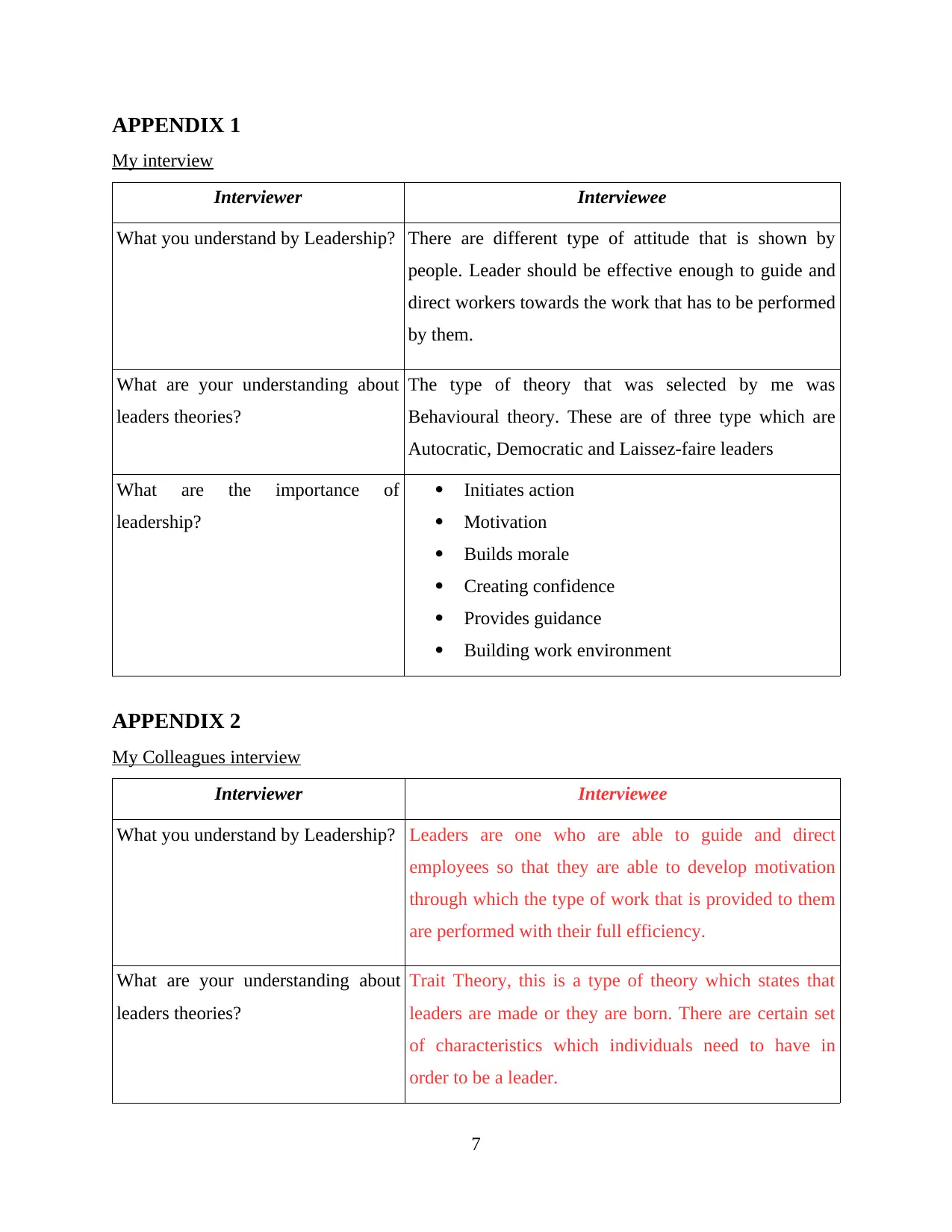
APPENDIX 1
My interview
Interviewer Interviewee
What you understand by Leadership? There are different type of attitude that is shown by
people. Leader should be effective enough to guide and
direct workers towards the work that has to be performed
by them.
What are your understanding about
leaders theories?
The type of theory that was selected by me was
Behavioural theory. These are of three type which are
Autocratic, Democratic and Laissez-faire leaders
What are the importance of
leadership?
Initiates action
Motivation
Builds morale
Creating confidence
Provides guidance
Building work environment
APPENDIX 2
My Colleagues interview
Interviewer Interviewee
What you understand by Leadership? Leaders are one who are able to guide and direct
employees so that they are able to develop motivation
through which the type of work that is provided to them
are performed with their full efficiency.
What are your understanding about
leaders theories?
Trait Theory, this is a type of theory which states that
leaders are made or they are born. There are certain set
of characteristics which individuals need to have in
order to be a leader.
7
My interview
Interviewer Interviewee
What you understand by Leadership? There are different type of attitude that is shown by
people. Leader should be effective enough to guide and
direct workers towards the work that has to be performed
by them.
What are your understanding about
leaders theories?
The type of theory that was selected by me was
Behavioural theory. These are of three type which are
Autocratic, Democratic and Laissez-faire leaders
What are the importance of
leadership?
Initiates action
Motivation
Builds morale
Creating confidence
Provides guidance
Building work environment
APPENDIX 2
My Colleagues interview
Interviewer Interviewee
What you understand by Leadership? Leaders are one who are able to guide and direct
employees so that they are able to develop motivation
through which the type of work that is provided to them
are performed with their full efficiency.
What are your understanding about
leaders theories?
Trait Theory, this is a type of theory which states that
leaders are made or they are born. There are certain set
of characteristics which individuals need to have in
order to be a leader.
7
⊘ This is a preview!⊘
Do you want full access?
Subscribe today to unlock all pages.
Trusted by 1+ million students worldwide

What are the importance of
leadership?
Crucial part in the success of any enterprise
Helps in influencing his subordinates to work
Best efforts so that goals could be attained
Helps in fulfilling the needs of his followers
8
leadership?
Crucial part in the success of any enterprise
Helps in influencing his subordinates to work
Best efforts so that goals could be attained
Helps in fulfilling the needs of his followers
8

1 out of 10


Related Documents


Your All-in-One AI-Powered Toolkit for Academic Success.
+13062052269
info@desklib.com
Available 24*7 on WhatsApp / Email
![[object Object]](/_next/static/media/star-bottom.7253800d.svg)
Unlock your academic potential
Copyright © 2020–2026 A2Z Services. All Rights Reserved. Developed and managed by ZUCOL.