Leadership and Management: Theories, Styles, and Self-Reflection
VerifiedAdded on 2024/04/24
|19
|4625
|111
Essay
AI Summary
This essay provides an overview of leadership and management, emphasizing their importance in today's business environment. It explores various leadership approaches, including individual, contextual, and relational perspectives, and discusses theories such as trait theory, skills theory, and behavioral theories. The essay also differentiates between leadership and management, highlighting the importance of adapting leadership styles to different situations. It further delves into situational leadership, path-goal theory, and relational approaches like servant leadership and transformational leadership. The study concludes by stressing the significance of understanding different leadership styles and their strengths and limitations for effective organizational performance. Desklib is a platform where students can find more solved assignments and study resources.
Leadership and management

Paraphrase This Document
Need a fresh take? Get an instant paraphrase of this document with our AI Paraphraser
ABSTRACT
In the business, the environment demands more work from fewer workforces, in order to stay a
step ahead the organization needs to employ the right leaders and managers who perform in an
effective manner. These two concepts can sometimes go hand in hand with the key differences as
well. Both the concepts are like wheels and collectively help to run the organisation.
Leadership and management are very useful practices to people’s success and that is of the
organisation. These two concepts serve as self study exercise to have knowledge of basic
management & leadership skills that can be applied to the various departments in the firm. This
study also aims to understand of various theories of leadership and management concept.
Management and leadership are like two categories of communications that includes written and
verbal as well.
In the business, the environment demands more work from fewer workforces, in order to stay a
step ahead the organization needs to employ the right leaders and managers who perform in an
effective manner. These two concepts can sometimes go hand in hand with the key differences as
well. Both the concepts are like wheels and collectively help to run the organisation.
Leadership and management are very useful practices to people’s success and that is of the
organisation. These two concepts serve as self study exercise to have knowledge of basic
management & leadership skills that can be applied to the various departments in the firm. This
study also aims to understand of various theories of leadership and management concept.
Management and leadership are like two categories of communications that includes written and
verbal as well.
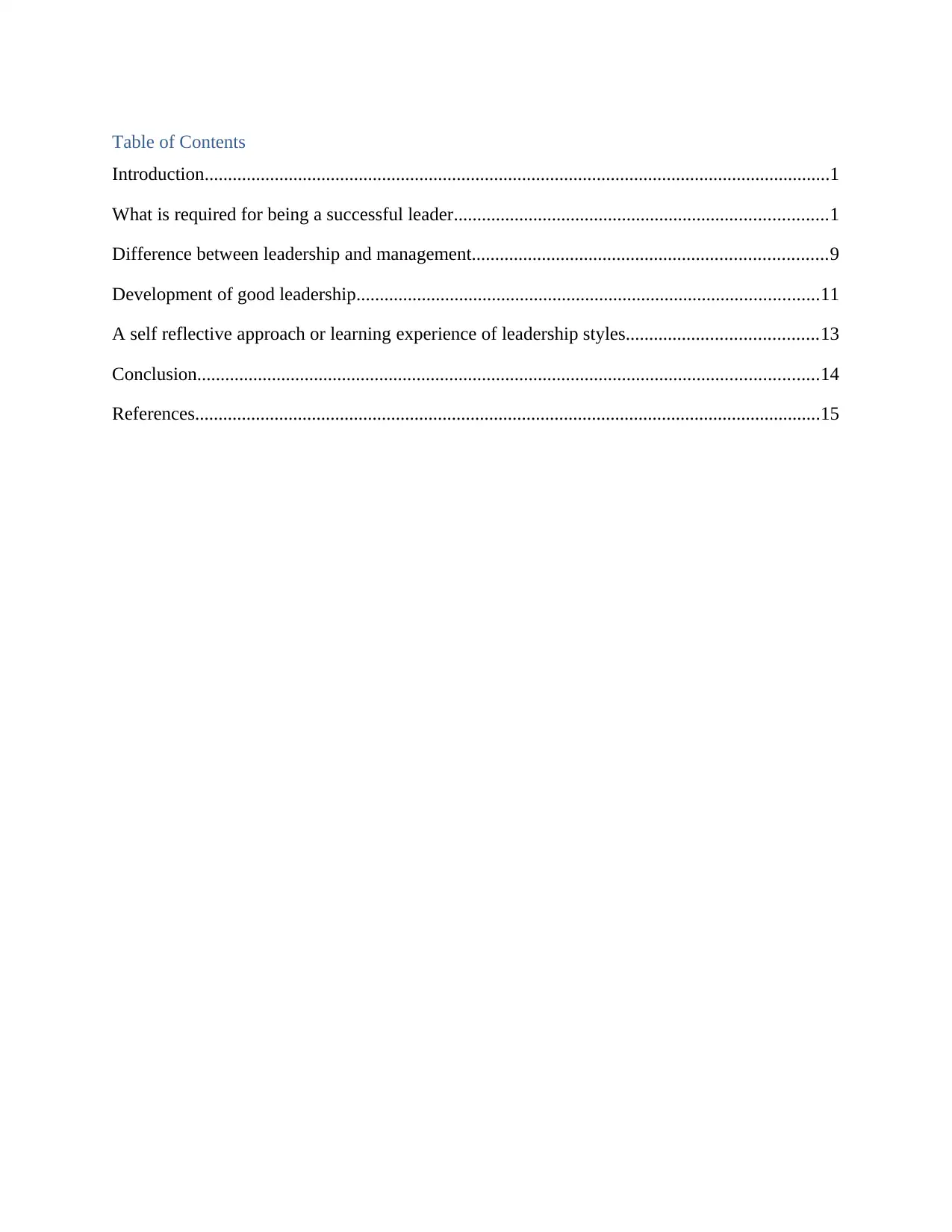
Table of Contents
Introduction......................................................................................................................................1
What is required for being a successful leader................................................................................1
Difference between leadership and management............................................................................9
Development of good leadership...................................................................................................11
A self reflective approach or learning experience of leadership styles.........................................13
Conclusion.....................................................................................................................................14
References......................................................................................................................................15
Introduction......................................................................................................................................1
What is required for being a successful leader................................................................................1
Difference between leadership and management............................................................................9
Development of good leadership...................................................................................................11
A self reflective approach or learning experience of leadership styles.........................................13
Conclusion.....................................................................................................................................14
References......................................................................................................................................15
⊘ This is a preview!⊘
Do you want full access?
Subscribe today to unlock all pages.

Trusted by 1+ million students worldwide
Introduction
Leadership and management are the concept which requires a precise and deep study to elaborate
its important and to develop these within the person or organization. Both are different in terms
of nature, quality and application but at the same time both have some similarities also as both
work for the attainment of goal. Whenever it is discussed about the development of leader, it
becomes very much important to know or to have the knowledge about every approach of
leadership which defines various theories, model, styles and practices of leadership. Here is the
study is helpful to have the idea about every approach to determine a leader’s behaviour in terms
of its development. Some differences also are there to differentiate both the practices to
understand concept in a better way.
What is required for being a successful leader
To get the answer or develop the view for this question, it is required to understand the basic
approach of the leadership. This leadership approaches can be divided into three categories as
individual, contextual and relational. The all theories of leadership can be categorised according
to this. Every approach has different theory which relates with the leadership style and pattern.
Every individual acts differently in every situation so if in terms of leadership development every
approach plays important role. Successful leader is not use a single approach or with the single
approach no effective leader can be developed but with the blend of various approaches or the
ability to adapt appropriate pattern according to the situation, can be a good or effective leader
(Northouse, 2015).
1
Leadership and management are the concept which requires a precise and deep study to elaborate
its important and to develop these within the person or organization. Both are different in terms
of nature, quality and application but at the same time both have some similarities also as both
work for the attainment of goal. Whenever it is discussed about the development of leader, it
becomes very much important to know or to have the knowledge about every approach of
leadership which defines various theories, model, styles and practices of leadership. Here is the
study is helpful to have the idea about every approach to determine a leader’s behaviour in terms
of its development. Some differences also are there to differentiate both the practices to
understand concept in a better way.
What is required for being a successful leader
To get the answer or develop the view for this question, it is required to understand the basic
approach of the leadership. This leadership approaches can be divided into three categories as
individual, contextual and relational. The all theories of leadership can be categorised according
to this. Every approach has different theory which relates with the leadership style and pattern.
Every individual acts differently in every situation so if in terms of leadership development every
approach plays important role. Successful leader is not use a single approach or with the single
approach no effective leader can be developed but with the blend of various approaches or the
ability to adapt appropriate pattern according to the situation, can be a good or effective leader
(Northouse, 2015).
1
Paraphrase This Document
Need a fresh take? Get an instant paraphrase of this document with our AI Paraphraser
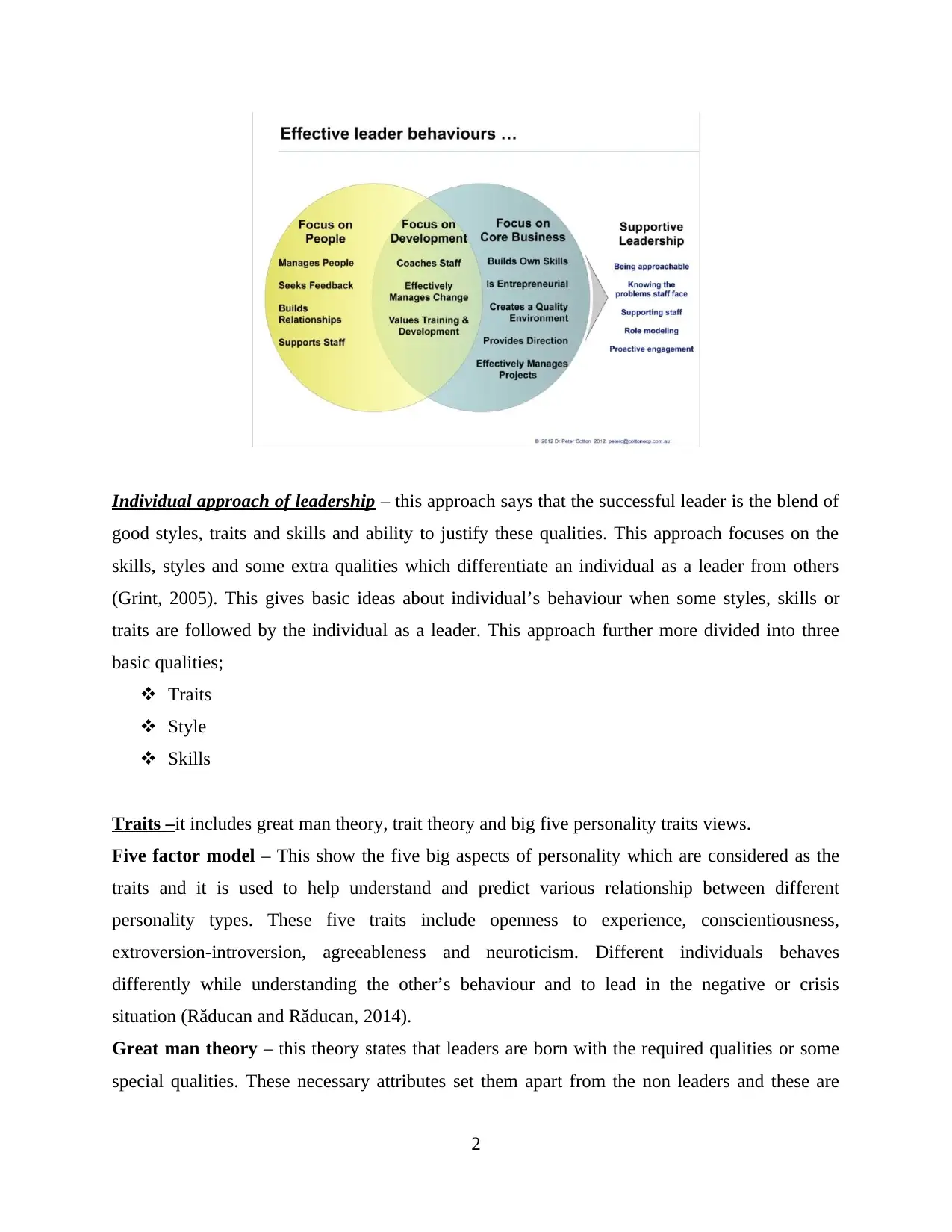
Individual approach of leadership – this approach says that the successful leader is the blend of
good styles, traits and skills and ability to justify these qualities. This approach focuses on the
skills, styles and some extra qualities which differentiate an individual as a leader from others
(Grint, 2005). This gives basic ideas about individual’s behaviour when some styles, skills or
traits are followed by the individual as a leader. This approach further more divided into three
basic qualities;
Traits
Style
Skills
Traits –it includes great man theory, trait theory and big five personality traits views.
Five factor model – This show the five big aspects of personality which are considered as the
traits and it is used to help understand and predict various relationship between different
personality types. These five traits include openness to experience, conscientiousness,
extroversion-introversion, agreeableness and neuroticism. Different individuals behaves
differently while understanding the other’s behaviour and to lead in the negative or crisis
situation (Răducan and Răducan, 2014).
Great man theory – this theory states that leaders are born with the required qualities or some
special qualities. These necessary attributes set them apart from the non leaders and these are
2
good styles, traits and skills and ability to justify these qualities. This approach focuses on the
skills, styles and some extra qualities which differentiate an individual as a leader from others
(Grint, 2005). This gives basic ideas about individual’s behaviour when some styles, skills or
traits are followed by the individual as a leader. This approach further more divided into three
basic qualities;
Traits
Style
Skills
Traits –it includes great man theory, trait theory and big five personality traits views.
Five factor model – This show the five big aspects of personality which are considered as the
traits and it is used to help understand and predict various relationship between different
personality types. These five traits include openness to experience, conscientiousness,
extroversion-introversion, agreeableness and neuroticism. Different individuals behaves
differently while understanding the other’s behaviour and to lead in the negative or crisis
situation (Răducan and Răducan, 2014).
Great man theory – this theory states that leaders are born with the required qualities or some
special qualities. These necessary attributes set them apart from the non leaders and these are
2
responsible for their assuming positions of authority. This theory supports the view that the
leaders re inborn it means they cannot be developed only comes from the inner side by the time
of birth. Leadership is seen as a blessing in this view without considering other aspect such as
training, education and human behaviour in terms of adapting good skills.
Trait theory - this approach says that some personality, social, physical and intellectual traits are
there which differentiate leaders from non leaders. This theory represents those virtues which are
specific but it also says that these can be acquired by the proper training and education (Bass and
Bass, 2009). This view of leadership has little predictive value. Some traits can be identified
which are as follows:
Intelligence
Physical features
Inner motivation
Maturity
Vision
Open- minded
Self confidence
Sense of responsibilities
Positive attitude
Fairness & objectivity
Skills - it consists Katz’s three skill theory, skills based model which represent more skill based
efficiency. Skills theory has grown from the flaw in the trait approach; traits are relatively fixed
that is why this theory supports skills to develop a successful leader.
Katz’s three skill theory or model – Robert Katz has identified three types of skills which are
very essential for a successful leader and that are as follows;
Technical – technical skills use to provide the leader’s ability to use different techniques to
achieve the goals.
Conceptual – it represents the knowledge of a leader for more abstract thought process, it means
the leader can easily see the whole by analysing and diagnosing of various states so leader would
be able to forecast (Northouse, 2015).
3
leaders re inborn it means they cannot be developed only comes from the inner side by the time
of birth. Leadership is seen as a blessing in this view without considering other aspect such as
training, education and human behaviour in terms of adapting good skills.
Trait theory - this approach says that some personality, social, physical and intellectual traits are
there which differentiate leaders from non leaders. This theory represents those virtues which are
specific but it also says that these can be acquired by the proper training and education (Bass and
Bass, 2009). This view of leadership has little predictive value. Some traits can be identified
which are as follows:
Intelligence
Physical features
Inner motivation
Maturity
Vision
Open- minded
Self confidence
Sense of responsibilities
Positive attitude
Fairness & objectivity
Skills - it consists Katz’s three skill theory, skills based model which represent more skill based
efficiency. Skills theory has grown from the flaw in the trait approach; traits are relatively fixed
that is why this theory supports skills to develop a successful leader.
Katz’s three skill theory or model – Robert Katz has identified three types of skills which are
very essential for a successful leader and that are as follows;
Technical – technical skills use to provide the leader’s ability to use different techniques to
achieve the goals.
Conceptual – it represents the knowledge of a leader for more abstract thought process, it means
the leader can easily see the whole by analysing and diagnosing of various states so leader would
be able to forecast (Northouse, 2015).
3
⊘ This is a preview!⊘
Do you want full access?
Subscribe today to unlock all pages.
Trusted by 1+ million students worldwide
Human – it is the ability to work with people. Actually these are the skills which enables
individual to become leader and help a leader to become effective leader.
Styles – style part of individual approach of leadership shows some patterns or some styles of
leadership which are really helpful for developing an effective or successful leader. It includes
behavioural theory, Lewin’s model and management grid.
Behavioural theories – this view of leadership do not support the trait theory and it attempts to
define leadership in terms of how leaders behave while trait view explains leadership on the
basis of what leaders are (Muenjohn and Armstrong, 2015). Leadership according to this theory
is an outcome of effective behaviour of role. According to this view, pattern of actions applied
by the individuals determines his or her leadership potential. Lewin’s model supports this
concept according to which the main different leadership styles are as follows;
Autocratic: This style of leadership allows leaders to settle on choices alone without considering
articulation or thoughts from other individuals. Leaders have the whole authority and instruct
their will on workforce. No individual worker can offer challenge to the choices of autocratic
leaders (Grint, 2015). This style is useful to people who require supervision intently. Inventive
people ordinarily not incline toward it.
Democratic: This style of leadership advances critical thinking recommendations from different
employees. In spite of the fact that the leader takes ultimate decision in each issue, his inclination
to permit people in the decision-making process not just helps the leader with new thoughts but
rather additionally helps his team with a feeling of reason and convenience. Democratic style
additionally includes gaining respect for leaders from his subordinates for having the quality to
be shared as opposed to controlling (Hendriks and Karsten, 2014).
Laissez-faire: This style allows a minimum of leadership functions and allows subordinates find
out solutions for the problems and to find their own roles and discuss their own work in their
own way without leader’s participation (Saeed.et.al, 2014). This style acts fittingly when driving
a group of exceptionally energetic and talented individuals who have done superb work
4
individual to become leader and help a leader to become effective leader.
Styles – style part of individual approach of leadership shows some patterns or some styles of
leadership which are really helpful for developing an effective or successful leader. It includes
behavioural theory, Lewin’s model and management grid.
Behavioural theories – this view of leadership do not support the trait theory and it attempts to
define leadership in terms of how leaders behave while trait view explains leadership on the
basis of what leaders are (Muenjohn and Armstrong, 2015). Leadership according to this theory
is an outcome of effective behaviour of role. According to this view, pattern of actions applied
by the individuals determines his or her leadership potential. Lewin’s model supports this
concept according to which the main different leadership styles are as follows;
Autocratic: This style of leadership allows leaders to settle on choices alone without considering
articulation or thoughts from other individuals. Leaders have the whole authority and instruct
their will on workforce. No individual worker can offer challenge to the choices of autocratic
leaders (Grint, 2015). This style is useful to people who require supervision intently. Inventive
people ordinarily not incline toward it.
Democratic: This style of leadership advances critical thinking recommendations from different
employees. In spite of the fact that the leader takes ultimate decision in each issue, his inclination
to permit people in the decision-making process not just helps the leader with new thoughts but
rather additionally helps his team with a feeling of reason and convenience. Democratic style
additionally includes gaining respect for leaders from his subordinates for having the quality to
be shared as opposed to controlling (Hendriks and Karsten, 2014).
Laissez-faire: This style allows a minimum of leadership functions and allows subordinates find
out solutions for the problems and to find their own roles and discuss their own work in their
own way without leader’s participation (Saeed.et.al, 2014). This style acts fittingly when driving
a group of exceptionally energetic and talented individuals who have done superb work
4
Paraphrase This Document
Need a fresh take? Get an instant paraphrase of this document with our AI Paraphraser
previously. Once a leader has certainty that his group is, proficient and spurred it is regularly best
to step back and let them get on with the work since any kind of intervention can produce
resentment and draw contrarily from their viability.
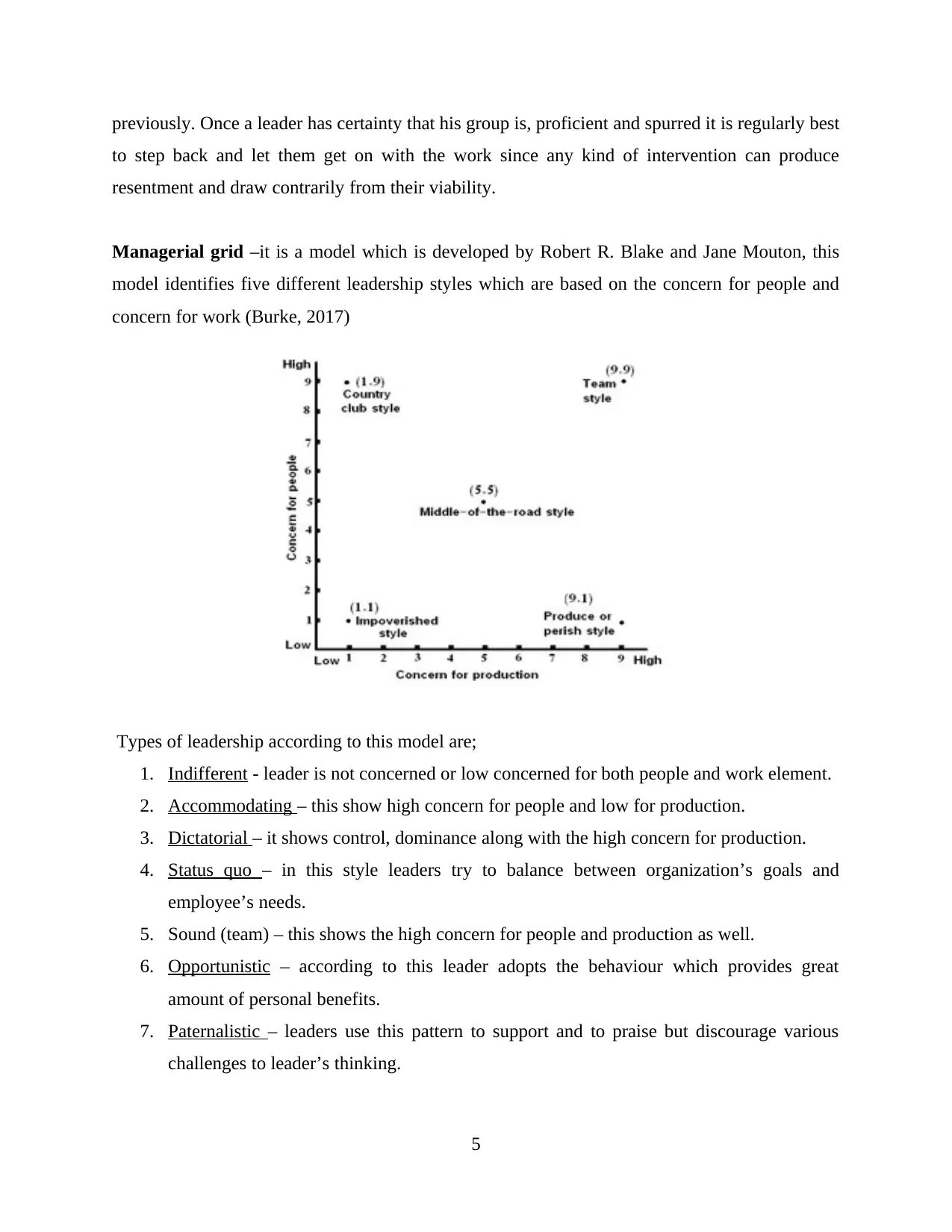
Managerial grid –it is a model which is developed by Robert R. Blake and Jane Mouton, this
model identifies five different leadership styles which are based on the concern for people and
concern for work (Burke, 2017)
Types of leadership according to this model are;
1. Indifferent - leader is not concerned or low concerned for both people and work element.
2. Accommodating – this show high concern for people and low for production.
3. Dictatorial – it shows control, dominance along with the high concern for production.
4. Status quo – in this style leaders try to balance between organization’s goals and
employee’s needs.
5. Sound (team) – this shows the high concern for people and production as well.
6. Opportunistic – according to this leader adopts the behaviour which provides great
amount of personal benefits.
7. Paternalistic – leaders use this pattern to support and to praise but discourage various
challenges to leader’s thinking.
5
to step back and let them get on with the work since any kind of intervention can produce
resentment and draw contrarily from their viability.
Managerial grid –it is a model which is developed by Robert R. Blake and Jane Mouton, this
model identifies five different leadership styles which are based on the concern for people and
concern for work (Burke, 2017)
Types of leadership according to this model are;
1. Indifferent - leader is not concerned or low concerned for both people and work element.
2. Accommodating – this show high concern for people and low for production.
3. Dictatorial – it shows control, dominance along with the high concern for production.
4. Status quo – in this style leaders try to balance between organization’s goals and
employee’s needs.
5. Sound (team) – this shows the high concern for people and production as well.
6. Opportunistic – according to this leader adopts the behaviour which provides great
amount of personal benefits.
7. Paternalistic – leaders use this pattern to support and to praise but discourage various
challenges to leader’s thinking.
5
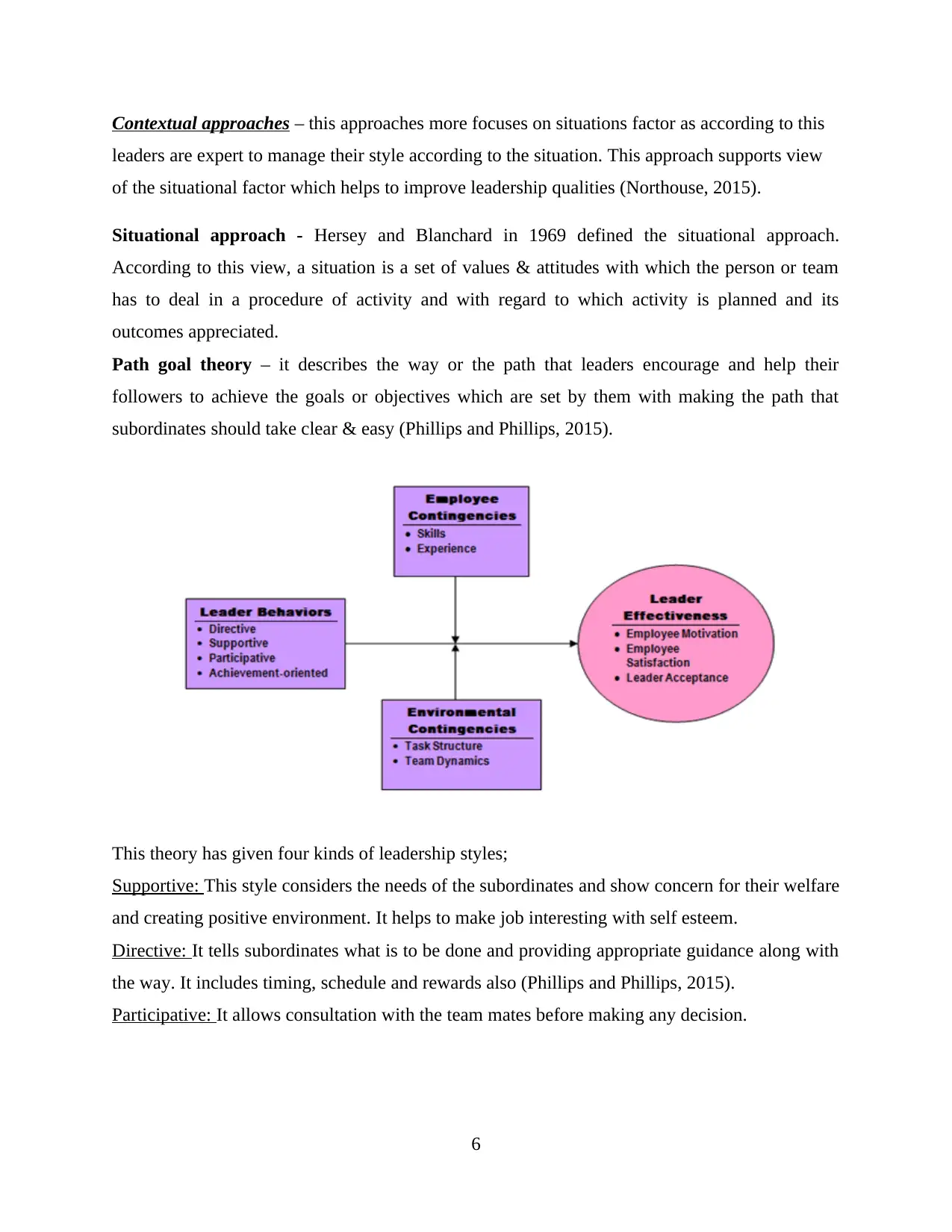
Contextual approaches – this approaches more focuses on situations factor as according to this
leaders are expert to manage their style according to the situation. This approach supports view
of the situational factor which helps to improve leadership qualities (Northouse, 2015).
Situational approach - Hersey and Blanchard in 1969 defined the situational approach.
According to this view, a situation is a set of values & attitudes with which the person or team
has to deal in a procedure of activity and with regard to which activity is planned and its
outcomes appreciated.
Path goal theory – it describes the way or the path that leaders encourage and help their
followers to achieve the goals or objectives which are set by them with making the path that
subordinates should take clear & easy (Phillips and Phillips, 2015).
This theory has given four kinds of leadership styles;
Supportive: This style considers the needs of the subordinates and show concern for their welfare
and creating positive environment. It helps to make job interesting with self esteem.
Directive: It tells subordinates what is to be done and providing appropriate guidance along with
the way. It includes timing, schedule and rewards also (Phillips and Phillips, 2015).
Participative: It allows consultation with the team mates before making any decision.
6
leaders are expert to manage their style according to the situation. This approach supports view
of the situational factor which helps to improve leadership qualities (Northouse, 2015).
Situational approach - Hersey and Blanchard in 1969 defined the situational approach.
According to this view, a situation is a set of values & attitudes with which the person or team
has to deal in a procedure of activity and with regard to which activity is planned and its
outcomes appreciated.
Path goal theory – it describes the way or the path that leaders encourage and help their
followers to achieve the goals or objectives which are set by them with making the path that
subordinates should take clear & easy (Phillips and Phillips, 2015).
This theory has given four kinds of leadership styles;
Supportive: This style considers the needs of the subordinates and show concern for their welfare
and creating positive environment. It helps to make job interesting with self esteem.
Directive: It tells subordinates what is to be done and providing appropriate guidance along with
the way. It includes timing, schedule and rewards also (Phillips and Phillips, 2015).
Participative: It allows consultation with the team mates before making any decision.
6
⊘ This is a preview!⊘
Do you want full access?
Subscribe today to unlock all pages.
Trusted by 1+ million students worldwide
Achievement oriented: It includes setting goals which are challenging in nature, both in task &
self improvement. High standard are set and result are expected accordingly and leaders show
faith in subordinate’s capabilities (Northouse, 2015).
Relational approach – this approach focuses on the matter that a successful leader is very much
able to develop a valuable and successful relationship with the others. This contains different
given theories;
Servant leadership – Servant leadership aims at serving. In servant leadership the leader first
thinks about the team and serving the team mates. A servant leader focuses more on the growth
and well being of people.
Transformational – In the transformational leaders, the leaders have good communication with
the team mates to achieve the goals. As a result it helps the employees to direct their efforts to
achieve the goals which are clearly communicated by leader. It requires the active participation
of management for attaining goals. Leaders focuses on key critical activities and delegate other
tasks to the team members (Mandell and Pherwani, 2015).
Leader member exchange theory – this view focuses on two way relationship between leaders
& followers and suggests that leader can develop an exchange with each of its follower and that
the virtue of this relationship influences follower’s overall performance.
Cross cultural theory of leadership – it is one more aspect which is very important while taking
about of development of successful leader; because this is the aspect which shows the
understanding of different individuals of different culture interact with each other. So it is
developed as a direction to understand leaders who work in the new market (Ayman and
Korabik, 2010).
Appreciation of the strength and limitations of the leadership styles
The abstract of all the leadership approaches determines the styles of leadership and that all are
more or less same in the nature for instance autocratic leadership style is similar with the
7
self improvement. High standard are set and result are expected accordingly and leaders show
faith in subordinate’s capabilities (Northouse, 2015).
Relational approach – this approach focuses on the matter that a successful leader is very much
able to develop a valuable and successful relationship with the others. This contains different
given theories;
Servant leadership – Servant leadership aims at serving. In servant leadership the leader first
thinks about the team and serving the team mates. A servant leader focuses more on the growth
and well being of people.
Transformational – In the transformational leaders, the leaders have good communication with
the team mates to achieve the goals. As a result it helps the employees to direct their efforts to
achieve the goals which are clearly communicated by leader. It requires the active participation
of management for attaining goals. Leaders focuses on key critical activities and delegate other
tasks to the team members (Mandell and Pherwani, 2015).
Leader member exchange theory – this view focuses on two way relationship between leaders
& followers and suggests that leader can develop an exchange with each of its follower and that
the virtue of this relationship influences follower’s overall performance.
Cross cultural theory of leadership – it is one more aspect which is very important while taking
about of development of successful leader; because this is the aspect which shows the
understanding of different individuals of different culture interact with each other. So it is
developed as a direction to understand leaders who work in the new market (Ayman and
Korabik, 2010).
Appreciation of the strength and limitations of the leadership styles
The abstract of all the leadership approaches determines the styles of leadership and that all are
more or less same in the nature for instance autocratic leadership style is similar with the
7
Paraphrase This Document
Need a fresh take? Get an instant paraphrase of this document with our AI Paraphraser
dictatorial pattern of individual approach and it is almost similar with the directive style of
contextual approach so it is seen that in the extract all the styles are similar with each other
(Limsila and Ogunlana, 2008).
Transformational leadership provides a better way to do something and helps to cater the niche
market in terms of business but at same time it puts people off with the amount of involved risk
because it creates challenge amongst the market leaders and also generates conflict with people
who resist change.
Pace setter leadership gives true vision which has potential to revolutionize the market, keeps
two steps ahead and promotes empowerment with people’s deep values. But on the other hand it
is outdone by the other transformational leader, and followers may get burnout because of trying
to keep pace.
Directive or coaching leadership transfers knowledge and it is good for successors because it
generates feeling of empowerment with motivation but again sometimes there can be cross
between the thin line of coaching and micro managing (Kotterman, 2006). It also discouraging
for independent workers so it cannot work for large team and organization.
Authoritative style does great in crisis situation and gets things done but it hampers creativity
and also creates conflict between leader and the members who know more than leader. It
generates fear among staff rather than respect.
If charismatic leadership inspire people towards goals and it is more approachable than the other
style but sometimes it lacks in execution, it this style builds strong relationship also repairs the
sore relationships but sometimes can be for self promoting, it also miss the technical & practical
aspect as more focus is given only towards the human relations.
8
contextual approach so it is seen that in the extract all the styles are similar with each other
(Limsila and Ogunlana, 2008).
Transformational leadership provides a better way to do something and helps to cater the niche
market in terms of business but at same time it puts people off with the amount of involved risk
because it creates challenge amongst the market leaders and also generates conflict with people
who resist change.
Pace setter leadership gives true vision which has potential to revolutionize the market, keeps
two steps ahead and promotes empowerment with people’s deep values. But on the other hand it
is outdone by the other transformational leader, and followers may get burnout because of trying
to keep pace.
Directive or coaching leadership transfers knowledge and it is good for successors because it
generates feeling of empowerment with motivation but again sometimes there can be cross
between the thin line of coaching and micro managing (Kotterman, 2006). It also discouraging
for independent workers so it cannot work for large team and organization.
Authoritative style does great in crisis situation and gets things done but it hampers creativity
and also creates conflict between leader and the members who know more than leader. It
generates fear among staff rather than respect.
If charismatic leadership inspire people towards goals and it is more approachable than the other
style but sometimes it lacks in execution, it this style builds strong relationship also repairs the
sore relationships but sometimes can be for self promoting, it also miss the technical & practical
aspect as more focus is given only towards the human relations.
8
Difference between leadership and management
Meaning and concept of leadership – it can be described as quality to influence people in order
to achieve the objectives. So goals are attained willingly and effectively by the effective
leadership, it is not exactly same as management or it is said that it is one of the strong and major
element of the management. It cannot be defined as a lesson to teach but it is a quality that
possessed by only few people and the person who possess it, called leader. Leader is the one who
has many of the followers (Răducan and Răducan, 2014). So leadership is understood as an
activity of guiding others to work together for attaining the final aim that is why it needs a good
vision to foresight the things. In terms of business it is not only restricted within the person, but
the company can also acquire the leadership by defeating the competitors such as in market,
production, bran image etc.
Meaning and concept of management – it is discipline of managing things in the best way. It is
the art of getting the things done through and with the other people. It incorporates the complete
balance of men, machine, material, methods and money in order to achieve goals (Răducan and
Răducan, 2014). Actually management process starts right from the home as how a house wife
managing all the households and budgeting the things, organising all the house hold task,
planning for the finance in advance so all of these are nothing but the management process and
that is all what management is.
Key differences
Leadership is a virtue to lead people by encouraging them whereas management is a
procedure of managing the activities of the firm.
Leadership needs trust of subordinates on their leader whereas management requires
control of manager over its employee.
Leadership is a skill which helps in influencing followers whereas management the
quality of ruling.
Leadership aims at establishing the principles & guidelines which can be followed by
others whereas in management the policies and procedures are drafted by the
management team and are implemented and followed by the employees.
Leadership is a proactive whereas management is reactive.
Leadership helps to bring change whereas management helps to bring stability.
9
Meaning and concept of leadership – it can be described as quality to influence people in order
to achieve the objectives. So goals are attained willingly and effectively by the effective
leadership, it is not exactly same as management or it is said that it is one of the strong and major
element of the management. It cannot be defined as a lesson to teach but it is a quality that
possessed by only few people and the person who possess it, called leader. Leader is the one who
has many of the followers (Răducan and Răducan, 2014). So leadership is understood as an
activity of guiding others to work together for attaining the final aim that is why it needs a good
vision to foresight the things. In terms of business it is not only restricted within the person, but
the company can also acquire the leadership by defeating the competitors such as in market,
production, bran image etc.
Meaning and concept of management – it is discipline of managing things in the best way. It is
the art of getting the things done through and with the other people. It incorporates the complete
balance of men, machine, material, methods and money in order to achieve goals (Răducan and
Răducan, 2014). Actually management process starts right from the home as how a house wife
managing all the households and budgeting the things, organising all the house hold task,
planning for the finance in advance so all of these are nothing but the management process and
that is all what management is.
Key differences
Leadership is a virtue to lead people by encouraging them whereas management is a
procedure of managing the activities of the firm.
Leadership needs trust of subordinates on their leader whereas management requires
control of manager over its employee.
Leadership is a skill which helps in influencing followers whereas management the
quality of ruling.
Leadership aims at establishing the principles & guidelines which can be followed by
others whereas in management the policies and procedures are drafted by the
management team and are implemented and followed by the employees.
Leadership is a proactive whereas management is reactive.
Leadership helps to bring change whereas management helps to bring stability.
9
⊘ This is a preview!⊘
Do you want full access?
Subscribe today to unlock all pages.
Trusted by 1+ million students worldwide

1 out of 19


Related Documents


Your All-in-One AI-Powered Toolkit for Academic Success.
+13062052269
info@desklib.com
Available 24*7 on WhatsApp / Email
![[object Object]](/_next/static/media/star-bottom.7253800d.svg)
Unlock your academic potential
Copyright © 2020–2026 A2Z Services. All Rights Reserved. Developed and managed by ZUCOL.