Analyzing Leadership and Management Roles: The Toyota Plc Example
VerifiedAdded on 2020/06/04
|17
|4722
|32
Report
AI Summary
This report provides an in-depth analysis of leadership and management roles, using Toyota Plc as a case study. It begins by defining and comparing the roles and characteristics of leaders and managers, highlighting their distinct responsibilities in achieving organizational goals. The report then explores various leadership theories, including the Great Man theory, trait theory, contingency leadership, and situational leadership, and how they apply within Toyota Plc's operational context. The report further examines the functions of leaders and managers in different situations, such as planning, organizing, staffing, coordinating, and controlling, and how these functions contribute to Toyota's business strategies and decision-making processes. The report concludes by discussing the importance of adapting leadership styles to various situations and the impact of these styles on employee motivation and overall organizational success. The case study of Toyota Plc offers practical insights into how effective leadership and management practices can drive business growth and efficiency in the automotive industry.
MANAGEMENT AND
OPERATIONS
OPERATIONS

Paraphrase This Document
Need a fresh take? Get an instant paraphrase of this document with our AI Paraphraser

INTRODUCTION
Management and Operation an activity of administration of business practices for
developing high level of quality and within an organization. It makes certain goals in
converting labour and material into services and goods. This report is prepared in
defining of role of leaders and managers in an enterprise which helps in developing quality
products and increase efficiency. In report we have studied case of Toyota Plc(White, 2016 ). A
company in Japan which is among the world leader in auto mobile sector . The company is
known for business planning and effective business operations which are being executed at the
time of manufacturing of their products (Chen and et. al., 2011). This management activities
also includes effective planning in utilisation of resources and efficiently fulfil requirements of
their customers. Through report has thrown light on differences in roles between managers and
leaders and determine their functions and roles. It also describes values, importance and
approaches of business. It also discuss factors that affect decision makings and operational
management in business organisation, this report also includes importance of different
management theories and leadership styles.
TASK 1
P. Define and compare the different roles and characteristics of a leader and a manager
Toyota Plc was founded in 1965 having headquarter in Burgh Heath, Surrey, UK. It deals
purely in auto mobile company. It is a fast developing company having innovative ideas and
better organisational culture. Due to this they able to dominate worldwide market in very short
period of time. They used to follow old and traditional structure of Japan ( strong centralised
hierarchy which is just like spoke and wheel structure). In this structure all the departments of
organisation are connected to one singe decision makers, this structure has helped them to
monitor and control all of their branches in all over the world.
Manager – A manager is responsible for designing and managing work of an
organisation for fulfilling their goals and pre determined objectives. To accomplish the objective
successfully managers make certain policies and strategies and plans for staffs and employee to
accomplish their target. Managers are also responsible for monitoring their employee and make
available all required elements which enhances their skills. Managers are always part of top
1
Management and Operation an activity of administration of business practices for
developing high level of quality and within an organization. It makes certain goals in
converting labour and material into services and goods. This report is prepared in
defining of role of leaders and managers in an enterprise which helps in developing quality
products and increase efficiency. In report we have studied case of Toyota Plc(White, 2016 ). A
company in Japan which is among the world leader in auto mobile sector . The company is
known for business planning and effective business operations which are being executed at the
time of manufacturing of their products (Chen and et. al., 2011). This management activities
also includes effective planning in utilisation of resources and efficiently fulfil requirements of
their customers. Through report has thrown light on differences in roles between managers and
leaders and determine their functions and roles. It also describes values, importance and
approaches of business. It also discuss factors that affect decision makings and operational
management in business organisation, this report also includes importance of different
management theories and leadership styles.
TASK 1
P. Define and compare the different roles and characteristics of a leader and a manager
Toyota Plc was founded in 1965 having headquarter in Burgh Heath, Surrey, UK. It deals
purely in auto mobile company. It is a fast developing company having innovative ideas and
better organisational culture. Due to this they able to dominate worldwide market in very short
period of time. They used to follow old and traditional structure of Japan ( strong centralised
hierarchy which is just like spoke and wheel structure). In this structure all the departments of
organisation are connected to one singe decision makers, this structure has helped them to
monitor and control all of their branches in all over the world.
Manager – A manager is responsible for designing and managing work of an
organisation for fulfilling their goals and pre determined objectives. To accomplish the objective
successfully managers make certain policies and strategies and plans for staffs and employee to
accomplish their target. Managers are also responsible for monitoring their employee and make
available all required elements which enhances their skills. Managers are always part of top
1
⊘ This is a preview!⊘
Do you want full access?
Subscribe today to unlock all pages.

Trusted by 1+ million students worldwide
level management who guides and instruct leaders in performing all operations in an
organisation
Leaders- leadership position is a goal oriented and task oriented . They make plans to
achieve their goals in specific time period for that they must make plan according to the target,
play a very vital role in motivating their employee and having skills like inheritance and
influential communication (Chen and et. al., 2011). Guide their employee to work in a goal
oriented manner. The major prospect of a leader is to increase their productivity and efficiency
on their enterprise.
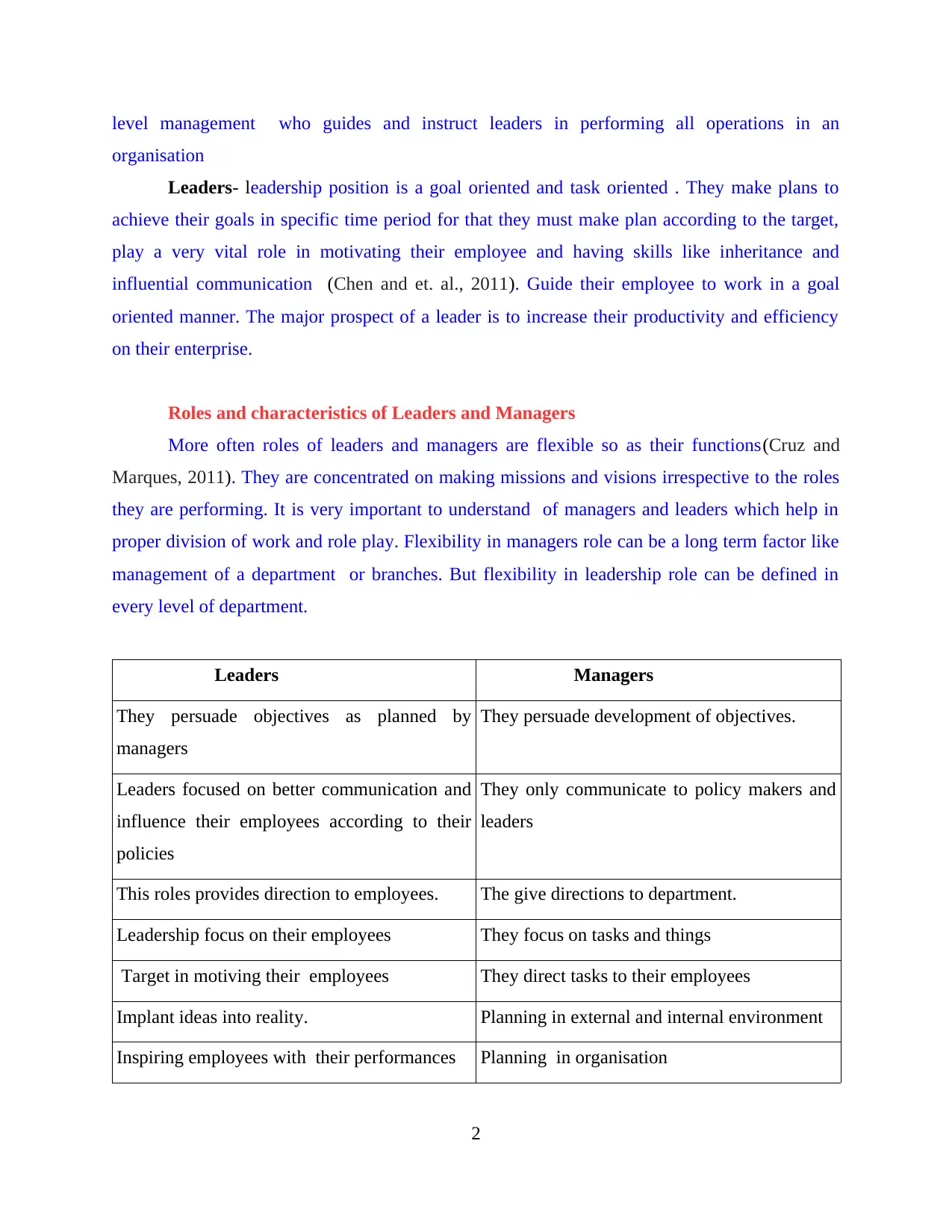
Roles and characteristics of Leaders and Managers
More often roles of leaders and managers are flexible so as their functions(Cruz and
Marques, 2011). They are concentrated on making missions and visions irrespective to the roles
they are performing. It is very important to understand of managers and leaders which help in
proper division of work and role play. Flexibility in managers role can be a long term factor like
management of a department or branches. But flexibility in leadership role can be defined in
every level of department.
Leaders Managers
They persuade objectives as planned by
managers
They persuade development of objectives.
Leaders focused on better communication and
influence their employees according to their
policies
They only communicate to policy makers and
leaders
This roles provides direction to employees. The give directions to department.
Leadership focus on their employees They focus on tasks and things
Target in motiving their employees They direct tasks to their employees
Implant ideas into reality. Planning in external and internal environment
Inspiring employees with their performances Planning in organisation
2
organisation
Leaders- leadership position is a goal oriented and task oriented . They make plans to
achieve their goals in specific time period for that they must make plan according to the target,
play a very vital role in motivating their employee and having skills like inheritance and
influential communication (Chen and et. al., 2011). Guide their employee to work in a goal
oriented manner. The major prospect of a leader is to increase their productivity and efficiency
on their enterprise.
Roles and characteristics of Leaders and Managers
More often roles of leaders and managers are flexible so as their functions(Cruz and
Marques, 2011). They are concentrated on making missions and visions irrespective to the roles
they are performing. It is very important to understand of managers and leaders which help in
proper division of work and role play. Flexibility in managers role can be a long term factor like
management of a department or branches. But flexibility in leadership role can be defined in
every level of department.
Leaders Managers
They persuade objectives as planned by
managers
They persuade development of objectives.
Leaders focused on better communication and
influence their employees according to their
policies
They only communicate to policy makers and
leaders
This roles provides direction to employees. The give directions to department.
Leadership focus on their employees They focus on tasks and things
Target in motiving their employees They direct tasks to their employees
Implant ideas into reality. Planning in external and internal environment
Inspiring employees with their performances Planning in organisation
2
Paraphrase This Document
Need a fresh take? Get an instant paraphrase of this document with our AI Paraphraser
In Toyota Plc. The business mainly deals with business activities related to
manufacturing of auto mobile products like assembly, sales and design in Japan and other global
market like Asia or North America(Cruz and Marques, 2011). Company is known for making
effectual planning and strategies of envelopment and growth. They have analyse market in Asian
continents and predicted opportunities of growth in these market making it an appreciable
prospect of a manager in profit gaining activity(Expósito, 2016). This defined role and their
effectiveness helps in deeply penetrating a market.
MI. Different roles of leaders and managers
Two most effective theories which defines roles of managers are Great man theory and
trait theory Great man theory of leadership- this theory is a scientific theory in identification of
different properties of leaders and analyse their affectivity in performing leadership roles. This
theory believes that great leaders are born while dealing with difficult situation in business
environment. This theory was given by Thomas Carlyle (Fayol, 2016). This is an ancient theory
but are effective in business environment
Trait theory - This theory believe that people have leadership genes are transferred from
parent to their next generation. This inherited quality help them in prosper in life. Certain
qualities which are inherited are creativity, sense of responsibility, value education etc. this
theory was prescribed by Gordon All port. This analysis focus on factors like physical, mental
and social characteristic to understand combined characteristics.
3
manufacturing of auto mobile products like assembly, sales and design in Japan and other global
market like Asia or North America(Cruz and Marques, 2011). Company is known for making
effectual planning and strategies of envelopment and growth. They have analyse market in Asian
continents and predicted opportunities of growth in these market making it an appreciable
prospect of a manager in profit gaining activity(Expósito, 2016). This defined role and their
effectiveness helps in deeply penetrating a market.
MI. Different roles of leaders and managers
Two most effective theories which defines roles of managers are Great man theory and
trait theory Great man theory of leadership- this theory is a scientific theory in identification of
different properties of leaders and analyse their affectivity in performing leadership roles. This
theory believes that great leaders are born while dealing with difficult situation in business
environment. This theory was given by Thomas Carlyle (Fayol, 2016). This is an ancient theory
but are effective in business environment
Trait theory - This theory believe that people have leadership genes are transferred from
parent to their next generation. This inherited quality help them in prosper in life. Certain
qualities which are inherited are creativity, sense of responsibility, value education etc. this
theory was prescribed by Gordon All port. This analysis focus on factors like physical, mental
and social characteristic to understand combined characteristics.
3
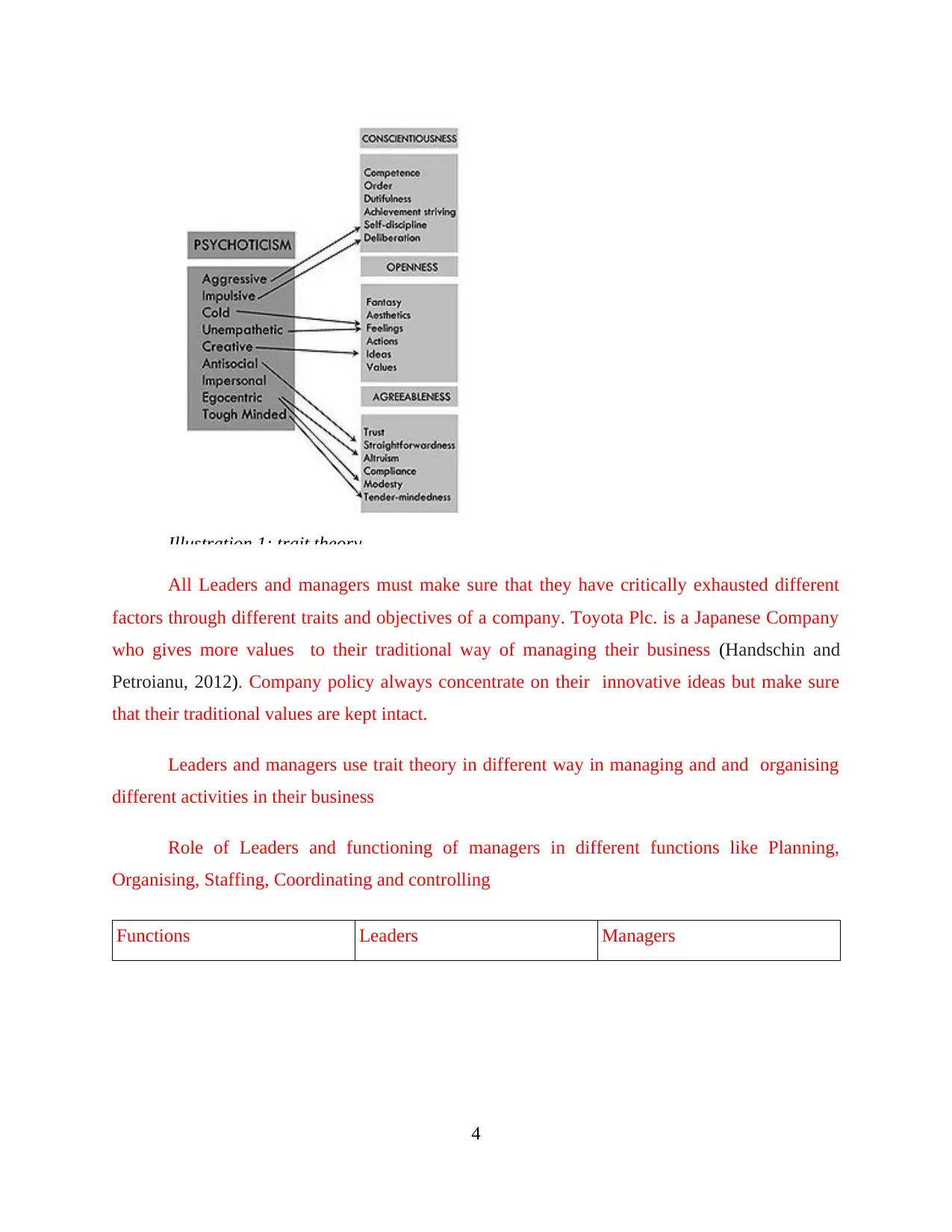
Illustration 1: trait theory
All Leaders and managers must make sure that they have critically exhausted different
factors through different traits and objectives of a company. Toyota Plc. is a Japanese Company
who gives more values to their traditional way of managing their business (Handschin and
Petroianu, 2012). Company policy always concentrate on their innovative ideas but make sure
that their traditional values are kept intact.
Leaders and managers use trait theory in different way in managing and and organising
different activities in their business
Role of Leaders and functioning of managers in different functions like Planning,
Organising, Staffing, Coordinating and controlling
Functions Leaders Managers
4
All Leaders and managers must make sure that they have critically exhausted different
factors through different traits and objectives of a company. Toyota Plc. is a Japanese Company
who gives more values to their traditional way of managing their business (Handschin and
Petroianu, 2012). Company policy always concentrate on their innovative ideas but make sure
that their traditional values are kept intact.
Leaders and managers use trait theory in different way in managing and and organising
different activities in their business
Role of Leaders and functioning of managers in different functions like Planning,
Organising, Staffing, Coordinating and controlling
Functions Leaders Managers
4
⊘ This is a preview!⊘
Do you want full access?
Subscribe today to unlock all pages.
Trusted by 1+ million students worldwide
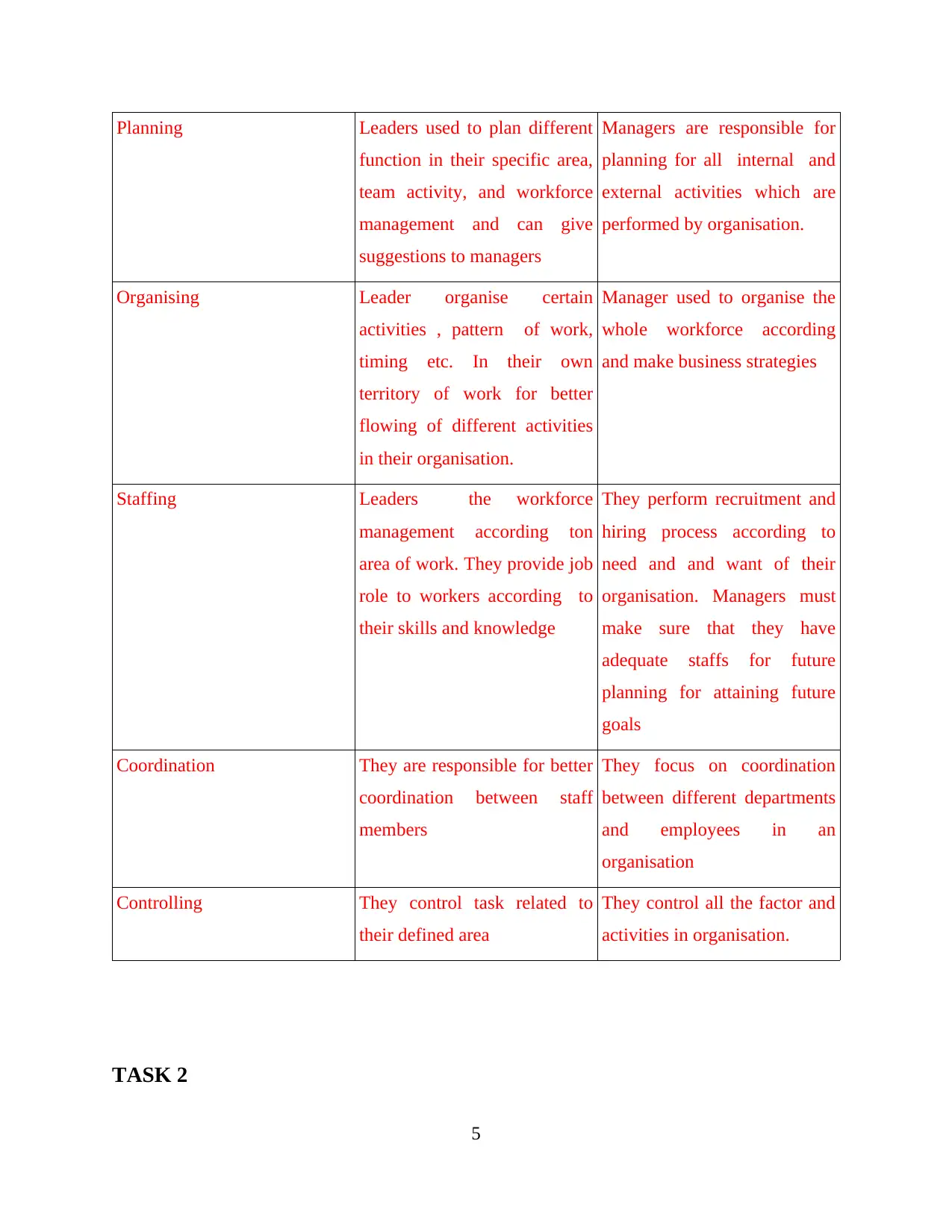
Planning Leaders used to plan different
function in their specific area,
team activity, and workforce
management and can give
suggestions to managers
Managers are responsible for
planning for all internal and
external activities which are
performed by organisation.
Organising Leader organise certain
activities , pattern of work,
timing etc. In their own
territory of work for better
flowing of different activities
in their organisation.
Manager used to organise the
whole workforce according
and make business strategies
Staffing Leaders the workforce
management according ton
area of work. They provide job
role to workers according to
their skills and knowledge
They perform recruitment and
hiring process according to
need and and want of their
organisation. Managers must
make sure that they have
adequate staffs for future
planning for attaining future
goals
Coordination They are responsible for better
coordination between staff
members
They focus on coordination
between different departments
and employees in an
organisation
Controlling They control task related to
their defined area
They control all the factor and
activities in organisation.
TASK 2
5
function in their specific area,
team activity, and workforce
management and can give
suggestions to managers
Managers are responsible for
planning for all internal and
external activities which are
performed by organisation.
Organising Leader organise certain
activities , pattern of work,
timing etc. In their own
territory of work for better
flowing of different activities
in their organisation.
Manager used to organise the
whole workforce according
and make business strategies
Staffing Leaders the workforce
management according ton
area of work. They provide job
role to workers according to
their skills and knowledge
They perform recruitment and
hiring process according to
need and and want of their
organisation. Managers must
make sure that they have
adequate staffs for future
planning for attaining future
goals
Coordination They are responsible for better
coordination between staff
members
They focus on coordination
between different departments
and employees in an
organisation
Controlling They control task related to
their defined area
They control all the factor and
activities in organisation.
TASK 2
5
Paraphrase This Document
Need a fresh take? Get an instant paraphrase of this document with our AI Paraphraser
P2. Role of a leader and the function of a manager in difference situations
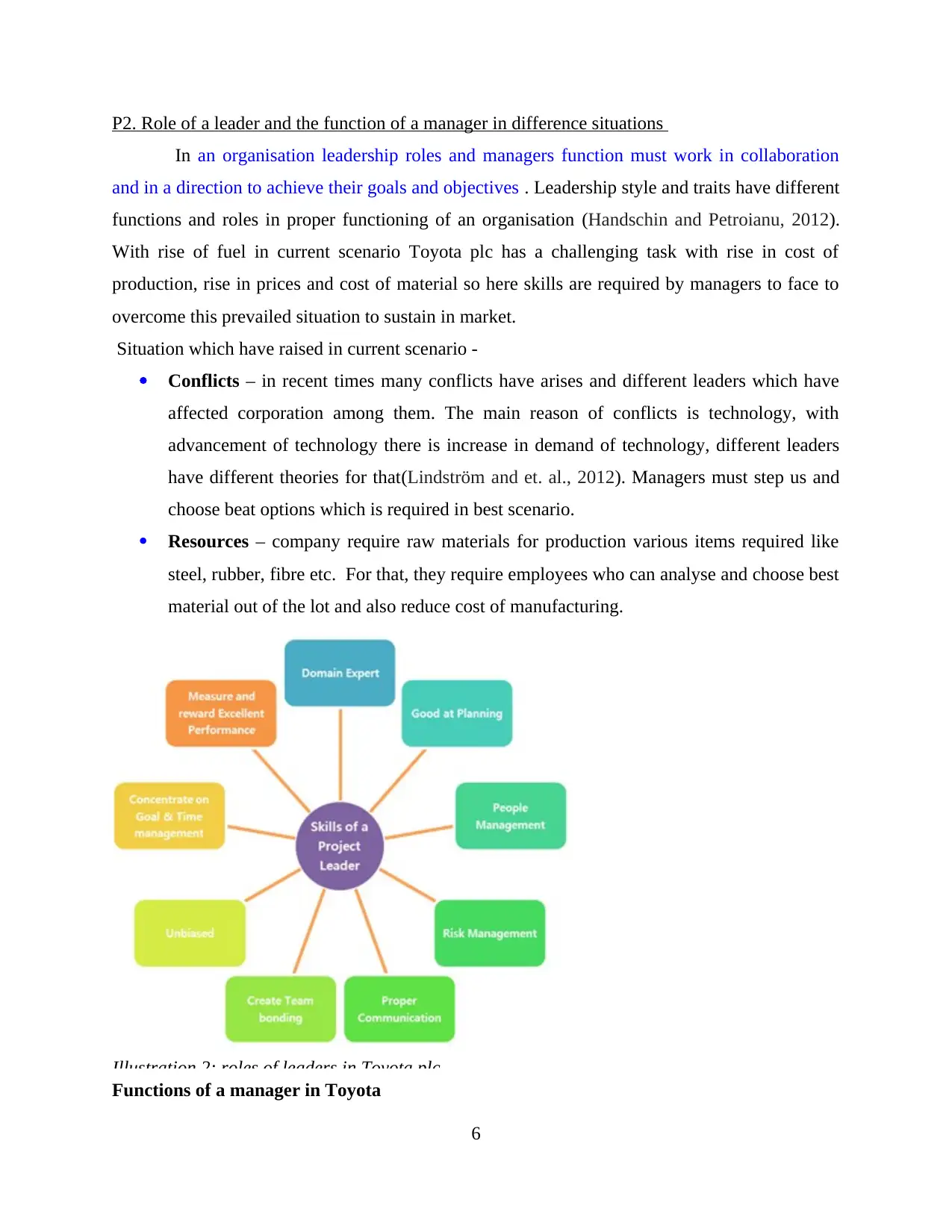
In an organisation leadership roles and managers function must work in collaboration
and in a direction to achieve their goals and objectives . Leadership style and traits have different
functions and roles in proper functioning of an organisation (Handschin and Petroianu, 2012).
With rise of fuel in current scenario Toyota plc has a challenging task with rise in cost of
production, rise in prices and cost of material so here skills are required by managers to face to
overcome this prevailed situation to sustain in market.
Situation which have raised in current scenario -
Conflicts – in recent times many conflicts have arises and different leaders which have
affected corporation among them. The main reason of conflicts is technology, with
advancement of technology there is increase in demand of technology, different leaders
have different theories for that(Lindström and et. al., 2012). Managers must step us and
choose beat options which is required in best scenario.
Resources – company require raw materials for production various items required like
steel, rubber, fibre etc. For that, they require employees who can analyse and choose best
material out of the lot and also reduce cost of manufacturing.
Illustration 2: roles of leaders in Toyota plc.
Functions of a manager in Toyota
6
In an organisation leadership roles and managers function must work in collaboration
and in a direction to achieve their goals and objectives . Leadership style and traits have different
functions and roles in proper functioning of an organisation (Handschin and Petroianu, 2012).
With rise of fuel in current scenario Toyota plc has a challenging task with rise in cost of
production, rise in prices and cost of material so here skills are required by managers to face to
overcome this prevailed situation to sustain in market.
Situation which have raised in current scenario -
Conflicts – in recent times many conflicts have arises and different leaders which have
affected corporation among them. The main reason of conflicts is technology, with
advancement of technology there is increase in demand of technology, different leaders
have different theories for that(Lindström and et. al., 2012). Managers must step us and
choose beat options which is required in best scenario.
Resources – company require raw materials for production various items required like
steel, rubber, fibre etc. For that, they require employees who can analyse and choose best
material out of the lot and also reduce cost of manufacturing.
Illustration 2: roles of leaders in Toyota plc.
Functions of a manager in Toyota
6
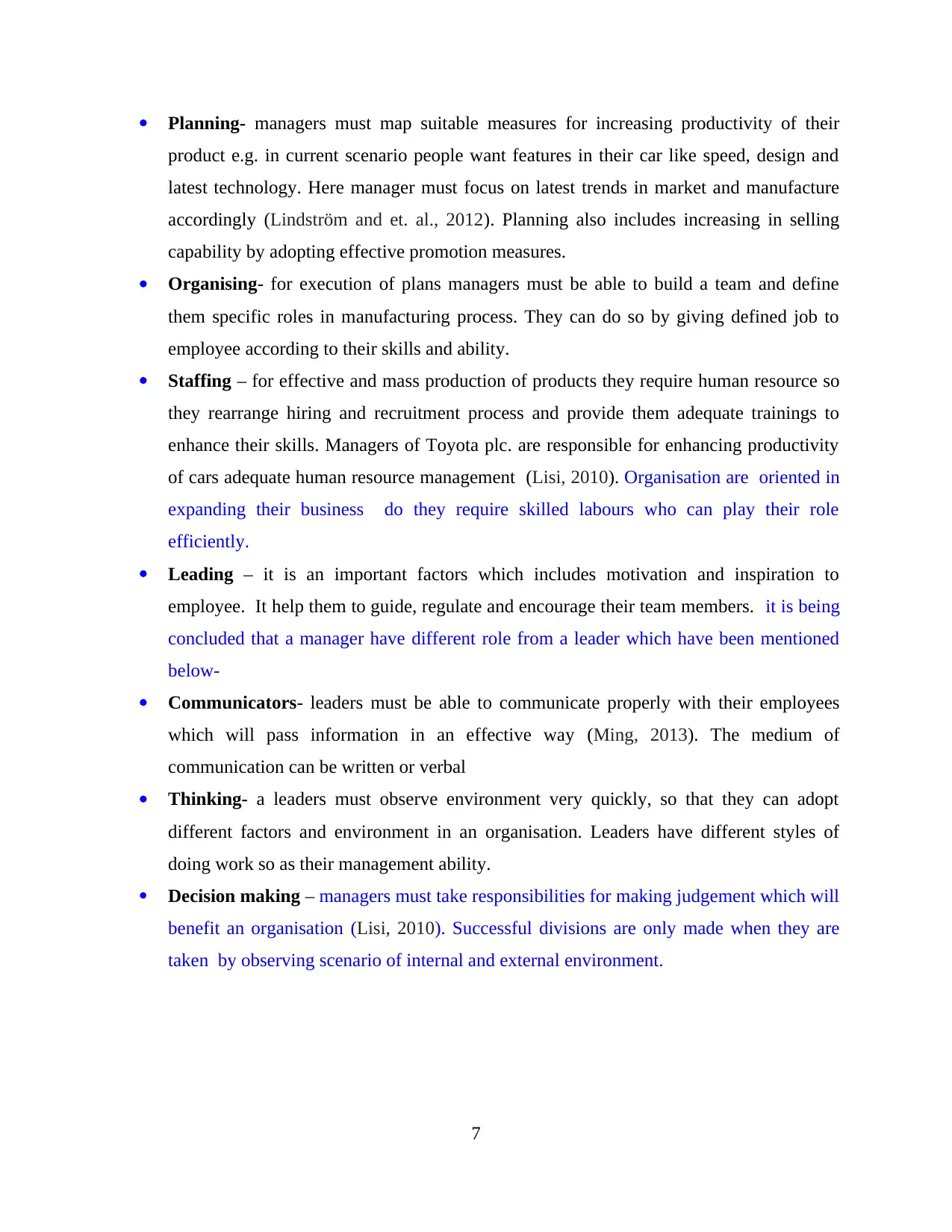
Planning- managers must map suitable measures for increasing productivity of their
product e.g. in current scenario people want features in their car like speed, design and
latest technology. Here manager must focus on latest trends in market and manufacture
accordingly (Lindström and et. al., 2012). Planning also includes increasing in selling
capability by adopting effective promotion measures.
Organising- for execution of plans managers must be able to build a team and define
them specific roles in manufacturing process. They can do so by giving defined job to
employee according to their skills and ability.
Staffing – for effective and mass production of products they require human resource so
they rearrange hiring and recruitment process and provide them adequate trainings to
enhance their skills. Managers of Toyota plc. are responsible for enhancing productivity
of cars adequate human resource management (Lisi, 2010). Organisation are oriented in
expanding their business do they require skilled labours who can play their role
efficiently.
Leading – it is an important factors which includes motivation and inspiration to
employee. It help them to guide, regulate and encourage their team members. it is being
concluded that a manager have different role from a leader which have been mentioned
below-
Communicators- leaders must be able to communicate properly with their employees
which will pass information in an effective way (Ming, 2013). The medium of
communication can be written or verbal
Thinking- a leaders must observe environment very quickly, so that they can adopt
different factors and environment in an organisation. Leaders have different styles of
doing work so as their management ability.
Decision making – managers must take responsibilities for making judgement which will
benefit an organisation (Lisi, 2010). Successful divisions are only made when they are
taken by observing scenario of internal and external environment.
7
product e.g. in current scenario people want features in their car like speed, design and
latest technology. Here manager must focus on latest trends in market and manufacture
accordingly (Lindström and et. al., 2012). Planning also includes increasing in selling
capability by adopting effective promotion measures.
Organising- for execution of plans managers must be able to build a team and define
them specific roles in manufacturing process. They can do so by giving defined job to
employee according to their skills and ability.
Staffing – for effective and mass production of products they require human resource so
they rearrange hiring and recruitment process and provide them adequate trainings to
enhance their skills. Managers of Toyota plc. are responsible for enhancing productivity
of cars adequate human resource management (Lisi, 2010). Organisation are oriented in
expanding their business do they require skilled labours who can play their role
efficiently.
Leading – it is an important factors which includes motivation and inspiration to
employee. It help them to guide, regulate and encourage their team members. it is being
concluded that a manager have different role from a leader which have been mentioned
below-
Communicators- leaders must be able to communicate properly with their employees
which will pass information in an effective way (Ming, 2013). The medium of
communication can be written or verbal
Thinking- a leaders must observe environment very quickly, so that they can adopt
different factors and environment in an organisation. Leaders have different styles of
doing work so as their management ability.
Decision making – managers must take responsibilities for making judgement which will
benefit an organisation (Lisi, 2010). Successful divisions are only made when they are
taken by observing scenario of internal and external environment.
7
⊘ This is a preview!⊘
Do you want full access?
Subscribe today to unlock all pages.
Trusted by 1+ million students worldwide
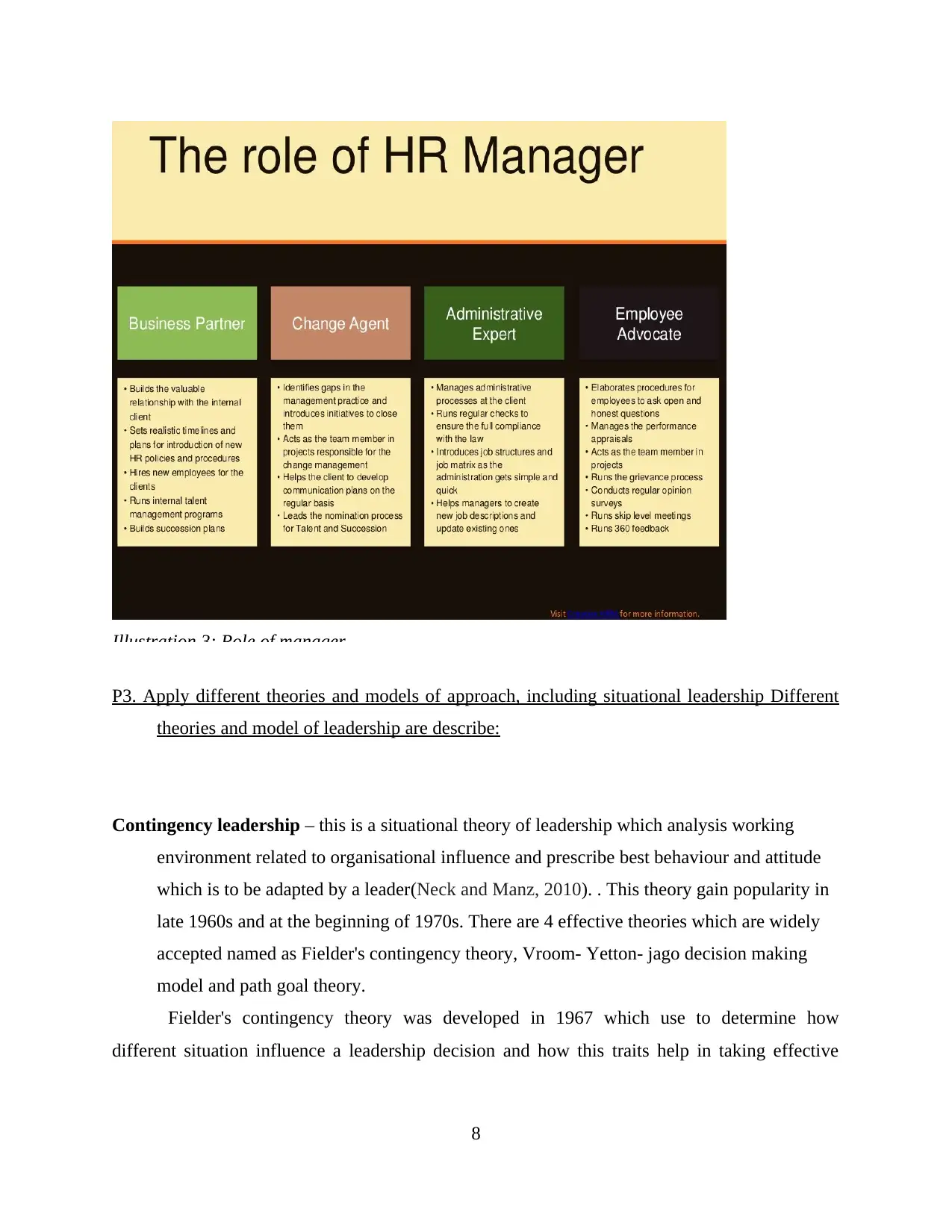
Illustration 3: Role of manager
P3. Apply different theories and models of approach, including situational leadership Different
theories and model of leadership are describe:
Contingency leadership – this is a situational theory of leadership which analysis working
environment related to organisational influence and prescribe best behaviour and attitude
which is to be adapted by a leader(Neck and Manz, 2010). . This theory gain popularity in
late 1960s and at the beginning of 1970s. There are 4 effective theories which are widely
accepted named as Fielder's contingency theory, Vroom- Yetton- jago decision making
model and path goal theory.
Fielder's contingency theory was developed in 1967 which use to determine how
different situation influence a leadership decision and how this traits help in taking effective
8
P3. Apply different theories and models of approach, including situational leadership Different
theories and model of leadership are describe:
Contingency leadership – this is a situational theory of leadership which analysis working
environment related to organisational influence and prescribe best behaviour and attitude
which is to be adapted by a leader(Neck and Manz, 2010). . This theory gain popularity in
late 1960s and at the beginning of 1970s. There are 4 effective theories which are widely
accepted named as Fielder's contingency theory, Vroom- Yetton- jago decision making
model and path goal theory.
Fielder's contingency theory was developed in 1967 which use to determine how
different situation influence a leadership decision and how this traits help in taking effective
8
Paraphrase This Document
Need a fresh take? Get an instant paraphrase of this document with our AI Paraphraser
decisions. It suggest some favourable conditions which enhance effectiveness of person- oriented
behaviour.
Path goal theory was formulated by Robert House in 1971. According to this theory,
qualities and characters of their employees are analysed and helps in enhancing their behaviour.
Performing task, working experience situation control are some of the key factors of
subordinates which can be evaluated through this theory(Neck and Manz, 2010). . This describe
four different behaviours like supportive, pronouncement, achievement- oriented leadership and
participation.
Situational theory- this theory guides a leader for selection of better course of action.
Style of leadership adopted by leaders have different approaches in dealing different
situations. e.g. There are some situations which arises where some technical researches
are requires so those situations must be handled with experience and educated members,
System leadership theory – it is the total outcome of all the hard work off different
researches. It helps in generation of framework for interpretation and presentation of any
realities and phenomenon. It can be simply stated as a management discipline which
focus on understanding a system and identifying roles and relations of different
components in an organisation (Smith, Rahn and Wang, 2010).. Management have an
objective in sorting operation issues by sharing and discussing different decision making
processes. The management by objectives process are used for motivating their
employees and giving them values in in organisation.
M2. Assess the strengths and weaknesses of different approaches to situations within the work
environment.
System leadership approach
Strength- they quickly resolve issues by having a better understanding of situationist. It
helps in motivating employees hence it will make environment effective
Weakness – weak point of this system that there may be some clashes in system due to
partiality among employees hence it will generate a sense of negative environment in the
organisational structure (Smith, Rahn and Wang, 2010)..Situational theory - Strength – it
helps in better planning in dealing in different situations Weakness – sometimes a leader is
not equipped to deal with a situation like a manager related to cost will find it very difficult to
deal with pro0blemm of different issues.
9
behaviour.
Path goal theory was formulated by Robert House in 1971. According to this theory,
qualities and characters of their employees are analysed and helps in enhancing their behaviour.
Performing task, working experience situation control are some of the key factors of
subordinates which can be evaluated through this theory(Neck and Manz, 2010). . This describe
four different behaviours like supportive, pronouncement, achievement- oriented leadership and
participation.
Situational theory- this theory guides a leader for selection of better course of action.
Style of leadership adopted by leaders have different approaches in dealing different
situations. e.g. There are some situations which arises where some technical researches
are requires so those situations must be handled with experience and educated members,
System leadership theory – it is the total outcome of all the hard work off different
researches. It helps in generation of framework for interpretation and presentation of any
realities and phenomenon. It can be simply stated as a management discipline which
focus on understanding a system and identifying roles and relations of different
components in an organisation (Smith, Rahn and Wang, 2010).. Management have an
objective in sorting operation issues by sharing and discussing different decision making
processes. The management by objectives process are used for motivating their
employees and giving them values in in organisation.
M2. Assess the strengths and weaknesses of different approaches to situations within the work
environment.
System leadership approach
Strength- they quickly resolve issues by having a better understanding of situationist. It
helps in motivating employees hence it will make environment effective
Weakness – weak point of this system that there may be some clashes in system due to
partiality among employees hence it will generate a sense of negative environment in the
organisational structure (Smith, Rahn and Wang, 2010)..Situational theory - Strength – it
helps in better planning in dealing in different situations Weakness – sometimes a leader is
not equipped to deal with a situation like a manager related to cost will find it very difficult to
deal with pro0blemm of different issues.
9
D1. Theory and approaches of leadership
Different theory of leadership have been prescribed are very effective. These theories
which are discussed above can be implemented in different ways in different challenges hence
help in better monitoring and coping up with the situations (White, 2016). System leadership
approach, contingency, situations analysis are all different theories helps in dealing with
different type of situations
TASK 3
P4. Approaches to operations management and the role of managers and leaders
Operational management in an important factor of management of Toyota. It is an
important division of management where operational and designing are monitored and focus on
increasing their productivity by enhancing production of goods and service. Different approach
of of management of operations in an organisation
Top down method – in this method top level management or leaders take all important
decisions in regard all aspect in both internal and external part of an organisations. They have all
the authority to take decision inside the organisations as well as in external activities like sales
and profit. Lower level employees follow the instructions and orders of higher employees.
Executives want corporation from employee to achieve their goal and sustain in longer run.
Bottoms up approach - this approach give more values to level people they focus on
gathering information from them like suggestion on sales policies, and expectations. Concept of
risk management is also included in this approach (Lisi, 2010). In this bonding are made by
shareholders and stake holders where certain amounts are taken as proofs. It has 2 marketing
approaches which includes mandatory insurance and assuring bonds.
Resource capability approaches – it is a theoretical framework with 2 standard
assertions. First one is claiming employee’s freedom and second is understanding capabilities of
employees.
Market requirement approaches – In this it is responsibility of an organisation to fulfil
all the things required for market approach. It includes all inventories, transportation raw
materials. Fulfilling these requirement will help the organisation to grow in a faster way.
10
Different theory of leadership have been prescribed are very effective. These theories
which are discussed above can be implemented in different ways in different challenges hence
help in better monitoring and coping up with the situations (White, 2016). System leadership
approach, contingency, situations analysis are all different theories helps in dealing with
different type of situations
TASK 3
P4. Approaches to operations management and the role of managers and leaders
Operational management in an important factor of management of Toyota. It is an
important division of management where operational and designing are monitored and focus on
increasing their productivity by enhancing production of goods and service. Different approach
of of management of operations in an organisation
Top down method – in this method top level management or leaders take all important
decisions in regard all aspect in both internal and external part of an organisations. They have all
the authority to take decision inside the organisations as well as in external activities like sales
and profit. Lower level employees follow the instructions and orders of higher employees.
Executives want corporation from employee to achieve their goal and sustain in longer run.
Bottoms up approach - this approach give more values to level people they focus on
gathering information from them like suggestion on sales policies, and expectations. Concept of
risk management is also included in this approach (Lisi, 2010). In this bonding are made by
shareholders and stake holders where certain amounts are taken as proofs. It has 2 marketing
approaches which includes mandatory insurance and assuring bonds.
Resource capability approaches – it is a theoretical framework with 2 standard
assertions. First one is claiming employee’s freedom and second is understanding capabilities of
employees.
Market requirement approaches – In this it is responsibility of an organisation to fulfil
all the things required for market approach. It includes all inventories, transportation raw
materials. Fulfilling these requirement will help the organisation to grow in a faster way.
10
⊘ This is a preview!⊘
Do you want full access?
Subscribe today to unlock all pages.
Trusted by 1+ million students worldwide

1 out of 17


Related Documents


Your All-in-One AI-Powered Toolkit for Academic Success.
+13062052269
info@desklib.com
Available 24*7 on WhatsApp / Email
![[object Object]](/_next/static/media/star-bottom.7253800d.svg)
Unlock your academic potential
Copyright © 2020–2026 A2Z Services. All Rights Reserved. Developed and managed by ZUCOL.