University Report: Coaching, Mentoring, Leadership, and Management
VerifiedAdded on 2020/02/05
|10
|2525
|87
Report
AI Summary
This report delves into the interconnectedness of leadership and management, emphasizing their crucial roles in coaching and mentoring processes. It explores various leadership styles, including participative, democratic, and transactional models, and their impact on team motivation, performance, and goal achievement. The report highlights the importance of reflective practice for coaches and mentors, discussing models for self-assessment and continuous improvement. It examines the significance of employee motivation, outlining strategies for creating a positive work environment and fostering job satisfaction. Furthermore, the report analyzes the benefits of effective communication, team building, and the adoption of leadership strategies tailored to specific situations and employee expectations. The report concludes by emphasizing the importance of understanding and applying these principles for successful coaching and mentoring outcomes.

University
Coaching and Mentoring / Leadership and Management
By
Date
Name
Lecturer’s Name
Coaching and Mentoring / Leadership and Management
By
Date
Name
Lecturer’s Name

Paraphrase This Document
Need a fresh take? Get an instant paraphrase of this document with our AI Paraphraser
Coaching and Mentoring / Leadership and Management
Leadership and Management
Leadership and Management took as same content. But there are some differences can be seen
between leadership and management. Leadership is an important part of management. It means
the ability to influence someone's behaviour to achieve coal. Management consist of various
notions and leadership is one of its notions (Daft, 2011). Management heads of on organisation
use leadership strategies to lead their employees to meet the challenges. This study on leadership
and management will help us to know the basic stuff of management and leadership which can
be effective for the tools of coaching and mentoring. It will also make us recognise the concept
of leadership and management, how to recover performance and motivation by applying the
relevant skills and effectiveness of teams (Graf, 2015). At the end of this paper, I can expect us
to perceive leadership and management skills and practices as a tool for motivating the coaching
and mentoring process. Leading a team to get the best outcomes is called leadership. A great
leader would be aware of his strengths and weaknesses. Because it helps to motivate people for
new challenges and opportunities (Graf, 2015). Leadership style should be participative so that
the leader should go through self-assessments. Hard work is undoubtedly the biggest strength of
a good leader. A leader should have a fare sense of sharing ideas, information and data in an
accountable manner. It makes their decision better (Daft, 2011). There should also be a good
communication process, as a good leader is he who have an excellent communication skill.
I as a leader should maintain a good relation with my team members so that the members will
come close to the team. A true leader leads a team properly, motivate the team members, can set
goals for his team, meet all the deadlines, and can make a good rapport amongst the followers.
Managers are vital for any business activity. Managers are known to the responsible persons for
anything that gets done within the company to run a business. Managers are also a kind of leader,
Page 2 of 10
Leadership and Management
Leadership and Management took as same content. But there are some differences can be seen
between leadership and management. Leadership is an important part of management. It means
the ability to influence someone's behaviour to achieve coal. Management consist of various
notions and leadership is one of its notions (Daft, 2011). Management heads of on organisation
use leadership strategies to lead their employees to meet the challenges. This study on leadership
and management will help us to know the basic stuff of management and leadership which can
be effective for the tools of coaching and mentoring. It will also make us recognise the concept
of leadership and management, how to recover performance and motivation by applying the
relevant skills and effectiveness of teams (Graf, 2015). At the end of this paper, I can expect us
to perceive leadership and management skills and practices as a tool for motivating the coaching
and mentoring process. Leading a team to get the best outcomes is called leadership. A great
leader would be aware of his strengths and weaknesses. Because it helps to motivate people for
new challenges and opportunities (Graf, 2015). Leadership style should be participative so that
the leader should go through self-assessments. Hard work is undoubtedly the biggest strength of
a good leader. A leader should have a fare sense of sharing ideas, information and data in an
accountable manner. It makes their decision better (Daft, 2011). There should also be a good
communication process, as a good leader is he who have an excellent communication skill.
I as a leader should maintain a good relation with my team members so that the members will
come close to the team. A true leader leads a team properly, motivate the team members, can set
goals for his team, meet all the deadlines, and can make a good rapport amongst the followers.
Managers are vital for any business activity. Managers are known to the responsible persons for
anything that gets done within the company to run a business. Managers are also a kind of leader,
Page 2 of 10
Coaching and Mentoring / Leadership and Management
who motivates his sub-ordinates, helps to achieve a certain goal and meet all the challenges.
Managers performances on behalf of an organisation. They set objectives for the organisation
and makes sure whether the goals are achieved or not. A manager is answerable for all the
activities to the directors or shareholders. Leadership is a significant function of management.
Leadership and Management exist at every level of management.
Reflection is used to increase coaching practices through diversity. According to some experts, a
particularly significant part of empowerment whereby coaches themselves take ownership of
their learning and decision making. Retrospective reflection on action is further described as that
which occurs outside the action-present. Using other coaches is one-way reflective practice can
be more dependable and well-organized. Coaching points are a very simple and essential way of
reflecting on a performer. Management and leadership models aim at what potentials separate
between followers and leaders in a company. Leaders need to change their behaviour towards the
team members. This will be performed by depending on a particular situation. Task behaviour is
one of those. Leaders and describe the duties and responsibilities of the team through his
behaviour. A leader should encourage his team mates to get a task done on the given time. It is
called situational leadership model.
A leader's behaviour can influence a tea to reach their goals. A leader provides guidance here
about different word methods, develops work schedules and indicates the possible outcomes.
This is known as expectancy model. Leader's behaviour effects the perception of the followers.
Leaders do small thing to make an assignment more attractive (Brockbank and McGill, 2012).
Sometimes leaders have several discussions with the team, where he get to know the present
mental state of the members, appreciates their suggestions, encourages them to invent new ideas.
One of the most effective models of leadership is Participative Model (Special issue of
Page 3 of 10
who motivates his sub-ordinates, helps to achieve a certain goal and meet all the challenges.
Managers performances on behalf of an organisation. They set objectives for the organisation
and makes sure whether the goals are achieved or not. A manager is answerable for all the
activities to the directors or shareholders. Leadership is a significant function of management.
Leadership and Management exist at every level of management.
Reflection is used to increase coaching practices through diversity. According to some experts, a
particularly significant part of empowerment whereby coaches themselves take ownership of
their learning and decision making. Retrospective reflection on action is further described as that
which occurs outside the action-present. Using other coaches is one-way reflective practice can
be more dependable and well-organized. Coaching points are a very simple and essential way of
reflecting on a performer. Management and leadership models aim at what potentials separate
between followers and leaders in a company. Leaders need to change their behaviour towards the
team members. This will be performed by depending on a particular situation. Task behaviour is
one of those. Leaders and describe the duties and responsibilities of the team through his
behaviour. A leader should encourage his team mates to get a task done on the given time. It is
called situational leadership model.
A leader's behaviour can influence a tea to reach their goals. A leader provides guidance here
about different word methods, develops work schedules and indicates the possible outcomes.
This is known as expectancy model. Leader's behaviour effects the perception of the followers.
Leaders do small thing to make an assignment more attractive (Brockbank and McGill, 2012).
Sometimes leaders have several discussions with the team, where he get to know the present
mental state of the members, appreciates their suggestions, encourages them to invent new ideas.
One of the most effective models of leadership is Participative Model (Special issue of
Page 3 of 10
⊘ This is a preview!⊘
Do you want full access?
Subscribe today to unlock all pages.

Trusted by 1+ million students worldwide
Coaching and Mentoring / Leadership and Management
Management Accounting Research: Risk management, corporate governance and management
accounting, 2010). The leaders allow his followers to state their ideas and views here in this
model. Teachers use this kind of leadership in the classroom, where they direct the students to
invent new thoughts or opportunities. After finishing a task, the teacher appreciates his students
for their efforts. This is known as Democratic Leadership Model. If a team is working on a
project, they follow this model.Another model is known as normative leadership, where leaders
make the decision, as well as the managers. At first, leaders discusses the strength and
weaknesses of the team and gathers all the probable information from his team members; then he
makes a decision primarily. After that, the leader checks with the manager and look for
suggestions. Here in this model, the manager asks several questions to the leader and then end up
making a final decision. A team or a group always obeys his leader's instructions. Leaders can
use the alternate process for different tasks. They observe their follower’s working style to find
out the faults and weaknesses. It is called Transactional Leadership. There are some benefits of
this model such as everyone is aware of their strengths and weaknesses, obligations and
responsibilities. The disadvantages of this model are: Members does not improve their
performance on a serious note, which cause job satisfaction to the team. This model also doesn't
have the sincere leadership style. Because the team works on a short term objectives (Brockbank
and McGill, 2012).
Knowledge and skills contribute directly to the process of leadership and management while
other attributes give the leader and manager certain qualities that make them different. The
leadership and management process of a company includes growing a visualisation for the
organisation (Höher, 2015). The leadership process creates improbability and alteration in the
organisation. The management process also involves in planning, budgeting, organising,
Page 4 of 10
Management Accounting Research: Risk management, corporate governance and management
accounting, 2010). The leaders allow his followers to state their ideas and views here in this
model. Teachers use this kind of leadership in the classroom, where they direct the students to
invent new thoughts or opportunities. After finishing a task, the teacher appreciates his students
for their efforts. This is known as Democratic Leadership Model. If a team is working on a
project, they follow this model.Another model is known as normative leadership, where leaders
make the decision, as well as the managers. At first, leaders discusses the strength and
weaknesses of the team and gathers all the probable information from his team members; then he
makes a decision primarily. After that, the leader checks with the manager and look for
suggestions. Here in this model, the manager asks several questions to the leader and then end up
making a final decision. A team or a group always obeys his leader's instructions. Leaders can
use the alternate process for different tasks. They observe their follower’s working style to find
out the faults and weaknesses. It is called Transactional Leadership. There are some benefits of
this model such as everyone is aware of their strengths and weaknesses, obligations and
responsibilities. The disadvantages of this model are: Members does not improve their
performance on a serious note, which cause job satisfaction to the team. This model also doesn't
have the sincere leadership style. Because the team works on a short term objectives (Brockbank
and McGill, 2012).
Knowledge and skills contribute directly to the process of leadership and management while
other attributes give the leader and manager certain qualities that make them different. The
leadership and management process of a company includes growing a visualisation for the
organisation (Höher, 2015). The leadership process creates improbability and alteration in the
organisation. The management process also involves in planning, budgeting, organising,
Page 4 of 10
Paraphrase This Document
Need a fresh take? Get an instant paraphrase of this document with our AI Paraphraser
Coaching and Mentoring / Leadership and Management
recruiting, controlling and solving problems. A well-organized management process stabilises
the business activity (Special issue of Management Accounting Research: Risk management,
corporate governance and management accounting, 2010). A relationship has been found
between the uses of reflective practice in teachers ad effective teaching. Here I would like to
mention one more thing that through self-evaluation and improved awareness, the coach can
intentionally improve their coaching practices.
To coach properly, positive principles need to be followed. Reflection needs to be fair, accurate
and honest (Getting ahead in leadership: Exploring the ‘leadership equals improvement'
relationship, 2011). Because it helps to provide a review of any concern. Coaches should
examine their familiarity, seeking for meaning by queries (Brockbank and McGill, 2012). Here
the coach must be open-minded and to answer with decency.
Several models have been described for using a reflective method to professional development.
A coach will primarily be presented with an issue in their coaching practice. If this concern is
sufficient, the coach or the mentor will enter into a reflective conservation. A four stage model
can be described for the coach to work through the concern reflectively:
The coach or the mentor sets the issues
The coach determines strategies with the help of reflection, experience, etc
The coach appraises the policies by consulting with others or individually
The coach researches with the probable solutions, either virtually such as writing down or
talking over or in the real world by applying the strategy
This may involve the mentor going through a cyclical process of appreciation, and action
(Brockbank and McGill, 2012). This process could be done in a group setting, with the group
Page 5 of 10
recruiting, controlling and solving problems. A well-organized management process stabilises
the business activity (Special issue of Management Accounting Research: Risk management,
corporate governance and management accounting, 2010). A relationship has been found
between the uses of reflective practice in teachers ad effective teaching. Here I would like to
mention one more thing that through self-evaluation and improved awareness, the coach can
intentionally improve their coaching practices.
To coach properly, positive principles need to be followed. Reflection needs to be fair, accurate
and honest (Getting ahead in leadership: Exploring the ‘leadership equals improvement'
relationship, 2011). Because it helps to provide a review of any concern. Coaches should
examine their familiarity, seeking for meaning by queries (Brockbank and McGill, 2012). Here
the coach must be open-minded and to answer with decency.
Several models have been described for using a reflective method to professional development.
A coach will primarily be presented with an issue in their coaching practice. If this concern is
sufficient, the coach or the mentor will enter into a reflective conservation. A four stage model
can be described for the coach to work through the concern reflectively:
The coach or the mentor sets the issues
The coach determines strategies with the help of reflection, experience, etc
The coach appraises the policies by consulting with others or individually
The coach researches with the probable solutions, either virtually such as writing down or
talking over or in the real world by applying the strategy
This may involve the mentor going through a cyclical process of appreciation, and action
(Brockbank and McGill, 2012). This process could be done in a group setting, with the group
Page 5 of 10
Coaching and Mentoring / Leadership and Management
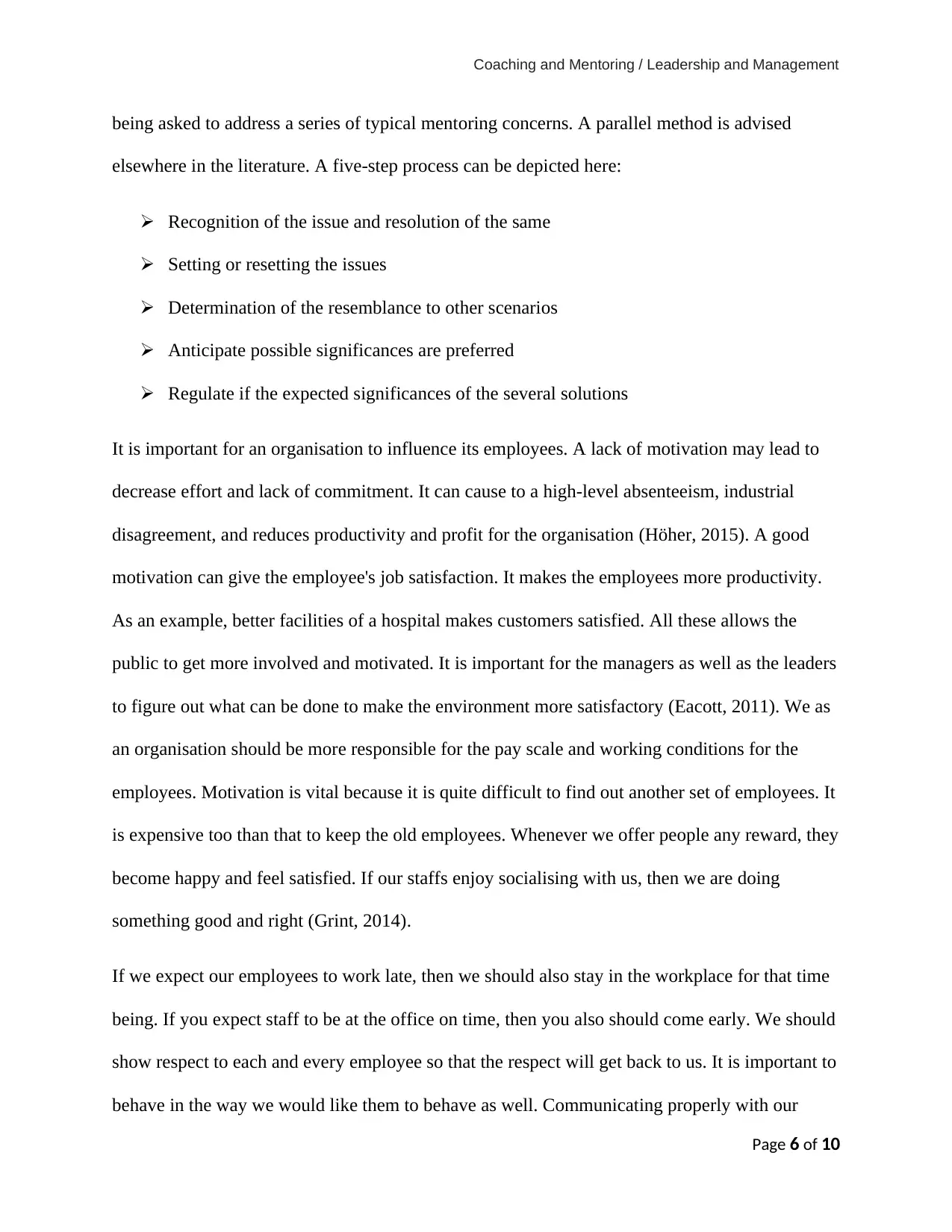
being asked to address a series of typical mentoring concerns. A parallel method is advised
elsewhere in the literature. A five-step process can be depicted here:
Recognition of the issue and resolution of the same
Setting or resetting the issues
Determination of the resemblance to other scenarios
Anticipate possible significances are preferred
Regulate if the expected significances of the several solutions
It is important for an organisation to influence its employees. A lack of motivation may lead to
decrease effort and lack of commitment. It can cause to a high-level absenteeism, industrial
disagreement, and reduces productivity and profit for the organisation (Höher, 2015). A good
motivation can give the employee's job satisfaction. It makes the employees more productivity.
As an example, better facilities of a hospital makes customers satisfied. All these allows the
public to get more involved and motivated. It is important for the managers as well as the leaders
to figure out what can be done to make the environment more satisfactory (Eacott, 2011). We as
an organisation should be more responsible for the pay scale and working conditions for the
employees. Motivation is vital because it is quite difficult to find out another set of employees. It
is expensive too than that to keep the old employees. Whenever we offer people any reward, they
become happy and feel satisfied. If our staffs enjoy socialising with us, then we are doing
something good and right (Grint, 2014).
If we expect our employees to work late, then we should also stay in the workplace for that time
being. If you expect staff to be at the office on time, then you also should come early. We should
show respect to each and every employee so that the respect will get back to us. It is important to
behave in the way we would like them to behave as well. Communicating properly with our
Page 6 of 10
being asked to address a series of typical mentoring concerns. A parallel method is advised
elsewhere in the literature. A five-step process can be depicted here:
Recognition of the issue and resolution of the same
Setting or resetting the issues
Determination of the resemblance to other scenarios
Anticipate possible significances are preferred
Regulate if the expected significances of the several solutions
It is important for an organisation to influence its employees. A lack of motivation may lead to
decrease effort and lack of commitment. It can cause to a high-level absenteeism, industrial
disagreement, and reduces productivity and profit for the organisation (Höher, 2015). A good
motivation can give the employee's job satisfaction. It makes the employees more productivity.
As an example, better facilities of a hospital makes customers satisfied. All these allows the
public to get more involved and motivated. It is important for the managers as well as the leaders
to figure out what can be done to make the environment more satisfactory (Eacott, 2011). We as
an organisation should be more responsible for the pay scale and working conditions for the
employees. Motivation is vital because it is quite difficult to find out another set of employees. It
is expensive too than that to keep the old employees. Whenever we offer people any reward, they
become happy and feel satisfied. If our staffs enjoy socialising with us, then we are doing
something good and right (Grint, 2014).
If we expect our employees to work late, then we should also stay in the workplace for that time
being. If you expect staff to be at the office on time, then you also should come early. We should
show respect to each and every employee so that the respect will get back to us. It is important to
behave in the way we would like them to behave as well. Communicating properly with our
Page 6 of 10
⊘ This is a preview!⊘
Do you want full access?
Subscribe today to unlock all pages.
Trusted by 1+ million students worldwide
Coaching and Mentoring / Leadership and Management
employee should be on the top of our priority list. I as a leader should easily reach wherever a
problem is found (Eacott, 2011). We should also go for some frequent group discussions or team
huddle. It is also very important to get feedback from the team members as well the employees.
Thus a management process can be standardised.
The leadership of teams must get members of team work with each other. This is one of the
significant approaches that involves low levels of risk among members. A team leader should be
able to organise joint projects. If every single activity is connected with each other, then
achieving the target will be easier. Members will enjoy while performing their roles and are also
discovering something new about themselves, their co-workers and the organisation as a whole.
The leader of any team of an organisation focuses on creating group/team that is effective and
efficient (Grint, 2014). If we can motivate our team members to work harder to achieve goals,
then job satisfaction will be created easily.We should adopt leadership strategies according to the
region in which we are working. The more we are according to the employee's expectations, the
more we are working (Teraman and Ergun, 2016). The more we are according to the employee's
expectations, the more we will gain the satisfaction. The above-mentioned leadership strategies
should be adopted by the leaders to provide sufficient leadership qualities with the alternate in
situation and time.
Coaches can be inspired to engross in their reflective process, possibly through enquiring, by
working at one of the three levels of reflection (Teraman and Ergun, 2016). They could reflect on
the perceptive aspects of coaching and mentor such as coaching knowledge and processes,
examine personal experiences and the underlying themes to create their coaching concepts.
Reflective dialogue involves a group of coaches who share their ideas on a subject, and then self-
Page 7 of 10
employee should be on the top of our priority list. I as a leader should easily reach wherever a
problem is found (Eacott, 2011). We should also go for some frequent group discussions or team
huddle. It is also very important to get feedback from the team members as well the employees.
Thus a management process can be standardised.
The leadership of teams must get members of team work with each other. This is one of the
significant approaches that involves low levels of risk among members. A team leader should be
able to organise joint projects. If every single activity is connected with each other, then
achieving the target will be easier. Members will enjoy while performing their roles and are also
discovering something new about themselves, their co-workers and the organisation as a whole.
The leader of any team of an organisation focuses on creating group/team that is effective and
efficient (Grint, 2014). If we can motivate our team members to work harder to achieve goals,
then job satisfaction will be created easily.We should adopt leadership strategies according to the
region in which we are working. The more we are according to the employee's expectations, the
more we are working (Teraman and Ergun, 2016). The more we are according to the employee's
expectations, the more we will gain the satisfaction. The above-mentioned leadership strategies
should be adopted by the leaders to provide sufficient leadership qualities with the alternate in
situation and time.
Coaches can be inspired to engross in their reflective process, possibly through enquiring, by
working at one of the three levels of reflection (Teraman and Ergun, 2016). They could reflect on
the perceptive aspects of coaching and mentor such as coaching knowledge and processes,
examine personal experiences and the underlying themes to create their coaching concepts.
Reflective dialogue involves a group of coaches who share their ideas on a subject, and then self-
Page 7 of 10
Paraphrase This Document
Need a fresh take? Get an instant paraphrase of this document with our AI Paraphraser
Coaching and Mentoring / Leadership and Management
reflect on themselves and their rejoinder to the dialogue of other contributors. Every coach and
mentor critically examine the fundamental norms behind their thinking.
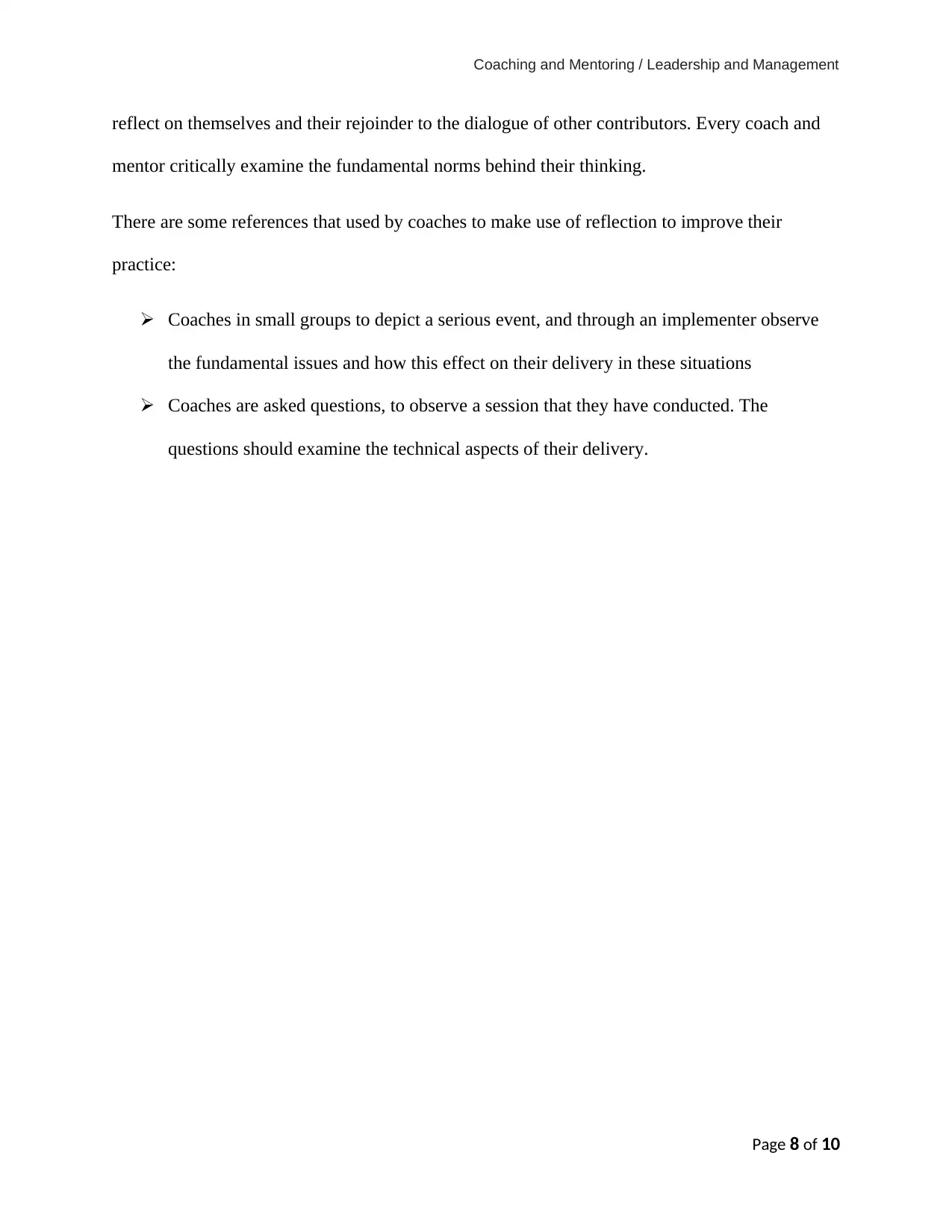
There are some references that used by coaches to make use of reflection to improve their
practice:
Coaches in small groups to depict a serious event, and through an implementer observe
the fundamental issues and how this effect on their delivery in these situations
Coaches are asked questions, to observe a session that they have conducted. The
questions should examine the technical aspects of their delivery.
Page 8 of 10
reflect on themselves and their rejoinder to the dialogue of other contributors. Every coach and
mentor critically examine the fundamental norms behind their thinking.
There are some references that used by coaches to make use of reflection to improve their
practice:
Coaches in small groups to depict a serious event, and through an implementer observe
the fundamental issues and how this effect on their delivery in these situations
Coaches are asked questions, to observe a session that they have conducted. The
questions should examine the technical aspects of their delivery.
Page 8 of 10
Coaching and Mentoring / Leadership and Management
References
Brockbank, A. and McGill, I. (2012). Facilitating reflective learning. 1st ed. London:
Kogan Page.
Daft, R. (2011). Leadership. 1st ed. [S.l.]: South-Western Cengage Learning.
Eacott, S. (2011). Leadership strategies: re-conceptualising strategy for educational
leadership. School Leadership & Management, 31(1), pp.35-46.
Getting ahead in leadership: Exploring the ‘leadership equals improvement' relationship.
(2011). School Leadership & Management, 25(1), pp.3-6.
Graf, E. (2015). Kommunikative Basisaktivitäten in Coaching-Gespräch: Ein linguist
Fischer Beitrag Zur Coaching-Prozessforschung. Coaching | Theorie & Praxis, 1(1), pp.5-
14.
Grint, K. (2014). Leadership, management and command. 1st ed. [Place of publication not
identified]: Palgrave Macmillan.
Höher, F. (2015). Was kind Coaching von Mentoring learned?. Coaching | Theorie &
Praxis, 1(1), pp.37-41.
Special issue of Management Accounting Research: Risk management, corporate
governance and management accounting. (2010). Management Accounting Research, 17(2),
pp.224-225.
Teraman, S. and Ergun, H. (2016). Garden of mentorig: revisiting mentoring in
entrepreneurial sense. Pressacademia, 5(4), pp.365-375.
Page 9 of 10
References
Brockbank, A. and McGill, I. (2012). Facilitating reflective learning. 1st ed. London:
Kogan Page.
Daft, R. (2011). Leadership. 1st ed. [S.l.]: South-Western Cengage Learning.
Eacott, S. (2011). Leadership strategies: re-conceptualising strategy for educational
leadership. School Leadership & Management, 31(1), pp.35-46.
Getting ahead in leadership: Exploring the ‘leadership equals improvement' relationship.
(2011). School Leadership & Management, 25(1), pp.3-6.
Graf, E. (2015). Kommunikative Basisaktivitäten in Coaching-Gespräch: Ein linguist
Fischer Beitrag Zur Coaching-Prozessforschung. Coaching | Theorie & Praxis, 1(1), pp.5-
14.
Grint, K. (2014). Leadership, management and command. 1st ed. [Place of publication not
identified]: Palgrave Macmillan.
Höher, F. (2015). Was kind Coaching von Mentoring learned?. Coaching | Theorie &
Praxis, 1(1), pp.37-41.
Special issue of Management Accounting Research: Risk management, corporate
governance and management accounting. (2010). Management Accounting Research, 17(2),
pp.224-225.
Teraman, S. and Ergun, H. (2016). Garden of mentorig: revisiting mentoring in
entrepreneurial sense. Pressacademia, 5(4), pp.365-375.
Page 9 of 10
⊘ This is a preview!⊘
Do you want full access?
Subscribe today to unlock all pages.
Trusted by 1+ million students worldwide

Coaching and Mentoring / Leadership and Management
Wu, B. (2013). New theory on leadership management science. 1st ed. [Oxford]: Chartridge
Books Oxford.
Page 10 of 10
Wu, B. (2013). New theory on leadership management science. 1st ed. [Oxford]: Chartridge
Books Oxford.
Page 10 of 10

1 out of 10


Related Documents


Your All-in-One AI-Powered Toolkit for Academic Success.
+13062052269
info@desklib.com
Available 24*7 on WhatsApp / Email
![[object Object]](/_next/static/media/star-bottom.7253800d.svg)
Unlock your academic potential
Copyright © 2020–2026 A2Z Services. All Rights Reserved. Developed and managed by ZUCOL.