Individual Essay: Leadership and Management in Community Services
VerifiedAdded on 2022/08/30
|8
|2582
|20
Essay
AI Summary
This essay examines the interconnected roles of leadership and management, emphasizing their significance in the face of contemporary challenges such as information overload and workplace diversity. It explores three distinct leadership styles: Laissez-Faire, Authoritarian, and Democratic, analyzing their respective benefits and drawbacks within various organizational contexts. The essay further differentiates between leadership and management, highlighting their complementary functions and decision-making processes. Focusing on the Australian community service sector, it identifies key challenges for leaders and managers, including funding arrangements, governance issues, and the demands of adapting to a dynamic environment. The analysis underscores the importance of skills development, collaboration, and adaptability for effective leadership in this evolving sector, supported by academic references and real-world examples.

Running Head: MANAGEMENT 0
MANAGEMENT AND
LEADERSHIP
MANAGEMENT AND
LEADERSHIP

Paraphrase This Document
Need a fresh take? Get an instant paraphrase of this document with our AI Paraphraser
MANAGEMENT 1
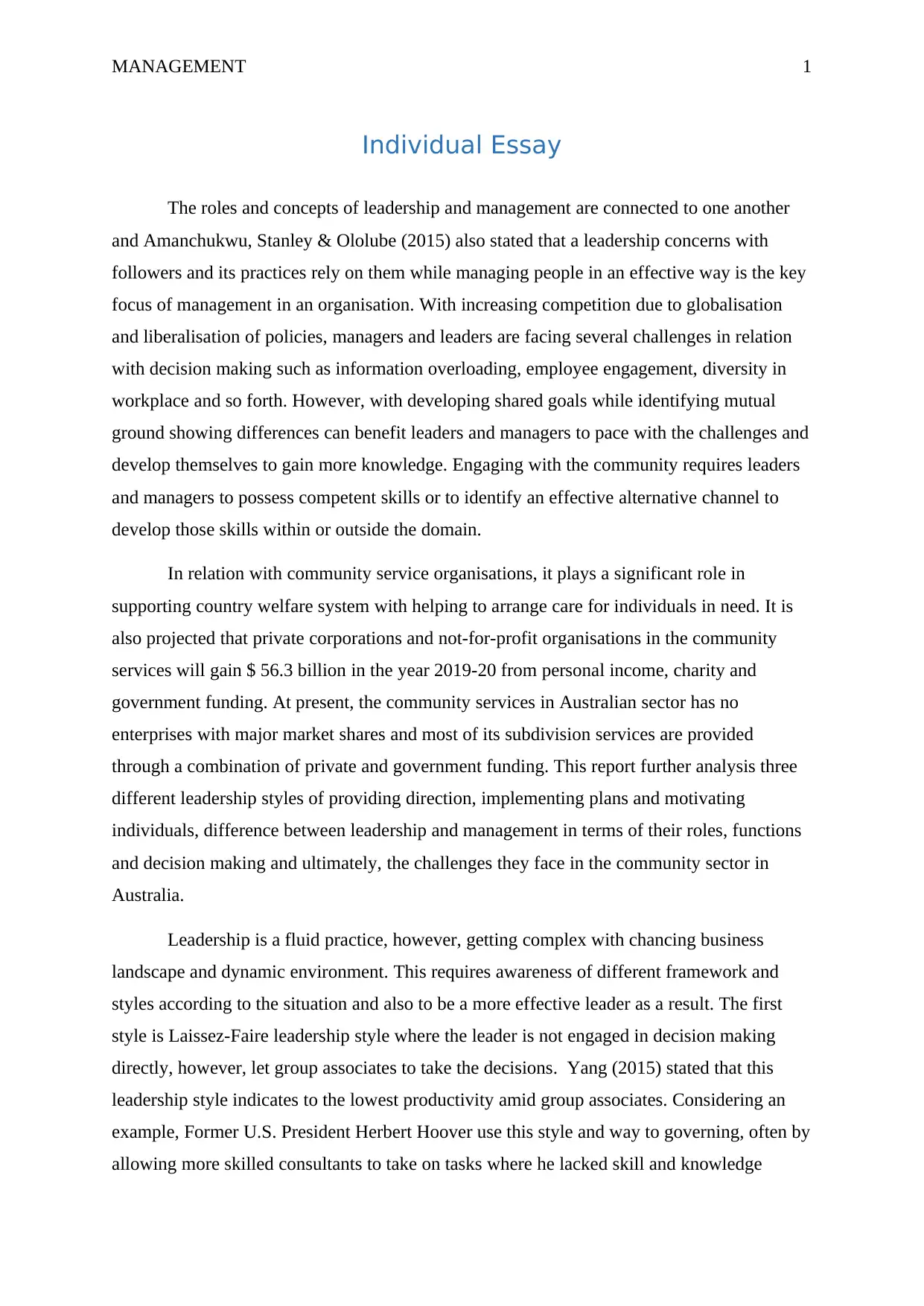
Individual Essay
The roles and concepts of leadership and management are connected to one another
and Amanchukwu, Stanley & Ololube (2015) also stated that a leadership concerns with
followers and its practices rely on them while managing people in an effective way is the key
focus of management in an organisation. With increasing competition due to globalisation
and liberalisation of policies, managers and leaders are facing several challenges in relation
with decision making such as information overloading, employee engagement, diversity in
workplace and so forth. However, with developing shared goals while identifying mutual
ground showing differences can benefit leaders and managers to pace with the challenges and
develop themselves to gain more knowledge. Engaging with the community requires leaders
and managers to possess competent skills or to identify an effective alternative channel to
develop those skills within or outside the domain.
In relation with community service organisations, it plays a significant role in
supporting country welfare system with helping to arrange care for individuals in need. It is
also projected that private corporations and not-for-profit organisations in the community
services will gain $ 56.3 billion in the year 2019-20 from personal income, charity and
government funding. At present, the community services in Australian sector has no
enterprises with major market shares and most of its subdivision services are provided
through a combination of private and government funding. This report further analysis three
different leadership styles of providing direction, implementing plans and motivating
individuals, difference between leadership and management in terms of their roles, functions
and decision making and ultimately, the challenges they face in the community sector in
Australia.
Leadership is a fluid practice, however, getting complex with chancing business
landscape and dynamic environment. This requires awareness of different framework and
styles according to the situation and also to be a more effective leader as a result. The first
style is Laissez-Faire leadership style where the leader is not engaged in decision making
directly, however, let group associates to take the decisions. Yang (2015) stated that this
leadership style indicates to the lowest productivity amid group associates. Considering an
example, Former U.S. President Herbert Hoover use this style and way to governing, often by
allowing more skilled consultants to take on tasks where he lacked skill and knowledge
Individual Essay
The roles and concepts of leadership and management are connected to one another
and Amanchukwu, Stanley & Ololube (2015) also stated that a leadership concerns with
followers and its practices rely on them while managing people in an effective way is the key
focus of management in an organisation. With increasing competition due to globalisation
and liberalisation of policies, managers and leaders are facing several challenges in relation
with decision making such as information overloading, employee engagement, diversity in
workplace and so forth. However, with developing shared goals while identifying mutual
ground showing differences can benefit leaders and managers to pace with the challenges and
develop themselves to gain more knowledge. Engaging with the community requires leaders
and managers to possess competent skills or to identify an effective alternative channel to
develop those skills within or outside the domain.
In relation with community service organisations, it plays a significant role in
supporting country welfare system with helping to arrange care for individuals in need. It is
also projected that private corporations and not-for-profit organisations in the community
services will gain $ 56.3 billion in the year 2019-20 from personal income, charity and
government funding. At present, the community services in Australian sector has no
enterprises with major market shares and most of its subdivision services are provided
through a combination of private and government funding. This report further analysis three
different leadership styles of providing direction, implementing plans and motivating
individuals, difference between leadership and management in terms of their roles, functions
and decision making and ultimately, the challenges they face in the community sector in
Australia.
Leadership is a fluid practice, however, getting complex with chancing business
landscape and dynamic environment. This requires awareness of different framework and
styles according to the situation and also to be a more effective leader as a result. The first
style is Laissez-Faire leadership style where the leader is not engaged in decision making
directly, however, let group associates to take the decisions. Yang (2015) stated that this
leadership style indicates to the lowest productivity amid group associates. Considering an
example, Former U.S. President Herbert Hoover use this style and way to governing, often by
allowing more skilled consultants to take on tasks where he lacked skill and knowledge
MANAGEMENT 2
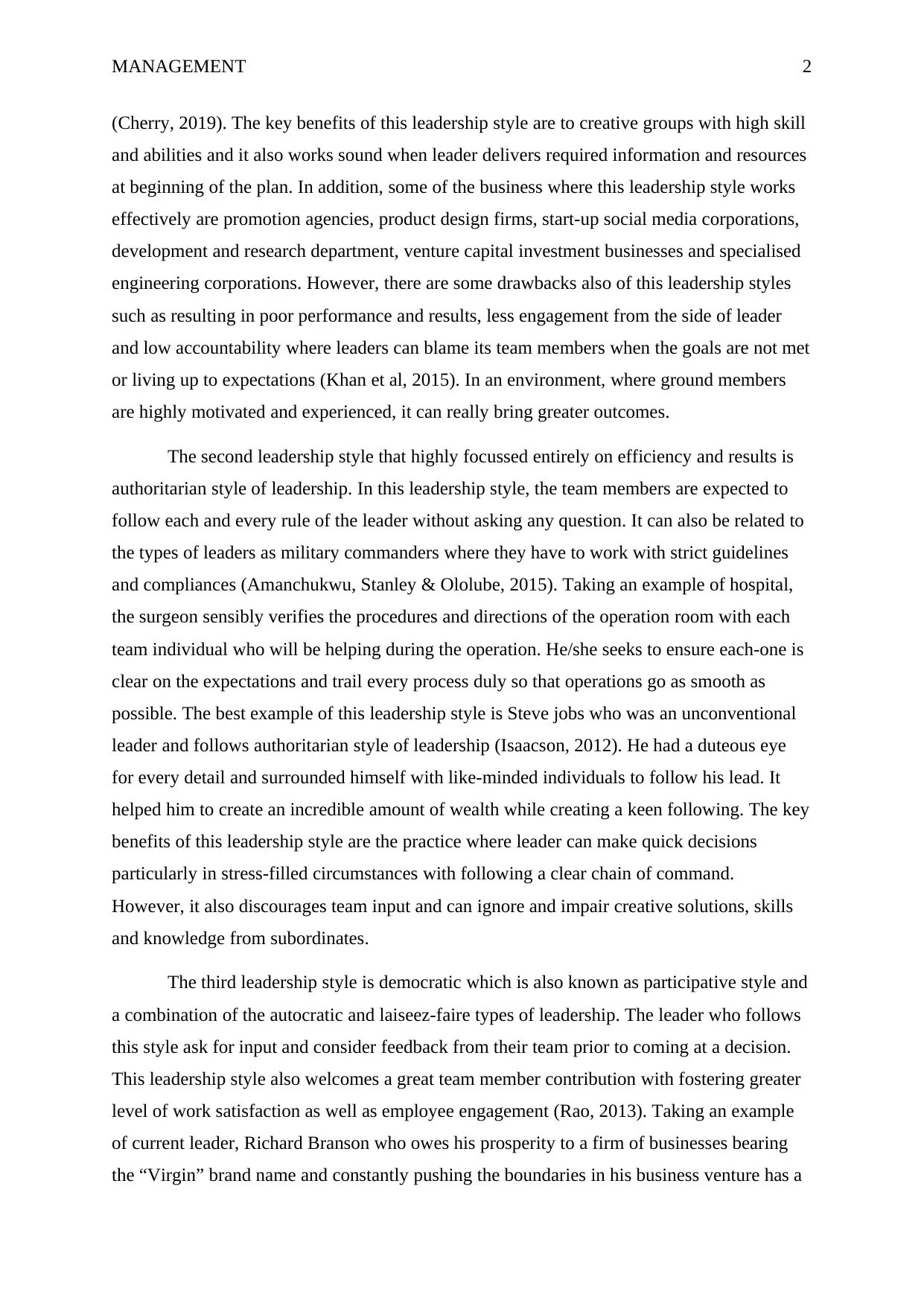
(Cherry, 2019). The key benefits of this leadership style are to creative groups with high skill
and abilities and it also works sound when leader delivers required information and resources
at beginning of the plan. In addition, some of the business where this leadership style works
effectively are promotion agencies, product design firms, start-up social media corporations,
development and research department, venture capital investment businesses and specialised
engineering corporations. However, there are some drawbacks also of this leadership styles
such as resulting in poor performance and results, less engagement from the side of leader
and low accountability where leaders can blame its team members when the goals are not met
or living up to expectations (Khan et al, 2015). In an environment, where ground members
are highly motivated and experienced, it can really bring greater outcomes.
The second leadership style that highly focussed entirely on efficiency and results is
authoritarian style of leadership. In this leadership style, the team members are expected to
follow each and every rule of the leader without asking any question. It can also be related to
the types of leaders as military commanders where they have to work with strict guidelines
and compliances (Amanchukwu, Stanley & Ololube, 2015). Taking an example of hospital,
the surgeon sensibly verifies the procedures and directions of the operation room with each
team individual who will be helping during the operation. He/she seeks to ensure each-one is
clear on the expectations and trail every process duly so that operations go as smooth as
possible. The best example of this leadership style is Steve jobs who was an unconventional
leader and follows authoritarian style of leadership (Isaacson, 2012). He had a duteous eye
for every detail and surrounded himself with like-minded individuals to follow his lead. It
helped him to create an incredible amount of wealth while creating a keen following. The key
benefits of this leadership style are the practice where leader can make quick decisions
particularly in stress-filled circumstances with following a clear chain of command.
However, it also discourages team input and can ignore and impair creative solutions, skills
and knowledge from subordinates.
The third leadership style is democratic which is also known as participative style and
a combination of the autocratic and laiseez-faire types of leadership. The leader who follows
this style ask for input and consider feedback from their team prior to coming at a decision.
This leadership style also welcomes a great team member contribution with fostering greater
level of work satisfaction as well as employee engagement (Rao, 2013). Taking an example
of current leader, Richard Branson who owes his prosperity to a firm of businesses bearing
the “Virgin” brand name and constantly pushing the boundaries in his business venture has a
(Cherry, 2019). The key benefits of this leadership style are to creative groups with high skill
and abilities and it also works sound when leader delivers required information and resources
at beginning of the plan. In addition, some of the business where this leadership style works
effectively are promotion agencies, product design firms, start-up social media corporations,
development and research department, venture capital investment businesses and specialised
engineering corporations. However, there are some drawbacks also of this leadership styles
such as resulting in poor performance and results, less engagement from the side of leader
and low accountability where leaders can blame its team members when the goals are not met
or living up to expectations (Khan et al, 2015). In an environment, where ground members
are highly motivated and experienced, it can really bring greater outcomes.
The second leadership style that highly focussed entirely on efficiency and results is
authoritarian style of leadership. In this leadership style, the team members are expected to
follow each and every rule of the leader without asking any question. It can also be related to
the types of leaders as military commanders where they have to work with strict guidelines
and compliances (Amanchukwu, Stanley & Ololube, 2015). Taking an example of hospital,
the surgeon sensibly verifies the procedures and directions of the operation room with each
team individual who will be helping during the operation. He/she seeks to ensure each-one is
clear on the expectations and trail every process duly so that operations go as smooth as
possible. The best example of this leadership style is Steve jobs who was an unconventional
leader and follows authoritarian style of leadership (Isaacson, 2012). He had a duteous eye
for every detail and surrounded himself with like-minded individuals to follow his lead. It
helped him to create an incredible amount of wealth while creating a keen following. The key
benefits of this leadership style are the practice where leader can make quick decisions
particularly in stress-filled circumstances with following a clear chain of command.
However, it also discourages team input and can ignore and impair creative solutions, skills
and knowledge from subordinates.
The third leadership style is democratic which is also known as participative style and
a combination of the autocratic and laiseez-faire types of leadership. The leader who follows
this style ask for input and consider feedback from their team prior to coming at a decision.
This leadership style also welcomes a great team member contribution with fostering greater
level of work satisfaction as well as employee engagement (Rao, 2013). Taking an example
of current leader, Richard Branson who owes his prosperity to a firm of businesses bearing
the “Virgin” brand name and constantly pushing the boundaries in his business venture has a
⊘ This is a preview!⊘
Do you want full access?
Subscribe today to unlock all pages.

Trusted by 1+ million students worldwide
MANAGEMENT 3
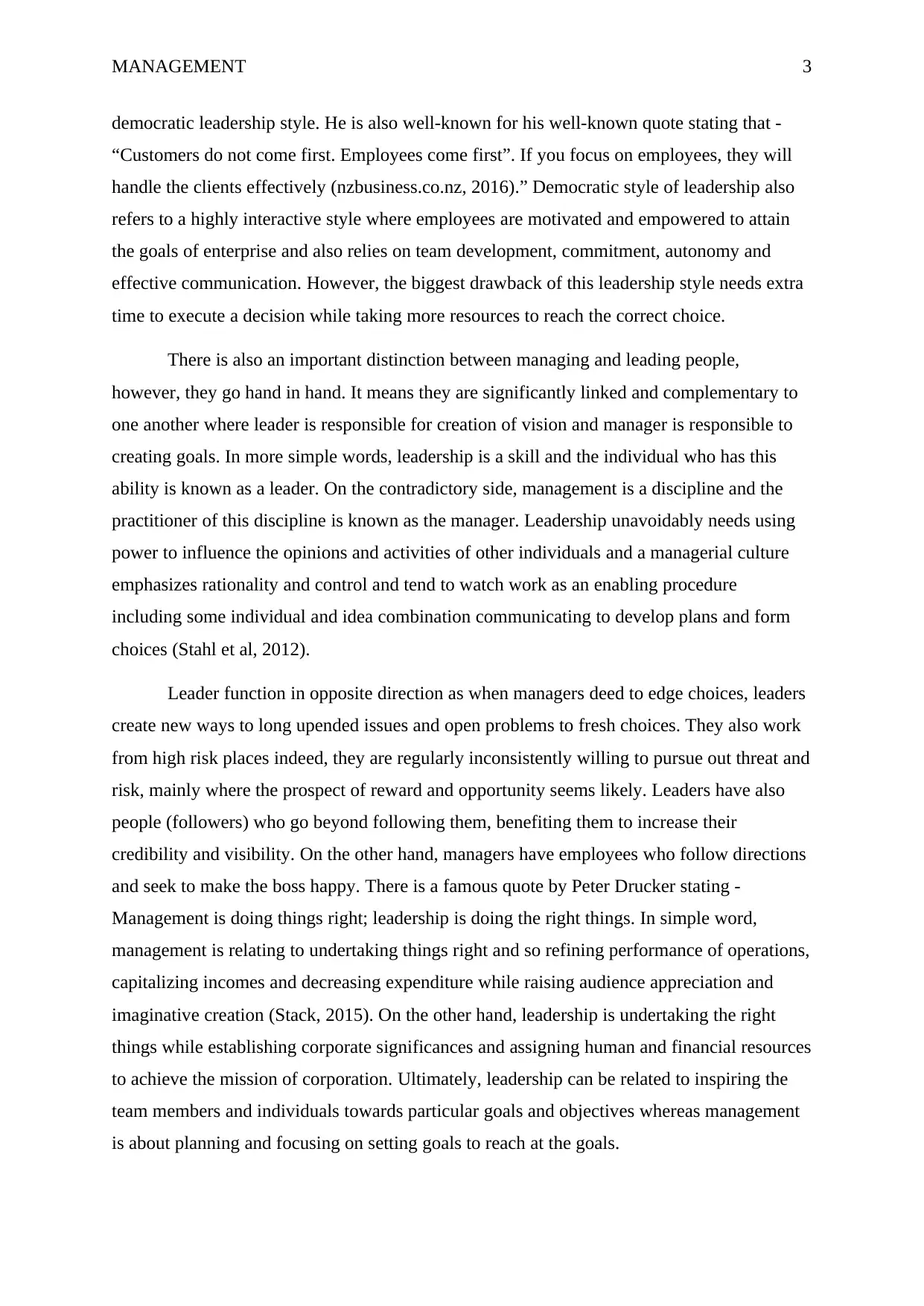
democratic leadership style. He is also well-known for his well-known quote stating that -
“Customers do not come first. Employees come first”. If you focus on employees, they will
handle the clients effectively (nzbusiness.co.nz, 2016).” Democratic style of leadership also
refers to a highly interactive style where employees are motivated and empowered to attain
the goals of enterprise and also relies on team development, commitment, autonomy and
effective communication. However, the biggest drawback of this leadership style needs extra
time to execute a decision while taking more resources to reach the correct choice.
There is also an important distinction between managing and leading people,
however, they go hand in hand. It means they are significantly linked and complementary to
one another where leader is responsible for creation of vision and manager is responsible to
creating goals. In more simple words, leadership is a skill and the individual who has this
ability is known as a leader. On the contradictory side, management is a discipline and the
practitioner of this discipline is known as the manager. Leadership unavoidably needs using
power to influence the opinions and activities of other individuals and a managerial culture
emphasizes rationality and control and tend to watch work as an enabling procedure
including some individual and idea combination communicating to develop plans and form
choices (Stahl et al, 2012).
Leader function in opposite direction as when managers deed to edge choices, leaders
create new ways to long upended issues and open problems to fresh choices. They also work
from high risk places indeed, they are regularly inconsistently willing to pursue out threat and
risk, mainly where the prospect of reward and opportunity seems likely. Leaders have also
people (followers) who go beyond following them, benefiting them to increase their
credibility and visibility. On the other hand, managers have employees who follow directions
and seek to make the boss happy. There is a famous quote by Peter Drucker stating -
Management is doing things right; leadership is doing the right things. In simple word,
management is relating to undertaking things right and so refining performance of operations,
capitalizing incomes and decreasing expenditure while raising audience appreciation and
imaginative creation (Stack, 2015). On the other hand, leadership is undertaking the right
things while establishing corporate significances and assigning human and financial resources
to achieve the mission of corporation. Ultimately, leadership can be related to inspiring the
team members and individuals towards particular goals and objectives whereas management
is about planning and focusing on setting goals to reach at the goals.
democratic leadership style. He is also well-known for his well-known quote stating that -
“Customers do not come first. Employees come first”. If you focus on employees, they will
handle the clients effectively (nzbusiness.co.nz, 2016).” Democratic style of leadership also
refers to a highly interactive style where employees are motivated and empowered to attain
the goals of enterprise and also relies on team development, commitment, autonomy and
effective communication. However, the biggest drawback of this leadership style needs extra
time to execute a decision while taking more resources to reach the correct choice.
There is also an important distinction between managing and leading people,
however, they go hand in hand. It means they are significantly linked and complementary to
one another where leader is responsible for creation of vision and manager is responsible to
creating goals. In more simple words, leadership is a skill and the individual who has this
ability is known as a leader. On the contradictory side, management is a discipline and the
practitioner of this discipline is known as the manager. Leadership unavoidably needs using
power to influence the opinions and activities of other individuals and a managerial culture
emphasizes rationality and control and tend to watch work as an enabling procedure
including some individual and idea combination communicating to develop plans and form
choices (Stahl et al, 2012).
Leader function in opposite direction as when managers deed to edge choices, leaders
create new ways to long upended issues and open problems to fresh choices. They also work
from high risk places indeed, they are regularly inconsistently willing to pursue out threat and
risk, mainly where the prospect of reward and opportunity seems likely. Leaders have also
people (followers) who go beyond following them, benefiting them to increase their
credibility and visibility. On the other hand, managers have employees who follow directions
and seek to make the boss happy. There is a famous quote by Peter Drucker stating -
Management is doing things right; leadership is doing the right things. In simple word,
management is relating to undertaking things right and so refining performance of operations,
capitalizing incomes and decreasing expenditure while raising audience appreciation and
imaginative creation (Stack, 2015). On the other hand, leadership is undertaking the right
things while establishing corporate significances and assigning human and financial resources
to achieve the mission of corporation. Ultimately, leadership can be related to inspiring the
team members and individuals towards particular goals and objectives whereas management
is about planning and focusing on setting goals to reach at the goals.
Paraphrase This Document
Need a fresh take? Get an instant paraphrase of this document with our AI Paraphraser
MANAGEMENT 4
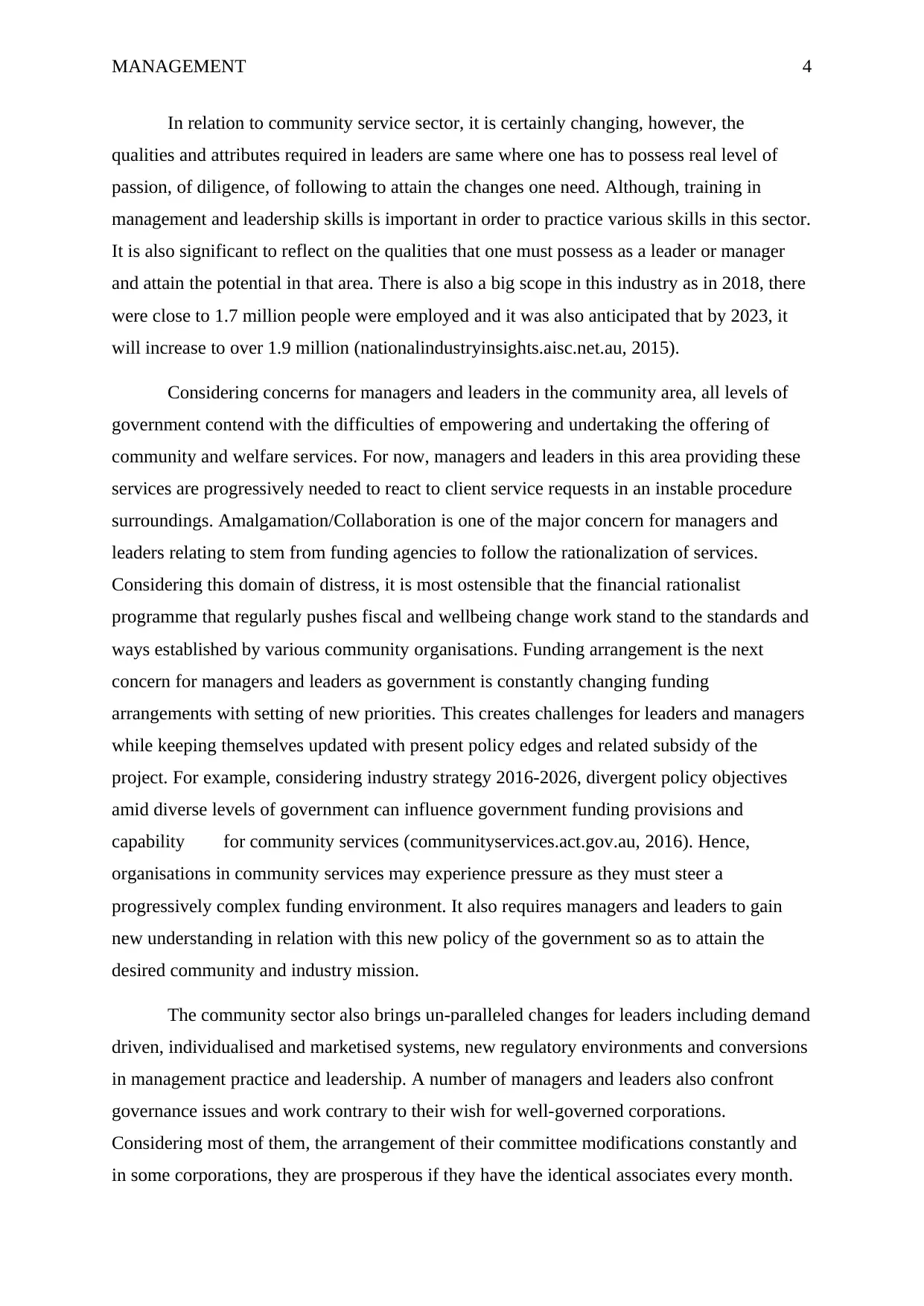
In relation to community service sector, it is certainly changing, however, the
qualities and attributes required in leaders are same where one has to possess real level of
passion, of diligence, of following to attain the changes one need. Although, training in
management and leadership skills is important in order to practice various skills in this sector.
It is also significant to reflect on the qualities that one must possess as a leader or manager
and attain the potential in that area. There is also a big scope in this industry as in 2018, there
were close to 1.7 million people were employed and it was also anticipated that by 2023, it
will increase to over 1.9 million (nationalindustryinsights.aisc.net.au, 2015).
Considering concerns for managers and leaders in the community area, all levels of
government contend with the difficulties of empowering and undertaking the offering of
community and welfare services. For now, managers and leaders in this area providing these
services are progressively needed to react to client service requests in an instable procedure
surroundings. Amalgamation/Collaboration is one of the major concern for managers and
leaders relating to stem from funding agencies to follow the rationalization of services.
Considering this domain of distress, it is most ostensible that the financial rationalist
programme that regularly pushes fiscal and wellbeing change work stand to the standards and
ways established by various community organisations. Funding arrangement is the next
concern for managers and leaders as government is constantly changing funding
arrangements with setting of new priorities. This creates challenges for leaders and managers
while keeping themselves updated with present policy edges and related subsidy of the
project. For example, considering industry strategy 2016-2026, divergent policy objectives
amid diverse levels of government can influence government funding provisions and
capability for community services (communityservices.act.gov.au, 2016). Hence,
organisations in community services may experience pressure as they must steer a
progressively complex funding environment. It also requires managers and leaders to gain
new understanding in relation with this new policy of the government so as to attain the
desired community and industry mission.
The community sector also brings un-paralleled changes for leaders including demand
driven, individualised and marketised systems, new regulatory environments and conversions
in management practice and leadership. A number of managers and leaders also confront
governance issues and work contrary to their wish for well-governed corporations.
Considering most of them, the arrangement of their committee modifications constantly and
in some corporations, they are prosperous if they have the identical associates every month.
In relation to community service sector, it is certainly changing, however, the
qualities and attributes required in leaders are same where one has to possess real level of
passion, of diligence, of following to attain the changes one need. Although, training in
management and leadership skills is important in order to practice various skills in this sector.
It is also significant to reflect on the qualities that one must possess as a leader or manager
and attain the potential in that area. There is also a big scope in this industry as in 2018, there
were close to 1.7 million people were employed and it was also anticipated that by 2023, it
will increase to over 1.9 million (nationalindustryinsights.aisc.net.au, 2015).
Considering concerns for managers and leaders in the community area, all levels of
government contend with the difficulties of empowering and undertaking the offering of
community and welfare services. For now, managers and leaders in this area providing these
services are progressively needed to react to client service requests in an instable procedure
surroundings. Amalgamation/Collaboration is one of the major concern for managers and
leaders relating to stem from funding agencies to follow the rationalization of services.
Considering this domain of distress, it is most ostensible that the financial rationalist
programme that regularly pushes fiscal and wellbeing change work stand to the standards and
ways established by various community organisations. Funding arrangement is the next
concern for managers and leaders as government is constantly changing funding
arrangements with setting of new priorities. This creates challenges for leaders and managers
while keeping themselves updated with present policy edges and related subsidy of the
project. For example, considering industry strategy 2016-2026, divergent policy objectives
amid diverse levels of government can influence government funding provisions and
capability for community services (communityservices.act.gov.au, 2016). Hence,
organisations in community services may experience pressure as they must steer a
progressively complex funding environment. It also requires managers and leaders to gain
new understanding in relation with this new policy of the government so as to attain the
desired community and industry mission.
The community sector also brings un-paralleled changes for leaders including demand
driven, individualised and marketised systems, new regulatory environments and conversions
in management practice and leadership. A number of managers and leaders also confront
governance issues and work contrary to their wish for well-governed corporations.
Considering most of them, the arrangement of their committee modifications constantly and
in some corporations, they are prosperous if they have the identical associates every month.
MANAGEMENT 5
For the effective management, management groups required an equilibrium of expertise and
generally, there is no much capital for training and development and hence, in the end, kills
the time of both leaders and managers in community sector.
Furthermore, manager and leader also face challenge of managing change where the
continuous claim to remain in coordination with the developing problems in the industry,
mainly in the domain of capitalization, states that a leader devotes a lesser amount of time on
straight delivery of service (Shelton, 2012). Subsequently, leaders and managers have to
misrepresent the requirement of straight service delivery with condensed finances incline to
drive away from accepting variation for its personal sake or merely as capitalizing
corporations need them to be viable, accountable and co-operative in various means.
Ultimately, community leadership and managerial understand benefits an individual
from being rooted into social networks, shared vision and decision making, however, pre-
existing abilities and implicit knowledge also play a part. With working effective with
various government bodies and private organisations, leaders and managers can develop and
assist niche building and help in welfare of the whole country. Meanwhile, different
leadership styles are also being discussed in the study, however, prior to that, it is also
important to have superior leadership trait in any discipline like responsibility and integrity to
also be excellence as community leaders. It is also clear from the study about the current
concerns of managers and leaders in the community industry and more evidence can also be
discovered with associating the areas of management challenge and therefore, effectively
evaluating the implications of current social policies in the sector.
For the effective management, management groups required an equilibrium of expertise and
generally, there is no much capital for training and development and hence, in the end, kills
the time of both leaders and managers in community sector.
Furthermore, manager and leader also face challenge of managing change where the
continuous claim to remain in coordination with the developing problems in the industry,
mainly in the domain of capitalization, states that a leader devotes a lesser amount of time on
straight delivery of service (Shelton, 2012). Subsequently, leaders and managers have to
misrepresent the requirement of straight service delivery with condensed finances incline to
drive away from accepting variation for its personal sake or merely as capitalizing
corporations need them to be viable, accountable and co-operative in various means.
Ultimately, community leadership and managerial understand benefits an individual
from being rooted into social networks, shared vision and decision making, however, pre-
existing abilities and implicit knowledge also play a part. With working effective with
various government bodies and private organisations, leaders and managers can develop and
assist niche building and help in welfare of the whole country. Meanwhile, different
leadership styles are also being discussed in the study, however, prior to that, it is also
important to have superior leadership trait in any discipline like responsibility and integrity to
also be excellence as community leaders. It is also clear from the study about the current
concerns of managers and leaders in the community industry and more evidence can also be
discovered with associating the areas of management challenge and therefore, effectively
evaluating the implications of current social policies in the sector.
⊘ This is a preview!⊘
Do you want full access?
Subscribe today to unlock all pages.
Trusted by 1+ million students worldwide
MANAGEMENT 6
References
Amanchukwu, R. N., Stanley, G. J., & Ololube, N. P. (2015). A review of leadership theories,
principles and styles and their relevance to educational
management. Management, 5(1), 6-14.
Amanchukwu, R. N., Stanley, G. J., & Ololube, N. P. (2015). A review of leadership theories,
principles and styles and their relevance to educational
management. Management, 5(1), 6-14.
Cherry, K. (2019). Pros and Cons of Laissez-Faire Leadership. Retrieved from
https://www.verywellmind.com/what-is-laissez-faire-leadership-2795316
communityservices.act.gov.au. (2016). Industry Strategy 2016-2026. Retrieved from
https://www.communityservices.act.gov.au/hcs/community-sector-reform/industry-
strategy-2016-2026
Isaacson, W. (2012). The real leadership lessons of Steve Jobs. Harvard business
review, 90(4), 92-102.
Khan, M. S., Khan, I., Qureshi, Q. A., Ismail, H. M., Rauf, H., Latif, A., & Tahir, M. (2015).
The styles of leadership: A critical review. Public Policy and Administration
Research, 5(3), 87-92.
nationalindustryinsights.aisc.net.au. (2019). Community Service. Retrieved from
https://nationalindustryinsights.aisc.net.au/industries/community-services
nzbusiness.co.nz. (2016). Why you should put employees, not customers, first. Retrieved from
https://nzbusiness.co.nz/article/why-you-should-put-employees-not-customers-first
Perkins, B. (2019). What is ERP? A guide to enterprise resource planning systems. Retrieved
from https://www.cio.com/article/2439502/enterprise-resource-planning/enterprise-
resource-planning-erp-definition-and-solutions.html
Rao, M. S. (2013). Soft leadership: a new direction to leadership. Industrial and Commercial
Training, 45(3), 143-149.
Shelton, E.J., 2012. Transformational leadership: Trust, motivation and engagement. USA:
Trafford Publishing.
References
Amanchukwu, R. N., Stanley, G. J., & Ololube, N. P. (2015). A review of leadership theories,
principles and styles and their relevance to educational
management. Management, 5(1), 6-14.
Amanchukwu, R. N., Stanley, G. J., & Ololube, N. P. (2015). A review of leadership theories,
principles and styles and their relevance to educational
management. Management, 5(1), 6-14.
Cherry, K. (2019). Pros and Cons of Laissez-Faire Leadership. Retrieved from
https://www.verywellmind.com/what-is-laissez-faire-leadership-2795316
communityservices.act.gov.au. (2016). Industry Strategy 2016-2026. Retrieved from
https://www.communityservices.act.gov.au/hcs/community-sector-reform/industry-
strategy-2016-2026
Isaacson, W. (2012). The real leadership lessons of Steve Jobs. Harvard business
review, 90(4), 92-102.
Khan, M. S., Khan, I., Qureshi, Q. A., Ismail, H. M., Rauf, H., Latif, A., & Tahir, M. (2015).
The styles of leadership: A critical review. Public Policy and Administration
Research, 5(3), 87-92.
nationalindustryinsights.aisc.net.au. (2019). Community Service. Retrieved from
https://nationalindustryinsights.aisc.net.au/industries/community-services
nzbusiness.co.nz. (2016). Why you should put employees, not customers, first. Retrieved from
https://nzbusiness.co.nz/article/why-you-should-put-employees-not-customers-first
Perkins, B. (2019). What is ERP? A guide to enterprise resource planning systems. Retrieved
from https://www.cio.com/article/2439502/enterprise-resource-planning/enterprise-
resource-planning-erp-definition-and-solutions.html
Rao, M. S. (2013). Soft leadership: a new direction to leadership. Industrial and Commercial
Training, 45(3), 143-149.
Shelton, E.J., 2012. Transformational leadership: Trust, motivation and engagement. USA:
Trafford Publishing.
Paraphrase This Document
Need a fresh take? Get an instant paraphrase of this document with our AI Paraphraser

MANAGEMENT 7
Stack, L. (2015). The modern executive: How to do the right things right. Retrieved from
https://www.bizjournals.com/bizjournals/how-to/growth-strategies/2015/12/the-
modern-executive-how-to-do-right-things-right.html
Stahl, G., Bjorkman, I., Farndale, E., Morris, S. S., Paauwe, J., Stiles, P., ... & Wright, P.
(2012). Six principles of effective global talent management. Sloan Management
Review, 53(2), 25-42.
Yang, I. (2015). Positive effects of laissez-faire leadership: conceptual exploration. Journal
of Management Development, 34(10), 1246-1261.
Stack, L. (2015). The modern executive: How to do the right things right. Retrieved from
https://www.bizjournals.com/bizjournals/how-to/growth-strategies/2015/12/the-
modern-executive-how-to-do-right-things-right.html
Stahl, G., Bjorkman, I., Farndale, E., Morris, S. S., Paauwe, J., Stiles, P., ... & Wright, P.
(2012). Six principles of effective global talent management. Sloan Management
Review, 53(2), 25-42.
Yang, I. (2015). Positive effects of laissez-faire leadership: conceptual exploration. Journal
of Management Development, 34(10), 1246-1261.

1 out of 8


Related Documents


Your All-in-One AI-Powered Toolkit for Academic Success.
+13062052269
info@desklib.com
Available 24*7 on WhatsApp / Email
![[object Object]](/_next/static/media/star-bottom.7253800d.svg)
Unlock your academic potential
Copyright © 2020–2025 A2Z Services. All Rights Reserved. Developed and managed by ZUCOL.