Comprehensive Report on Leadership and Management for llford-on-Sea
VerifiedAdded on 2020/02/03
|16
|5508
|207
Report
AI Summary
This report provides a detailed analysis of leadership and management, focusing on the case of Ilford-on-Sea limited, a construction company facing workforce management challenges. The report begins by comparing the roles and characteristics of leaders and managers, highlighting their distinct responsibilities in guiding and motivating employees. It then delves into various leadership and management theories, including behavioral, contingency, chaos, and systems theories, and their application to the case study. The report further examines the roles of leaders and managers in different situations, such as conflict resolution and project success. Finally, the report explores key approaches to operational management, emphasizing the importance of efficiency and the impact of various factors on business operations. The report suggests that by implementing these theories, Ilford-on-Sea can improve its workforce management, achieve its goals, and enhance the overall efficiency of its operations.
MANAGEMENT AND
OPERATIONS
OPERATIONS

Paraphrase This Document
Need a fresh take? Get an instant paraphrase of this document with our AI Paraphraser
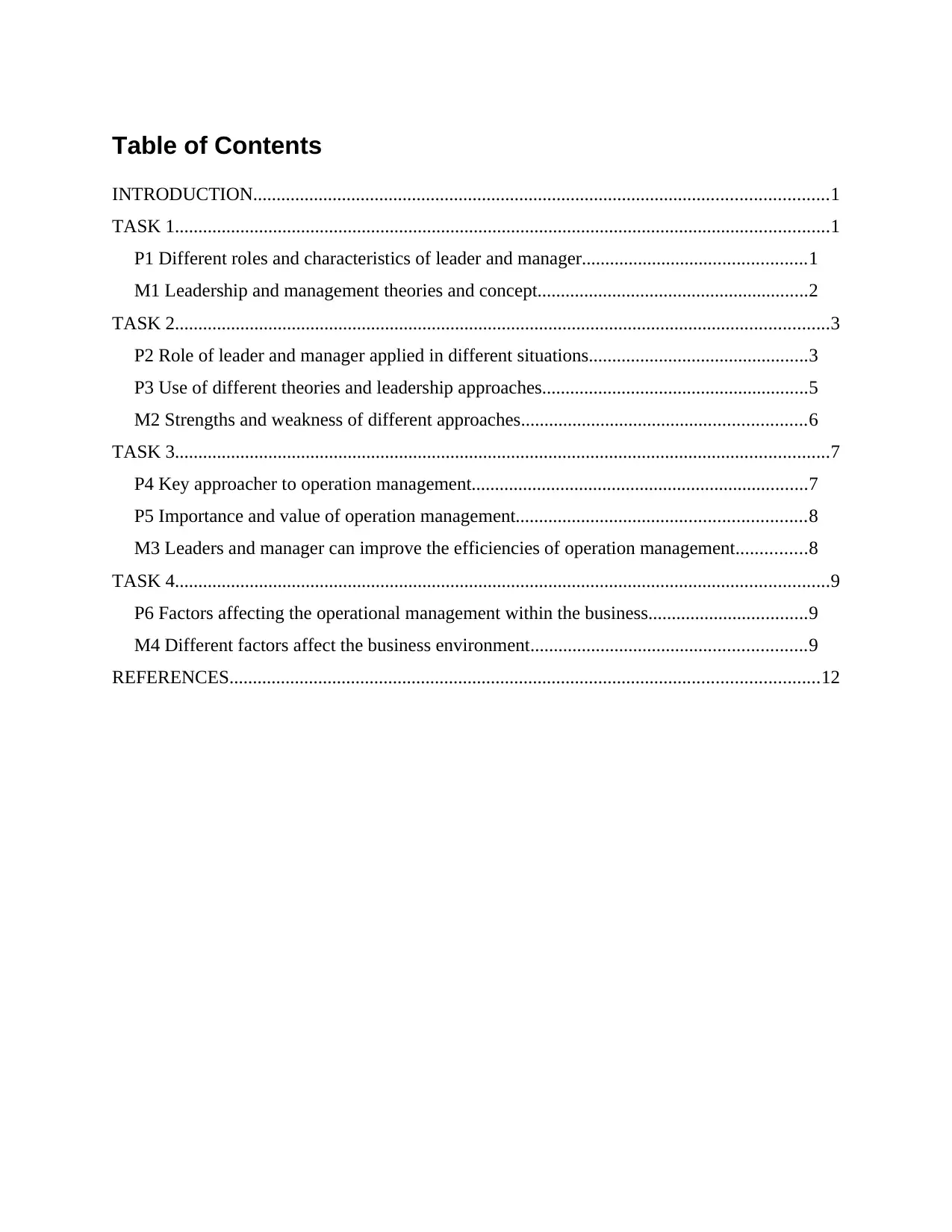
Table of Contents
INTRODUCTION...........................................................................................................................1
TASK 1............................................................................................................................................1
P1 Different roles and characteristics of leader and manager................................................1
M1 Leadership and management theories and concept..........................................................2
TASK 2............................................................................................................................................3
P2 Role of leader and manager applied in different situations...............................................3
P3 Use of different theories and leadership approaches.........................................................5
M2 Strengths and weakness of different approaches.............................................................6
TASK 3............................................................................................................................................7
P4 Key approacher to operation management........................................................................7
P5 Importance and value of operation management..............................................................8
M3 Leaders and manager can improve the efficiencies of operation management...............8
TASK 4............................................................................................................................................9
P6 Factors affecting the operational management within the business..................................9
M4 Different factors affect the business environment...........................................................9
REFERENCES..............................................................................................................................12
INTRODUCTION...........................................................................................................................1
TASK 1............................................................................................................................................1
P1 Different roles and characteristics of leader and manager................................................1
M1 Leadership and management theories and concept..........................................................2
TASK 2............................................................................................................................................3
P2 Role of leader and manager applied in different situations...............................................3
P3 Use of different theories and leadership approaches.........................................................5
M2 Strengths and weakness of different approaches.............................................................6
TASK 3............................................................................................................................................7
P4 Key approacher to operation management........................................................................7
P5 Importance and value of operation management..............................................................8
M3 Leaders and manager can improve the efficiencies of operation management...............8
TASK 4............................................................................................................................................9
P6 Factors affecting the operational management within the business..................................9
M4 Different factors affect the business environment...........................................................9
REFERENCES..............................................................................................................................12
INTRODUCTION
Operation management is a crucial area where an organization requires focusing in order to
design and control the production process. However, the defined process assists in administrating
the business at higher growth and efficiency. It consists of resources development and its use
which is required to the firm for delivering the goods and services in an effectual manner. In
every organization, the process is being monitored and focused to attain the organizational
objectives. The present report is based on the case study of llford-on-Sea limited where the firm
operates in East end of London. The stated firm is operating in the field of construction and has
expertise in repairs and renovation. The operations of this company are mainly affected by the
economic slowdown in 2008. It was seen that the firm was awarded in 2007 for the renovation of
100 units by Jarvis Construction Group. Presently, the organization has recruited 10 employees
but the company is facing the issue of monitoring and controlling of workforce due to different
construction sites. Therefore, the current document is prepared with a motive to provide an
effective solution to this firm. Additionally, the report will describe the role of a leader and the
functions of manager (Alderton and Saieva, 2013).
TASK 1
P1 Comparison about roles and characteristics of leader and manager
In the organization, there are several roles and responsibilities which are being performed
by the leaders and mangers to attain goals and objectives. The leader is majorly responsible for
leading people at the workplace. The behaviour of employees is influenced by the leader in
different ways. It is seen that a leader has a clear vision towards goals and objectives of the
company. For the same, the concerned person is accountable to guide and provide direction to
the work staff. Apart from this, a leader also plays the role of representative of the organization.
During the seminars and conferences, the major concerned is being delivered by them. In case of
llford-on-Sea the organization faces the issue of the workforce management. Even, lack of
coordination is being witnessed by the management of stated organization. In context to this, the
top management is unable to raise finance and other operational issues. However, in this
situation the leader of the adapted firm is accountable to conduct proper staff training. It will
provide assistance to the organization to enhance current position of employees. The employees
will be able to understand their responsibilities towards the organization. It will result in
performing roles in an effectual manner Tayur, Ganeshan and Magazine, 2012).
1
Operation management is a crucial area where an organization requires focusing in order to
design and control the production process. However, the defined process assists in administrating
the business at higher growth and efficiency. It consists of resources development and its use
which is required to the firm for delivering the goods and services in an effectual manner. In
every organization, the process is being monitored and focused to attain the organizational
objectives. The present report is based on the case study of llford-on-Sea limited where the firm
operates in East end of London. The stated firm is operating in the field of construction and has
expertise in repairs and renovation. The operations of this company are mainly affected by the
economic slowdown in 2008. It was seen that the firm was awarded in 2007 for the renovation of
100 units by Jarvis Construction Group. Presently, the organization has recruited 10 employees
but the company is facing the issue of monitoring and controlling of workforce due to different
construction sites. Therefore, the current document is prepared with a motive to provide an
effective solution to this firm. Additionally, the report will describe the role of a leader and the
functions of manager (Alderton and Saieva, 2013).
TASK 1
P1 Comparison about roles and characteristics of leader and manager
In the organization, there are several roles and responsibilities which are being performed
by the leaders and mangers to attain goals and objectives. The leader is majorly responsible for
leading people at the workplace. The behaviour of employees is influenced by the leader in
different ways. It is seen that a leader has a clear vision towards goals and objectives of the
company. For the same, the concerned person is accountable to guide and provide direction to
the work staff. Apart from this, a leader also plays the role of representative of the organization.
During the seminars and conferences, the major concerned is being delivered by them. In case of
llford-on-Sea the organization faces the issue of the workforce management. Even, lack of
coordination is being witnessed by the management of stated organization. In context to this, the
top management is unable to raise finance and other operational issues. However, in this
situation the leader of the adapted firm is accountable to conduct proper staff training. It will
provide assistance to the organization to enhance current position of employees. The employees
will be able to understand their responsibilities towards the organization. It will result in
performing roles in an effectual manner Tayur, Ganeshan and Magazine, 2012).
1
⊘ This is a preview!⊘
Do you want full access?
Subscribe today to unlock all pages.

Trusted by 1+ million students worldwide
In context to above, the manager is also accountable for certain roles and responsibilities
towards workforce and their issues. Howsoever, the manger is required to become a leader first
to manager its workforce. Apart from this, the organizational plans and strategies are being
formulated by the manager itself. In the case of the stated organization, it is essential for the
manager to inspire and motivate employees towards their roles and responsibilities. It is
identified that the cited establishment is facing several operational issues where the manager
needs to focus on effective communication. This will result in resolving coordination between
employees and the top management. Additionally, it is seen that the manager of the stated firm is
facing misunderstanding because the employees are not able to understand the pressure of this
firm as it is a small organization (Morrison, 2013). The manager is required to make the
employees understand to talk them and let them understand the values and mission of company.
Additionally, the manager needs to be a liaison between employees and the other stakeholders of
the company. This will assist the organization to sort out its issues and problems effectively. The
employees of this company are also need to understand the value because if the issues will not be
solved then it will result in terminating the contract with llford-on-Sea Tayur, Ganeshan and
Magazine, 2012). It is seen that a leader has a clear vision towards goals and objectives of the
company. For the same, the concerned person is accountable to guide and provide direction to
the work staff. Apart from this, a leader also plays the role of representative of the organization.
During the seminars and conferences, the major concerned is being delivered by them. In case of
llford-on-Sea the organization faces the issue of the workforce management. Even, lack of
coordination is being witnessed by the management of stated organization. In context to this, the
top management is unable to raise finance and other operational issues.
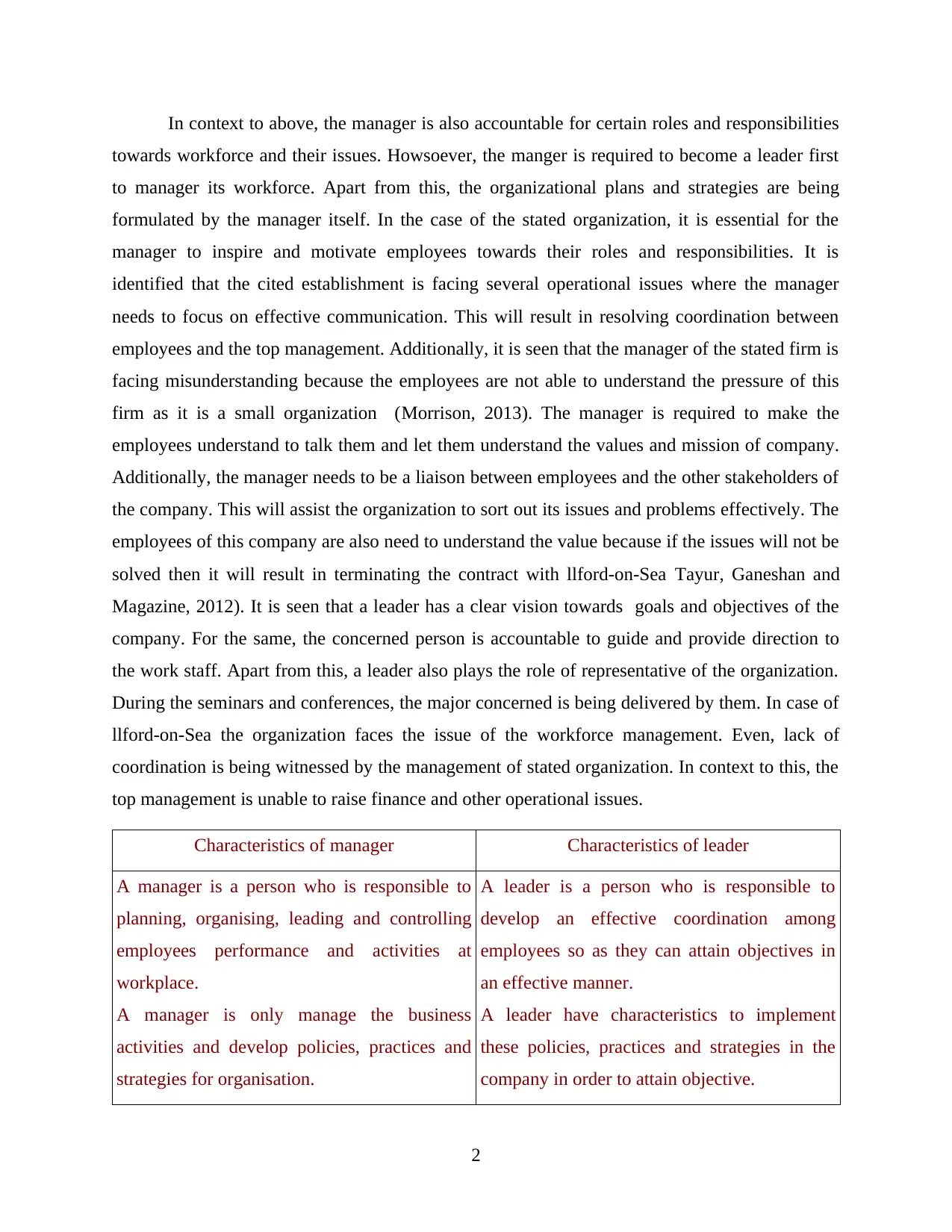
Characteristics of manager Characteristics of leader
A manager is a person who is responsible to
planning, organising, leading and controlling
employees performance and activities at
workplace.
A manager is only manage the business
activities and develop policies, practices and
strategies for organisation.
A leader is a person who is responsible to
develop an effective coordination among
employees so as they can attain objectives in
an effective manner.
A leader have characteristics to implement
these policies, practices and strategies in the
company in order to attain objective.
2
towards workforce and their issues. Howsoever, the manger is required to become a leader first
to manager its workforce. Apart from this, the organizational plans and strategies are being
formulated by the manager itself. In the case of the stated organization, it is essential for the
manager to inspire and motivate employees towards their roles and responsibilities. It is
identified that the cited establishment is facing several operational issues where the manager
needs to focus on effective communication. This will result in resolving coordination between
employees and the top management. Additionally, it is seen that the manager of the stated firm is
facing misunderstanding because the employees are not able to understand the pressure of this
firm as it is a small organization (Morrison, 2013). The manager is required to make the
employees understand to talk them and let them understand the values and mission of company.
Additionally, the manager needs to be a liaison between employees and the other stakeholders of
the company. This will assist the organization to sort out its issues and problems effectively. The
employees of this company are also need to understand the value because if the issues will not be
solved then it will result in terminating the contract with llford-on-Sea Tayur, Ganeshan and
Magazine, 2012). It is seen that a leader has a clear vision towards goals and objectives of the
company. For the same, the concerned person is accountable to guide and provide direction to
the work staff. Apart from this, a leader also plays the role of representative of the organization.
During the seminars and conferences, the major concerned is being delivered by them. In case of
llford-on-Sea the organization faces the issue of the workforce management. Even, lack of
coordination is being witnessed by the management of stated organization. In context to this, the
top management is unable to raise finance and other operational issues.
Characteristics of manager Characteristics of leader
A manager is a person who is responsible to
planning, organising, leading and controlling
employees performance and activities at
workplace.
A manager is only manage the business
activities and develop policies, practices and
strategies for organisation.
A leader is a person who is responsible to
develop an effective coordination among
employees so as they can attain objectives in
an effective manner.
A leader have characteristics to implement
these policies, practices and strategies in the
company in order to attain objective.
2
Paraphrase This Document
Need a fresh take? Get an instant paraphrase of this document with our AI Paraphraser
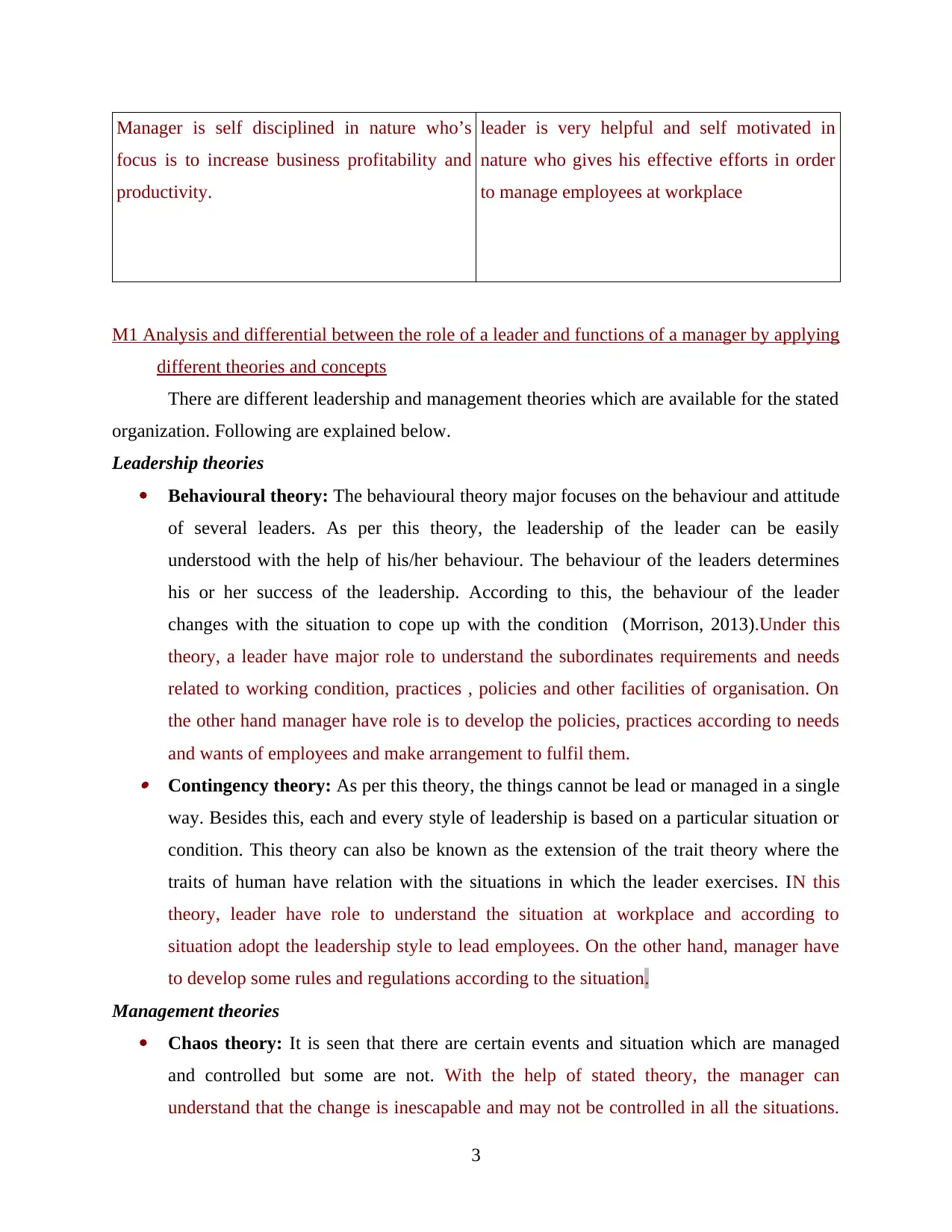
Manager is self disciplined in nature who’s
focus is to increase business profitability and
productivity.
leader is very helpful and self motivated in
nature who gives his effective efforts in order
to manage employees at workplace
M1 Analysis and differential between the role of a leader and functions of a manager by applying
different theories and concepts
There are different leadership and management theories which are available for the stated
organization. Following are explained below.
Leadership theories
Behavioural theory: The behavioural theory major focuses on the behaviour and attitude
of several leaders. As per this theory, the leadership of the leader can be easily
understood with the help of his/her behaviour. The behaviour of the leaders determines
his or her success of the leadership. According to this, the behaviour of the leader
changes with the situation to cope up with the condition (Morrison, 2013).Under this
theory, a leader have major role to understand the subordinates requirements and needs
related to working condition, practices , policies and other facilities of organisation. On
the other hand manager have role is to develop the policies, practices according to needs
and wants of employees and make arrangement to fulfil them. Contingency theory: As per this theory, the things cannot be lead or managed in a single
way. Besides this, each and every style of leadership is based on a particular situation or
condition. This theory can also be known as the extension of the trait theory where the
traits of human have relation with the situations in which the leader exercises. IN this
theory, leader have role to understand the situation at workplace and according to
situation adopt the leadership style to lead employees. On the other hand, manager have
to develop some rules and regulations according to the situation.
Management theories
Chaos theory: It is seen that there are certain events and situation which are managed
and controlled but some are not. With the help of stated theory, the manager can
understand that the change is inescapable and may not be controlled in all the situations.
3
focus is to increase business profitability and
productivity.
leader is very helpful and self motivated in
nature who gives his effective efforts in order
to manage employees at workplace
M1 Analysis and differential between the role of a leader and functions of a manager by applying
different theories and concepts
There are different leadership and management theories which are available for the stated
organization. Following are explained below.
Leadership theories
Behavioural theory: The behavioural theory major focuses on the behaviour and attitude
of several leaders. As per this theory, the leadership of the leader can be easily
understood with the help of his/her behaviour. The behaviour of the leaders determines
his or her success of the leadership. According to this, the behaviour of the leader
changes with the situation to cope up with the condition (Morrison, 2013).Under this
theory, a leader have major role to understand the subordinates requirements and needs
related to working condition, practices , policies and other facilities of organisation. On
the other hand manager have role is to develop the policies, practices according to needs
and wants of employees and make arrangement to fulfil them. Contingency theory: As per this theory, the things cannot be lead or managed in a single
way. Besides this, each and every style of leadership is based on a particular situation or
condition. This theory can also be known as the extension of the trait theory where the
traits of human have relation with the situations in which the leader exercises. IN this
theory, leader have role to understand the situation at workplace and according to
situation adopt the leadership style to lead employees. On the other hand, manager have
to develop some rules and regulations according to the situation.
Management theories
Chaos theory: It is seen that there are certain events and situation which are managed
and controlled but some are not. With the help of stated theory, the manager can
understand that the change is inescapable and may not be controlled in all the situations.
3
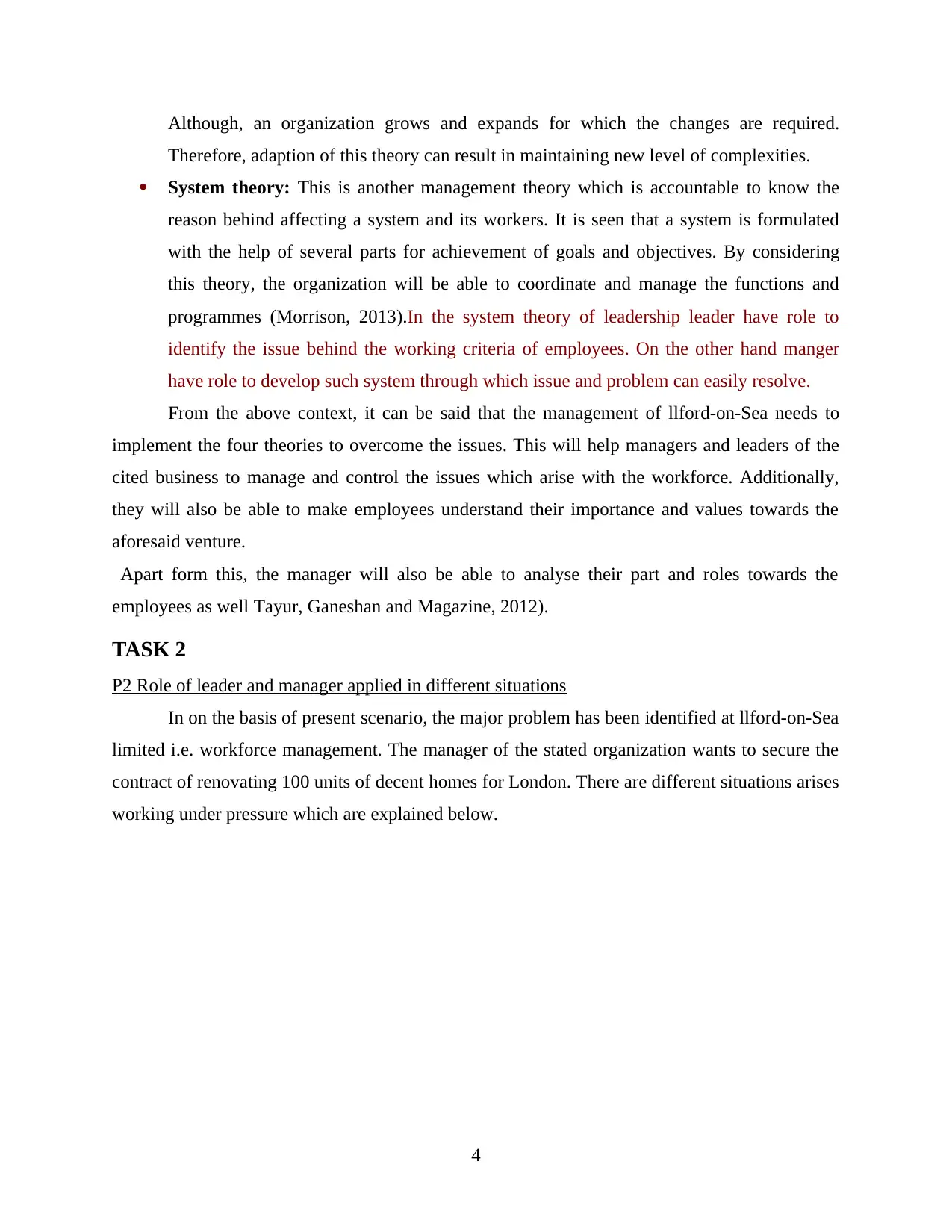
Although, an organization grows and expands for which the changes are required.
Therefore, adaption of this theory can result in maintaining new level of complexities.
System theory: This is another management theory which is accountable to know the
reason behind affecting a system and its workers. It is seen that a system is formulated
with the help of several parts for achievement of goals and objectives. By considering
this theory, the organization will be able to coordinate and manage the functions and
programmes (Morrison, 2013).In the system theory of leadership leader have role to
identify the issue behind the working criteria of employees. On the other hand manger
have role to develop such system through which issue and problem can easily resolve.
From the above context, it can be said that the management of llford-on-Sea needs to
implement the four theories to overcome the issues. This will help managers and leaders of the
cited business to manage and control the issues which arise with the workforce. Additionally,
they will also be able to make employees understand their importance and values towards the
aforesaid venture.
Apart form this, the manager will also be able to analyse their part and roles towards the
employees as well Tayur, Ganeshan and Magazine, 2012).
TASK 2
P2 Role of leader and manager applied in different situations
In on the basis of present scenario, the major problem has been identified at llford-on-Sea
limited i.e. workforce management. The manager of the stated organization wants to secure the
contract of renovating 100 units of decent homes for London. There are different situations arises
working under pressure which are explained below.
4
Therefore, adaption of this theory can result in maintaining new level of complexities.
System theory: This is another management theory which is accountable to know the
reason behind affecting a system and its workers. It is seen that a system is formulated
with the help of several parts for achievement of goals and objectives. By considering
this theory, the organization will be able to coordinate and manage the functions and
programmes (Morrison, 2013).In the system theory of leadership leader have role to
identify the issue behind the working criteria of employees. On the other hand manger
have role to develop such system through which issue and problem can easily resolve.
From the above context, it can be said that the management of llford-on-Sea needs to
implement the four theories to overcome the issues. This will help managers and leaders of the
cited business to manage and control the issues which arise with the workforce. Additionally,
they will also be able to make employees understand their importance and values towards the
aforesaid venture.
Apart form this, the manager will also be able to analyse their part and roles towards the
employees as well Tayur, Ganeshan and Magazine, 2012).
TASK 2
P2 Role of leader and manager applied in different situations
In on the basis of present scenario, the major problem has been identified at llford-on-Sea
limited i.e. workforce management. The manager of the stated organization wants to secure the
contract of renovating 100 units of decent homes for London. There are different situations arises
working under pressure which are explained below.
4
⊘ This is a preview!⊘
Do you want full access?
Subscribe today to unlock all pages.
Trusted by 1+ million students worldwide
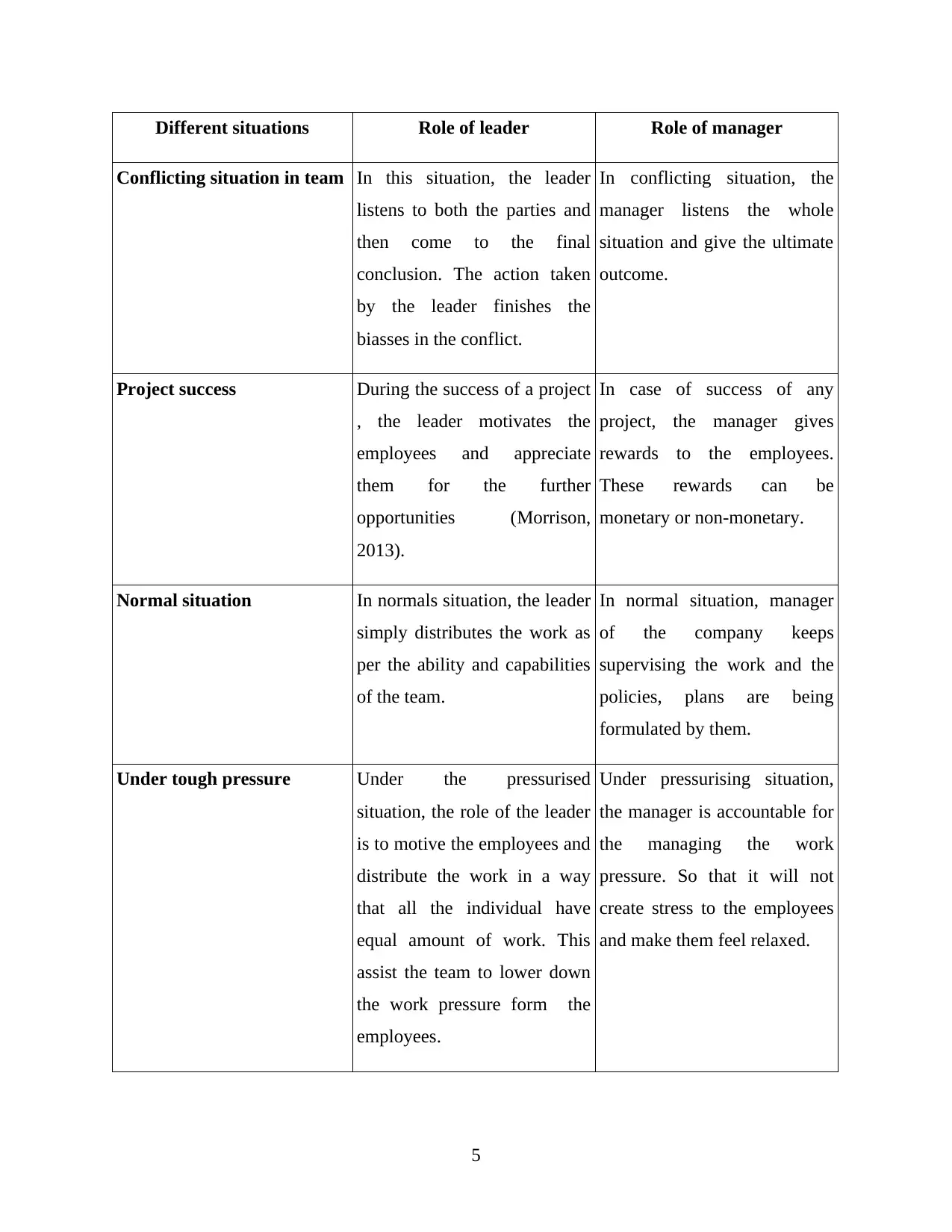
Different situations Role of leader Role of manager
Conflicting situation in team In this situation, the leader
listens to both the parties and
then come to the final
conclusion. The action taken
by the leader finishes the
biasses in the conflict.
In conflicting situation, the
manager listens the whole
situation and give the ultimate
outcome.
Project success During the success of a project
, the leader motivates the
employees and appreciate
them for the further
opportunities (Morrison,
2013).
In case of success of any
project, the manager gives
rewards to the employees.
These rewards can be
monetary or non-monetary.
Normal situation In normals situation, the leader
simply distributes the work as
per the ability and capabilities
of the team.
In normal situation, manager
of the company keeps
supervising the work and the
policies, plans are being
formulated by them.
Under tough pressure Under the pressurised
situation, the role of the leader
is to motive the employees and
distribute the work in a way
that all the individual have
equal amount of work. This
assist the team to lower down
the work pressure form the
employees.
Under pressurising situation,
the manager is accountable for
the managing the work
pressure. So that it will not
create stress to the employees
and make them feel relaxed.
5
Conflicting situation in team In this situation, the leader
listens to both the parties and
then come to the final
conclusion. The action taken
by the leader finishes the
biasses in the conflict.
In conflicting situation, the
manager listens the whole
situation and give the ultimate
outcome.
Project success During the success of a project
, the leader motivates the
employees and appreciate
them for the further
opportunities (Morrison,
2013).
In case of success of any
project, the manager gives
rewards to the employees.
These rewards can be
monetary or non-monetary.
Normal situation In normals situation, the leader
simply distributes the work as
per the ability and capabilities
of the team.
In normal situation, manager
of the company keeps
supervising the work and the
policies, plans are being
formulated by them.
Under tough pressure Under the pressurised
situation, the role of the leader
is to motive the employees and
distribute the work in a way
that all the individual have
equal amount of work. This
assist the team to lower down
the work pressure form the
employees.
Under pressurising situation,
the manager is accountable for
the managing the work
pressure. So that it will not
create stress to the employees
and make them feel relaxed.
5
Paraphrase This Document
Need a fresh take? Get an instant paraphrase of this document with our AI Paraphraser
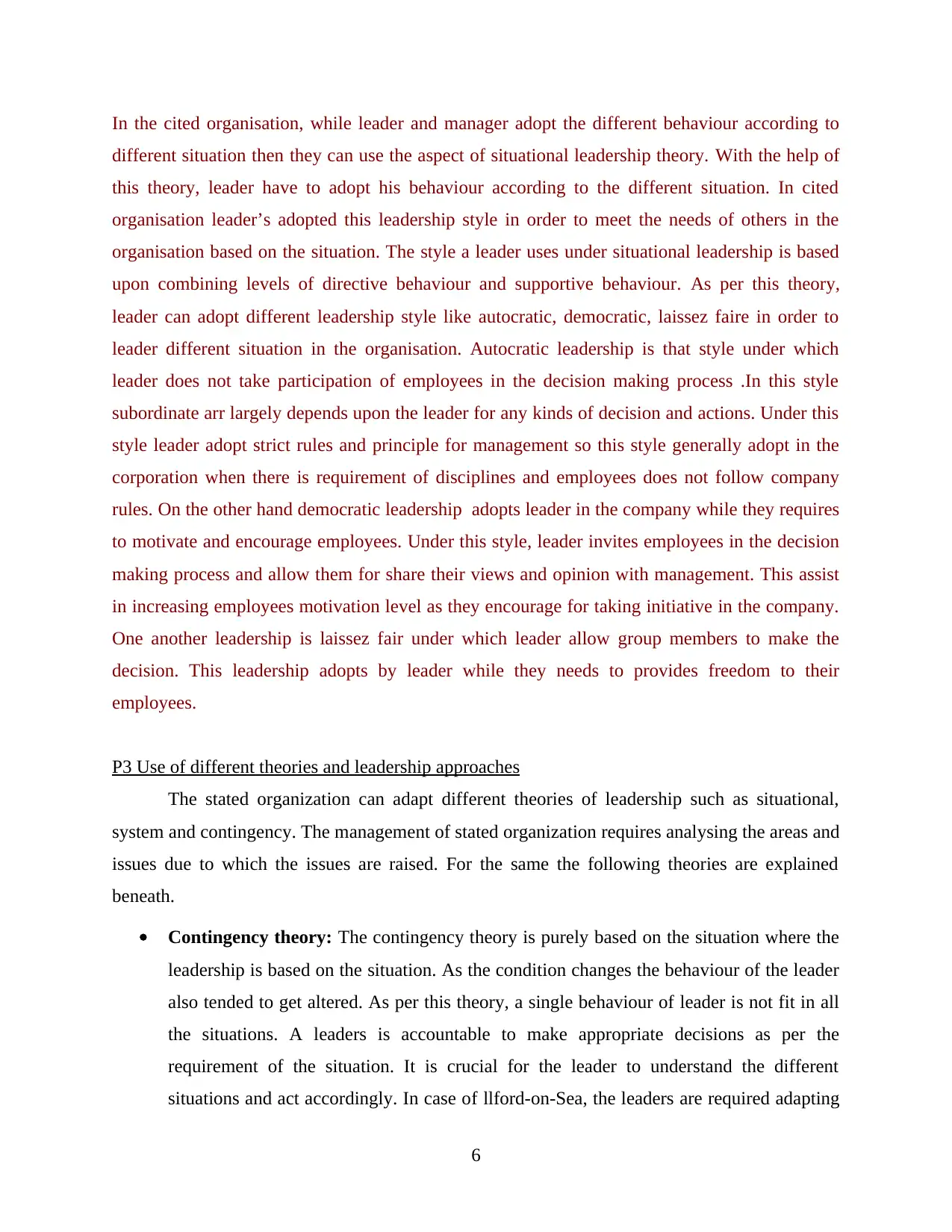
In the cited organisation, while leader and manager adopt the different behaviour according to
different situation then they can use the aspect of situational leadership theory. With the help of
this theory, leader have to adopt his behaviour according to the different situation. In cited
organisation leader’s adopted this leadership style in order to meet the needs of others in the
organisation based on the situation. The style a leader uses under situational leadership is based
upon combining levels of directive behaviour and supportive behaviour. As per this theory,
leader can adopt different leadership style like autocratic, democratic, laissez faire in order to
leader different situation in the organisation. Autocratic leadership is that style under which
leader does not take participation of employees in the decision making process .In this style
subordinate arr largely depends upon the leader for any kinds of decision and actions. Under this
style leader adopt strict rules and principle for management so this style generally adopt in the
corporation when there is requirement of disciplines and employees does not follow company
rules. On the other hand democratic leadership adopts leader in the company while they requires
to motivate and encourage employees. Under this style, leader invites employees in the decision
making process and allow them for share their views and opinion with management. This assist
in increasing employees motivation level as they encourage for taking initiative in the company.
One another leadership is laissez fair under which leader allow group members to make the
decision. This leadership adopts by leader while they needs to provides freedom to their
employees.
P3 Use of different theories and leadership approaches
The stated organization can adapt different theories of leadership such as situational,
system and contingency. The management of stated organization requires analysing the areas and
issues due to which the issues are raised. For the same the following theories are explained
beneath.
Contingency theory: The contingency theory is purely based on the situation where the
leadership is based on the situation. As the condition changes the behaviour of the leader
also tended to get altered. As per this theory, a single behaviour of leader is not fit in all
the situations. A leaders is accountable to make appropriate decisions as per the
requirement of the situation. It is crucial for the leader to understand the different
situations and act accordingly. In case of llford-on-Sea, the leaders are required adapting
6
different situation then they can use the aspect of situational leadership theory. With the help of
this theory, leader have to adopt his behaviour according to the different situation. In cited
organisation leader’s adopted this leadership style in order to meet the needs of others in the
organisation based on the situation. The style a leader uses under situational leadership is based
upon combining levels of directive behaviour and supportive behaviour. As per this theory,
leader can adopt different leadership style like autocratic, democratic, laissez faire in order to
leader different situation in the organisation. Autocratic leadership is that style under which
leader does not take participation of employees in the decision making process .In this style
subordinate arr largely depends upon the leader for any kinds of decision and actions. Under this
style leader adopt strict rules and principle for management so this style generally adopt in the
corporation when there is requirement of disciplines and employees does not follow company
rules. On the other hand democratic leadership adopts leader in the company while they requires
to motivate and encourage employees. Under this style, leader invites employees in the decision
making process and allow them for share their views and opinion with management. This assist
in increasing employees motivation level as they encourage for taking initiative in the company.
One another leadership is laissez fair under which leader allow group members to make the
decision. This leadership adopts by leader while they needs to provides freedom to their
employees.
P3 Use of different theories and leadership approaches
The stated organization can adapt different theories of leadership such as situational,
system and contingency. The management of stated organization requires analysing the areas and
issues due to which the issues are raised. For the same the following theories are explained
beneath.
Contingency theory: The contingency theory is purely based on the situation where the
leadership is based on the situation. As the condition changes the behaviour of the leader
also tended to get altered. As per this theory, a single behaviour of leader is not fit in all
the situations. A leaders is accountable to make appropriate decisions as per the
requirement of the situation. It is crucial for the leader to understand the different
situations and act accordingly. In case of llford-on-Sea, the leaders are required adapting
6
the stated theory where they needs to focus on the changing needs and conditions in an
effective manner. Here, the leader ensures the satisfaction level of the workforce in the
organization. It will assist the firm to overcome the issues faced by the stated company.
With the help of contingency theory, a leader can effectively satisfy the need and wants
of employees and motivate them for high productivity and performance. This leadership
theory assist in developing healthy relationship between employer and employees. In this
style, leader deals with the general atmosphere of the group and the feeling such as trust,
loyalty and confidence that the group has for its leader.
Situational leadership: According to this theory, the leaders needs to adjust himself as
per the situation of the organization. On the basis of this, there is no particular style of
leadership is there which can remain fit in all the situations. The effectiveness of
leadership is related with the relevancy of the tasks. The most effective leaders are those
who acts as per the requirement of the situations. Additionally, these kinds of leaders are
always ready for making the attempts and lead their groups. The stated model is based on
the two concepts i.e. leadership styles and readiness of an individual towards the
performance. In context to llford-on-Sea, the organization is facing problems of
coordination, instability in finance etc. However, the leaders are required to take
corrective measures for the improvement of current situation. With the help of this
theory, leader have to adopt his behaviour according to the different situation. In cited
organisation leader’s adopted this leadership style in order to meet the needs of others in
the organisation based on the situation. The style a leader uses under situational
leadership is based upon combining levels of directive behaviour and supportive
behaviour.
System theory: This is another theory of leadership in which the leaders have a belief
that the success they achieved are attained due their work done instead of leading. As per
the system theory, the leader is required to understand the system by which the workers
are being affected. Systems theory is a broad perspective that allows managers to
examine patterns and events in the workplace. This helps managers to coordinate
programs to work as a collective whole for the overall goal or mission of the organization
rather than for isolated. Cited venture leader adopt this approach of leadership while they
requires to develop an integrated, complex composition of many interconnected systems.
7
effective manner. Here, the leader ensures the satisfaction level of the workforce in the
organization. It will assist the firm to overcome the issues faced by the stated company.
With the help of contingency theory, a leader can effectively satisfy the need and wants
of employees and motivate them for high productivity and performance. This leadership
theory assist in developing healthy relationship between employer and employees. In this
style, leader deals with the general atmosphere of the group and the feeling such as trust,
loyalty and confidence that the group has for its leader.
Situational leadership: According to this theory, the leaders needs to adjust himself as
per the situation of the organization. On the basis of this, there is no particular style of
leadership is there which can remain fit in all the situations. The effectiveness of
leadership is related with the relevancy of the tasks. The most effective leaders are those
who acts as per the requirement of the situations. Additionally, these kinds of leaders are
always ready for making the attempts and lead their groups. The stated model is based on
the two concepts i.e. leadership styles and readiness of an individual towards the
performance. In context to llford-on-Sea, the organization is facing problems of
coordination, instability in finance etc. However, the leaders are required to take
corrective measures for the improvement of current situation. With the help of this
theory, leader have to adopt his behaviour according to the different situation. In cited
organisation leader’s adopted this leadership style in order to meet the needs of others in
the organisation based on the situation. The style a leader uses under situational
leadership is based upon combining levels of directive behaviour and supportive
behaviour.
System theory: This is another theory of leadership in which the leaders have a belief
that the success they achieved are attained due their work done instead of leading. As per
the system theory, the leader is required to understand the system by which the workers
are being affected. Systems theory is a broad perspective that allows managers to
examine patterns and events in the workplace. This helps managers to coordinate
programs to work as a collective whole for the overall goal or mission of the organization
rather than for isolated. Cited venture leader adopt this approach of leadership while they
requires to develop an integrated, complex composition of many interconnected systems.
7
⊘ This is a preview!⊘
Do you want full access?
Subscribe today to unlock all pages.
Trusted by 1+ million students worldwide
With help of this theory, leader motivate employees to formulate collaborative working
environment at workplace.
M2 Strengths and weakness of different approaches
In above context, different approach have certain strengths and weaknesses which are
needed to be analysed by the organization.
Situational leadership: The stated leadership has certain strengths and weaknesses
which are explained further. The major strengths are its applicability, well known and
majorly used by the leaders in order to train the employees. Besides this, it is one of the
practical approach which can be easily applied in the organization. The stated leadership
is flexible and helps the leader to solve any situation in an effectual manner. As per this
style, the leader is able to act as per the changing situation which leads to remain useful.
On contrary to this, the approach may create the chances of confusion for the employees.
The employees may not be able to judge the reaction of the managers and leaders due to
the characteristic of this theory. Besides this, the another con of the situational leadership
is that it may create a manipulative image in the minds of its employees. Some employees
may feel this theory as the unauthentic mode of communication (Tayur, Ganeshan and
Magazine, 2012).
System approach leadership: The system leadership also has some pros and cons which
are necessarily be analysed by the organization. In this style, the leaders set the goals and
objectives for them in which the employees are being assisted by the leaders what are the
requirements. However, the pros of this style is that it gives clear ideas to the employees
regard what is to be done. Here, the employees have proper understanding of the things to
be done and goals of the company. This is useful in case of structured work environment
where the process of work is well defined. On opposition to this, the weakness of this
style is that there is fear of breaking rules which can result in affecting and lacking the
creativity. Additionally, this leadership may result in high turnover and lower the morale
of the employees (Zurich, 2016).
Contingency theory The strengths and weaknesses of contingency theory are that its
existence. This is one of the oldest theory and it is reliable approach in order to attain the
concept of effective. Apart from this, the stated leadership has broaden scope of
understanding to get the employees view point. It will help the leader to analyse the needs
8
environment at workplace.
M2 Strengths and weakness of different approaches
In above context, different approach have certain strengths and weaknesses which are
needed to be analysed by the organization.
Situational leadership: The stated leadership has certain strengths and weaknesses
which are explained further. The major strengths are its applicability, well known and
majorly used by the leaders in order to train the employees. Besides this, it is one of the
practical approach which can be easily applied in the organization. The stated leadership
is flexible and helps the leader to solve any situation in an effectual manner. As per this
style, the leader is able to act as per the changing situation which leads to remain useful.
On contrary to this, the approach may create the chances of confusion for the employees.
The employees may not be able to judge the reaction of the managers and leaders due to
the characteristic of this theory. Besides this, the another con of the situational leadership
is that it may create a manipulative image in the minds of its employees. Some employees
may feel this theory as the unauthentic mode of communication (Tayur, Ganeshan and
Magazine, 2012).
System approach leadership: The system leadership also has some pros and cons which
are necessarily be analysed by the organization. In this style, the leaders set the goals and
objectives for them in which the employees are being assisted by the leaders what are the
requirements. However, the pros of this style is that it gives clear ideas to the employees
regard what is to be done. Here, the employees have proper understanding of the things to
be done and goals of the company. This is useful in case of structured work environment
where the process of work is well defined. On opposition to this, the weakness of this
style is that there is fear of breaking rules which can result in affecting and lacking the
creativity. Additionally, this leadership may result in high turnover and lower the morale
of the employees (Zurich, 2016).
Contingency theory The strengths and weaknesses of contingency theory are that its
existence. This is one of the oldest theory and it is reliable approach in order to attain the
concept of effective. Apart from this, the stated leadership has broaden scope of
understanding to get the employees view point. It will help the leader to analyse the needs
8
Paraphrase This Document
Need a fresh take? Get an instant paraphrase of this document with our AI Paraphraser
and demands of various situations. As per this theory, the leaders are considered to be
optimal in all the circumstances. Apart from this, the limitations of this theory is
inadequacy of the literature. Here, it can not be judged what action is about to be taken
for employees in changing situations. Additionally, the strategy may be complex and
difficult for the manager. In this theory several factors are being ignored by the managers
and leaders.
As per the current situation of the stated organization, the firm needs to analyse the pros
and cons of these approaches. The management can adopt the system and situation leadership in
order to sort out the defined issues. This will help the management to manage its workforce in an
effectual manner.
TASK 3
P4 Key approacher to operation management
In production process, operation management has an indefensible role which helps the
organization to manage the process of operations. By adapting this process, the managers of
llford-on-Sea will be able creating the efficiency level in the organization. Presently, the
manager has adapted the six strategies for the achievement of effectual management of
operations. Additionally, institution has framed global strategy, competitive strategy, inventory
management, quality strategy, process strategy and layout strategy. With the use of these
strategies the aforesaid firm will be able to enhance its services and product quality. The cited
firm aims at completing the contract of 100 renovation by Jarvis construction group. However,
the firm needs to adapt the improved quality of technology and other resources. This will assist
the management to attain its project on time. With the use of competitive strategy, the firm will
be able to attain the project by using appropriate resources and methods (Stadtler, 2015).
In context to above, the firm has good number of resources in order to serve the customer
demands and needs. However, the organization needs to trained its employees in a way that the
workforce management issue can get sorted out. If the quality strategy is considered then the
firm is major focused on the quality of the products. In component to it, the administrator of the
arrangement execute abstraction with various business office and also to form the effectual
trading operations of the fellowship. In circumstance to this, the director centring on the
gainfulness of the companionship. He makes confident of the client request and form them
contented with the superior services (Zurich, 2016).
9
optimal in all the circumstances. Apart from this, the limitations of this theory is
inadequacy of the literature. Here, it can not be judged what action is about to be taken
for employees in changing situations. Additionally, the strategy may be complex and
difficult for the manager. In this theory several factors are being ignored by the managers
and leaders.
As per the current situation of the stated organization, the firm needs to analyse the pros
and cons of these approaches. The management can adopt the system and situation leadership in
order to sort out the defined issues. This will help the management to manage its workforce in an
effectual manner.
TASK 3
P4 Key approacher to operation management
In production process, operation management has an indefensible role which helps the
organization to manage the process of operations. By adapting this process, the managers of
llford-on-Sea will be able creating the efficiency level in the organization. Presently, the
manager has adapted the six strategies for the achievement of effectual management of
operations. Additionally, institution has framed global strategy, competitive strategy, inventory
management, quality strategy, process strategy and layout strategy. With the use of these
strategies the aforesaid firm will be able to enhance its services and product quality. The cited
firm aims at completing the contract of 100 renovation by Jarvis construction group. However,
the firm needs to adapt the improved quality of technology and other resources. This will assist
the management to attain its project on time. With the use of competitive strategy, the firm will
be able to attain the project by using appropriate resources and methods (Stadtler, 2015).
In context to above, the firm has good number of resources in order to serve the customer
demands and needs. However, the organization needs to trained its employees in a way that the
workforce management issue can get sorted out. If the quality strategy is considered then the
firm is major focused on the quality of the products. In component to it, the administrator of the
arrangement execute abstraction with various business office and also to form the effectual
trading operations of the fellowship. In circumstance to this, the director centring on the
gainfulness of the companionship. He makes confident of the client request and form them
contented with the superior services (Zurich, 2016).
9
P5 Importance and value of operation management
Operation management is an inevitable factor which is being adapted by the management
of llford-on-Sea. The major objective of operation management are the customers services and
effective utilization of the resources. It is seen that each and every company has one motive i.e.
rendering the quality products and services to the customers. After all, the profitability of the
firm is purely depends upon the services and products consumed by the customers. There
satisfaction level is majorly attained by the organization so that it can strengthen the customer
satisfaction. As a result, the concept of operation management make sure the needs and demands
of the customers. Additionally, the demands of the service users is mainly met with the help of
operation management. This will allow the establishment gain the satisfaction level of the
customers in an effectual manner. Besides, this the another motive of operation management is
proper utilization of the resources (Zurich, 2016).
In context to above, if the resources are not properly utilized then it will affect the
production process of the organization. It will result in increasing the cost of end products and
the ultimate margin of the profits of the company will get tended to down. However, the
objectives of the stated organization can be effective adapted with the use of this concept. The
importance of operation management in manufacturing firm is higher. In case of llford-on-Sea,
operation management will help this company to take care of the several process of operations.
The said process will assist the organization to trace the process from starting to the end point
(Stadtler, 2015).
M3 Leaders and manager can improve the efficiencies of operation management
The higher authorities of aforesaid firm can result in improving the efficiencies of
operational management by centring over the several decision fields. The same are explained
beneath.
Design of goods and services: The efficiencies of the operational management can be improved
with the help of effective designing. Here, the management needs to implement the generic
strategy and premium pricing strategy. For the maintenance of company image, it is required to
the organization to uplift its customer satisfaction (Reason, 2016).
Quality management: The operation management of this establishment may get enhanced by
improving the quality of the produced products. For instance, the undertaking can hold over its
10
Operation management is an inevitable factor which is being adapted by the management
of llford-on-Sea. The major objective of operation management are the customers services and
effective utilization of the resources. It is seen that each and every company has one motive i.e.
rendering the quality products and services to the customers. After all, the profitability of the
firm is purely depends upon the services and products consumed by the customers. There
satisfaction level is majorly attained by the organization so that it can strengthen the customer
satisfaction. As a result, the concept of operation management make sure the needs and demands
of the customers. Additionally, the demands of the service users is mainly met with the help of
operation management. This will allow the establishment gain the satisfaction level of the
customers in an effectual manner. Besides, this the another motive of operation management is
proper utilization of the resources (Zurich, 2016).
In context to above, if the resources are not properly utilized then it will affect the
production process of the organization. It will result in increasing the cost of end products and
the ultimate margin of the profits of the company will get tended to down. However, the
objectives of the stated organization can be effective adapted with the use of this concept. The
importance of operation management in manufacturing firm is higher. In case of llford-on-Sea,
operation management will help this company to take care of the several process of operations.
The said process will assist the organization to trace the process from starting to the end point
(Stadtler, 2015).
M3 Leaders and manager can improve the efficiencies of operation management
The higher authorities of aforesaid firm can result in improving the efficiencies of
operational management by centring over the several decision fields. The same are explained
beneath.
Design of goods and services: The efficiencies of the operational management can be improved
with the help of effective designing. Here, the management needs to implement the generic
strategy and premium pricing strategy. For the maintenance of company image, it is required to
the organization to uplift its customer satisfaction (Reason, 2016).
Quality management: The operation management of this establishment may get enhanced by
improving the quality of the produced products. For instance, the undertaking can hold over its
10
⊘ This is a preview!⊘
Do you want full access?
Subscribe today to unlock all pages.
Trusted by 1+ million students worldwide

1 out of 16


Related Documents


Your All-in-One AI-Powered Toolkit for Academic Success.
+13062052269
info@desklib.com
Available 24*7 on WhatsApp / Email
![[object Object]](/_next/static/media/star-bottom.7253800d.svg)
Unlock your academic potential
Copyright © 2020–2026 A2Z Services. All Rights Reserved. Developed and managed by ZUCOL.