Analysis of Leadership and Management in Nestle's Operations Report
VerifiedAdded on 2023/01/12
|12
|3388
|59
Report
AI Summary
This report provides a comprehensive analysis of leadership and management practices within Nestle, a leading multinational food and beverage company. It begins by differentiating between the roles and characteristics of leaders and managers, highlighting their respective responsibilities in driving organizational success. The report then explores how these roles apply in various situational contexts, such as conflict resolution, adapting to increased competition, and maintaining product quality. It delves into different leadership theories, including contingency, situational, and system theories, illustrating their application within Nestle. Furthermore, the report examines various approaches to operation management, such as Six Sigma, lean production, total quality management, and just-in-time inventory management, and outlines the roles of leaders and managers in implementing these approaches. The importance and value of operation management in achieving organizational goals, including transforming raw materials into final products, production efficiency, and inventory management, are also discussed. Finally, the report considers the business environmental factors affecting decision-making and operational management at Nestle, providing a holistic view of leadership and management in a dynamic business context. The report is a valuable resource for students seeking insights into effective leadership and management strategies.
Management and
Operations
Operations

Paraphrase This Document
Need a fresh take? Get an instant paraphrase of this document with our AI Paraphraser
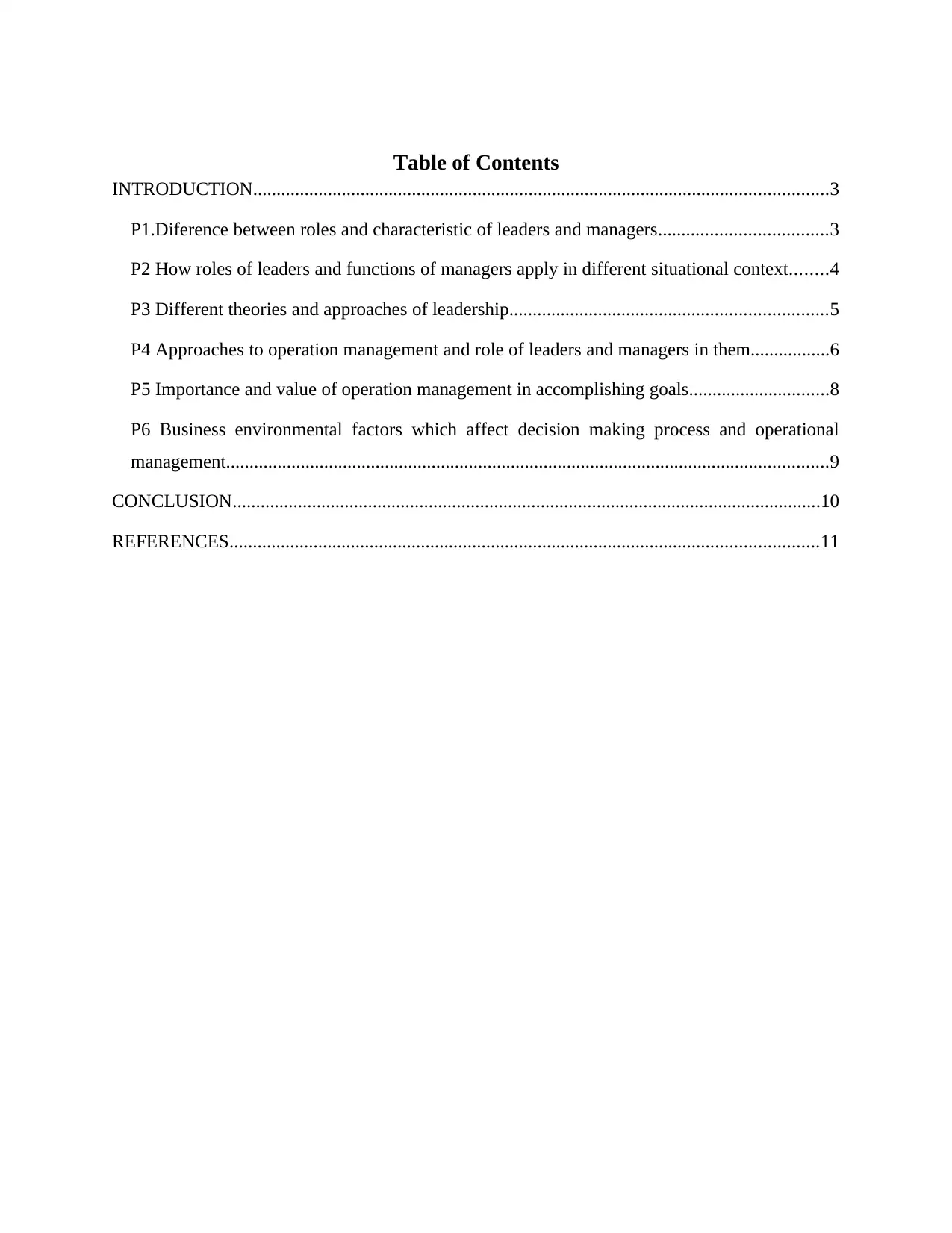
Table of Contents
INTRODUCTION...........................................................................................................................3
P1.Diference between roles and characteristic of leaders and managers....................................3
P2 How roles of leaders and functions of managers apply in different situational context........4
P3 Different theories and approaches of leadership....................................................................5
P4 Approaches to operation management and role of leaders and managers in them.................6
P5 Importance and value of operation management in accomplishing goals..............................8
P6 Business environmental factors which affect decision making process and operational
management.................................................................................................................................9
CONCLUSION..............................................................................................................................10
REFERENCES..............................................................................................................................11
INTRODUCTION...........................................................................................................................3
P1.Diference between roles and characteristic of leaders and managers....................................3
P2 How roles of leaders and functions of managers apply in different situational context........4
P3 Different theories and approaches of leadership....................................................................5
P4 Approaches to operation management and role of leaders and managers in them.................6
P5 Importance and value of operation management in accomplishing goals..............................8
P6 Business environmental factors which affect decision making process and operational
management.................................................................................................................................9
CONCLUSION..............................................................................................................................10
REFERENCES..............................................................................................................................11
INTRODUCTION
Management and operation is the administration of all practices of business for creating
the highest level of efficiency possible (Kang and et.al., 2016). One of the main functions of this
management is to convert raw materials into final product by reducing wastes and improving
quality. This present study is based on Nestle which is Swiss multinational food and drink
processing company. It is the largest food company in the world by revenues. This study is going
to show roles of leaders and managers in different organizational situations. It will also show
different leadership styles which help them out in solving problems of organization and improve
performance of employees. Further, this study will also discuss some approaches of operation
management such as: total quality management, six sigma and others by which company reduces
waste materials and improve quality.
P1.Diference between roles and characteristic of leaders and managers
Leaders: They can be defined as those persons who lead or command a group of
individuals. In a business setting, this can mean directing workers and colleagues with a strategy
to meet the company's needs. A good leader needs to have vision and plan accordingly with it.
Manager: Manager is a person who is engaged in managing the day to day activities that
is going in business. They basically manage and organize task so that goals and objectives can be
achieved.
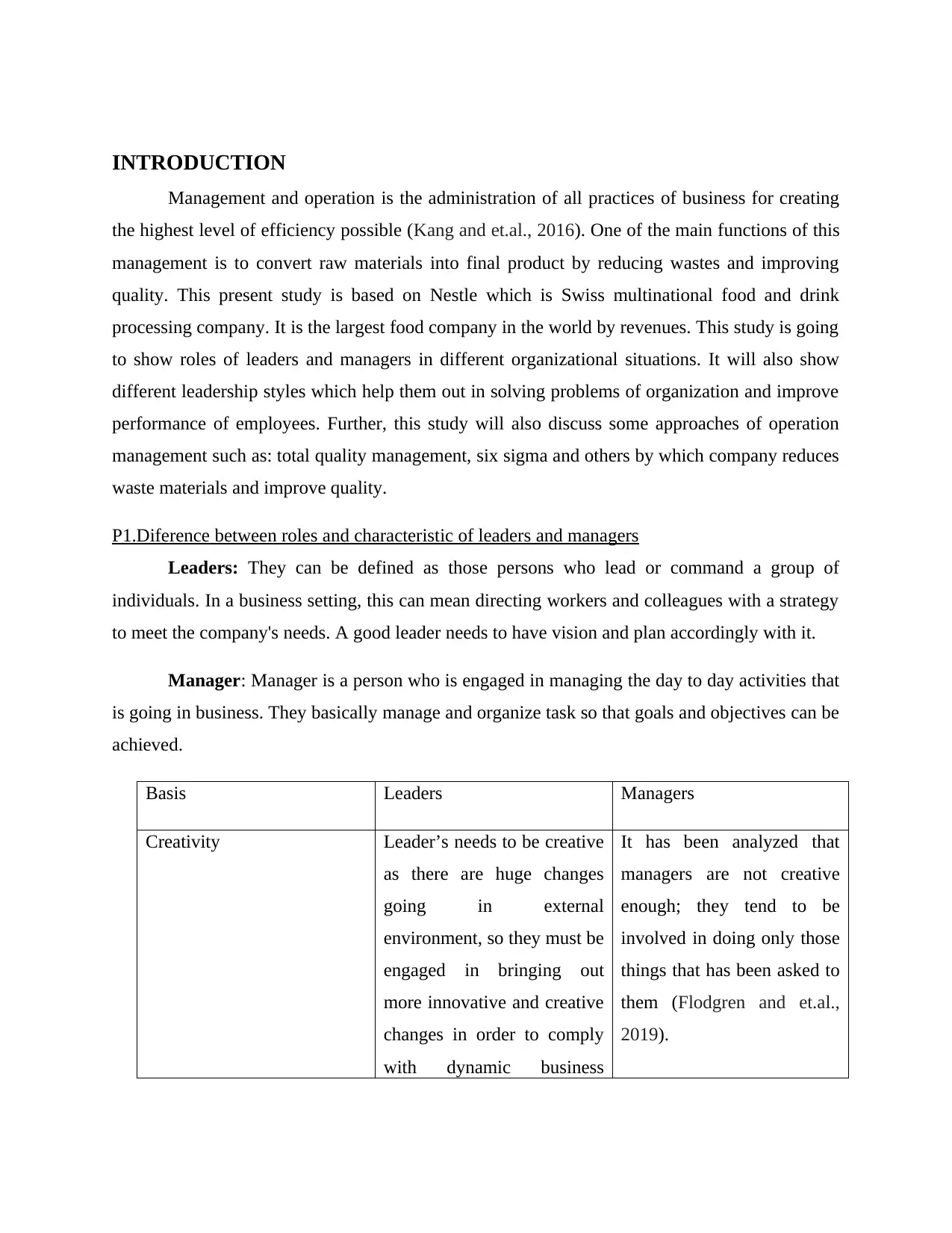
Basis Leaders Managers
Creativity Leader’s needs to be creative
as there are huge changes
going in external
environment, so they must be
engaged in bringing out
more innovative and creative
changes in order to comply
with dynamic business
It has been analyzed that
managers are not creative
enough; they tend to be
involved in doing only those
things that has been asked to
them (Flodgren and et.al.,
2019).
Management and operation is the administration of all practices of business for creating
the highest level of efficiency possible (Kang and et.al., 2016). One of the main functions of this
management is to convert raw materials into final product by reducing wastes and improving
quality. This present study is based on Nestle which is Swiss multinational food and drink
processing company. It is the largest food company in the world by revenues. This study is going
to show roles of leaders and managers in different organizational situations. It will also show
different leadership styles which help them out in solving problems of organization and improve
performance of employees. Further, this study will also discuss some approaches of operation
management such as: total quality management, six sigma and others by which company reduces
waste materials and improve quality.
P1.Diference between roles and characteristic of leaders and managers
Leaders: They can be defined as those persons who lead or command a group of
individuals. In a business setting, this can mean directing workers and colleagues with a strategy
to meet the company's needs. A good leader needs to have vision and plan accordingly with it.
Manager: Manager is a person who is engaged in managing the day to day activities that
is going in business. They basically manage and organize task so that goals and objectives can be
achieved.
Basis Leaders Managers
Creativity Leader’s needs to be creative
as there are huge changes
going in external
environment, so they must be
engaged in bringing out
more innovative and creative
changes in order to comply
with dynamic business
It has been analyzed that
managers are not creative
enough; they tend to be
involved in doing only those
things that has been asked to
them (Flodgren and et.al.,
2019).
⊘ This is a preview!⊘
Do you want full access?
Subscribe today to unlock all pages.

Trusted by 1+ million students worldwide
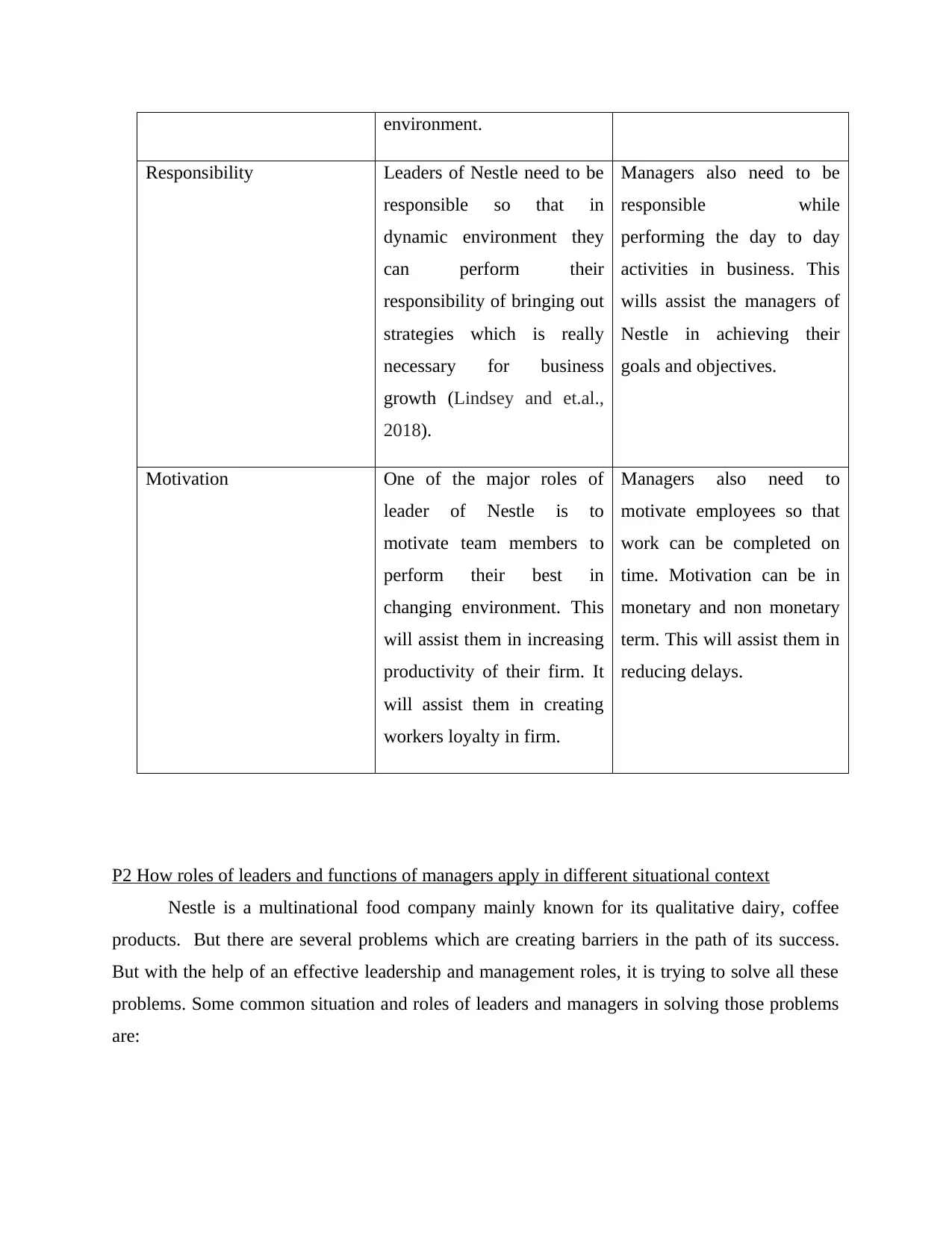
environment.
Responsibility Leaders of Nestle need to be
responsible so that in
dynamic environment they
can perform their
responsibility of bringing out
strategies which is really
necessary for business
growth (Lindsey and et.al.,
2018).
Managers also need to be
responsible while
performing the day to day
activities in business. This
wills assist the managers of
Nestle in achieving their
goals and objectives.
Motivation One of the major roles of
leader of Nestle is to
motivate team members to
perform their best in
changing environment. This
will assist them in increasing
productivity of their firm. It
will assist them in creating
workers loyalty in firm.
Managers also need to
motivate employees so that
work can be completed on
time. Motivation can be in
monetary and non monetary
term. This will assist them in
reducing delays.
P2 How roles of leaders and functions of managers apply in different situational context
Nestle is a multinational food company mainly known for its qualitative dairy, coffee
products. But there are several problems which are creating barriers in the path of its success.
But with the help of an effective leadership and management roles, it is trying to solve all these
problems. Some common situation and roles of leaders and managers in solving those problems
are:
Responsibility Leaders of Nestle need to be
responsible so that in
dynamic environment they
can perform their
responsibility of bringing out
strategies which is really
necessary for business
growth (Lindsey and et.al.,
2018).
Managers also need to be
responsible while
performing the day to day
activities in business. This
wills assist the managers of
Nestle in achieving their
goals and objectives.
Motivation One of the major roles of
leader of Nestle is to
motivate team members to
perform their best in
changing environment. This
will assist them in increasing
productivity of their firm. It
will assist them in creating
workers loyalty in firm.
Managers also need to
motivate employees so that
work can be completed on
time. Motivation can be in
monetary and non monetary
term. This will assist them in
reducing delays.
P2 How roles of leaders and functions of managers apply in different situational context
Nestle is a multinational food company mainly known for its qualitative dairy, coffee
products. But there are several problems which are creating barriers in the path of its success.
But with the help of an effective leadership and management roles, it is trying to solve all these
problems. Some common situation and roles of leaders and managers in solving those problems
are:
Paraphrase This Document
Need a fresh take? Get an instant paraphrase of this document with our AI Paraphraser
Conflicts among employees: It is one of the main and common problems which may occur and
can even decrease working environment. There may be several reasons of conflicts among
employees. One of the main reasons of conflict is different culture and background. Nestle have
around 352,000 diverse employees. Employees face difficulties in interacting with each other’s
and different opinion also become the reason of conflicts. In this situation, leader of the company
focus on identifying the main reason. As per the reason they use situation leadership style and
provide training to employees. By providing training they guide them and increase their
knowledge about different cultures and languages. On the other hand, manager focuses on team
working. Manager believe that by working in a team, employees interact with each other’s which
improves their relation and it can be the best way of solving conflicts (Friedrich, Griffith and
Mumford, 2016).
Increased competition: It is also one of the main threat. Some reasons which is
increasing this problem is increased use of technology and innovation. For solving this problem,
leader of Nestle develop new strategies and way of working for making products and processes
innovative. They also make their employees able to adapt changes which occur in business
environmental factors in order to change strategies accordingly and taking competitive
advantages. On the other hand, manager focuses on measuring and controlling functions in order
to see whether al employees are performing their functions effectively or not. With the help of an
effective measurement tool like KPI, they manage all functions.
Poor quality of some products: It is stated that people of the UK and others are becoming
health conscious so, they prefer healthy foods. Managing quality and providing them at
affordable price is one of the main tasks. In this situation, manager focuses on implementation
some operational management or quality management tools such as six sigma, TQM and just in
time. Whereas, leaders guide and support all employees by making them know that how to use
all tools and monitor their performance. It helps them out in reducing errors in the process of
manufacturing (Jung and Yoon, 2018).
P3 Different theories and approaches of leadership
Leadership theories refers the way of solving situations or adapting company’s different
situations and providing the best solutions for improving productivity and performance of the
company. There are mainly 3 strategies of leadership such as:
can even decrease working environment. There may be several reasons of conflicts among
employees. One of the main reasons of conflict is different culture and background. Nestle have
around 352,000 diverse employees. Employees face difficulties in interacting with each other’s
and different opinion also become the reason of conflicts. In this situation, leader of the company
focus on identifying the main reason. As per the reason they use situation leadership style and
provide training to employees. By providing training they guide them and increase their
knowledge about different cultures and languages. On the other hand, manager focuses on team
working. Manager believe that by working in a team, employees interact with each other’s which
improves their relation and it can be the best way of solving conflicts (Friedrich, Griffith and
Mumford, 2016).
Increased competition: It is also one of the main threat. Some reasons which is
increasing this problem is increased use of technology and innovation. For solving this problem,
leader of Nestle develop new strategies and way of working for making products and processes
innovative. They also make their employees able to adapt changes which occur in business
environmental factors in order to change strategies accordingly and taking competitive
advantages. On the other hand, manager focuses on measuring and controlling functions in order
to see whether al employees are performing their functions effectively or not. With the help of an
effective measurement tool like KPI, they manage all functions.
Poor quality of some products: It is stated that people of the UK and others are becoming
health conscious so, they prefer healthy foods. Managing quality and providing them at
affordable price is one of the main tasks. In this situation, manager focuses on implementation
some operational management or quality management tools such as six sigma, TQM and just in
time. Whereas, leaders guide and support all employees by making them know that how to use
all tools and monitor their performance. It helps them out in reducing errors in the process of
manufacturing (Jung and Yoon, 2018).
P3 Different theories and approaches of leadership
Leadership theories refers the way of solving situations or adapting company’s different
situations and providing the best solutions for improving productivity and performance of the
company. There are mainly 3 strategies of leadership such as:
Contingency: This theory of leadership states that an effective leader is he one who
adapt their style of leading as per the factors or situations, or success of a leader is not only
depends upon their abilities but it is contingent so, leader have to match their abilities with
situations because situations keep changing but abilities remain fixed (Boylan, 2018). So, as per
this situation, leader can make itself successful when he uses effectiveness of his abilities or
styles of leading with the situation as well as environment around him.
Situational: It is somehow as like contingency but the only difference is in this type of
style, an effective leader adapts different leadership styles as per the current situation. So, it can
be said that success of a leader depends upon their ability of using their style as per the situation
for example: If nestle have to deliver some projects in a few time and fir that they need to take
decision. In this type of situation, a situational leader can use autocratic leadership style in which
he takes decision on their own by not allowing employees in the process. On the other hand, if
leader have enough time to deliver projects and he finds that he has effective workforce than he
can use democratic leadership style. According to this style, he allows all employees in decision
making process and improves the process as well as morale of employees.
System: This leadership theory makes a leader able to create a condition in an
organization or making a system where all types, culture, levels and languages of employees can
work together. One of the main aims of using this theory is to increase morale of employees and
support the company in increasing their productivity and performance as well. In this strategy,
leaders make an effective use of principles about human behaviour in order to create models of a
good leadership (Shao, Feng and Hu, 2016).
P4 Approaches to operation management and role of leaders and managers in them
Operation management refers a procedure of managing raw materials, energy and all
those things which help company in making the final product. One of the main aims of operation
management is to make sure that manager has used the least amount of resources in making the
final products for increasing profit and improving quality (Igata and et.al., 2019). There are
several approaches of operation management which are being used by Nestle such as:
Six sigma: It is one of the effective approaches of operation management which is being used by
Nestle and several other companies. The main purpose of using this approach is to decrease the
adapt their style of leading as per the factors or situations, or success of a leader is not only
depends upon their abilities but it is contingent so, leader have to match their abilities with
situations because situations keep changing but abilities remain fixed (Boylan, 2018). So, as per
this situation, leader can make itself successful when he uses effectiveness of his abilities or
styles of leading with the situation as well as environment around him.
Situational: It is somehow as like contingency but the only difference is in this type of
style, an effective leader adapts different leadership styles as per the current situation. So, it can
be said that success of a leader depends upon their ability of using their style as per the situation
for example: If nestle have to deliver some projects in a few time and fir that they need to take
decision. In this type of situation, a situational leader can use autocratic leadership style in which
he takes decision on their own by not allowing employees in the process. On the other hand, if
leader have enough time to deliver projects and he finds that he has effective workforce than he
can use democratic leadership style. According to this style, he allows all employees in decision
making process and improves the process as well as morale of employees.
System: This leadership theory makes a leader able to create a condition in an
organization or making a system where all types, culture, levels and languages of employees can
work together. One of the main aims of using this theory is to increase morale of employees and
support the company in increasing their productivity and performance as well. In this strategy,
leaders make an effective use of principles about human behaviour in order to create models of a
good leadership (Shao, Feng and Hu, 2016).
P4 Approaches to operation management and role of leaders and managers in them
Operation management refers a procedure of managing raw materials, energy and all
those things which help company in making the final product. One of the main aims of operation
management is to make sure that manager has used the least amount of resources in making the
final products for increasing profit and improving quality (Igata and et.al., 2019). There are
several approaches of operation management which are being used by Nestle such as:
Six sigma: It is one of the effective approaches of operation management which is being used by
Nestle and several other companies. The main purpose of using this approach is to decrease the
⊘ This is a preview!⊘
Do you want full access?
Subscribe today to unlock all pages.
Trusted by 1+ million students worldwide
probability that a decision taken by operation manager will be misleading. So, it can be said that
it is an approach which is being used to take the decision along with the risk of failure. It makes
managers able to make better decisions and improve productivity (Jayaram, 2016).
Roles of leader:
Leader has the main responsibility of approving the projects which are being
made in a qualitative manner.
They also guide employees in telling them the way of using this approach.
Roles of manager
Manager tries to create an environment and stage where employees can use this
approach effectively.
They also monitor the whole manufacturing process.
Lean productions: It is one of the systematic production processes which can be used to
reduce the waste of resources or raw materials. It is useful and efficient when an organization
produces products in a huge quantity. Some roles of leaders and managers in this approach for
making it successful include:
Roles of leader
Leaders make sure that all employees are contributing and reducing production
time and wastes.
Roles of manager
Manager provides rewards to employees for motivating them and improving
techniques of this approach.
Total quality management: TQM is a customer focused approach whose main aim is to
improve quality of products by reducing wastes in the production or manufacturing process. It
involves all employees in the continuous improvement. For making it successful it is also
it is an approach which is being used to take the decision along with the risk of failure. It makes
managers able to make better decisions and improve productivity (Jayaram, 2016).
Roles of leader:
Leader has the main responsibility of approving the projects which are being
made in a qualitative manner.
They also guide employees in telling them the way of using this approach.
Roles of manager
Manager tries to create an environment and stage where employees can use this
approach effectively.
They also monitor the whole manufacturing process.
Lean productions: It is one of the systematic production processes which can be used to
reduce the waste of resources or raw materials. It is useful and efficient when an organization
produces products in a huge quantity. Some roles of leaders and managers in this approach for
making it successful include:
Roles of leader
Leaders make sure that all employees are contributing and reducing production
time and wastes.
Roles of manager
Manager provides rewards to employees for motivating them and improving
techniques of this approach.
Total quality management: TQM is a customer focused approach whose main aim is to
improve quality of products by reducing wastes in the production or manufacturing process. It
involves all employees in the continuous improvement. For making it successful it is also
Paraphrase This Document
Need a fresh take? Get an instant paraphrase of this document with our AI Paraphraser
important for all employees to make an effective use of communication, strategies as well as
data.
Roles of leader
Leaders in this approach guide employees in implementation of this approach in
an efficient manner.
Roles of manager
Manager in this approach define and make sure continuous efforts by employees
in order to upgrade processes.
Just in time: It is an inventory management strategy or approach in which manager focuses on
ordering only those materials which are required at that time for completing the production
process. In this approach, manager does not order inventory in bulks or excessive as one of the
main aims is to complete production process and deliver demanded products in a timely manner.
It reduces cost and space in warehouse (Nahum-Shani and et.al., 2018).
Roles of leader
Leader in this approach focuses on developing people by providing training and
making them know about the importance of balancing between demand and
supply.
Roles of manager
Manager oversees whether all products are being ordered in an effective or proper
quantity or not.
P5 Importance and value of operation management in accomplishing goals.
Operation management plays an important role in adding value and maximizing profits of
company. Some values of operation management include:
Transferring raw materials into final products: One of the main uses of implementing
operation management and its approaches is to transform raw materials or input into outputs by
data.
Roles of leader
Leaders in this approach guide employees in implementation of this approach in
an efficient manner.
Roles of manager
Manager in this approach define and make sure continuous efforts by employees
in order to upgrade processes.
Just in time: It is an inventory management strategy or approach in which manager focuses on
ordering only those materials which are required at that time for completing the production
process. In this approach, manager does not order inventory in bulks or excessive as one of the
main aims is to complete production process and deliver demanded products in a timely manner.
It reduces cost and space in warehouse (Nahum-Shani and et.al., 2018).
Roles of leader
Leader in this approach focuses on developing people by providing training and
making them know about the importance of balancing between demand and
supply.
Roles of manager
Manager oversees whether all products are being ordered in an effective or proper
quantity or not.
P5 Importance and value of operation management in accomplishing goals.
Operation management plays an important role in adding value and maximizing profits of
company. Some values of operation management include:
Transferring raw materials into final products: One of the main uses of implementing
operation management and its approaches is to transform raw materials or input into outputs by
making appropriate use of resources. This process increase value in products and increase
customers’ satisfaction.
Production efficiency: Production efficiency is other main characteristic of an effective
operation management and its approaches. By implementing appropriate approaches, company
can improve process of manufacturing which allows them to deliver qualitative products to
customers (Sampaio and et.al., 2016).
Inventory management: Just in time is one of the approaches of operation management which
allows company in managing their inventory and reducing operational cost. Inventory
management with the help of operation management also allow company in delivering products
to customers in a timely manner and satisfying their needs. With an effective operation
management and approaches, Nestle can take competitive advantages because one of the main
reasons of competitive advantages is satisfied customers. So, by satisfying customers’, providing
them products in a timely manner they can take advantages of several opportunities
Profit maximization: An effective operation management and appropriate implementation of all
approaches directly help company in increasing profit. It makes all employees able to improve
their productivity which affects sales in a positive manner (Hack and et.al., 2018).
P6 Business environmental factors which affect decision making process and operational
management
CSR: Corporate social responsibility is one of the main factors which help Nestle in improving
their brand image with the help of some strategies. One of the main roles or aims of using CSR
theories is to improve lives of people. It can be said that it can affect Nestle because some of its
production processes create waste materials. So, it is important for manager and leaders of Nestle
to focus on CSR otherwise it can decrease its profit (Crane, Matten and Spence, 2019).
Culture: It refers some sets of values, believes and ways of performing and interacting with each
others. Culture also plays an important role as it can affect performance of an organization in
both positive and in a negative manner. Its up to the company that how it perform ways as if it
deliver products by considering culture of the country in which it operates than it can satisfy its
customers. By considering culture of the country it can also improve it s decision making process
customers’ satisfaction.
Production efficiency: Production efficiency is other main characteristic of an effective
operation management and its approaches. By implementing appropriate approaches, company
can improve process of manufacturing which allows them to deliver qualitative products to
customers (Sampaio and et.al., 2016).
Inventory management: Just in time is one of the approaches of operation management which
allows company in managing their inventory and reducing operational cost. Inventory
management with the help of operation management also allow company in delivering products
to customers in a timely manner and satisfying their needs. With an effective operation
management and approaches, Nestle can take competitive advantages because one of the main
reasons of competitive advantages is satisfied customers. So, by satisfying customers’, providing
them products in a timely manner they can take advantages of several opportunities
Profit maximization: An effective operation management and appropriate implementation of all
approaches directly help company in increasing profit. It makes all employees able to improve
their productivity which affects sales in a positive manner (Hack and et.al., 2018).
P6 Business environmental factors which affect decision making process and operational
management
CSR: Corporate social responsibility is one of the main factors which help Nestle in improving
their brand image with the help of some strategies. One of the main roles or aims of using CSR
theories is to improve lives of people. It can be said that it can affect Nestle because some of its
production processes create waste materials. So, it is important for manager and leaders of Nestle
to focus on CSR otherwise it can decrease its profit (Crane, Matten and Spence, 2019).
Culture: It refers some sets of values, believes and ways of performing and interacting with each
others. Culture also plays an important role as it can affect performance of an organization in
both positive and in a negative manner. Its up to the company that how it perform ways as if it
deliver products by considering culture of the country in which it operates than it can satisfy its
customers. By considering culture of the country it can also improve it s decision making process
⊘ This is a preview!⊘
Do you want full access?
Subscribe today to unlock all pages.
Trusted by 1+ million students worldwide
Ethics: It can be defined a way in which company interacts and perform all its activities. Ethics
is one of the main important factors which need to be considered by Nestle in order to run
business activities effectively. It is also important for Nestle to see whether their employees are
following all principles or codes of ethics or not. By performing all activities in an ethical
manner, company can improve its image and can also attract customers’ to the wide range.
Sustainability: It refers a long term plan by which managers and leaders of an organization can
maintain their brand for the long run. The actual meaning of sustainability is to use resources in a
manner which can satisfy needs of the present generation and do not hurt needs o the future
generation. To not increase waste is one of the main principles of sustainability. In this context, it
can be said that people of the UK and other countries prefer to buy products from those
companies who are sustainable and use related principles. It can affect an organization
performance to the great extent so, it is important for Nestle to use natural resources in a limited
manner.
Values: It is other important factor which can influence decision making process of leaders and
managers. It is important for manager of Nestle to develop their products after measuring
effectiveness of those products or identifying values. By doing this, it can improve productivity
and quality of services and processes (Porter and Kramer, 2019).
CONCLUSION
On the basis of above discussion it can be concluded that operation management played a
vital role as it helps an organization in accomplishing their goals Operation management have
several effective approaches and with the help of effective roles of managers and leaders in all
approaches organization improve quality of their products, reduces wastes and improve
productivity. Further, it has also shown some differences between a leader and a manager as how
they both play an important role with having different characteristics. It has discussed different
leadership strategies such as contingency, situational and others which help them out in handling
situations of the company and solving them in an effective manner. Lastly, it has shown some
business environmental factors like ethics, sustainability, value and others which affect
performance of an organization in a critic manner.
is one of the main important factors which need to be considered by Nestle in order to run
business activities effectively. It is also important for Nestle to see whether their employees are
following all principles or codes of ethics or not. By performing all activities in an ethical
manner, company can improve its image and can also attract customers’ to the wide range.
Sustainability: It refers a long term plan by which managers and leaders of an organization can
maintain their brand for the long run. The actual meaning of sustainability is to use resources in a
manner which can satisfy needs of the present generation and do not hurt needs o the future
generation. To not increase waste is one of the main principles of sustainability. In this context, it
can be said that people of the UK and other countries prefer to buy products from those
companies who are sustainable and use related principles. It can affect an organization
performance to the great extent so, it is important for Nestle to use natural resources in a limited
manner.
Values: It is other important factor which can influence decision making process of leaders and
managers. It is important for manager of Nestle to develop their products after measuring
effectiveness of those products or identifying values. By doing this, it can improve productivity
and quality of services and processes (Porter and Kramer, 2019).
CONCLUSION
On the basis of above discussion it can be concluded that operation management played a
vital role as it helps an organization in accomplishing their goals Operation management have
several effective approaches and with the help of effective roles of managers and leaders in all
approaches organization improve quality of their products, reduces wastes and improve
productivity. Further, it has also shown some differences between a leader and a manager as how
they both play an important role with having different characteristics. It has discussed different
leadership strategies such as contingency, situational and others which help them out in handling
situations of the company and solving them in an effective manner. Lastly, it has shown some
business environmental factors like ethics, sustainability, value and others which affect
performance of an organization in a critic manner.
Paraphrase This Document
Need a fresh take? Get an instant paraphrase of this document with our AI Paraphraser
REFERENCES
Books and Journals
Boylan, M., 2018. Enabling adaptive system leadership: Teachers leading professional
development. Educational management administration & leadership, 46(1). pp.86-106.
Crane, A., Matten, D. and Spence, L. eds., 2019. Corporate social responsibility: Readings and
cases in a global context. Routledge.
Flodgren, G. and et.al., 2019. Local opinion leaders: effects on professional practice and
healthcare outcomes. Cochrane Database of Systematic Reviews. (6).
Friedrich, T.L., Griffith, J.A. and Mumford, M.D., 2016. Collective leadership behaviors:
Evaluating the leader, team network, and problem situation characteristics that influence
their use. The Leadership Quarterly. 27(2). pp.312-333.
Hack, M.H. and et.al., 2018. Cache management in RDMA distributed key/value stores based on
atomic operations. U.S. Patent 10,031,883.
Igata, H. and et.al., 2019. Vehicle operation management system and vehicle operation
management method. U.S. Patent Application 16/233,265.
Jayaram, A., 2016, December. Lean six sigma approach for global supply chain management
using industry 4.0 and IIoT. In 2016 2nd international conference on contemporary
computing and informatics (IC3I) (pp. 89-94). IEEE.
Jung, H.S. and Yoon, H.H., 2018. Improving frontline service employees' innovative behavior
using conflict management in the hospitality industry: The mediating role of
engagement. Tourism Management. 69. pp.498-507.
Kang, N. and et.al., 2016. A Hierarchical structure of key performance indicators for operation
management and continuous improvement in production systems. International Journal of
Production Research. 54(21). pp.6333-6350.
Lindsey, R.B. and et.al., 2018. Cultural proficiency: A manual for school leaders. Corwin Press.
Nahum-Shani, I. and et.al., 2018. Just-in-time adaptive interventions (JITAIs) in mobile health:
key components and design principles for ongoing health behavior support. Annals of
Behavioral Medicine. 52(6). pp.446-462.
Porter, M.E. and Kramer, M.R., 2019. Creating shared value. In Managing sustainable
business (pp. 323-346). Springer, Dordrecht.
Sampaio, P. and et.al., 2016. Supply chain value stream mapping: a new tool of operation
management. International Journal of Quality & Reliability Management.
Books and Journals
Boylan, M., 2018. Enabling adaptive system leadership: Teachers leading professional
development. Educational management administration & leadership, 46(1). pp.86-106.
Crane, A., Matten, D. and Spence, L. eds., 2019. Corporate social responsibility: Readings and
cases in a global context. Routledge.
Flodgren, G. and et.al., 2019. Local opinion leaders: effects on professional practice and
healthcare outcomes. Cochrane Database of Systematic Reviews. (6).
Friedrich, T.L., Griffith, J.A. and Mumford, M.D., 2016. Collective leadership behaviors:
Evaluating the leader, team network, and problem situation characteristics that influence
their use. The Leadership Quarterly. 27(2). pp.312-333.
Hack, M.H. and et.al., 2018. Cache management in RDMA distributed key/value stores based on
atomic operations. U.S. Patent 10,031,883.
Igata, H. and et.al., 2019. Vehicle operation management system and vehicle operation
management method. U.S. Patent Application 16/233,265.
Jayaram, A., 2016, December. Lean six sigma approach for global supply chain management
using industry 4.0 and IIoT. In 2016 2nd international conference on contemporary
computing and informatics (IC3I) (pp. 89-94). IEEE.
Jung, H.S. and Yoon, H.H., 2018. Improving frontline service employees' innovative behavior
using conflict management in the hospitality industry: The mediating role of
engagement. Tourism Management. 69. pp.498-507.
Kang, N. and et.al., 2016. A Hierarchical structure of key performance indicators for operation
management and continuous improvement in production systems. International Journal of
Production Research. 54(21). pp.6333-6350.
Lindsey, R.B. and et.al., 2018. Cultural proficiency: A manual for school leaders. Corwin Press.
Nahum-Shani, I. and et.al., 2018. Just-in-time adaptive interventions (JITAIs) in mobile health:
key components and design principles for ongoing health behavior support. Annals of
Behavioral Medicine. 52(6). pp.446-462.
Porter, M.E. and Kramer, M.R., 2019. Creating shared value. In Managing sustainable
business (pp. 323-346). Springer, Dordrecht.
Sampaio, P. and et.al., 2016. Supply chain value stream mapping: a new tool of operation
management. International Journal of Quality & Reliability Management.

Shao, Z., Feng, Y. and Hu, Q., 2016. Effectiveness of top management support in enterprise
systems success: a contingency perspective of fit between leadership style and system
life-cycle. European Journal of Information Systems. 25(2). pp.131-153.
systems success: a contingency perspective of fit between leadership style and system
life-cycle. European Journal of Information Systems. 25(2). pp.131-153.
⊘ This is a preview!⊘
Do you want full access?
Subscribe today to unlock all pages.
Trusted by 1+ million students worldwide

1 out of 12


Related Documents


Your All-in-One AI-Powered Toolkit for Academic Success.
+13062052269
info@desklib.com
Available 24*7 on WhatsApp / Email
![[object Object]](/_next/static/media/star-bottom.7253800d.svg)
Unlock your academic potential
Copyright © 2020–2026 A2Z Services. All Rights Reserved. Developed and managed by ZUCOL.