MBA Dissertation: Leadership & Management in Non-Profit Organization
VerifiedAdded on 2023/06/14
|8
|3933
|104
Thesis and Dissertation
AI Summary
This MBA dissertation delves into the leadership and management dynamics within a non-profit organization, utilizing a case study approach. The research employs an interpretivism research philosophy and qualitative research methodology, focusing on in-depth interviews with leaders, management officers, and volunteers. The study adopts a purposive sampling strategy and an inductive research approach to explore the hiring of volunteers and the implications of leadership and management within the organization. The methodology chapter details the rationale behind choosing interpretivism over positivism, qualitative over quantitative methods, and purposive sampling for its suitability in gathering detailed, context-specific data. The research aims to provide valuable insights and references for similar non-profit organizations, particularly concerning volunteer management and organizational strategy. Desklib provides access to this document and a wealth of study resources for students.
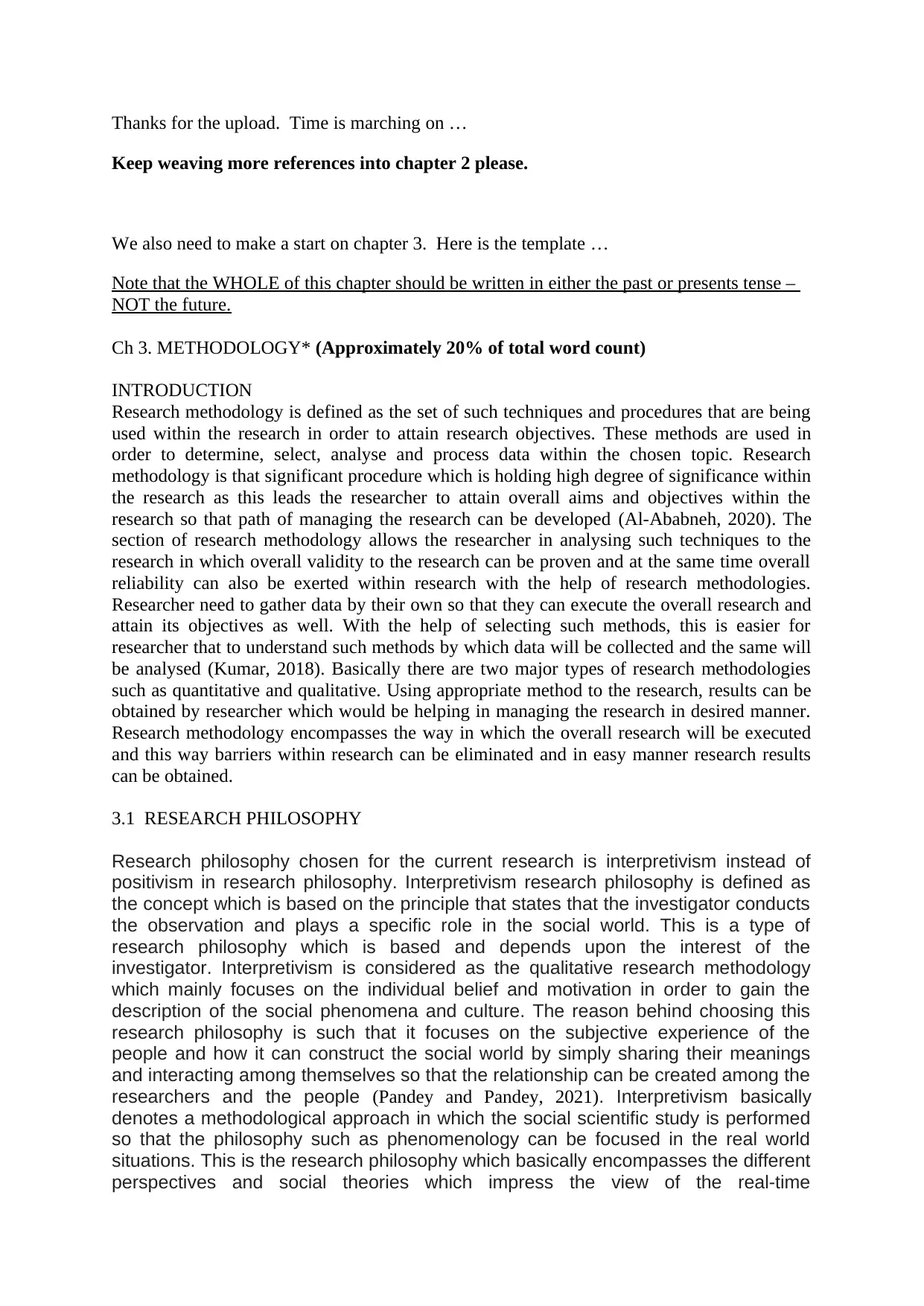
Thanks for the upload. Time is marching on …
Keep weaving more references into chapter 2 please.
We also need to make a start on chapter 3. Here is the template …
Note that the WHOLE of this chapter should be written in either the past or presents tense –
NOT the future.
Ch 3. METHODOLOGY* (Approximately 20% of total word count)
INTRODUCTION
Research methodology is defined as the set of such techniques and procedures that are being
used within the research in order to attain research objectives. These methods are used in
order to determine, select, analyse and process data within the chosen topic. Research
methodology is that significant procedure which is holding high degree of significance within
the research as this leads the researcher to attain overall aims and objectives within the
research so that path of managing the research can be developed (Al-Ababneh, 2020). The
section of research methodology allows the researcher in analysing such techniques to the
research in which overall validity to the research can be proven and at the same time overall
reliability can also be exerted within research with the help of research methodologies.
Researcher need to gather data by their own so that they can execute the overall research and
attain its objectives as well. With the help of selecting such methods, this is easier for
researcher that to understand such methods by which data will be collected and the same will
be analysed (Kumar, 2018). Basically there are two major types of research methodologies
such as quantitative and qualitative. Using appropriate method to the research, results can be
obtained by researcher which would be helping in managing the research in desired manner.
Research methodology encompasses the way in which the overall research will be executed
and this way barriers within research can be eliminated and in easy manner research results
can be obtained.
3.1 RESEARCH PHILOSOPHY
Research philosophy chosen for the current research is interpretivism instead of
positivism in research philosophy. Interpretivism research philosophy is defined as
the concept which is based on the principle that states that the investigator conducts
the observation and plays a specific role in the social world. This is a type of
research philosophy which is based and depends upon the interest of the
investigator. Interpretivism is considered as the qualitative research methodology
which mainly focuses on the individual belief and motivation in order to gain the
description of the social phenomena and culture. The reason behind choosing this
research philosophy is such that it focuses on the subjective experience of the
people and how it can construct the social world by simply sharing their meanings
and interacting among themselves so that the relationship can be created among the
researchers and the people (Pandey and Pandey, 2021). Interpretivism basically
denotes a methodological approach in which the social scientific study is performed
so that the philosophy such as phenomenology can be focused in the real world
situations. This is the research philosophy which basically encompasses the different
perspectives and social theories which impress the view of the real-time
Keep weaving more references into chapter 2 please.
We also need to make a start on chapter 3. Here is the template …
Note that the WHOLE of this chapter should be written in either the past or presents tense –
NOT the future.
Ch 3. METHODOLOGY* (Approximately 20% of total word count)
INTRODUCTION
Research methodology is defined as the set of such techniques and procedures that are being
used within the research in order to attain research objectives. These methods are used in
order to determine, select, analyse and process data within the chosen topic. Research
methodology is that significant procedure which is holding high degree of significance within
the research as this leads the researcher to attain overall aims and objectives within the
research so that path of managing the research can be developed (Al-Ababneh, 2020). The
section of research methodology allows the researcher in analysing such techniques to the
research in which overall validity to the research can be proven and at the same time overall
reliability can also be exerted within research with the help of research methodologies.
Researcher need to gather data by their own so that they can execute the overall research and
attain its objectives as well. With the help of selecting such methods, this is easier for
researcher that to understand such methods by which data will be collected and the same will
be analysed (Kumar, 2018). Basically there are two major types of research methodologies
such as quantitative and qualitative. Using appropriate method to the research, results can be
obtained by researcher which would be helping in managing the research in desired manner.
Research methodology encompasses the way in which the overall research will be executed
and this way barriers within research can be eliminated and in easy manner research results
can be obtained.
3.1 RESEARCH PHILOSOPHY
Research philosophy chosen for the current research is interpretivism instead of
positivism in research philosophy. Interpretivism research philosophy is defined as
the concept which is based on the principle that states that the investigator conducts
the observation and plays a specific role in the social world. This is a type of
research philosophy which is based and depends upon the interest of the
investigator. Interpretivism is considered as the qualitative research methodology
which mainly focuses on the individual belief and motivation in order to gain the
description of the social phenomena and culture. The reason behind choosing this
research philosophy is such that it focuses on the subjective experience of the
people and how it can construct the social world by simply sharing their meanings
and interacting among themselves so that the relationship can be created among the
researchers and the people (Pandey and Pandey, 2021). Interpretivism basically
denotes a methodological approach in which the social scientific study is performed
so that the philosophy such as phenomenology can be focused in the real world
situations. This is the research philosophy which basically encompasses the different
perspectives and social theories which impress the view of the real-time

Paraphrase This Document
Need a fresh take? Get an instant paraphrase of this document with our AI Paraphraser
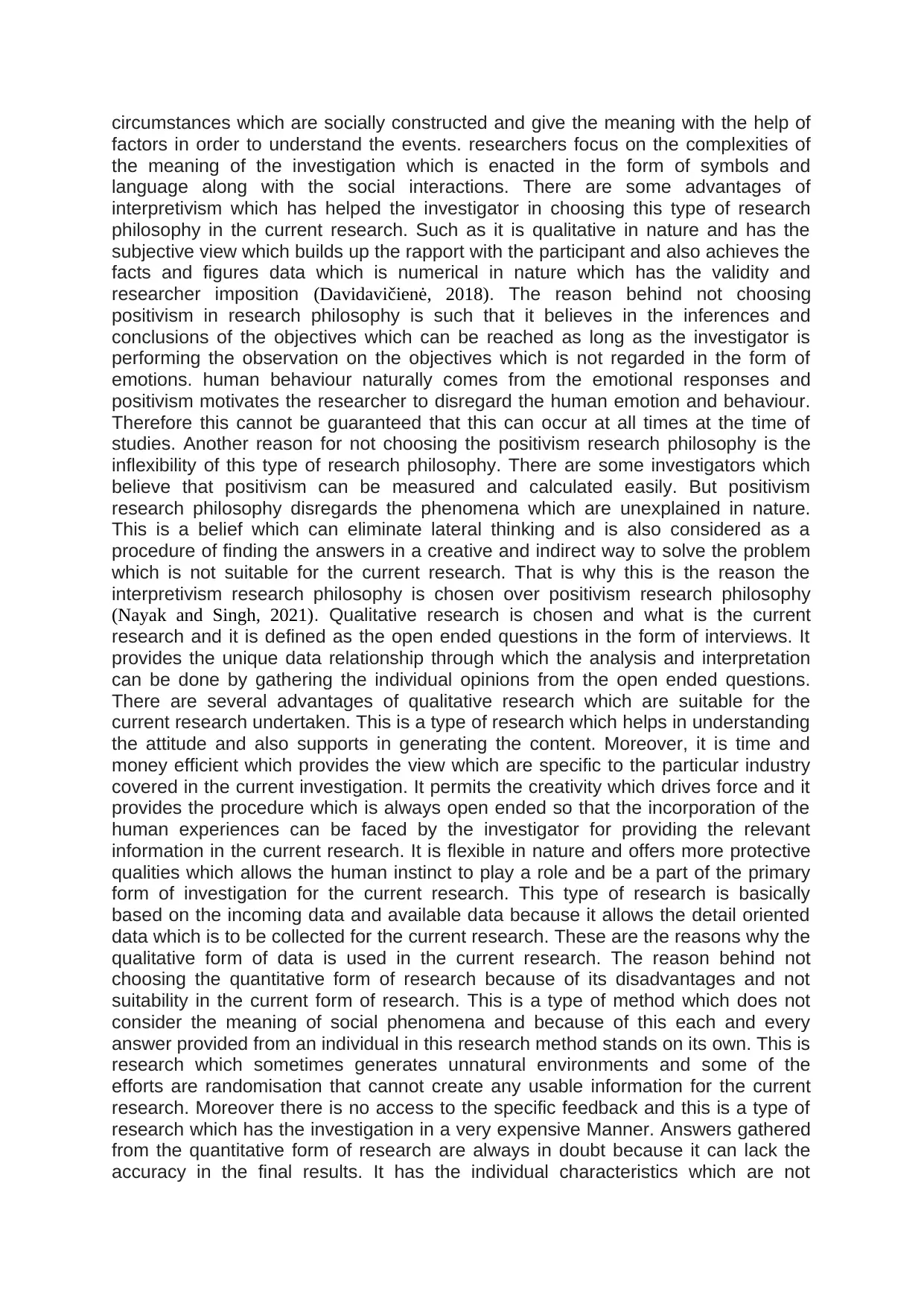
circumstances which are socially constructed and give the meaning with the help of
factors in order to understand the events. researchers focus on the complexities of
the meaning of the investigation which is enacted in the form of symbols and
language along with the social interactions. There are some advantages of
interpretivism which has helped the investigator in choosing this type of research
philosophy in the current research. Such as it is qualitative in nature and has the
subjective view which builds up the rapport with the participant and also achieves the
facts and figures data which is numerical in nature which has the validity and
researcher imposition (Davidavičienė, 2018). The reason behind not choosing
positivism in research philosophy is such that it believes in the inferences and
conclusions of the objectives which can be reached as long as the investigator is
performing the observation on the objectives which is not regarded in the form of
emotions. human behaviour naturally comes from the emotional responses and
positivism motivates the researcher to disregard the human emotion and behaviour.
Therefore this cannot be guaranteed that this can occur at all times at the time of
studies. Another reason for not choosing the positivism research philosophy is the
inflexibility of this type of research philosophy. There are some investigators which
believe that positivism can be measured and calculated easily. But positivism
research philosophy disregards the phenomena which are unexplained in nature.
This is a belief which can eliminate lateral thinking and is also considered as a
procedure of finding the answers in a creative and indirect way to solve the problem
which is not suitable for the current research. That is why this is the reason the
interpretivism research philosophy is chosen over positivism research philosophy
(Nayak and Singh, 2021). Qualitative research is chosen and what is the current
research and it is defined as the open ended questions in the form of interviews. It
provides the unique data relationship through which the analysis and interpretation
can be done by gathering the individual opinions from the open ended questions.
There are several advantages of qualitative research which are suitable for the
current research undertaken. This is a type of research which helps in understanding
the attitude and also supports in generating the content. Moreover, it is time and
money efficient which provides the view which are specific to the particular industry
covered in the current investigation. It permits the creativity which drives force and it
provides the procedure which is always open ended so that the incorporation of the
human experiences can be faced by the investigator for providing the relevant
information in the current research. It is flexible in nature and offers more protective
qualities which allows the human instinct to play a role and be a part of the primary
form of investigation for the current research. This type of research is basically
based on the incoming data and available data because it allows the detail oriented
data which is to be collected for the current research. These are the reasons why the
qualitative form of data is used in the current research. The reason behind not
choosing the quantitative form of research because of its disadvantages and not
suitability in the current form of research. This is a type of method which does not
consider the meaning of social phenomena and because of this each and every
answer provided from an individual in this research method stands on its own. This is
research which sometimes generates unnatural environments and some of the
efforts are randomisation that cannot create any usable information for the current
research. Moreover there is no access to the specific feedback and this is a type of
research which has the investigation in a very expensive Manner. Answers gathered
from the quantitative form of research are always in doubt because it can lack the
accuracy in the final results. It has the individual characteristics which are not
factors in order to understand the events. researchers focus on the complexities of
the meaning of the investigation which is enacted in the form of symbols and
language along with the social interactions. There are some advantages of
interpretivism which has helped the investigator in choosing this type of research
philosophy in the current research. Such as it is qualitative in nature and has the
subjective view which builds up the rapport with the participant and also achieves the
facts and figures data which is numerical in nature which has the validity and
researcher imposition (Davidavičienė, 2018). The reason behind not choosing
positivism in research philosophy is such that it believes in the inferences and
conclusions of the objectives which can be reached as long as the investigator is
performing the observation on the objectives which is not regarded in the form of
emotions. human behaviour naturally comes from the emotional responses and
positivism motivates the researcher to disregard the human emotion and behaviour.
Therefore this cannot be guaranteed that this can occur at all times at the time of
studies. Another reason for not choosing the positivism research philosophy is the
inflexibility of this type of research philosophy. There are some investigators which
believe that positivism can be measured and calculated easily. But positivism
research philosophy disregards the phenomena which are unexplained in nature.
This is a belief which can eliminate lateral thinking and is also considered as a
procedure of finding the answers in a creative and indirect way to solve the problem
which is not suitable for the current research. That is why this is the reason the
interpretivism research philosophy is chosen over positivism research philosophy
(Nayak and Singh, 2021). Qualitative research is chosen and what is the current
research and it is defined as the open ended questions in the form of interviews. It
provides the unique data relationship through which the analysis and interpretation
can be done by gathering the individual opinions from the open ended questions.
There are several advantages of qualitative research which are suitable for the
current research undertaken. This is a type of research which helps in understanding
the attitude and also supports in generating the content. Moreover, it is time and
money efficient which provides the view which are specific to the particular industry
covered in the current investigation. It permits the creativity which drives force and it
provides the procedure which is always open ended so that the incorporation of the
human experiences can be faced by the investigator for providing the relevant
information in the current research. It is flexible in nature and offers more protective
qualities which allows the human instinct to play a role and be a part of the primary
form of investigation for the current research. This type of research is basically
based on the incoming data and available data because it allows the detail oriented
data which is to be collected for the current research. These are the reasons why the
qualitative form of data is used in the current research. The reason behind not
choosing the quantitative form of research because of its disadvantages and not
suitability in the current form of research. This is a type of method which does not
consider the meaning of social phenomena and because of this each and every
answer provided from an individual in this research method stands on its own. This is
research which sometimes generates unnatural environments and some of the
efforts are randomisation that cannot create any usable information for the current
research. Moreover there is no access to the specific feedback and this is a type of
research which has the investigation in a very expensive Manner. Answers gathered
from the quantitative form of research are always in doubt because it can lack the
accuracy in the final results. It has the individual characteristics which are not
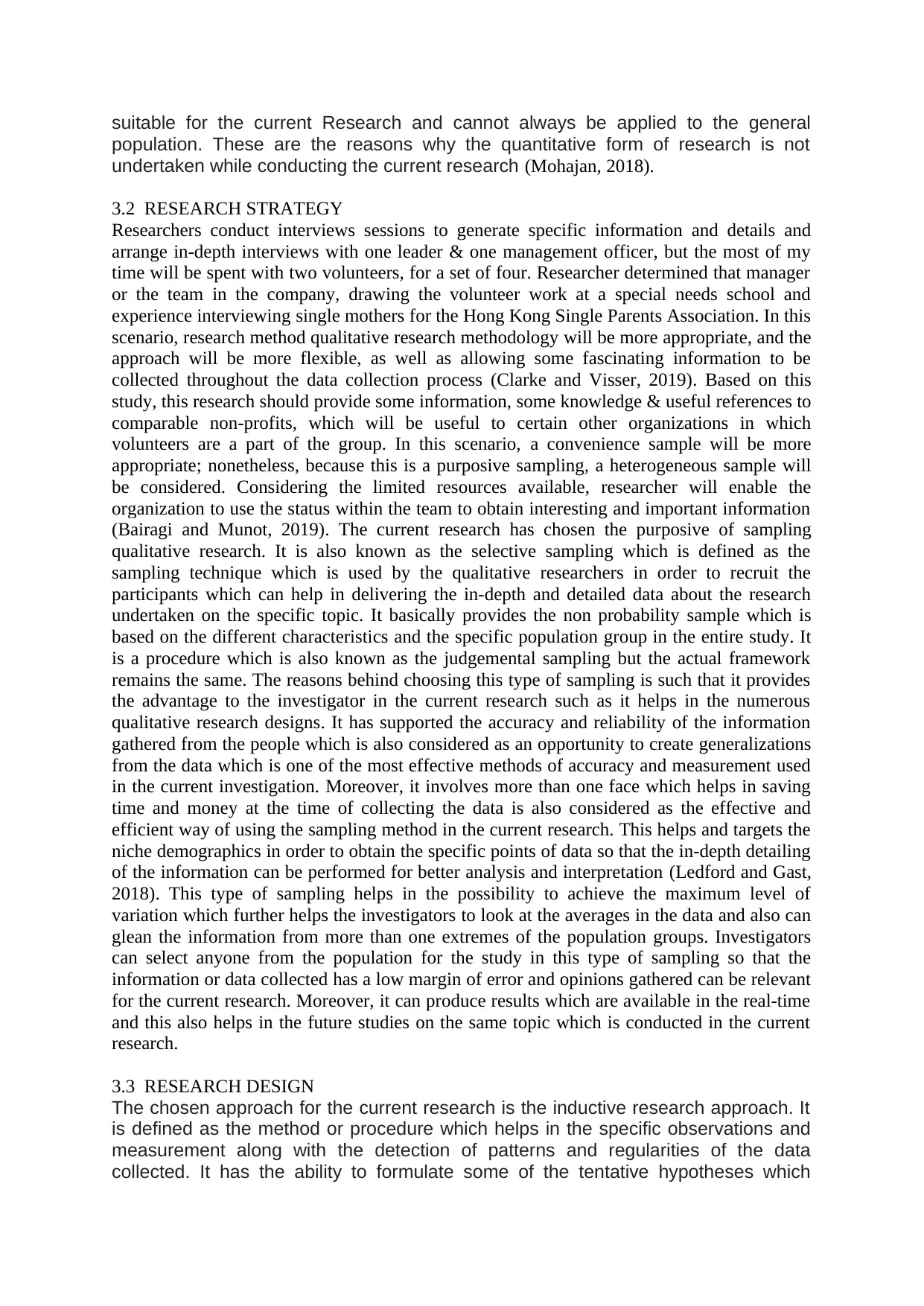
suitable for the current Research and cannot always be applied to the general
population. These are the reasons why the quantitative form of research is not
undertaken while conducting the current research (Mohajan, 2018).
3.2 RESEARCH STRATEGY
Researchers conduct interviews sessions to generate specific information and details and
arrange in-depth interviews with one leader & one management officer, but the most of my
time will be spent with two volunteers, for a set of four. Researcher determined that manager
or the team in the company, drawing the volunteer work at a special needs school and
experience interviewing single mothers for the Hong Kong Single Parents Association. In this
scenario, research method qualitative research methodology will be more appropriate, and the
approach will be more flexible, as well as allowing some fascinating information to be
collected throughout the data collection process (Clarke and Visser, 2019). Based on this
study, this research should provide some information, some knowledge & useful references to
comparable non-profits, which will be useful to certain other organizations in which
volunteers are a part of the group. In this scenario, a convenience sample will be more
appropriate; nonetheless, because this is a purposive sampling, a heterogeneous sample will
be considered. Considering the limited resources available, researcher will enable the
organization to use the status within the team to obtain interesting and important information
(Bairagi and Munot, 2019). The current research has chosen the purposive of sampling
qualitative research. It is also known as the selective sampling which is defined as the
sampling technique which is used by the qualitative researchers in order to recruit the
participants which can help in delivering the in-depth and detailed data about the research
undertaken on the specific topic. It basically provides the non probability sample which is
based on the different characteristics and the specific population group in the entire study. It
is a procedure which is also known as the judgemental sampling but the actual framework
remains the same. The reasons behind choosing this type of sampling is such that it provides
the advantage to the investigator in the current research such as it helps in the numerous
qualitative research designs. It has supported the accuracy and reliability of the information
gathered from the people which is also considered as an opportunity to create generalizations
from the data which is one of the most effective methods of accuracy and measurement used
in the current investigation. Moreover, it involves more than one face which helps in saving
time and money at the time of collecting the data is also considered as the effective and
efficient way of using the sampling method in the current research. This helps and targets the
niche demographics in order to obtain the specific points of data so that the in-depth detailing
of the information can be performed for better analysis and interpretation (Ledford and Gast,
2018). This type of sampling helps in the possibility to achieve the maximum level of
variation which further helps the investigators to look at the averages in the data and also can
glean the information from more than one extremes of the population groups. Investigators
can select anyone from the population for the study in this type of sampling so that the
information or data collected has a low margin of error and opinions gathered can be relevant
for the current research. Moreover, it can produce results which are available in the real-time
and this also helps in the future studies on the same topic which is conducted in the current
research.
3.3 RESEARCH DESIGN
The chosen approach for the current research is the inductive research approach. It
is defined as the method or procedure which helps in the specific observations and
measurement along with the detection of patterns and regularities of the data
collected. It has the ability to formulate some of the tentative hypotheses which
population. These are the reasons why the quantitative form of research is not
undertaken while conducting the current research (Mohajan, 2018).
3.2 RESEARCH STRATEGY
Researchers conduct interviews sessions to generate specific information and details and
arrange in-depth interviews with one leader & one management officer, but the most of my
time will be spent with two volunteers, for a set of four. Researcher determined that manager
or the team in the company, drawing the volunteer work at a special needs school and
experience interviewing single mothers for the Hong Kong Single Parents Association. In this
scenario, research method qualitative research methodology will be more appropriate, and the
approach will be more flexible, as well as allowing some fascinating information to be
collected throughout the data collection process (Clarke and Visser, 2019). Based on this
study, this research should provide some information, some knowledge & useful references to
comparable non-profits, which will be useful to certain other organizations in which
volunteers are a part of the group. In this scenario, a convenience sample will be more
appropriate; nonetheless, because this is a purposive sampling, a heterogeneous sample will
be considered. Considering the limited resources available, researcher will enable the
organization to use the status within the team to obtain interesting and important information
(Bairagi and Munot, 2019). The current research has chosen the purposive of sampling
qualitative research. It is also known as the selective sampling which is defined as the
sampling technique which is used by the qualitative researchers in order to recruit the
participants which can help in delivering the in-depth and detailed data about the research
undertaken on the specific topic. It basically provides the non probability sample which is
based on the different characteristics and the specific population group in the entire study. It
is a procedure which is also known as the judgemental sampling but the actual framework
remains the same. The reasons behind choosing this type of sampling is such that it provides
the advantage to the investigator in the current research such as it helps in the numerous
qualitative research designs. It has supported the accuracy and reliability of the information
gathered from the people which is also considered as an opportunity to create generalizations
from the data which is one of the most effective methods of accuracy and measurement used
in the current investigation. Moreover, it involves more than one face which helps in saving
time and money at the time of collecting the data is also considered as the effective and
efficient way of using the sampling method in the current research. This helps and targets the
niche demographics in order to obtain the specific points of data so that the in-depth detailing
of the information can be performed for better analysis and interpretation (Ledford and Gast,
2018). This type of sampling helps in the possibility to achieve the maximum level of
variation which further helps the investigators to look at the averages in the data and also can
glean the information from more than one extremes of the population groups. Investigators
can select anyone from the population for the study in this type of sampling so that the
information or data collected has a low margin of error and opinions gathered can be relevant
for the current research. Moreover, it can produce results which are available in the real-time
and this also helps in the future studies on the same topic which is conducted in the current
research.
3.3 RESEARCH DESIGN
The chosen approach for the current research is the inductive research approach. It
is defined as the method or procedure which helps in the specific observations and
measurement along with the detection of patterns and regularities of the data
collected. It has the ability to formulate some of the tentative hypotheses which
⊘ This is a preview!⊘
Do you want full access?
Subscribe today to unlock all pages.

Trusted by 1+ million students worldwide
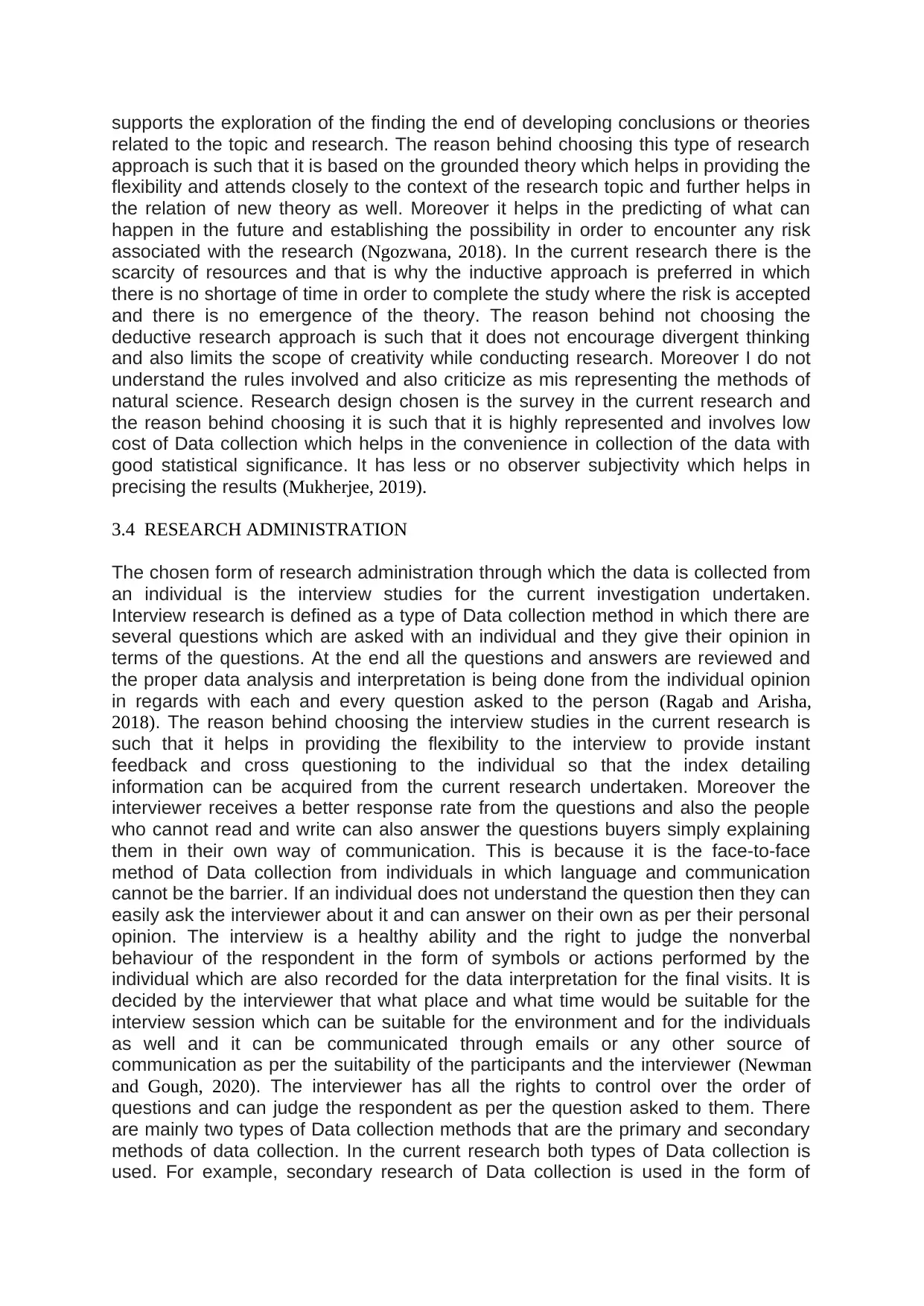
supports the exploration of the finding the end of developing conclusions or theories
related to the topic and research. The reason behind choosing this type of research
approach is such that it is based on the grounded theory which helps in providing the
flexibility and attends closely to the context of the research topic and further helps in
the relation of new theory as well. Moreover it helps in the predicting of what can
happen in the future and establishing the possibility in order to encounter any risk
associated with the research (Ngozwana, 2018). In the current research there is the
scarcity of resources and that is why the inductive approach is preferred in which
there is no shortage of time in order to complete the study where the risk is accepted
and there is no emergence of the theory. The reason behind not choosing the
deductive research approach is such that it does not encourage divergent thinking
and also limits the scope of creativity while conducting research. Moreover I do not
understand the rules involved and also criticize as mis representing the methods of
natural science. Research design chosen is the survey in the current research and
the reason behind choosing it is such that it is highly represented and involves low
cost of Data collection which helps in the convenience in collection of the data with
good statistical significance. It has less or no observer subjectivity which helps in
precising the results (Mukherjee, 2019).
3.4 RESEARCH ADMINISTRATION
The chosen form of research administration through which the data is collected from
an individual is the interview studies for the current investigation undertaken.
Interview research is defined as a type of Data collection method in which there are
several questions which are asked with an individual and they give their opinion in
terms of the questions. At the end all the questions and answers are reviewed and
the proper data analysis and interpretation is being done from the individual opinion
in regards with each and every question asked to the person (Ragab and Arisha,
2018). The reason behind choosing the interview studies in the current research is
such that it helps in providing the flexibility to the interview to provide instant
feedback and cross questioning to the individual so that the index detailing
information can be acquired from the current research undertaken. Moreover the
interviewer receives a better response rate from the questions and also the people
who cannot read and write can also answer the questions buyers simply explaining
them in their own way of communication. This is because it is the face-to-face
method of Data collection from individuals in which language and communication
cannot be the barrier. If an individual does not understand the question then they can
easily ask the interviewer about it and can answer on their own as per their personal
opinion. The interview is a healthy ability and the right to judge the nonverbal
behaviour of the respondent in the form of symbols or actions performed by the
individual which are also recorded for the data interpretation for the final visits. It is
decided by the interviewer that what place and what time would be suitable for the
interview session which can be suitable for the environment and for the individuals
as well and it can be communicated through emails or any other source of
communication as per the suitability of the participants and the interviewer (Newman
and Gough, 2020). The interviewer has all the rights to control over the order of
questions and can judge the respondent as per the question asked to them. There
are mainly two types of Data collection methods that are the primary and secondary
methods of data collection. In the current research both types of Data collection is
used. For example, secondary research of Data collection is used in the form of
related to the topic and research. The reason behind choosing this type of research
approach is such that it is based on the grounded theory which helps in providing the
flexibility and attends closely to the context of the research topic and further helps in
the relation of new theory as well. Moreover it helps in the predicting of what can
happen in the future and establishing the possibility in order to encounter any risk
associated with the research (Ngozwana, 2018). In the current research there is the
scarcity of resources and that is why the inductive approach is preferred in which
there is no shortage of time in order to complete the study where the risk is accepted
and there is no emergence of the theory. The reason behind not choosing the
deductive research approach is such that it does not encourage divergent thinking
and also limits the scope of creativity while conducting research. Moreover I do not
understand the rules involved and also criticize as mis representing the methods of
natural science. Research design chosen is the survey in the current research and
the reason behind choosing it is such that it is highly represented and involves low
cost of Data collection which helps in the convenience in collection of the data with
good statistical significance. It has less or no observer subjectivity which helps in
precising the results (Mukherjee, 2019).
3.4 RESEARCH ADMINISTRATION
The chosen form of research administration through which the data is collected from
an individual is the interview studies for the current investigation undertaken.
Interview research is defined as a type of Data collection method in which there are
several questions which are asked with an individual and they give their opinion in
terms of the questions. At the end all the questions and answers are reviewed and
the proper data analysis and interpretation is being done from the individual opinion
in regards with each and every question asked to the person (Ragab and Arisha,
2018). The reason behind choosing the interview studies in the current research is
such that it helps in providing the flexibility to the interview to provide instant
feedback and cross questioning to the individual so that the index detailing
information can be acquired from the current research undertaken. Moreover the
interviewer receives a better response rate from the questions and also the people
who cannot read and write can also answer the questions buyers simply explaining
them in their own way of communication. This is because it is the face-to-face
method of Data collection from individuals in which language and communication
cannot be the barrier. If an individual does not understand the question then they can
easily ask the interviewer about it and can answer on their own as per their personal
opinion. The interview is a healthy ability and the right to judge the nonverbal
behaviour of the respondent in the form of symbols or actions performed by the
individual which are also recorded for the data interpretation for the final visits. It is
decided by the interviewer that what place and what time would be suitable for the
interview session which can be suitable for the environment and for the individuals
as well and it can be communicated through emails or any other source of
communication as per the suitability of the participants and the interviewer (Newman
and Gough, 2020). The interviewer has all the rights to control over the order of
questions and can judge the respondent as per the question asked to them. There
are mainly two types of Data collection methods that are the primary and secondary
methods of data collection. In the current research both types of Data collection is
used. For example, secondary research of Data collection is used in the form of
Paraphrase This Document
Need a fresh take? Get an instant paraphrase of this document with our AI Paraphraser
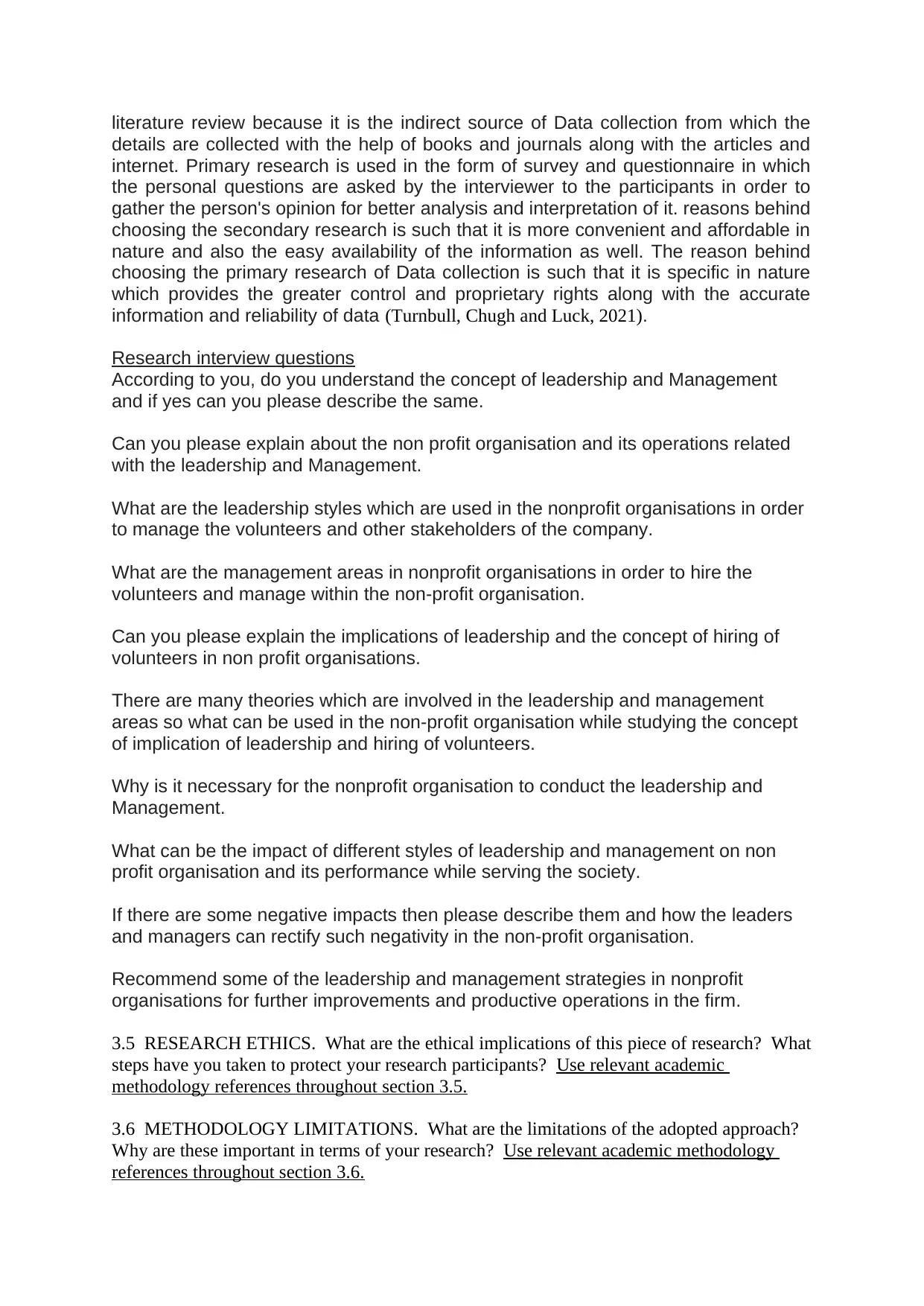
literature review because it is the indirect source of Data collection from which the
details are collected with the help of books and journals along with the articles and
internet. Primary research is used in the form of survey and questionnaire in which
the personal questions are asked by the interviewer to the participants in order to
gather the person's opinion for better analysis and interpretation of it. reasons behind
choosing the secondary research is such that it is more convenient and affordable in
nature and also the easy availability of the information as well. The reason behind
choosing the primary research of Data collection is such that it is specific in nature
which provides the greater control and proprietary rights along with the accurate
information and reliability of data (Turnbull, Chugh and Luck, 2021).
Research interview questions
According to you, do you understand the concept of leadership and Management
and if yes can you please describe the same.
Can you please explain about the non profit organisation and its operations related
with the leadership and Management.
What are the leadership styles which are used in the nonprofit organisations in order
to manage the volunteers and other stakeholders of the company.
What are the management areas in nonprofit organisations in order to hire the
volunteers and manage within the non-profit organisation.
Can you please explain the implications of leadership and the concept of hiring of
volunteers in non profit organisations.
There are many theories which are involved in the leadership and management
areas so what can be used in the non-profit organisation while studying the concept
of implication of leadership and hiring of volunteers.
Why is it necessary for the nonprofit organisation to conduct the leadership and
Management.
What can be the impact of different styles of leadership and management on non
profit organisation and its performance while serving the society.
If there are some negative impacts then please describe them and how the leaders
and managers can rectify such negativity in the non-profit organisation.
Recommend some of the leadership and management strategies in nonprofit
organisations for further improvements and productive operations in the firm.
3.5 RESEARCH ETHICS. What are the ethical implications of this piece of research? What
steps have you taken to protect your research participants? Use relevant academic
methodology references throughout section 3.5.
3.6 METHODOLOGY LIMITATIONS. What are the limitations of the adopted approach?
Why are these important in terms of your research? Use relevant academic methodology
references throughout section 3.6.
details are collected with the help of books and journals along with the articles and
internet. Primary research is used in the form of survey and questionnaire in which
the personal questions are asked by the interviewer to the participants in order to
gather the person's opinion for better analysis and interpretation of it. reasons behind
choosing the secondary research is such that it is more convenient and affordable in
nature and also the easy availability of the information as well. The reason behind
choosing the primary research of Data collection is such that it is specific in nature
which provides the greater control and proprietary rights along with the accurate
information and reliability of data (Turnbull, Chugh and Luck, 2021).
Research interview questions
According to you, do you understand the concept of leadership and Management
and if yes can you please describe the same.
Can you please explain about the non profit organisation and its operations related
with the leadership and Management.
What are the leadership styles which are used in the nonprofit organisations in order
to manage the volunteers and other stakeholders of the company.
What are the management areas in nonprofit organisations in order to hire the
volunteers and manage within the non-profit organisation.
Can you please explain the implications of leadership and the concept of hiring of
volunteers in non profit organisations.
There are many theories which are involved in the leadership and management
areas so what can be used in the non-profit organisation while studying the concept
of implication of leadership and hiring of volunteers.
Why is it necessary for the nonprofit organisation to conduct the leadership and
Management.
What can be the impact of different styles of leadership and management on non
profit organisation and its performance while serving the society.
If there are some negative impacts then please describe them and how the leaders
and managers can rectify such negativity in the non-profit organisation.
Recommend some of the leadership and management strategies in nonprofit
organisations for further improvements and productive operations in the firm.
3.5 RESEARCH ETHICS. What are the ethical implications of this piece of research? What
steps have you taken to protect your research participants? Use relevant academic
methodology references throughout section 3.5.
3.6 METHODOLOGY LIMITATIONS. What are the limitations of the adopted approach?
Why are these important in terms of your research? Use relevant academic methodology
references throughout section 3.6.
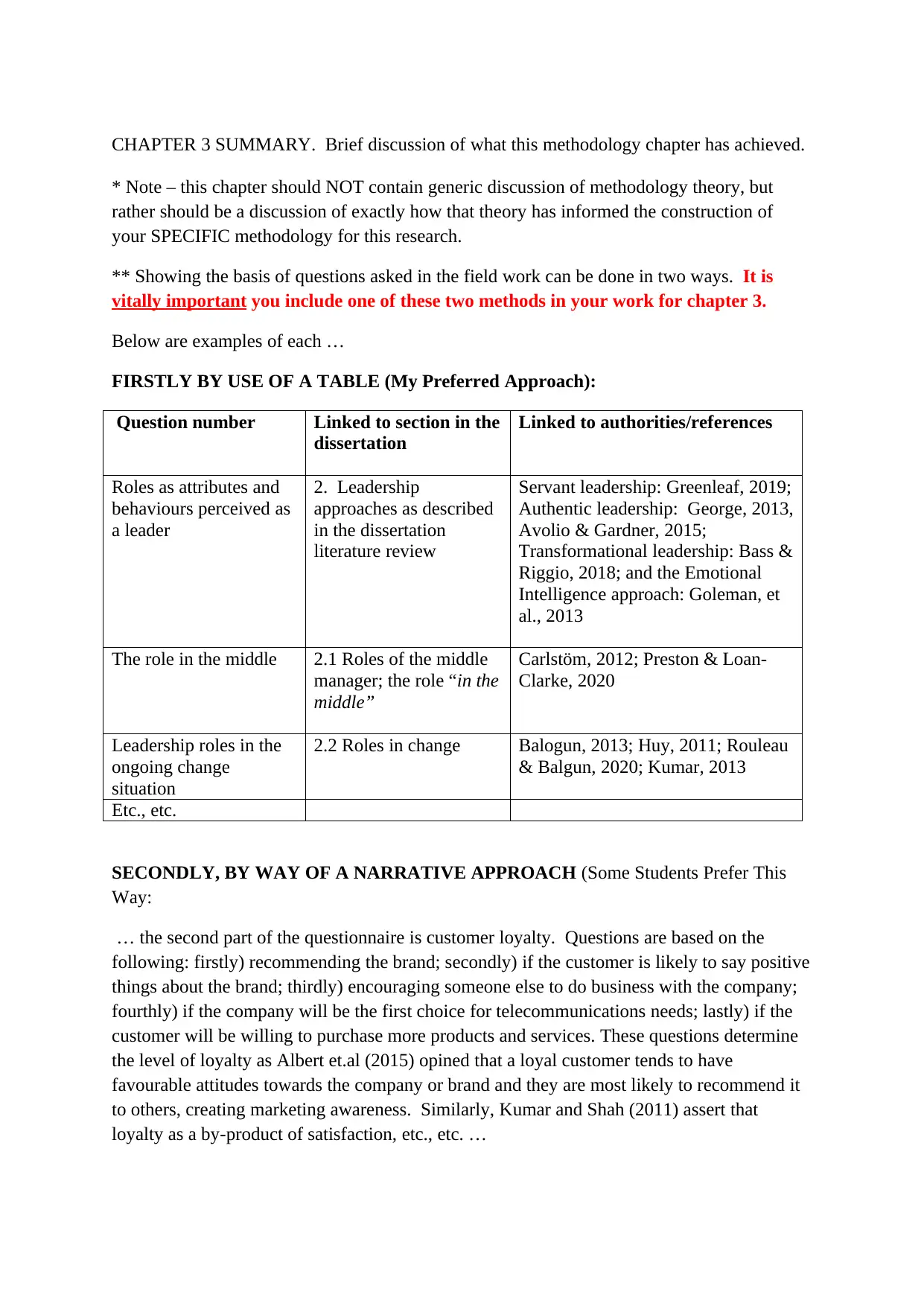
CHAPTER 3 SUMMARY. Brief discussion of what this methodology chapter has achieved.
* Note – this chapter should NOT contain generic discussion of methodology theory, but
rather should be a discussion of exactly how that theory has informed the construction of
your SPECIFIC methodology for this research.
** Showing the basis of questions asked in the field work can be done in two ways. It is
vitally important you include one of these two methods in your work for chapter 3.
Below are examples of each …
FIRSTLY BY USE OF A TABLE (My Preferred Approach):
Question number Linked to section in the
dissertation
Linked to authorities/references
Roles as attributes and
behaviours perceived as
a leader
2. Leadership
approaches as described
in the dissertation
literature review
Servant leadership: Greenleaf, 2019;
Authentic leadership: George, 2013,
Avolio & Gardner, 2015;
Transformational leadership: Bass &
Riggio, 2018; and the Emotional
Intelligence approach: Goleman, et
al., 2013
The role in the middle 2.1 Roles of the middle
manager; the role “in the
middle”
Carlstöm, 2012; Preston & Loan-
Clarke, 2020
Leadership roles in the
ongoing change
situation
2.2 Roles in change Balogun, 2013; Huy, 2011; Rouleau
& Balgun, 2020; Kumar, 2013
Etc., etc.
SECONDLY, BY WAY OF A NARRATIVE APPROACH (Some Students Prefer This
Way:
… the second part of the questionnaire is customer loyalty. Questions are based on the
following: firstly) recommending the brand; secondly) if the customer is likely to say positive
things about the brand; thirdly) encouraging someone else to do business with the company;
fourthly) if the company will be the first choice for telecommunications needs; lastly) if the
customer will be willing to purchase more products and services. These questions determine
the level of loyalty as Albert et.al (2015) opined that a loyal customer tends to have
favourable attitudes towards the company or brand and they are most likely to recommend it
to others, creating marketing awareness. Similarly, Kumar and Shah (2011) assert that
loyalty as a by-product of satisfaction, etc., etc. …
* Note – this chapter should NOT contain generic discussion of methodology theory, but
rather should be a discussion of exactly how that theory has informed the construction of
your SPECIFIC methodology for this research.
** Showing the basis of questions asked in the field work can be done in two ways. It is
vitally important you include one of these two methods in your work for chapter 3.
Below are examples of each …
FIRSTLY BY USE OF A TABLE (My Preferred Approach):
Question number Linked to section in the
dissertation
Linked to authorities/references
Roles as attributes and
behaviours perceived as
a leader
2. Leadership
approaches as described
in the dissertation
literature review
Servant leadership: Greenleaf, 2019;
Authentic leadership: George, 2013,
Avolio & Gardner, 2015;
Transformational leadership: Bass &
Riggio, 2018; and the Emotional
Intelligence approach: Goleman, et
al., 2013
The role in the middle 2.1 Roles of the middle
manager; the role “in the
middle”
Carlstöm, 2012; Preston & Loan-
Clarke, 2020
Leadership roles in the
ongoing change
situation
2.2 Roles in change Balogun, 2013; Huy, 2011; Rouleau
& Balgun, 2020; Kumar, 2013
Etc., etc.
SECONDLY, BY WAY OF A NARRATIVE APPROACH (Some Students Prefer This
Way:
… the second part of the questionnaire is customer loyalty. Questions are based on the
following: firstly) recommending the brand; secondly) if the customer is likely to say positive
things about the brand; thirdly) encouraging someone else to do business with the company;
fourthly) if the company will be the first choice for telecommunications needs; lastly) if the
customer will be willing to purchase more products and services. These questions determine
the level of loyalty as Albert et.al (2015) opined that a loyal customer tends to have
favourable attitudes towards the company or brand and they are most likely to recommend it
to others, creating marketing awareness. Similarly, Kumar and Shah (2011) assert that
loyalty as a by-product of satisfaction, etc., etc. …
⊘ This is a preview!⊘
Do you want full access?
Subscribe today to unlock all pages.
Trusted by 1+ million students worldwide
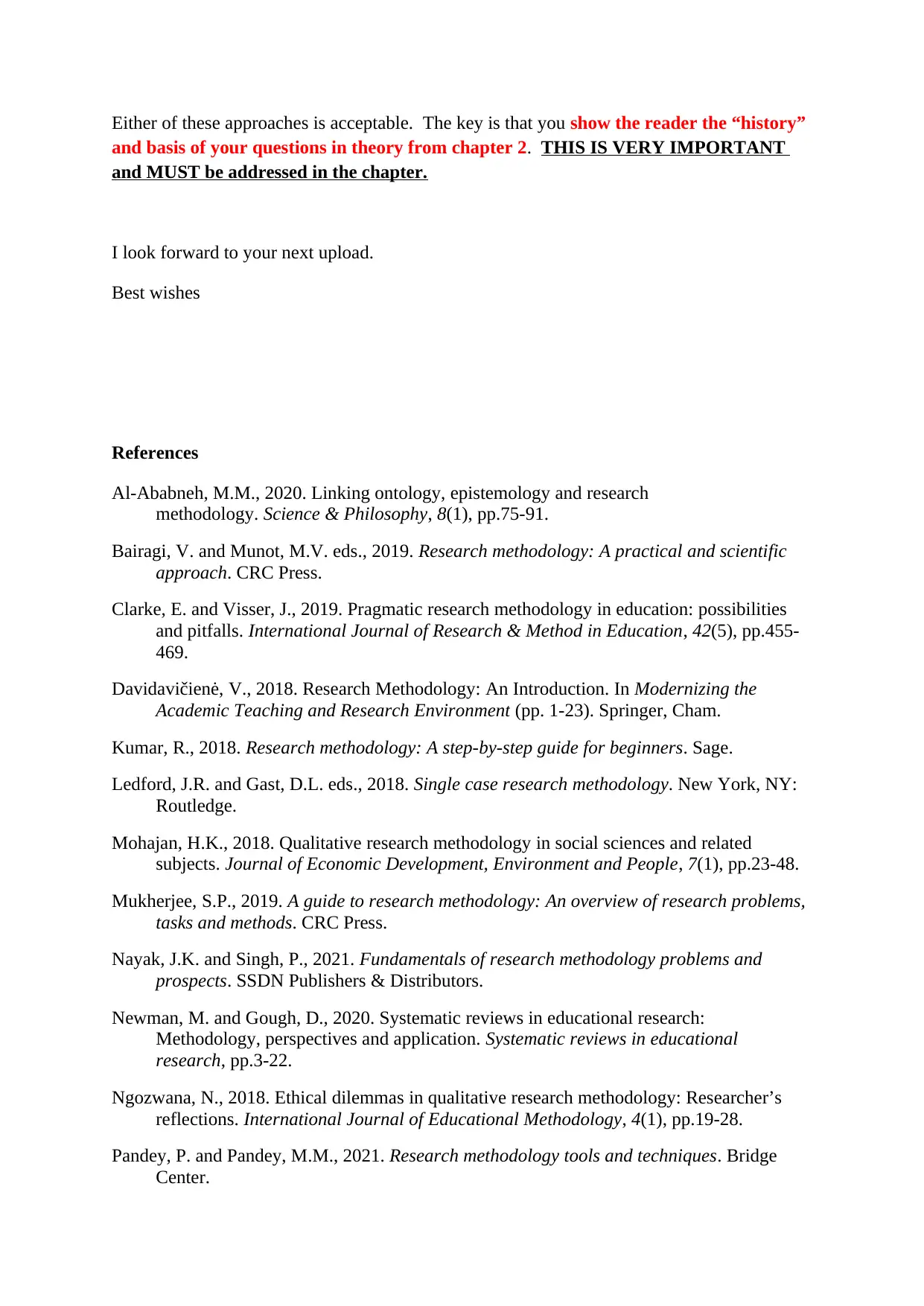
Either of these approaches is acceptable. The key is that you show the reader the “history”
and basis of your questions in theory from chapter 2. THIS IS VERY IMPORTANT
and MUST be addressed in the chapter.
I look forward to your next upload.
Best wishes
References
Al-Ababneh, M.M., 2020. Linking ontology, epistemology and research
methodology. Science & Philosophy, 8(1), pp.75-91.
Bairagi, V. and Munot, M.V. eds., 2019. Research methodology: A practical and scientific
approach. CRC Press.
Clarke, E. and Visser, J., 2019. Pragmatic research methodology in education: possibilities
and pitfalls. International Journal of Research & Method in Education, 42(5), pp.455-
469.
Davidavičienė, V., 2018. Research Methodology: An Introduction. In Modernizing the
Academic Teaching and Research Environment (pp. 1-23). Springer, Cham.
Kumar, R., 2018. Research methodology: A step-by-step guide for beginners. Sage.
Ledford, J.R. and Gast, D.L. eds., 2018. Single case research methodology. New York, NY:
Routledge.
Mohajan, H.K., 2018. Qualitative research methodology in social sciences and related
subjects. Journal of Economic Development, Environment and People, 7(1), pp.23-48.
Mukherjee, S.P., 2019. A guide to research methodology: An overview of research problems,
tasks and methods. CRC Press.
Nayak, J.K. and Singh, P., 2021. Fundamentals of research methodology problems and
prospects. SSDN Publishers & Distributors.
Newman, M. and Gough, D., 2020. Systematic reviews in educational research:
Methodology, perspectives and application. Systematic reviews in educational
research, pp.3-22.
Ngozwana, N., 2018. Ethical dilemmas in qualitative research methodology: Researcher’s
reflections. International Journal of Educational Methodology, 4(1), pp.19-28.
Pandey, P. and Pandey, M.M., 2021. Research methodology tools and techniques. Bridge
Center.
and basis of your questions in theory from chapter 2. THIS IS VERY IMPORTANT
and MUST be addressed in the chapter.
I look forward to your next upload.
Best wishes
References
Al-Ababneh, M.M., 2020. Linking ontology, epistemology and research
methodology. Science & Philosophy, 8(1), pp.75-91.
Bairagi, V. and Munot, M.V. eds., 2019. Research methodology: A practical and scientific
approach. CRC Press.
Clarke, E. and Visser, J., 2019. Pragmatic research methodology in education: possibilities
and pitfalls. International Journal of Research & Method in Education, 42(5), pp.455-
469.
Davidavičienė, V., 2018. Research Methodology: An Introduction. In Modernizing the
Academic Teaching and Research Environment (pp. 1-23). Springer, Cham.
Kumar, R., 2018. Research methodology: A step-by-step guide for beginners. Sage.
Ledford, J.R. and Gast, D.L. eds., 2018. Single case research methodology. New York, NY:
Routledge.
Mohajan, H.K., 2018. Qualitative research methodology in social sciences and related
subjects. Journal of Economic Development, Environment and People, 7(1), pp.23-48.
Mukherjee, S.P., 2019. A guide to research methodology: An overview of research problems,
tasks and methods. CRC Press.
Nayak, J.K. and Singh, P., 2021. Fundamentals of research methodology problems and
prospects. SSDN Publishers & Distributors.
Newman, M. and Gough, D., 2020. Systematic reviews in educational research:
Methodology, perspectives and application. Systematic reviews in educational
research, pp.3-22.
Ngozwana, N., 2018. Ethical dilemmas in qualitative research methodology: Researcher’s
reflections. International Journal of Educational Methodology, 4(1), pp.19-28.
Pandey, P. and Pandey, M.M., 2021. Research methodology tools and techniques. Bridge
Center.
Paraphrase This Document
Need a fresh take? Get an instant paraphrase of this document with our AI Paraphraser

Ragab, M.A. and Arisha, A., 2018. Research methodology in business: A starter’s
guide. Management and organizational studies, 5(1), pp.1-14.
Snyder, H., 2019. Literature review as a research methodology: An overview and
guidelines. Journal of business research, 104, pp.333-339.
Turnbull, D., Chugh, R. and Luck, J., 2021. Learning management systems: A review of the
research methodology literature in Australia and China. International Journal of
Research & Method in Education, 44(2), pp.164-178.
guide. Management and organizational studies, 5(1), pp.1-14.
Snyder, H., 2019. Literature review as a research methodology: An overview and
guidelines. Journal of business research, 104, pp.333-339.
Turnbull, D., Chugh, R. and Luck, J., 2021. Learning management systems: A review of the
research methodology literature in Australia and China. International Journal of
Research & Method in Education, 44(2), pp.164-178.

1 out of 8


Related Documents


Your All-in-One AI-Powered Toolkit for Academic Success.
+13062052269
info@desklib.com
Available 24*7 on WhatsApp / Email
![[object Object]](/_next/static/media/star-bottom.7253800d.svg)
Unlock your academic potential
Copyright © 2020–2026 A2Z Services. All Rights Reserved. Developed and managed by ZUCOL.