Comparative Analysis of Leadership and Management Roles at M&S
VerifiedAdded on 2023/01/06
|16
|4681
|87
Report
AI Summary
This report provides a comprehensive analysis of the roles of leaders and managers within Marks & Spencer (M&S). It begins by defining and differentiating between the characteristics and responsibilities of leaders and managers, highlighting their distinct approaches to motivating employees, managing tasks, and achieving organizational goals. The report then delves into the application of leadership and management in various contexts, including change management, strategic planning, and training, emphasizing the importance of both roles in achieving business objectives. It explores different leadership theories such as situational, contingency, and systems leadership, evaluating their strengths and weaknesses within the work environment. The report further examines key approaches to operations management, including Just-In-Time and Total Quality Management, and assesses how these approaches, along with the roles of leaders and managers, contribute to operational efficiency. It also discusses the impact of factors within the business environment on operational management and decision-making, concluding with an appreciation of the roles leaders and managers play in a contemporary business environment.

Management and Operations

Paraphrase This Document
Need a fresh take? Get an instant paraphrase of this document with our AI Paraphraser
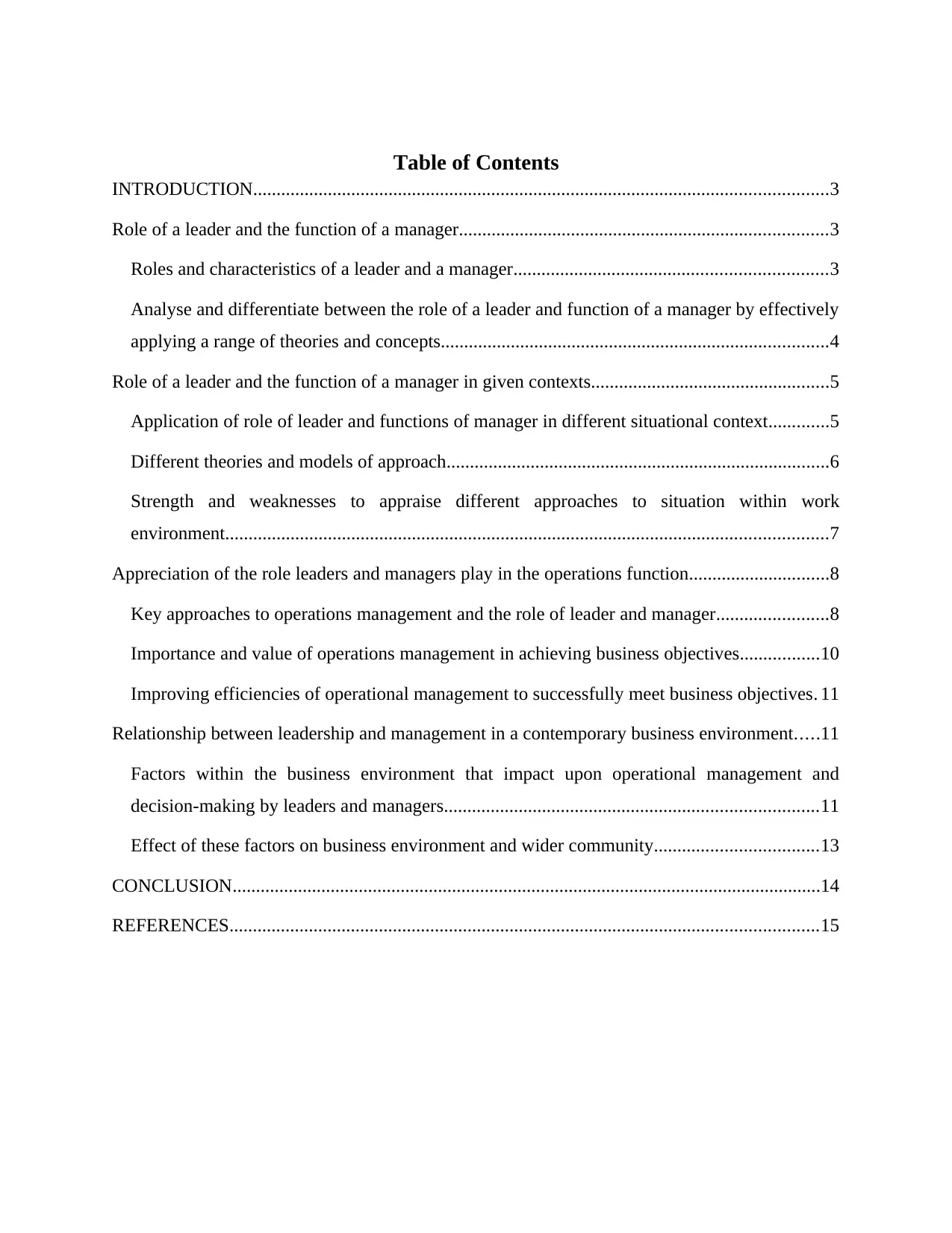
Table of Contents
INTRODUCTION...........................................................................................................................3
Role of a leader and the function of a manager...............................................................................3
Roles and characteristics of a leader and a manager...................................................................3
Analyse and differentiate between the role of a leader and function of a manager by effectively
applying a range of theories and concepts...................................................................................4
Role of a leader and the function of a manager in given contexts...................................................5
Application of role of leader and functions of manager in different situational context.............5
Different theories and models of approach..................................................................................6
Strength and weaknesses to appraise different approaches to situation within work
environment.................................................................................................................................7
Appreciation of the role leaders and managers play in the operations function..............................8
Key approaches to operations management and the role of leader and manager........................8
Importance and value of operations management in achieving business objectives.................10
Improving efficiencies of operational management to successfully meet business objectives. 11
Relationship between leadership and management in a contemporary business environment.....11
Factors within the business environment that impact upon operational management and
decision-making by leaders and managers................................................................................11
Effect of these factors on business environment and wider community...................................13
CONCLUSION..............................................................................................................................14
REFERENCES..............................................................................................................................15
INTRODUCTION...........................................................................................................................3
Role of a leader and the function of a manager...............................................................................3
Roles and characteristics of a leader and a manager...................................................................3
Analyse and differentiate between the role of a leader and function of a manager by effectively
applying a range of theories and concepts...................................................................................4
Role of a leader and the function of a manager in given contexts...................................................5
Application of role of leader and functions of manager in different situational context.............5
Different theories and models of approach..................................................................................6
Strength and weaknesses to appraise different approaches to situation within work
environment.................................................................................................................................7
Appreciation of the role leaders and managers play in the operations function..............................8
Key approaches to operations management and the role of leader and manager........................8
Importance and value of operations management in achieving business objectives.................10
Improving efficiencies of operational management to successfully meet business objectives. 11
Relationship between leadership and management in a contemporary business environment.....11
Factors within the business environment that impact upon operational management and
decision-making by leaders and managers................................................................................11
Effect of these factors on business environment and wider community...................................13
CONCLUSION..............................................................................................................................14
REFERENCES..............................................................................................................................15
INTRODUCTION
Management can be defined as different methods and style used by the organizations in
directing, managing, controlling different individuals to work within organization. Operational
management is the function area of management helping organization in planning, supervising
with managing all task and activities of company (Bolden, Gulati. and Edwards., 2019). The
report will have focus on Marks and Spencer, a British multinational retail company founded in
year 1884 headquarter is in London. The firm is keen interested in products like cloths, food
products, home products. The report will lay proper emphasize on different role and
characteristics of leader and manager with respective approaches, main approaches of operation
management and factor effecting the operational efficiency of company.
Role of a leader and the function of a manager
Roles and characteristics of a leader and a manager
Leader and manager are two important individual of company having different role and
responsibility handling different function and management area of organizations. A leader is the
individual within company looking up with focus on motivating employee to move in forward
and correct direction. They also help out in predetermining organization and individual gaols and
objectives which can be achieved through proper strategic approach. Whereas manager is
individual who tends to works in all situations designing effective working manner so that firm
can achieved it goals and objective in proper planned way.
Difference between roles and characteristics of leaders and managers are as follows:
Leader have a role to take care of everyone along with working as team together achieving all
goal and objective and focus on achievement of success (Conaway, 2017). Where as Main role
of managers is managing all task and activity to achieved pre-determined targets in proper
manner.
Leader will analyse the employee behaviours at each level providing proper guidance for
improvement in performance ineffective manner. But Manager is providing effective training
and directions to work accordingly and activities to be completed in timely manner.
Leader will have to focus on question of why and what for relation to focus on task. On other
hand, managers have focus on when and relation questions to complete the task. Leader tends to
Management can be defined as different methods and style used by the organizations in
directing, managing, controlling different individuals to work within organization. Operational
management is the function area of management helping organization in planning, supervising
with managing all task and activities of company (Bolden, Gulati. and Edwards., 2019). The
report will have focus on Marks and Spencer, a British multinational retail company founded in
year 1884 headquarter is in London. The firm is keen interested in products like cloths, food
products, home products. The report will lay proper emphasize on different role and
characteristics of leader and manager with respective approaches, main approaches of operation
management and factor effecting the operational efficiency of company.
Role of a leader and the function of a manager
Roles and characteristics of a leader and a manager
Leader and manager are two important individual of company having different role and
responsibility handling different function and management area of organizations. A leader is the
individual within company looking up with focus on motivating employee to move in forward
and correct direction. They also help out in predetermining organization and individual gaols and
objectives which can be achieved through proper strategic approach. Whereas manager is
individual who tends to works in all situations designing effective working manner so that firm
can achieved it goals and objective in proper planned way.
Difference between roles and characteristics of leaders and managers are as follows:
Leader have a role to take care of everyone along with working as team together achieving all
goal and objective and focus on achievement of success (Conaway, 2017). Where as Main role
of managers is managing all task and activity to achieved pre-determined targets in proper
manner.
Leader will analyse the employee behaviours at each level providing proper guidance for
improvement in performance ineffective manner. But Manager is providing effective training
and directions to work accordingly and activities to be completed in timely manner.
Leader will have to focus on question of why and what for relation to focus on task. On other
hand, managers have focus on when and relation questions to complete the task. Leader tends to
⊘ This is a preview!⊘
Do you want full access?
Subscribe today to unlock all pages.

Trusted by 1+ million students worldwide
be unique in nature. Whereas manager is considered to be commanding in nature. Leader look to
be creative in nature whereas manager is flexible in nature.
There are thinking out to have original ideas for growth and development of organization. but
manager are tending to coping different ideas and strategies of leader to take completions of
assigned activities and task on perfect time. Motivating employees to do regular work with
proper efficiency and effectiveness come under the responsibility of leader whereas Manager
will manager and direct work of employees (Hwang, Han. and Chang, 2020). Leader are creative
and confident in term of differ condition. Whereas, manger are considered patients and flexible
in nature.
The important characteristics of leader tends to be differentiated from manager are such
as confident, motivator, caring, good decision makers. On the other hand, some of the
characterises of manager are such as empathetic, responsible, accountable, reliable and specific
in nature
Analyse and differentiate between the role of a leader and function of a manager by effectively
applying a range of theories and concepts
Role of leader and manager are tends to have completely differ from each and other. Main role of
leader and function of manager playing vital role in success of Marks and Spencer are as follow-
Planning
The main function of manger is planning major goals and objective of M&S in much as manner
enhancing overall sales and revenue. This will result in reduction of employee turnover in better
manner. On the other hand, leader have to take proper communication of these goals to
employee by putting efforts for the achievement of goals decided by manager.
Organizing: Functions of manager have to make utilization and organize all research looking into
proper adequate a proper manner. where as the role of leader is to efficiently reallocate resource
looking out to have desired outcomes to achieve it in proper manner.
Controlling – Manager have need to take control and guide respective employees for
achievements of desired outcomes along with leader verify outcome achieved by employee.
be creative in nature whereas manager is flexible in nature.
There are thinking out to have original ideas for growth and development of organization. but
manager are tending to coping different ideas and strategies of leader to take completions of
assigned activities and task on perfect time. Motivating employees to do regular work with
proper efficiency and effectiveness come under the responsibility of leader whereas Manager
will manager and direct work of employees (Hwang, Han. and Chang, 2020). Leader are creative
and confident in term of differ condition. Whereas, manger are considered patients and flexible
in nature.
The important characteristics of leader tends to be differentiated from manager are such
as confident, motivator, caring, good decision makers. On the other hand, some of the
characterises of manager are such as empathetic, responsible, accountable, reliable and specific
in nature
Analyse and differentiate between the role of a leader and function of a manager by effectively
applying a range of theories and concepts
Role of leader and manager are tends to have completely differ from each and other. Main role of
leader and function of manager playing vital role in success of Marks and Spencer are as follow-
Planning
The main function of manger is planning major goals and objective of M&S in much as manner
enhancing overall sales and revenue. This will result in reduction of employee turnover in better
manner. On the other hand, leader have to take proper communication of these goals to
employee by putting efforts for the achievement of goals decided by manager.
Organizing: Functions of manager have to make utilization and organize all research looking into
proper adequate a proper manner. where as the role of leader is to efficiently reallocate resource
looking out to have desired outcomes to achieve it in proper manner.
Controlling – Manager have need to take control and guide respective employees for
achievements of desired outcomes along with leader verify outcome achieved by employee.
Paraphrase This Document
Need a fresh take? Get an instant paraphrase of this document with our AI Paraphraser
Role of a leader and the function of a manager in given contexts
Application of role of leader and functions of manager in different situational context
Leader and manager both are important for overall success of M&S. However role of
leader and functions of manager are different from each other. Role of leader and function of
manager in different situations can be-
Change management- This is a process in which M&S undertake changes in organisation in
order to achieve certain objectives. Leader and managers play highly important role, this is
because change is a crucial and complex process.
Role of leader in change management involves determination of vision to be achieved
through change management and determination of direction in which organisation will go
through change. Leaders also play role in motivating employees during the process of
change.
Functions of manager involve facilitating change so that everyone can successfully be a
part of change management in M&S (Su and Baird, 2017). Managers also ensure
availability of required resources.
Strategic planning and management- This is another situation in which leader and manager
have different roles and functions. In terms of strategic planning
Functions of manager involve ensuring availability of resources required for
implementing strategic planning, this can be required skills, material resources. Analysis
and evaluation of data for decision-making. Managers also needs to ensure evaluation of
environment, on the basis of which organisation can identify opportunities and threats.
Role of leader involves identification of right vision and mission for the organisation.
Leaders also play important role in determination of objectives and purpose of
organisation. Leader also ensures opportunities to utilise and threats to avoid and taking
right decisions accordingly.
Training- Training is an important element that contributes in effectiveness of employees’
performance. Training is an important activity that is undertaken in M&S and this is why leader
and manager have different role and functions for training.
Application of role of leader and functions of manager in different situational context
Leader and manager both are important for overall success of M&S. However role of
leader and functions of manager are different from each other. Role of leader and function of
manager in different situations can be-
Change management- This is a process in which M&S undertake changes in organisation in
order to achieve certain objectives. Leader and managers play highly important role, this is
because change is a crucial and complex process.
Role of leader in change management involves determination of vision to be achieved
through change management and determination of direction in which organisation will go
through change. Leaders also play role in motivating employees during the process of
change.
Functions of manager involve facilitating change so that everyone can successfully be a
part of change management in M&S (Su and Baird, 2017). Managers also ensure
availability of required resources.
Strategic planning and management- This is another situation in which leader and manager
have different roles and functions. In terms of strategic planning
Functions of manager involve ensuring availability of resources required for
implementing strategic planning, this can be required skills, material resources. Analysis
and evaluation of data for decision-making. Managers also needs to ensure evaluation of
environment, on the basis of which organisation can identify opportunities and threats.
Role of leader involves identification of right vision and mission for the organisation.
Leaders also play important role in determination of objectives and purpose of
organisation. Leader also ensures opportunities to utilise and threats to avoid and taking
right decisions accordingly.
Training- Training is an important element that contributes in effectiveness of employees’
performance. Training is an important activity that is undertaken in M&S and this is why leader
and manager have different role and functions for training.
Functions of managers in training involve identification of training requirements,
designing and developing training process, facilitating training process and management
of overall training process (Conaway, 2017).
Leaders also play role in training and development, by determining vision and purpose of
training and development. Selection of training methods and standards of training and
creating a culture of development of also a role that leader play in organisation.
Different theories and models of approach
Situational leadership
Situation leadership style or approach involves adaptation of leadership style according to
requirement of situation. Leader in this style needs to identify and understand requirement of the
organisation and situations in terms of subordinates or teams that they are leading. On the basis
of situation leader has to modify their style or approach of leadership. On the basis of this styles
that leader can adapt are telling, selling, participating and delegating. Situation that determine
requirement of particular style involves competency and commitment of the employees.
Situation for leadership in terms of development of team or subordinates and suitable leadership
style is as follows-
In M&S leaders can identify these situations on different basis this can be joining of the
employees in M&S (Meier, 2016). This is followed by their development in M&S.
Contingency leadership
Contingency leadership considers that success of the leader is contingent upon whether
leadership style is suits a particular action. In other words, leaders can be effective in one
situation whereas can be less or not successful in other situation. M&S when applies this theory,
it requires to consider certain elements that are leader, followers, organisation and environment.
In this theory two styles have been outlined that are task-motivated and relationship motivated
style. In sometimes task motivated leadership style is suitable and in some situations relationship
oriented style is more successful. M&S to ensure success of contingency leadership requires
analysing leadership style and then matches this style with required and suitable situation.
Systems leadership
designing and developing training process, facilitating training process and management
of overall training process (Conaway, 2017).
Leaders also play role in training and development, by determining vision and purpose of
training and development. Selection of training methods and standards of training and
creating a culture of development of also a role that leader play in organisation.
Different theories and models of approach
Situational leadership
Situation leadership style or approach involves adaptation of leadership style according to
requirement of situation. Leader in this style needs to identify and understand requirement of the
organisation and situations in terms of subordinates or teams that they are leading. On the basis
of situation leader has to modify their style or approach of leadership. On the basis of this styles
that leader can adapt are telling, selling, participating and delegating. Situation that determine
requirement of particular style involves competency and commitment of the employees.
Situation for leadership in terms of development of team or subordinates and suitable leadership
style is as follows-
In M&S leaders can identify these situations on different basis this can be joining of the
employees in M&S (Meier, 2016). This is followed by their development in M&S.
Contingency leadership
Contingency leadership considers that success of the leader is contingent upon whether
leadership style is suits a particular action. In other words, leaders can be effective in one
situation whereas can be less or not successful in other situation. M&S when applies this theory,
it requires to consider certain elements that are leader, followers, organisation and environment.
In this theory two styles have been outlined that are task-motivated and relationship motivated
style. In sometimes task motivated leadership style is suitable and in some situations relationship
oriented style is more successful. M&S to ensure success of contingency leadership requires
analysing leadership style and then matches this style with required and suitable situation.
Systems leadership
⊘ This is a preview!⊘
Do you want full access?
Subscribe today to unlock all pages.
Trusted by 1+ million students worldwide
System leadership can be defined as an approach of leadership in which leaders create
conditions in organisation in which people at all level can work productively to their best
potential. In system leadership leaders in M&S require to use sound principles of human
behaviour to create models of good leadership, organisational strategy and system designs and
social process (Bolden, Gulati and Edwards, 2019). This leadership and different models provide
tools to leader through which leaders can predict behaviour of people in M&S. This also helps in
driving productive behaviour and more effective achievement of organisational purpose and
vision. Key elements of system leadership involve complex systems insights, coalition building
and advocacy tactics and collaborative leadership skills. System leadership is when implemented
in M&S, it needs to consider certain elements that are convene and commit, look and learn,
engage and energize, act with accountability and review and revise. Based on these elements
M&S can establish effective system leadership in organisation to drive best possible results.
Strength and weaknesses to appraise different approaches to situation within work environment
Strength and Weaknesses of situational leadership
Strength
Leaders can change their style according to requirement of employees and members. This
help in maintaining effectiveness of members in when their commitment and competency
are not similar (Shonhiwa, 2016).
This style helps in maintaining effective and harmonious environment within
organisation
Weaknesses
This style is short-term and leaders might need to change style frequently
Sometimes it is not easy to identify and understand right situation and this may affect
effectiveness of leadership
Strength and Weaknesses of Contingency leadership
Strength
conditions in organisation in which people at all level can work productively to their best
potential. In system leadership leaders in M&S require to use sound principles of human
behaviour to create models of good leadership, organisational strategy and system designs and
social process (Bolden, Gulati and Edwards, 2019). This leadership and different models provide
tools to leader through which leaders can predict behaviour of people in M&S. This also helps in
driving productive behaviour and more effective achievement of organisational purpose and
vision. Key elements of system leadership involve complex systems insights, coalition building
and advocacy tactics and collaborative leadership skills. System leadership is when implemented
in M&S, it needs to consider certain elements that are convene and commit, look and learn,
engage and energize, act with accountability and review and revise. Based on these elements
M&S can establish effective system leadership in organisation to drive best possible results.
Strength and weaknesses to appraise different approaches to situation within work environment
Strength and Weaknesses of situational leadership
Strength
Leaders can change their style according to requirement of employees and members. This
help in maintaining effectiveness of members in when their commitment and competency
are not similar (Shonhiwa, 2016).
This style helps in maintaining effective and harmonious environment within
organisation
Weaknesses
This style is short-term and leaders might need to change style frequently
Sometimes it is not easy to identify and understand right situation and this may affect
effectiveness of leadership
Strength and Weaknesses of Contingency leadership
Strength
Paraphrase This Document
Need a fresh take? Get an instant paraphrase of this document with our AI Paraphraser
Leaders can work on their style to ensure effectiveness in situation that matches their
leadership style
Contribute in bringing effective results as leader and members are aware of leaders’
preferences (Shonhiwa, 2016).
Weaknesses
Only suitable in one type of situations
This is a complex approach linking right leadership style with situation
Appreciation of the role leaders and managers play in the operations function
Key approaches to operations management and the role of leader and manager
Operations management can be defined as administration of business practices to create
highest level of efficiency possible within organisation. There are different approaches with help
of which M&S can carry out its operations management. These approaches and role of leader
and manager are-
Just In Time
This is approach of operations management in which management of M&S requires to
align supply of raw material orders with scheduled production. This means that when production
is likely to being undertaken, only on that time raw material should be scheduled to be supplied
(Pinto and et.al., 2018). There are different benefits of this approach such as this reduces cost of
inventory management and increases overall efficiency of organisation. In terms of production
just in times is used for aligning production process with orders. Just in time approach in M&S
can also be utilised for inventory management in stores of M&S. This approach can be utilised in
production as well as in retail operations of M&S.
Role of leaders in this is to maintain effective relations with suppliers so that they can
supply on demand.
Role of manager is to ensure production facility is prepared to carry out production.
Other than this, it is also role of manager to ensure store is ready for stocking inventory.
Total Quality Management
leadership style
Contribute in bringing effective results as leader and members are aware of leaders’
preferences (Shonhiwa, 2016).
Weaknesses
Only suitable in one type of situations
This is a complex approach linking right leadership style with situation
Appreciation of the role leaders and managers play in the operations function
Key approaches to operations management and the role of leader and manager
Operations management can be defined as administration of business practices to create
highest level of efficiency possible within organisation. There are different approaches with help
of which M&S can carry out its operations management. These approaches and role of leader
and manager are-
Just In Time
This is approach of operations management in which management of M&S requires to
align supply of raw material orders with scheduled production. This means that when production
is likely to being undertaken, only on that time raw material should be scheduled to be supplied
(Pinto and et.al., 2018). There are different benefits of this approach such as this reduces cost of
inventory management and increases overall efficiency of organisation. In terms of production
just in times is used for aligning production process with orders. Just in time approach in M&S
can also be utilised for inventory management in stores of M&S. This approach can be utilised in
production as well as in retail operations of M&S.
Role of leaders in this is to maintain effective relations with suppliers so that they can
supply on demand.
Role of manager is to ensure production facility is prepared to carry out production.
Other than this, it is also role of manager to ensure store is ready for stocking inventory.
Total Quality Management
This involves an approach of management for long-term success through customer
satisfaction. In this process all members of customers participate in improving overall process,
products, service and culture of organisation. Elements of TQM involve customer-focused, total
employee involvement, process-centred, integrated system, fact-based decision making and
continuous improvement. This means that M&S needs to focus on customer satisfaction and
continuous improvement to drive efficiency of the organisational processes (Obeidat and et.al.,
2016). In this approach organisation also needs to involve all employees in the process of M&S.
Other than this, TQM also involve decisions that are completely based on facts and data and
communication in order to integrate quality as an important element of culture of organisation.
Role of leader in this is to create culture of quality and determine standards of quality
Role of manager in this approach is to collect right data to analyse results for accurate
decision-making
Lean production
Lean production is another approach for operations management, in this process a
method involves creating more effective processes by eliminating wasteful practices and
improving efficiency. This means that M&S in this approach needs to ensure that waste in
production process is least. This approach considers that waste does not have any value for
customers and customers not pay for waste. Hence by reducing waste, M&S can enhance overall
customer satisfaction and improve value for customers. M&S in this approach needs to identify
best methods to be applied for production that reduces waste (Pinto and et.al., 2018). This is also
important for M&S to apply this approach in its retail stores to ensure waste that generates in its
retail stores is least.
Role of Leader is to identify and inform about best methods of work regardless of the
approach
Role of Manager is to analyse different information available in terms of production
methods and its suitability
Importance and value of operations management in achieving business objectives
Operations management can play an important role in achieving business objectives of
M&S. M&S has an objective of consistent and profitable growth (Machado and et.al., 2017).
satisfaction. In this process all members of customers participate in improving overall process,
products, service and culture of organisation. Elements of TQM involve customer-focused, total
employee involvement, process-centred, integrated system, fact-based decision making and
continuous improvement. This means that M&S needs to focus on customer satisfaction and
continuous improvement to drive efficiency of the organisational processes (Obeidat and et.al.,
2016). In this approach organisation also needs to involve all employees in the process of M&S.
Other than this, TQM also involve decisions that are completely based on facts and data and
communication in order to integrate quality as an important element of culture of organisation.
Role of leader in this is to create culture of quality and determine standards of quality
Role of manager in this approach is to collect right data to analyse results for accurate
decision-making
Lean production
Lean production is another approach for operations management, in this process a
method involves creating more effective processes by eliminating wasteful practices and
improving efficiency. This means that M&S in this approach needs to ensure that waste in
production process is least. This approach considers that waste does not have any value for
customers and customers not pay for waste. Hence by reducing waste, M&S can enhance overall
customer satisfaction and improve value for customers. M&S in this approach needs to identify
best methods to be applied for production that reduces waste (Pinto and et.al., 2018). This is also
important for M&S to apply this approach in its retail stores to ensure waste that generates in its
retail stores is least.
Role of Leader is to identify and inform about best methods of work regardless of the
approach
Role of Manager is to analyse different information available in terms of production
methods and its suitability
Importance and value of operations management in achieving business objectives
Operations management can play an important role in achieving business objectives of
M&S. M&S has an objective of consistent and profitable growth (Machado and et.al., 2017).
⊘ This is a preview!⊘
Do you want full access?
Subscribe today to unlock all pages.
Trusted by 1+ million students worldwide
These objectives of M&S can be achieved through effective utilisation of operations
management and its different approaches.
Profitability- operations management employs different approaches that M&S can utilise in its
production as well as retail operations. With help of these approaches it can increase productivity
and reduce waste, this contribute in increasing profitability of M&S. Lean production is an
approach of operations management in which major focus remains on the reduction of waste to
least possible and this then contribute in increasing qualitative output and also reduce the cost
leading organisation towards profitability.
Quality of Output- With application of different approaches of operations management M&S
can enhance quality of output of M&S. This also involve element of continuous improvement
with help of which M&S can enhance and increase quality of output that it provide to its
customers. With help of increasing quality, it will also be able to attract more customers, this will
lead to increase in productivity, reduction of cost and increase in revenue of M&S.
Reduction in Cost- With help of application of different approaches of operations management,
M&S can also reduce cost of production. Approaches like Just In Time and Lean Production can
make direct impact on cost of M&S. this is why operations management is important and highly
valuable for M&S in terms of reducing cost of production and reduction in cost also increases
profitability of the organisation.
Effective and efficient utilisation of resources- This is another importance and value of
operations management and according to this, organisations can use their resources effectively
and efficiently (Pinto and et.al., 2018). In this just in time production ensures that M&S is able to
utilise its production facility in most effective way and lean production approach enables
organisation to efficiently utilise all resources efficiently.
Competitive advantage- This means that in operations management different types of methods
and techniques are employed by organisations and these techniques and methods improve overall
effectiveness of M&S (Hwang, Han and Chang, 2020). This allows different types of
competitive advantages to M&S in terms of reduction in cost, improved quality, and increased
value for customers and this allows different types of competitive advantages for M&S.
management and its different approaches.
Profitability- operations management employs different approaches that M&S can utilise in its
production as well as retail operations. With help of these approaches it can increase productivity
and reduce waste, this contribute in increasing profitability of M&S. Lean production is an
approach of operations management in which major focus remains on the reduction of waste to
least possible and this then contribute in increasing qualitative output and also reduce the cost
leading organisation towards profitability.
Quality of Output- With application of different approaches of operations management M&S
can enhance quality of output of M&S. This also involve element of continuous improvement
with help of which M&S can enhance and increase quality of output that it provide to its
customers. With help of increasing quality, it will also be able to attract more customers, this will
lead to increase in productivity, reduction of cost and increase in revenue of M&S.
Reduction in Cost- With help of application of different approaches of operations management,
M&S can also reduce cost of production. Approaches like Just In Time and Lean Production can
make direct impact on cost of M&S. this is why operations management is important and highly
valuable for M&S in terms of reducing cost of production and reduction in cost also increases
profitability of the organisation.
Effective and efficient utilisation of resources- This is another importance and value of
operations management and according to this, organisations can use their resources effectively
and efficiently (Pinto and et.al., 2018). In this just in time production ensures that M&S is able to
utilise its production facility in most effective way and lean production approach enables
organisation to efficiently utilise all resources efficiently.
Competitive advantage- This means that in operations management different types of methods
and techniques are employed by organisations and these techniques and methods improve overall
effectiveness of M&S (Hwang, Han and Chang, 2020). This allows different types of
competitive advantages to M&S in terms of reduction in cost, improved quality, and increased
value for customers and this allows different types of competitive advantages for M&S.
Paraphrase This Document
Need a fresh take? Get an instant paraphrase of this document with our AI Paraphraser
Improving efficiencies of operational management to successfully meet business objectives
There are certain practices with help of which M&S can improve efficiencies of
operational management in order to meet successfully meet objectives of M&S. These practices
are-
Open communication- This means that in order to improve efficiency there should be effective
mechanism for communication in which problems can be easily shared and solutions can be
collected.
Involving right skills and knowledge- Leaders and managers’ needs to ensure that along with
right technique and approach of operations management, right skills and knowledge also have
been involved in operations management.
Focusing on Quality- This means that regardless of which approach and technique is employed
and adopted by M&S, quality should be at the centre of operations management (Sartal,
Rodríguez and Vázquez, 2020).
Relationship between leadership and management in a contemporary business
environment
Factors within the business environment that impact upon operational management and decision-
making by leaders and managers
There are several factors within internal and external business environment of M&S that
affect and influence operations management and decisions of leaders and managers.
Resources- This is another factor that affect and influence operations and management and
decisions of leaders and management. This means that availability of resources also influence
operations management and related decision of leaders and management.
Human resources- This is another important factors that affect and influence operational
objectives of M&S. this means that availability of skills and knowledge play important role in
realisation of operational objectives hence this factors affect operations management and
decisions of leaders and manager.
There are certain practices with help of which M&S can improve efficiencies of
operational management in order to meet successfully meet objectives of M&S. These practices
are-
Open communication- This means that in order to improve efficiency there should be effective
mechanism for communication in which problems can be easily shared and solutions can be
collected.
Involving right skills and knowledge- Leaders and managers’ needs to ensure that along with
right technique and approach of operations management, right skills and knowledge also have
been involved in operations management.
Focusing on Quality- This means that regardless of which approach and technique is employed
and adopted by M&S, quality should be at the centre of operations management (Sartal,
Rodríguez and Vázquez, 2020).
Relationship between leadership and management in a contemporary business
environment
Factors within the business environment that impact upon operational management and decision-
making by leaders and managers
There are several factors within internal and external business environment of M&S that
affect and influence operations management and decisions of leaders and managers.
Resources- This is another factor that affect and influence operations and management and
decisions of leaders and management. This means that availability of resources also influence
operations management and related decision of leaders and management.
Human resources- This is another important factors that affect and influence operational
objectives of M&S. this means that availability of skills and knowledge play important role in
realisation of operational objectives hence this factors affect operations management and
decisions of leaders and manager.
Financial Capability- This means that in order to implement right strategy and technique to
achieve operations objectives of M&S (Komljenovic, Loiselle and Kumral, 2017). Leaders and
managers when determine applicability of technique and approach of operation management,
they need to ensure that M&S have enough financial resources to implement techniques.
Corporate social responsibility- This is also an important factor that affect and influence
operations management and decisions and leaders and managers related to operations
management. Corporate social responsibility involves different practices that M&S undertake to
add value in society and there are different elements of this for example environment
sustainability, providing high quality product at low cost. These are certain elements of this and
operations management and related decisions also involve consideration of these.
Culture- This is another element of organisational environment that affect and influence
operations management. Culture is collection of values, expectations, beliefs and practices that
are undertaken in the organisation (Komljenovic, Loiselle and Kumral, 2017). These values and
beliefs also play important role in determination of operational objectives and then determination
of practices to achieve operational objectives.
Values- Quality, Value, Service, Innovation and Trust, these are values of M&S and these are
also an environmental factor to affect decisions of leaders and managers in relation to operations
management. This means that practices that are employed in M&S related to operations
management should be based on these values.
Ethics- This is another factors that suggests that decisions of leaders and managers should be
based on the criteria of right and wrong. This means only practices that are ethical should be
considered in relation with operations management.
Sustainability- This is concerned with something that provide long term benefits to M&S,
leaders and managers needs to consider that practices of operations management can provide
long term benefit and competitive advantage to M&S (Raut and et.al., 2019).
achieve operations objectives of M&S (Komljenovic, Loiselle and Kumral, 2017). Leaders and
managers when determine applicability of technique and approach of operation management,
they need to ensure that M&S have enough financial resources to implement techniques.
Corporate social responsibility- This is also an important factor that affect and influence
operations management and decisions and leaders and managers related to operations
management. Corporate social responsibility involves different practices that M&S undertake to
add value in society and there are different elements of this for example environment
sustainability, providing high quality product at low cost. These are certain elements of this and
operations management and related decisions also involve consideration of these.
Culture- This is another element of organisational environment that affect and influence
operations management. Culture is collection of values, expectations, beliefs and practices that
are undertaken in the organisation (Komljenovic, Loiselle and Kumral, 2017). These values and
beliefs also play important role in determination of operational objectives and then determination
of practices to achieve operational objectives.
Values- Quality, Value, Service, Innovation and Trust, these are values of M&S and these are
also an environmental factor to affect decisions of leaders and managers in relation to operations
management. This means that practices that are employed in M&S related to operations
management should be based on these values.
Ethics- This is another factors that suggests that decisions of leaders and managers should be
based on the criteria of right and wrong. This means only practices that are ethical should be
considered in relation with operations management.
Sustainability- This is concerned with something that provide long term benefits to M&S,
leaders and managers needs to consider that practices of operations management can provide
long term benefit and competitive advantage to M&S (Raut and et.al., 2019).
⊘ This is a preview!⊘
Do you want full access?
Subscribe today to unlock all pages.
Trusted by 1+ million students worldwide

1 out of 16


Related Documents


Your All-in-One AI-Powered Toolkit for Academic Success.
+13062052269
info@desklib.com
Available 24*7 on WhatsApp / Email
![[object Object]](/_next/static/media/star-bottom.7253800d.svg)
Unlock your academic potential
Copyright © 2020–2026 A2Z Services. All Rights Reserved. Developed and managed by ZUCOL.