HRM2014 - Management, Leadership, Power and Motivation: An Evaluation
VerifiedAdded on 2023/06/12
|9
|2584
|68
Essay
AI Summary
This essay provides a comprehensive evaluation of the differences between managing employees and leading people, examining how managers and leaders utilize power and motivation in various organizational contexts. It delves into the contrasting approaches of management, which emphasizes control and task organization, and leadership, which focuses on influence, motivation, and employee engagement. The essay further explores how managers and leaders wield power and motivation in diverse situations, considering factors such as risk-taking, innovation, goal setting, relationship building, and coaching. The analysis incorporates relevant literature and theoretical frameworks to provide a well-reasoned and evidenced justification for the conclusions drawn. The essay concludes by highlighting the importance of both management and leadership in achieving business success, emphasizing the need for a balanced approach that leverages the strengths of each style.
Management Leadership Power and Motivation

Paraphrase This Document
Need a fresh take? Get an instant paraphrase of this document with our AI Paraphraser
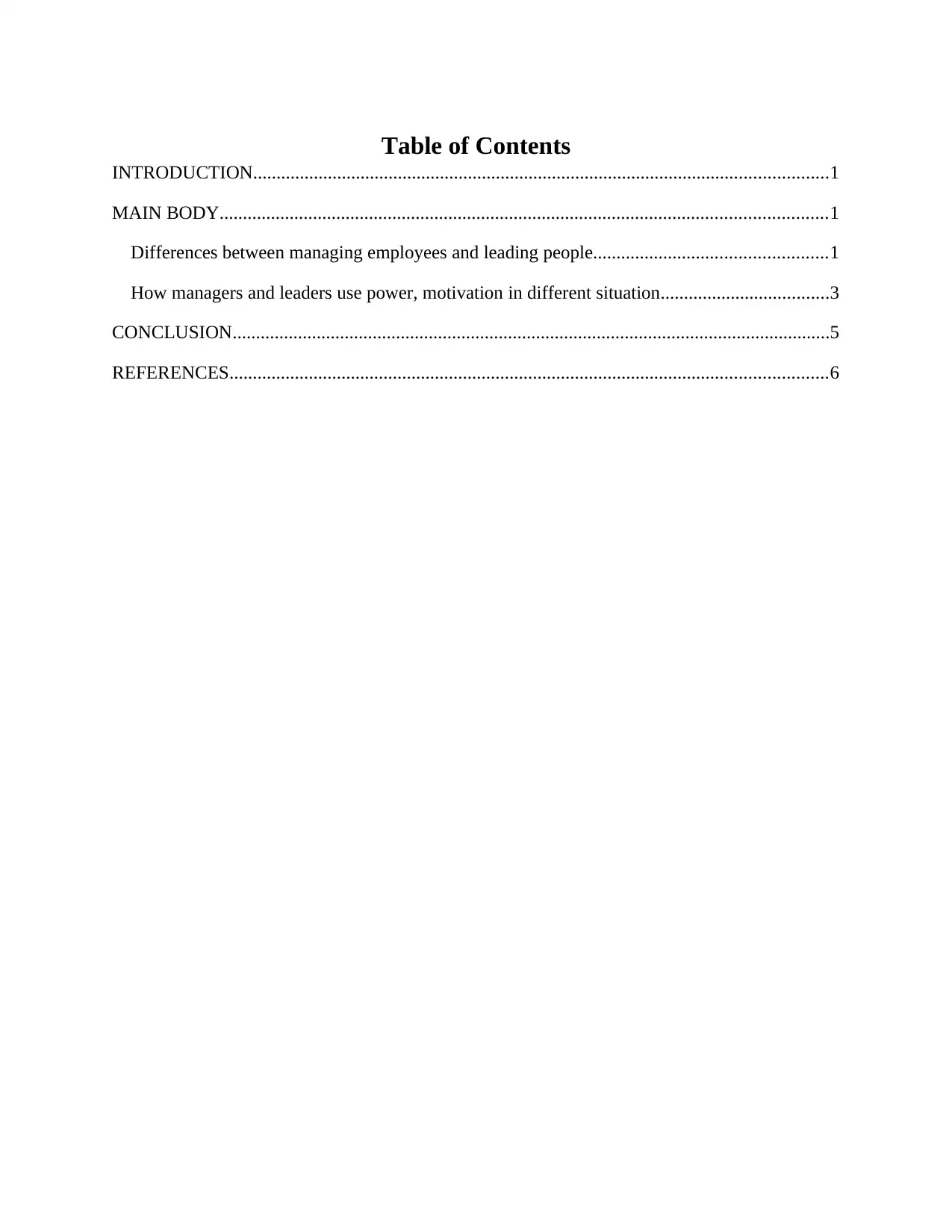
Table of Contents
INTRODUCTION...........................................................................................................................1
MAIN BODY..................................................................................................................................1
Differences between managing employees and leading people..................................................1
How managers and leaders use power, motivation in different situation....................................3
CONCLUSION................................................................................................................................5
REFERENCES................................................................................................................................6
INTRODUCTION...........................................................................................................................1
MAIN BODY..................................................................................................................................1
Differences between managing employees and leading people..................................................1
How managers and leaders use power, motivation in different situation....................................3
CONCLUSION................................................................................................................................5
REFERENCES................................................................................................................................6
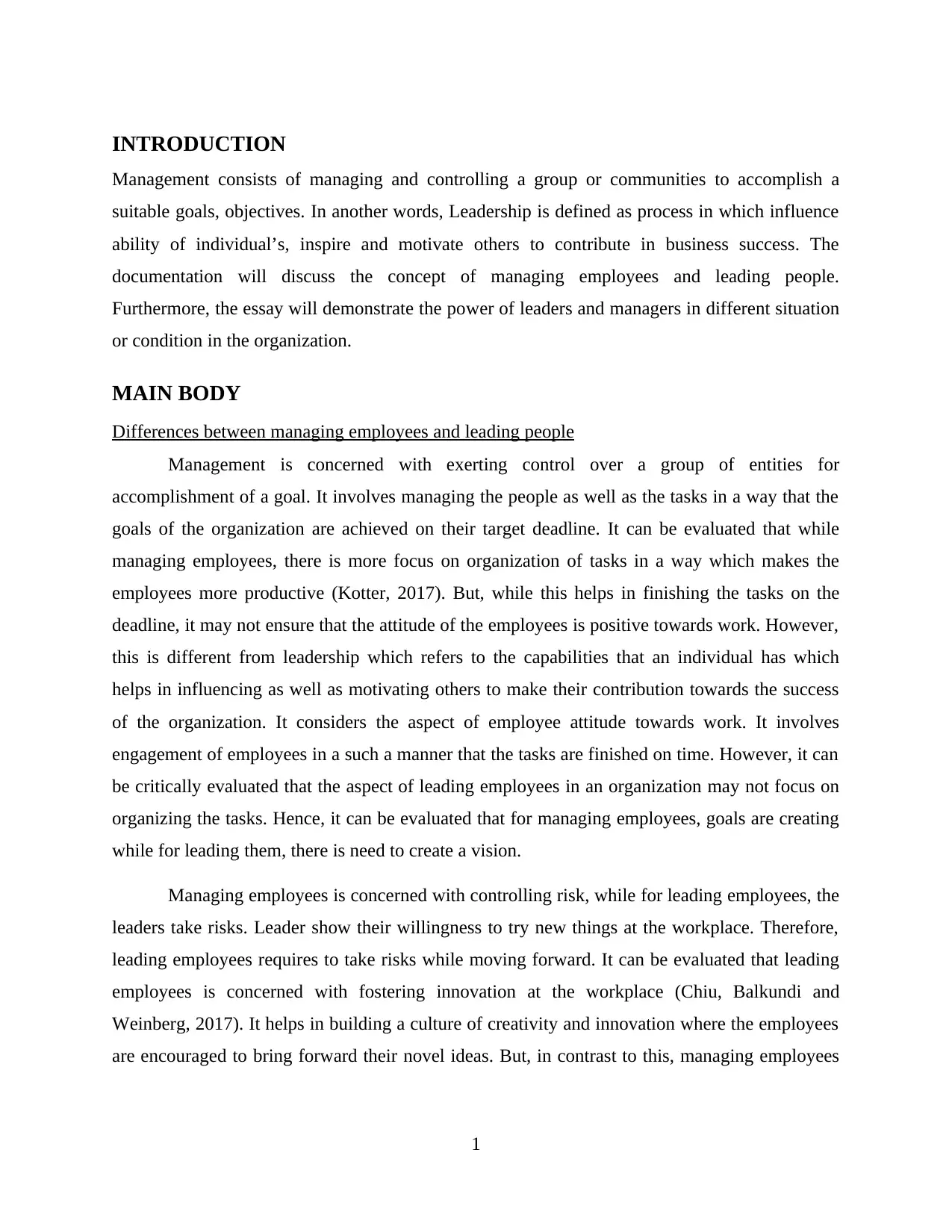
INTRODUCTION
Management consists of managing and controlling a group or communities to accomplish a
suitable goals, objectives. In another words, Leadership is defined as process in which influence
ability of individual’s, inspire and motivate others to contribute in business success. The
documentation will discuss the concept of managing employees and leading people.
Furthermore, the essay will demonstrate the power of leaders and managers in different situation
or condition in the organization.
MAIN BODY
Differences between managing employees and leading people
Management is concerned with exerting control over a group of entities for
accomplishment of a goal. It involves managing the people as well as the tasks in a way that the
goals of the organization are achieved on their target deadline. It can be evaluated that while
managing employees, there is more focus on organization of tasks in a way which makes the
employees more productive (Kotter, 2017). But, while this helps in finishing the tasks on the
deadline, it may not ensure that the attitude of the employees is positive towards work. However,
this is different from leadership which refers to the capabilities that an individual has which
helps in influencing as well as motivating others to make their contribution towards the success
of the organization. It considers the aspect of employee attitude towards work. It involves
engagement of employees in a such a manner that the tasks are finished on time. However, it can
be critically evaluated that the aspect of leading employees in an organization may not focus on
organizing the tasks. Hence, it can be evaluated that for managing employees, goals are creating
while for leading them, there is need to create a vision.
Managing employees is concerned with controlling risk, while for leading employees, the
leaders take risks. Leader show their willingness to try new things at the workplace. Therefore,
leading employees requires to take risks while moving forward. It can be evaluated that leading
employees is concerned with fostering innovation at the workplace (Chiu, Balkundi and
Weinberg, 2017). It helps in building a culture of creativity and innovation where the employees
are encouraged to bring forward their novel ideas. But, in contrast to this, managing employees
1
Management consists of managing and controlling a group or communities to accomplish a
suitable goals, objectives. In another words, Leadership is defined as process in which influence
ability of individual’s, inspire and motivate others to contribute in business success. The
documentation will discuss the concept of managing employees and leading people.
Furthermore, the essay will demonstrate the power of leaders and managers in different situation
or condition in the organization.
MAIN BODY
Differences between managing employees and leading people
Management is concerned with exerting control over a group of entities for
accomplishment of a goal. It involves managing the people as well as the tasks in a way that the
goals of the organization are achieved on their target deadline. It can be evaluated that while
managing employees, there is more focus on organization of tasks in a way which makes the
employees more productive (Kotter, 2017). But, while this helps in finishing the tasks on the
deadline, it may not ensure that the attitude of the employees is positive towards work. However,
this is different from leadership which refers to the capabilities that an individual has which
helps in influencing as well as motivating others to make their contribution towards the success
of the organization. It considers the aspect of employee attitude towards work. It involves
engagement of employees in a such a manner that the tasks are finished on time. However, it can
be critically evaluated that the aspect of leading employees in an organization may not focus on
organizing the tasks. Hence, it can be evaluated that for managing employees, goals are creating
while for leading them, there is need to create a vision.
Managing employees is concerned with controlling risk, while for leading employees, the
leaders take risks. Leader show their willingness to try new things at the workplace. Therefore,
leading employees requires to take risks while moving forward. It can be evaluated that leading
employees is concerned with fostering innovation at the workplace (Chiu, Balkundi and
Weinberg, 2017). It helps in building a culture of creativity and innovation where the employees
are encouraged to bring forward their novel ideas. But, in contrast to this, managing employees
1
⊘ This is a preview!⊘
Do you want full access?
Subscribe today to unlock all pages.

Trusted by 1+ million students worldwide
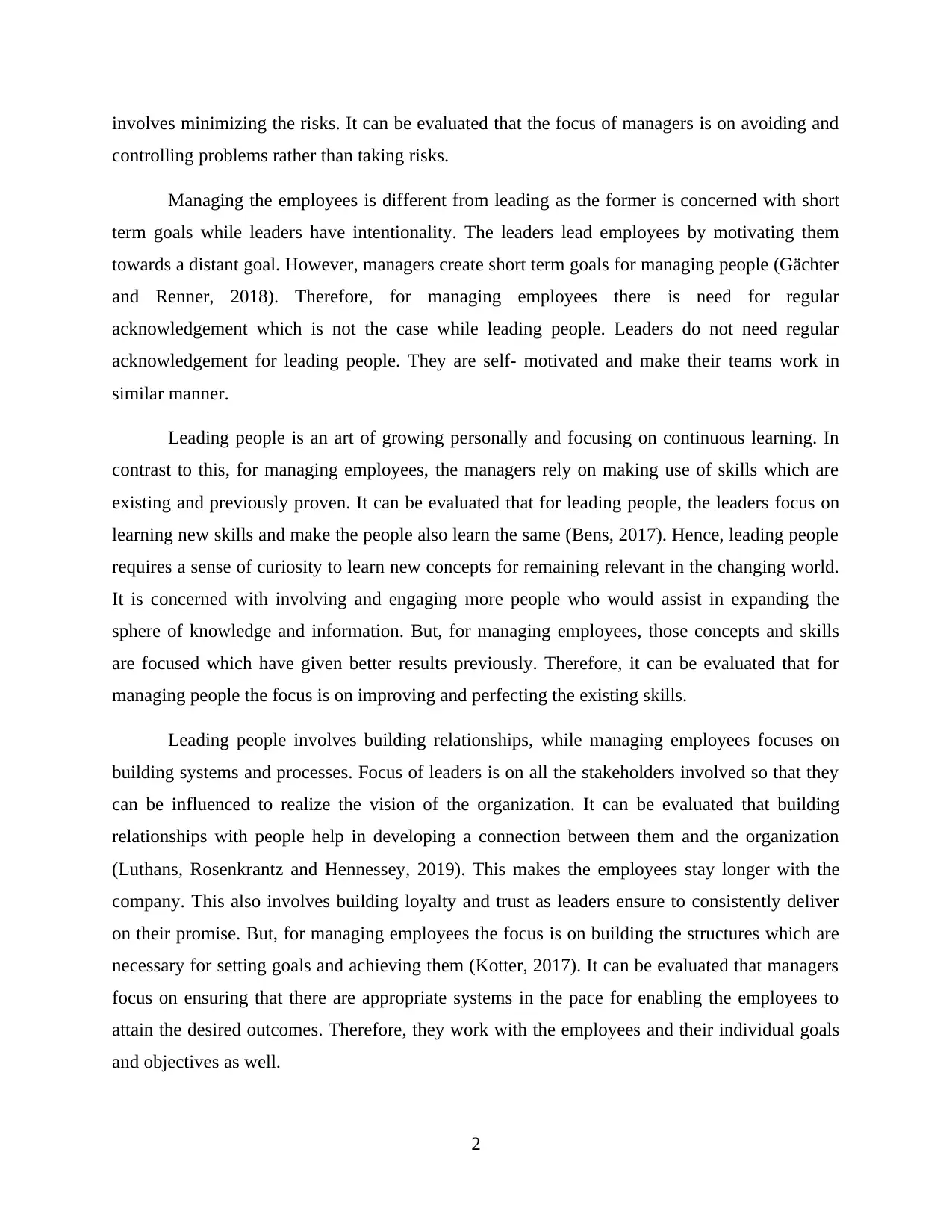
involves minimizing the risks. It can be evaluated that the focus of managers is on avoiding and
controlling problems rather than taking risks.
Managing the employees is different from leading as the former is concerned with short
term goals while leaders have intentionality. The leaders lead employees by motivating them
towards a distant goal. However, managers create short term goals for managing people (Gächter
and Renner, 2018). Therefore, for managing employees there is need for regular
acknowledgement which is not the case while leading people. Leaders do not need regular
acknowledgement for leading people. They are self- motivated and make their teams work in
similar manner.
Leading people is an art of growing personally and focusing on continuous learning. In
contrast to this, for managing employees, the managers rely on making use of skills which are
existing and previously proven. It can be evaluated that for leading people, the leaders focus on
learning new skills and make the people also learn the same (Bens, 2017). Hence, leading people
requires a sense of curiosity to learn new concepts for remaining relevant in the changing world.
It is concerned with involving and engaging more people who would assist in expanding the
sphere of knowledge and information. But, for managing employees, those concepts and skills
are focused which have given better results previously. Therefore, it can be evaluated that for
managing people the focus is on improving and perfecting the existing skills.
Leading people involves building relationships, while managing employees focuses on
building systems and processes. Focus of leaders is on all the stakeholders involved so that they
can be influenced to realize the vision of the organization. It can be evaluated that building
relationships with people help in developing a connection between them and the organization
(Luthans, Rosenkrantz and Hennessey, 2019). This makes the employees stay longer with the
company. This also involves building loyalty and trust as leaders ensure to consistently deliver
on their promise. But, for managing employees the focus is on building the structures which are
necessary for setting goals and achieving them (Kotter, 2017). It can be evaluated that managers
focus on ensuring that there are appropriate systems in the pace for enabling the employees to
attain the desired outcomes. Therefore, they work with the employees and their individual goals
and objectives as well.
2
controlling problems rather than taking risks.
Managing the employees is different from leading as the former is concerned with short
term goals while leaders have intentionality. The leaders lead employees by motivating them
towards a distant goal. However, managers create short term goals for managing people (Gächter
and Renner, 2018). Therefore, for managing employees there is need for regular
acknowledgement which is not the case while leading people. Leaders do not need regular
acknowledgement for leading people. They are self- motivated and make their teams work in
similar manner.
Leading people is an art of growing personally and focusing on continuous learning. In
contrast to this, for managing employees, the managers rely on making use of skills which are
existing and previously proven. It can be evaluated that for leading people, the leaders focus on
learning new skills and make the people also learn the same (Bens, 2017). Hence, leading people
requires a sense of curiosity to learn new concepts for remaining relevant in the changing world.
It is concerned with involving and engaging more people who would assist in expanding the
sphere of knowledge and information. But, for managing employees, those concepts and skills
are focused which have given better results previously. Therefore, it can be evaluated that for
managing people the focus is on improving and perfecting the existing skills.
Leading people involves building relationships, while managing employees focuses on
building systems and processes. Focus of leaders is on all the stakeholders involved so that they
can be influenced to realize the vision of the organization. It can be evaluated that building
relationships with people help in developing a connection between them and the organization
(Luthans, Rosenkrantz and Hennessey, 2019). This makes the employees stay longer with the
company. This also involves building loyalty and trust as leaders ensure to consistently deliver
on their promise. But, for managing employees the focus is on building the structures which are
necessary for setting goals and achieving them (Kotter, 2017). It can be evaluated that managers
focus on ensuring that there are appropriate systems in the pace for enabling the employees to
attain the desired outcomes. Therefore, they work with the employees and their individual goals
and objectives as well.
2
Paraphrase This Document
Need a fresh take? Get an instant paraphrase of this document with our AI Paraphraser
Leading people is concerned with coaching them while managing employees is
concerned with directing. It can be evaluated that while leading people, the leaders consider them
as competent enough. They depict their confidence in the people and are optimistic about their
potential (Oh, 2019). They adopt an approach where they do not tell the people about the tasks to
be done and the ways of doping them. Rather, they encourage the people to develop ways of
working and coach them during work. But, managers, while managing the employees, assign
tasks and focus on providing guidance to them for accomplishment.
How managers and leaders use power, motivation in different situation
Power, motivation is based on theory that is always inspired or motivate individuals to
handle critical situation in the organization. Manger and leaders express their desire for power in
different situation (Zohar, 2022). Sometimes, it may be drawn as great opportunity where
manager and leaders can establish a direct coordination with people in positive manner. For
example- business executive is playing an important role in the organization to estimate a
specific requirements such as resource allocation, budget handling. These kind of operational
activities are handled by manager or leaders (Su, Yang and Huang, 2022). But it can be possible
due to the position of power. Therefore, a great leader can use their power in business growth
and development. At the time of critical situation, it obvious thing that increase level of risks and
use prestige to inspire or motivate others.
Manager and leader in the workplace who are showing interest in building a strong power
through influence rather than goals achievement (Peng, Yang and Huan, 2022). This kind of
approach is the most effectively motivate or inspire other team members. In the workplace, team
members are mainly inspired with manager or leader because they were trying to find
achievement of manager, leaders.
The manager’s job seems to influence people and use their power in business
management processes. In the context of motivation, manager is expected to focus on the
improvement areas of team members and use their power to give instruction accordingly. But
there are some good qualities beside need for power and motivation (Santosa, 2022). To measure
the motivation of managers, it can be identified the opinion of individuals in different areas. For
example- In M&S, manager is participating a significant role in business planning workshop,
designed to improve their managerial effectiveness. With another example- manager of Tesco
3
concerned with directing. It can be evaluated that while leading people, the leaders consider them
as competent enough. They depict their confidence in the people and are optimistic about their
potential (Oh, 2019). They adopt an approach where they do not tell the people about the tasks to
be done and the ways of doping them. Rather, they encourage the people to develop ways of
working and coach them during work. But, managers, while managing the employees, assign
tasks and focus on providing guidance to them for accomplishment.
How managers and leaders use power, motivation in different situation
Power, motivation is based on theory that is always inspired or motivate individuals to
handle critical situation in the organization. Manger and leaders express their desire for power in
different situation (Zohar, 2022). Sometimes, it may be drawn as great opportunity where
manager and leaders can establish a direct coordination with people in positive manner. For
example- business executive is playing an important role in the organization to estimate a
specific requirements such as resource allocation, budget handling. These kind of operational
activities are handled by manager or leaders (Su, Yang and Huang, 2022). But it can be possible
due to the position of power. Therefore, a great leader can use their power in business growth
and development. At the time of critical situation, it obvious thing that increase level of risks and
use prestige to inspire or motivate others.
Manager and leader in the workplace who are showing interest in building a strong power
through influence rather than goals achievement (Peng, Yang and Huan, 2022). This kind of
approach is the most effectively motivate or inspire other team members. In the workplace, team
members are mainly inspired with manager or leader because they were trying to find
achievement of manager, leaders.
The manager’s job seems to influence people and use their power in business
management processes. In the context of motivation, manager is expected to focus on the
improvement areas of team members and use their power to give instruction accordingly. But
there are some good qualities beside need for power and motivation (Santosa, 2022). To measure
the motivation of managers, it can be identified the opinion of individuals in different areas. For
example- In M&S, manager is participating a significant role in business planning workshop,
designed to improve their managerial effectiveness. With another example- manager of Tesco
3
must focus on the need of power and motivation (Luthans, Rosenkrantz and Hennessey, 2019).
Sometimes, they are influencing team members to complete assign tasks within specific
deadline. Power without discipline holds by manager’s to agree on specific business decision.
During conflicts resolution, managers can be used their power to provide right direction
for their team members in the workplace. But the most important thing is to identifying high
moral ability of team members and then manager can use their power to motivate or inspire staff
members (Supriyono and Susmonowati, 2022). For example- In research, managers of M&S
focus on the product development, operations activities. At that time, it can be used their
motivation and power to improve the performance of staff members. In this way, it will be
achieved desirable goals and objectives.
Apart from that, it is focused on the power and motivation of leader’s in the workplace at
the time of different situations. In some cases, Leader will be used power and motivation
together, develop a strong leadership style in business operations (Luthans, Rosenkrantz and
Hennessey, 2019). For example- In M&S, leader have been identified unexpected error in
product development so that it is important to motivate team members towards task management.
In this case, leader can use their power to direct team member in terms of actionable tasks
(Moring, 2022). On the other hand, when it focuses on daily work activity, inclusive leader who
can establish a coordination with team members and motivate them. As per requirement, leader
motivate team member where they will be putting more efforts and complete product
development process. In the workplace, 70% of leaders are extremely engaged with employees,
who act as pressure from power. The performance of staff members comes from power of
leader’s.
The power rests in the ability and capability of manager and leaders to force staff
members regarding business situation management. The power of leader typically leads to the
long term and short term compliance. For example- companies are faced a lot of problems
regarding employee dissatisfaction with their job responsibilities (Henderikx and Stoffers, 2022).
In some cases, it may be increased a lack of commitment. So, it is important to resolve these kind
of complex situation in the organization. Afterward, the significantly use of leader’s power
influence staff members to follow a proper rules and regulations. In critical situation, leader can
4
Sometimes, they are influencing team members to complete assign tasks within specific
deadline. Power without discipline holds by manager’s to agree on specific business decision.
During conflicts resolution, managers can be used their power to provide right direction
for their team members in the workplace. But the most important thing is to identifying high
moral ability of team members and then manager can use their power to motivate or inspire staff
members (Supriyono and Susmonowati, 2022). For example- In research, managers of M&S
focus on the product development, operations activities. At that time, it can be used their
motivation and power to improve the performance of staff members. In this way, it will be
achieved desirable goals and objectives.
Apart from that, it is focused on the power and motivation of leader’s in the workplace at
the time of different situations. In some cases, Leader will be used power and motivation
together, develop a strong leadership style in business operations (Luthans, Rosenkrantz and
Hennessey, 2019). For example- In M&S, leader have been identified unexpected error in
product development so that it is important to motivate team members towards task management.
In this case, leader can use their power to direct team member in terms of actionable tasks
(Moring, 2022). On the other hand, when it focuses on daily work activity, inclusive leader who
can establish a coordination with team members and motivate them. As per requirement, leader
motivate team member where they will be putting more efforts and complete product
development process. In the workplace, 70% of leaders are extremely engaged with employees,
who act as pressure from power. The performance of staff members comes from power of
leader’s.
The power rests in the ability and capability of manager and leaders to force staff
members regarding business situation management. The power of leader typically leads to the
long term and short term compliance. For example- companies are faced a lot of problems
regarding employee dissatisfaction with their job responsibilities (Henderikx and Stoffers, 2022).
In some cases, it may be increased a lack of commitment. So, it is important to resolve these kind
of complex situation in the organization. Afterward, the significantly use of leader’s power
influence staff members to follow a proper rules and regulations. In critical situation, leader can
4
⊘ This is a preview!⊘
Do you want full access?
Subscribe today to unlock all pages.
Trusted by 1+ million students worldwide
be used legitimate power and develop belief among staff members that their manager have a
right to give order based on his position (Balasubramanian and Fernandes, 2022). According to
the needs of business, it is important to comply with instruction of manager and leader.
Therefore, it can easily handle position of business in the competitive marketplace.
By using traditional theories such as Hofstede, it has been expressed the significance of
power and motivation (Litton and Knight, 2022). In some cases, it can be defined the cultural
feel where leader and manager create a dynamic environment. A great leader can use their own
power in right direction and influence to build or balance strong coordination.
CONCLUSION
From above discussion, it has been identified the importance of Management and Leadership in
the business context. Analyzing the motivation and power of both manager, leader in the
organization. It can be analysed the process in which influence ability of individual’s, inspire and
motivate others to contribute in business success. It has been summarized the concept of
managing employee and leading people in the organization. Based on the discussion, it has been
identified the role of manager and leader in organization to implement suitable actions for
business growth or development.
5
right to give order based on his position (Balasubramanian and Fernandes, 2022). According to
the needs of business, it is important to comply with instruction of manager and leader.
Therefore, it can easily handle position of business in the competitive marketplace.
By using traditional theories such as Hofstede, it has been expressed the significance of
power and motivation (Litton and Knight, 2022). In some cases, it can be defined the cultural
feel where leader and manager create a dynamic environment. A great leader can use their own
power in right direction and influence to build or balance strong coordination.
CONCLUSION
From above discussion, it has been identified the importance of Management and Leadership in
the business context. Analyzing the motivation and power of both manager, leader in the
organization. It can be analysed the process in which influence ability of individual’s, inspire and
motivate others to contribute in business success. It has been summarized the concept of
managing employee and leading people in the organization. Based on the discussion, it has been
identified the role of manager and leader in organization to implement suitable actions for
business growth or development.
5
Paraphrase This Document
Need a fresh take? Get an instant paraphrase of this document with our AI Paraphraser
REFERENCES
Journals and Books
Balasubramanian, S. and Fernandes, C., 2022. Confirmation of a crisis leadership model and its
effectiveness: Lessons from the COVID-19 pandemic. Cogent Business & Management.
9(1). p.2022824.
Bens, I., 2017. Facilitating with Ease!: core skills for facilitators, team leaders and members,
managers, consultants, and trainers. John Wiley & Sons.
Chiu, C.Y.C., Balkundi, P. and Weinberg, F.J., 2017. When managers become leaders: The role
of manager network centralities, social power, and followers' perception of
leadership. The Leadership Quarterly. 28(2). pp.334-348.
Gächter, S. and Renner, E., 2018. Leaders as role models and ‘belief managers’ in social
dilemmas. Journal of Economic Behavior & Organization. 154. pp.321-334.
Henderikx, M. and Stoffers, J., 2022. An Exploratory Literature Study into Digital
Transformation and Leadership: Toward Future-Proof Middle
Managers. Sustainability. 14(2). p.687.
Kotter, J.P., 2017. What leaders really do. In Leadership perspectives (pp. 7-15). Routledge.
Litton, E. and Knight, R., 2022. The Risks of Leadership in Plutarch’s Coriolanus. SAGE
Publications: SAGE Business Cases Originals.
Luthans, F., Rosenkrantz, S.A. and Hennessey, H.W., 2019. What do successful managers really
do? An observation study of managerial activities. In Managerial Work (pp. 165-180).
Routledge.
Moring, A., 2022. Basic Principles of Motivation. In AI on The Job (pp. 49-65). Springer, Berlin,
Heidelberg.
Oh, S.Y., 2019. Effects of organizational learning on performance: the moderating roles of trust
in leaders and organizational justice. Journal of Knowledge Management.
Peng, J., Yang, X. and Huan, T.C., 2022. The effects of empowering leadership on employee
adaptiveness in luxury hotel services: Evidence from a mixed-methods
research. International Journal of Hospitality Management. 101. p.103113.
Santosa, A.M., 2022. Character Based Leadership In Higher Quality Improvement. International
Journal of Education, Information Technology, and Others. 5(1). pp.26-31.
6
Journals and Books
Balasubramanian, S. and Fernandes, C., 2022. Confirmation of a crisis leadership model and its
effectiveness: Lessons from the COVID-19 pandemic. Cogent Business & Management.
9(1). p.2022824.
Bens, I., 2017. Facilitating with Ease!: core skills for facilitators, team leaders and members,
managers, consultants, and trainers. John Wiley & Sons.
Chiu, C.Y.C., Balkundi, P. and Weinberg, F.J., 2017. When managers become leaders: The role
of manager network centralities, social power, and followers' perception of
leadership. The Leadership Quarterly. 28(2). pp.334-348.
Gächter, S. and Renner, E., 2018. Leaders as role models and ‘belief managers’ in social
dilemmas. Journal of Economic Behavior & Organization. 154. pp.321-334.
Henderikx, M. and Stoffers, J., 2022. An Exploratory Literature Study into Digital
Transformation and Leadership: Toward Future-Proof Middle
Managers. Sustainability. 14(2). p.687.
Kotter, J.P., 2017. What leaders really do. In Leadership perspectives (pp. 7-15). Routledge.
Litton, E. and Knight, R., 2022. The Risks of Leadership in Plutarch’s Coriolanus. SAGE
Publications: SAGE Business Cases Originals.
Luthans, F., Rosenkrantz, S.A. and Hennessey, H.W., 2019. What do successful managers really
do? An observation study of managerial activities. In Managerial Work (pp. 165-180).
Routledge.
Moring, A., 2022. Basic Principles of Motivation. In AI on The Job (pp. 49-65). Springer, Berlin,
Heidelberg.
Oh, S.Y., 2019. Effects of organizational learning on performance: the moderating roles of trust
in leaders and organizational justice. Journal of Knowledge Management.
Peng, J., Yang, X. and Huan, T.C., 2022. The effects of empowering leadership on employee
adaptiveness in luxury hotel services: Evidence from a mixed-methods
research. International Journal of Hospitality Management. 101. p.103113.
Santosa, A.M., 2022. Character Based Leadership In Higher Quality Improvement. International
Journal of Education, Information Technology, and Others. 5(1). pp.26-31.
6
Su, L., Yang, X. and Huang, Y., 2022. How do tourism goal disclosure motivations drive
Chinese tourists' goal-directed behaviors? The influences of feedback valence, affective
rumination, and emotional engagement. Tourism Management. 90. p.104483.
Supriyono, S. and Susmonowati, T., 2022. The Role of Extrinsic and Intrinsic Motivation to
Maintain Employee Performance Productivity During Work From Home (WFH): A Case
Study of a Private University in Jakarta. Technium Social Sciences Journal. 27. pp.606-
619.
Zohar, D., 2022. A Leader of Leaders. In Zero Distance (pp. 127-135). Palgrave Macmillan,
Singapore.
7
Chinese tourists' goal-directed behaviors? The influences of feedback valence, affective
rumination, and emotional engagement. Tourism Management. 90. p.104483.
Supriyono, S. and Susmonowati, T., 2022. The Role of Extrinsic and Intrinsic Motivation to
Maintain Employee Performance Productivity During Work From Home (WFH): A Case
Study of a Private University in Jakarta. Technium Social Sciences Journal. 27. pp.606-
619.
Zohar, D., 2022. A Leader of Leaders. In Zero Distance (pp. 127-135). Palgrave Macmillan,
Singapore.
7
⊘ This is a preview!⊘
Do you want full access?
Subscribe today to unlock all pages.
Trusted by 1+ million students worldwide

1 out of 9


Related Documents


Your All-in-One AI-Powered Toolkit for Academic Success.
+13062052269
info@desklib.com
Available 24*7 on WhatsApp / Email
![[object Object]](/_next/static/media/star-bottom.7253800d.svg)
Unlock your academic potential
Copyright © 2020–2026 A2Z Services. All Rights Reserved. Developed and managed by ZUCOL.