MGMT1101: Leadership Management Profile Assignment and Analysis Report

Verified

Added on  2022/08/15

|10
|2230
|15
Report
AI Summary
This report analyzes various leadership theories, including trait, situational, transformational, and servant leadership, to connect theory with practical application. The assignment begins with an exploration of the trait theory, identifying personal strengths such as leadership motivation and knowledge of business, and areas for improvement like emotional maturity. It then delves into situational, transformational, and servant leadership styles, highlighting the benefits of transformational leadership. The report further examines the concept of leader power, using examples of Obama and Trump. A leadership scenario is presented, exploring different leadership styles for various employee situations. The report concludes with a personal leadership and management profile, reflecting on the student's leadership skills, areas for development, and the importance of communication. The student acknowledges the value of communication in leadership and the need for adaptability. The report includes references to support the analysis.
Document Page
Running Head: LEADERSHIP MANAGEMENT
0
LEADERSHIP MANAGEMENT
System04121
2/7/2020
tabler-icon-diamond-filled.svg

Paraphrase This Document

Need a fresh take? Get an instant paraphrase of this document with our AI Paraphraser
Document Page
LEADERSHIP MANAGEMENT
1
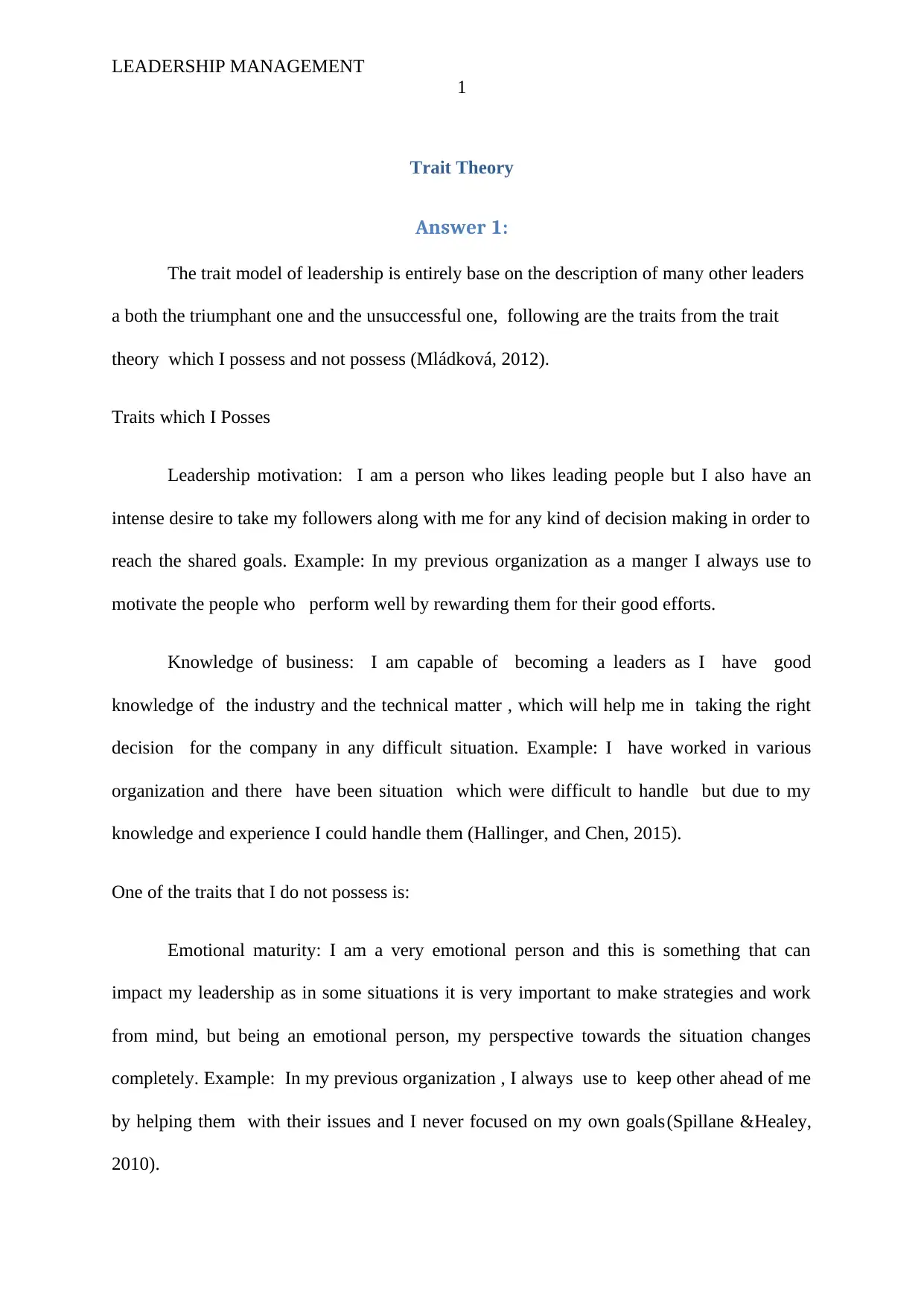
Trait Theory
Answer 1:
The trait model of leadership is entirely base on the description of many other leaders
a both the triumphant one and the unsuccessful one, following are the traits from the trait
theory which I possess and not possess (Mládková, 2012).
Traits which I Posses
Leadership motivation: I am a person who likes leading people but I also have an
intense desire to take my followers along with me for any kind of decision making in order to
reach the shared goals. Example: In my previous organization as a manger I always use to
motivate the people who perform well by rewarding them for their good efforts.
Knowledge of business: I am capable of becoming a leaders as I have good
knowledge of the industry and the technical matter , which will help me in taking the right
decision for the company in any difficult situation. Example: I have worked in various
organization and there have been situation which were difficult to handle but due to my
knowledge and experience I could handle them (Hallinger, and Chen, 2015).
One of the traits that I do not possess is:
Emotional maturity: I am a very emotional person and this is something that can
impact my leadership as in some situations it is very important to make strategies and work
from mind, but being an emotional person, my perspective towards the situation changes
completely. Example: In my previous organization , I always use to keep other ahead of me
by helping them with their issues and I never focused on my own goals(Spillane &Healey,
2010).
Document Page
LEADERSHIP MANAGEMENT
2
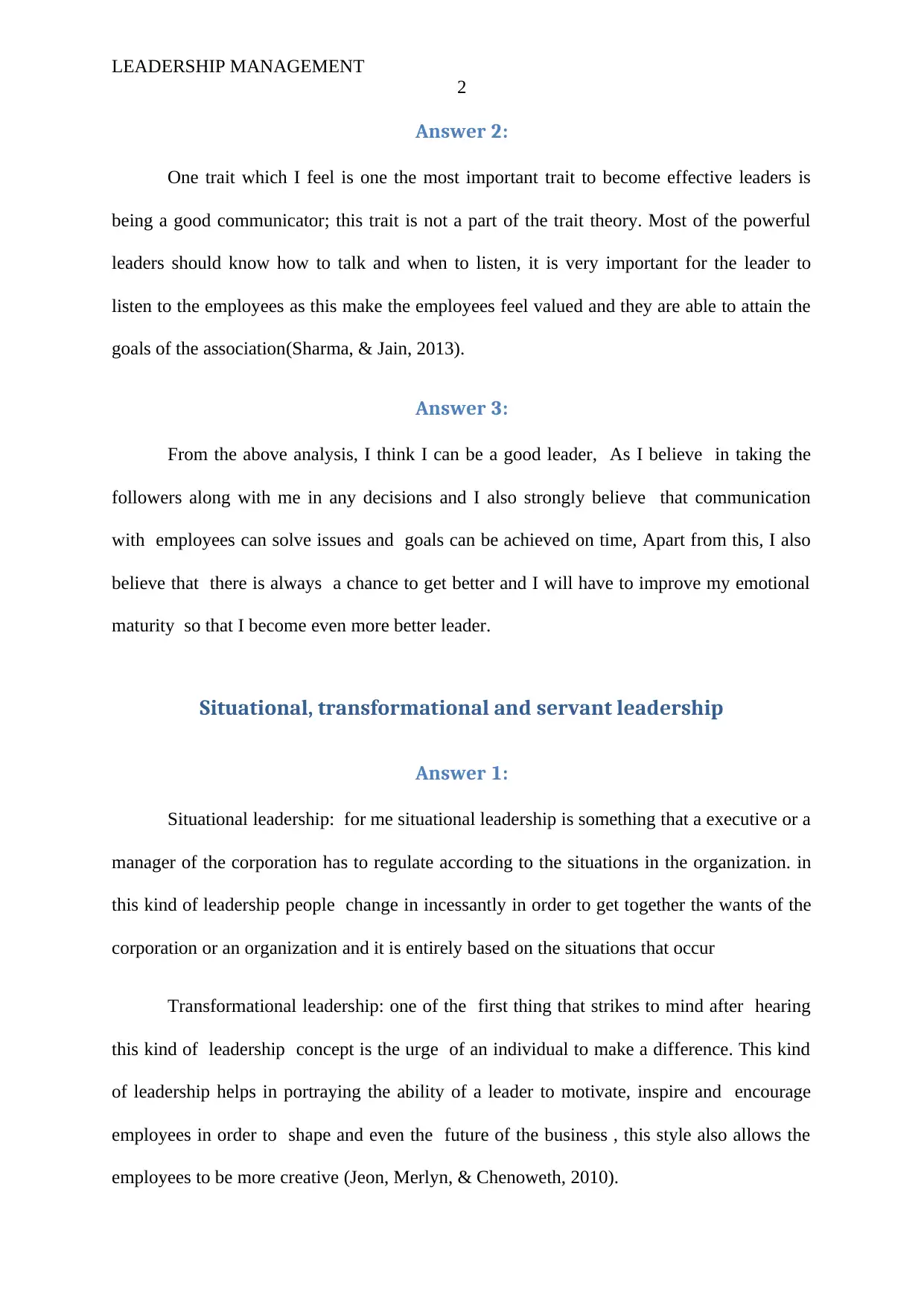
Answer 2:
One trait which I feel is one the most important trait to become effective leaders is
being a good communicator; this trait is not a part of the trait theory. Most of the powerful
leaders should know how to talk and when to listen, it is very important for the leader to
listen to the employees as this make the employees feel valued and they are able to attain the
goals of the association(Sharma, & Jain, 2013).
Answer 3:
From the above analysis, I think I can be a good leader, As I believe in taking the
followers along with me in any decisions and I also strongly believe that communication
with employees can solve issues and goals can be achieved on time, Apart from this, I also
believe that there is always a chance to get better and I will have to improve my emotional
maturity so that I become even more better leader.
Situational, transformational and servant leadership
Answer 1:
Situational leadership: for me situational leadership is something that a executive or a
manager of the corporation has to regulate according to the situations in the organization. in
this kind of leadership people change in incessantly in order to get together the wants of the
corporation or an organization and it is entirely based on the situations that occur
Transformational leadership: one of the first thing that strikes to mind after hearing
this kind of leadership concept is the urge of an individual to make a difference. This kind
of leadership helps in portraying the ability of a leader to motivate, inspire and encourage
employees in order to shape and even the future of the business , this style also allows the
employees to be more creative (Jeon, Merlyn, & Chenoweth, 2010).
Document Page
LEADERSHIP MANAGEMENT
3
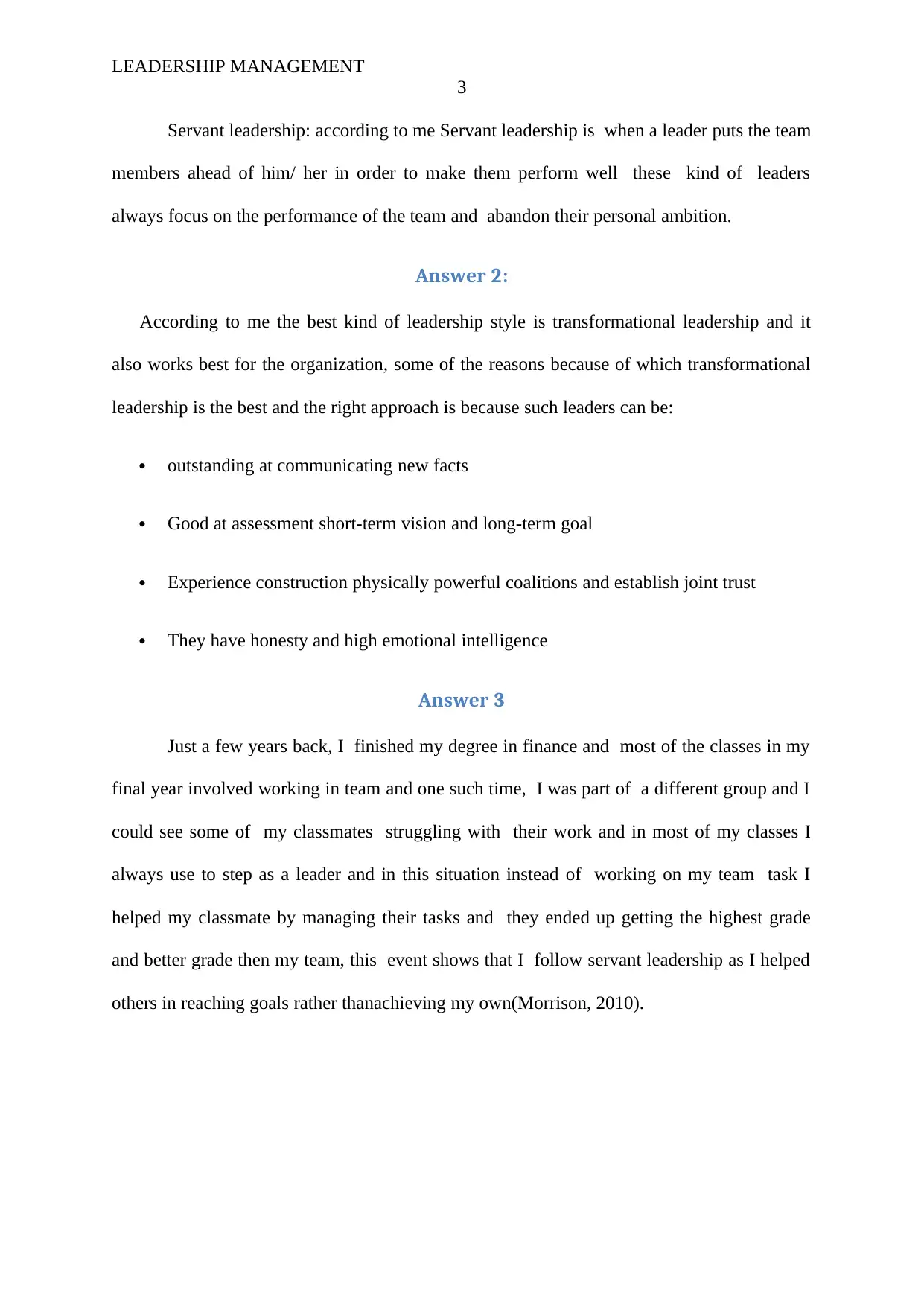
Servant leadership: according to me Servant leadership is when a leader puts the team
members ahead of him/ her in order to make them perform well these kind of leaders
always focus on the performance of the team and abandon their personal ambition.
Answer 2:
According to me the best kind of leadership style is transformational leadership and it
also works best for the organization, some of the reasons because of which transformational
leadership is the best and the right approach is because such leaders can be:
outstanding at communicating new facts
Good at assessment short-term vision and long-term goal
Experience construction physically powerful coalitions and establish joint trust
They have honesty and high emotional intelligence
Answer 3
Just a few years back, I finished my degree in finance and most of the classes in my
final year involved working in team and one such time, I was part of a different group and I
could see some of my classmates struggling with their work and in most of my classes I
always use to step as a leader and in this situation instead of working on my team task I
helped my classmate by managing their tasks and they ended up getting the highest grade
and better grade then my team, this event shows that I follow servant leadership as I helped
others in reaching goals rather thanachieving my own(Morrison, 2010).
tabler-icon-diamond-filled.svg

Paraphrase This Document

Need a fresh take? Get an instant paraphrase of this document with our AI Paraphraser
Document Page
LEADERSHIP MANAGEMENT
4
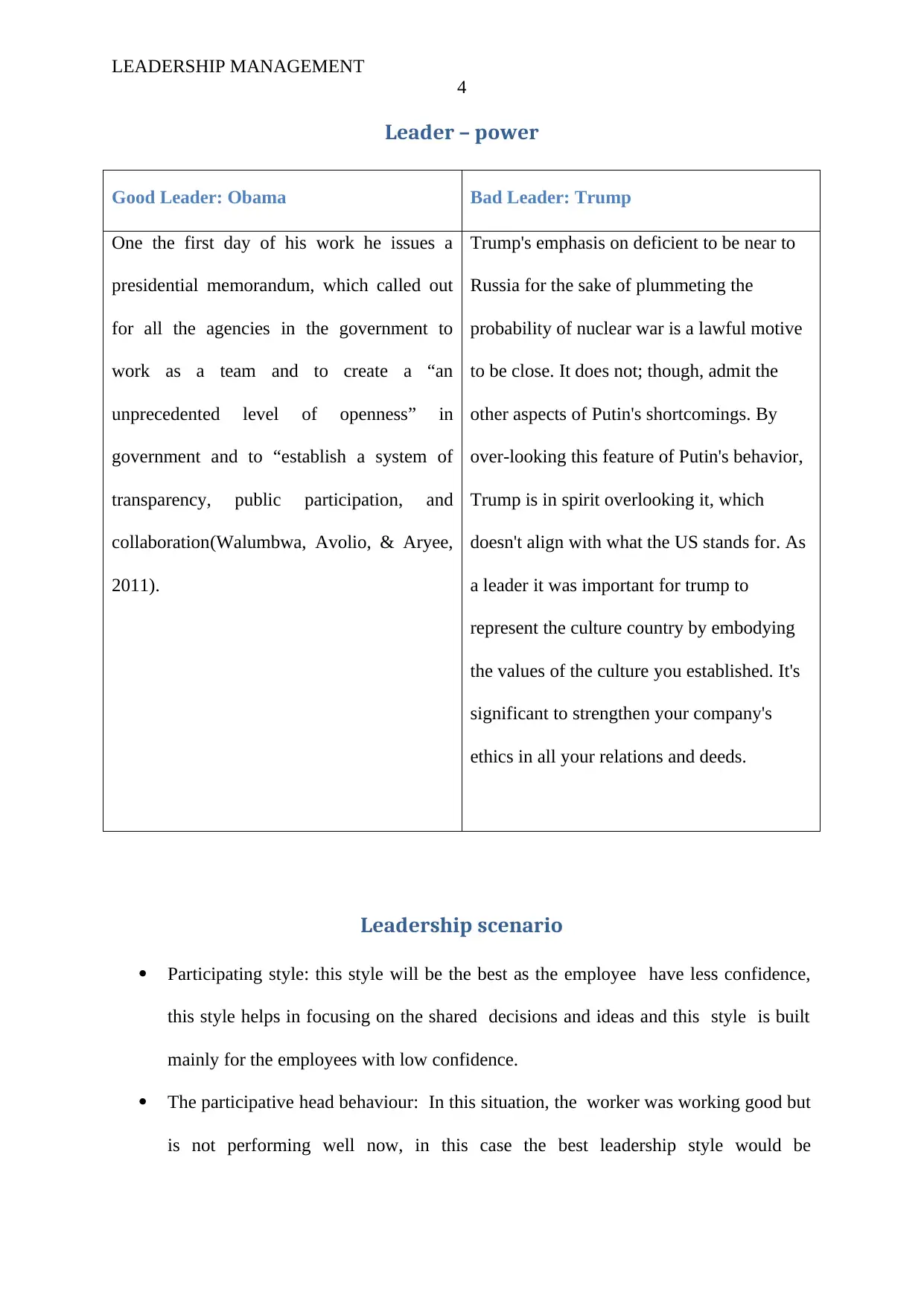
Leader – power
Good Leader: Obama Bad Leader: Trump
One the first day of his work he issues a
presidential memorandum, which called out
for all the agencies in the government to
work as a team and to create a “an
unprecedented level of openness” in
government and to “establish a system of
transparency, public participation, and
collaboration(Walumbwa, Avolio, & Aryee,
2011).
Trump's emphasis on deficient to be near to
Russia for the sake of plummeting the
probability of nuclear war is a lawful motive
to be close. It does not; though, admit the
other aspects of Putin's shortcomings. By
over-looking this feature of Putin's behavior,
Trump is in spirit overlooking it, which
doesn't align with what the US stands for. As
a leader it was important for trump to
represent the culture country by embodying
the values of the culture you established. It's
significant to strengthen your company's
ethics in all your relations and deeds.
Leadership scenario
Participating style: this style will be the best as the employee have less confidence,
this style helps in focusing on the shared decisions and ideas and this style is built
mainly for the employees with low confidence.
The participative head behaviour: In this situation, the worker was working good but
is not performing well now, in this case the best leadership style would be
Document Page
LEADERSHIP MANAGEMENT
5
The participative leader behaviour, which involve consulting with the employees and
also asking for some of the suggestion before taking any kind of decision
The supportive leader behaviour: Under this case the workers are unsatisfied by the
reward system of the corporation and for this the best style of leadership will be
The supportive leader behavior as the leader should show more focus towards the
needs and wants of the employees and
Telling style which: This case is same as the 3rdcase but under this the best style
would be the Telling style which refers a high-task, low-relationship style
wherein the leader gives explicit instructions and oversees work carefully. This style
is geared toward low maturity followers.
Under this situation, the employees have low morale and the best leadership
style would be The achievement-oriented leader behavior which refers to situation
where the head sets stimulating goals for workers, expects them to carry out at their
highest level, and shows self-assurance in their capability to encounter this
anticipation(Hallinger, & Bryant, 2013).
Personal leadership and management profile
Answer 1
According to the above analysis, it can be seen that I am very decent when it comes
to working in a team as my skills of leadership, personal capabilities of managing and my
high level of confidence helps me in working in s team. I mainly possess in 2 traits which
are motivation and knowledge which can help me in becoming a good leaders, these 2 traits
have also helped me to improve my abilities and comprehend my leadership and has also
reinforced my characteristics to a higher level. I have also learned that I need to work on
myself mainly on my low emotional intelligence. In the above assignment, I have discussed
Document Page
LEADERSHIP MANAGEMENT
6
various events which I faced in my workplace, I have also learned that I use servant
leadership and I learned this through various events of my life as I have also erudite that
knowing about leadership assistances a being to examinenumerous situation form a different
viewpoint and learn how to develop more effective by exploring management in both society
and business.From the above analysis, I think I can be a good leader, As I believe in taking
the followers along with me in any decisions and I also strongly believe that communication
with employees can solve issues and goals can be achieved on time, Apart from this, I also
believe that there is always a chance to get better and I will have to improve my emotional
maturity so that I become even more better leader(Amanchukwu, Stanley, J., & Ololube,
2015).
Answer 2:
According to my current views, communication is one of the most important thing for
me as a leaders and I believe that it is very important to communicate with the employees to
make them feel good and valued in an organization, I do believe that communication can be
one of the best chance to solve all the issues and to encourage and motivate to create an
environment in which the people woke and it mainly comes by building trust, however there
is also a major challenge in this as communication does not solve the issues every time.
Sure, communication can solve matters but not the whole thing. People need to be
devoted in the solution. That means he or she must to be eager to be susceptible and connect
openly and honestly about their insight of what is going on. If one of the additional is not
willing to be honest, then a answer may not be conceivable. There are numerous reasons
people choose not to be vulnerable so it is not about arbitrating them, but understanding that
they are, for whatever reason, unable to communicate honestly. Thus the leaders should come
tabler-icon-diamond-filled.svg

Paraphrase This Document

Need a fresh take? Get an instant paraphrase of this document with our AI Paraphraser
Document Page
LEADERSHIP MANAGEMENT
7
up with various different strategies to know the issues of the employees some of the
example are, building a training workshop for them and analysing their behaviour.
Document Page
LEADERSHIP MANAGEMENT
8
References
Amanchukwu, R. N., Stanley, G. J., & Ololube, N. P. (2015). A review of leadership theories,
principles and styles and their relevance to educational
management. Management, 5(1), 6-14.
Hallinger, P. and Chen, J., 2015. Review of research on educational leadership and
management in Asia: A comparative analysis of research topics and methods, 1995–
2012. Educational management administration & leadership, 43(1), pp.5-27.
Hallinger, P., & Bryant, D. (2013). Mapping the terrain of educational leadership and
management in East Asia. Journal of Educational Administration.
Hechanova, R. M., & Cementina-Olpoc, R. (2013). Transformational leadership, change
management, and commitment to change: A comparison of academic and business
organizations. The Asia-Pacific Education Researcher, 22(1), 11-19.
Jeon, Y. H., Merlyn, T., & Chenoweth, L. (2010). Leadership and management in the aged
care sector: a narrative synthesis. Australasian journal on ageing, 29(2), 54-60.
Mládková, L. (2012). Leadership in management of knowledge workers. Procedia-Social and
Behavioral Sciences, 41, 243-250.
Morrison, K. (2010). Complexity theory, school leadership and management: Questions for
theory and practice. Educational Management Administration & Leadership, 38(3),
374-393.
Sharma, M. K., & Jain, S. (2013). Leadership management: Principles, models and
theories. Global Journal of Management and Business Studies, 3(3), 309-318.
Document Page
LEADERSHIP MANAGEMENT
9
Spillane, J. P., & Healey, K. (2010). Conceptualizing school leadership and management
from a distributed perspective: An exploration of some study operations and
measures. The elementary school journal, 111(2), 253-281.
Walumbwa, F. O., Avolio, B. J., & Aryee, S. (2011). Leadership and management research in
Africa: A synthesis and suggestions for future research. Journal of Occupational and
Organizational Psychology, 84(3), 425-439.
chevron_up_icon
1 out of 10
circle_padding
hide_on_mobile
zoom_out_icon
[object Object]