Leadership and Management for Service Industries: Report and Analysis
VerifiedAdded on 2021/02/21
|11
|2237
|461
Report
AI Summary
This report delves into leadership and management principles within the service industry, using Wa-pila Hotels as a case study. It begins by outlining different management theories, including administrative and scientific theories, and contrasts the roles of leaders and managers, exploring various leadership styles such as autocratic, democratic, and laissez-faire. The report then reviews management styles like Herzberg's Two-Factor Theory and Maslow's Hierarchy of Needs, evaluating their pros and cons. It analyzes factors influencing management styles and structures, both internal (organizational structure, business demand, financial structure) and external (customers, stakeholders, government). Hard and soft skills essential for managers are identified, along with future skills required in the service industry, such as diverse team and technology management. Finally, it compares leadership styles (transformational, democratic, transactional) for change management within the organization, providing a comprehensive overview of effective leadership and management practices in the service sector.
Leadership and Management for
Service Industries
Service Industries

Paraphrase This Document
Need a fresh take? Get an instant paraphrase of this document with our AI Paraphraser
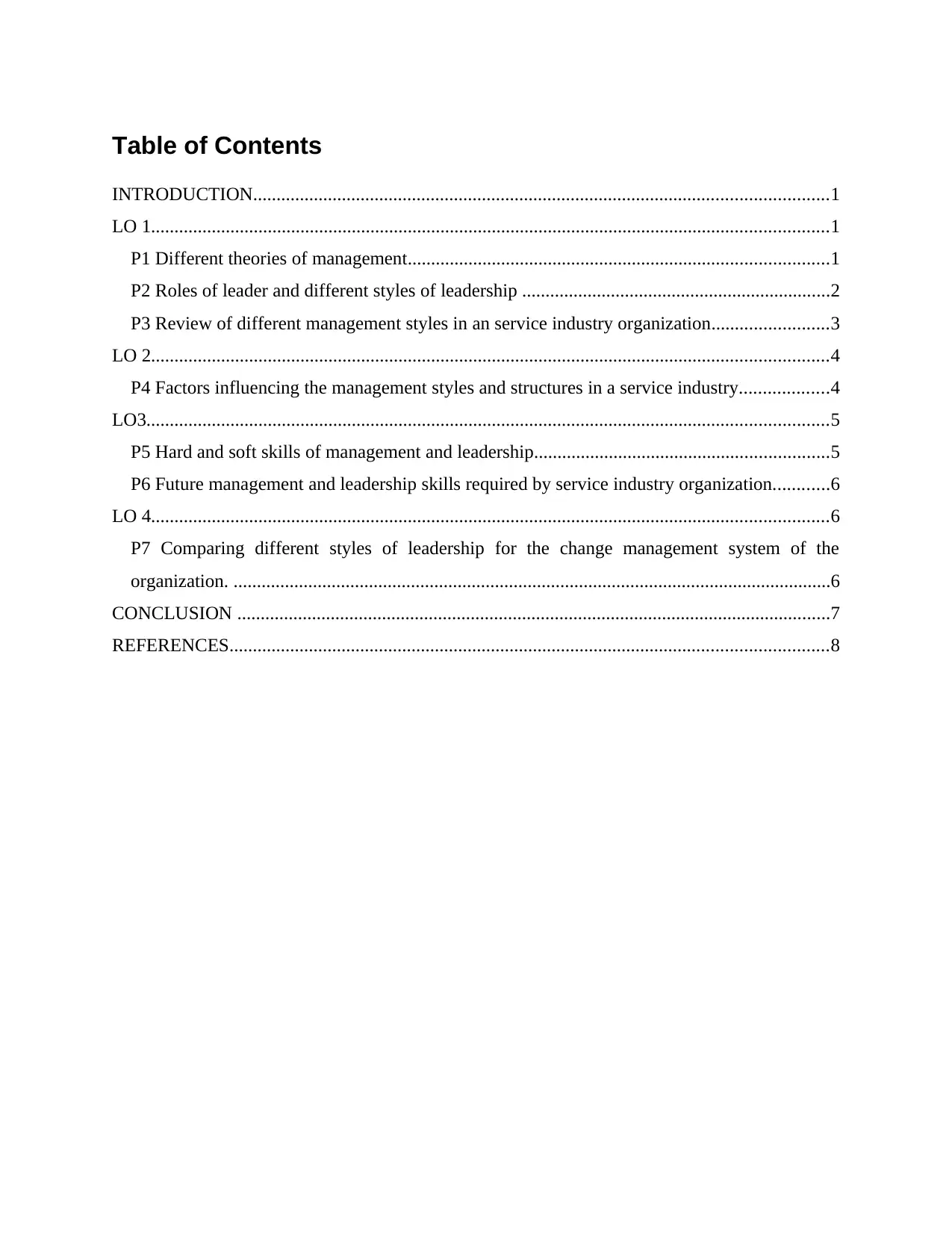
Table of Contents
INTRODUCTION...........................................................................................................................1
LO 1.................................................................................................................................................1
P1 Different theories of management..........................................................................................1
P2 Roles of leader and different styles of leadership ..................................................................2
P3 Review of different management styles in an service industry organization.........................3
LO 2.................................................................................................................................................4
P4 Factors influencing the management styles and structures in a service industry...................4
LO3..................................................................................................................................................5
P5 Hard and soft skills of management and leadership...............................................................5
P6 Future management and leadership skills required by service industry organization............6
LO 4.................................................................................................................................................6
P7 Comparing different styles of leadership for the change management system of the
organization. ................................................................................................................................6
CONCLUSION ...............................................................................................................................7
REFERENCES................................................................................................................................8
INTRODUCTION...........................................................................................................................1
LO 1.................................................................................................................................................1
P1 Different theories of management..........................................................................................1
P2 Roles of leader and different styles of leadership ..................................................................2
P3 Review of different management styles in an service industry organization.........................3
LO 2.................................................................................................................................................4
P4 Factors influencing the management styles and structures in a service industry...................4
LO3..................................................................................................................................................5
P5 Hard and soft skills of management and leadership...............................................................5
P6 Future management and leadership skills required by service industry organization............6
LO 4.................................................................................................................................................6
P7 Comparing different styles of leadership for the change management system of the
organization. ................................................................................................................................6
CONCLUSION ...............................................................................................................................7
REFERENCES................................................................................................................................8
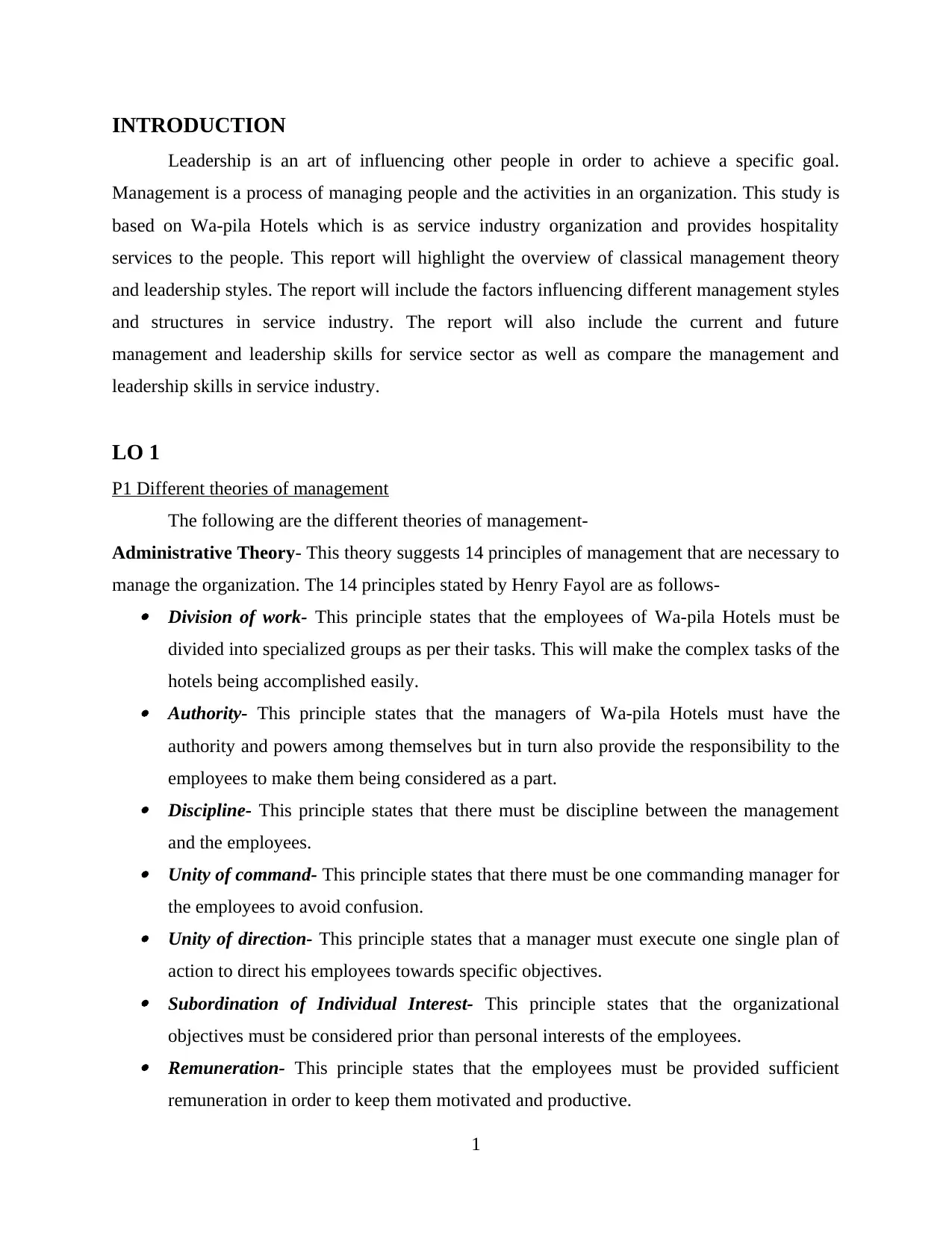
INTRODUCTION
Leadership is an art of influencing other people in order to achieve a specific goal.
Management is a process of managing people and the activities in an organization. This study is
based on Wa-pila Hotels which is as service industry organization and provides hospitality
services to the people. This report will highlight the overview of classical management theory
and leadership styles. The report will include the factors influencing different management styles
and structures in service industry. The report will also include the current and future
management and leadership skills for service sector as well as compare the management and
leadership skills in service industry.
LO 1
P1 Different theories of management
The following are the different theories of management-
Administrative Theory- This theory suggests 14 principles of management that are necessary to
manage the organization. The 14 principles stated by Henry Fayol are as follows- Division of work- This principle states that the employees of Wa-pila Hotels must be
divided into specialized groups as per their tasks. This will make the complex tasks of the
hotels being accomplished easily. Authority- This principle states that the managers of Wa-pila Hotels must have the
authority and powers among themselves but in turn also provide the responsibility to the
employees to make them being considered as a part. Discipline- This principle states that there must be discipline between the management
and the employees. Unity of command- This principle states that there must be one commanding manager for
the employees to avoid confusion. Unity of direction- This principle states that a manager must execute one single plan of
action to direct his employees towards specific objectives. Subordination of Individual Interest- This principle states that the organizational
objectives must be considered prior than personal interests of the employees. Remuneration- This principle states that the employees must be provided sufficient
remuneration in order to keep them motivated and productive.
1
Leadership is an art of influencing other people in order to achieve a specific goal.
Management is a process of managing people and the activities in an organization. This study is
based on Wa-pila Hotels which is as service industry organization and provides hospitality
services to the people. This report will highlight the overview of classical management theory
and leadership styles. The report will include the factors influencing different management styles
and structures in service industry. The report will also include the current and future
management and leadership skills for service sector as well as compare the management and
leadership skills in service industry.
LO 1
P1 Different theories of management
The following are the different theories of management-
Administrative Theory- This theory suggests 14 principles of management that are necessary to
manage the organization. The 14 principles stated by Henry Fayol are as follows- Division of work- This principle states that the employees of Wa-pila Hotels must be
divided into specialized groups as per their tasks. This will make the complex tasks of the
hotels being accomplished easily. Authority- This principle states that the managers of Wa-pila Hotels must have the
authority and powers among themselves but in turn also provide the responsibility to the
employees to make them being considered as a part. Discipline- This principle states that there must be discipline between the management
and the employees. Unity of command- This principle states that there must be one commanding manager for
the employees to avoid confusion. Unity of direction- This principle states that a manager must execute one single plan of
action to direct his employees towards specific objectives. Subordination of Individual Interest- This principle states that the organizational
objectives must be considered prior than personal interests of the employees. Remuneration- This principle states that the employees must be provided sufficient
remuneration in order to keep them motivated and productive.
1
⊘ This is a preview!⊘
Do you want full access?
Subscribe today to unlock all pages.

Trusted by 1+ million students worldwide
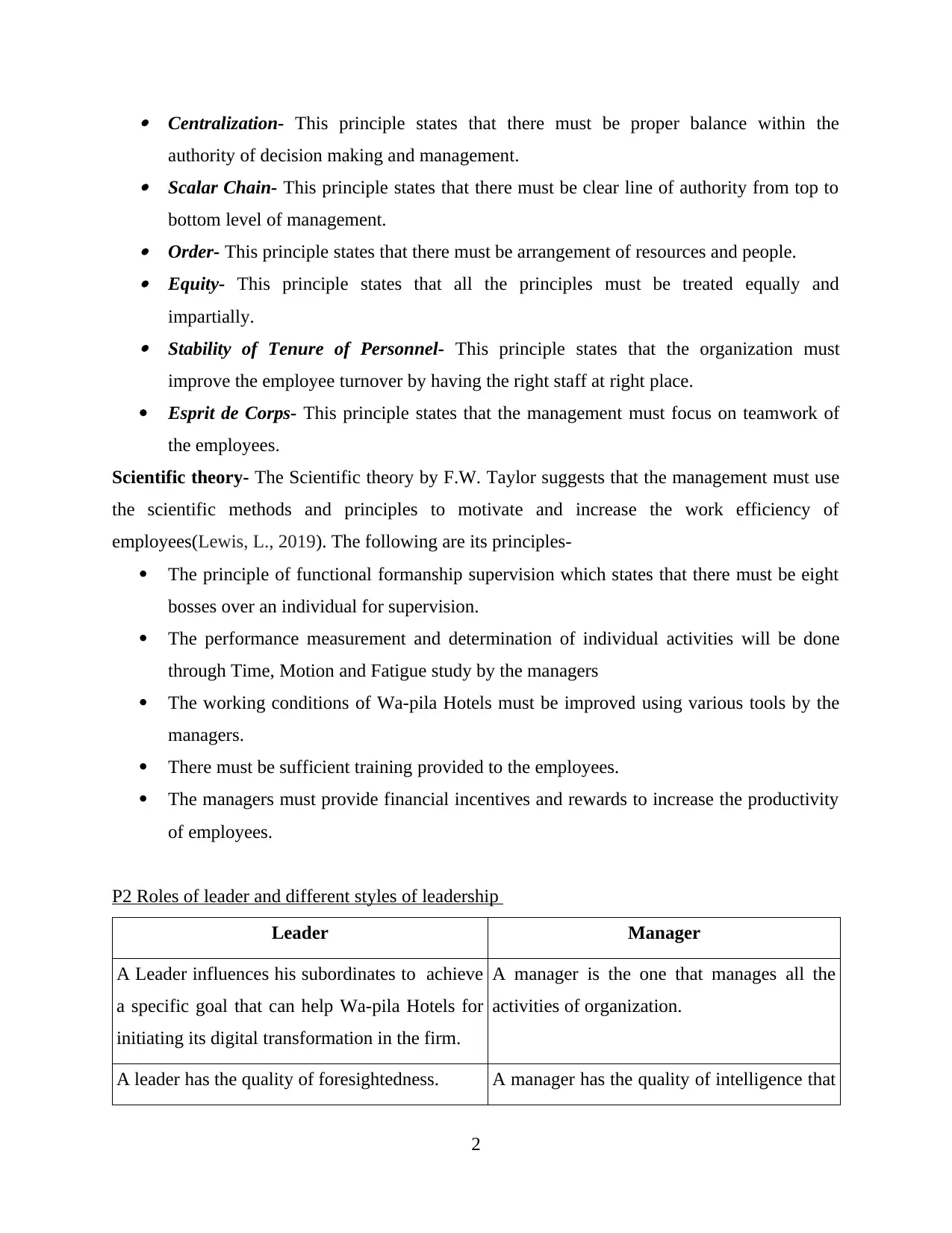
Centralization- This principle states that there must be proper balance within the
authority of decision making and management. Scalar Chain- This principle states that there must be clear line of authority from top to
bottom level of management. Order- This principle states that there must be arrangement of resources and people. Equity- This principle states that all the principles must be treated equally and
impartially. Stability of Tenure of Personnel- This principle states that the organization must
improve the employee turnover by having the right staff at right place.
Esprit de Corps- This principle states that the management must focus on teamwork of
the employees.
Scientific theory- The Scientific theory by F.W. Taylor suggests that the management must use
the scientific methods and principles to motivate and increase the work efficiency of
employees(Lewis, L., 2019). The following are its principles-
The principle of functional formanship supervision which states that there must be eight
bosses over an individual for supervision.
The performance measurement and determination of individual activities will be done
through Time, Motion and Fatigue study by the managers
The working conditions of Wa-pila Hotels must be improved using various tools by the
managers.
There must be sufficient training provided to the employees.
The managers must provide financial incentives and rewards to increase the productivity
of employees.
P2 Roles of leader and different styles of leadership
Leader Manager
A Leader influences his subordinates to achieve
a specific goal that can help Wa-pila Hotels for
initiating its digital transformation in the firm.
A manager is the one that manages all the
activities of organization.
A leader has the quality of foresightedness. A manager has the quality of intelligence that
2
authority of decision making and management. Scalar Chain- This principle states that there must be clear line of authority from top to
bottom level of management. Order- This principle states that there must be arrangement of resources and people. Equity- This principle states that all the principles must be treated equally and
impartially. Stability of Tenure of Personnel- This principle states that the organization must
improve the employee turnover by having the right staff at right place.
Esprit de Corps- This principle states that the management must focus on teamwork of
the employees.
Scientific theory- The Scientific theory by F.W. Taylor suggests that the management must use
the scientific methods and principles to motivate and increase the work efficiency of
employees(Lewis, L., 2019). The following are its principles-
The principle of functional formanship supervision which states that there must be eight
bosses over an individual for supervision.
The performance measurement and determination of individual activities will be done
through Time, Motion and Fatigue study by the managers
The working conditions of Wa-pila Hotels must be improved using various tools by the
managers.
There must be sufficient training provided to the employees.
The managers must provide financial incentives and rewards to increase the productivity
of employees.
P2 Roles of leader and different styles of leadership
Leader Manager
A Leader influences his subordinates to achieve
a specific goal that can help Wa-pila Hotels for
initiating its digital transformation in the firm.
A manager is the one that manages all the
activities of organization.
A leader has the quality of foresightedness. A manager has the quality of intelligence that
2
Paraphrase This Document
Need a fresh take? Get an instant paraphrase of this document with our AI Paraphraser
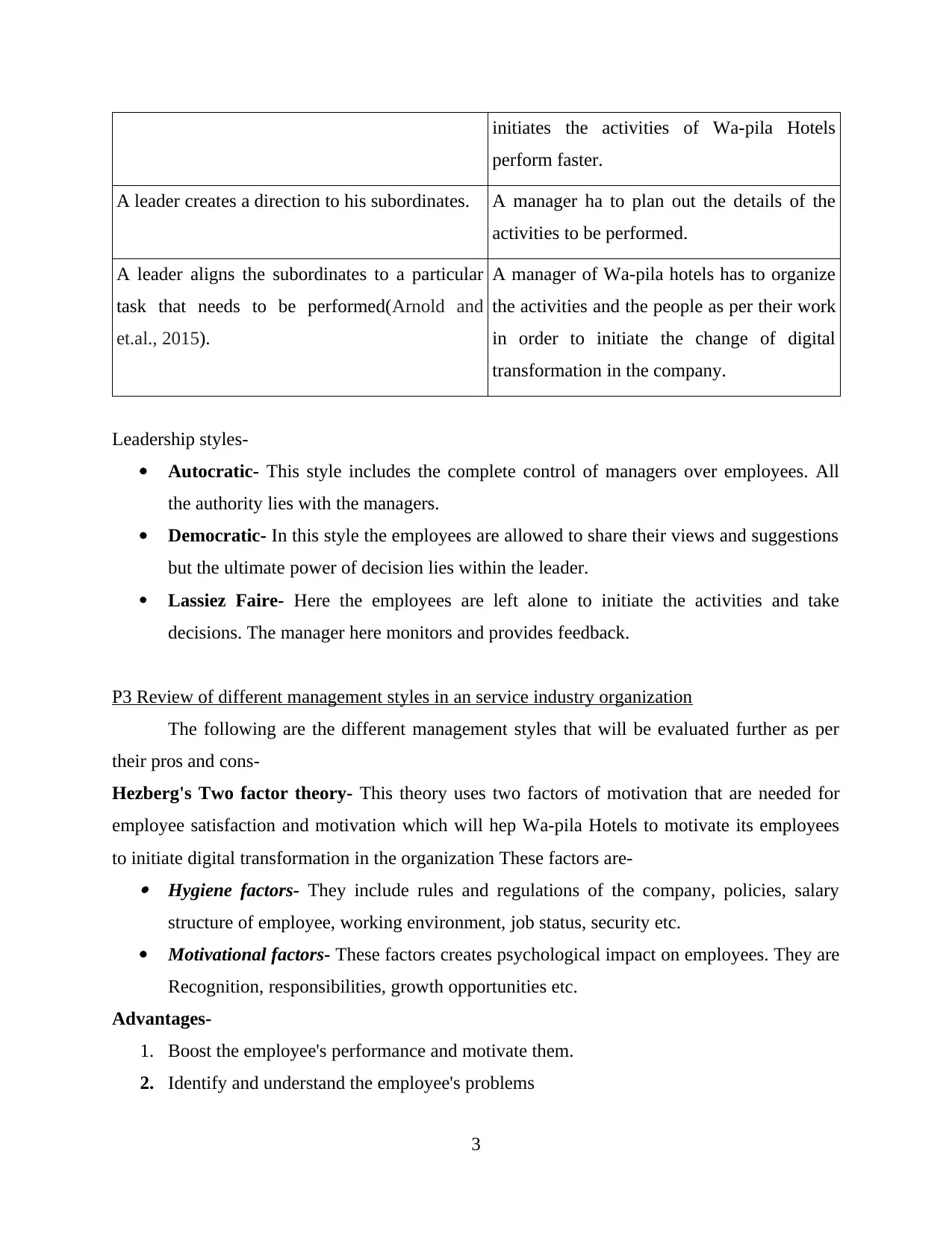
initiates the activities of Wa-pila Hotels
perform faster.
A leader creates a direction to his subordinates. A manager ha to plan out the details of the
activities to be performed.
A leader aligns the subordinates to a particular
task that needs to be performed(Arnold and
et.al., 2015).
A manager of Wa-pila hotels has to organize
the activities and the people as per their work
in order to initiate the change of digital
transformation in the company.
Leadership styles-
Autocratic- This style includes the complete control of managers over employees. All
the authority lies with the managers.
Democratic- In this style the employees are allowed to share their views and suggestions
but the ultimate power of decision lies within the leader.
Lassiez Faire- Here the employees are left alone to initiate the activities and take
decisions. The manager here monitors and provides feedback.
P3 Review of different management styles in an service industry organization
The following are the different management styles that will be evaluated further as per
their pros and cons-
Hezberg's Two factor theory- This theory uses two factors of motivation that are needed for
employee satisfaction and motivation which will hep Wa-pila Hotels to motivate its employees
to initiate digital transformation in the organization These factors are- Hygiene factors- They include rules and regulations of the company, policies, salary
structure of employee, working environment, job status, security etc.
Motivational factors- These factors creates psychological impact on employees. They are
Recognition, responsibilities, growth opportunities etc.
Advantages-
1. Boost the employee's performance and motivate them.
2. Identify and understand the employee's problems
3
perform faster.
A leader creates a direction to his subordinates. A manager ha to plan out the details of the
activities to be performed.
A leader aligns the subordinates to a particular
task that needs to be performed(Arnold and
et.al., 2015).
A manager of Wa-pila hotels has to organize
the activities and the people as per their work
in order to initiate the change of digital
transformation in the company.
Leadership styles-
Autocratic- This style includes the complete control of managers over employees. All
the authority lies with the managers.
Democratic- In this style the employees are allowed to share their views and suggestions
but the ultimate power of decision lies within the leader.
Lassiez Faire- Here the employees are left alone to initiate the activities and take
decisions. The manager here monitors and provides feedback.
P3 Review of different management styles in an service industry organization
The following are the different management styles that will be evaluated further as per
their pros and cons-
Hezberg's Two factor theory- This theory uses two factors of motivation that are needed for
employee satisfaction and motivation which will hep Wa-pila Hotels to motivate its employees
to initiate digital transformation in the organization These factors are- Hygiene factors- They include rules and regulations of the company, policies, salary
structure of employee, working environment, job status, security etc.
Motivational factors- These factors creates psychological impact on employees. They are
Recognition, responsibilities, growth opportunities etc.
Advantages-
1. Boost the employee's performance and motivate them.
2. Identify and understand the employee's problems
3
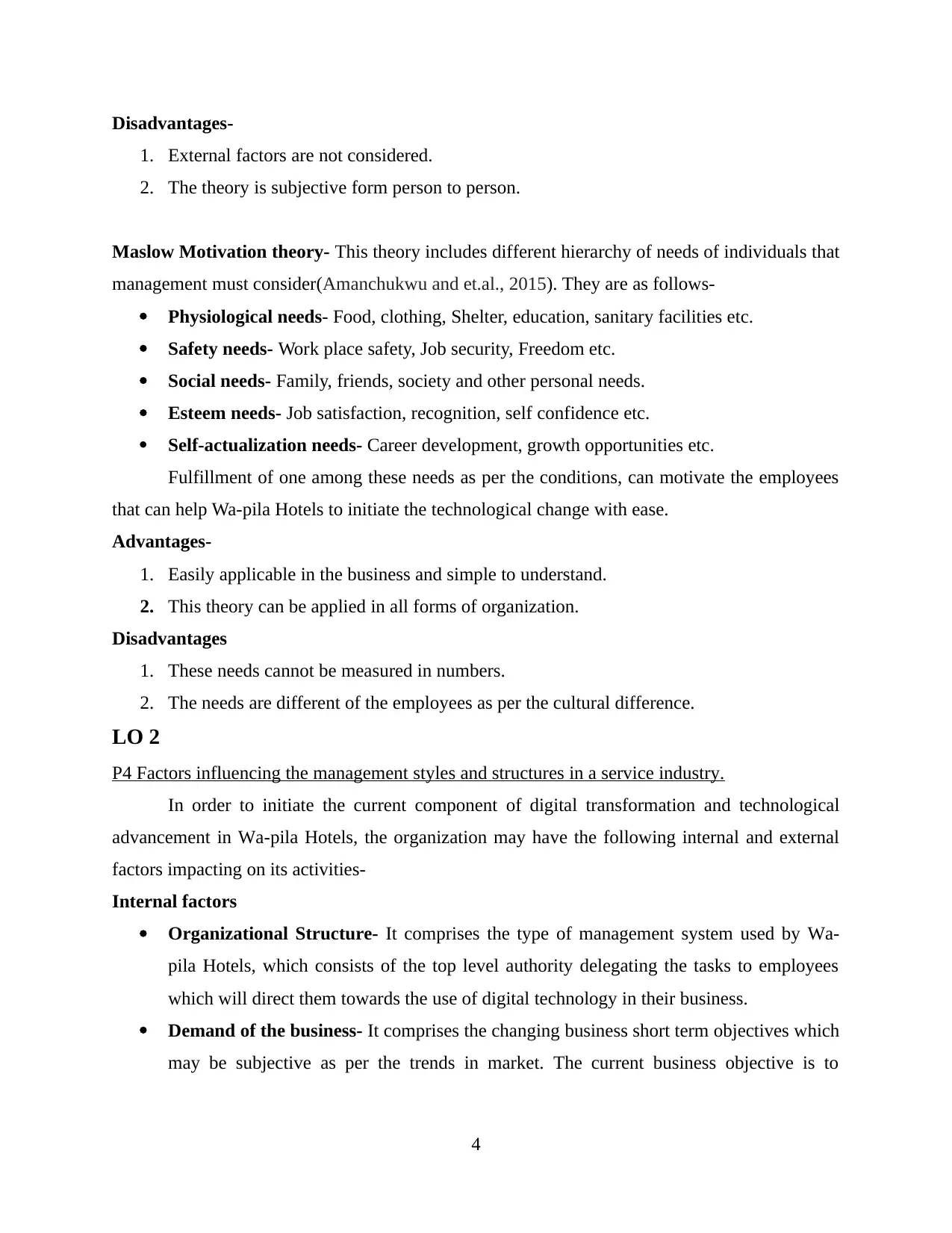
Disadvantages-
1. External factors are not considered.
2. The theory is subjective form person to person.
Maslow Motivation theory- This theory includes different hierarchy of needs of individuals that
management must consider(Amanchukwu and et.al., 2015). They are as follows-
Physiological needs- Food, clothing, Shelter, education, sanitary facilities etc.
Safety needs- Work place safety, Job security, Freedom etc.
Social needs- Family, friends, society and other personal needs.
Esteem needs- Job satisfaction, recognition, self confidence etc.
Self-actualization needs- Career development, growth opportunities etc.
Fulfillment of one among these needs as per the conditions, can motivate the employees
that can help Wa-pila Hotels to initiate the technological change with ease.
Advantages-
1. Easily applicable in the business and simple to understand.
2. This theory can be applied in all forms of organization.
Disadvantages
1. These needs cannot be measured in numbers.
2. The needs are different of the employees as per the cultural difference.
LO 2
P4 Factors influencing the management styles and structures in a service industry.
In order to initiate the current component of digital transformation and technological
advancement in Wa-pila Hotels, the organization may have the following internal and external
factors impacting on its activities-
Internal factors
Organizational Structure- It comprises the type of management system used by Wa-
pila Hotels, which consists of the top level authority delegating the tasks to employees
which will direct them towards the use of digital technology in their business.
Demand of the business- It comprises the changing business short term objectives which
may be subjective as per the trends in market. The current business objective is to
4
1. External factors are not considered.
2. The theory is subjective form person to person.
Maslow Motivation theory- This theory includes different hierarchy of needs of individuals that
management must consider(Amanchukwu and et.al., 2015). They are as follows-
Physiological needs- Food, clothing, Shelter, education, sanitary facilities etc.
Safety needs- Work place safety, Job security, Freedom etc.
Social needs- Family, friends, society and other personal needs.
Esteem needs- Job satisfaction, recognition, self confidence etc.
Self-actualization needs- Career development, growth opportunities etc.
Fulfillment of one among these needs as per the conditions, can motivate the employees
that can help Wa-pila Hotels to initiate the technological change with ease.
Advantages-
1. Easily applicable in the business and simple to understand.
2. This theory can be applied in all forms of organization.
Disadvantages
1. These needs cannot be measured in numbers.
2. The needs are different of the employees as per the cultural difference.
LO 2
P4 Factors influencing the management styles and structures in a service industry.
In order to initiate the current component of digital transformation and technological
advancement in Wa-pila Hotels, the organization may have the following internal and external
factors impacting on its activities-
Internal factors
Organizational Structure- It comprises the type of management system used by Wa-
pila Hotels, which consists of the top level authority delegating the tasks to employees
which will direct them towards the use of digital technology in their business.
Demand of the business- It comprises the changing business short term objectives which
may be subjective as per the trends in market. The current business objective is to
4
⊘ This is a preview!⊘
Do you want full access?
Subscribe today to unlock all pages.
Trusted by 1+ million students worldwide
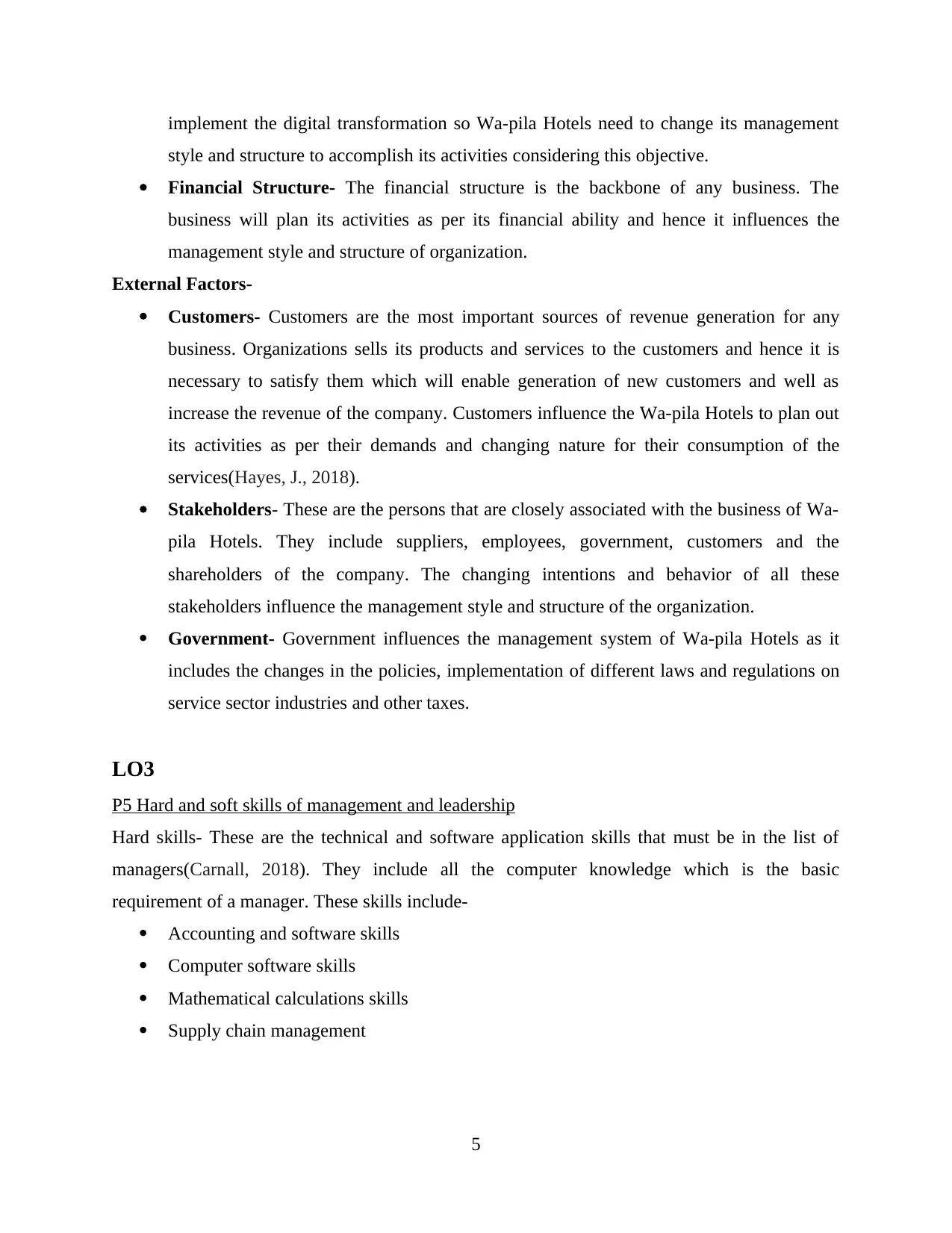
implement the digital transformation so Wa-pila Hotels need to change its management
style and structure to accomplish its activities considering this objective.
Financial Structure- The financial structure is the backbone of any business. The
business will plan its activities as per its financial ability and hence it influences the
management style and structure of organization.
External Factors-
Customers- Customers are the most important sources of revenue generation for any
business. Organizations sells its products and services to the customers and hence it is
necessary to satisfy them which will enable generation of new customers and well as
increase the revenue of the company. Customers influence the Wa-pila Hotels to plan out
its activities as per their demands and changing nature for their consumption of the
services(Hayes, J., 2018).
Stakeholders- These are the persons that are closely associated with the business of Wa-
pila Hotels. They include suppliers, employees, government, customers and the
shareholders of the company. The changing intentions and behavior of all these
stakeholders influence the management style and structure of the organization.
Government- Government influences the management system of Wa-pila Hotels as it
includes the changes in the policies, implementation of different laws and regulations on
service sector industries and other taxes.
LO3
P5 Hard and soft skills of management and leadership
Hard skills- These are the technical and software application skills that must be in the list of
managers(Carnall, 2018). They include all the computer knowledge which is the basic
requirement of a manager. These skills include-
Accounting and software skills
Computer software skills
Mathematical calculations skills
Supply chain management
5
style and structure to accomplish its activities considering this objective.
Financial Structure- The financial structure is the backbone of any business. The
business will plan its activities as per its financial ability and hence it influences the
management style and structure of organization.
External Factors-
Customers- Customers are the most important sources of revenue generation for any
business. Organizations sells its products and services to the customers and hence it is
necessary to satisfy them which will enable generation of new customers and well as
increase the revenue of the company. Customers influence the Wa-pila Hotels to plan out
its activities as per their demands and changing nature for their consumption of the
services(Hayes, J., 2018).
Stakeholders- These are the persons that are closely associated with the business of Wa-
pila Hotels. They include suppliers, employees, government, customers and the
shareholders of the company. The changing intentions and behavior of all these
stakeholders influence the management style and structure of the organization.
Government- Government influences the management system of Wa-pila Hotels as it
includes the changes in the policies, implementation of different laws and regulations on
service sector industries and other taxes.
LO3
P5 Hard and soft skills of management and leadership
Hard skills- These are the technical and software application skills that must be in the list of
managers(Carnall, 2018). They include all the computer knowledge which is the basic
requirement of a manager. These skills include-
Accounting and software skills
Computer software skills
Mathematical calculations skills
Supply chain management
5
Paraphrase This Document
Need a fresh take? Get an instant paraphrase of this document with our AI Paraphraser
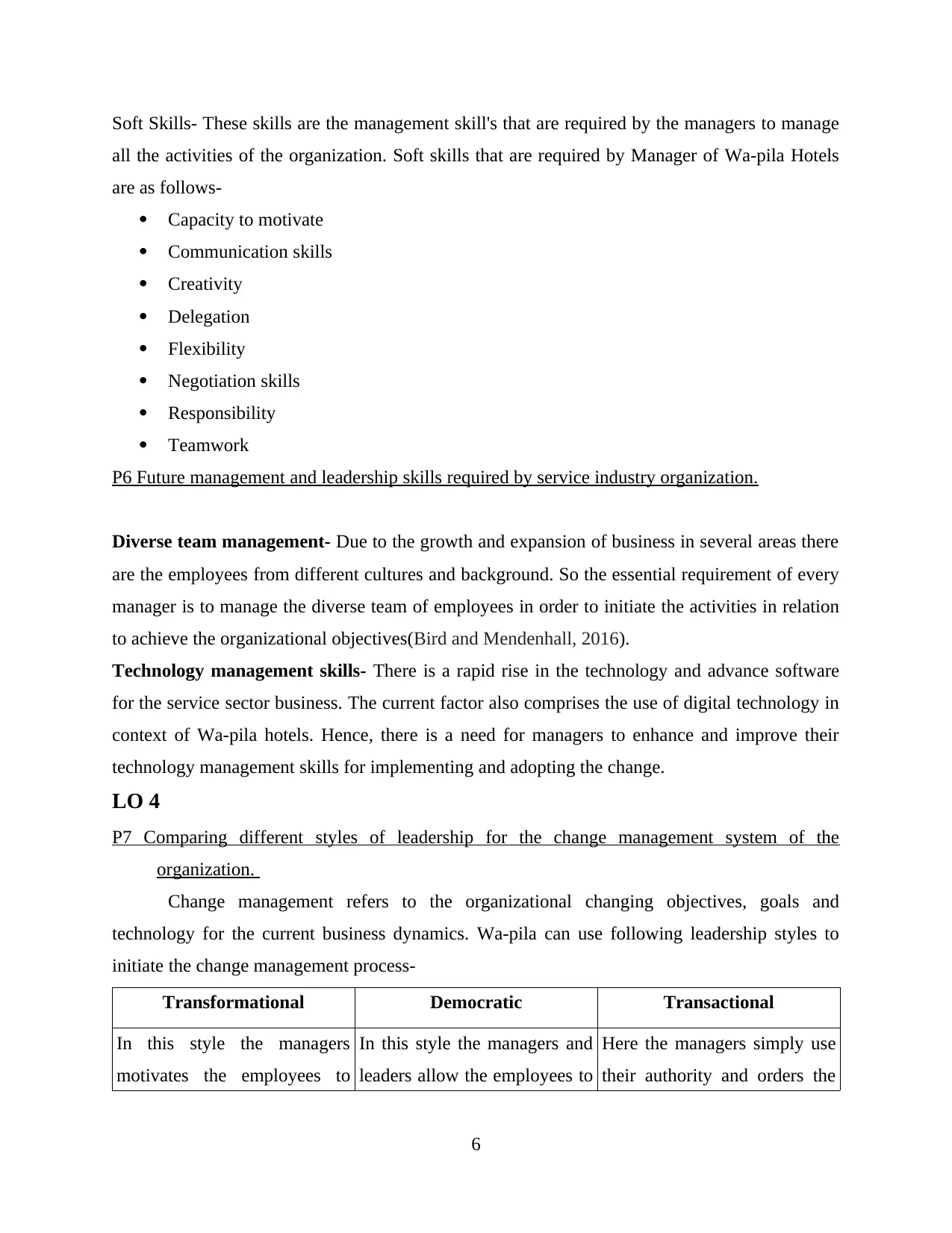
Soft Skills- These skills are the management skill's that are required by the managers to manage
all the activities of the organization. Soft skills that are required by Manager of Wa-pila Hotels
are as follows-
Capacity to motivate
Communication skills
Creativity
Delegation
Flexibility
Negotiation skills
Responsibility
Teamwork
P6 Future management and leadership skills required by service industry organization.
Diverse team management- Due to the growth and expansion of business in several areas there
are the employees from different cultures and background. So the essential requirement of every
manager is to manage the diverse team of employees in order to initiate the activities in relation
to achieve the organizational objectives(Bird and Mendenhall, 2016).
Technology management skills- There is a rapid rise in the technology and advance software
for the service sector business. The current factor also comprises the use of digital technology in
context of Wa-pila hotels. Hence, there is a need for managers to enhance and improve their
technology management skills for implementing and adopting the change.
LO 4
P7 Comparing different styles of leadership for the change management system of the
organization.
Change management refers to the organizational changing objectives, goals and
technology for the current business dynamics. Wa-pila can use following leadership styles to
initiate the change management process-
Transformational Democratic Transactional
In this style the managers
motivates the employees to
In this style the managers and
leaders allow the employees to
Here the managers simply use
their authority and orders the
6
all the activities of the organization. Soft skills that are required by Manager of Wa-pila Hotels
are as follows-
Capacity to motivate
Communication skills
Creativity
Delegation
Flexibility
Negotiation skills
Responsibility
Teamwork
P6 Future management and leadership skills required by service industry organization.
Diverse team management- Due to the growth and expansion of business in several areas there
are the employees from different cultures and background. So the essential requirement of every
manager is to manage the diverse team of employees in order to initiate the activities in relation
to achieve the organizational objectives(Bird and Mendenhall, 2016).
Technology management skills- There is a rapid rise in the technology and advance software
for the service sector business. The current factor also comprises the use of digital technology in
context of Wa-pila hotels. Hence, there is a need for managers to enhance and improve their
technology management skills for implementing and adopting the change.
LO 4
P7 Comparing different styles of leadership for the change management system of the
organization.
Change management refers to the organizational changing objectives, goals and
technology for the current business dynamics. Wa-pila can use following leadership styles to
initiate the change management process-
Transformational Democratic Transactional
In this style the managers
motivates the employees to
In this style the managers and
leaders allow the employees to
Here the managers simply use
their authority and orders the
6
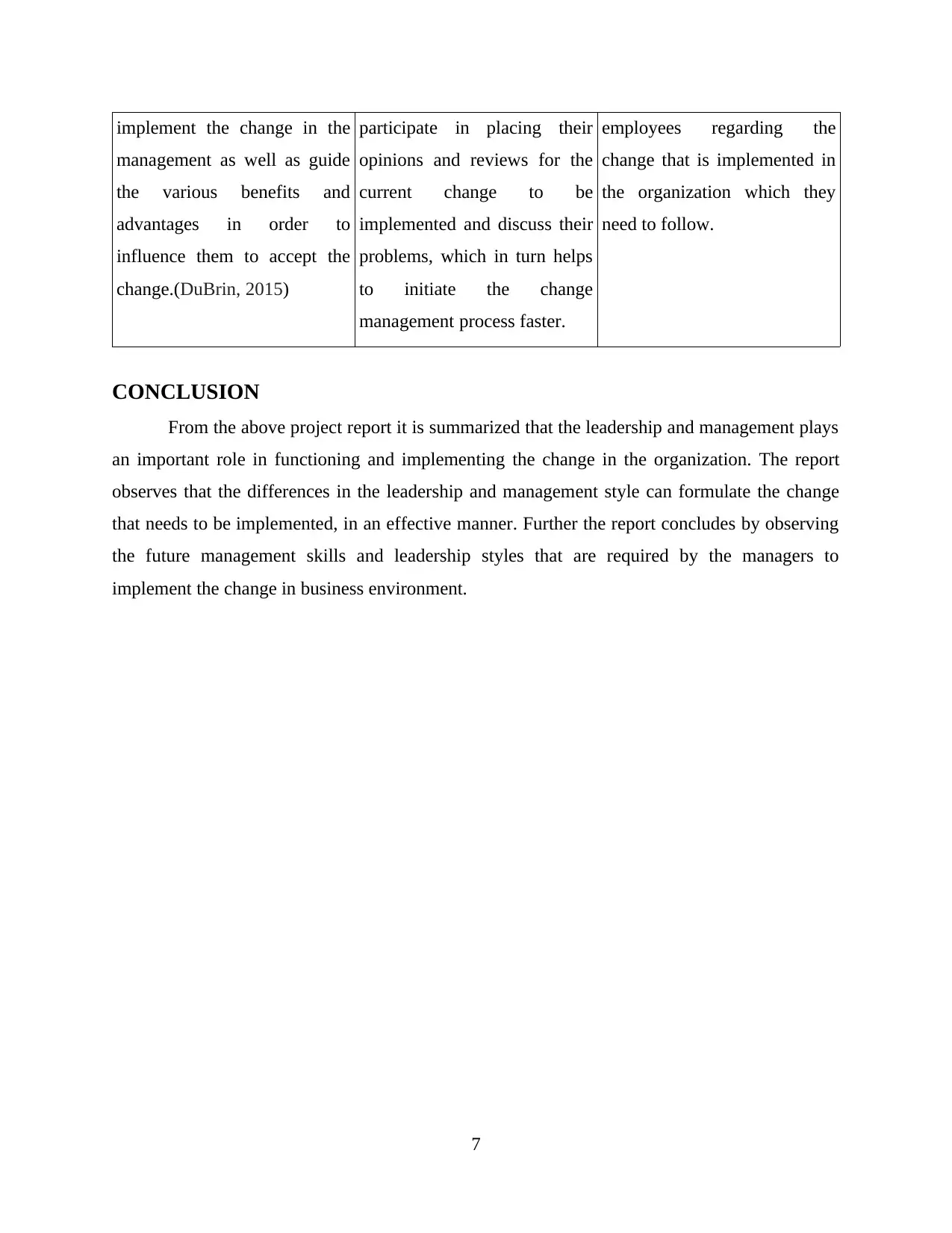
implement the change in the
management as well as guide
the various benefits and
advantages in order to
influence them to accept the
change.(DuBrin, 2015)
participate in placing their
opinions and reviews for the
current change to be
implemented and discuss their
problems, which in turn helps
to initiate the change
management process faster.
employees regarding the
change that is implemented in
the organization which they
need to follow.
CONCLUSION
From the above project report it is summarized that the leadership and management plays
an important role in functioning and implementing the change in the organization. The report
observes that the differences in the leadership and management style can formulate the change
that needs to be implemented, in an effective manner. Further the report concludes by observing
the future management skills and leadership styles that are required by the managers to
implement the change in business environment.
7
management as well as guide
the various benefits and
advantages in order to
influence them to accept the
change.(DuBrin, 2015)
participate in placing their
opinions and reviews for the
current change to be
implemented and discuss their
problems, which in turn helps
to initiate the change
management process faster.
employees regarding the
change that is implemented in
the organization which they
need to follow.
CONCLUSION
From the above project report it is summarized that the leadership and management plays
an important role in functioning and implementing the change in the organization. The report
observes that the differences in the leadership and management style can formulate the change
that needs to be implemented, in an effective manner. Further the report concludes by observing
the future management skills and leadership styles that are required by the managers to
implement the change in business environment.
7
⊘ This is a preview!⊘
Do you want full access?
Subscribe today to unlock all pages.
Trusted by 1+ million students worldwide
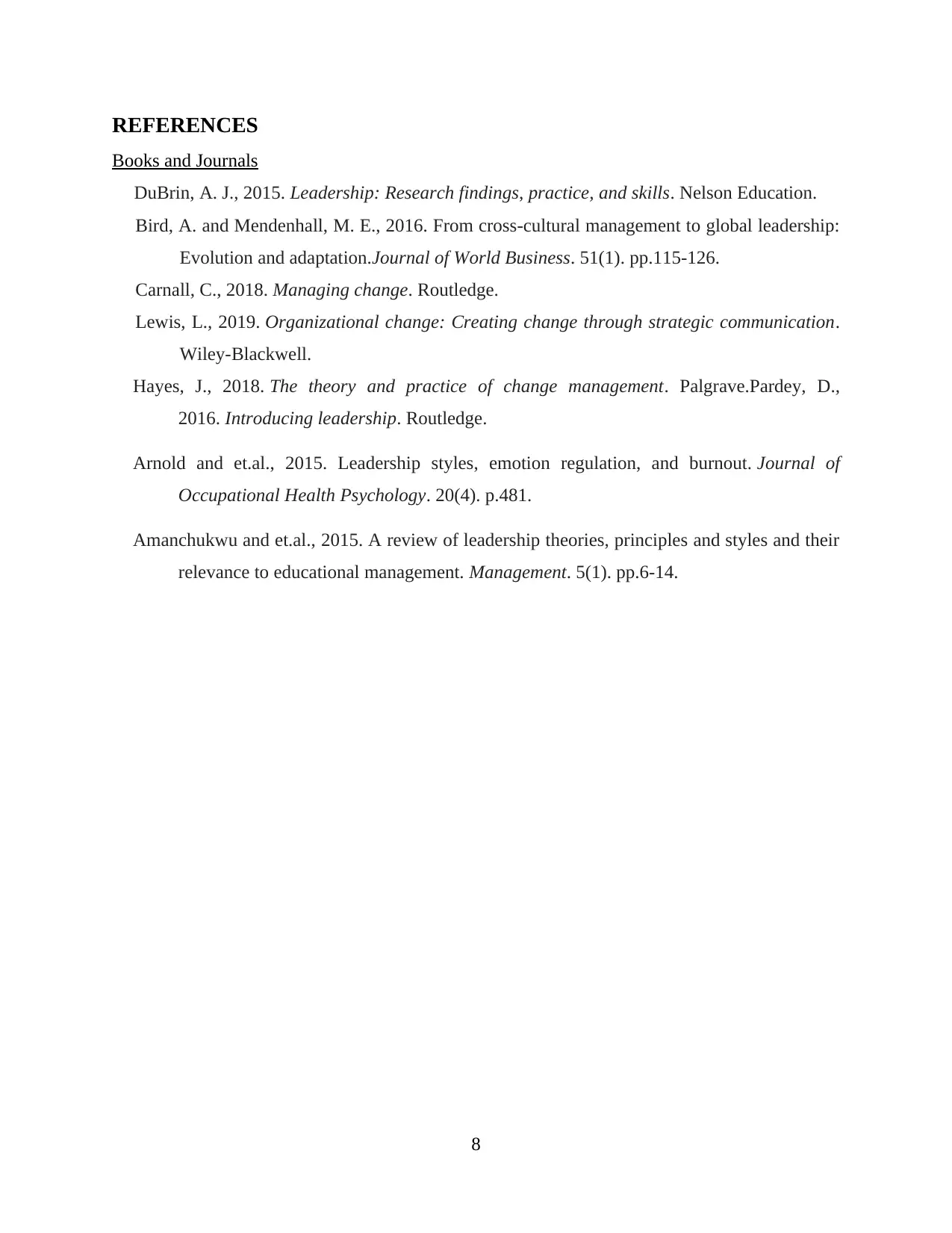
REFERENCES
Books and Journals
DuBrin, A. J., 2015. Leadership: Research findings, practice, and skills. Nelson Education.
Bird, A. and Mendenhall, M. E., 2016. From cross-cultural management to global leadership:
Evolution and adaptation.Journal of World Business. 51(1). pp.115-126.
Carnall, C., 2018. Managing change. Routledge.
Lewis, L., 2019. Organizational change: Creating change through strategic communication.
Wiley-Blackwell.
Hayes, J., 2018. The theory and practice of change management. Palgrave.Pardey, D.,
2016. Introducing leadership. Routledge.
Arnold and et.al., 2015. Leadership styles, emotion regulation, and burnout. Journal of
Occupational Health Psychology. 20(4). p.481.
Amanchukwu and et.al., 2015. A review of leadership theories, principles and styles and their
relevance to educational management. Management. 5(1). pp.6-14.
8
Books and Journals
DuBrin, A. J., 2015. Leadership: Research findings, practice, and skills. Nelson Education.
Bird, A. and Mendenhall, M. E., 2016. From cross-cultural management to global leadership:
Evolution and adaptation.Journal of World Business. 51(1). pp.115-126.
Carnall, C., 2018. Managing change. Routledge.
Lewis, L., 2019. Organizational change: Creating change through strategic communication.
Wiley-Blackwell.
Hayes, J., 2018. The theory and practice of change management. Palgrave.Pardey, D.,
2016. Introducing leadership. Routledge.
Arnold and et.al., 2015. Leadership styles, emotion regulation, and burnout. Journal of
Occupational Health Psychology. 20(4). p.481.
Amanchukwu and et.al., 2015. A review of leadership theories, principles and styles and their
relevance to educational management. Management. 5(1). pp.6-14.
8
Paraphrase This Document
Need a fresh take? Get an instant paraphrase of this document with our AI Paraphraser

9

1 out of 11


Related Documents


Your All-in-One AI-Powered Toolkit for Academic Success.
+13062052269
info@desklib.com
Available 24*7 on WhatsApp / Email
![[object Object]](/_next/static/media/star-bottom.7253800d.svg)
Unlock your academic potential
Copyright © 2020–2026 A2Z Services. All Rights Reserved. Developed and managed by ZUCOL.