Organisation Leadership and Management Report: Analysis and Comparison
VerifiedAdded on 2020/01/28
|18
|5938
|150
Report
AI Summary
This report provides a detailed analysis of leadership and management, exploring the core differences between the two concepts. It delves into various leadership theories, including behavioral and contingency theories, highlighting their key principles and applications within organizational contexts. The report compares and contrasts these theories, providing insights into their strengths and weaknesses. Furthermore, it examines the selection and training processes for leaders, addressing the question of whether managers can become leaders and the importance of developing leadership skills. The report uses examples and case studies to illustrate the practical implications of different leadership styles and approaches, offering a comprehensive understanding of effective leadership and management practices. It concludes by synthesizing the key findings and offering recommendations for organizations seeking to enhance their leadership capabilities.
ORGANISATION
LEADERSHIP AND
MANAGEMENT
LEADERSHIP AND
MANAGEMENT

Paraphrase This Document
Need a fresh take? Get an instant paraphrase of this document with our AI Paraphraser
TABLE OF CONTENTS
INTRODUCTION...........................................................................................................................1
TASK 5............................................................................................................................................2
5.1 Difference between concept of leadership and management...........................................2
5.2 Comparing the two theories of leadership........................................................................4
5.3 Selection of leadership and training.................................................................................8
5.4 Can managers become leaders?......................................................................................11
CONCLUSION..............................................................................................................................14
REFERENCES..............................................................................................................................15
Books and journals...............................................................................................................15
INTRODUCTION...........................................................................................................................1
TASK 5............................................................................................................................................2
5.1 Difference between concept of leadership and management...........................................2
5.2 Comparing the two theories of leadership........................................................................4
5.3 Selection of leadership and training.................................................................................8
5.4 Can managers become leaders?......................................................................................11
CONCLUSION..............................................................................................................................14
REFERENCES..............................................................................................................................15
Books and journals...............................................................................................................15
INTRODUCTION
The entire report is based on the learning of what leadership actually is and how
important role does it play in an individual’s life and into organisation. Some says leadership is
developed or can’t be developed but it is inborn in an individual and the person pursues the
leadership qualities since the day he is born. But either of the statement is correct both can’t be
applied together. The report will clear the concept about what leadership is and how it is related
with the term ‘management’. Also it will provide and answer to the question that a manger
should or should not need to develop his leadership skills.
TASK 5
5.1 Difference between concept of leadership and management
Definition of leadership- The skill of leading a Person or many people and inspiring them to
work efficiently in the best way possible and giving them the direction is known as leadership.
Definition of management –Management is the art of dealing with people and getting things
done through and with them in the most effective and efficient manner is known as management
(Allio. 2012).
Meaning of both leadership and management– “Leadership” is a skill of leading others by
providing the various examples where as “Management” is and art as well science of
systematically organising and coordinating people and getting the things done through and with
them in an efficient manner.
Difference between Leadership and Management -
Leadership is entirely based on an individual trust upon his leaders and also the trust of leaders
upon his followers whereas Management is entirely based on the controlling of the activities as
well as on the employees working the organisation (Amit and et.al, 2009).
Leadership emphasis more upon influencing people and motivates them to work more
efficiently for their organisation whereas Management emphasis more upon managing the
assigned activities given to the people into the organisation.
1
The entire report is based on the learning of what leadership actually is and how
important role does it play in an individual’s life and into organisation. Some says leadership is
developed or can’t be developed but it is inborn in an individual and the person pursues the
leadership qualities since the day he is born. But either of the statement is correct both can’t be
applied together. The report will clear the concept about what leadership is and how it is related
with the term ‘management’. Also it will provide and answer to the question that a manger
should or should not need to develop his leadership skills.
TASK 5
5.1 Difference between concept of leadership and management
Definition of leadership- The skill of leading a Person or many people and inspiring them to
work efficiently in the best way possible and giving them the direction is known as leadership.
Definition of management –Management is the art of dealing with people and getting things
done through and with them in the most effective and efficient manner is known as management
(Allio. 2012).
Meaning of both leadership and management– “Leadership” is a skill of leading others by
providing the various examples where as “Management” is and art as well science of
systematically organising and coordinating people and getting the things done through and with
them in an efficient manner.
Difference between Leadership and Management -
Leadership is entirely based on an individual trust upon his leaders and also the trust of leaders
upon his followers whereas Management is entirely based on the controlling of the activities as
well as on the employees working the organisation (Amit and et.al, 2009).
Leadership emphasis more upon influencing people and motivates them to work more
efficiently for their organisation whereas Management emphasis more upon managing the
assigned activities given to the people into the organisation.
1
⊘ This is a preview!⊘
Do you want full access?
Subscribe today to unlock all pages.

Trusted by 1+ million students worldwide
Leadership is powerful at influencing people and motivating them to be the same and perform
well for their organisation whereas Management is powerful at ruling the people to work in an
appropriate manner.
Leadership focuses upon encouraging the people to adopt changes and bring required and
timely changes into the organization whereas Management focuses on bringing the stability in
the organisation.
Leadership applies the strategy of proactive that is planning everything before the time whereas
Management applies the strategy of reactive that is it takes action after considering the actions
which are already taken place in the organisation.
Leadership is the formulation of principles and guidelines whereas Management is the
formulation of policies and procedures (Carnes. Houghton and Ellison. 2015).
Leadership major perspective is that leadership requires good foresightedness whereas
Management has a short range of perspective.
Leadership pursues the quality of influencing the mind of the people whereas Management is a
discipline of managing the things into the best way possible.
Leadership give the direction to the people into the organisation whereas Management controls
upon the direction which has been given to them.
Leadership is an interpersonal process whereas Management is the controlling and managing
process of the organisation.
In addition to this, it can be said that organisation leadership and management both are
different aspects which need to be referred by business firm. It has been noticed that leadership
allows to enhance the morale of employees. On the other side, the management is focused
towards tactics that helps in managing the simulation activities. Leadership allows to have better
application of tactics and management helps to design such tactics. It allows to advance the long
term sustainability. Leadership is a quality of influencing people, so that the objectives are
attained willingly and enthusiastically (Chapman. Johnson and Kilner. 2014). Management is
a discipline of managing things in the best possible manner. It is the art or skill of getting the
2
well for their organisation whereas Management is powerful at ruling the people to work in an
appropriate manner.
Leadership focuses upon encouraging the people to adopt changes and bring required and
timely changes into the organization whereas Management focuses on bringing the stability in
the organisation.
Leadership applies the strategy of proactive that is planning everything before the time whereas
Management applies the strategy of reactive that is it takes action after considering the actions
which are already taken place in the organisation.
Leadership is the formulation of principles and guidelines whereas Management is the
formulation of policies and procedures (Carnes. Houghton and Ellison. 2015).
Leadership major perspective is that leadership requires good foresightedness whereas
Management has a short range of perspective.
Leadership pursues the quality of influencing the mind of the people whereas Management is a
discipline of managing the things into the best way possible.
Leadership give the direction to the people into the organisation whereas Management controls
upon the direction which has been given to them.
Leadership is an interpersonal process whereas Management is the controlling and managing
process of the organisation.
In addition to this, it can be said that organisation leadership and management both are
different aspects which need to be referred by business firm. It has been noticed that leadership
allows to enhance the morale of employees. On the other side, the management is focused
towards tactics that helps in managing the simulation activities. Leadership allows to have better
application of tactics and management helps to design such tactics. It allows to advance the long
term sustainability. Leadership is a quality of influencing people, so that the objectives are
attained willingly and enthusiastically (Chapman. Johnson and Kilner. 2014). Management is
a discipline of managing things in the best possible manner. It is the art or skill of getting the
2
Paraphrase This Document
Need a fresh take? Get an instant paraphrase of this document with our AI Paraphraser
work done through and with others. It can be found in all the fields, like education, hospitality,
sports, offices etc.
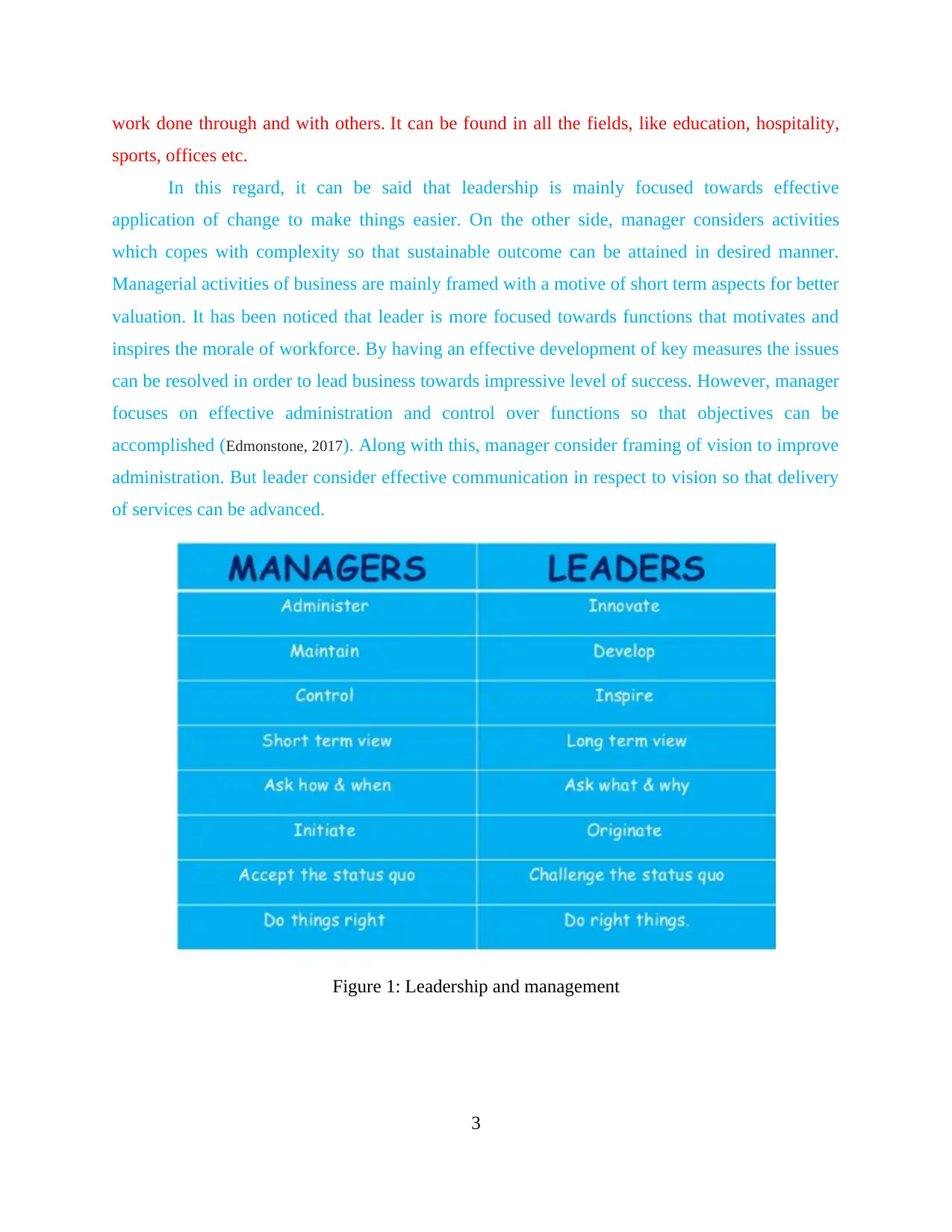
In this regard, it can be said that leadership is mainly focused towards effective
application of change to make things easier. On the other side, manager considers activities
which copes with complexity so that sustainable outcome can be attained in desired manner.
Managerial activities of business are mainly framed with a motive of short term aspects for better
valuation. It has been noticed that leader is more focused towards functions that motivates and
inspires the morale of workforce. By having an effective development of key measures the issues
can be resolved in order to lead business towards impressive level of success. However, manager
focuses on effective administration and control over functions so that objectives can be
accomplished (Edmonstone, 2017). Along with this, manager consider framing of vision to improve
administration. But leader consider effective communication in respect to vision so that delivery
of services can be advanced.
Figure 1: Leadership and management
3
sports, offices etc.
In this regard, it can be said that leadership is mainly focused towards effective
application of change to make things easier. On the other side, manager considers activities
which copes with complexity so that sustainable outcome can be attained in desired manner.
Managerial activities of business are mainly framed with a motive of short term aspects for better
valuation. It has been noticed that leader is more focused towards functions that motivates and
inspires the morale of workforce. By having an effective development of key measures the issues
can be resolved in order to lead business towards impressive level of success. However, manager
focuses on effective administration and control over functions so that objectives can be
accomplished (Edmonstone, 2017). Along with this, manager consider framing of vision to improve
administration. But leader consider effective communication in respect to vision so that delivery
of services can be advanced.
Figure 1: Leadership and management
3
5.2 Comparing the two theories of leadership
There are various types of theories being propounded by researchers to make the
leaderships and leaders more effective by adopting them into the organisation with reference to
the organisational environment. As every organisation differ with each other and they are
required to adopt it according to their requirements. Some of the theories are described below.
Behavioural theory- This theory focuses and study about the behaviours of the leader.
This theory states that the behaviour of the leader is the best example to know how much he will
influence leadership and how effective he will be to his followers and how he will lead them. He
is the best determinant for his leadership success. This theory provides real marketing potential,
as behaviours can differ with different persons and different persons have different specific
responses. Also it is stated that anyone can be the leader if he is taught about the good behaviour
response and how one has react or behave to be a good leader. Behaviour is something which is
very important element in leader which says that a manager must be good at his behaviour as
whatever he will lead the team or the followers will consummate the same and they will desire to
be like their leader or the mentor. For instance, behaviour is judged when the employees commit
any mistake or perform any work wrongly or anytime they come late o the office then the there
are certain list of punishments for them which they have to accept. Similarly, if they perform
good or work out of the box for the organisation there is also the list of rewards for them which
is given to them as an appreciation or we can as an appraisal. So it is up to the manager that what
behaviour he will show to his employees when they perform the good job and when they come
late to the office, the way manager deals with the employees and scolds them or appreciate them.
According to this theory behaviour can be studied in an observable and systematic manner
ignoring the mental stress this theory the conditions, moods, emotions are the major subject and
the most crucial element of this theory (Gowthorp, Toohey and Skinner, 2017). The entire theory
reflects about the individual behaviour the way person represents himself it is about how strict or
leniently he handles the situation. The core of the good leadership is entirely based on the
foundation of the behaviour that is if the leader does not carry the positive behaviour he may lead
his followers towards the wrong direction. As we understand this well that every team person
learns from hi leader the way he behaves. Everyone is carried out with the various situations.
Where the leader needs to change his behaviour according to the prevailing situation for an
4
There are various types of theories being propounded by researchers to make the
leaderships and leaders more effective by adopting them into the organisation with reference to
the organisational environment. As every organisation differ with each other and they are
required to adopt it according to their requirements. Some of the theories are described below.
Behavioural theory- This theory focuses and study about the behaviours of the leader.
This theory states that the behaviour of the leader is the best example to know how much he will
influence leadership and how effective he will be to his followers and how he will lead them. He
is the best determinant for his leadership success. This theory provides real marketing potential,
as behaviours can differ with different persons and different persons have different specific
responses. Also it is stated that anyone can be the leader if he is taught about the good behaviour
response and how one has react or behave to be a good leader. Behaviour is something which is
very important element in leader which says that a manager must be good at his behaviour as
whatever he will lead the team or the followers will consummate the same and they will desire to
be like their leader or the mentor. For instance, behaviour is judged when the employees commit
any mistake or perform any work wrongly or anytime they come late o the office then the there
are certain list of punishments for them which they have to accept. Similarly, if they perform
good or work out of the box for the organisation there is also the list of rewards for them which
is given to them as an appreciation or we can as an appraisal. So it is up to the manager that what
behaviour he will show to his employees when they perform the good job and when they come
late to the office, the way manager deals with the employees and scolds them or appreciate them.
According to this theory behaviour can be studied in an observable and systematic manner
ignoring the mental stress this theory the conditions, moods, emotions are the major subject and
the most crucial element of this theory (Gowthorp, Toohey and Skinner, 2017). The entire theory
reflects about the individual behaviour the way person represents himself it is about how strict or
leniently he handles the situation. The core of the good leadership is entirely based on the
foundation of the behaviour that is if the leader does not carry the positive behaviour he may lead
his followers towards the wrong direction. As we understand this well that every team person
learns from hi leader the way he behaves. Everyone is carried out with the various situations.
Where the leader needs to change his behaviour according to the prevailing situation for an
4
⊘ This is a preview!⊘
Do you want full access?
Subscribe today to unlock all pages.
Trusted by 1+ million students worldwide
instance if any employee in the organisation has performed well and the leader avoids to
appreciate him due to any reason or due to his unhealthy relations with the employee this may
reflects as a negative behaviour where the leader was supposed to provide rearwards to the
employees such type of situation can be the good example of wrong or unhealthy behaviour.
It is a theory which indicates the behavioural aspects related to the leadership. It means
the behaviour of leaders towards individual can be analysed in desired manner. With an
application of diverse measures such issues can be overcome. In addition to this, it can be said
that behavioural theory provides a concern for task. It means the followers and subordinate can
have means of accomplishing the task. In this style the people centric behavioural aspects are
being considered in order to have sustainable development. Under this approach the managers
can have desire of absolute control of their subordinates in order to accept the behavioural style.
Directive and participative leadership also provides an effective support to the behavioural
theory.
Assumptions of behaviour theory of leadership
The first assumption is that the leaders are made. Rather than are born. This states that the
leaders are made by teaching them the essence of behaviour and skills to be a good leader rather
than they are just born (Saunila, 2016). Successful leadership is based in definable, in the
learnable behaviour of the leader.
Description of behavioural theory of leadership
The behavioural theory does not seek the in born capabilities of the leader but this theory focuses
upon what the leader actually do also how they do is the major concern of this theory rather than
just considering what leader has got from his birth and within. If the success can be defined with
the terms of actions, then it becomes very easy to teach leaders about how behaviour is the major
element of achieving the success and how one has to react when the action is being done.
Another theory in contrast with behavioural theory is contingency theory.
Contingency theory-The contingency theory explains specific and various situational
factors which affects the direct relationships between dependent and independent various with
reference to the organisation behaviour where x is the dependent variable and y is the
independent variable. This theory that’s none of the theory is perfect unless it does not work with
5
appreciate him due to any reason or due to his unhealthy relations with the employee this may
reflects as a negative behaviour where the leader was supposed to provide rearwards to the
employees such type of situation can be the good example of wrong or unhealthy behaviour.
It is a theory which indicates the behavioural aspects related to the leadership. It means
the behaviour of leaders towards individual can be analysed in desired manner. With an
application of diverse measures such issues can be overcome. In addition to this, it can be said
that behavioural theory provides a concern for task. It means the followers and subordinate can
have means of accomplishing the task. In this style the people centric behavioural aspects are
being considered in order to have sustainable development. Under this approach the managers
can have desire of absolute control of their subordinates in order to accept the behavioural style.
Directive and participative leadership also provides an effective support to the behavioural
theory.
Assumptions of behaviour theory of leadership
The first assumption is that the leaders are made. Rather than are born. This states that the
leaders are made by teaching them the essence of behaviour and skills to be a good leader rather
than they are just born (Saunila, 2016). Successful leadership is based in definable, in the
learnable behaviour of the leader.
Description of behavioural theory of leadership
The behavioural theory does not seek the in born capabilities of the leader but this theory focuses
upon what the leader actually do also how they do is the major concern of this theory rather than
just considering what leader has got from his birth and within. If the success can be defined with
the terms of actions, then it becomes very easy to teach leaders about how behaviour is the major
element of achieving the success and how one has to react when the action is being done.
Another theory in contrast with behavioural theory is contingency theory.
Contingency theory-The contingency theory explains specific and various situational
factors which affects the direct relationships between dependent and independent various with
reference to the organisation behaviour where x is the dependent variable and y is the
independent variable. This theory that’s none of the theory is perfect unless it does not work with
5
Paraphrase This Document
Need a fresh take? Get an instant paraphrase of this document with our AI Paraphraser
the prevailing situation. By analysing such values the application of methods to manage change
can be taken into account. For better opportunities the business firm can also consider distinct
leadership styles which are associated with the contingency theory. In this managers focuses on
the direction that helps in advancing the overall development of followers. Participative aspects
are only being considered in situations when subordinates are capable enough to make effective
decisions which can advance the operational aspects. The contingency approach is one of the
appropriate theories which are structured to work according to the dependent situation or the
prevailing problem (Démeh and Rosengren, 2015). Employees problems re-solved in the best
possible manner through this approach by considering their real situation and dilemmas. This
theory says there is no best method or theory to solve the problems but if solved according to the
situation. The companies need to see which options work the best with the prevailing situation.
This approach states that organisation are open system where any type of situation or problem
can come into the way and can become hurdle into the organisation but taking corrective
decisions out of the problems by considering the situation as well is nothing but the contingency
approach. There is no one best way of doing the work of organisation the appropriate work is
that which happens according to the current environment or situation. Where the management
must have the idea about all the alternatives so that it becomes easy for them to evaluate which
one of them is the best option for the organisation. The company who adopts contingency
approach in their organisation ensure that the employees will provide the most accurate report by
considering the wishes of the clients because this theory i entirely based on the given case of
situation and similarly even the results are calculated in that reference. Such type of theory is
helpful at both small and large level of the organisation to provide the integrated solutions to the
problems. It is effectively applicable only when the management has complete control over the
behaviour of the employees. Such type of subject is very necessary in every organisation as we
can’t detect what will happen next and even forecasting is not always appropriate but it’s just an
assumption of the future risk which may occur (Turner, 2016). Where the companies who adopts
the contingency theory will never defeat in achieving the desired goals because the person who
never panic on the unplanned situations or on any future risk then he can present his best to his
organisation. Everything fails down when the situations turn worse and in unexpected way but
this theory helps to find out the solutions even out of those.
(Kapasi.I, C and Sitko 2016)
6
can be taken into account. For better opportunities the business firm can also consider distinct
leadership styles which are associated with the contingency theory. In this managers focuses on
the direction that helps in advancing the overall development of followers. Participative aspects
are only being considered in situations when subordinates are capable enough to make effective
decisions which can advance the operational aspects. The contingency approach is one of the
appropriate theories which are structured to work according to the dependent situation or the
prevailing problem (Démeh and Rosengren, 2015). Employees problems re-solved in the best
possible manner through this approach by considering their real situation and dilemmas. This
theory says there is no best method or theory to solve the problems but if solved according to the
situation. The companies need to see which options work the best with the prevailing situation.
This approach states that organisation are open system where any type of situation or problem
can come into the way and can become hurdle into the organisation but taking corrective
decisions out of the problems by considering the situation as well is nothing but the contingency
approach. There is no one best way of doing the work of organisation the appropriate work is
that which happens according to the current environment or situation. Where the management
must have the idea about all the alternatives so that it becomes easy for them to evaluate which
one of them is the best option for the organisation. The company who adopts contingency
approach in their organisation ensure that the employees will provide the most accurate report by
considering the wishes of the clients because this theory i entirely based on the given case of
situation and similarly even the results are calculated in that reference. Such type of theory is
helpful at both small and large level of the organisation to provide the integrated solutions to the
problems. It is effectively applicable only when the management has complete control over the
behaviour of the employees. Such type of subject is very necessary in every organisation as we
can’t detect what will happen next and even forecasting is not always appropriate but it’s just an
assumption of the future risk which may occur (Turner, 2016). Where the companies who adopts
the contingency theory will never defeat in achieving the desired goals because the person who
never panic on the unplanned situations or on any future risk then he can present his best to his
organisation. Everything fails down when the situations turn worse and in unexpected way but
this theory helps to find out the solutions even out of those.
(Kapasi.I, C and Sitko 2016)
6
So the organisation which adopts the best theory of leadership always succeeds in life.
Every organisation adopts various theories according to their working environment and
prevailing conditions. Both the above explained theories are good at their requirement but one
has no role if used at the wrong place at the wrong time. In addition to this, it can be said that
contingency theory consideration is significant to consider because it allows to meet key goals
and objectives. By having an effective focus on contingence values the issues can be resolved in
desired manner. A contingency theory is an organizational theory that claims that there is no best
way to organize a corporation, to lead a company, or to make decisions. Instead, the optimal
course of action is contingent (dependent) upon the internal and external situation (Vveinhardt and
Andriukaitiene, 2015). Behaviourism is a learning theory that only focuses on objectively
observable behaviours and discounts any independent activities of the mind. Behaviour theorists
define learning as nothing more than the acquisition of new behaviour based on environmental
conditions.
In addition to this, it can be said that contingency theory allows to have application of
leadership style which depends on the situational conditions. It means if leader has accomplished
success in one situation that does not mean he/she will get success in another situation as well. It
has been noticed that by having an effective understanding of contingency aspects the better
relationship can be advanced. With a help of diverse factors covered in contingency the issues
can be overcome. Classification of factors can be as relationship, structure of task and authority
of power.
5.3 Selection of leadership and training
Selecting the leaders an the leadership style is not an easy job for any organisation as the
sole and whole of the organisation totally depends upon what type of leadership style the
organisation adopts. As leaders follow the same style which is been adopted by the organisation
for them According to the organisation environment and prevailing situation. Nothing is as easy
as selection of leadership is the foundation of success for every organisation. W all can’t deny
from the fact that employees or team members in the organisation do learn and follow their
leader and their behaviour. Leadership theories and leadership style are acquired for the
development of every person in the organisation as well as for the growth of the organisation.
Leadership plays the vital role in the organisation because if the leaders will not be effective the
7
Every organisation adopts various theories according to their working environment and
prevailing conditions. Both the above explained theories are good at their requirement but one
has no role if used at the wrong place at the wrong time. In addition to this, it can be said that
contingency theory consideration is significant to consider because it allows to meet key goals
and objectives. By having an effective focus on contingence values the issues can be resolved in
desired manner. A contingency theory is an organizational theory that claims that there is no best
way to organize a corporation, to lead a company, or to make decisions. Instead, the optimal
course of action is contingent (dependent) upon the internal and external situation (Vveinhardt and
Andriukaitiene, 2015). Behaviourism is a learning theory that only focuses on objectively
observable behaviours and discounts any independent activities of the mind. Behaviour theorists
define learning as nothing more than the acquisition of new behaviour based on environmental
conditions.
In addition to this, it can be said that contingency theory allows to have application of
leadership style which depends on the situational conditions. It means if leader has accomplished
success in one situation that does not mean he/she will get success in another situation as well. It
has been noticed that by having an effective understanding of contingency aspects the better
relationship can be advanced. With a help of diverse factors covered in contingency the issues
can be overcome. Classification of factors can be as relationship, structure of task and authority
of power.
5.3 Selection of leadership and training
Selecting the leaders an the leadership style is not an easy job for any organisation as the
sole and whole of the organisation totally depends upon what type of leadership style the
organisation adopts. As leaders follow the same style which is been adopted by the organisation
for them According to the organisation environment and prevailing situation. Nothing is as easy
as selection of leadership is the foundation of success for every organisation. W all can’t deny
from the fact that employees or team members in the organisation do learn and follow their
leader and their behaviour. Leadership theories and leadership style are acquired for the
development of every person in the organisation as well as for the growth of the organisation.
Leadership plays the vital role in the organisation because if the leaders will not be effective the
7
⊘ This is a preview!⊘
Do you want full access?
Subscribe today to unlock all pages.
Trusted by 1+ million students worldwide
employees will not get motivated and influenced by them (Turner, 2016). So it is entirely up to the
leaders that how they lead their employees and other members in the organisation. As we know
leadership is nothing but the collection of various processed a person uses to put all the people
together and coordinate with each other to work effectively for the organisation goal and set
objectives. If the inappropriate up of leadership style would be selected into the organisation it
would affect the working of the overall organisation. Leaders create the plans, secure the
resources, allocate the resources and rectify the errors therefore, if the leader and the leadership
style would be not effective it never let an organization to attain its desired goals and objectives.
The leader has to do planning, organising, directing, monitoring. Planning ref their aims and
direct them the course of action they need to followers to leadership’s role in determine the
actions of the individual needs to do and what is his job. He then accomplishes those actions and
converts them into reality. Good planning means leader’s posses the understanding of the
capabilities and to minimize the cost of action, cost of labour, cost of time etc. the next process
is of organising when the leader do assign the work and course of action to the employees and
then organise them where he see to it that the resources are secured , no unnecessary wastage of
goods and services. Under this the leadership ensures that the right work is happening into the
organisation and no fraud is talking [place the leaders check the errors and try to rectify them in
the best possible manner way they could do. The capability of leader depends upon the type of
leadership he adopts. He selects the right resources in the right quantity including human
personnel. (Carnes.A, Houghton and Ellison 2015)
Effectiveness of training program
Measuring the effectiveness of the training program consumes valuable time and resources
for evaluating it. As we all know how training program are important in every organisation in
the modern era. Many of the training programs results bad for the organisation and does not
achieve the set and expected standards. Having a well-structured measuring system will
making it very easy to know where the problem actually lies into the organisation. It will let
the organisation to turn towards the positive track and take corrective actions by measuring
the exact problems and solving them (Saunila, 2016). There could be change into the methods,
procedures, market, technology, policies, competitors, trends, legislation etc. there are many
such elements which keep on changing with the change in the time. What was the successful
8
leaders that how they lead their employees and other members in the organisation. As we know
leadership is nothing but the collection of various processed a person uses to put all the people
together and coordinate with each other to work effectively for the organisation goal and set
objectives. If the inappropriate up of leadership style would be selected into the organisation it
would affect the working of the overall organisation. Leaders create the plans, secure the
resources, allocate the resources and rectify the errors therefore, if the leader and the leadership
style would be not effective it never let an organization to attain its desired goals and objectives.
The leader has to do planning, organising, directing, monitoring. Planning ref their aims and
direct them the course of action they need to followers to leadership’s role in determine the
actions of the individual needs to do and what is his job. He then accomplishes those actions and
converts them into reality. Good planning means leader’s posses the understanding of the
capabilities and to minimize the cost of action, cost of labour, cost of time etc. the next process
is of organising when the leader do assign the work and course of action to the employees and
then organise them where he see to it that the resources are secured , no unnecessary wastage of
goods and services. Under this the leadership ensures that the right work is happening into the
organisation and no fraud is talking [place the leaders check the errors and try to rectify them in
the best possible manner way they could do. The capability of leader depends upon the type of
leadership he adopts. He selects the right resources in the right quantity including human
personnel. (Carnes.A, Houghton and Ellison 2015)
Effectiveness of training program
Measuring the effectiveness of the training program consumes valuable time and resources
for evaluating it. As we all know how training program are important in every organisation in
the modern era. Many of the training programs results bad for the organisation and does not
achieve the set and expected standards. Having a well-structured measuring system will
making it very easy to know where the problem actually lies into the organisation. It will let
the organisation to turn towards the positive track and take corrective actions by measuring
the exact problems and solving them (Saunila, 2016). There could be change into the methods,
procedures, market, technology, policies, competitors, trends, legislation etc. there are many
such elements which keep on changing with the change in the time. What was the successful
8
Paraphrase This Document
Need a fresh take? Get an instant paraphrase of this document with our AI Paraphraser
training program may not be so effective today therefore one need to change as per the
prevailing business environment in your organisation. Being able to understand the changes
will let you to achieve the better results and provide an understanding about the
circumstances.
In addition to this, it can be said that 3M is considered as one of leading manufacturing
firm. However, the company is also well focused towards application of training program in
order to advance the overall outcome. By having an effective management of key values the
training program effectiveness can be developed. Moreover, the business firm mainly focuses
on selection of internal factors for effective training program. With an assistance of such
values the issues can be overcome. It help in saving almost every resources of the
organisation and use them into more effective way (Vveinhardt and Andriukaitiene, 2015). It
is important to understand that your business environment is not standing still or is constant
in nature but the environment keep on changing according to the change in time.
There are various ways for measuring the effectiveness of training program one could adopt
and find out the better results for the organisation growth and development.
(Agrawal , and Rook.2014)
Evaluating the pre and post test scores of the employees. On the job assessments. Completed self
assessment questionnaire. Quality inspections of the employees. Reports from customers, peers
and participant’s manager
Impacts of change management
Change as we know is intangible and can’t be seen but can be determined how an
organisation experience failure and success with the prevailing or coming changes into the
organisation. The manager role is to change with the change in time. The change
management is the core of the success and failure as it badly affect the outsiders ,
shareholders in the business. It affects in many ways some of them are mentioned below.
Initial reactions, shock and denial of the potential loss. Realisation of the new needs into the
business organisation and knowing their benefits. Fear of not being able to cope up with the
9
prevailing business environment in your organisation. Being able to understand the changes
will let you to achieve the better results and provide an understanding about the
circumstances.
In addition to this, it can be said that 3M is considered as one of leading manufacturing
firm. However, the company is also well focused towards application of training program in
order to advance the overall outcome. By having an effective management of key values the
training program effectiveness can be developed. Moreover, the business firm mainly focuses
on selection of internal factors for effective training program. With an assistance of such
values the issues can be overcome. It help in saving almost every resources of the
organisation and use them into more effective way (Vveinhardt and Andriukaitiene, 2015). It
is important to understand that your business environment is not standing still or is constant
in nature but the environment keep on changing according to the change in time.
There are various ways for measuring the effectiveness of training program one could adopt
and find out the better results for the organisation growth and development.
(Agrawal , and Rook.2014)
Evaluating the pre and post test scores of the employees. On the job assessments. Completed self
assessment questionnaire. Quality inspections of the employees. Reports from customers, peers
and participant’s manager
Impacts of change management
Change as we know is intangible and can’t be seen but can be determined how an
organisation experience failure and success with the prevailing or coming changes into the
organisation. The manager role is to change with the change in time. The change
management is the core of the success and failure as it badly affect the outsiders ,
shareholders in the business. It affects in many ways some of them are mentioned below.
Initial reactions, shock and denial of the potential loss. Realisation of the new needs into the
business organisation and knowing their benefits. Fear of not being able to cope up with the
9
coming change or which has already come. Difficulty in adopting the changes. It affects the
working of the existing employees as it takes time for them to understand the new techniques and
methods which has come. Understanding the importance of changes which has come into the
business organisation. Sometimes it also becomes the reason of stress and more stress for the
entire organisation employees as well as for the management. Changes also bring prosperity and
success. It also helps in the development of the employees as well as the managers.
By having an effective selection of leadership and development program the businesses can
have better opportunities in the market. With an application of diverse standards in context to
sustainability the businesses can have continuous improvement. Changes in terms of policies of
training must be according to standards which helps in continuous process (Démeh and
Rosengren, 2015). It is necessary to make sure that better opportunities in context to
development program is dependent over continuous changes in methodologies.
For example, HP considers the situational leadership style in order to have effective
management of aspects so that long term sustainability can be advanced. For effective selection
of methods, the manager of HP mainly focuses on the understanding of philosophy of leadership
so that key aspects can be consider. It allows to have appropriate selection of tools so that goals
and objectives can be accomplished. By having an effective consideration of
5.4 Can managers become leaders?
Various authors have given different theories and concept about the leaders. They have stated
that leaders are not always born but they can be developed by training and development. A
good leader does not only need the knowledge and skills but positive behaviour in the
organisation. Hence, the above statement says that the managers could become good leaders
if they are trained and guided. A person can become a leader if he pursues all the qualities of
a good leader it is not necessary to be born always. For turning a manger as a good leader
there are following things one need to follow and remember.
Look to bring value- As a good manger you can take the orders an deliver it to the
perfection within the scheduled time managing the budget and analysing the cost. But to
move towards the effective leader you need to move much further than that. Being a good
10
working of the existing employees as it takes time for them to understand the new techniques and
methods which has come. Understanding the importance of changes which has come into the
business organisation. Sometimes it also becomes the reason of stress and more stress for the
entire organisation employees as well as for the management. Changes also bring prosperity and
success. It also helps in the development of the employees as well as the managers.
By having an effective selection of leadership and development program the businesses can
have better opportunities in the market. With an application of diverse standards in context to
sustainability the businesses can have continuous improvement. Changes in terms of policies of
training must be according to standards which helps in continuous process (Démeh and
Rosengren, 2015). It is necessary to make sure that better opportunities in context to
development program is dependent over continuous changes in methodologies.
For example, HP considers the situational leadership style in order to have effective
management of aspects so that long term sustainability can be advanced. For effective selection
of methods, the manager of HP mainly focuses on the understanding of philosophy of leadership
so that key aspects can be consider. It allows to have appropriate selection of tools so that goals
and objectives can be accomplished. By having an effective consideration of
5.4 Can managers become leaders?
Various authors have given different theories and concept about the leaders. They have stated
that leaders are not always born but they can be developed by training and development. A
good leader does not only need the knowledge and skills but positive behaviour in the
organisation. Hence, the above statement says that the managers could become good leaders
if they are trained and guided. A person can become a leader if he pursues all the qualities of
a good leader it is not necessary to be born always. For turning a manger as a good leader
there are following things one need to follow and remember.
Look to bring value- As a good manger you can take the orders an deliver it to the
perfection within the scheduled time managing the budget and analysing the cost. But to
move towards the effective leader you need to move much further than that. Being a good
10
⊘ This is a preview!⊘
Do you want full access?
Subscribe today to unlock all pages.
Trusted by 1+ million students worldwide

1 out of 18


Related Documents


Your All-in-One AI-Powered Toolkit for Academic Success.
+13062052269
info@desklib.com
Available 24*7 on WhatsApp / Email
![[object Object]](/_next/static/media/star-bottom.7253800d.svg)
Unlock your academic potential
Copyright © 2020–2026 A2Z Services. All Rights Reserved. Developed and managed by ZUCOL.