Report on the Roles of Leaders and Managers at M&S Ltd: Operations
VerifiedAdded on 2023/04/05
|13
|3387
|276
Report
AI Summary
This report delves into the roles of leaders and managers within M&S Ltd, a UK-based retail company. It differentiates between the functions of leaders, who inspire and guide employees, and managers, who organize and implement strategies. The report examines how leadership and management are applied in various situational contexts within M&S Ltd, including planning, organizing, recruitment, and coordination. It then explores the application of leadership theories such as situational, system, and contingency leadership. Furthermore, the report discusses major approaches to operational management and the importance of leaders and managers in driving organizational success. The report highlights the importance of operational management in enhancing productivity and efficiency within the company. The report concludes by summarizing the key findings and emphasizing the critical roles of leaders and managers in achieving organizational goals and maintaining a competitive edge in the retail market.
MANAGEMENT AND OPERATION
Student Name:
Student ID:
Professor Name:
Subject Name:
1
Student Name:
Student ID:
Professor Name:
Subject Name:
1

Paraphrase This Document
Need a fresh take? Get an instant paraphrase of this document with our AI Paraphraser
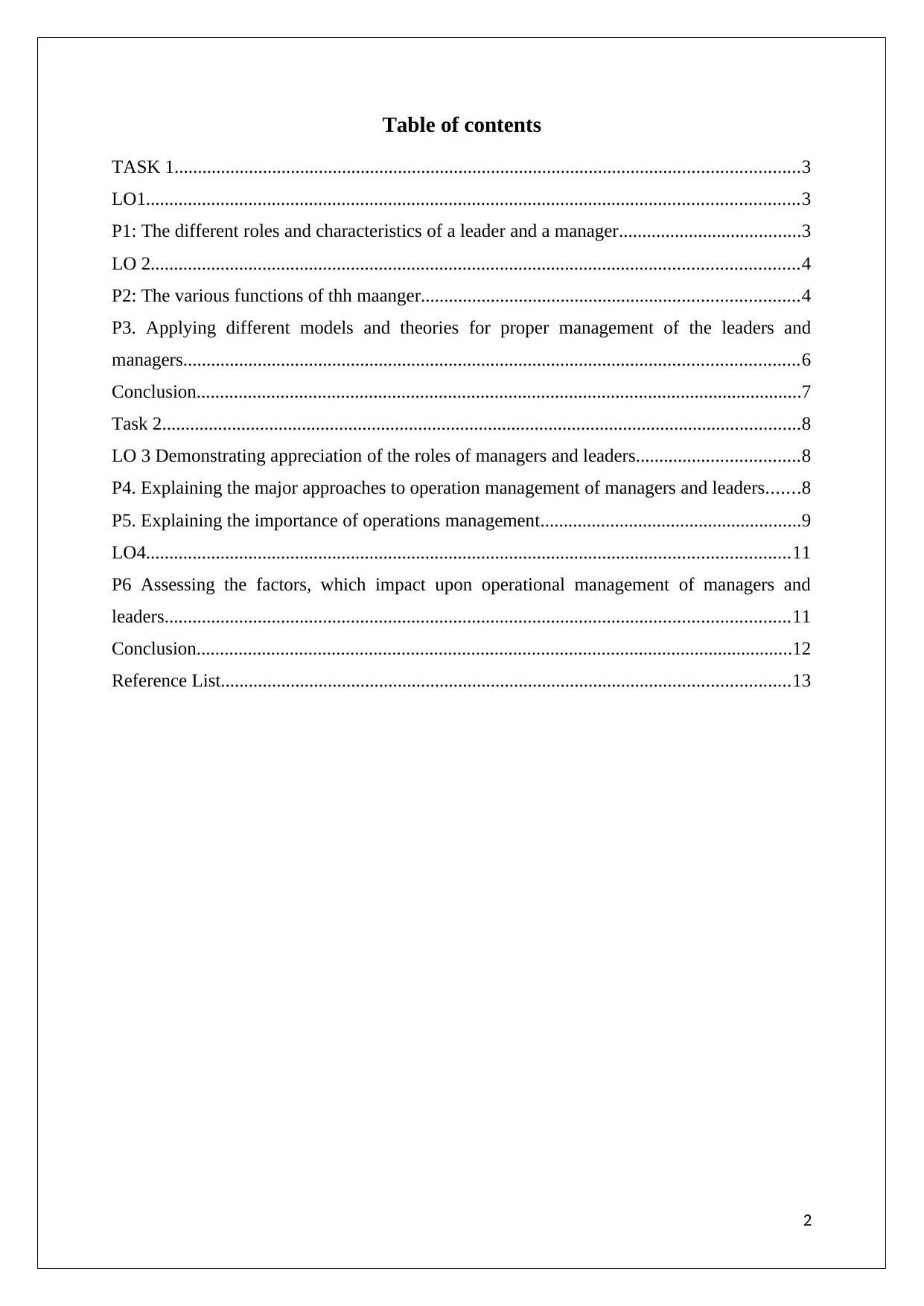
Table of contents
TASK 1......................................................................................................................................3
LO1............................................................................................................................................3
P1: The different roles and characteristics of a leader and a manager.......................................3
LO 2...........................................................................................................................................4
P2: The various functions of thh maanger.................................................................................4
P3. Applying different models and theories for proper management of the leaders and
managers....................................................................................................................................6
Conclusion..................................................................................................................................7
Task 2.........................................................................................................................................8
LO 3 Demonstrating appreciation of the roles of managers and leaders...................................8
P4. Explaining the major approaches to operation management of managers and leaders.......8
P5. Explaining the importance of operations management........................................................9
LO4..........................................................................................................................................11
P6 Assessing the factors, which impact upon operational management of managers and
leaders......................................................................................................................................11
Conclusion................................................................................................................................12
Reference List..........................................................................................................................13
2
TASK 1......................................................................................................................................3
LO1............................................................................................................................................3
P1: The different roles and characteristics of a leader and a manager.......................................3
LO 2...........................................................................................................................................4
P2: The various functions of thh maanger.................................................................................4
P3. Applying different models and theories for proper management of the leaders and
managers....................................................................................................................................6
Conclusion..................................................................................................................................7
Task 2.........................................................................................................................................8
LO 3 Demonstrating appreciation of the roles of managers and leaders...................................8
P4. Explaining the major approaches to operation management of managers and leaders.......8
P5. Explaining the importance of operations management........................................................9
LO4..........................................................................................................................................11
P6 Assessing the factors, which impact upon operational management of managers and
leaders......................................................................................................................................11
Conclusion................................................................................................................................12
Reference List..........................................................................................................................13
2
TASK 1
The operation refers to the organisational functions and the management is the hierarchy who
managers the organisational operations. The operation and management helps to enhance the
efficiency of the entire organisation. In the opinion of Goetsch and Davis (2014, p.12),
leaders and managers of a company help the organisation to acquire value or brand image in
market in which firm is operating their business. In this report, managerial operations of M&
S Ltd, that is a UK based company which is dealing in retails products, will be discussed. In
order to make the employees effective enough in their operations, role of leaders and
managers of concerned company will be evaluated here. Finally, importance of different
leadership styles and theories related to the management will be analysed with reference to M
& S Ltd. `
LO1
P1: Different roles and characteristics of a leader and a manager
Leaders:
In the opinion of Caldwell and Ndalamba (2017, p.4), leaders are the motivating factor within
an organisation as they help employees to perform their job in a proper way in order to
acquire the business objectives effectually. As per the views of Fee (2014, p.13), leaders
acknowledge other employees with effective communication skill through which they convey
the mission and vision of firm to the team members. Main objective of organisation is to
inspire and guide the team members in order to enhance performance and productivity of
business.
Managers:
According to Robbins and McFarland (2015, 219), within organisation managers play a
critical role as they manage and organise the work of an enterprise in order to help attaining
the desired objectives and goals. In the opinion of Hill et al. (2014, p.15), to achieve the
business objectives managers of an organisation develops several policies and strategies to
make employee’s performance effective to acquire the organisational mission, vision and
3
The operation refers to the organisational functions and the management is the hierarchy who
managers the organisational operations. The operation and management helps to enhance the
efficiency of the entire organisation. In the opinion of Goetsch and Davis (2014, p.12),
leaders and managers of a company help the organisation to acquire value or brand image in
market in which firm is operating their business. In this report, managerial operations of M&
S Ltd, that is a UK based company which is dealing in retails products, will be discussed. In
order to make the employees effective enough in their operations, role of leaders and
managers of concerned company will be evaluated here. Finally, importance of different
leadership styles and theories related to the management will be analysed with reference to M
& S Ltd. `
LO1
P1: Different roles and characteristics of a leader and a manager
Leaders:
In the opinion of Caldwell and Ndalamba (2017, p.4), leaders are the motivating factor within
an organisation as they help employees to perform their job in a proper way in order to
acquire the business objectives effectually. As per the views of Fee (2014, p.13), leaders
acknowledge other employees with effective communication skill through which they convey
the mission and vision of firm to the team members. Main objective of organisation is to
inspire and guide the team members in order to enhance performance and productivity of
business.
Managers:
According to Robbins and McFarland (2015, 219), within organisation managers play a
critical role as they manage and organise the work of an enterprise in order to help attaining
the desired objectives and goals. In the opinion of Hill et al. (2014, p.15), to achieve the
business objectives managers of an organisation develops several policies and strategies to
make employee’s performance effective to acquire the organisational mission, vision and
3
⊘ This is a preview!⊘
Do you want full access?
Subscribe today to unlock all pages.

Trusted by 1+ million students worldwide
objectives. In order to judge the efficiency of performance of employees, managers develop
performance appraisal process which helps in increasing efficiency of workers.
Comparison between leaders and the managers:
Though the task of the managers and the leaders is complement each other but there is a fine
line of difference in their tasks. In the opinion of Robbins and McFarland (2015, p.219),
managers and leaders try to enhance the productivity of organisation but they choose a
different way to acquire the same. Managers within an organisation develop the objectives of
same whereas leaders guide employees to acquire those decided goals. Management of an
organisation develops rules so that the leaders can convey the instruction of the same to the
team members. Leaders inspire and influence the employees to work according to these
policies. Managers need to deal with a group of people whereas the leaders guide their team
only. More preciously, a manager innovates several plans for the betterment of organisation
and the leaders make implementation of those plans in reality. Leaders within an organisation
motivate the team members whereas managers provide orders to the employees to perform
their job.
In M & S Ltd, that is, one of the UK-based private retail companies, role of leaders and
managers can be differentiated in many factors. Managers of concerned company develop
different business plans in order to gain the competitive advantage in the UK retail market
leaders of the concerned company help in using their interpersonal communication skills to
communicate with team members and also to motivate them to perform their tasks properly.
Main role of managers and leaders are to achieve the pre-planned objective of M & S Ltd
which is to acquire a competitive edge over others and brand value in the competitive market.
LO 2
P2: Way in which role of a leader and the function of a manager is applied
in different situational contexts
In M & S Ltd functions of the managers and leaders are as follows:
Making plans and strategies:
4
performance appraisal process which helps in increasing efficiency of workers.
Comparison between leaders and the managers:
Though the task of the managers and the leaders is complement each other but there is a fine
line of difference in their tasks. In the opinion of Robbins and McFarland (2015, p.219),
managers and leaders try to enhance the productivity of organisation but they choose a
different way to acquire the same. Managers within an organisation develop the objectives of
same whereas leaders guide employees to acquire those decided goals. Management of an
organisation develops rules so that the leaders can convey the instruction of the same to the
team members. Leaders inspire and influence the employees to work according to these
policies. Managers need to deal with a group of people whereas the leaders guide their team
only. More preciously, a manager innovates several plans for the betterment of organisation
and the leaders make implementation of those plans in reality. Leaders within an organisation
motivate the team members whereas managers provide orders to the employees to perform
their job.
In M & S Ltd, that is, one of the UK-based private retail companies, role of leaders and
managers can be differentiated in many factors. Managers of concerned company develop
different business plans in order to gain the competitive advantage in the UK retail market
leaders of the concerned company help in using their interpersonal communication skills to
communicate with team members and also to motivate them to perform their tasks properly.
Main role of managers and leaders are to achieve the pre-planned objective of M & S Ltd
which is to acquire a competitive edge over others and brand value in the competitive market.
LO 2
P2: Way in which role of a leader and the function of a manager is applied
in different situational contexts
In M & S Ltd functions of the managers and leaders are as follows:
Making plans and strategies:
4
Paraphrase This Document
Need a fresh take? Get an instant paraphrase of this document with our AI Paraphraser
Managers of M & S Ltd set the goals of concerned company which help it to increase their
revenues and selling percentage. “Look at the Label” is one of the strategies which are
undertaken by the concerned firm in order to increases its profitability. At this point, leaders
guide and motivate the employees to perform their job by communicating with them
personally in accordance with the managerial strategy.
Organise:
In M & S Ltd, managers collect resources and organise them properly in order to achieve the
objectives of concerned company. However, the leaders allocate these collected resources
according to the efficiency of employees and guide them in a proper way to gain the common
goal of company.
Recruitment and staff:
In this function, leaders and managers have to contribute their best. In M& S Ltd. managers
recruit employees by judging the ability of individuals. After the recruitment and selection
process, leaders of concerned company allocate the jobs to employees based on their
efficiency and skills in order to enhance the productivity of entire company.
Development of coordination:
In the opinion of Sijbom et al. (2013, p.12), coordination is required for proper functioning of
an organisation to acquire effective outcomes. In the concerned company the managers
coordinate with organisational functions for the betterment of its performance. Productivity
of M& S Ltd depends on the functions of departments like sales, marketing and finance.
Managers help to develop practices to coordinate among these departments. Leaders
implement the developed practices to ensure coordination of the functions of different
departments of concerned company.
Controlling process:
In the firm M & S Ltd., managers formulate different strategies and leaders take initiatives to
implement the same in order to meet the business objectives. But this implementation
process needs to be monitored and controlled by an experienced supervisor to ensure the
positive outcomes. Mainly managers of concerned company control and monitor the strategy
implementation process and leaders provide guidance to the employees so that positive
outcomes can be acquired which enhances the performance of concerned organisation.
5
revenues and selling percentage. “Look at the Label” is one of the strategies which are
undertaken by the concerned firm in order to increases its profitability. At this point, leaders
guide and motivate the employees to perform their job by communicating with them
personally in accordance with the managerial strategy.
Organise:
In M & S Ltd, managers collect resources and organise them properly in order to achieve the
objectives of concerned company. However, the leaders allocate these collected resources
according to the efficiency of employees and guide them in a proper way to gain the common
goal of company.
Recruitment and staff:
In this function, leaders and managers have to contribute their best. In M& S Ltd. managers
recruit employees by judging the ability of individuals. After the recruitment and selection
process, leaders of concerned company allocate the jobs to employees based on their
efficiency and skills in order to enhance the productivity of entire company.
Development of coordination:
In the opinion of Sijbom et al. (2013, p.12), coordination is required for proper functioning of
an organisation to acquire effective outcomes. In the concerned company the managers
coordinate with organisational functions for the betterment of its performance. Productivity
of M& S Ltd depends on the functions of departments like sales, marketing and finance.
Managers help to develop practices to coordinate among these departments. Leaders
implement the developed practices to ensure coordination of the functions of different
departments of concerned company.
Controlling process:
In the firm M & S Ltd., managers formulate different strategies and leaders take initiatives to
implement the same in order to meet the business objectives. But this implementation
process needs to be monitored and controlled by an experienced supervisor to ensure the
positive outcomes. Mainly managers of concerned company control and monitor the strategy
implementation process and leaders provide guidance to the employees so that positive
outcomes can be acquired which enhances the performance of concerned organisation.
5
P3. Applying different models, approaches and theories
In the opinion of Antonakis and House (2013, p. 33), business organisations structure the
economy of a country. Firms are bound to follow certain roles and responsibilities, which will
help them to move on the path of glory and success. Leaders and even the managers of a
business organisation can be symbolically equated to the roots of a firm. In the opinion of
Antonakis and House (2013, p. 33), proper and productive functioning of managers, as well
as, the leaders of an enterprise shapes the success of enterprise. Leaders and even the
managers of M & S Ltd perform numerous activities for the growth of an organisation. In the
perspective of Bowers et al. (2016, p. 96), these roles and responsibilities performed by the
leaders of an organisation, as well as managers are analysed and even guided with help of
various models and theories. In this section such models and theories will be analysed which
are used for evaluating the functioning of managers, and leaders of M & S Ltd. Some of the
most important theories for fulfilling the above mentioned tasks are:
Situational leadership
This is a form of leadership, which is developed or created by Paul Hersey and Kenneth
Blanchard. In this type of leadership the leaders of business organisation must at first
completely analyse the capabilities and skills of every employee organisation. Next step that
leaders need to perform is to structure the activities and tasks in such a way that employees
will be able to present their creativity in that work. Therefore, leader makes the situation
easy, so that they can work productively and profitably for the enterprise are referred as
Situational leadership. In the perspective of Bowers et al. (2016, p. 96), this form of
leadership can affect the operations of M & S Ltd positively. Moreover, by utilising this form
of leadership enterprise will be able to derive the best productivity from employees of
enterprise. The employees are influenced by the organisation, as they will find that
organisation is giving importance to their perspectives and even thinking for their betterment.
System leadership
In the view of Carter and DeChurch (2014, p. 482), this is another form of leadership used by
business enterprises. In this type of leadership the leaders of enterprise do not structure the
situations in accordance to the employees. However, System leadership believes that
employees of organisation must be well informed about its functioning, so that they may
work accordingly. In this form of leadership members at the position of leaders, do not much
6
In the opinion of Antonakis and House (2013, p. 33), business organisations structure the
economy of a country. Firms are bound to follow certain roles and responsibilities, which will
help them to move on the path of glory and success. Leaders and even the managers of a
business organisation can be symbolically equated to the roots of a firm. In the opinion of
Antonakis and House (2013, p. 33), proper and productive functioning of managers, as well
as, the leaders of an enterprise shapes the success of enterprise. Leaders and even the
managers of M & S Ltd perform numerous activities for the growth of an organisation. In the
perspective of Bowers et al. (2016, p. 96), these roles and responsibilities performed by the
leaders of an organisation, as well as managers are analysed and even guided with help of
various models and theories. In this section such models and theories will be analysed which
are used for evaluating the functioning of managers, and leaders of M & S Ltd. Some of the
most important theories for fulfilling the above mentioned tasks are:
Situational leadership
This is a form of leadership, which is developed or created by Paul Hersey and Kenneth
Blanchard. In this type of leadership the leaders of business organisation must at first
completely analyse the capabilities and skills of every employee organisation. Next step that
leaders need to perform is to structure the activities and tasks in such a way that employees
will be able to present their creativity in that work. Therefore, leader makes the situation
easy, so that they can work productively and profitably for the enterprise are referred as
Situational leadership. In the perspective of Bowers et al. (2016, p. 96), this form of
leadership can affect the operations of M & S Ltd positively. Moreover, by utilising this form
of leadership enterprise will be able to derive the best productivity from employees of
enterprise. The employees are influenced by the organisation, as they will find that
organisation is giving importance to their perspectives and even thinking for their betterment.
System leadership
In the view of Carter and DeChurch (2014, p. 482), this is another form of leadership used by
business enterprises. In this type of leadership the leaders of enterprise do not structure the
situations in accordance to the employees. However, System leadership believes that
employees of organisation must be well informed about its functioning, so that they may
work accordingly. In this form of leadership members at the position of leaders, do not much
6
⊘ This is a preview!⊘
Do you want full access?
Subscribe today to unlock all pages.
Trusted by 1+ million students worldwide
focus on deriving the capabilities of working force. However, they believe in moulding the
capabilities and skills of the employees according to needs or the demands of business
enterprise.
Contingency leadership
According to this leadership theory, the function of organisation and its decision making
process can only be done through the dependency on the external and inter situation. thus,
while leading a team the situation of a firm needs to be concerned.
Conclusion
The characteristics of managers and leaders are to guide the employee and manage the
organisational function in order success in the competitive field. Managers of a firm develop
rules and regulations, which are conveyed to the employees through the leaders. Managers
recruit staff and organise the work process. Leaders guide the team members and influence
their performance. In future, the leaders can use internet to get update of the work team
member and can maintain the accuracy of the work. Managers can develop seminar with the
leaders to get news regarding the progress in work.
Task 2
LO 3 Demonstrating appreciation of the roles of managers and leaders
Introduction
In the words of Cavarretta et al. (2015, p. 16822), leaders and managers play an important
role towards the growth of an organisation. In this particular section of the assignment, a
discussion will be conducted on various approaches undertaken by the business enterprises.
Moreover, management consultant of M & S Ltd will explain various approaches undertaken
by firm for managing the operations of business enterprise. At the end of assignment,
management consultant will also demonstrate a clear understanding about relationship, which
exists between the leaders and the managers leading M & S Ltd on the path of glory and
success.
7
capabilities and skills of the employees according to needs or the demands of business
enterprise.
Contingency leadership
According to this leadership theory, the function of organisation and its decision making
process can only be done through the dependency on the external and inter situation. thus,
while leading a team the situation of a firm needs to be concerned.
Conclusion
The characteristics of managers and leaders are to guide the employee and manage the
organisational function in order success in the competitive field. Managers of a firm develop
rules and regulations, which are conveyed to the employees through the leaders. Managers
recruit staff and organise the work process. Leaders guide the team members and influence
their performance. In future, the leaders can use internet to get update of the work team
member and can maintain the accuracy of the work. Managers can develop seminar with the
leaders to get news regarding the progress in work.
Task 2
LO 3 Demonstrating appreciation of the roles of managers and leaders
Introduction
In the words of Cavarretta et al. (2015, p. 16822), leaders and managers play an important
role towards the growth of an organisation. In this particular section of the assignment, a
discussion will be conducted on various approaches undertaken by the business enterprises.
Moreover, management consultant of M & S Ltd will explain various approaches undertaken
by firm for managing the operations of business enterprise. At the end of assignment,
management consultant will also demonstrate a clear understanding about relationship, which
exists between the leaders and the managers leading M & S Ltd on the path of glory and
success.
7
Paraphrase This Document
Need a fresh take? Get an instant paraphrase of this document with our AI Paraphraser
P4. Explaining the major approaches to operation management and role
that leaders and managers play
In the perspective of Cavarretta et al. (2015, p. 16822), operational management is a kind of
business practice or functioning undertaken by business enterprises for the development of #
organisation. A firm comprises of various elements which work towards the growth of the
organisation. Elements are employees, leaders and even managers. In the opinion of Chuang
et al. (2016, p. 524), operational management refers to the process performed by business
oriented enterprises in order to extract complete productivity from the members working for
business organisation. Moreover, operational management focuses on increasing or
enhancing the productivity of business enterprise, whereas utilising minimum amount of
resources. As per Colbert et al. (2014, p. 351), operational management functions towards the
role manager and leaders which confirms the profitability of the same. Some of the
approaches of managers and leaders of an organisation are as follows:
Deriving out great mentors
This is the first approach, which M & S Ltd must undertake in order to improve the
leadership quality of an organisation, so that firm can perform in a profitable way and lead to
economic growth of the country. In the perspective of Luo and Liu (2014, p.1725), leaders
are the most important elements existing within a business enterprise who influence other
employees of organisation to work, with higher productivity and profits for the business
organisation. Therefore, the organisation must find proper mentor among the other members
of the firm who can motivate the other staffs of the business enterprise.
Objectives
According to Manley and Titchen (2016, p.24), it is important to note that the members
linked with any company will not be able to work efficiently for the organisation, until they
are acknowledge d with the objective of firm. Therefore, the business enterprise must focus
on providing proper training to the leaders, so that objectives or goals will be clear to them.
Once the objective is clear to leaders, they can create their own vision about the growth of
enterprise and work on it.
Six Sigma
8
that leaders and managers play
In the perspective of Cavarretta et al. (2015, p. 16822), operational management is a kind of
business practice or functioning undertaken by business enterprises for the development of #
organisation. A firm comprises of various elements which work towards the growth of the
organisation. Elements are employees, leaders and even managers. In the opinion of Chuang
et al. (2016, p. 524), operational management refers to the process performed by business
oriented enterprises in order to extract complete productivity from the members working for
business organisation. Moreover, operational management focuses on increasing or
enhancing the productivity of business enterprise, whereas utilising minimum amount of
resources. As per Colbert et al. (2014, p. 351), operational management functions towards the
role manager and leaders which confirms the profitability of the same. Some of the
approaches of managers and leaders of an organisation are as follows:
Deriving out great mentors
This is the first approach, which M & S Ltd must undertake in order to improve the
leadership quality of an organisation, so that firm can perform in a profitable way and lead to
economic growth of the country. In the perspective of Luo and Liu (2014, p.1725), leaders
are the most important elements existing within a business enterprise who influence other
employees of organisation to work, with higher productivity and profits for the business
organisation. Therefore, the organisation must find proper mentor among the other members
of the firm who can motivate the other staffs of the business enterprise.
Objectives
According to Manley and Titchen (2016, p.24), it is important to note that the members
linked with any company will not be able to work efficiently for the organisation, until they
are acknowledge d with the objective of firm. Therefore, the business enterprise must focus
on providing proper training to the leaders, so that objectives or goals will be clear to them.
Once the objective is clear to leaders, they can create their own vision about the growth of
enterprise and work on it.
Six Sigma
8
As per McCleskey (2014, p.117), another important methodology utilised by the business
enterprises to manage functions of managers and leaders of organisation involves
incorporating Six Sigma methodology. It is beneficial for the firm as it focuses on improving
activities or functions performed by the leaders of organisation. The Six Sigma methodology
forces the leaders to undertake the process of team work. The efforts that a leader shows
while managing a whole team, show his efficiency. Similarly, M & S Ltd can also utilise
such approaches for the cause of operational management of leadership. Similarly, various
approaches are also undertaken for managing proper functioning of managers of organisation.
P5. Explaining the importance and value of operations management in
achieving business objectives
In the perspective of Pratt (2014, p.55), business organisations are structured or formed by
accomplishing or fulfilling numerous roles and responsibilities. Various operations of a firm
are to be carried out properly for the development of a business enterprise. Operational
management refers to the management of numerous activities of organisation. Business
organisations are divided into various departments, forming different functions. All these
functions are utmost necessary for the regular expansion of business enterprise, which is
conducted by the Operational management. Operational management is important for an
organisation, not only to scrutinise the functions performed by various departments, rather it
also focuses on undertaking decision- making process, which will be highly beneficial for the
business enterprise. Moreover, all the processes, which are performed by various
departments, are also controlled in the functioning of Operational management.
Earlier, it was considered that the department of economic and finance are necessary for
organisation. However, in this modern era it is proven that importance of operational
management is enormously necessary for the progress of a business enterprise. In this
competitive business world, where there are numerous other business competitors, it is
necessary that the operations of a business enterprise are managed properly, so that it can
defeat the other business competitors.
In the perspective of Pratt (2014, p.55), proper operational management of a business
enterprise influence the enterprise to perform in a productive, efficient and profitable manner
leading to the growth of enterprise. There are some important departments within a business
organisation such as HRM, finance department etc. The functioning of these is managed by
9
enterprises to manage functions of managers and leaders of organisation involves
incorporating Six Sigma methodology. It is beneficial for the firm as it focuses on improving
activities or functions performed by the leaders of organisation. The Six Sigma methodology
forces the leaders to undertake the process of team work. The efforts that a leader shows
while managing a whole team, show his efficiency. Similarly, M & S Ltd can also utilise
such approaches for the cause of operational management of leadership. Similarly, various
approaches are also undertaken for managing proper functioning of managers of organisation.
P5. Explaining the importance and value of operations management in
achieving business objectives
In the perspective of Pratt (2014, p.55), business organisations are structured or formed by
accomplishing or fulfilling numerous roles and responsibilities. Various operations of a firm
are to be carried out properly for the development of a business enterprise. Operational
management refers to the management of numerous activities of organisation. Business
organisations are divided into various departments, forming different functions. All these
functions are utmost necessary for the regular expansion of business enterprise, which is
conducted by the Operational management. Operational management is important for an
organisation, not only to scrutinise the functions performed by various departments, rather it
also focuses on undertaking decision- making process, which will be highly beneficial for the
business enterprise. Moreover, all the processes, which are performed by various
departments, are also controlled in the functioning of Operational management.
Earlier, it was considered that the department of economic and finance are necessary for
organisation. However, in this modern era it is proven that importance of operational
management is enormously necessary for the progress of a business enterprise. In this
competitive business world, where there are numerous other business competitors, it is
necessary that the operations of a business enterprise are managed properly, so that it can
defeat the other business competitors.
In the perspective of Pratt (2014, p.55), proper operational management of a business
enterprise influence the enterprise to perform in a productive, efficient and profitable manner
leading to the growth of enterprise. There are some important departments within a business
organisation such as HRM, finance department etc. The functioning of these is managed by
9
⊘ This is a preview!⊘
Do you want full access?
Subscribe today to unlock all pages.
Trusted by 1+ million students worldwide
operation management. Major objective of operational department is to enhance the
productivity of enterprise to numerous folds, by using minimum amount of natural and
human resources. Moreover, the operational management, also works towards utilising the
current or present resources in such a manner that it gives rise to innovative resources, which
the organisation can further use to gain profit. Employees are important resources that are
available with a business organisation. The Operational Management of the employees will
work towards motivating, as well as, providing them with beneficial training so that they
would work efficiently for the business enterprises, leading organisation on the path of
progress. M & S Ltd can also gain huge profits by incorporating operational management in
their organisational functions.
LO4
P6 Assessing the factors within the business environment, which impact
upon operational management and decision making by managers and
leaders
As per the perspective of Schuh (2014, p.363), Operational Management is performed for
managing the performance of leaders and managers of a business enterprise. This function is
necessary for the proper functioning of a business organisation. Leaders and managers of an
organisation are the building blocks of organisation, as they have responsibilities of
controlling the entire firm. In the perspective of Schuh (2014, p.363), employees of a
business enterprise are motivated by the leaders, as well as, by through managers. However,
in the process of operation management, managers and even leaders of the organisation may
face huge number of obstacles, which hinder the process of management. M & S Ltd also
faces these kinds of barriers, which influence the operational management of leaders and
managers. These obstacles are mitigated by incorporating proper management within
organisation. Major factors that influence the operational management of leaders of M & S
Ltd and the managers are as follows:
Improvement of Relationship
Proper operational management helps in making the relationship between leaders and the
managers of organisation strong for improving functioning of the enterprise.
10
productivity of enterprise to numerous folds, by using minimum amount of natural and
human resources. Moreover, the operational management, also works towards utilising the
current or present resources in such a manner that it gives rise to innovative resources, which
the organisation can further use to gain profit. Employees are important resources that are
available with a business organisation. The Operational Management of the employees will
work towards motivating, as well as, providing them with beneficial training so that they
would work efficiently for the business enterprises, leading organisation on the path of
progress. M & S Ltd can also gain huge profits by incorporating operational management in
their organisational functions.
LO4
P6 Assessing the factors within the business environment, which impact
upon operational management and decision making by managers and
leaders
As per the perspective of Schuh (2014, p.363), Operational Management is performed for
managing the performance of leaders and managers of a business enterprise. This function is
necessary for the proper functioning of a business organisation. Leaders and managers of an
organisation are the building blocks of organisation, as they have responsibilities of
controlling the entire firm. In the perspective of Schuh (2014, p.363), employees of a
business enterprise are motivated by the leaders, as well as, by through managers. However,
in the process of operation management, managers and even leaders of the organisation may
face huge number of obstacles, which hinder the process of management. M & S Ltd also
faces these kinds of barriers, which influence the operational management of leaders and
managers. These obstacles are mitigated by incorporating proper management within
organisation. Major factors that influence the operational management of leaders of M & S
Ltd and the managers are as follows:
Improvement of Relationship
Proper operational management helps in making the relationship between leaders and the
managers of organisation strong for improving functioning of the enterprise.
10
Paraphrase This Document
Need a fresh take? Get an instant paraphrase of this document with our AI Paraphraser
Enhancing better Communication
All the policies of environmental protection, maintaining quality of products, satisfying
customers etc. are created or formed by the managers of organisation, which are to be
implemented for proper functioning of M & S Ltd. This is possible via operational
Management, which helps managers and leaders to communicate with each other leading to
the implementation of policies.
Conclusion
In short, the role of managers and leaders is to derive out better mentors from existing
employees. Main objective of manager and leaders is to acquire six sigma. Through proper
functioning of six sigma, the objective of firm can be acquired. In future by using technology
the business functions can be improved to enhance profitability.
11
All the policies of environmental protection, maintaining quality of products, satisfying
customers etc. are created or formed by the managers of organisation, which are to be
implemented for proper functioning of M & S Ltd. This is possible via operational
Management, which helps managers and leaders to communicate with each other leading to
the implementation of policies.
Conclusion
In short, the role of managers and leaders is to derive out better mentors from existing
employees. Main objective of manager and leaders is to acquire six sigma. Through proper
functioning of six sigma, the objective of firm can be acquired. In future by using technology
the business functions can be improved to enhance profitability.
11
Reference List
Antonakis, J. and House, R.J. (2013). The full-range leadership theory: The way forward.
In Transformational and Charismatic Leadership: The Road Ahead 10th Anniversary
Edition (pp. 3-33). Emerald Group Publishing Limited.
Bowers, J.R., Rosch, D.M. and Collier, D.A. (2016). Examining the relationship between
role models and leadership growth during the transition to adulthood. Journal of Adolescent
Research, 31(1), pp.96-118.
Caldwell, C. and Ndalamba, K.K. (2017). Human Resource Professionals as Strategic
Leaders—A Behavioral Opportunity for Improving Information Management. The Journal of
Values-Based Leadership, 10(1), p.4.
Carter, D.R. and DeChurch, L.A. (2014). Leadership in multiteam systems: A network
perspective. Oxford library of psychology. The Oxford handbook of leadership and
organizations, pp.482-502.
Cavarretta, F., Piccolo, R.F. and Uhl-Bien, M. (2015), January. Leadership Beyond the
Tipping Point: Discovering Inversions and Complementary Hypotheses. In Academy of
Management Proceedings (Vol. 2015, No. 1, p. 16822). Academy of Management.
Chuang, C.H., Jackson, S.E. and Jiang, Y. (2016). Can knowledge-intensive teamwork be
managed? Examining the roles of HRM systems, leadership, and tacit knowledge. Journal of
management, 42(2), pp.524-554.
Colbert, A.E., Barrick, M.R. and Bradley, B.H. (2014). Personality and leadership
composition in top management teams: Implications for organizational
effectiveness. Personnel Psychology, 67(2), pp.351-387.
Fee, M.C. (2014). Human resources management. Pearson Publication, Holloway.
Goetsch, D.L. and Davis, S.B. (2014). Quality management for organizational excellence.
Upper Saddle River, NJ: pearson.
Hill, C.W., Jones, G.R. and Schilling, M.A. (2014). Strategic management: theory: an
integrated approach. Massachusetts: Cengage Learning.
Luo, H. and Liu, S. (2014). Effect of situational leadership and employee readiness match on
organizational citizenship behavior in China. Social Behavior and Personality: an
international journal, 42(10), pp.1725-1732.
12
Antonakis, J. and House, R.J. (2013). The full-range leadership theory: The way forward.
In Transformational and Charismatic Leadership: The Road Ahead 10th Anniversary
Edition (pp. 3-33). Emerald Group Publishing Limited.
Bowers, J.R., Rosch, D.M. and Collier, D.A. (2016). Examining the relationship between
role models and leadership growth during the transition to adulthood. Journal of Adolescent
Research, 31(1), pp.96-118.
Caldwell, C. and Ndalamba, K.K. (2017). Human Resource Professionals as Strategic
Leaders—A Behavioral Opportunity for Improving Information Management. The Journal of
Values-Based Leadership, 10(1), p.4.
Carter, D.R. and DeChurch, L.A. (2014). Leadership in multiteam systems: A network
perspective. Oxford library of psychology. The Oxford handbook of leadership and
organizations, pp.482-502.
Cavarretta, F., Piccolo, R.F. and Uhl-Bien, M. (2015), January. Leadership Beyond the
Tipping Point: Discovering Inversions and Complementary Hypotheses. In Academy of
Management Proceedings (Vol. 2015, No. 1, p. 16822). Academy of Management.
Chuang, C.H., Jackson, S.E. and Jiang, Y. (2016). Can knowledge-intensive teamwork be
managed? Examining the roles of HRM systems, leadership, and tacit knowledge. Journal of
management, 42(2), pp.524-554.
Colbert, A.E., Barrick, M.R. and Bradley, B.H. (2014). Personality and leadership
composition in top management teams: Implications for organizational
effectiveness. Personnel Psychology, 67(2), pp.351-387.
Fee, M.C. (2014). Human resources management. Pearson Publication, Holloway.
Goetsch, D.L. and Davis, S.B. (2014). Quality management for organizational excellence.
Upper Saddle River, NJ: pearson.
Hill, C.W., Jones, G.R. and Schilling, M.A. (2014). Strategic management: theory: an
integrated approach. Massachusetts: Cengage Learning.
Luo, H. and Liu, S. (2014). Effect of situational leadership and employee readiness match on
organizational citizenship behavior in China. Social Behavior and Personality: an
international journal, 42(10), pp.1725-1732.
12
⊘ This is a preview!⊘
Do you want full access?
Subscribe today to unlock all pages.
Trusted by 1+ million students worldwide

1 out of 13


Related Documents


Your All-in-One AI-Powered Toolkit for Academic Success.
+13062052269
info@desklib.com
Available 24*7 on WhatsApp / Email
![[object Object]](/_next/static/media/star-bottom.7253800d.svg)
Unlock your academic potential
Copyright © 2020–2026 A2Z Services. All Rights Reserved. Developed and managed by ZUCOL.