Leadership and Management in Organizations: A Comprehensive Analysis
VerifiedAdded on 2020/06/04
|17
|5967
|47
Report
AI Summary
This report delves into the critical roles of leaders and managers within organizations, specifically using Ernst & Young as a case study. It begins by defining and contrasting the characteristics of managers and leaders, highlighting their distinct responsibilities and functions. The report then explores the application of various leadership theories and management models within different organizational contexts, such as delegation of authority, employee engagement, and training and development. It examines key approaches to operations management, emphasizing the importance of operational efficiency and the value of effective management practices. Furthermore, the report analyzes the relationship between leadership and management in the business environment, emphasizing the impact of external factors on internal operations. Through this comprehensive analysis, the report aims to provide a deeper understanding of how effective leadership and management contribute to organizational success.
Management and operations

Paraphrase This Document
Need a fresh take? Get an instant paraphrase of this document with our AI Paraphraser
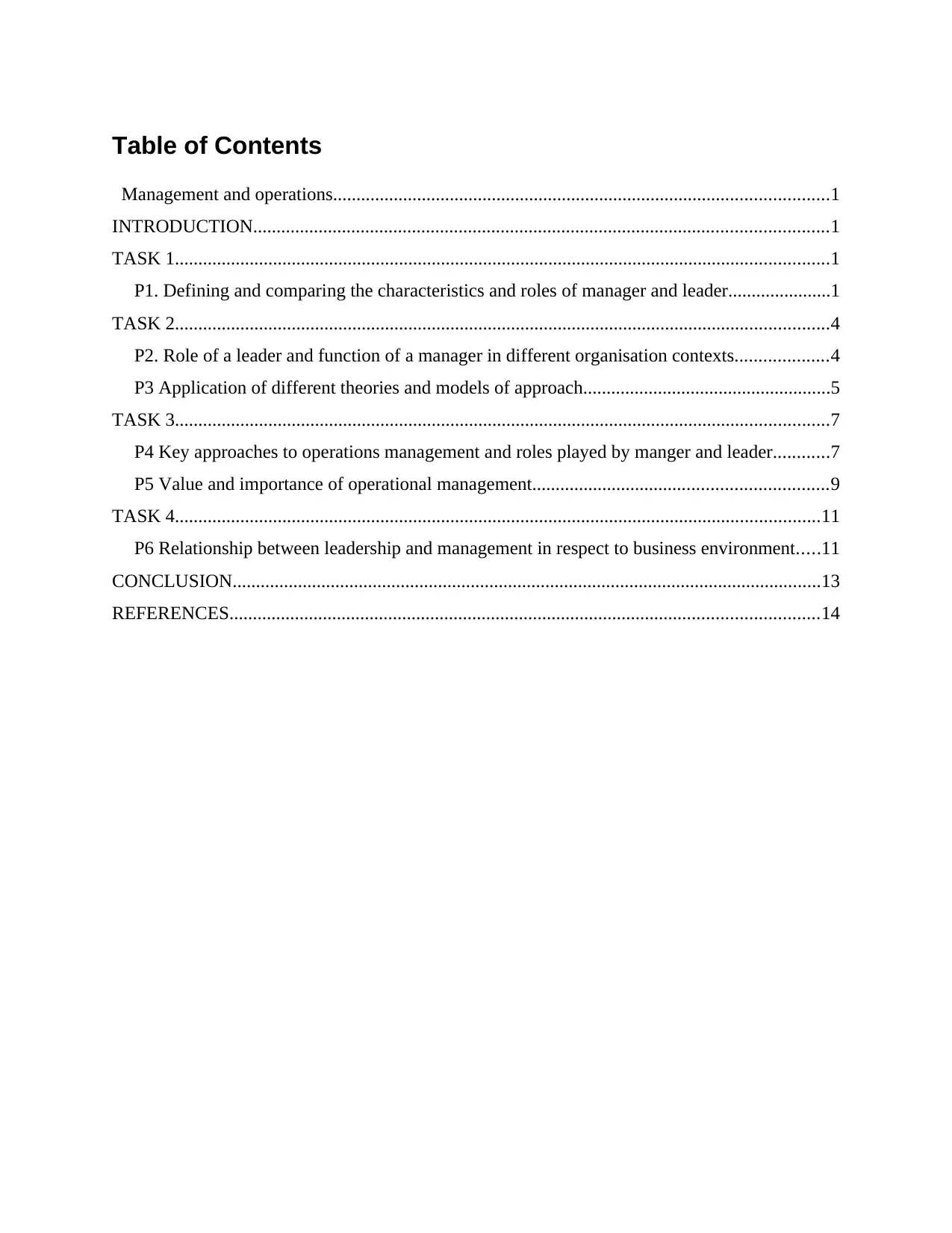
Table of Contents
Management and operations..........................................................................................................1
INTRODUCTION...........................................................................................................................1
TASK 1............................................................................................................................................1
P1. Defining and comparing the characteristics and roles of manager and leader......................1
TASK 2............................................................................................................................................4
P2. Role of a leader and function of a manager in different organisation contexts....................4
P3 Application of different theories and models of approach.....................................................5
TASK 3............................................................................................................................................7
P4 Key approaches to operations management and roles played by manger and leader............7
P5 Value and importance of operational management...............................................................9
TASK 4..........................................................................................................................................11
P6 Relationship between leadership and management in respect to business environment.....11
CONCLUSION..............................................................................................................................13
REFERENCES..............................................................................................................................14
Management and operations..........................................................................................................1
INTRODUCTION...........................................................................................................................1
TASK 1............................................................................................................................................1
P1. Defining and comparing the characteristics and roles of manager and leader......................1
TASK 2............................................................................................................................................4
P2. Role of a leader and function of a manager in different organisation contexts....................4
P3 Application of different theories and models of approach.....................................................5
TASK 3............................................................................................................................................7
P4 Key approaches to operations management and roles played by manger and leader............7
P5 Value and importance of operational management...............................................................9
TASK 4..........................................................................................................................................11
P6 Relationship between leadership and management in respect to business environment.....11
CONCLUSION..............................................................................................................................13
REFERENCES..............................................................................................................................14
INTRODUCTION
It is correct to say that management and operations play a vital role in running the
business or in other words, operation management means administration of all business practices
in order to create highest level of efficiency possible within an organisation (Yang, Hong and
Modi, 2011). Company at the time of formulating corporate policies and objectives needs to
concern about the availability of resources so that at the time of manufacturing process which
includes conversion of material and labour into goods and services are converting effectively.
The whole assignment gives a brief discussion about role of leader and manager as well as
various theories and models used in operations management. It also tell about effect of business
environment in internal operations of organisations. In this report, Ernst & Young is taken which
is the UK based multinational management consultancy firm that deals in audit financial audit,
consultancy and advisory service. In this report, the importance of various leadership styles,
recruitment selection process and significance of management theory and operations which help
organisation in accomplishing their task and objectives in an effective and efficient manner are
discussed.
TASK 1
P1. Defining and comparing the characteristics and roles of manager and leader
In the dynamic business environment, both leaders and managers play a significant role
in organisation. Managers are those assets of organisation which manage all the activities related
to planning of upcoming strategies and effectively utilise all the resources of company and
leaders are those inspiring personalities who give direction to whole team for the
accomplishment of organisational objectives (Ward and et. al., 2010). The different types of
roles played by them are:
Role of a Manager
Goal oriented: Managers who are working in organisation are always focused towards
their daily targets and objectives. The main role conduct by her or him is to give the direction to
team members according to policies, strategy for goal accomplishment which impact lot.
Risk control: During the phase when whole organisation structure changed according to
external environment then in such case, manager interacts with every individual who faces
difficulty in accepting change in work culture. This will give hedge to organisation from all the
It is correct to say that management and operations play a vital role in running the
business or in other words, operation management means administration of all business practices
in order to create highest level of efficiency possible within an organisation (Yang, Hong and
Modi, 2011). Company at the time of formulating corporate policies and objectives needs to
concern about the availability of resources so that at the time of manufacturing process which
includes conversion of material and labour into goods and services are converting effectively.
The whole assignment gives a brief discussion about role of leader and manager as well as
various theories and models used in operations management. It also tell about effect of business
environment in internal operations of organisations. In this report, Ernst & Young is taken which
is the UK based multinational management consultancy firm that deals in audit financial audit,
consultancy and advisory service. In this report, the importance of various leadership styles,
recruitment selection process and significance of management theory and operations which help
organisation in accomplishing their task and objectives in an effective and efficient manner are
discussed.
TASK 1
P1. Defining and comparing the characteristics and roles of manager and leader
In the dynamic business environment, both leaders and managers play a significant role
in organisation. Managers are those assets of organisation which manage all the activities related
to planning of upcoming strategies and effectively utilise all the resources of company and
leaders are those inspiring personalities who give direction to whole team for the
accomplishment of organisational objectives (Ward and et. al., 2010). The different types of
roles played by them are:
Role of a Manager
Goal oriented: Managers who are working in organisation are always focused towards
their daily targets and objectives. The main role conduct by her or him is to give the direction to
team members according to policies, strategy for goal accomplishment which impact lot.
Risk control: During the phase when whole organisation structure changed according to
external environment then in such case, manager interacts with every individual who faces
difficulty in accepting change in work culture. This will give hedge to organisation from all the
⊘ This is a preview!⊘
Do you want full access?
Subscribe today to unlock all pages.

Trusted by 1+ million students worldwide
risks associated with unethical and negative behaviour which affect internal operations of
company.
Role of a Leader
Setting up a vision: The primary task of manager in organisation is setting up vision in
organisation because this helps in guiding employees what next they have to do in order to fulfil
each and every objectives of companies (Tang and Musa, 2011).
Building morale: This is an important part in order to improve the performance. For this
leader communicates with every employee and builds the morale of workforce so that they will
put efforts in their specialised sector. After that, feedback process is conducted in which
opinions and viewpoints of individuals are taken so that leader will organise training
programmes according to requirement of workforce in order to accomplished goals.
Management by objective: This theory is given by Peter Drucker in 1934 in which
organisation employees clearly know about the objectives and time limit regarding their
accomplishment. After that feedback about the all the methods used under it and at last compare
actual performance with standard performance and if any deviation arises take appropriate step
to solve it.
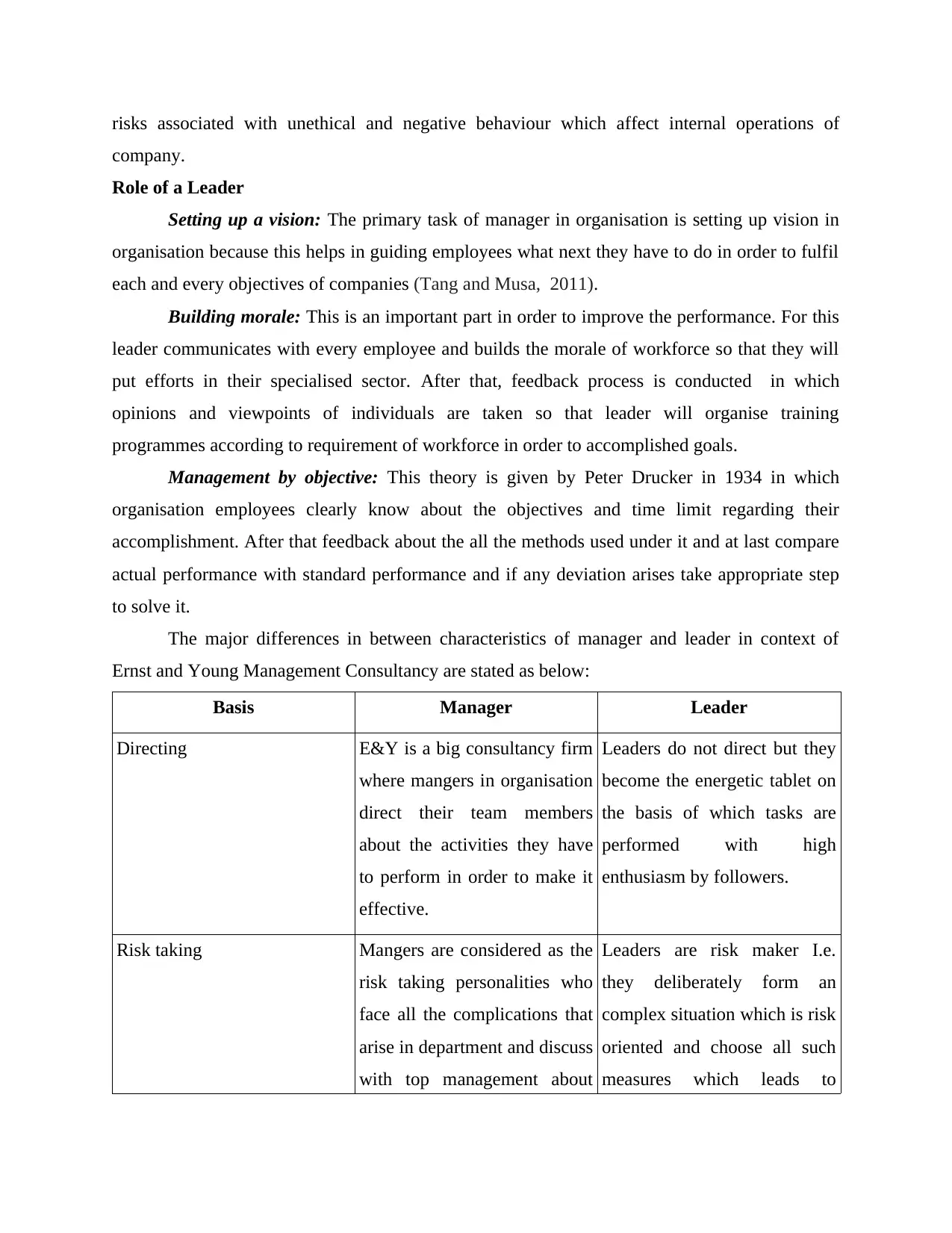
The major differences in between characteristics of manager and leader in context of
Ernst and Young Management Consultancy are stated as below:
Basis Manager Leader
Directing E&Y is a big consultancy firm
where mangers in organisation
direct their team members
about the activities they have
to perform in order to make it
effective.
Leaders do not direct but they
become the energetic tablet on
the basis of which tasks are
performed with high
enthusiasm by followers.
Risk taking Mangers are considered as the
risk taking personalities who
face all the complications that
arise in department and discuss
with top management about
Leaders are risk maker I.e.
they deliberately form an
complex situation which is risk
oriented and choose all such
measures which leads to
company.
Role of a Leader
Setting up a vision: The primary task of manager in organisation is setting up vision in
organisation because this helps in guiding employees what next they have to do in order to fulfil
each and every objectives of companies (Tang and Musa, 2011).
Building morale: This is an important part in order to improve the performance. For this
leader communicates with every employee and builds the morale of workforce so that they will
put efforts in their specialised sector. After that, feedback process is conducted in which
opinions and viewpoints of individuals are taken so that leader will organise training
programmes according to requirement of workforce in order to accomplished goals.
Management by objective: This theory is given by Peter Drucker in 1934 in which
organisation employees clearly know about the objectives and time limit regarding their
accomplishment. After that feedback about the all the methods used under it and at last compare
actual performance with standard performance and if any deviation arises take appropriate step
to solve it.
The major differences in between characteristics of manager and leader in context of
Ernst and Young Management Consultancy are stated as below:
Basis Manager Leader
Directing E&Y is a big consultancy firm
where mangers in organisation
direct their team members
about the activities they have
to perform in order to make it
effective.
Leaders do not direct but they
become the energetic tablet on
the basis of which tasks are
performed with high
enthusiasm by followers.
Risk taking Mangers are considered as the
risk taking personalities who
face all the complications that
arise in department and discuss
with top management about
Leaders are risk maker I.e.
they deliberately form an
complex situation which is risk
oriented and choose all such
measures which leads to
Paraphrase This Document
Need a fresh take? Get an instant paraphrase of this document with our AI Paraphraser
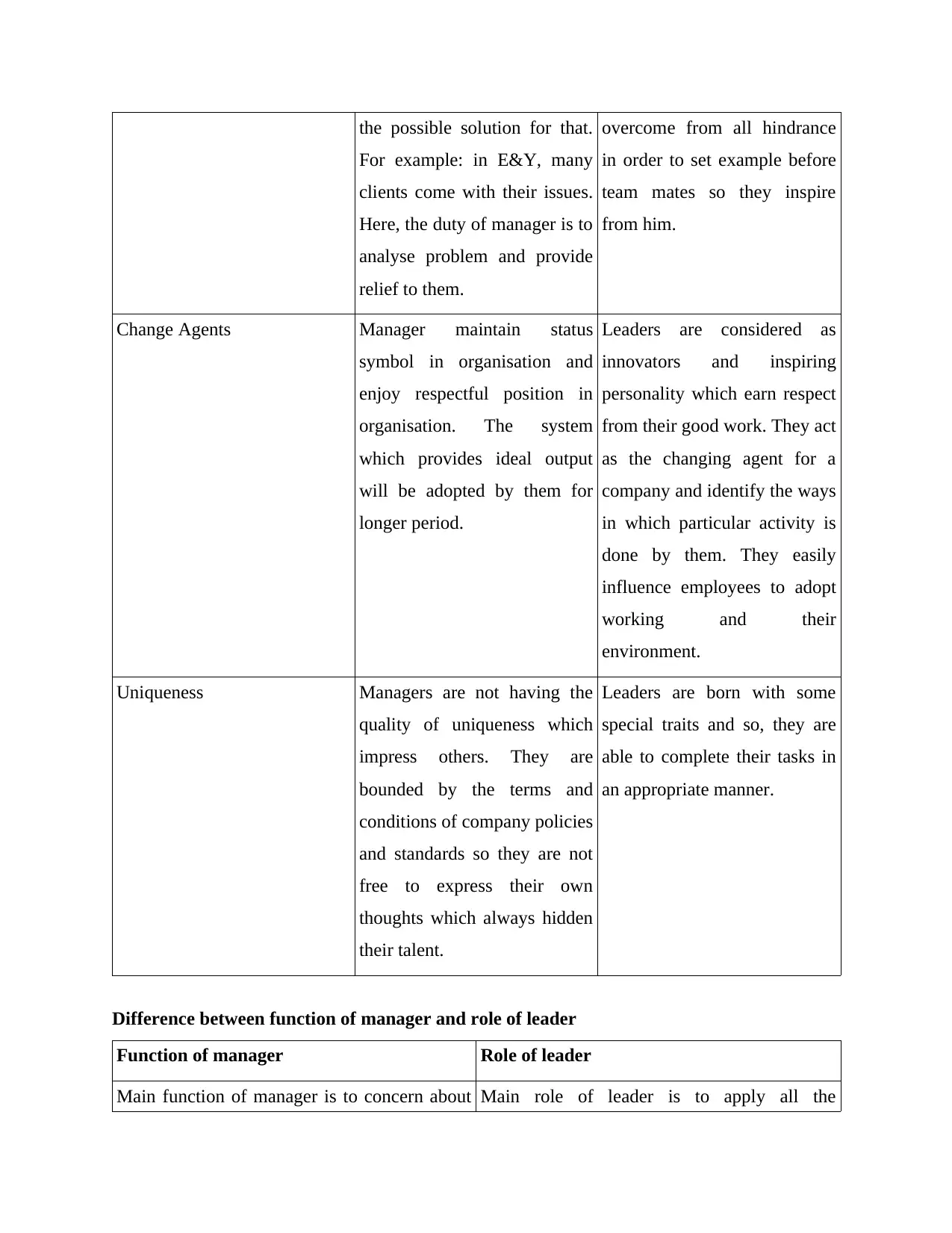
the possible solution for that.
For example: in E&Y, many
clients come with their issues.
Here, the duty of manager is to
analyse problem and provide
relief to them.
overcome from all hindrance
in order to set example before
team mates so they inspire
from him.
Change Agents Manager maintain status
symbol in organisation and
enjoy respectful position in
organisation. The system
which provides ideal output
will be adopted by them for
longer period.
Leaders are considered as
innovators and inspiring
personality which earn respect
from their good work. They act
as the changing agent for a
company and identify the ways
in which particular activity is
done by them. They easily
influence employees to adopt
working and their
environment.
Uniqueness Managers are not having the
quality of uniqueness which
impress others. They are
bounded by the terms and
conditions of company policies
and standards so they are not
free to express their own
thoughts which always hidden
their talent.
Leaders are born with some
special traits and so, they are
able to complete their tasks in
an appropriate manner.
Difference between function of manager and role of leader
Function of manager Role of leader
Main function of manager is to concern about Main role of leader is to apply all the
For example: in E&Y, many
clients come with their issues.
Here, the duty of manager is to
analyse problem and provide
relief to them.
overcome from all hindrance
in order to set example before
team mates so they inspire
from him.
Change Agents Manager maintain status
symbol in organisation and
enjoy respectful position in
organisation. The system
which provides ideal output
will be adopted by them for
longer period.
Leaders are considered as
innovators and inspiring
personality which earn respect
from their good work. They act
as the changing agent for a
company and identify the ways
in which particular activity is
done by them. They easily
influence employees to adopt
working and their
environment.
Uniqueness Managers are not having the
quality of uniqueness which
impress others. They are
bounded by the terms and
conditions of company policies
and standards so they are not
free to express their own
thoughts which always hidden
their talent.
Leaders are born with some
special traits and so, they are
able to complete their tasks in
an appropriate manner.
Difference between function of manager and role of leader
Function of manager Role of leader
Main function of manager is to concern about Main role of leader is to apply all the
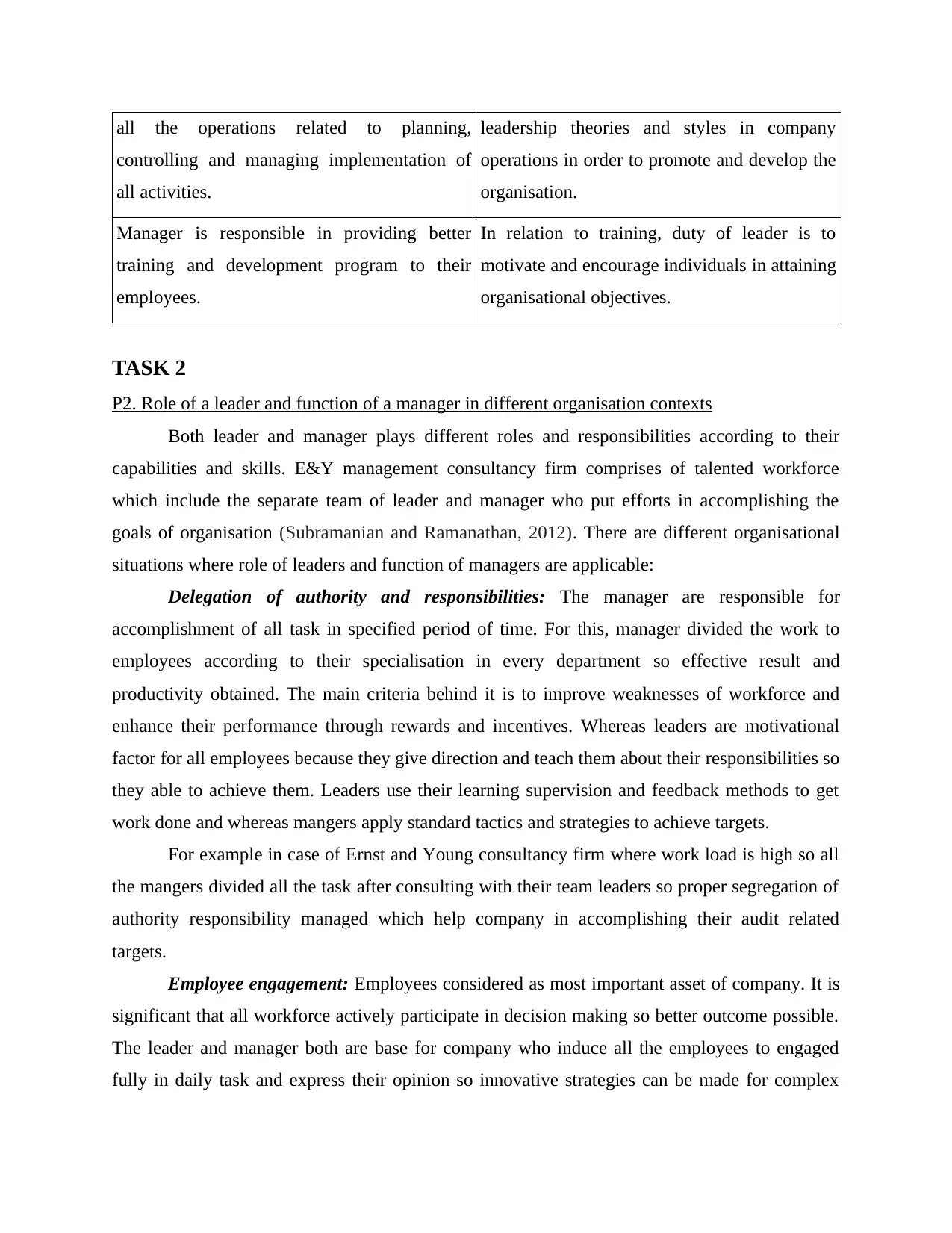
all the operations related to planning,
controlling and managing implementation of
all activities.
leadership theories and styles in company
operations in order to promote and develop the
organisation.
Manager is responsible in providing better
training and development program to their
employees.
In relation to training, duty of leader is to
motivate and encourage individuals in attaining
organisational objectives.
TASK 2
P2. Role of a leader and function of a manager in different organisation contexts
Both leader and manager plays different roles and responsibilities according to their
capabilities and skills. E&Y management consultancy firm comprises of talented workforce
which include the separate team of leader and manager who put efforts in accomplishing the
goals of organisation (Subramanian and Ramanathan, 2012). There are different organisational
situations where role of leaders and function of managers are applicable:
Delegation of authority and responsibilities: The manager are responsible for
accomplishment of all task in specified period of time. For this, manager divided the work to
employees according to their specialisation in every department so effective result and
productivity obtained. The main criteria behind it is to improve weaknesses of workforce and
enhance their performance through rewards and incentives. Whereas leaders are motivational
factor for all employees because they give direction and teach them about their responsibilities so
they able to achieve them. Leaders use their learning supervision and feedback methods to get
work done and whereas mangers apply standard tactics and strategies to achieve targets.
For example in case of Ernst and Young consultancy firm where work load is high so all
the mangers divided all the task after consulting with their team leaders so proper segregation of
authority responsibility managed which help company in accomplishing their audit related
targets.
Employee engagement: Employees considered as most important asset of company. It is
significant that all workforce actively participate in decision making so better outcome possible.
The leader and manager both are base for company who induce all the employees to engaged
fully in daily task and express their opinion so innovative strategies can be made for complex
controlling and managing implementation of
all activities.
leadership theories and styles in company
operations in order to promote and develop the
organisation.
Manager is responsible in providing better
training and development program to their
employees.
In relation to training, duty of leader is to
motivate and encourage individuals in attaining
organisational objectives.
TASK 2
P2. Role of a leader and function of a manager in different organisation contexts
Both leader and manager plays different roles and responsibilities according to their
capabilities and skills. E&Y management consultancy firm comprises of talented workforce
which include the separate team of leader and manager who put efforts in accomplishing the
goals of organisation (Subramanian and Ramanathan, 2012). There are different organisational
situations where role of leaders and function of managers are applicable:
Delegation of authority and responsibilities: The manager are responsible for
accomplishment of all task in specified period of time. For this, manager divided the work to
employees according to their specialisation in every department so effective result and
productivity obtained. The main criteria behind it is to improve weaknesses of workforce and
enhance their performance through rewards and incentives. Whereas leaders are motivational
factor for all employees because they give direction and teach them about their responsibilities so
they able to achieve them. Leaders use their learning supervision and feedback methods to get
work done and whereas mangers apply standard tactics and strategies to achieve targets.
For example in case of Ernst and Young consultancy firm where work load is high so all
the mangers divided all the task after consulting with their team leaders so proper segregation of
authority responsibility managed which help company in accomplishing their audit related
targets.
Employee engagement: Employees considered as most important asset of company. It is
significant that all workforce actively participate in decision making so better outcome possible.
The leader and manager both are base for company who induce all the employees to engaged
fully in daily task and express their opinion so innovative strategies can be made for complex
⊘ This is a preview!⊘
Do you want full access?
Subscribe today to unlock all pages.
Trusted by 1+ million students worldwide
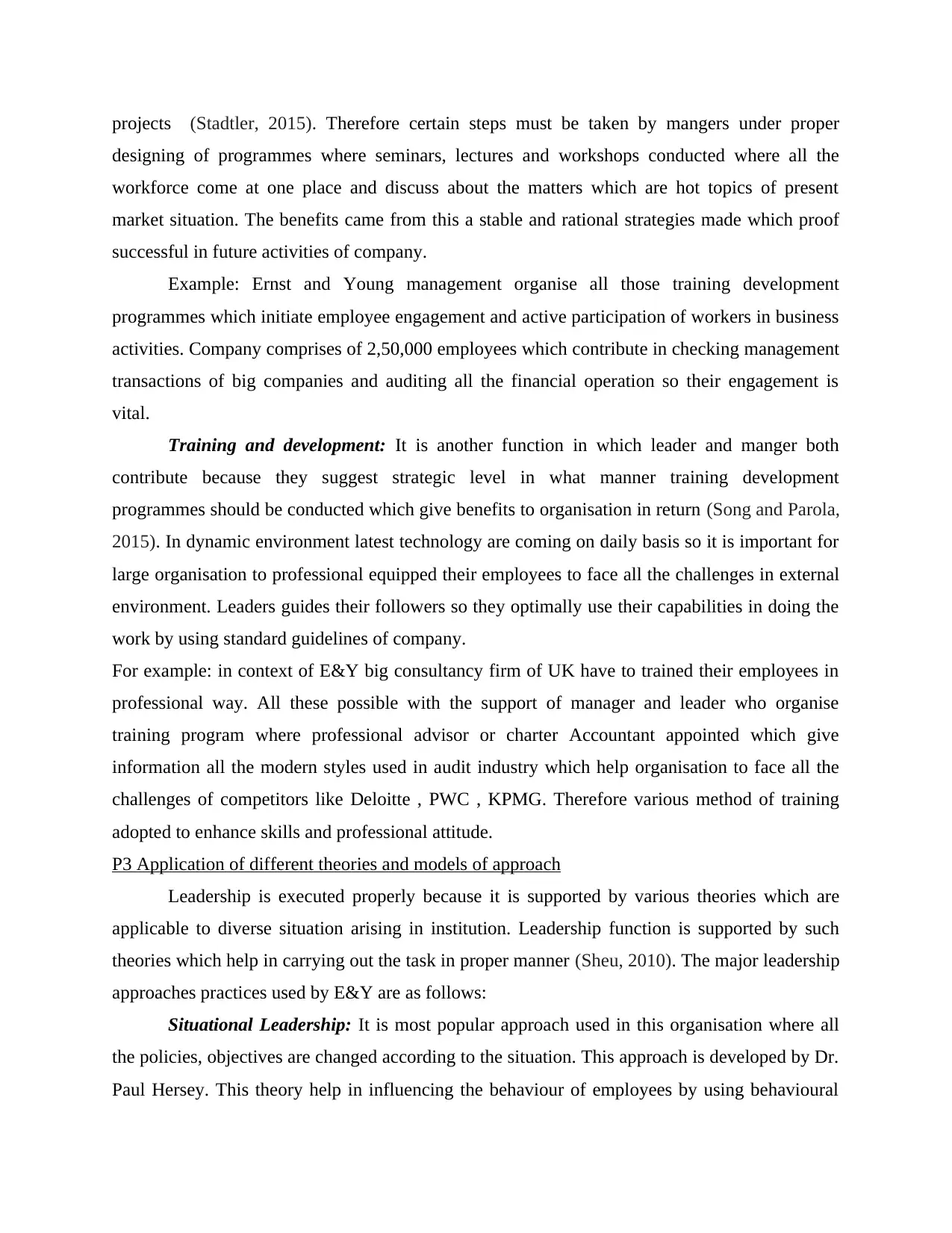
projects (Stadtler, 2015). Therefore certain steps must be taken by mangers under proper
designing of programmes where seminars, lectures and workshops conducted where all the
workforce come at one place and discuss about the matters which are hot topics of present
market situation. The benefits came from this a stable and rational strategies made which proof
successful in future activities of company.
Example: Ernst and Young management organise all those training development
programmes which initiate employee engagement and active participation of workers in business
activities. Company comprises of 2,50,000 employees which contribute in checking management
transactions of big companies and auditing all the financial operation so their engagement is
vital.
Training and development: It is another function in which leader and manger both
contribute because they suggest strategic level in what manner training development
programmes should be conducted which give benefits to organisation in return (Song and Parola,
2015). In dynamic environment latest technology are coming on daily basis so it is important for
large organisation to professional equipped their employees to face all the challenges in external
environment. Leaders guides their followers so they optimally use their capabilities in doing the
work by using standard guidelines of company.
For example: in context of E&Y big consultancy firm of UK have to trained their employees in
professional way. All these possible with the support of manager and leader who organise
training program where professional advisor or charter Accountant appointed which give
information all the modern styles used in audit industry which help organisation to face all the
challenges of competitors like Deloitte , PWC , KPMG. Therefore various method of training
adopted to enhance skills and professional attitude.
P3 Application of different theories and models of approach
Leadership is executed properly because it is supported by various theories which are
applicable to diverse situation arising in institution. Leadership function is supported by such
theories which help in carrying out the task in proper manner (Sheu, 2010). The major leadership
approaches practices used by E&Y are as follows:
Situational Leadership: It is most popular approach used in this organisation where all
the policies, objectives are changed according to the situation. This approach is developed by Dr.
Paul Hersey. This theory help in influencing the behaviour of employees by using behavioural
designing of programmes where seminars, lectures and workshops conducted where all the
workforce come at one place and discuss about the matters which are hot topics of present
market situation. The benefits came from this a stable and rational strategies made which proof
successful in future activities of company.
Example: Ernst and Young management organise all those training development
programmes which initiate employee engagement and active participation of workers in business
activities. Company comprises of 2,50,000 employees which contribute in checking management
transactions of big companies and auditing all the financial operation so their engagement is
vital.
Training and development: It is another function in which leader and manger both
contribute because they suggest strategic level in what manner training development
programmes should be conducted which give benefits to organisation in return (Song and Parola,
2015). In dynamic environment latest technology are coming on daily basis so it is important for
large organisation to professional equipped their employees to face all the challenges in external
environment. Leaders guides their followers so they optimally use their capabilities in doing the
work by using standard guidelines of company.
For example: in context of E&Y big consultancy firm of UK have to trained their employees in
professional way. All these possible with the support of manager and leader who organise
training program where professional advisor or charter Accountant appointed which give
information all the modern styles used in audit industry which help organisation to face all the
challenges of competitors like Deloitte , PWC , KPMG. Therefore various method of training
adopted to enhance skills and professional attitude.
P3 Application of different theories and models of approach
Leadership is executed properly because it is supported by various theories which are
applicable to diverse situation arising in institution. Leadership function is supported by such
theories which help in carrying out the task in proper manner (Sheu, 2010). The major leadership
approaches practices used by E&Y are as follows:
Situational Leadership: It is most popular approach used in this organisation where all
the policies, objectives are changed according to the situation. This approach is developed by Dr.
Paul Hersey. This theory help in influencing the behaviour of employees by using behavioural
Paraphrase This Document
Need a fresh take? Get an instant paraphrase of this document with our AI Paraphraser
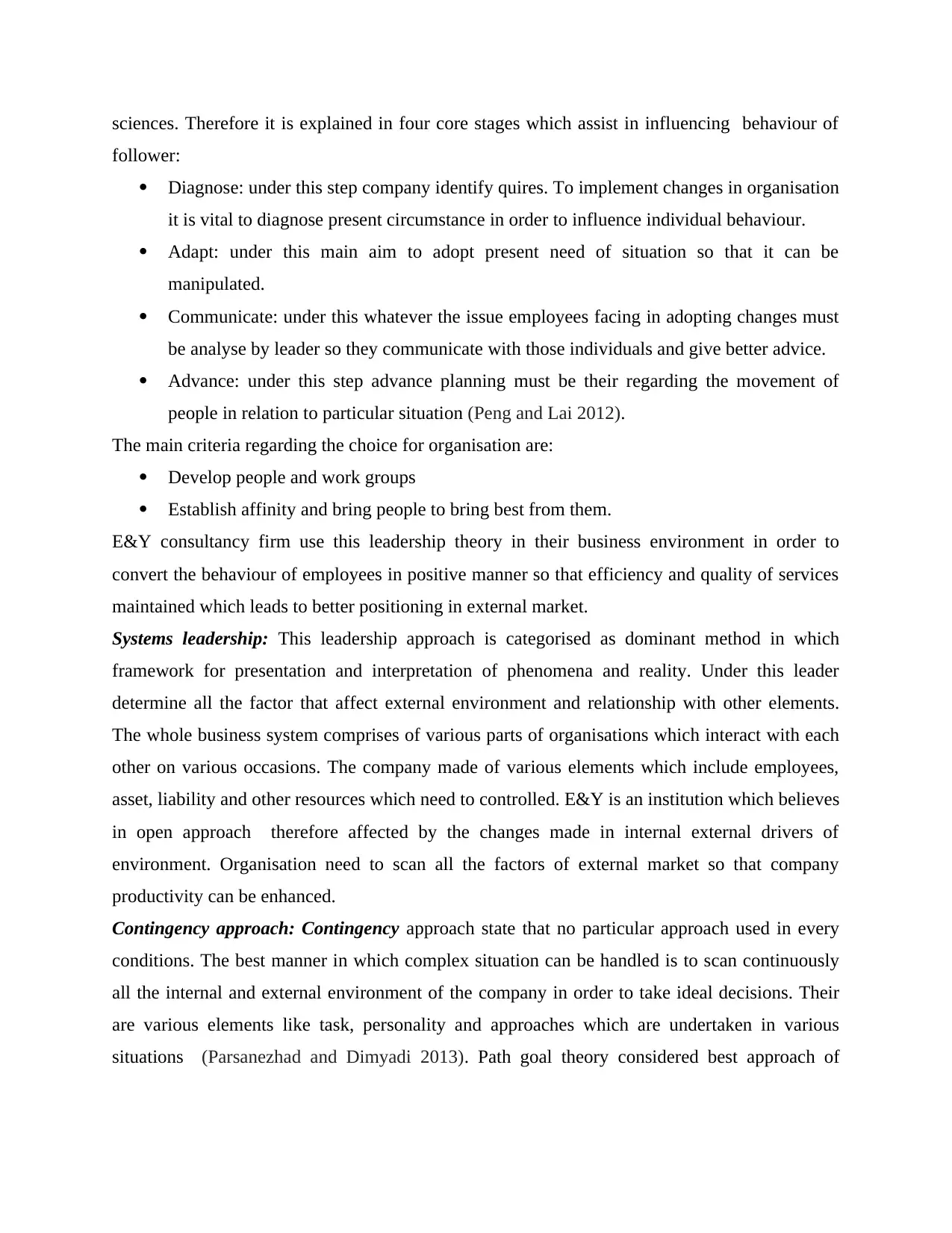
sciences. Therefore it is explained in four core stages which assist in influencing behaviour of
follower:
Diagnose: under this step company identify quires. To implement changes in organisation
it is vital to diagnose present circumstance in order to influence individual behaviour.
Adapt: under this main aim to adopt present need of situation so that it can be
manipulated.
Communicate: under this whatever the issue employees facing in adopting changes must
be analyse by leader so they communicate with those individuals and give better advice.
Advance: under this step advance planning must be their regarding the movement of
people in relation to particular situation (Peng and Lai 2012).
The main criteria regarding the choice for organisation are:
Develop people and work groups
Establish affinity and bring people to bring best from them.
E&Y consultancy firm use this leadership theory in their business environment in order to
convert the behaviour of employees in positive manner so that efficiency and quality of services
maintained which leads to better positioning in external market.
Systems leadership: This leadership approach is categorised as dominant method in which
framework for presentation and interpretation of phenomena and reality. Under this leader
determine all the factor that affect external environment and relationship with other elements.
The whole business system comprises of various parts of organisations which interact with each
other on various occasions. The company made of various elements which include employees,
asset, liability and other resources which need to controlled. E&Y is an institution which believes
in open approach therefore affected by the changes made in internal external drivers of
environment. Organisation need to scan all the factors of external market so that company
productivity can be enhanced.
Contingency approach: Contingency approach state that no particular approach used in every
conditions. The best manner in which complex situation can be handled is to scan continuously
all the internal and external environment of the company in order to take ideal decisions. Their
are various elements like task, personality and approaches which are undertaken in various
situations (Parsanezhad and Dimyadi 2013). Path goal theory considered best approach of
follower:
Diagnose: under this step company identify quires. To implement changes in organisation
it is vital to diagnose present circumstance in order to influence individual behaviour.
Adapt: under this main aim to adopt present need of situation so that it can be
manipulated.
Communicate: under this whatever the issue employees facing in adopting changes must
be analyse by leader so they communicate with those individuals and give better advice.
Advance: under this step advance planning must be their regarding the movement of
people in relation to particular situation (Peng and Lai 2012).
The main criteria regarding the choice for organisation are:
Develop people and work groups
Establish affinity and bring people to bring best from them.
E&Y consultancy firm use this leadership theory in their business environment in order to
convert the behaviour of employees in positive manner so that efficiency and quality of services
maintained which leads to better positioning in external market.
Systems leadership: This leadership approach is categorised as dominant method in which
framework for presentation and interpretation of phenomena and reality. Under this leader
determine all the factor that affect external environment and relationship with other elements.
The whole business system comprises of various parts of organisations which interact with each
other on various occasions. The company made of various elements which include employees,
asset, liability and other resources which need to controlled. E&Y is an institution which believes
in open approach therefore affected by the changes made in internal external drivers of
environment. Organisation need to scan all the factors of external market so that company
productivity can be enhanced.
Contingency approach: Contingency approach state that no particular approach used in every
conditions. The best manner in which complex situation can be handled is to scan continuously
all the internal and external environment of the company in order to take ideal decisions. Their
are various elements like task, personality and approaches which are undertaken in various
situations (Parsanezhad and Dimyadi 2013). Path goal theory considered best approach of
contingency which aim to provide appropriate style which help company in accomplishing their
targets. Management by objectives: This leadership style given by Peter Drucker in 1954. Under
this approach objectives and task of company are clearly defined to all the employees
along with time limit. Leaders organise various training programmes where they give
direction to all individuals to accomplish task effectively and then give feedback about all
the issue they faced during whole performance. The main objective behind it to check the
actual and standard performance of employees and if any deviation arises then manger
analyse whole circumstances and find possible solution for better outcomes (Omansky
and Kanner, Autodesk Inc, 2014).
Critical analysation of different theories:
After the wide description of all above theories and apply them from organisation context
it has been analysed that companies at the time of establishing their vision and objectives also
evaluate the type of leadership styles that used by organisation in working style which bring
profits and increase market share of company. Selection of leader and manager is important
because it decide the attitude of employees. At the change management these two personality
contribute at the time when existing employees against all the alteration which impact their
career. In such situation stress management activities are organised by manager which is execute
with support of leaders which also possible for business to explore opportunities and earn huge
profits from them. Managers must use hard management skills and leader use soft leadership
skills which include motivation,flexibility, problem solving abilities in such conditions. Rational
selection of leadership styles, theories is significant and done according to the budget and
resources which leads to effective operational management and better decision making.
TASK 3
P4 Key approaches to operations management and roles played by manger and leader
Management is about planning, organising and controlling. There are many activities
happening in organisation, it is important to take care of them and hence provide guidance to
subordinates. Leader and manager plays vital role in coop up with various activities and in case
of negative results corrective measures are taken. It is important to communicate with employees
so that they also know reason behind making changes in plans and policies (Kato, NEC Corp,
targets. Management by objectives: This leadership style given by Peter Drucker in 1954. Under
this approach objectives and task of company are clearly defined to all the employees
along with time limit. Leaders organise various training programmes where they give
direction to all individuals to accomplish task effectively and then give feedback about all
the issue they faced during whole performance. The main objective behind it to check the
actual and standard performance of employees and if any deviation arises then manger
analyse whole circumstances and find possible solution for better outcomes (Omansky
and Kanner, Autodesk Inc, 2014).
Critical analysation of different theories:
After the wide description of all above theories and apply them from organisation context
it has been analysed that companies at the time of establishing their vision and objectives also
evaluate the type of leadership styles that used by organisation in working style which bring
profits and increase market share of company. Selection of leader and manager is important
because it decide the attitude of employees. At the change management these two personality
contribute at the time when existing employees against all the alteration which impact their
career. In such situation stress management activities are organised by manager which is execute
with support of leaders which also possible for business to explore opportunities and earn huge
profits from them. Managers must use hard management skills and leader use soft leadership
skills which include motivation,flexibility, problem solving abilities in such conditions. Rational
selection of leadership styles, theories is significant and done according to the budget and
resources which leads to effective operational management and better decision making.
TASK 3
P4 Key approaches to operations management and roles played by manger and leader
Management is about planning, organising and controlling. There are many activities
happening in organisation, it is important to take care of them and hence provide guidance to
subordinates. Leader and manager plays vital role in coop up with various activities and in case
of negative results corrective measures are taken. It is important to communicate with employees
so that they also know reason behind making changes in plans and policies (Kato, NEC Corp,
⊘ This is a preview!⊘
Do you want full access?
Subscribe today to unlock all pages.
Trusted by 1+ million students worldwide
2011). Advantage of communicating with employee's is that top level management get new ideas
and to chech what employees feel. There is important role of manger and leader to provide
assistance in change of change in external or internal environment of business. There must be
regular check done to what is happening in society where business operates. Ernst and Young
has office at different locations so there are different problems as per environment. To tackle this
situation there are few approaches used by Ernst and Young are- Lean production- This approach aims at production in most efficient manner. Manager
should focus on adopt that method which most appropriate and cost minimisation. There
are many alternatives which organisation can adopt to give best services. There is
requirement of time to plan which alternative has to adopt, so it is important to consider
all factor which many affect business and decision making (Hamilton, Holub and Blunt,
2011). Queueing and continuous production- This approach is tough to apply in organisation.
This can be only applied by big organisations and in certain case. This focus on
continuous production with few breaks for maintenance of plant and machinery. A
machine can work for 24 hours but it is not possible for machine operator to whole day.
In case of sweater manufacturing company, they have to apply this approach so that
demand for woollens can be achieved. This will help in provide product at specified time.
This will provide edge to organisation over competitive firm. Six sigma- This will approach launched by Bill Smith for Motorola's Electronic
manufacturing processes, it is important to take part in quality determination so that there
is improvement in quality. It is enhance efficiency of employees as well as company. It
provides various tools and techniques to reduces defects and improves efficiency (Gillen,
Jacquillat and Odoni, 2016). Just in time- There is some specific time determined for production of goods and
services. Other name of this technique is Toyota Production system. There must be
product ready in determined time so that company can satisfy needs in time, which will
help in increasing faith of customers in brand. There are various departments in company
and interrelated. If there is proper schedule of production then it will provide help in
determination of other activities, so that there will be no wastage of resources. Company
will order raw material as per requirement.
and to chech what employees feel. There is important role of manger and leader to provide
assistance in change of change in external or internal environment of business. There must be
regular check done to what is happening in society where business operates. Ernst and Young
has office at different locations so there are different problems as per environment. To tackle this
situation there are few approaches used by Ernst and Young are- Lean production- This approach aims at production in most efficient manner. Manager
should focus on adopt that method which most appropriate and cost minimisation. There
are many alternatives which organisation can adopt to give best services. There is
requirement of time to plan which alternative has to adopt, so it is important to consider
all factor which many affect business and decision making (Hamilton, Holub and Blunt,
2011). Queueing and continuous production- This approach is tough to apply in organisation.
This can be only applied by big organisations and in certain case. This focus on
continuous production with few breaks for maintenance of plant and machinery. A
machine can work for 24 hours but it is not possible for machine operator to whole day.
In case of sweater manufacturing company, they have to apply this approach so that
demand for woollens can be achieved. This will help in provide product at specified time.
This will provide edge to organisation over competitive firm. Six sigma- This will approach launched by Bill Smith for Motorola's Electronic
manufacturing processes, it is important to take part in quality determination so that there
is improvement in quality. It is enhance efficiency of employees as well as company. It
provides various tools and techniques to reduces defects and improves efficiency (Gillen,
Jacquillat and Odoni, 2016). Just in time- There is some specific time determined for production of goods and
services. Other name of this technique is Toyota Production system. There must be
product ready in determined time so that company can satisfy needs in time, which will
help in increasing faith of customers in brand. There are various departments in company
and interrelated. If there is proper schedule of production then it will provide help in
determination of other activities, so that there will be no wastage of resources. Company
will order raw material as per requirement.
Paraphrase This Document
Need a fresh take? Get an instant paraphrase of this document with our AI Paraphraser
Total quality management- Total quality management means to give best quality
services with no defect. Practically no defect is not possible but manager should focus on
minimum shortcoming. This will prove helpful in reduction in wastage of resources. To
motivate employees there must be some rewards set so that employees tries to minimise
defects in product and services. Through management of organisation can make workers
as well customers happy (Galindo and Batta, 2013).
Role of manger and leader in operations management
Leaders and manger are most important component in organisation. They does not
perform any physical activity but they emphasis on planning and directing task. It is important to
convey what is motive behind performing activities to employees so that they also give their best
achieve targets. There are changes taken place in environment and as business runs in society so
it also gets affected. It is duty of manger to modify plans and strategies so that organisation can
take long run with competitive firms.
Ernst and Young organisation provides accounting services and as per rules and
regulations of environment organisation has to modify their as well. As there are many changes
in laws related to accounting, in case company does not accept them, client will switch to other
firm. Customer want best services and at appropriate time, manager can make employee's
performance skill full.
P5 Value and importance of operational management
Operational management means planning done to performs activities. These days
organisation has to perform many different activities as compared to older days. It is important to
perform these task to compete with firms and make same brand image in market. Though this is
tough but if manger boost employees regularly then achievement of goals and objective become
easy. Customer satisfaction- Operational manager prefers this objective as main. It is
important to take care of customer satisfaction. Company can achieve its goals and
targets only by keeping customer happy (Ergun and et. al., 2010). Manager has access
market regularly so that they can know what consumer want. In current scenario there is
frequent changes in demand, so to achieve them corrective measures have to be taken. Profit motive- Operations department performs their activities to get more profit so that
there will be proper satisfaction to stakeholders. There are ways which proves helpful in
services with no defect. Practically no defect is not possible but manager should focus on
minimum shortcoming. This will prove helpful in reduction in wastage of resources. To
motivate employees there must be some rewards set so that employees tries to minimise
defects in product and services. Through management of organisation can make workers
as well customers happy (Galindo and Batta, 2013).
Role of manger and leader in operations management
Leaders and manger are most important component in organisation. They does not
perform any physical activity but they emphasis on planning and directing task. It is important to
convey what is motive behind performing activities to employees so that they also give their best
achieve targets. There are changes taken place in environment and as business runs in society so
it also gets affected. It is duty of manger to modify plans and strategies so that organisation can
take long run with competitive firms.
Ernst and Young organisation provides accounting services and as per rules and
regulations of environment organisation has to modify their as well. As there are many changes
in laws related to accounting, in case company does not accept them, client will switch to other
firm. Customer want best services and at appropriate time, manager can make employee's
performance skill full.
P5 Value and importance of operational management
Operational management means planning done to performs activities. These days
organisation has to perform many different activities as compared to older days. It is important to
perform these task to compete with firms and make same brand image in market. Though this is
tough but if manger boost employees regularly then achievement of goals and objective become
easy. Customer satisfaction- Operational manager prefers this objective as main. It is
important to take care of customer satisfaction. Company can achieve its goals and
targets only by keeping customer happy (Ergun and et. al., 2010). Manager has access
market regularly so that they can know what consumer want. In current scenario there is
frequent changes in demand, so to achieve them corrective measures have to be taken. Profit motive- Operations department performs their activities to get more profit so that
there will be proper satisfaction to stakeholders. There are ways which proves helpful in
making profit. Ernst and Young organisation should provide cheap rate as compared to
other firms. They provide tax advise, so they should firstly know requirement of
consumer and then provide best piece of advise. Achievement of target- There are few data which has to be achieve through employees.
Manger has to motive employees to achieve target, it is important that delegation of
responsibility must be according to skill of employees. There is important role of
assigning task so that there will be proper flow of communication and accountability.
This will create employees awareness that he/ she can accountable for specific task
(Chevalier and et. al., 2015). Brand image- Ernst and Young has good image in market, so it is important to maintain
that goodwill which proves helpful in customer satisfaction. Customer belief in
organisation only by hearing name. It is tough to build this image but its more tough to
continuous with that approach. Manager has top perform various activities to know how
much brand is popular, company has to focus on it. There are ways such as questionnaire,
survey, interview, etc. through which manager can know about brand image. To make
same brand image, manager has to make policies which timely modify working style and
gives best services in minimum time.
Qualitative approach – This means organisation should emphasis on quality of product
and services. These days consumer is ready to pay more bugs but they want quality in
that. So manger and leader has to emphasis on giving quality in their act. Leader has to
check employees performance and in case of flaws corrective measures has to be taken. If
company gives qualitative services, then automatically their revenue's graph will
increase, which is primary motive of organisation.
Ernst and Young have branches in may countries. It is important to analyse them all
according to environment in which they are dealing. Objective of operational department is to
check whether actions are happening smoothly or not. Sometimes due to personal conflicts
employees does not prefer to communicate with one another. There are many changes taking
place to create ease in working style but sometime personnel does not like accept those change
and they want to resistant to what they know (Brandon and Mullan, 2013). So in this case it is
responsibility of team head to give proper guidance to staff and try to know what problems are
they facing and resolve them. This shows that operation management plays vital role in
other firms. They provide tax advise, so they should firstly know requirement of
consumer and then provide best piece of advise. Achievement of target- There are few data which has to be achieve through employees.
Manger has to motive employees to achieve target, it is important that delegation of
responsibility must be according to skill of employees. There is important role of
assigning task so that there will be proper flow of communication and accountability.
This will create employees awareness that he/ she can accountable for specific task
(Chevalier and et. al., 2015). Brand image- Ernst and Young has good image in market, so it is important to maintain
that goodwill which proves helpful in customer satisfaction. Customer belief in
organisation only by hearing name. It is tough to build this image but its more tough to
continuous with that approach. Manager has top perform various activities to know how
much brand is popular, company has to focus on it. There are ways such as questionnaire,
survey, interview, etc. through which manager can know about brand image. To make
same brand image, manager has to make policies which timely modify working style and
gives best services in minimum time.
Qualitative approach – This means organisation should emphasis on quality of product
and services. These days consumer is ready to pay more bugs but they want quality in
that. So manger and leader has to emphasis on giving quality in their act. Leader has to
check employees performance and in case of flaws corrective measures has to be taken. If
company gives qualitative services, then automatically their revenue's graph will
increase, which is primary motive of organisation.
Ernst and Young have branches in may countries. It is important to analyse them all
according to environment in which they are dealing. Objective of operational department is to
check whether actions are happening smoothly or not. Sometimes due to personal conflicts
employees does not prefer to communicate with one another. There are many changes taking
place to create ease in working style but sometime personnel does not like accept those change
and they want to resistant to what they know (Brandon and Mullan, 2013). So in this case it is
responsibility of team head to give proper guidance to staff and try to know what problems are
they facing and resolve them. This shows that operation management plays vital role in
⊘ This is a preview!⊘
Do you want full access?
Subscribe today to unlock all pages.
Trusted by 1+ million students worldwide

1 out of 17


Related Documents


Your All-in-One AI-Powered Toolkit for Academic Success.
+13062052269
info@desklib.com
Available 24*7 on WhatsApp / Email
![[object Object]](/_next/static/media/star-bottom.7253800d.svg)
Unlock your academic potential
Copyright © 2020–2026 A2Z Services. All Rights Reserved. Developed and managed by ZUCOL.