Leadership and Management Report for Service Industries Analysis
VerifiedAdded on 2020/10/05
|9
|2437
|217
Report
AI Summary
This report delves into the realm of leadership and management within the service industry, focusing on the practical application of various theories and styles. It begins by outlining classical management theories, including bureaucratic, administrative, and scientific approaches, and contextualizes them within the operations of service-based organizations like Havez, Haz, and Tas. The report then examines different leadership styles such as autocratic, democratic, and laissez-faire, and explores their roles in influencing and motivating employees. Furthermore, it analyzes the interplay between management and leadership styles in relation to organizational culture and structure, highlighting the impact of internal and external factors such as political, economic, social, and technological influences. The report also includes a discussion on change management, hard and soft skills, and their significance in the service industry. Through a blend of theoretical frameworks and real-world examples, the report provides a comprehensive understanding of effective leadership and management strategies in the service sector.
Leadership and
Management for Service
Industries
Management for Service
Industries

Paraphrase This Document
Need a fresh take? Get an instant paraphrase of this document with our AI Paraphraser
Table of Contents
INTRODUCTION...........................................................................................................................1
TASK 1............................................................................................................................................1
P1. Different classical management theories in service industry context....................................1
P2. Different leadership styles and role of leaders......................................................................2
P3. Review of management and leadership styles in relation to organisational culture and
structure........................................................................................................................................3
TASK 2............................................................................................................................................4
P4. Internal and external factors which influence management styles and structures. ...............4
TASK 3............................................................................................................................................6
TASK 4............................................................................................................................................6
CONCLUSION................................................................................................................................6
REFERENCES................................................................................................................................7
INTRODUCTION...........................................................................................................................1
TASK 1............................................................................................................................................1
P1. Different classical management theories in service industry context....................................1
P2. Different leadership styles and role of leaders......................................................................2
P3. Review of management and leadership styles in relation to organisational culture and
structure........................................................................................................................................3
TASK 2............................................................................................................................................4
P4. Internal and external factors which influence management styles and structures. ...............4
TASK 3............................................................................................................................................6
TASK 4............................................................................................................................................6
CONCLUSION................................................................................................................................6
REFERENCES................................................................................................................................7
INTRODUCTION
Management is a tool which is used for dealing with people as well as controlling work
for attaining profitable results in the organisation (Biemans, Griffin and Moenaert, 2016).
Leadership is a process for influencing an individual at work place to perform activities by
considering organisational objectives. It is the power to influence, inspiration and directing
which distinguishes leaders from managers. Docklands Academy, London has close partnership
with Havez, Haz and Tas which performs hospitality operations all around central London. In
this report, classical management theories, role of leaders and different leadership styles are
explained in relation to service industry. It further includes internal as well as external factors
which influences management styles and structures in an organisation. Lastly, it involves hard
and soft skills, different service industry organisations, change management styles and leadership
in implementing change are clearly defined.
TASK 1
P1. Different classical management theories in service industry context
Management theories are general rules which are used for guiding managers for
managing personnels at work place for effectively achieving business goals. Such theories are
used for finding best solutions for completion of critical tasks (Chang, 2016). Classical
management theory is a type of management theory which is based on assumptions and beliefs
related to employees which illustrates that they have physical along with economic needs only
and it do not consider social needs. Different classical management theories are the followings:
Bureaucratic management theory: Under this theory, management focuses on operations of
tasks using hierarchy of positions. Authority responsibility relationships are set for
communicating information in bureaucratic management. Such theory is used for setting ideal
models of management by converting organisational structure into hierarchy positions. Major
focus of this theory is on hierarchy structure along with rules and regulations. Business
executives along with organisational members together governs legal decisions for the
betterment of organisation.
Administrative management theory: Under this theory, tasks are organised in systematic
manner through clearly defining to labour division by organisational hierarchy structure. Such
theory is used for improving performance along with overall functions of enterprise. Basic
1
Management is a tool which is used for dealing with people as well as controlling work
for attaining profitable results in the organisation (Biemans, Griffin and Moenaert, 2016).
Leadership is a process for influencing an individual at work place to perform activities by
considering organisational objectives. It is the power to influence, inspiration and directing
which distinguishes leaders from managers. Docklands Academy, London has close partnership
with Havez, Haz and Tas which performs hospitality operations all around central London. In
this report, classical management theories, role of leaders and different leadership styles are
explained in relation to service industry. It further includes internal as well as external factors
which influences management styles and structures in an organisation. Lastly, it involves hard
and soft skills, different service industry organisations, change management styles and leadership
in implementing change are clearly defined.
TASK 1
P1. Different classical management theories in service industry context
Management theories are general rules which are used for guiding managers for
managing personnels at work place for effectively achieving business goals. Such theories are
used for finding best solutions for completion of critical tasks (Chang, 2016). Classical
management theory is a type of management theory which is based on assumptions and beliefs
related to employees which illustrates that they have physical along with economic needs only
and it do not consider social needs. Different classical management theories are the followings:
Bureaucratic management theory: Under this theory, management focuses on operations of
tasks using hierarchy of positions. Authority responsibility relationships are set for
communicating information in bureaucratic management. Such theory is used for setting ideal
models of management by converting organisational structure into hierarchy positions. Major
focus of this theory is on hierarchy structure along with rules and regulations. Business
executives along with organisational members together governs legal decisions for the
betterment of organisation.
Administrative management theory: Under this theory, tasks are organised in systematic
manner through clearly defining to labour division by organisational hierarchy structure. Such
theory is used for improving performance along with overall functions of enterprise. Basic
1
⊘ This is a preview!⊘
Do you want full access?
Subscribe today to unlock all pages.

Trusted by 1+ million students worldwide
functions includes planning, organising, directing, commanding, coordinating and controlling the
work in systematic manner. It is applied in chosen business for finding rational solutions for the
organisation as whole by creating departments to perform activities to achieve common
purposes.
Scientific management theory: Under this theory, main focus is on improving production
efficiency by using appropriate technology systems. It plays an important role in respective chain
of business by improving efficiency as well as capability of each personnel at work place to
achieve outputs as per the set standards. There are various techniques for processing one task,
considering all techniques and choosing best one is the objective of scientific management
theory (Chin, 2015). For instance, Havez, Haz and Tas give more financial incentives to workers
for boosting productivity and motivating them for performing with full efficiency to achieve
organisational objectives.
Thus, management of Havez, Haz and Tas applies bureaucratic management theory,
administrative management theory as well as scientific management theory according to the
situations. Bureaucratic management theory is used for governs legal decisions for the
betterment of organisation. Administrative management theory is used for improving
performance and overall functions at work place. Scientific management theory is applied for
choosing best way to perform tasks by using appropriate technology systems.
P2. Different leadership styles and role of leaders.
Leadership is the process of influencing other to perform work which they do not want to
perform. It is an act of influencing and motivating people for improving their performance in any
organisation. Leadership styles are the methods adopted by leaders to provide directions,
motivating people and implementing plans. Different leadership styles are as follows:
Autocratic leadership style: In such style, all powers and authority are in the hands of leaders.
They do not involve subordinates in decision making process, rather wants their opinions to be
followed without any arguments. Under this style, leader is the king. The selected chain of
restaurant uses such style under critical circumstances.
Democratic leadership style: In such style, ideas and suggestions are taken from employees in
decision making process. It is a participative style where major decisions are taken after
consulting with staff members. The managers of chosen business also follows this style of
leadership style to motivate the ideas and enhancing communication with all staff at work place.
2
work in systematic manner. It is applied in chosen business for finding rational solutions for the
organisation as whole by creating departments to perform activities to achieve common
purposes.
Scientific management theory: Under this theory, main focus is on improving production
efficiency by using appropriate technology systems. It plays an important role in respective chain
of business by improving efficiency as well as capability of each personnel at work place to
achieve outputs as per the set standards. There are various techniques for processing one task,
considering all techniques and choosing best one is the objective of scientific management
theory (Chin, 2015). For instance, Havez, Haz and Tas give more financial incentives to workers
for boosting productivity and motivating them for performing with full efficiency to achieve
organisational objectives.
Thus, management of Havez, Haz and Tas applies bureaucratic management theory,
administrative management theory as well as scientific management theory according to the
situations. Bureaucratic management theory is used for governs legal decisions for the
betterment of organisation. Administrative management theory is used for improving
performance and overall functions at work place. Scientific management theory is applied for
choosing best way to perform tasks by using appropriate technology systems.
P2. Different leadership styles and role of leaders.
Leadership is the process of influencing other to perform work which they do not want to
perform. It is an act of influencing and motivating people for improving their performance in any
organisation. Leadership styles are the methods adopted by leaders to provide directions,
motivating people and implementing plans. Different leadership styles are as follows:
Autocratic leadership style: In such style, all powers and authority are in the hands of leaders.
They do not involve subordinates in decision making process, rather wants their opinions to be
followed without any arguments. Under this style, leader is the king. The selected chain of
restaurant uses such style under critical circumstances.
Democratic leadership style: In such style, ideas and suggestions are taken from employees in
decision making process. It is a participative style where major decisions are taken after
consulting with staff members. The managers of chosen business also follows this style of
leadership style to motivate the ideas and enhancing communication with all staff at work place.
2
Paraphrase This Document
Need a fresh take? Get an instant paraphrase of this document with our AI Paraphraser
Laissez faire style: in this style, leaders do not involve themselves in decision making rather
motivates team members to formulate all decisions and implement them for the betterment of
team functioning. Managers of selected restaurant chain provide employees the organisational
vision and trust in capabilities of team members for taking appropriate decision for completion of
tasks and to achieve goals in right manner (Kim, Song and Triche, 2015).
In relation to Havez, Haz and Tas, managers along with leaders follows all the above
stated leadership styles as different situation occurs at different time period. They adopts such
styles to motivate team members and their potentiality to take decisions and achieve objectives.
Role of leaders: In any organisation, different roles are played by leaders pertaining to
the situations. Some of the role of leaders are describes as:
Leaders builds trusted relationship between employees to perform in team.
Clearly define vision and develop strategies for attaining them for the betterment of
business.
Communicate instructions to team members along with other departments at work place
by maintaining hierarchical structures .
Maintains healthy and competitive work environment to motivate employees for working
with desired efficiency.
Understands responsibilities, capabilities as well as potentiality of individual employee
and accordingly assigns tasks to them.
P3. Review of management and leadership styles in relation to organisational culture and
structure
Management and leadership styles are used for achieving objectives of any business
entity. Different organisations follows different management and leadership styles according to
the culture as well as structure. Docklands academy with the help of Havez, Haz and Tas
restaurants maintains healthy work culture by successfully running operations and coordinating
work to promote restaurants as well as contributing towards society. The organisational structure
consists of 21 food and beverage restaurants from cafes to bars which follows hierarchy structure
from top level management to lower level management for communicating information.
In relation to classical management theory, theory are applied by managers as per the
situations such as bureaucratic management theory is used for governing legal decisions for the
betterment of organisation where as administrative management theory is used for improving
3
motivates team members to formulate all decisions and implement them for the betterment of
team functioning. Managers of selected restaurant chain provide employees the organisational
vision and trust in capabilities of team members for taking appropriate decision for completion of
tasks and to achieve goals in right manner (Kim, Song and Triche, 2015).
In relation to Havez, Haz and Tas, managers along with leaders follows all the above
stated leadership styles as different situation occurs at different time period. They adopts such
styles to motivate team members and their potentiality to take decisions and achieve objectives.
Role of leaders: In any organisation, different roles are played by leaders pertaining to
the situations. Some of the role of leaders are describes as:
Leaders builds trusted relationship between employees to perform in team.
Clearly define vision and develop strategies for attaining them for the betterment of
business.
Communicate instructions to team members along with other departments at work place
by maintaining hierarchical structures .
Maintains healthy and competitive work environment to motivate employees for working
with desired efficiency.
Understands responsibilities, capabilities as well as potentiality of individual employee
and accordingly assigns tasks to them.
P3. Review of management and leadership styles in relation to organisational culture and
structure
Management and leadership styles are used for achieving objectives of any business
entity. Different organisations follows different management and leadership styles according to
the culture as well as structure. Docklands academy with the help of Havez, Haz and Tas
restaurants maintains healthy work culture by successfully running operations and coordinating
work to promote restaurants as well as contributing towards society. The organisational structure
consists of 21 food and beverage restaurants from cafes to bars which follows hierarchy structure
from top level management to lower level management for communicating information.
In relation to classical management theory, theory are applied by managers as per the
situations such as bureaucratic management theory is used for governing legal decisions for the
betterment of organisation where as administrative management theory is used for improving
3
performance and overall functions at work place and scientific management theory is applied for
choosing best way to perform tasks by using appropriate technology systems.
In relation to leadership style, leaders also adopts styles to direct and guide people as per
the circumstances. Leaders follows different styles in relation to organisational cultures and
structures. If organisational structure and culture is complex, then autocratic leadership style is
used where subordinates have to follow the guidelines and decisions taken by top level of
management. In some restaurants of Havez, Haz and Tas, democratic leadership style as well as
laissez faire style is followed for motivating team members and their potentiality to take
decisions and achieve objectives (Kiran, 2016).
TASK 2
P4. Internal and external factors which influence management styles and structures.
There are numerous factors which influences management styles and structures
pertaining to service industry. Internal and external factors which influences are as described:
External factors: These are the outsider influencers which are uncontrollable and leads to have
impact on business ability to achieve strategic objectives. Some of them are:
Political factors: Political climate in the country where operations of Havez, Haz and Tas are
performed influences management styles and structure. The chain of restaurant has to follow
rules, regulations, legislations such as cleanliness, food quality, employee rights as well as
environment laws for reducing impact on management styles and structures.
Economical factors: Economic factors includes inflation rates, interest rates, economic cycles,
saving rate, foreign exchange rates and many more (Le and Lei, 2017). All these factors
influences at great extent such as when economic changes occurs, operations are affected
resulting in slow growth rate leads to lower revenues and profitability.
Social factors: Society culture, shared beliefs, population perception, hierarchy as well as power
structure, leisure interests and many more are some of the factors which influences management
style ans structure at great extent. For example, if perception of population changes towards the
selected business food, then the managers have to consider needs and demands of public and
accordingly provide quality food for building trusted relationships by providing healthy along
with quality food products.
4
choosing best way to perform tasks by using appropriate technology systems.
In relation to leadership style, leaders also adopts styles to direct and guide people as per
the circumstances. Leaders follows different styles in relation to organisational cultures and
structures. If organisational structure and culture is complex, then autocratic leadership style is
used where subordinates have to follow the guidelines and decisions taken by top level of
management. In some restaurants of Havez, Haz and Tas, democratic leadership style as well as
laissez faire style is followed for motivating team members and their potentiality to take
decisions and achieve objectives (Kiran, 2016).
TASK 2
P4. Internal and external factors which influence management styles and structures.
There are numerous factors which influences management styles and structures
pertaining to service industry. Internal and external factors which influences are as described:
External factors: These are the outsider influencers which are uncontrollable and leads to have
impact on business ability to achieve strategic objectives. Some of them are:
Political factors: Political climate in the country where operations of Havez, Haz and Tas are
performed influences management styles and structure. The chain of restaurant has to follow
rules, regulations, legislations such as cleanliness, food quality, employee rights as well as
environment laws for reducing impact on management styles and structures.
Economical factors: Economic factors includes inflation rates, interest rates, economic cycles,
saving rate, foreign exchange rates and many more (Le and Lei, 2017). All these factors
influences at great extent such as when economic changes occurs, operations are affected
resulting in slow growth rate leads to lower revenues and profitability.
Social factors: Society culture, shared beliefs, population perception, hierarchy as well as power
structure, leisure interests and many more are some of the factors which influences management
style ans structure at great extent. For example, if perception of population changes towards the
selected business food, then the managers have to consider needs and demands of public and
accordingly provide quality food for building trusted relationships by providing healthy along
with quality food products.
4
⊘ This is a preview!⊘
Do you want full access?
Subscribe today to unlock all pages.
Trusted by 1+ million students worldwide
Technological factors: Managers of Havez, Haz and Tas should adopt different technologies for
creating awareness about their restaurants in the mind of customers. They should adopt updated
technologies for promoting brand image (Pollitt, Birchall and Putman, 2016). For instance, the
organisational mangers can develop own websites for uploading details related to changes done
in restaurant and they should also consider food delivery through online bookings. Recent
technological developments, cost structure impacts, technological diffusion rates are some of the
technological factors which influences management styles and structures of selected business.
Internal factors: These are the insider influences which influences industries internally. It
includes controllable factors. SWOT analysis is used for investigating internal factors which
influences management styles and structures. The explanation is as follows:
Strength: Brand image of selected restaurant chain is high which is a result of providing
quality products at best suitable prices. It can strengthen pricing structure and
organisation can adopt scientific management theory for further improving production
efficiency with usage of appropriate technology systems.
Weaknesses: In any restaurant, successfully delivering services by staff workers on time
is the major factor which influences its profits. But in relation to Havez, Haz and Tas, it is
the weakness that they sometimes lacks to deliver food items on time as well as
customers have to wait for longer time. If the products mentioned on menu card not
available discourages customers and it influences management style and structure at great
extent.
Opportunities: Chosen business can expand its operations in multiple countries fopr
delivering services of different kinds of food and beverages from cafes, bars to large
restaurants by understanding the trends and providing related services. Offering services
and food products as per market trends and meeting customer requirements can influence
management styles and structures (Singh, Jain and Sharma, 2015).
Threats: There are various situations which poses threats to the selected chain of
restaurant such as launching a new restaurant in the locality where a renowned restaurant
is already established. Such situation can be threat and influences adoption of
management style and structure based on potential rise in profits.
TASK 3
Covered in PPT.
5
creating awareness about their restaurants in the mind of customers. They should adopt updated
technologies for promoting brand image (Pollitt, Birchall and Putman, 2016). For instance, the
organisational mangers can develop own websites for uploading details related to changes done
in restaurant and they should also consider food delivery through online bookings. Recent
technological developments, cost structure impacts, technological diffusion rates are some of the
technological factors which influences management styles and structures of selected business.
Internal factors: These are the insider influences which influences industries internally. It
includes controllable factors. SWOT analysis is used for investigating internal factors which
influences management styles and structures. The explanation is as follows:
Strength: Brand image of selected restaurant chain is high which is a result of providing
quality products at best suitable prices. It can strengthen pricing structure and
organisation can adopt scientific management theory for further improving production
efficiency with usage of appropriate technology systems.
Weaknesses: In any restaurant, successfully delivering services by staff workers on time
is the major factor which influences its profits. But in relation to Havez, Haz and Tas, it is
the weakness that they sometimes lacks to deliver food items on time as well as
customers have to wait for longer time. If the products mentioned on menu card not
available discourages customers and it influences management style and structure at great
extent.
Opportunities: Chosen business can expand its operations in multiple countries fopr
delivering services of different kinds of food and beverages from cafes, bars to large
restaurants by understanding the trends and providing related services. Offering services
and food products as per market trends and meeting customer requirements can influence
management styles and structures (Singh, Jain and Sharma, 2015).
Threats: There are various situations which poses threats to the selected chain of
restaurant such as launching a new restaurant in the locality where a renowned restaurant
is already established. Such situation can be threat and influences adoption of
management style and structure based on potential rise in profits.
TASK 3
Covered in PPT.
5
Paraphrase This Document
Need a fresh take? Get an instant paraphrase of this document with our AI Paraphraser
TASK 4
Covered in PPT.
CONCLUSION
Management and leadership both plays important function for managing people and
motivating them to achieve organisational objectives. Classical management theory involves
bureaucratic management theory, administrative management theory, scientific management
theory in the service sector. Different leadership styles includes autocratic leadership style
democratic leadership style, laissez faire style for taking decisions and achieving objectives. It
further includes internal as well as external factors which influences management styles and
structures in an organisation. Hard skills and soft skills in different service industry for managing
change and implementing change are defined.
6
Covered in PPT.
CONCLUSION
Management and leadership both plays important function for managing people and
motivating them to achieve organisational objectives. Classical management theory involves
bureaucratic management theory, administrative management theory, scientific management
theory in the service sector. Different leadership styles includes autocratic leadership style
democratic leadership style, laissez faire style for taking decisions and achieving objectives. It
further includes internal as well as external factors which influences management styles and
structures in an organisation. Hard skills and soft skills in different service industry for managing
change and implementing change are defined.
6
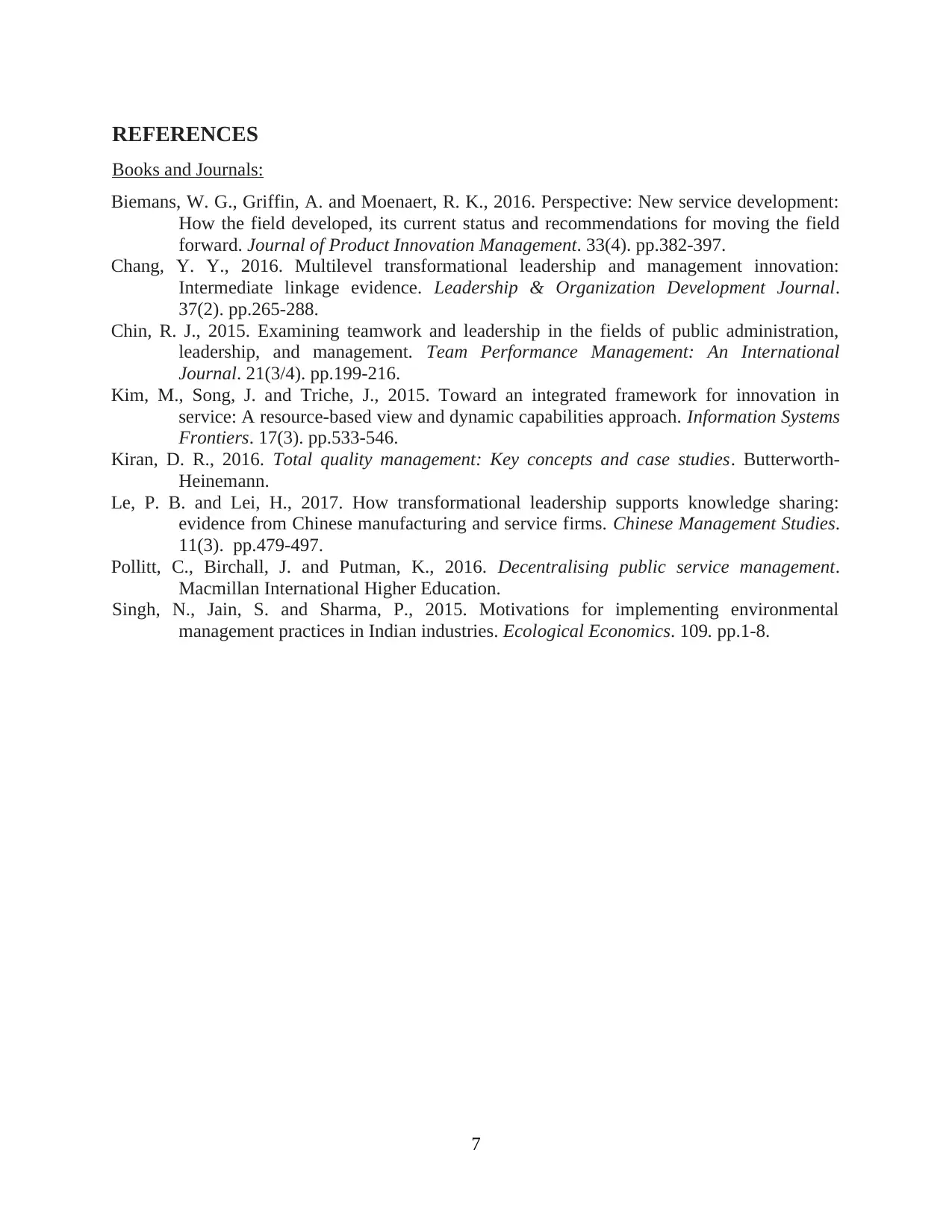
REFERENCES
Books and Journals:
Biemans, W. G., Griffin, A. and Moenaert, R. K., 2016. Perspective: New service development:
How the field developed, its current status and recommendations for moving the field
forward. Journal of Product Innovation Management. 33(4). pp.382-397.
Chang, Y. Y., 2016. Multilevel transformational leadership and management innovation:
Intermediate linkage evidence. Leadership & Organization Development Journal.
37(2). pp.265-288.
Chin, R. J., 2015. Examining teamwork and leadership in the fields of public administration,
leadership, and management. Team Performance Management: An International
Journal. 21(3/4). pp.199-216.
Kim, M., Song, J. and Triche, J., 2015. Toward an integrated framework for innovation in
service: A resource-based view and dynamic capabilities approach. Information Systems
Frontiers. 17(3). pp.533-546.
Kiran, D. R., 2016. Total quality management: Key concepts and case studies. Butterworth-
Heinemann.
Le, P. B. and Lei, H., 2017. How transformational leadership supports knowledge sharing:
evidence from Chinese manufacturing and service firms. Chinese Management Studies.
11(3). pp.479-497.
Pollitt, C., Birchall, J. and Putman, K., 2016. Decentralising public service management.
Macmillan International Higher Education.
Singh, N., Jain, S. and Sharma, P., 2015. Motivations for implementing environmental
management practices in Indian industries. Ecological Economics. 109. pp.1-8.
7
Books and Journals:
Biemans, W. G., Griffin, A. and Moenaert, R. K., 2016. Perspective: New service development:
How the field developed, its current status and recommendations for moving the field
forward. Journal of Product Innovation Management. 33(4). pp.382-397.
Chang, Y. Y., 2016. Multilevel transformational leadership and management innovation:
Intermediate linkage evidence. Leadership & Organization Development Journal.
37(2). pp.265-288.
Chin, R. J., 2015. Examining teamwork and leadership in the fields of public administration,
leadership, and management. Team Performance Management: An International
Journal. 21(3/4). pp.199-216.
Kim, M., Song, J. and Triche, J., 2015. Toward an integrated framework for innovation in
service: A resource-based view and dynamic capabilities approach. Information Systems
Frontiers. 17(3). pp.533-546.
Kiran, D. R., 2016. Total quality management: Key concepts and case studies. Butterworth-
Heinemann.
Le, P. B. and Lei, H., 2017. How transformational leadership supports knowledge sharing:
evidence from Chinese manufacturing and service firms. Chinese Management Studies.
11(3). pp.479-497.
Pollitt, C., Birchall, J. and Putman, K., 2016. Decentralising public service management.
Macmillan International Higher Education.
Singh, N., Jain, S. and Sharma, P., 2015. Motivations for implementing environmental
management practices in Indian industries. Ecological Economics. 109. pp.1-8.
7
⊘ This is a preview!⊘
Do you want full access?
Subscribe today to unlock all pages.
Trusted by 1+ million students worldwide

1 out of 9


Related Documents


Your All-in-One AI-Powered Toolkit for Academic Success.
+13062052269
info@desklib.com
Available 24*7 on WhatsApp / Email
![[object Object]](/_next/static/media/star-bottom.7253800d.svg)
Unlock your academic potential
Copyright © 2020–2026 A2Z Services. All Rights Reserved. Developed and managed by ZUCOL.