Comparing Leadership and Management in Siemens and Volkswagen
VerifiedAdded on 2021/01/02
|17
|5689
|338
Report
AI Summary
This report provides a comprehensive analysis of leadership and management within the context of Siemens and Volkswagen. It begins by defining and comparing the roles and characteristics of leaders and managers, highlighting key differences and similarities. The report then delves into the roles of leaders and managers in various situational contexts, such as technological changes, labor turnover, and conflict situations, providing practical examples and insights. It also explores different theories and approaches within the work environment, including Fiedler’s Contingency Model, and examines key approaches of managers and leaders towards operations management. Furthermore, the importance and values of operation management in achieving business goals are discussed, along with factors that impact operation management and decision-making by leaders and managers. The report utilizes examples from Siemens and Volkswagen to illustrate the concepts, providing a practical understanding of effective leadership and management practices.
MANAGEMENT AND
OPERATIONS
OPERATIONS

Paraphrase This Document
Need a fresh take? Get an instant paraphrase of this document with our AI Paraphraser
Table of Contents
INTRODUCTION...........................................................................................................................1
TASK...............................................................................................................................................1
P1 Define and compare roles and characteristics of a leader and manager............................1
P2 Role of leader and the function of a manager in different situational context..................4
P3 Theories and approaches within the work environment....................................................5
Fiedler’s Contingency Model:.............................................................................6
P4 Key approaches of managers and leaders towards the operations management...............9
P5 Operation management importance and values in achieving business goals..................10
P6 Factors that impact on operation management and decision making by leaders and
managers within the environment........................................................................................12
CONCLUSION..............................................................................................................................13
REFERENCES..............................................................................................................................14
INTRODUCTION...........................................................................................................................1
TASK...............................................................................................................................................1
P1 Define and compare roles and characteristics of a leader and manager............................1
P2 Role of leader and the function of a manager in different situational context..................4
P3 Theories and approaches within the work environment....................................................5
Fiedler’s Contingency Model:.............................................................................6
P4 Key approaches of managers and leaders towards the operations management...............9
P5 Operation management importance and values in achieving business goals..................10
P6 Factors that impact on operation management and decision making by leaders and
managers within the environment........................................................................................12
CONCLUSION..............................................................................................................................13
REFERENCES..............................................................................................................................14
INTRODUCTION
Operation and Management is the administration of the practice done by organisation to
increase the efficiency at the highest level within an organisation. As it is associated with
converting the material and labour into goods and services to maximise the profit of an
organisation. Present study is based on Siemens is the company deals in the renewable energy
industry which gives a portfolio of products and services and provides the distribution and
generation of electrical energy. Furthermore, Volkswagen is also taken for the project, is the firm
that deals in auto mobile sector. This report elaborates the role of leaders and managers in
organisation. In addition, approaches of operation management are being explained in this
assignment.
TASK
P1 Define and compare roles and characteristics of a leader and manager
This Siemens underlines the difference between leadership and management with the
understanding that the percentage of leadership and management needed for one's career varies
based on position, Siemens understand the core components of leaders and managers. Both
leadership and management occupy an important part of every job.
Leaders refers to the art of looking after others. Leaders also refers to the definition of
new directions for following certain groups. This means that the leader is the commander of the
new course. This is also defined as acting in the middle, provided the leader regulates the
conditions of other people and humans (Leon, Vazquez and Franquelo, 2017). The leader
observes sharply and clearly how he can adapt to the environment better. Siemens has great
leaders who can achieve challenging results by involving others in their work. Excellent
leadership skills are a result of the Siemens success.
Definition of Leader and Manager
Leadership is the art to motivate the group of people to act towards in achieving the goal of
the organization and keep the employees motivation towards the goal of the organisation.
while the Manager is the person responsible for the controlling and administering the part
of the company.
Characteristics of a good leader
Confidence is the main characteristics of a good leader, individual has to be sure in his all
decision so that positive results can be gained by Volkswagen. Self-control is another main
Operation and Management is the administration of the practice done by organisation to
increase the efficiency at the highest level within an organisation. As it is associated with
converting the material and labour into goods and services to maximise the profit of an
organisation. Present study is based on Siemens is the company deals in the renewable energy
industry which gives a portfolio of products and services and provides the distribution and
generation of electrical energy. Furthermore, Volkswagen is also taken for the project, is the firm
that deals in auto mobile sector. This report elaborates the role of leaders and managers in
organisation. In addition, approaches of operation management are being explained in this
assignment.
TASK
P1 Define and compare roles and characteristics of a leader and manager
This Siemens underlines the difference between leadership and management with the
understanding that the percentage of leadership and management needed for one's career varies
based on position, Siemens understand the core components of leaders and managers. Both
leadership and management occupy an important part of every job.
Leaders refers to the art of looking after others. Leaders also refers to the definition of
new directions for following certain groups. This means that the leader is the commander of the
new course. This is also defined as acting in the middle, provided the leader regulates the
conditions of other people and humans (Leon, Vazquez and Franquelo, 2017). The leader
observes sharply and clearly how he can adapt to the environment better. Siemens has great
leaders who can achieve challenging results by involving others in their work. Excellent
leadership skills are a result of the Siemens success.
Definition of Leader and Manager
Leadership is the art to motivate the group of people to act towards in achieving the goal of
the organization and keep the employees motivation towards the goal of the organisation.
while the Manager is the person responsible for the controlling and administering the part
of the company.
Characteristics of a good leader
Confidence is the main characteristics of a good leader, individual has to be sure in his all
decision so that positive results can be gained by Volkswagen. Self-control is another main
⊘ This is a preview!⊘
Do you want full access?
Subscribe today to unlock all pages.

Trusted by 1+ million students worldwide
characteristics of a leader. A good leader must be able to be a leader, he must be well-tuned, he
knows how to do things, manage tasks carefully, and avoid change. Visionary is another great
feature of a good leader, every leader of Volkswagen have a vision.
As a leader you have to work for big goals. This can be a small vision or a bigger vision.
Siemens continue to strive to improve renewable energy solutions to provide people with
cleaner, more reliable and affordable energy, and to create lasting value for all involved. It is
another quality of leader which makes them unique from other managers. Individual have
creativity and innovative ideas which makes them able to complete the task in Volkswagen in
significant manner. Leader has ability to inspire others that is the reason that most of the people
follow leaders.
Managers plays an important role in the process that involves strategic planning, goal
setting, real estate management, and the provision of financial and human resources to achieve
the goals set. Management also includes recording and storing data and information for later use
or for other people in the same organization. Mr. Sunil Mathur is Managing Director has been
with Siemens for over 26 years, holding several senior management positions in Germany and
the UK in the Energy and Industry Sectors. Management work is not limited to managers and
supervisors. Every member of the organization has leadership responsibilities as part of their
routine duties. The starting point of control is planning (Smoląg, Ślusarczyk and Kot, 2016).
Excellent managers starts with proper planning. Naturally, planning is like an investment. The
aim is to archive the best resources, add value and achieve the best results.
Communication is an important characteristic of good manager. A good manager must be
able to communicate well. In regular work situations, managers communicate with employees
who report it to senior executives and customers. In addition, a good manager must be a good
listener. They also must have the ability to communicate non-verbally. A good manager must be
an example. A good manager must be a competent planner. It must also be able to solve the
problem effectively. An active manager is responsible for the problems that arise instead of
accepting them as the responsibility of others and resolving them. As the highest executive of the
company, the Executive Board is committed to serving the interests of the Siemens and
continuously enhancing the value of the company.
Difference in between the role of leader and manager
Criteria Leader Manager
knows how to do things, manage tasks carefully, and avoid change. Visionary is another great
feature of a good leader, every leader of Volkswagen have a vision.
As a leader you have to work for big goals. This can be a small vision or a bigger vision.
Siemens continue to strive to improve renewable energy solutions to provide people with
cleaner, more reliable and affordable energy, and to create lasting value for all involved. It is
another quality of leader which makes them unique from other managers. Individual have
creativity and innovative ideas which makes them able to complete the task in Volkswagen in
significant manner. Leader has ability to inspire others that is the reason that most of the people
follow leaders.
Managers plays an important role in the process that involves strategic planning, goal
setting, real estate management, and the provision of financial and human resources to achieve
the goals set. Management also includes recording and storing data and information for later use
or for other people in the same organization. Mr. Sunil Mathur is Managing Director has been
with Siemens for over 26 years, holding several senior management positions in Germany and
the UK in the Energy and Industry Sectors. Management work is not limited to managers and
supervisors. Every member of the organization has leadership responsibilities as part of their
routine duties. The starting point of control is planning (Smoląg, Ślusarczyk and Kot, 2016).
Excellent managers starts with proper planning. Naturally, planning is like an investment. The
aim is to archive the best resources, add value and achieve the best results.
Communication is an important characteristic of good manager. A good manager must be
able to communicate well. In regular work situations, managers communicate with employees
who report it to senior executives and customers. In addition, a good manager must be a good
listener. They also must have the ability to communicate non-verbally. A good manager must be
an example. A good manager must be a competent planner. It must also be able to solve the
problem effectively. An active manager is responsible for the problems that arise instead of
accepting them as the responsibility of others and resolving them. As the highest executive of the
company, the Executive Board is committed to serving the interests of the Siemens and
continuously enhancing the value of the company.
Difference in between the role of leader and manager
Criteria Leader Manager
Paraphrase This Document
Need a fresh take? Get an instant paraphrase of this document with our AI Paraphraser
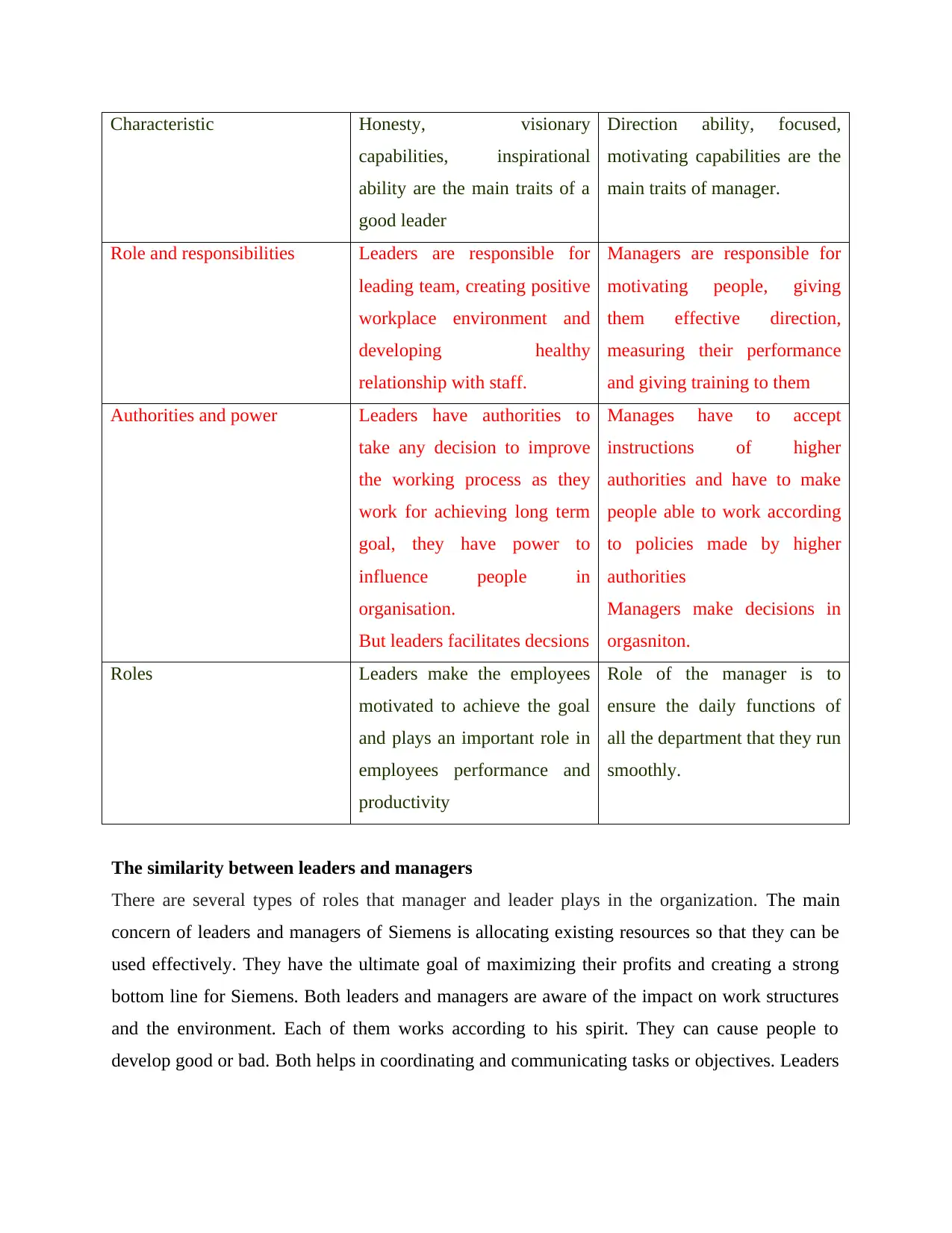
Characteristic Honesty, visionary
capabilities, inspirational
ability are the main traits of a
good leader
Direction ability, focused,
motivating capabilities are the
main traits of manager.
Role and responsibilities Leaders are responsible for
leading team, creating positive
workplace environment and
developing healthy
relationship with staff.
Managers are responsible for
motivating people, giving
them effective direction,
measuring their performance
and giving training to them
Authorities and power Leaders have authorities to
take any decision to improve
the working process as they
work for achieving long term
goal, they have power to
influence people in
organisation.
But leaders facilitates decsions
Manages have to accept
instructions of higher
authorities and have to make
people able to work according
to policies made by higher
authorities
Managers make decisions in
orgasniton.
Roles Leaders make the employees
motivated to achieve the goal
and plays an important role in
employees performance and
productivity
Role of the manager is to
ensure the daily functions of
all the department that they run
smoothly.
The similarity between leaders and managers
There are several types of roles that manager and leader plays in the organization. The main
concern of leaders and managers of Siemens is allocating existing resources so that they can be
used effectively. They have the ultimate goal of maximizing their profits and creating a strong
bottom line for Siemens. Both leaders and managers are aware of the impact on work structures
and the environment. Each of them works according to his spirit. They can cause people to
develop good or bad. Both helps in coordinating and communicating tasks or objectives. Leaders
capabilities, inspirational
ability are the main traits of a
good leader
Direction ability, focused,
motivating capabilities are the
main traits of manager.
Role and responsibilities Leaders are responsible for
leading team, creating positive
workplace environment and
developing healthy
relationship with staff.
Managers are responsible for
motivating people, giving
them effective direction,
measuring their performance
and giving training to them
Authorities and power Leaders have authorities to
take any decision to improve
the working process as they
work for achieving long term
goal, they have power to
influence people in
organisation.
But leaders facilitates decsions
Manages have to accept
instructions of higher
authorities and have to make
people able to work according
to policies made by higher
authorities
Managers make decisions in
orgasniton.
Roles Leaders make the employees
motivated to achieve the goal
and plays an important role in
employees performance and
productivity
Role of the manager is to
ensure the daily functions of
all the department that they run
smoothly.
The similarity between leaders and managers
There are several types of roles that manager and leader plays in the organization. The main
concern of leaders and managers of Siemens is allocating existing resources so that they can be
used effectively. They have the ultimate goal of maximizing their profits and creating a strong
bottom line for Siemens. Both leaders and managers are aware of the impact on work structures
and the environment. Each of them works according to his spirit. They can cause people to
develop good or bad. Both helps in coordinating and communicating tasks or objectives. Leaders
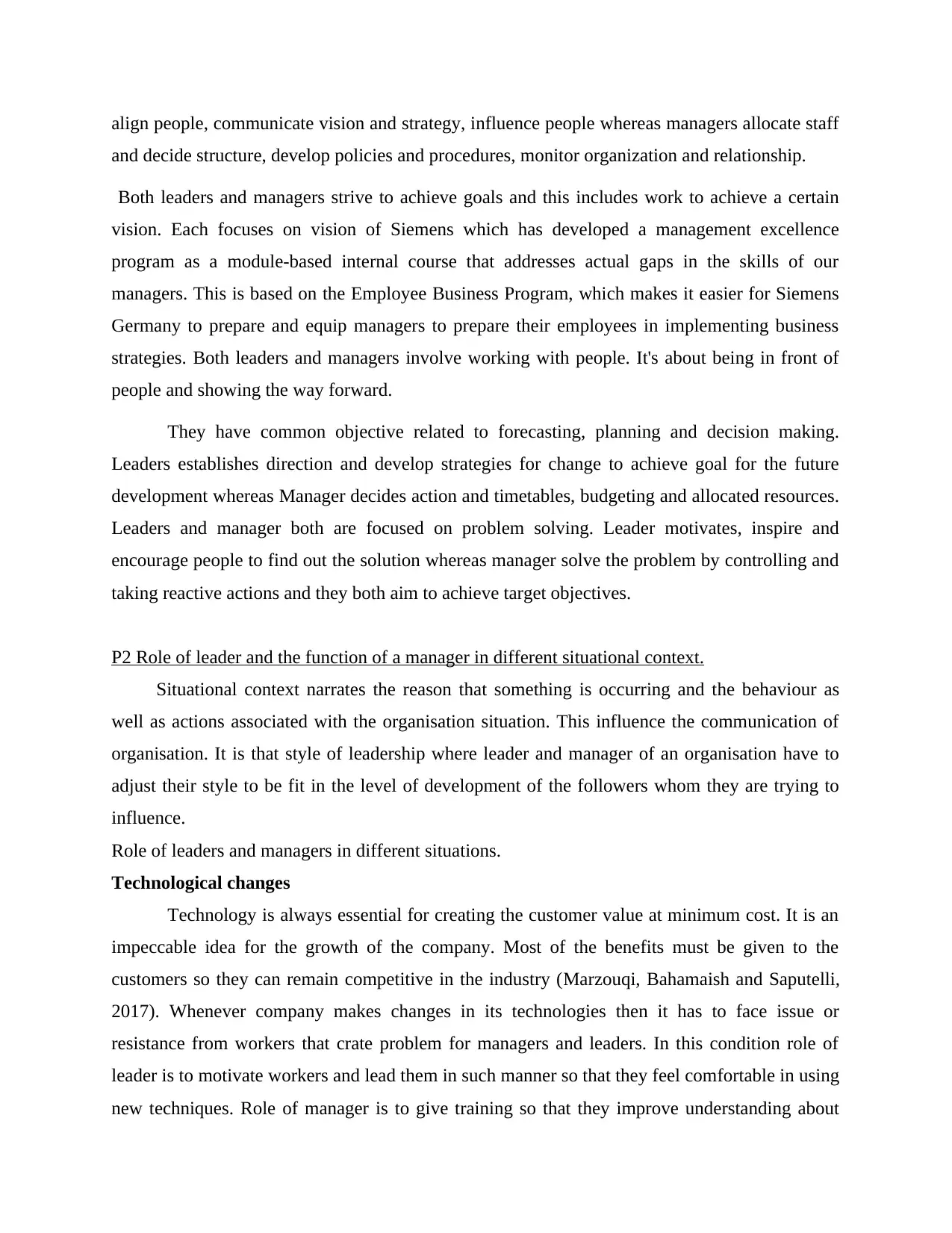
align people, communicate vision and strategy, influence people whereas managers allocate staff
and decide structure, develop policies and procedures, monitor organization and relationship.
Both leaders and managers strive to achieve goals and this includes work to achieve a certain
vision. Each focuses on vision of Siemens which has developed a management excellence
program as a module-based internal course that addresses actual gaps in the skills of our
managers. This is based on the Employee Business Program, which makes it easier for Siemens
Germany to prepare and equip managers to prepare their employees in implementing business
strategies. Both leaders and managers involve working with people. It's about being in front of
people and showing the way forward.
They have common objective related to forecasting, planning and decision making.
Leaders establishes direction and develop strategies for change to achieve goal for the future
development whereas Manager decides action and timetables, budgeting and allocated resources.
Leaders and manager both are focused on problem solving. Leader motivates, inspire and
encourage people to find out the solution whereas manager solve the problem by controlling and
taking reactive actions and they both aim to achieve target objectives.
P2 Role of leader and the function of a manager in different situational context.
Situational context narrates the reason that something is occurring and the behaviour as
well as actions associated with the organisation situation. This influence the communication of
organisation. It is that style of leadership where leader and manager of an organisation have to
adjust their style to be fit in the level of development of the followers whom they are trying to
influence.
Role of leaders and managers in different situations.
Technological changes
Technology is always essential for creating the customer value at minimum cost. It is an
impeccable idea for the growth of the company. Most of the benefits must be given to the
customers so they can remain competitive in the industry (Marzouqi, Bahamaish and Saputelli,
2017). Whenever company makes changes in its technologies then it has to face issue or
resistance from workers that crate problem for managers and leaders. In this condition role of
leader is to motivate workers and lead them in such manner so that they feel comfortable in using
new techniques. Role of manager is to give training so that they improve understanding about
and decide structure, develop policies and procedures, monitor organization and relationship.
Both leaders and managers strive to achieve goals and this includes work to achieve a certain
vision. Each focuses on vision of Siemens which has developed a management excellence
program as a module-based internal course that addresses actual gaps in the skills of our
managers. This is based on the Employee Business Program, which makes it easier for Siemens
Germany to prepare and equip managers to prepare their employees in implementing business
strategies. Both leaders and managers involve working with people. It's about being in front of
people and showing the way forward.
They have common objective related to forecasting, planning and decision making.
Leaders establishes direction and develop strategies for change to achieve goal for the future
development whereas Manager decides action and timetables, budgeting and allocated resources.
Leaders and manager both are focused on problem solving. Leader motivates, inspire and
encourage people to find out the solution whereas manager solve the problem by controlling and
taking reactive actions and they both aim to achieve target objectives.
P2 Role of leader and the function of a manager in different situational context.
Situational context narrates the reason that something is occurring and the behaviour as
well as actions associated with the organisation situation. This influence the communication of
organisation. It is that style of leadership where leader and manager of an organisation have to
adjust their style to be fit in the level of development of the followers whom they are trying to
influence.
Role of leaders and managers in different situations.
Technological changes
Technology is always essential for creating the customer value at minimum cost. It is an
impeccable idea for the growth of the company. Most of the benefits must be given to the
customers so they can remain competitive in the industry (Marzouqi, Bahamaish and Saputelli,
2017). Whenever company makes changes in its technologies then it has to face issue or
resistance from workers that crate problem for managers and leaders. In this condition role of
leader is to motivate workers and lead them in such manner so that they feel comfortable in using
new techniques. Role of manager is to give training so that they improve understanding about
⊘ This is a preview!⊘
Do you want full access?
Subscribe today to unlock all pages.
Trusted by 1+ million students worldwide
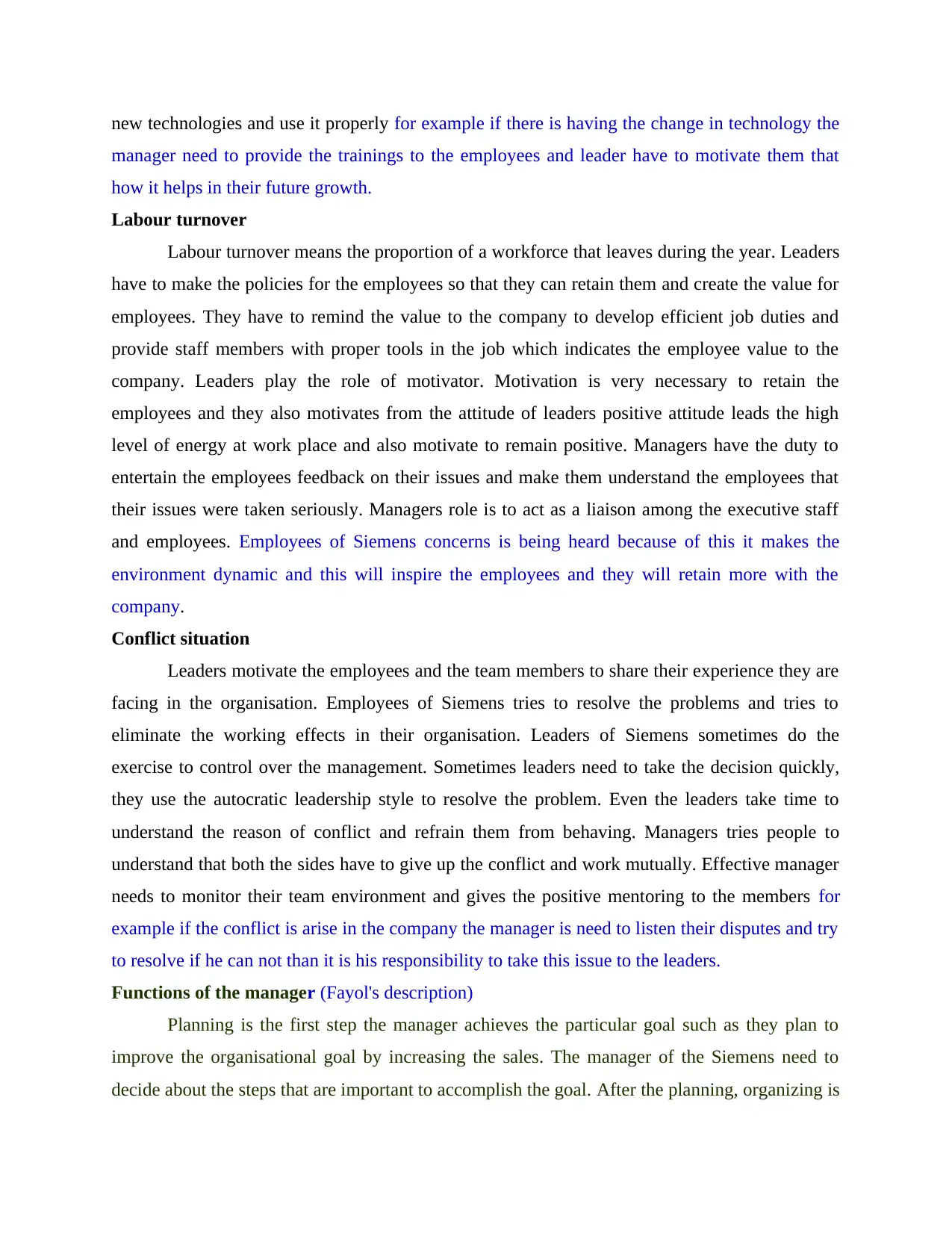
new technologies and use it properly for example if there is having the change in technology the
manager need to provide the trainings to the employees and leader have to motivate them that
how it helps in their future growth.
Labour turnover
Labour turnover means the proportion of a workforce that leaves during the year. Leaders
have to make the policies for the employees so that they can retain them and create the value for
employees. They have to remind the value to the company to develop efficient job duties and
provide staff members with proper tools in the job which indicates the employee value to the
company. Leaders play the role of motivator. Motivation is very necessary to retain the
employees and they also motivates from the attitude of leaders positive attitude leads the high
level of energy at work place and also motivate to remain positive. Managers have the duty to
entertain the employees feedback on their issues and make them understand the employees that
their issues were taken seriously. Managers role is to act as a liaison among the executive staff
and employees. Employees of Siemens concerns is being heard because of this it makes the
environment dynamic and this will inspire the employees and they will retain more with the
company.
Conflict situation
Leaders motivate the employees and the team members to share their experience they are
facing in the organisation. Employees of Siemens tries to resolve the problems and tries to
eliminate the working effects in their organisation. Leaders of Siemens sometimes do the
exercise to control over the management. Sometimes leaders need to take the decision quickly,
they use the autocratic leadership style to resolve the problem. Even the leaders take time to
understand the reason of conflict and refrain them from behaving. Managers tries people to
understand that both the sides have to give up the conflict and work mutually. Effective manager
needs to monitor their team environment and gives the positive mentoring to the members for
example if the conflict is arise in the company the manager is need to listen their disputes and try
to resolve if he can not than it is his responsibility to take this issue to the leaders.
Functions of the manager (Fayol's description)
Planning is the first step the manager achieves the particular goal such as they plan to
improve the organisational goal by increasing the sales. The manager of the Siemens need to
decide about the steps that are important to accomplish the goal. After the planning, organizing is
manager need to provide the trainings to the employees and leader have to motivate them that
how it helps in their future growth.
Labour turnover
Labour turnover means the proportion of a workforce that leaves during the year. Leaders
have to make the policies for the employees so that they can retain them and create the value for
employees. They have to remind the value to the company to develop efficient job duties and
provide staff members with proper tools in the job which indicates the employee value to the
company. Leaders play the role of motivator. Motivation is very necessary to retain the
employees and they also motivates from the attitude of leaders positive attitude leads the high
level of energy at work place and also motivate to remain positive. Managers have the duty to
entertain the employees feedback on their issues and make them understand the employees that
their issues were taken seriously. Managers role is to act as a liaison among the executive staff
and employees. Employees of Siemens concerns is being heard because of this it makes the
environment dynamic and this will inspire the employees and they will retain more with the
company.
Conflict situation
Leaders motivate the employees and the team members to share their experience they are
facing in the organisation. Employees of Siemens tries to resolve the problems and tries to
eliminate the working effects in their organisation. Leaders of Siemens sometimes do the
exercise to control over the management. Sometimes leaders need to take the decision quickly,
they use the autocratic leadership style to resolve the problem. Even the leaders take time to
understand the reason of conflict and refrain them from behaving. Managers tries people to
understand that both the sides have to give up the conflict and work mutually. Effective manager
needs to monitor their team environment and gives the positive mentoring to the members for
example if the conflict is arise in the company the manager is need to listen their disputes and try
to resolve if he can not than it is his responsibility to take this issue to the leaders.
Functions of the manager (Fayol's description)
Planning is the first step the manager achieves the particular goal such as they plan to
improve the organisational goal by increasing the sales. The manager of the Siemens need to
decide about the steps that are important to accomplish the goal. After the planning, organizing is
Paraphrase This Document
Need a fresh take? Get an instant paraphrase of this document with our AI Paraphraser
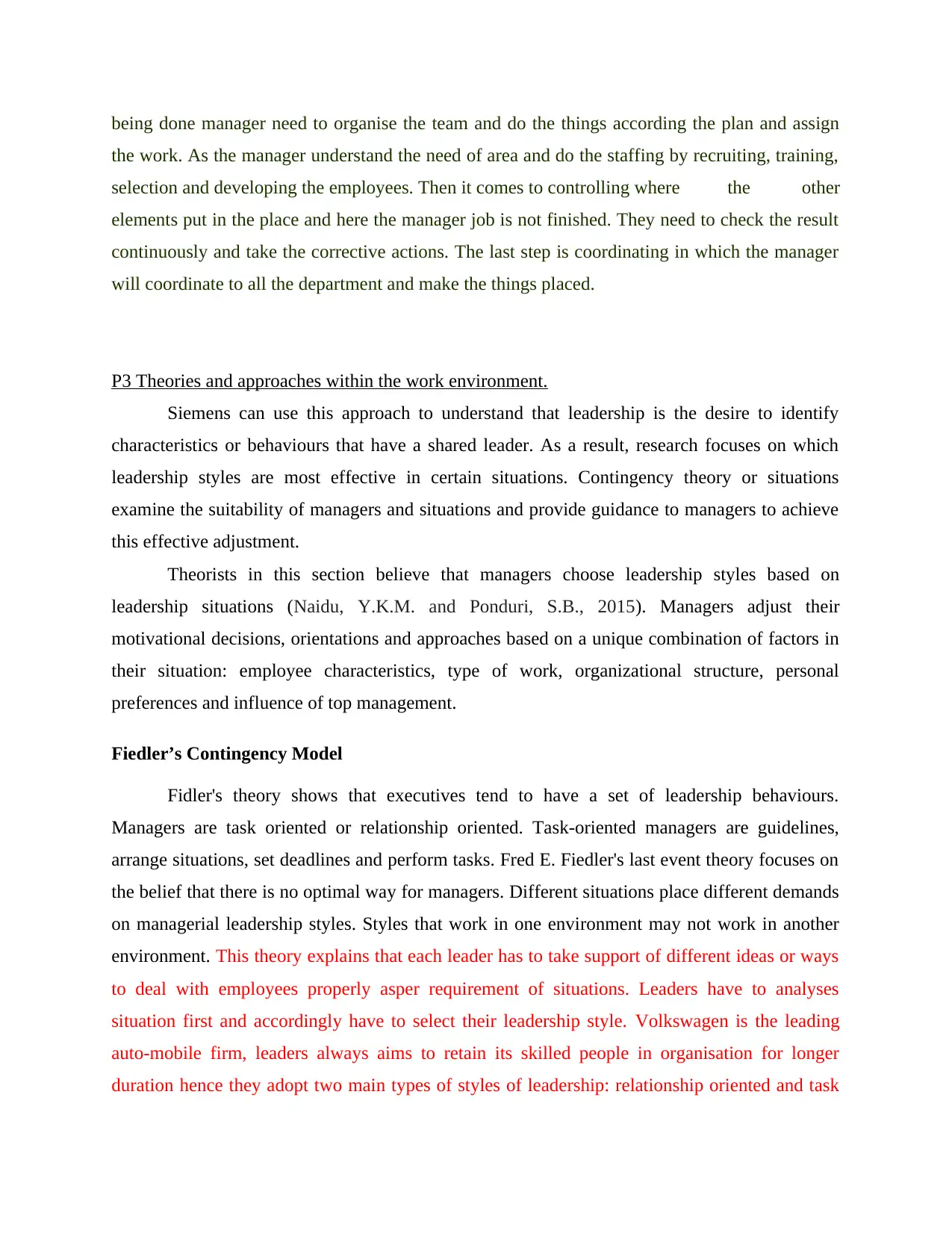
being done manager need to organise the team and do the things according the plan and assign
the work. As the manager understand the need of area and do the staffing by recruiting, training,
selection and developing the employees. Then it comes to controlling where the other
elements put in the place and here the manager job is not finished. They need to check the result
continuously and take the corrective actions. The last step is coordinating in which the manager
will coordinate to all the department and make the things placed.
P3 Theories and approaches within the work environment.
Siemens can use this approach to understand that leadership is the desire to identify
characteristics or behaviours that have a shared leader. As a result, research focuses on which
leadership styles are most effective in certain situations. Contingency theory or situations
examine the suitability of managers and situations and provide guidance to managers to achieve
this effective adjustment.
Theorists in this section believe that managers choose leadership styles based on
leadership situations (Naidu, Y.K.M. and Ponduri, S.B., 2015). Managers adjust their
motivational decisions, orientations and approaches based on a unique combination of factors in
their situation: employee characteristics, type of work, organizational structure, personal
preferences and influence of top management.
Fiedler’s Contingency Model
Fidler's theory shows that executives tend to have a set of leadership behaviours.
Managers are task oriented or relationship oriented. Task-oriented managers are guidelines,
arrange situations, set deadlines and perform tasks. Fred E. Fiedler's last event theory focuses on
the belief that there is no optimal way for managers. Different situations place different demands
on managerial leadership styles. Styles that work in one environment may not work in another
environment. This theory explains that each leader has to take support of different ideas or ways
to deal with employees properly asper requirement of situations. Leaders have to analyses
situation first and accordingly have to select their leadership style. Volkswagen is the leading
auto-mobile firm, leaders always aims to retain its skilled people in organisation for longer
duration hence they adopt two main types of styles of leadership: relationship oriented and task
the work. As the manager understand the need of area and do the staffing by recruiting, training,
selection and developing the employees. Then it comes to controlling where the other
elements put in the place and here the manager job is not finished. They need to check the result
continuously and take the corrective actions. The last step is coordinating in which the manager
will coordinate to all the department and make the things placed.
P3 Theories and approaches within the work environment.
Siemens can use this approach to understand that leadership is the desire to identify
characteristics or behaviours that have a shared leader. As a result, research focuses on which
leadership styles are most effective in certain situations. Contingency theory or situations
examine the suitability of managers and situations and provide guidance to managers to achieve
this effective adjustment.
Theorists in this section believe that managers choose leadership styles based on
leadership situations (Naidu, Y.K.M. and Ponduri, S.B., 2015). Managers adjust their
motivational decisions, orientations and approaches based on a unique combination of factors in
their situation: employee characteristics, type of work, organizational structure, personal
preferences and influence of top management.
Fiedler’s Contingency Model
Fidler's theory shows that executives tend to have a set of leadership behaviours.
Managers are task oriented or relationship oriented. Task-oriented managers are guidelines,
arrange situations, set deadlines and perform tasks. Fred E. Fiedler's last event theory focuses on
the belief that there is no optimal way for managers. Different situations place different demands
on managerial leadership styles. Styles that work in one environment may not work in another
environment. This theory explains that each leader has to take support of different ideas or ways
to deal with employees properly asper requirement of situations. Leaders have to analyses
situation first and accordingly have to select their leadership style. Volkswagen is the leading
auto-mobile firm, leaders always aims to retain its skilled people in organisation for longer
duration hence they adopt two main types of styles of leadership: relationship oriented and task
oriented. They believe that leaders have to develop relationship with employees. For example, if
Volkswagen makes changes in technologies then this type of leadership style helps in enhancing
bonding with staff members and making them loyal towards the brand in such changing
situation. By this way resistance can be minimised. Furthermore, task oriented leadership is
another type of style which focuses more on tasks. This is applied by leaders of Volkswagen
when sales are getting declined, then leaders give specific tasks to all employees and make them
understand the task as well. This helps in improving performance of business to great extent.
The scope of the task structure assigned by the group to them. Leader-member relations:
Your personal relationship with members of your group. Position power: Strength and authority
that provide their position. Task-oriented leaders tend to do their best in group situations, which
are very cheap or very unfavourable for leaders. Relationship-oriented leaders work best in
situations where they are preferred.
Situational model
The Herci-Blanchard situation model also advocates linking leadership styles to different
situations to ensure effective leadership. However, the perspective of the situation variable is
different from the Fiedler model. This model is based on empirical studies, in which Hershey and
Blanchard believe that leaders must reconcile their style with the maturity of subordinates, who
move gradually and have cycles (Duhamel, P. and et.al., 2018). This model is also called the
Leadership Life Cycle Theory and is based on interactions between three factors such as task
behaviour, relationship behaviour, maturity level. Task behaviour: The extent to which leaders
tend to regulate and determine the role of their group members, and explain what activities they
must do when, where, and how to do the tasks achieved by identifying clear organizational forms
and the pathway from achieving work. Relationship behaviour: The extent to which leaders tend
to maintain personal relationships with themselves and with their group members by opening
communication channels that provide social-emotional support, active listening, psychological
strikes, and behavioural advocacy. Maturity level: Maturity level is based on the work of Chris
Argyris. Maturity is the ability to set high goals but can be achieved, as well as the desire and
ability to take responsibility and use education and / or experience. Ability refers to the
knowledge and ability of individuals to do work, and is referred to as older work.
Volkswagen makes changes in technologies then this type of leadership style helps in enhancing
bonding with staff members and making them loyal towards the brand in such changing
situation. By this way resistance can be minimised. Furthermore, task oriented leadership is
another type of style which focuses more on tasks. This is applied by leaders of Volkswagen
when sales are getting declined, then leaders give specific tasks to all employees and make them
understand the task as well. This helps in improving performance of business to great extent.
The scope of the task structure assigned by the group to them. Leader-member relations:
Your personal relationship with members of your group. Position power: Strength and authority
that provide their position. Task-oriented leaders tend to do their best in group situations, which
are very cheap or very unfavourable for leaders. Relationship-oriented leaders work best in
situations where they are preferred.
Situational model
The Herci-Blanchard situation model also advocates linking leadership styles to different
situations to ensure effective leadership. However, the perspective of the situation variable is
different from the Fiedler model. This model is based on empirical studies, in which Hershey and
Blanchard believe that leaders must reconcile their style with the maturity of subordinates, who
move gradually and have cycles (Duhamel, P. and et.al., 2018). This model is also called the
Leadership Life Cycle Theory and is based on interactions between three factors such as task
behaviour, relationship behaviour, maturity level. Task behaviour: The extent to which leaders
tend to regulate and determine the role of their group members, and explain what activities they
must do when, where, and how to do the tasks achieved by identifying clear organizational forms
and the pathway from achieving work. Relationship behaviour: The extent to which leaders tend
to maintain personal relationships with themselves and with their group members by opening
communication channels that provide social-emotional support, active listening, psychological
strikes, and behavioural advocacy. Maturity level: Maturity level is based on the work of Chris
Argyris. Maturity is the ability to set high goals but can be achieved, as well as the desire and
ability to take responsibility and use education and / or experience. Ability refers to the
knowledge and ability of individuals to do work, and is referred to as older work.
⊘ This is a preview!⊘
Do you want full access?
Subscribe today to unlock all pages.
Trusted by 1+ million students worldwide
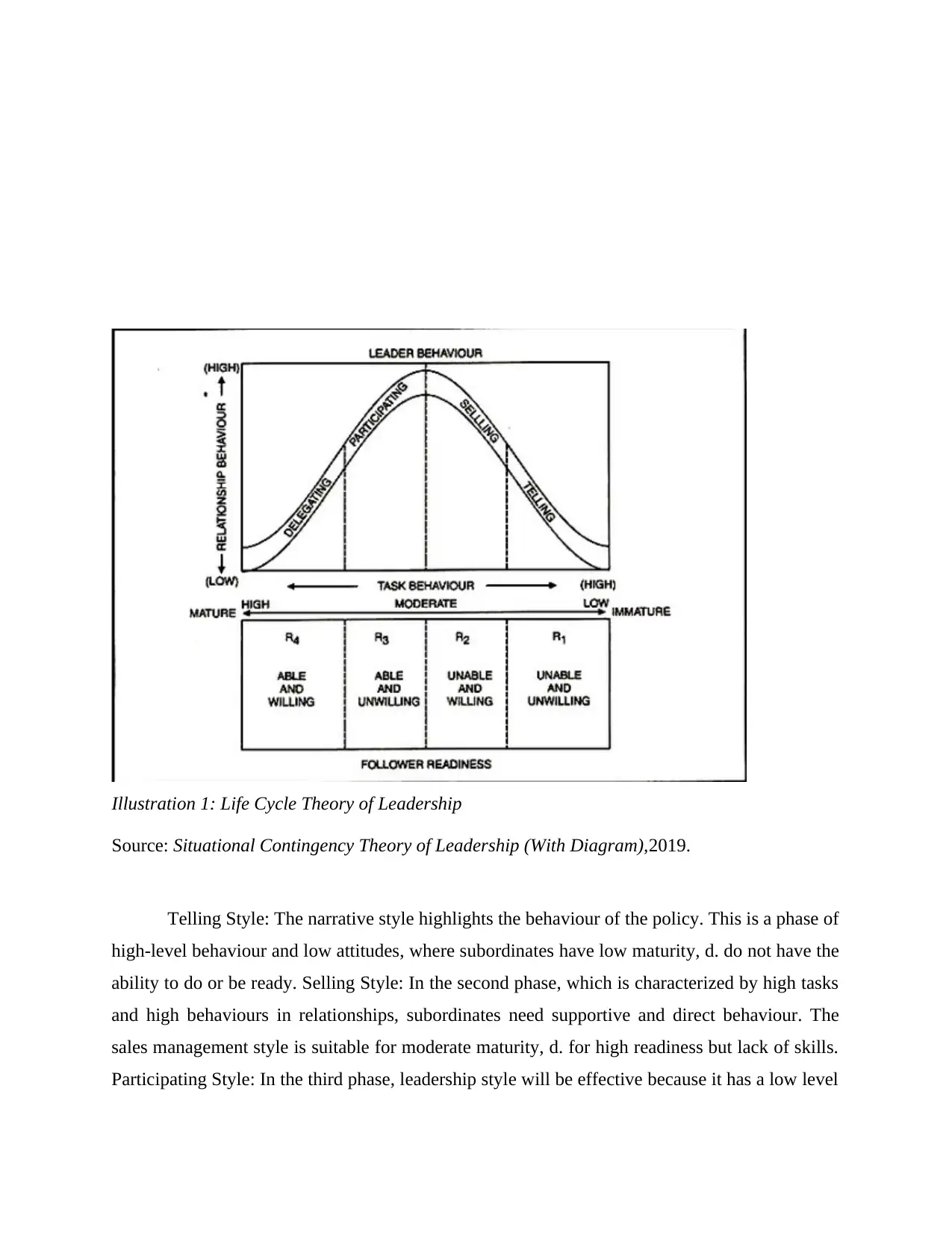
Illustration 1: Life Cycle Theory of Leadership
Source: Situational Contingency Theory of Leadership (With Diagram),2019.
Telling Style: The narrative style highlights the behaviour of the policy. This is a phase of
high-level behaviour and low attitudes, where subordinates have low maturity, d. do not have the
ability to do or be ready. Selling Style: In the second phase, which is characterized by high tasks
and high behaviours in relationships, subordinates need supportive and direct behaviour. The
sales management style is suitable for moderate maturity, d. for high readiness but lack of skills.
Participating Style: In the third phase, leadership style will be effective because it has a low level
Source: Situational Contingency Theory of Leadership (With Diagram),2019.
Telling Style: The narrative style highlights the behaviour of the policy. This is a phase of
high-level behaviour and low attitudes, where subordinates have low maturity, d. do not have the
ability to do or be ready. Selling Style: In the second phase, which is characterized by high tasks
and high behaviours in relationships, subordinates need supportive and direct behaviour. The
sales management style is suitable for moderate maturity, d. for high readiness but lack of skills.
Participating Style: In the third phase, leadership style will be effective because it has a low level
Paraphrase This Document
Need a fresh take? Get an instant paraphrase of this document with our AI Paraphraser
of attitude and posture. At this time, subordinates have high to medium maturity, who has the
ability to do but does not want to do it. Therefore, the power of a large external motivation is
needed to motivate these subordinates. Delegation style: In the fourth phase, small tasks and low
behaviours in relationships, delegation of leadership style are appropriate. The current subject is
at a very high level of maturity, have the ability and willingness to work (Jakubiak and Buchta,
2016). In this way they hardly need any support for leadership. The Hersey-Blanchard model is
simple and interesting. This helps managers determine what they need to do under what
circumstances. This model provides a place to train employees in the organization.
System Leadership
Through system leadership, leaders in organizations can create conditions where people
at all levels can work productively for their potential. It uses the principles of healthy human
behaviour to create good leadership models, organizational strategies, system design and social
processes. It provides executives with tools to predict employee behaviour in their organizations.
It also helps build effective systems that stimulate productive behaviour and lead to achieving
more effective business goals
The system approach describes the complexity and dynamics of the environment and
provides a framework for developing ideas. System leadership approaches, such as attempts to
derail literature for leadership and system theory to find meeting places. The system approach is
not a leadership approach to leadership, but the will of the leader to consider the external
environment and relations with and between the elements in his leadership (Appelbaum and
et.al., 2015). A leader without followers cannot carry out his leadership and ensures his
conviction that even though there is alternative chaos, he must provide a system, structure, and
purpose.
P4 Key approaches of managers and leaders towards the operations management.
Key approaches of operation management are explained as below:
Total Quality Management
It is the management system based on the principle that every employee of the
Volkswagen have to be committed for setting high standards in the operations of the company.
Leaders of Volkswagen emphasis on total quality management with the perspective of giving the
customer satisfaction with zero effects in their product and services that is the reason they are the
ability to do but does not want to do it. Therefore, the power of a large external motivation is
needed to motivate these subordinates. Delegation style: In the fourth phase, small tasks and low
behaviours in relationships, delegation of leadership style are appropriate. The current subject is
at a very high level of maturity, have the ability and willingness to work (Jakubiak and Buchta,
2016). In this way they hardly need any support for leadership. The Hersey-Blanchard model is
simple and interesting. This helps managers determine what they need to do under what
circumstances. This model provides a place to train employees in the organization.
System Leadership
Through system leadership, leaders in organizations can create conditions where people
at all levels can work productively for their potential. It uses the principles of healthy human
behaviour to create good leadership models, organizational strategies, system design and social
processes. It provides executives with tools to predict employee behaviour in their organizations.
It also helps build effective systems that stimulate productive behaviour and lead to achieving
more effective business goals
The system approach describes the complexity and dynamics of the environment and
provides a framework for developing ideas. System leadership approaches, such as attempts to
derail literature for leadership and system theory to find meeting places. The system approach is
not a leadership approach to leadership, but the will of the leader to consider the external
environment and relations with and between the elements in his leadership (Appelbaum and
et.al., 2015). A leader without followers cannot carry out his leadership and ensures his
conviction that even though there is alternative chaos, he must provide a system, structure, and
purpose.
P4 Key approaches of managers and leaders towards the operations management.
Key approaches of operation management are explained as below:
Total Quality Management
It is the management system based on the principle that every employee of the
Volkswagen have to be committed for setting high standards in the operations of the company.
Leaders of Volkswagen emphasis on total quality management with the perspective of giving the
customer satisfaction with zero effects in their product and services that is the reason they are the
leading in service industries. Leaders ensures that quality of products and process is the
responsibility of everyone who is involved. Leaders act as the successful agent in the
implementation in Total Quality Management. Managers can act as the senior management in
implementing this tool in two ways, first by the philosophy and principles within the
departmental operations and the second way is by developing and delivering the long term
training to adopt the necessary organisational culture.
Six sigma
leaders of Volkswagen applies the theory of six sigma and there is an evidence of lean six
sigma activity. Through this they have make the series of change in its operations and
manufacturing process. It is important that leaders use their skills and knowledge in this rapidly
changing world (Bamel and et.al., 2015). Leaders can successfully completing the improvement
in projects in different functional areas. Managers have to achieve all these benefits arising from
the six sigma and also gives the trainings to the people who are assessed as the potential leaders.
Black belts were given to the best people of the company. Managers need to be give the training
to the most extreme employees of the company.
Lean management
The management of Volkswagen adopts the Lean Management which is the continuous
improvement in the respect of peoples, focus on the values of customer and also makes the teams
to rethink the practices that guides them from the years. Managers practices the lean management
to shift the mind-set of employees and act as a teacher and coach. They improve the process and
products through the incremental changes. Leaders role is to lead employees well so that they
can support top management in continuous improvement process. Leader discuss the issues with
workers so that actual areas of improvement can be analysed and proper action can be taken to
improve such operations.
Just in Time
It is helpful in the manufacturing management process. Leaders of Volkswagen can
increase the inventory turnover and at the same time decrease the holding and all cost connected
to it. Motive of this approach is to place the order for the material on the same day of its
production and also identifies the obstacles in production. Managers plays the role in Just in
Time to eliminate the waste such as eliminates product waste, time, inventory or anything
associated with the production and manufacturing. Managers of Volkswagen keeps the cost of
responsibility of everyone who is involved. Leaders act as the successful agent in the
implementation in Total Quality Management. Managers can act as the senior management in
implementing this tool in two ways, first by the philosophy and principles within the
departmental operations and the second way is by developing and delivering the long term
training to adopt the necessary organisational culture.
Six sigma
leaders of Volkswagen applies the theory of six sigma and there is an evidence of lean six
sigma activity. Through this they have make the series of change in its operations and
manufacturing process. It is important that leaders use their skills and knowledge in this rapidly
changing world (Bamel and et.al., 2015). Leaders can successfully completing the improvement
in projects in different functional areas. Managers have to achieve all these benefits arising from
the six sigma and also gives the trainings to the people who are assessed as the potential leaders.
Black belts were given to the best people of the company. Managers need to be give the training
to the most extreme employees of the company.
Lean management
The management of Volkswagen adopts the Lean Management which is the continuous
improvement in the respect of peoples, focus on the values of customer and also makes the teams
to rethink the practices that guides them from the years. Managers practices the lean management
to shift the mind-set of employees and act as a teacher and coach. They improve the process and
products through the incremental changes. Leaders role is to lead employees well so that they
can support top management in continuous improvement process. Leader discuss the issues with
workers so that actual areas of improvement can be analysed and proper action can be taken to
improve such operations.
Just in Time
It is helpful in the manufacturing management process. Leaders of Volkswagen can
increase the inventory turnover and at the same time decrease the holding and all cost connected
to it. Motive of this approach is to place the order for the material on the same day of its
production and also identifies the obstacles in production. Managers plays the role in Just in
Time to eliminate the waste such as eliminates product waste, time, inventory or anything
associated with the production and manufacturing. Managers of Volkswagen keeps the cost of
⊘ This is a preview!⊘
Do you want full access?
Subscribe today to unlock all pages.
Trusted by 1+ million students worldwide

1 out of 17


Related Documents


Your All-in-One AI-Powered Toolkit for Academic Success.
+13062052269
info@desklib.com
Available 24*7 on WhatsApp / Email
![[object Object]](/_next/static/media/star-bottom.7253800d.svg)
Unlock your academic potential
Copyright © 2020–2026 A2Z Services. All Rights Reserved. Developed and managed by ZUCOL.