Leadership and Management for Service Industry: A Comprehensive Report
VerifiedAdded on 2021/02/19
|19
|6294
|24
Report
AI Summary
This report provides a detailed examination of leadership and management within the service industry, with a specific focus on the TUI Group. It begins by exploring classical management theories such as scientific management, bureaucratic management, and administrative management, along with system theory, and how these theories can be applied in the service sector. The report then delves into different leadership styles, including autocratic, democratic, and laissez-faire, and analyzes the roles of a leader, such as motivator, mentor, communicator, and navigator. Furthermore, it reviews the application of management and leadership styles within the service sector, considering the influence of technology and organizational structure. The report also discusses organizational culture models, such as Handy's culture model, and their impact on business operations. Finally, the report assesses current and future management and leadership skills, comparing different service organizations' change management systems and the role of leadership in implementing change. The report concludes by comparing and contrasting different service industry organizations, providing a comprehensive analysis of leadership and management practices.
LEADERSHIP AND
MANAGEMENT FOR
SERVICE INDUSTRY
MANAGEMENT FOR
SERVICE INDUSTRY

Paraphrase This Document
Need a fresh take? Get an instant paraphrase of this document with our AI Paraphraser
Table of Contents
INTRODUCTION.....................................................................................................................................3
TASK 1....................................................................................................................................................3
P1. Different classical theories of management ................................................................................3
P2. Role of the leader and different leadership style.........................................................................6
P3. Review management and leadership style in a specific service sector. ......................................8
TASK 2....................................................................................................................................................9
P4. Internal and external factors which influences the management style and structure within the
service industry..................................................................................................................................9
TASK 3..................................................................................................................................................11
P5 Assess current management and leadership ‘hard’ and ‘soft’ skills providing evidence from
specific service sector examples......................................................................................................11
P6 Future management and leadership skill ...................................................................................13
TASK 4..................................................................................................................................................15
P7 Comparison of different service organization ............................................................................15
CONCLUSION.......................................................................................................................................17
REFERENCES.........................................................................................................................................18
INTRODUCTION.....................................................................................................................................3
TASK 1....................................................................................................................................................3
P1. Different classical theories of management ................................................................................3
P2. Role of the leader and different leadership style.........................................................................6
P3. Review management and leadership style in a specific service sector. ......................................8
TASK 2....................................................................................................................................................9
P4. Internal and external factors which influences the management style and structure within the
service industry..................................................................................................................................9
TASK 3..................................................................................................................................................11
P5 Assess current management and leadership ‘hard’ and ‘soft’ skills providing evidence from
specific service sector examples......................................................................................................11
P6 Future management and leadership skill ...................................................................................13
TASK 4..................................................................................................................................................15
P7 Comparison of different service organization ............................................................................15
CONCLUSION.......................................................................................................................................17
REFERENCES.........................................................................................................................................18
INTRODUCTION
Leadership and management are two different but most crucial elements of the business
organisation. Leadership is concerned with the potential of the leader so that they can
influence and motivate the people to work for the attainment of business goals and objectives.
Management is concerned with the managerial action of the planning, organising, directing
and controlling the different activities of the business organisation (Deming, 2018). The
company which is to be considered for this report is TUI group which has initiated its
business from the year 1932 and deals in hospitality and tourism industry. This report will
explain the classical management theory and different leadership styles. It will search for
various factors which will influence different management style and structure in a service
industry. The report will also evaluate and assess the current and future management and
leadership skills for the service sector. The last part of the report will concentrate on
comparing and contrasting different service industry organisations change management
system and leadership is implementing change.
TASK 1
P1. Different classical theories of management
There are various views of management and classical views of management or
classical management theory is one of them. Planning, organising, recruiting, directing and
controlling etc. are some responsibilities of the manager (Deming, 2018). In TUI, the
manager of the organization can some theories of classical management for the effective
management of the company.
Clasical management theories-These theories are as following:
Scientific management theory- This theory is developed by Frederick Winslow
Taylor to manage the operation and activities of an organisation in an effective manner. The
author believed that if the manger of the company monitor the work in scientific manner then
the person an identifying and finding out an defective way and manner to perform the task
appropriately (Dhar, 2016). In context of TUI, the manger can implement this theory in the
operations and activities of the firm. If company's manager use this theory within
organisation then help them in maximizing profit and productivity of the company. As
manager provide proper guidance which encourage personnel to contribute tehir best effort
in scientific manner taht improves overall perfriomance of firm.
Leadership and management are two different but most crucial elements of the business
organisation. Leadership is concerned with the potential of the leader so that they can
influence and motivate the people to work for the attainment of business goals and objectives.
Management is concerned with the managerial action of the planning, organising, directing
and controlling the different activities of the business organisation (Deming, 2018). The
company which is to be considered for this report is TUI group which has initiated its
business from the year 1932 and deals in hospitality and tourism industry. This report will
explain the classical management theory and different leadership styles. It will search for
various factors which will influence different management style and structure in a service
industry. The report will also evaluate and assess the current and future management and
leadership skills for the service sector. The last part of the report will concentrate on
comparing and contrasting different service industry organisations change management
system and leadership is implementing change.
TASK 1
P1. Different classical theories of management
There are various views of management and classical views of management or
classical management theory is one of them. Planning, organising, recruiting, directing and
controlling etc. are some responsibilities of the manager (Deming, 2018). In TUI, the
manager of the organization can some theories of classical management for the effective
management of the company.
Clasical management theories-These theories are as following:
Scientific management theory- This theory is developed by Frederick Winslow
Taylor to manage the operation and activities of an organisation in an effective manner. The
author believed that if the manger of the company monitor the work in scientific manner then
the person an identifying and finding out an defective way and manner to perform the task
appropriately (Dhar, 2016). In context of TUI, the manger can implement this theory in the
operations and activities of the firm. If company's manager use this theory within
organisation then help them in maximizing profit and productivity of the company. As
manager provide proper guidance which encourage personnel to contribute tehir best effort
in scientific manner taht improves overall perfriomance of firm.
⊘ This is a preview!⊘
Do you want full access?
Subscribe today to unlock all pages.

Trusted by 1+ million students worldwide
Bureaucratic management theory- This theory was developed by Max Weber and
the author viewed that bureaucracy is the most efficient form of a company. This theory
focuses to operate the firm under a hierarchy of position and formalised the rules and
procedures to operate the task of the organisation in an appropriate manner (Donate and de
Pablo, 2015). Application of the rules and sanctions must be impersonal and authorities
should be formalized in to a hierarchical structure so that the task and work which is assigned
by the senior completed on time in proper way. In TUI, this theory can be used by the manger
to attain set objective in better manner. If the employees of this travel and tourism sector
organisation attain their target on time then they are rewarded for their work. This help in
motivating employees and they will put their best efforts in the growth and development of
organisation.
Administrative management theory(Classical management theory)- This theory
of management is developed by Henry Foyal. It is a type of classical management theory and
systematic way of organise and monitor activities and operations within a company. This
theory can be used by the management to improve the performance and overall functions of
an organisation. According to author, planning, organising, controlling, coordinating are
some functions of the management. In context of TUI, this approach can be implement by
manger in context of effective management. Because the main principle of this theory to
assigned the task in a systematic manner includes clearly defined task.
`System theory- This theory is proposed in 1940 by Ludwig von Bertalanffy as it is
the transdisciplinary study of the abstratct organisation of phenomena, independent of theiur
substance, type or spatialor temporal scale of existence. It is also known as management
methodology as it is a way of analysing about organisations and also an alternative approcah.
From the above motioned and defined information, it can be analysed that the
management of TUI can used and applied administrative theory of management because it
help tehm to delegate the tasks in systematic manner so that the employees can attain their
targets and goals in effective manner and make contribution in the growth of the firm (Gupta,
Sharma and Sunder, 2016).
Organizational structure- It is a system that outlines how ceratin activities are
directed to achive the aims of a company. These activties can include rules, roles and
responsibilities. There are different types of organisational structure some of them are as
following:
the author viewed that bureaucracy is the most efficient form of a company. This theory
focuses to operate the firm under a hierarchy of position and formalised the rules and
procedures to operate the task of the organisation in an appropriate manner (Donate and de
Pablo, 2015). Application of the rules and sanctions must be impersonal and authorities
should be formalized in to a hierarchical structure so that the task and work which is assigned
by the senior completed on time in proper way. In TUI, this theory can be used by the manger
to attain set objective in better manner. If the employees of this travel and tourism sector
organisation attain their target on time then they are rewarded for their work. This help in
motivating employees and they will put their best efforts in the growth and development of
organisation.
Administrative management theory(Classical management theory)- This theory
of management is developed by Henry Foyal. It is a type of classical management theory and
systematic way of organise and monitor activities and operations within a company. This
theory can be used by the management to improve the performance and overall functions of
an organisation. According to author, planning, organising, controlling, coordinating are
some functions of the management. In context of TUI, this approach can be implement by
manger in context of effective management. Because the main principle of this theory to
assigned the task in a systematic manner includes clearly defined task.
`System theory- This theory is proposed in 1940 by Ludwig von Bertalanffy as it is
the transdisciplinary study of the abstratct organisation of phenomena, independent of theiur
substance, type or spatialor temporal scale of existence. It is also known as management
methodology as it is a way of analysing about organisations and also an alternative approcah.
From the above motioned and defined information, it can be analysed that the
management of TUI can used and applied administrative theory of management because it
help tehm to delegate the tasks in systematic manner so that the employees can attain their
targets and goals in effective manner and make contribution in the growth of the firm (Gupta,
Sharma and Sunder, 2016).
Organizational structure- It is a system that outlines how ceratin activities are
directed to achive the aims of a company. These activties can include rules, roles and
responsibilities. There are different types of organisational structure some of them are as
following:
Paraphrase This Document
Need a fresh take? Get an instant paraphrase of this document with our AI Paraphraser
Matrix organisational structure- This structure provides for reporting levels both
horizontally as well as vertically. Employees may be part of a functional group but
may serve on a term or group that supports new product development.
Advantages- If the management of TUI adopt this structure then employees can share their
knowledge across the different functional divisions alowing for better communication and
understanding of each function's role.
Disadvantages- The drawback of this structure in context of TUI is that reporting to mulitple
managers may add confusion and conflict between managers over what should be reported. If
the prioritiues are not clearly desribed then employees may get confused about their roles.
Centralized organisational structure- It rely on one individual to make decisions and
proviode direction for company. If TUI adopt this structure then activities involving
planning and decision making within an organsiation are focused to a specific leader
and location.
Advantages- This structure provide supports focued vision and help in fast execution. In TUI,
it help in reducing internal conflicts, control and accountability.
Disadvantages- This organisation structure is more bureaucratic and often extra layers in the
hierarchy. There are lack of authority down the hierarchy may reduce manager motivation.
P2. Role of the leader and different leadership style
Leader refers to a person and individual who is responsible to guide and lead the
employees and team or group in which people are working to attain a common goal. In
context of TUI, the leader is also work for motivating employees and for this the person play
different roles, some of them are motioned as below:
Motivator- It is the major role of a leader which is played by them in effective manner. In
TUI, when the employees are working in a group or team to attain a common goal and they
are feeling demotivated then leader organised motivational sessions and programs to
encourage them whcih empower personnel to complete their work and attain their gaols
effectively in set period of time.
horizontally as well as vertically. Employees may be part of a functional group but
may serve on a term or group that supports new product development.
Advantages- If the management of TUI adopt this structure then employees can share their
knowledge across the different functional divisions alowing for better communication and
understanding of each function's role.
Disadvantages- The drawback of this structure in context of TUI is that reporting to mulitple
managers may add confusion and conflict between managers over what should be reported. If
the prioritiues are not clearly desribed then employees may get confused about their roles.
Centralized organisational structure- It rely on one individual to make decisions and
proviode direction for company. If TUI adopt this structure then activities involving
planning and decision making within an organsiation are focused to a specific leader
and location.
Advantages- This structure provide supports focued vision and help in fast execution. In TUI,
it help in reducing internal conflicts, control and accountability.
Disadvantages- This organisation structure is more bureaucratic and often extra layers in the
hierarchy. There are lack of authority down the hierarchy may reduce manager motivation.
P2. Role of the leader and different leadership style
Leader refers to a person and individual who is responsible to guide and lead the
employees and team or group in which people are working to attain a common goal. In
context of TUI, the leader is also work for motivating employees and for this the person play
different roles, some of them are motioned as below:
Motivator- It is the major role of a leader which is played by them in effective manner. In
TUI, when the employees are working in a group or team to attain a common goal and they
are feeling demotivated then leader organised motivational sessions and programs to
encourage them whcih empower personnel to complete their work and attain their gaols
effectively in set period of time.
Mentor- It is an another role which is played by leaders company. When workers have not
clear information about vision and mission of the task then leaders play an essential role as
mentor. In TUI, they help in providing clear information about the mission of work so that
employees can complete their job on time.
Communicator- It is the next role which is played by the leader as a communicator. In TUI,
within this role, leader make interaction with employees to get information about issues and
help in resolving or providing solution to them. As a communicator, individual can share
information to workers and help in offering necessary information to them.
Navigator- Within this role, leader help in generating and creating aims to support missions.
They designed aims which lead employees in right direction as well as creates vision to
accomplish their business goal. In TUI, it help its leader to behave responsible for
construction of aims so that workers can attain their aims. (Inkinen, 2016).
Different leadership styles
There are different types of leadership styles and the leadership styles which are
motioned below according to Lewin’s:
Autocratic leadership style- This leadership style is also known as authoritarian leadership
which offers clear expectations for requires to be done when it should be done. This style of
leadership is strongly make concentration on both command by leader and followers. Within
this style, leader is responsible to take decision or no little input from the rest of group.
Democratic leadership style- It is another type of leadership style which is also known as
participative leadership style. In this, it allowed to make participation in decision making
process and it encourage them to share their issues and ideas. If ideas of them are effective
then they are considered by management which feel them motivated as well as foster
commitment to the goals.
Laissez –Faire leadership style- This leadership style is known as delegative leadership style.
This leadership tended to outcome in teams that lacked direction where members blamed
each other for mistakes, refused to adopt personal responsibility and produced a lack of
progress and work (Inkinen, Kianto and Vanhala, 2015).
From the above analysis, it can be analysed that democratic leadership style is better
which can be followed by TUI. It is effective because both employees and leader are
clear information about vision and mission of the task then leaders play an essential role as
mentor. In TUI, they help in providing clear information about the mission of work so that
employees can complete their job on time.
Communicator- It is the next role which is played by the leader as a communicator. In TUI,
within this role, leader make interaction with employees to get information about issues and
help in resolving or providing solution to them. As a communicator, individual can share
information to workers and help in offering necessary information to them.
Navigator- Within this role, leader help in generating and creating aims to support missions.
They designed aims which lead employees in right direction as well as creates vision to
accomplish their business goal. In TUI, it help its leader to behave responsible for
construction of aims so that workers can attain their aims. (Inkinen, 2016).
Different leadership styles
There are different types of leadership styles and the leadership styles which are
motioned below according to Lewin’s:
Autocratic leadership style- This leadership style is also known as authoritarian leadership
which offers clear expectations for requires to be done when it should be done. This style of
leadership is strongly make concentration on both command by leader and followers. Within
this style, leader is responsible to take decision or no little input from the rest of group.
Democratic leadership style- It is another type of leadership style which is also known as
participative leadership style. In this, it allowed to make participation in decision making
process and it encourage them to share their issues and ideas. If ideas of them are effective
then they are considered by management which feel them motivated as well as foster
commitment to the goals.
Laissez –Faire leadership style- This leadership style is known as delegative leadership style.
This leadership tended to outcome in teams that lacked direction where members blamed
each other for mistakes, refused to adopt personal responsibility and produced a lack of
progress and work (Inkinen, Kianto and Vanhala, 2015).
From the above analysis, it can be analysed that democratic leadership style is better
which can be followed by TUI. It is effective because both employees and leader are
⊘ This is a preview!⊘
Do you want full access?
Subscribe today to unlock all pages.
Trusted by 1+ million students worldwide
responsible to take decision whcih bring high level of motivation within business premises. It
is beneficial because if the employees are participate in decision making process hen they can
share their ideas and views.
P3. Review management and leadership style in a specific service sector.
Leadership and management style are those which are specifically important for
business to adopt. As TUI deals in various sectors like airline, hotels, cruise, accommodation,
etc. so it becomes important for managers and leaders to follow proper structure and culture.
TUI is greatly influenced by use of technology and management and leadership style plays a
greater role in adopting those technologies. This is possible because customer are now able to
book the flights, hotels, resorts, etc. on the internet only with the help of mobile or any other
gadget. For this, leaders are required to concentrate on companies website, design it in a
manner such that when customer visit it, they will be inspired and book hotels or
transportation. Through digital technology, customer does not have to wait in a long queue to
book railways or air tickets.
In TUI, organisational structure which is perfect is centralised and decentralised
structure. In centralised structure, the TUI will br able to implement policies and practices for
whole businesses effectively and effecientely. This is because decisions are made in
hierarachy where organisation successfully prevents other areas of business to become
indepdent (Jaiswal, and Dhar, 2015).
Furthermore, leadership style which will be appropriate under TUI service sector is
democratic leadership style as it enable leader to take suggestions from team members and
takes decisions by taking into consideration their views. Culture is a aspect in which
organisation works and functions. This culture can be explained with the help of Handy's
culture model which is used in TUI as it describes distribution of power and level of
cooperation within organisation. For this purpose, model is divided into four different group
of culture and they are discussed below:
Role culture: This type of culture can be found in beauracratic organisations where
the individuals are highly oriented towards the job. If the TUI adopts this culture then
there will be very high level of discipline, rule, regulations, strictness, etc. within
organisations. Thus, this will create hurdle in way for flexibility.
is beneficial because if the employees are participate in decision making process hen they can
share their ideas and views.
P3. Review management and leadership style in a specific service sector.
Leadership and management style are those which are specifically important for
business to adopt. As TUI deals in various sectors like airline, hotels, cruise, accommodation,
etc. so it becomes important for managers and leaders to follow proper structure and culture.
TUI is greatly influenced by use of technology and management and leadership style plays a
greater role in adopting those technologies. This is possible because customer are now able to
book the flights, hotels, resorts, etc. on the internet only with the help of mobile or any other
gadget. For this, leaders are required to concentrate on companies website, design it in a
manner such that when customer visit it, they will be inspired and book hotels or
transportation. Through digital technology, customer does not have to wait in a long queue to
book railways or air tickets.
In TUI, organisational structure which is perfect is centralised and decentralised
structure. In centralised structure, the TUI will br able to implement policies and practices for
whole businesses effectively and effecientely. This is because decisions are made in
hierarachy where organisation successfully prevents other areas of business to become
indepdent (Jaiswal, and Dhar, 2015).
Furthermore, leadership style which will be appropriate under TUI service sector is
democratic leadership style as it enable leader to take suggestions from team members and
takes decisions by taking into consideration their views. Culture is a aspect in which
organisation works and functions. This culture can be explained with the help of Handy's
culture model which is used in TUI as it describes distribution of power and level of
cooperation within organisation. For this purpose, model is divided into four different group
of culture and they are discussed below:
Role culture: This type of culture can be found in beauracratic organisations where
the individuals are highly oriented towards the job. If the TUI adopts this culture then
there will be very high level of discipline, rule, regulations, strictness, etc. within
organisations. Thus, this will create hurdle in way for flexibility.
Paraphrase This Document
Need a fresh take? Get an instant paraphrase of this document with our AI Paraphraser
Power culture: Under this type of culture, there is a low level of power distribution
and low level of cooperation among the workforce. This type of culture is found in
entrepreneurs where power lies with superior authority (Noe, and et. al. 2017).
Person culture: In this, there is low level of cooperation and high power distribution
among the workforce. This type of power is generally found in such organisations
where workforce is highly professional, educated, skilled and they are independent.
Task culture: In this, there is high cooperation and power distribution in which
individuals or workforce is highly professional and problem solving oriented. There is
expert level of workforce which have flexibility and are effectively accomplishes
business tasks.
Therefore, it has been analysed that the best culture for TUI group is Task culture because
it enable workforce to be highly flexible in order to deal with any kind of problems and
difficulties in a better way.
The role of leader will be to motivate the employees on regular basis such that they will
be able to work with full confidence and effectiveness in order to attain business goals and
objectives. Furthermore, they work immensely in order to identify the training needs and
provide the required training to the employees. Whereas, the role of manager will be to put
great focus on the effective planning, coordinating, directing and controlling the various
business activities. They are held accountable for providing the mission and vision to the
company and leader makes people work in accordance to meet those mission and vision.
TASK 2
P4. Internal and external factors which influences the management style and structure within
the service industry.
Every service industry is surrounded by several business environmental factors which
are internal and external. The combination of internal and external factors affect the TUI
adversely and this will directly impact digital technology as well. Digitalisation is very
important for both internal and external factors. Such factors are helpful in determining
business environment (Lockwood, 2015).
Internal factors
and low level of cooperation among the workforce. This type of culture is found in
entrepreneurs where power lies with superior authority (Noe, and et. al. 2017).
Person culture: In this, there is low level of cooperation and high power distribution
among the workforce. This type of power is generally found in such organisations
where workforce is highly professional, educated, skilled and they are independent.
Task culture: In this, there is high cooperation and power distribution in which
individuals or workforce is highly professional and problem solving oriented. There is
expert level of workforce which have flexibility and are effectively accomplishes
business tasks.
Therefore, it has been analysed that the best culture for TUI group is Task culture because
it enable workforce to be highly flexible in order to deal with any kind of problems and
difficulties in a better way.
The role of leader will be to motivate the employees on regular basis such that they will
be able to work with full confidence and effectiveness in order to attain business goals and
objectives. Furthermore, they work immensely in order to identify the training needs and
provide the required training to the employees. Whereas, the role of manager will be to put
great focus on the effective planning, coordinating, directing and controlling the various
business activities. They are held accountable for providing the mission and vision to the
company and leader makes people work in accordance to meet those mission and vision.
TASK 2
P4. Internal and external factors which influences the management style and structure within
the service industry.
Every service industry is surrounded by several business environmental factors which
are internal and external. The combination of internal and external factors affect the TUI
adversely and this will directly impact digital technology as well. Digitalisation is very
important for both internal and external factors. Such factors are helpful in determining
business environment (Lockwood, 2015).
Internal factors
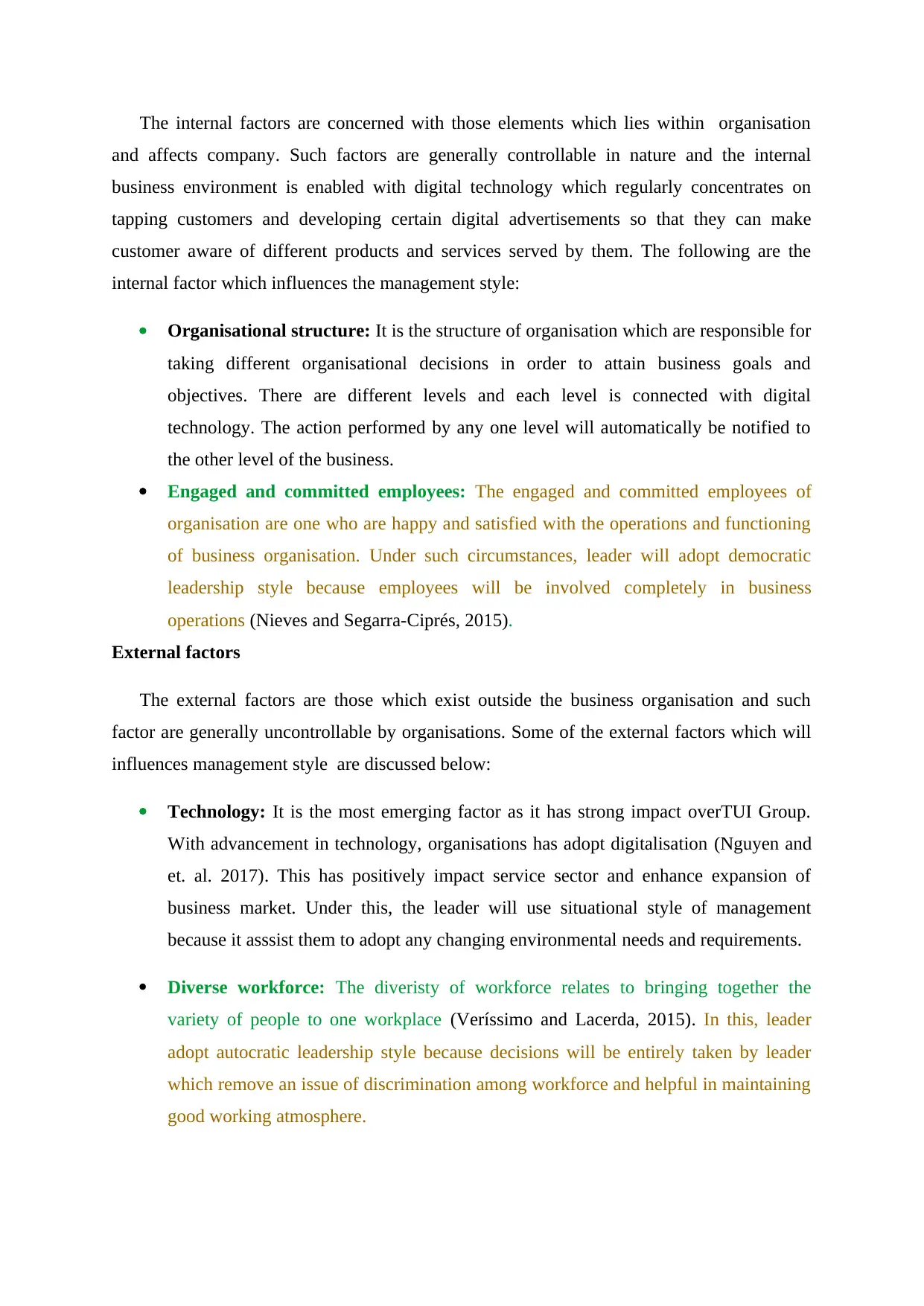
The internal factors are concerned with those elements which lies within organisation
and affects company. Such factors are generally controllable in nature and the internal
business environment is enabled with digital technology which regularly concentrates on
tapping customers and developing certain digital advertisements so that they can make
customer aware of different products and services served by them. The following are the
internal factor which influences the management style:
Organisational structure: It is the structure of organisation which are responsible for
taking different organisational decisions in order to attain business goals and
objectives. There are different levels and each level is connected with digital
technology. The action performed by any one level will automatically be notified to
the other level of the business.
Engaged and committed employees: The engaged and committed employees of
organisation are one who are happy and satisfied with the operations and functioning
of business organisation. Under such circumstances, leader will adopt democratic
leadership style because employees will be involved completely in business
operations (Nieves and Segarra-Ciprés, 2015).
External factors
The external factors are those which exist outside the business organisation and such
factor are generally uncontrollable by organisations. Some of the external factors which will
influences management style are discussed below:
Technology: It is the most emerging factor as it has strong impact overTUI Group.
With advancement in technology, organisations has adopt digitalisation (Nguyen and
et. al. 2017). This has positively impact service sector and enhance expansion of
business market. Under this, the leader will use situational style of management
because it asssist them to adopt any changing environmental needs and requirements.
Diverse workforce: The diveristy of workforce relates to bringing together the
variety of people to one workplace (Veríssimo and Lacerda, 2015). In this, leader
adopt autocratic leadership style because decisions will be entirely taken by leader
which remove an issue of discrimination among workforce and helpful in maintaining
good working atmosphere.
and affects company. Such factors are generally controllable in nature and the internal
business environment is enabled with digital technology which regularly concentrates on
tapping customers and developing certain digital advertisements so that they can make
customer aware of different products and services served by them. The following are the
internal factor which influences the management style:
Organisational structure: It is the structure of organisation which are responsible for
taking different organisational decisions in order to attain business goals and
objectives. There are different levels and each level is connected with digital
technology. The action performed by any one level will automatically be notified to
the other level of the business.
Engaged and committed employees: The engaged and committed employees of
organisation are one who are happy and satisfied with the operations and functioning
of business organisation. Under such circumstances, leader will adopt democratic
leadership style because employees will be involved completely in business
operations (Nieves and Segarra-Ciprés, 2015).
External factors
The external factors are those which exist outside the business organisation and such
factor are generally uncontrollable by organisations. Some of the external factors which will
influences management style are discussed below:
Technology: It is the most emerging factor as it has strong impact overTUI Group.
With advancement in technology, organisations has adopt digitalisation (Nguyen and
et. al. 2017). This has positively impact service sector and enhance expansion of
business market. Under this, the leader will use situational style of management
because it asssist them to adopt any changing environmental needs and requirements.
Diverse workforce: The diveristy of workforce relates to bringing together the
variety of people to one workplace (Veríssimo and Lacerda, 2015). In this, leader
adopt autocratic leadership style because decisions will be entirely taken by leader
which remove an issue of discrimination among workforce and helpful in maintaining
good working atmosphere.
⊘ This is a preview!⊘
Do you want full access?
Subscribe today to unlock all pages.
Trusted by 1+ million students worldwide
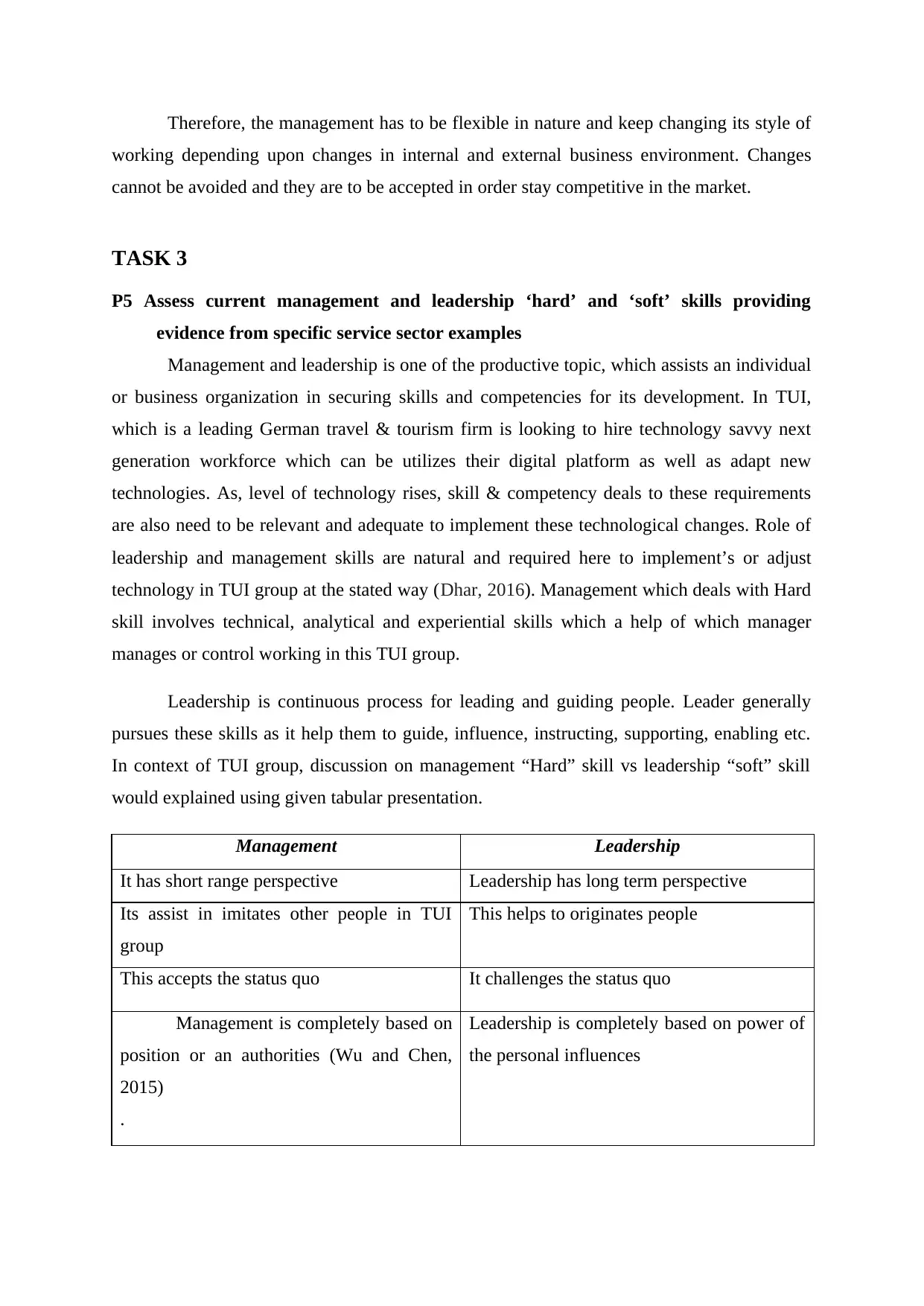
Therefore, the management has to be flexible in nature and keep changing its style of
working depending upon changes in internal and external business environment. Changes
cannot be avoided and they are to be accepted in order stay competitive in the market.
TASK 3
P5 Assess current management and leadership ‘hard’ and ‘soft’ skills providing
evidence from specific service sector examples
Management and leadership is one of the productive topic, which assists an individual
or business organization in securing skills and competencies for its development. In TUI,
which is a leading German travel & tourism firm is looking to hire technology savvy next
generation workforce which can be utilizes their digital platform as well as adapt new
technologies. As, level of technology rises, skill & competency deals to these requirements
are also need to be relevant and adequate to implement these technological changes. Role of
leadership and management skills are natural and required here to implement’s or adjust
technology in TUI group at the stated way (Dhar, 2016). Management which deals with Hard
skill involves technical, analytical and experiential skills which a help of which manager
manages or control working in this TUI group.
Leadership is continuous process for leading and guiding people. Leader generally
pursues these skills as it help them to guide, influence, instructing, supporting, enabling etc.
In context of TUI group, discussion on management “Hard” skill vs leadership “soft” skill
would explained using given tabular presentation.
Management Leadership
It has short range perspective Leadership has long term perspective
Its assist in imitates other people in TUI
group
This helps to originates people
This accepts the status quo It challenges the status quo
Management is completely based on
position or an authorities (Wu and Chen,
2015)
.
Leadership is completely based on power of
the personal influences
working depending upon changes in internal and external business environment. Changes
cannot be avoided and they are to be accepted in order stay competitive in the market.
TASK 3
P5 Assess current management and leadership ‘hard’ and ‘soft’ skills providing
evidence from specific service sector examples
Management and leadership is one of the productive topic, which assists an individual
or business organization in securing skills and competencies for its development. In TUI,
which is a leading German travel & tourism firm is looking to hire technology savvy next
generation workforce which can be utilizes their digital platform as well as adapt new
technologies. As, level of technology rises, skill & competency deals to these requirements
are also need to be relevant and adequate to implement these technological changes. Role of
leadership and management skills are natural and required here to implement’s or adjust
technology in TUI group at the stated way (Dhar, 2016). Management which deals with Hard
skill involves technical, analytical and experiential skills which a help of which manager
manages or control working in this TUI group.
Leadership is continuous process for leading and guiding people. Leader generally
pursues these skills as it help them to guide, influence, instructing, supporting, enabling etc.
In context of TUI group, discussion on management “Hard” skill vs leadership “soft” skill
would explained using given tabular presentation.
Management Leadership
It has short range perspective Leadership has long term perspective
Its assist in imitates other people in TUI
group
This helps to originates people
This accepts the status quo It challenges the status quo
Management is completely based on
position or an authorities (Wu and Chen,
2015)
.
Leadership is completely based on power of
the personal influences
Paraphrase This Document
Need a fresh take? Get an instant paraphrase of this document with our AI Paraphraser
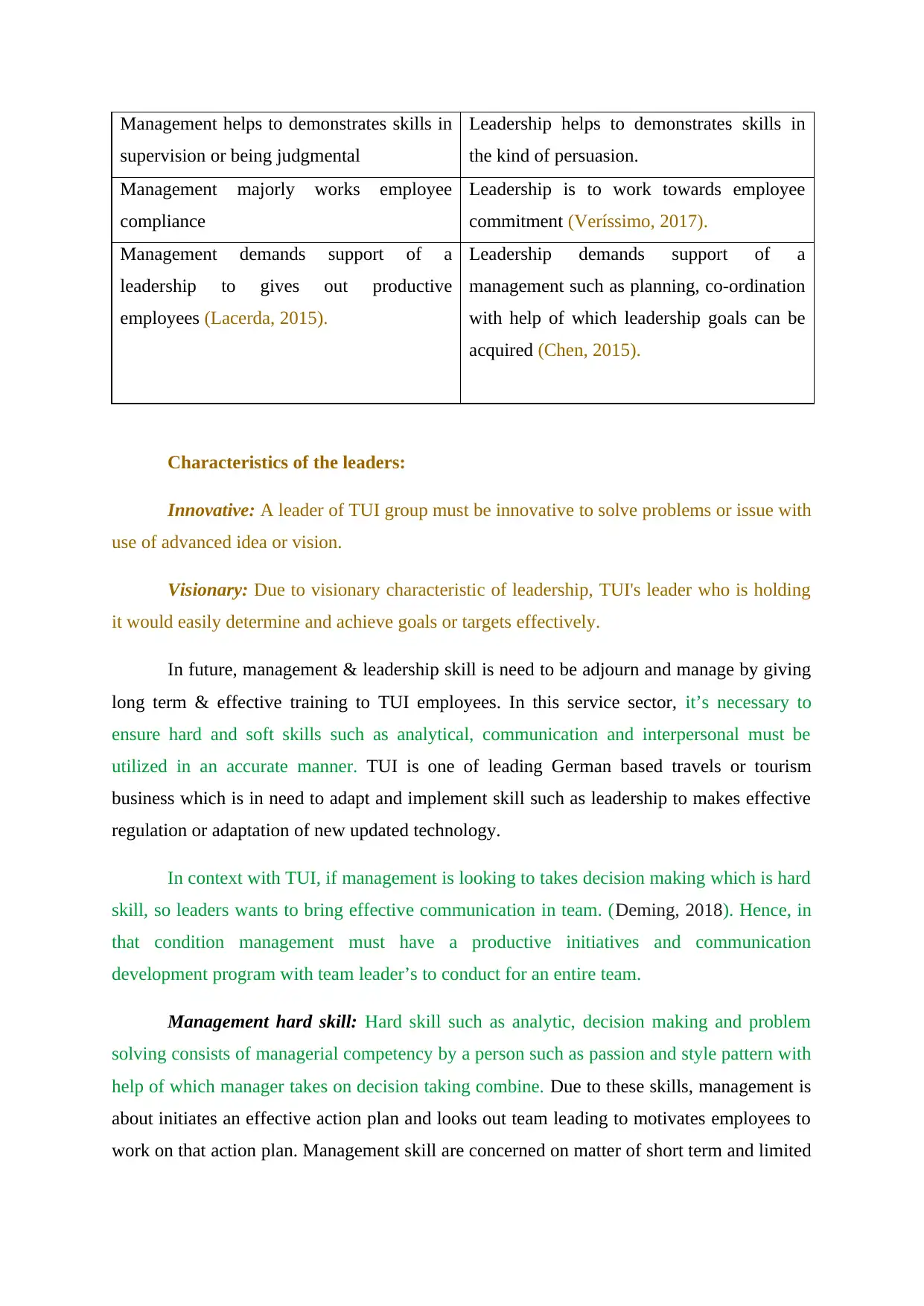
Management helps to demonstrates skills in
supervision or being judgmental
Leadership helps to demonstrates skills in
the kind of persuasion.
Management majorly works employee
compliance
Leadership is to work towards employee
commitment (Veríssimo, 2017).
Management demands support of a
leadership to gives out productive
employees (Lacerda, 2015).
Leadership demands support of a
management such as planning, co-ordination
with help of which leadership goals can be
acquired (Chen, 2015).
Characteristics of the leaders:
Innovative: A leader of TUI group must be innovative to solve problems or issue with
use of advanced idea or vision.
Visionary: Due to visionary characteristic of leadership, TUI's leader who is holding
it would easily determine and achieve goals or targets effectively.
In future, management & leadership skill is need to be adjourn and manage by giving
long term & effective training to TUI employees. In this service sector, it’s necessary to
ensure hard and soft skills such as analytical, communication and interpersonal must be
utilized in an accurate manner. TUI is one of leading German based travels or tourism
business which is in need to adapt and implement skill such as leadership to makes effective
regulation or adaptation of new updated technology.
In context with TUI, if management is looking to takes decision making which is hard
skill, so leaders wants to bring effective communication in team. (Deming, 2018). Hence, in
that condition management must have a productive initiatives and communication
development program with team leader’s to conduct for an entire team.
Management hard skill: Hard skill such as analytic, decision making and problem
solving consists of managerial competency by a person such as passion and style pattern with
help of which manager takes on decision taking combine. Due to these skills, management is
about initiates an effective action plan and looks out team leading to motivates employees to
work on that action plan. Management skill are concerned on matter of short term and limited
supervision or being judgmental
Leadership helps to demonstrates skills in
the kind of persuasion.
Management majorly works employee
compliance
Leadership is to work towards employee
commitment (Veríssimo, 2017).
Management demands support of a
leadership to gives out productive
employees (Lacerda, 2015).
Leadership demands support of a
management such as planning, co-ordination
with help of which leadership goals can be
acquired (Chen, 2015).
Characteristics of the leaders:
Innovative: A leader of TUI group must be innovative to solve problems or issue with
use of advanced idea or vision.
Visionary: Due to visionary characteristic of leadership, TUI's leader who is holding
it would easily determine and achieve goals or targets effectively.
In future, management & leadership skill is need to be adjourn and manage by giving
long term & effective training to TUI employees. In this service sector, it’s necessary to
ensure hard and soft skills such as analytical, communication and interpersonal must be
utilized in an accurate manner. TUI is one of leading German based travels or tourism
business which is in need to adapt and implement skill such as leadership to makes effective
regulation or adaptation of new updated technology.
In context with TUI, if management is looking to takes decision making which is hard
skill, so leaders wants to bring effective communication in team. (Deming, 2018). Hence, in
that condition management must have a productive initiatives and communication
development program with team leader’s to conduct for an entire team.
Management hard skill: Hard skill such as analytic, decision making and problem
solving consists of managerial competency by a person such as passion and style pattern with
help of which manager takes on decision taking combine. Due to these skills, management is
about initiates an effective action plan and looks out team leading to motivates employees to
work on that action plan. Management skill are concerned on matter of short term and limited
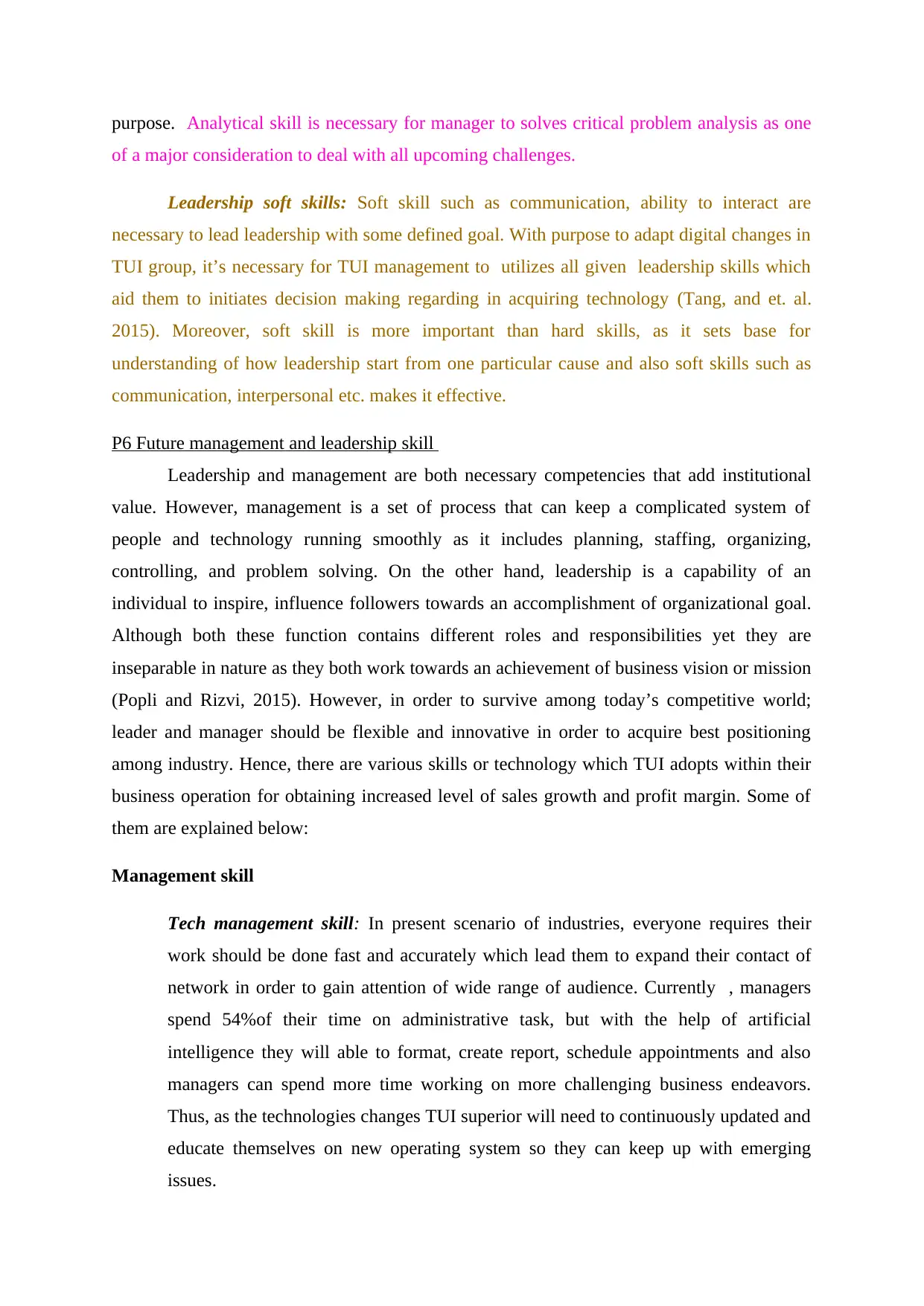
purpose. Analytical skill is necessary for manager to solves critical problem analysis as one
of a major consideration to deal with all upcoming challenges.
Leadership soft skills: Soft skill such as communication, ability to interact are
necessary to lead leadership with some defined goal. With purpose to adapt digital changes in
TUI group, it’s necessary for TUI management to utilizes all given leadership skills which
aid them to initiates decision making regarding in acquiring technology (Tang, and et. al.
2015). Moreover, soft skill is more important than hard skills, as it sets base for
understanding of how leadership start from one particular cause and also soft skills such as
communication, interpersonal etc. makes it effective.
P6 Future management and leadership skill
Leadership and management are both necessary competencies that add institutional
value. However, management is a set of process that can keep a complicated system of
people and technology running smoothly as it includes planning, staffing, organizing,
controlling, and problem solving. On the other hand, leadership is a capability of an
individual to inspire, influence followers towards an accomplishment of organizational goal.
Although both these function contains different roles and responsibilities yet they are
inseparable in nature as they both work towards an achievement of business vision or mission
(Popli and Rizvi, 2015). However, in order to survive among today’s competitive world;
leader and manager should be flexible and innovative in order to acquire best positioning
among industry. Hence, there are various skills or technology which TUI adopts within their
business operation for obtaining increased level of sales growth and profit margin. Some of
them are explained below:
Management skill
Tech management skill: In present scenario of industries, everyone requires their
work should be done fast and accurately which lead them to expand their contact of
network in order to gain attention of wide range of audience. Currently , managers
spend 54%of their time on administrative task, but with the help of artificial
intelligence they will able to format, create report, schedule appointments and also
managers can spend more time working on more challenging business endeavors.
Thus, as the technologies changes TUI superior will need to continuously updated and
educate themselves on new operating system so they can keep up with emerging
issues.
of a major consideration to deal with all upcoming challenges.
Leadership soft skills: Soft skill such as communication, ability to interact are
necessary to lead leadership with some defined goal. With purpose to adapt digital changes in
TUI group, it’s necessary for TUI management to utilizes all given leadership skills which
aid them to initiates decision making regarding in acquiring technology (Tang, and et. al.
2015). Moreover, soft skill is more important than hard skills, as it sets base for
understanding of how leadership start from one particular cause and also soft skills such as
communication, interpersonal etc. makes it effective.
P6 Future management and leadership skill
Leadership and management are both necessary competencies that add institutional
value. However, management is a set of process that can keep a complicated system of
people and technology running smoothly as it includes planning, staffing, organizing,
controlling, and problem solving. On the other hand, leadership is a capability of an
individual to inspire, influence followers towards an accomplishment of organizational goal.
Although both these function contains different roles and responsibilities yet they are
inseparable in nature as they both work towards an achievement of business vision or mission
(Popli and Rizvi, 2015). However, in order to survive among today’s competitive world;
leader and manager should be flexible and innovative in order to acquire best positioning
among industry. Hence, there are various skills or technology which TUI adopts within their
business operation for obtaining increased level of sales growth and profit margin. Some of
them are explained below:
Management skill
Tech management skill: In present scenario of industries, everyone requires their
work should be done fast and accurately which lead them to expand their contact of
network in order to gain attention of wide range of audience. Currently , managers
spend 54%of their time on administrative task, but with the help of artificial
intelligence they will able to format, create report, schedule appointments and also
managers can spend more time working on more challenging business endeavors.
Thus, as the technologies changes TUI superior will need to continuously updated and
educate themselves on new operating system so they can keep up with emerging
issues.
⊘ This is a preview!⊘
Do you want full access?
Subscribe today to unlock all pages.
Trusted by 1+ million students worldwide

1 out of 19


Related Documents


Your All-in-One AI-Powered Toolkit for Academic Success.
+13062052269
info@desklib.com
Available 24*7 on WhatsApp / Email
![[object Object]](/_next/static/media/star-bottom.7253800d.svg)
Unlock your academic potential
Copyright © 2020–2026 A2Z Services. All Rights Reserved. Developed and managed by ZUCOL.