Management and Leadership Styles in the Service Industry Report
VerifiedAdded on 2020/12/18
|11
|2906
|152
Report
AI Summary
This report provides a detailed analysis of leadership and management practices within the service industry, focusing on the case study of Docklands Academy and its relationship with the Havez, Haz, and Tas restaurant chains. The report begins by assessing classical management theories, including scientific, Weber's bureaucratic, and administrative approaches, and their applications in the service sector. It then explores the roles of leaders and various leadership styles, such as transformational and transactional leadership, in the service industry context. Furthermore, the report reviews the management and leadership styles of the mentioned restaurant chains, evaluating the impact of digital technology on internal and external factors influencing management styles and organizational structures. It also discusses the future management and leadership skills required in the service sector, suggesting methods for their attainment. Finally, the report compares and contrasts different service industry organization change management systems and leadership approaches in implementing change.

TITLE

Paraphrase This Document
Need a fresh take? Get an instant paraphrase of this document with our AI Paraphraser
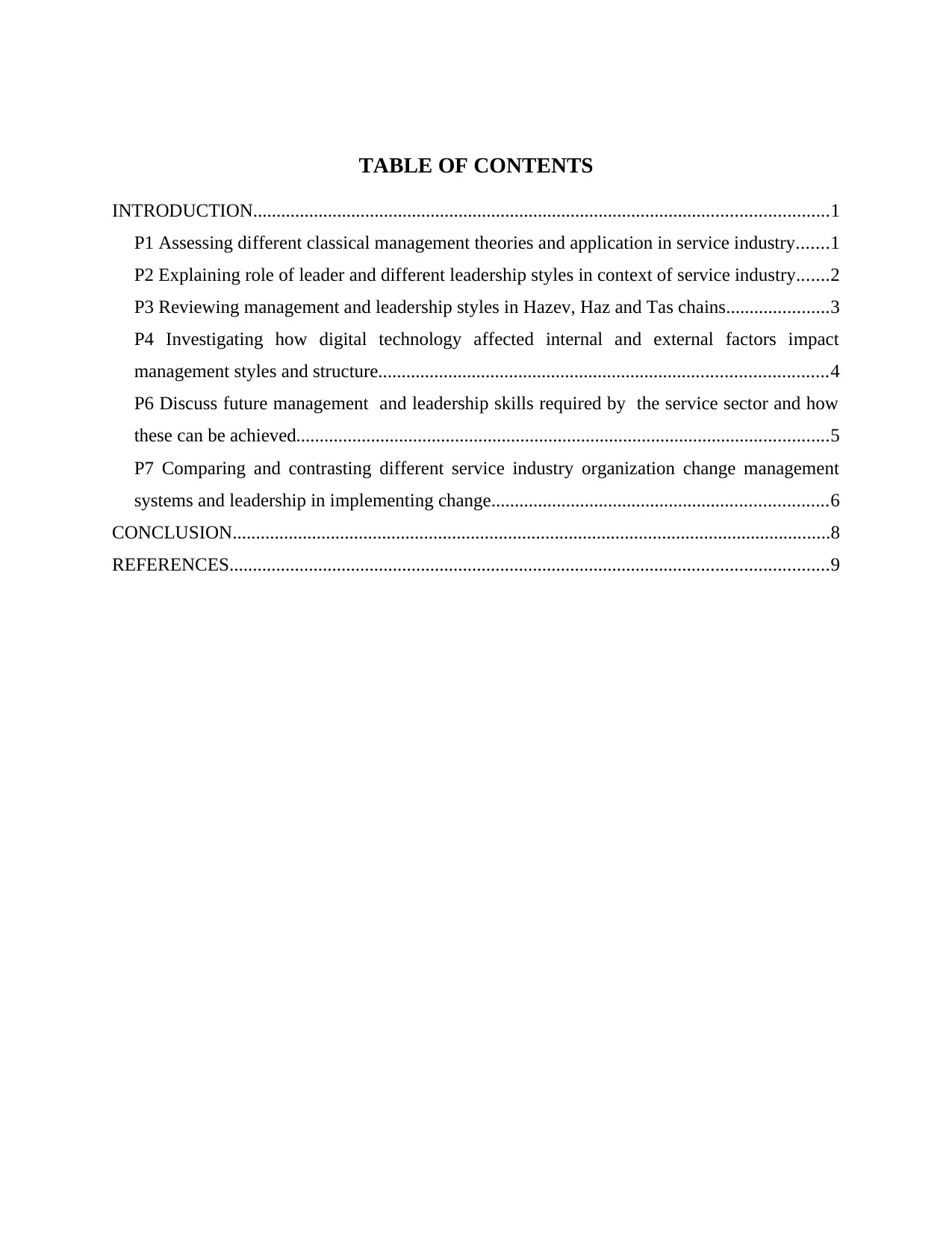
TABLE OF CONTENTS
INTRODUCTION...........................................................................................................................1
P1 Assessing different classical management theories and application in service industry.......1
P2 Explaining role of leader and different leadership styles in context of service industry.......2
P3 Reviewing management and leadership styles in Hazev, Haz and Tas chains......................3
P4 Investigating how digital technology affected internal and external factors impact
management styles and structure................................................................................................4
P6 Discuss future management and leadership skills required by the service sector and how
these can be achieved..................................................................................................................5
P7 Comparing and contrasting different service industry organization change management
systems and leadership in implementing change........................................................................6
CONCLUSION................................................................................................................................8
REFERENCES................................................................................................................................9
INTRODUCTION...........................................................................................................................1
P1 Assessing different classical management theories and application in service industry.......1
P2 Explaining role of leader and different leadership styles in context of service industry.......2
P3 Reviewing management and leadership styles in Hazev, Haz and Tas chains......................3
P4 Investigating how digital technology affected internal and external factors impact
management styles and structure................................................................................................4
P6 Discuss future management and leadership skills required by the service sector and how
these can be achieved..................................................................................................................5
P7 Comparing and contrasting different service industry organization change management
systems and leadership in implementing change........................................................................6
CONCLUSION................................................................................................................................8
REFERENCES................................................................................................................................9
INTRODUCTION
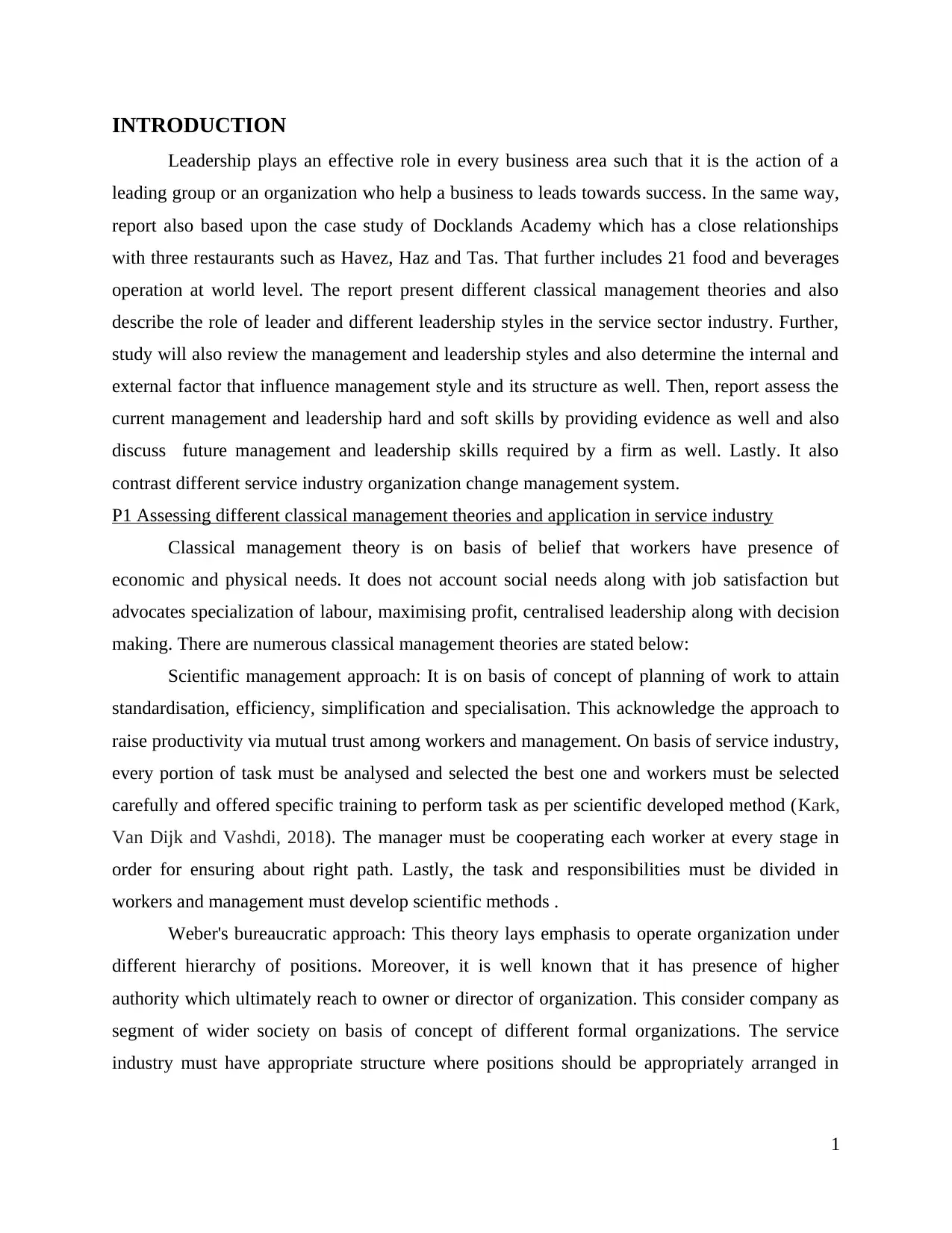
Leadership plays an effective role in every business area such that it is the action of a
leading group or an organization who help a business to leads towards success. In the same way,
report also based upon the case study of Docklands Academy which has a close relationships
with three restaurants such as Havez, Haz and Tas. That further includes 21 food and beverages
operation at world level. The report present different classical management theories and also
describe the role of leader and different leadership styles in the service sector industry. Further,
study will also review the management and leadership styles and also determine the internal and
external factor that influence management style and its structure as well. Then, report assess the
current management and leadership hard and soft skills by providing evidence as well and also
discuss future management and leadership skills required by a firm as well. Lastly. It also
contrast different service industry organization change management system.
P1 Assessing different classical management theories and application in service industry
Classical management theory is on basis of belief that workers have presence of
economic and physical needs. It does not account social needs along with job satisfaction but
advocates specialization of labour, maximising profit, centralised leadership along with decision
making. There are numerous classical management theories are stated below:
Scientific management approach: It is on basis of concept of planning of work to attain
standardisation, efficiency, simplification and specialisation. This acknowledge the approach to
raise productivity via mutual trust among workers and management. On basis of service industry,
every portion of task must be analysed and selected the best one and workers must be selected
carefully and offered specific training to perform task as per scientific developed method (Kark,
Van Dijk and Vashdi, 2018). The manager must be cooperating each worker at every stage in
order for ensuring about right path. Lastly, the task and responsibilities must be divided in
workers and management must develop scientific methods .
Weber's bureaucratic approach: This theory lays emphasis to operate organization under
different hierarchy of positions. Moreover, it is well known that it has presence of higher
authority which ultimately reach to owner or director of organization. This consider company as
segment of wider society on basis of concept of different formal organizations. The service
industry must have appropriate structure where positions should be appropriately arranged in
1
Leadership plays an effective role in every business area such that it is the action of a
leading group or an organization who help a business to leads towards success. In the same way,
report also based upon the case study of Docklands Academy which has a close relationships
with three restaurants such as Havez, Haz and Tas. That further includes 21 food and beverages
operation at world level. The report present different classical management theories and also
describe the role of leader and different leadership styles in the service sector industry. Further,
study will also review the management and leadership styles and also determine the internal and
external factor that influence management style and its structure as well. Then, report assess the
current management and leadership hard and soft skills by providing evidence as well and also
discuss future management and leadership skills required by a firm as well. Lastly. It also
contrast different service industry organization change management system.
P1 Assessing different classical management theories and application in service industry
Classical management theory is on basis of belief that workers have presence of
economic and physical needs. It does not account social needs along with job satisfaction but
advocates specialization of labour, maximising profit, centralised leadership along with decision
making. There are numerous classical management theories are stated below:
Scientific management approach: It is on basis of concept of planning of work to attain
standardisation, efficiency, simplification and specialisation. This acknowledge the approach to
raise productivity via mutual trust among workers and management. On basis of service industry,
every portion of task must be analysed and selected the best one and workers must be selected
carefully and offered specific training to perform task as per scientific developed method (Kark,
Van Dijk and Vashdi, 2018). The manager must be cooperating each worker at every stage in
order for ensuring about right path. Lastly, the task and responsibilities must be divided in
workers and management must develop scientific methods .
Weber's bureaucratic approach: This theory lays emphasis to operate organization under
different hierarchy of positions. Moreover, it is well known that it has presence of higher
authority which ultimately reach to owner or director of organization. This consider company as
segment of wider society on basis of concept of different formal organizations. The service
industry must have appropriate structure where positions should be appropriately arranged in
1
⊘ This is a preview!⊘
Do you want full access?
Subscribe today to unlock all pages.

Trusted by 1+ million students worldwide
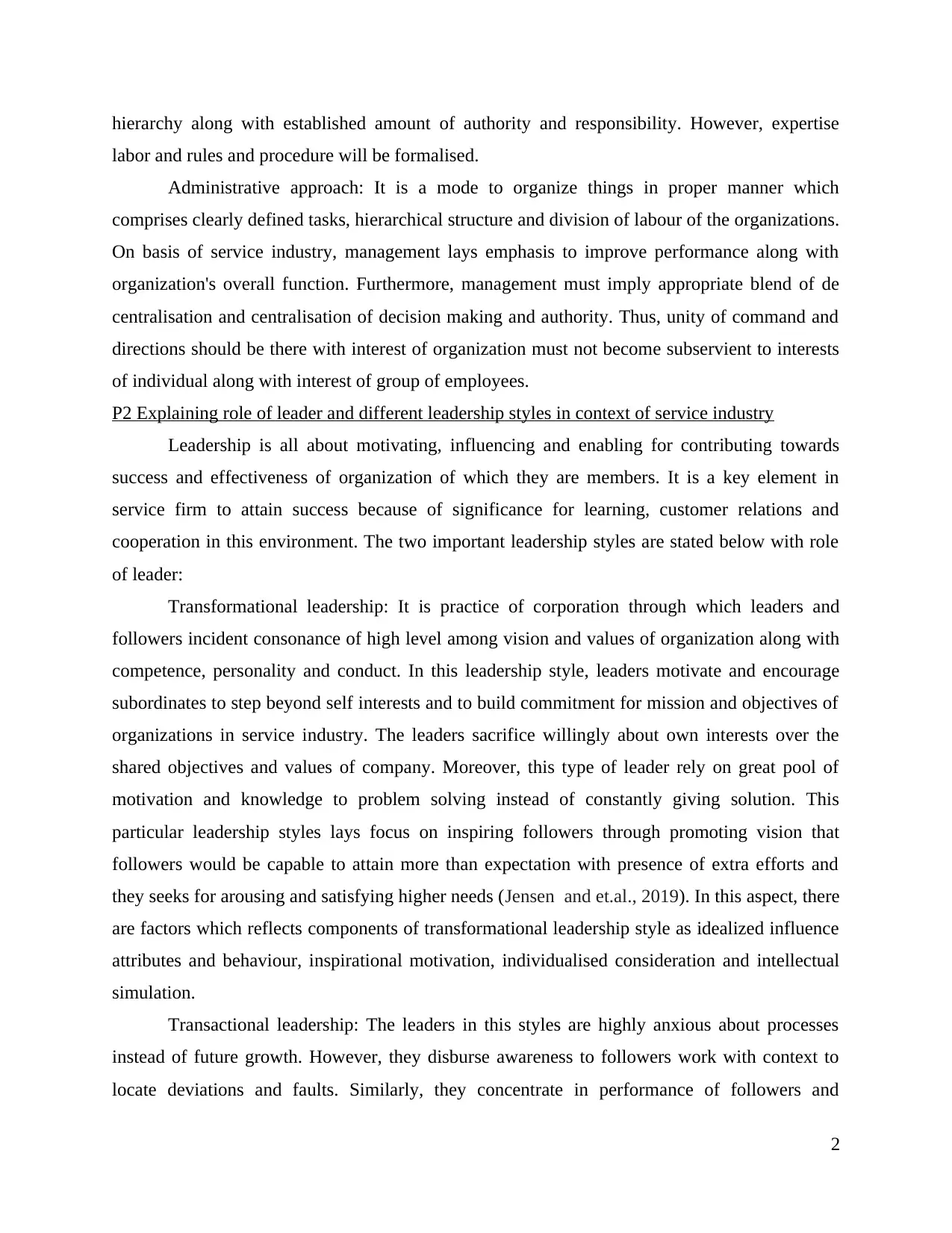
hierarchy along with established amount of authority and responsibility. However, expertise
labor and rules and procedure will be formalised.
Administrative approach: It is a mode to organize things in proper manner which
comprises clearly defined tasks, hierarchical structure and division of labour of the organizations.
On basis of service industry, management lays emphasis to improve performance along with
organization's overall function. Furthermore, management must imply appropriate blend of de
centralisation and centralisation of decision making and authority. Thus, unity of command and
directions should be there with interest of organization must not become subservient to interests
of individual along with interest of group of employees.
P2 Explaining role of leader and different leadership styles in context of service industry
Leadership is all about motivating, influencing and enabling for contributing towards
success and effectiveness of organization of which they are members. It is a key element in
service firm to attain success because of significance for learning, customer relations and
cooperation in this environment. The two important leadership styles are stated below with role
of leader:
Transformational leadership: It is practice of corporation through which leaders and
followers incident consonance of high level among vision and values of organization along with
competence, personality and conduct. In this leadership style, leaders motivate and encourage
subordinates to step beyond self interests and to build commitment for mission and objectives of
organizations in service industry. The leaders sacrifice willingly about own interests over the
shared objectives and values of company. Moreover, this type of leader rely on great pool of
motivation and knowledge to problem solving instead of constantly giving solution. This
particular leadership styles lays focus on inspiring followers through promoting vision that
followers would be capable to attain more than expectation with presence of extra efforts and
they seeks for arousing and satisfying higher needs (Jensen and et.al., 2019). In this aspect, there
are factors which reflects components of transformational leadership style as idealized influence
attributes and behaviour, inspirational motivation, individualised consideration and intellectual
simulation.
Transactional leadership: The leaders in this styles are highly anxious about processes
instead of future growth. However, they disburse awareness to followers work with context to
locate deviations and faults. Similarly, they concentrate in performance of followers and
2
labor and rules and procedure will be formalised.
Administrative approach: It is a mode to organize things in proper manner which
comprises clearly defined tasks, hierarchical structure and division of labour of the organizations.
On basis of service industry, management lays emphasis to improve performance along with
organization's overall function. Furthermore, management must imply appropriate blend of de
centralisation and centralisation of decision making and authority. Thus, unity of command and
directions should be there with interest of organization must not become subservient to interests
of individual along with interest of group of employees.
P2 Explaining role of leader and different leadership styles in context of service industry
Leadership is all about motivating, influencing and enabling for contributing towards
success and effectiveness of organization of which they are members. It is a key element in
service firm to attain success because of significance for learning, customer relations and
cooperation in this environment. The two important leadership styles are stated below with role
of leader:
Transformational leadership: It is practice of corporation through which leaders and
followers incident consonance of high level among vision and values of organization along with
competence, personality and conduct. In this leadership style, leaders motivate and encourage
subordinates to step beyond self interests and to build commitment for mission and objectives of
organizations in service industry. The leaders sacrifice willingly about own interests over the
shared objectives and values of company. Moreover, this type of leader rely on great pool of
motivation and knowledge to problem solving instead of constantly giving solution. This
particular leadership styles lays focus on inspiring followers through promoting vision that
followers would be capable to attain more than expectation with presence of extra efforts and
they seeks for arousing and satisfying higher needs (Jensen and et.al., 2019). In this aspect, there
are factors which reflects components of transformational leadership style as idealized influence
attributes and behaviour, inspirational motivation, individualised consideration and intellectual
simulation.
Transactional leadership: The leaders in this styles are highly anxious about processes
instead of future growth. However, they disburse awareness to followers work with context to
locate deviations and faults. Similarly, they concentrate in performance of followers and
2
Paraphrase This Document
Need a fresh take? Get an instant paraphrase of this document with our AI Paraphraser
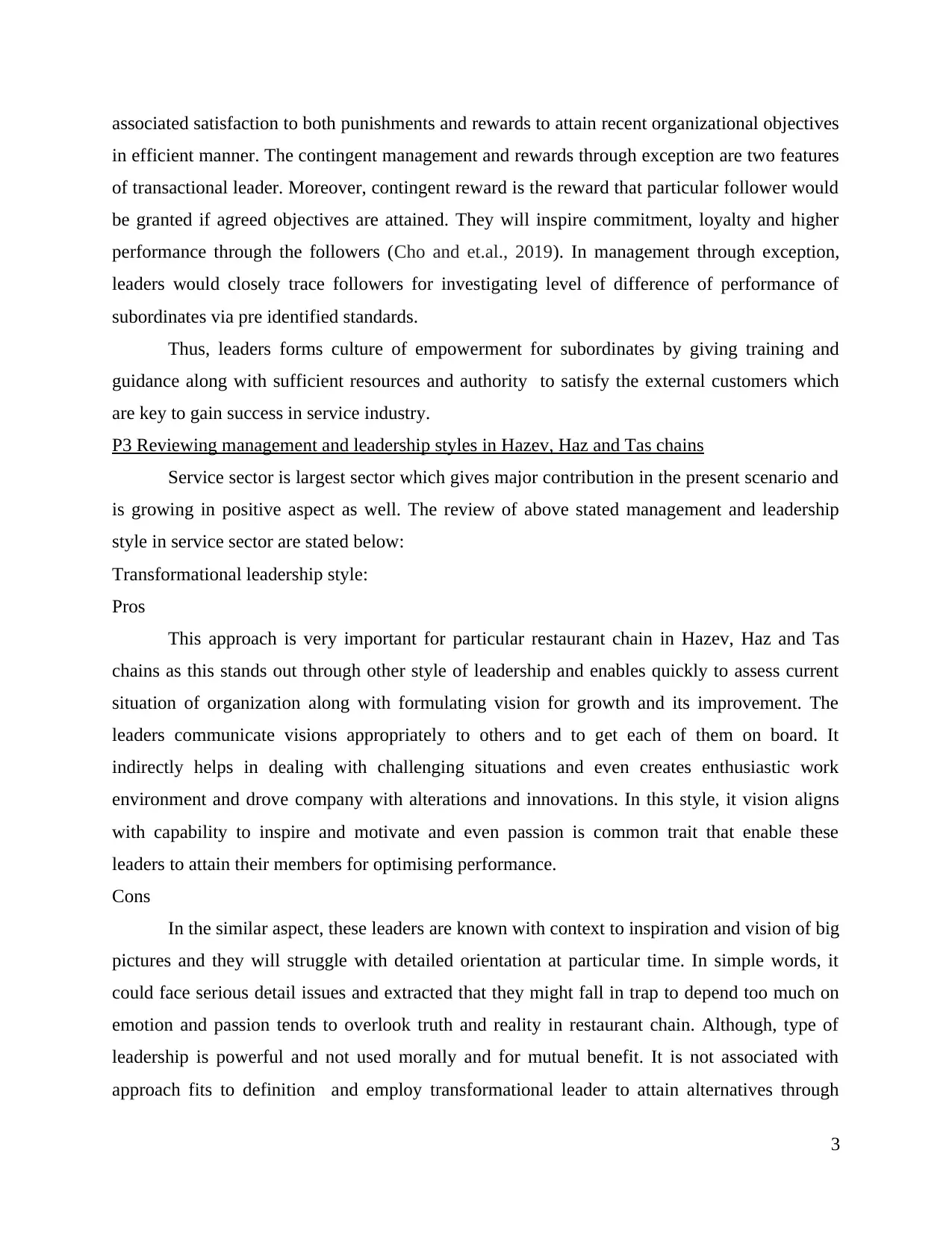
associated satisfaction to both punishments and rewards to attain recent organizational objectives
in efficient manner. The contingent management and rewards through exception are two features
of transactional leader. Moreover, contingent reward is the reward that particular follower would
be granted if agreed objectives are attained. They will inspire commitment, loyalty and higher
performance through the followers (Cho and et.al., 2019). In management through exception,
leaders would closely trace followers for investigating level of difference of performance of
subordinates via pre identified standards.
Thus, leaders forms culture of empowerment for subordinates by giving training and
guidance along with sufficient resources and authority to satisfy the external customers which
are key to gain success in service industry.
P3 Reviewing management and leadership styles in Hazev, Haz and Tas chains
Service sector is largest sector which gives major contribution in the present scenario and
is growing in positive aspect as well. The review of above stated management and leadership
style in service sector are stated below:
Transformational leadership style:
Pros
This approach is very important for particular restaurant chain in Hazev, Haz and Tas
chains as this stands out through other style of leadership and enables quickly to assess current
situation of organization along with formulating vision for growth and its improvement. The
leaders communicate visions appropriately to others and to get each of them on board. It
indirectly helps in dealing with challenging situations and even creates enthusiastic work
environment and drove company with alterations and innovations. In this style, it vision aligns
with capability to inspire and motivate and even passion is common trait that enable these
leaders to attain their members for optimising performance.
Cons
In the similar aspect, these leaders are known with context to inspiration and vision of big
pictures and they will struggle with detailed orientation at particular time. In simple words, it
could face serious detail issues and extracted that they might fall in trap to depend too much on
emotion and passion tends to overlook truth and reality in restaurant chain. Although, type of
leadership is powerful and not used morally and for mutual benefit. It is not associated with
approach fits to definition and employ transformational leader to attain alternatives through
3
in efficient manner. The contingent management and rewards through exception are two features
of transactional leader. Moreover, contingent reward is the reward that particular follower would
be granted if agreed objectives are attained. They will inspire commitment, loyalty and higher
performance through the followers (Cho and et.al., 2019). In management through exception,
leaders would closely trace followers for investigating level of difference of performance of
subordinates via pre identified standards.
Thus, leaders forms culture of empowerment for subordinates by giving training and
guidance along with sufficient resources and authority to satisfy the external customers which
are key to gain success in service industry.
P3 Reviewing management and leadership styles in Hazev, Haz and Tas chains
Service sector is largest sector which gives major contribution in the present scenario and
is growing in positive aspect as well. The review of above stated management and leadership
style in service sector are stated below:
Transformational leadership style:
Pros
This approach is very important for particular restaurant chain in Hazev, Haz and Tas
chains as this stands out through other style of leadership and enables quickly to assess current
situation of organization along with formulating vision for growth and its improvement. The
leaders communicate visions appropriately to others and to get each of them on board. It
indirectly helps in dealing with challenging situations and even creates enthusiastic work
environment and drove company with alterations and innovations. In this style, it vision aligns
with capability to inspire and motivate and even passion is common trait that enable these
leaders to attain their members for optimising performance.
Cons
In the similar aspect, these leaders are known with context to inspiration and vision of big
pictures and they will struggle with detailed orientation at particular time. In simple words, it
could face serious detail issues and extracted that they might fall in trap to depend too much on
emotion and passion tends to overlook truth and reality in restaurant chain. Although, type of
leadership is powerful and not used morally and for mutual benefit. It is not associated with
approach fits to definition and employ transformational leader to attain alternatives through
3
motivating followers for setting aside individual and short term interests to work together for
common objective.
Transactional leadership style
Pros
It helps in giving clear evaluation about roles and expectations through leader and
followers and even this ensures culture within service sector is maintained. It also observes that
rules are strictly followed according to behavioural norms. This is composed of structure which
is concise and clear and employees with this type of management style informed prior hand that
what company expects from them. Lastly, this is very effective within terms of production and
cutting down costs with fact that leadership style has presence of short term objectives that
creates ease for employees to get the things done in restaurant chain.
Cons
On the contrary, it signifies failure for delivering the expected result cold give
consequences such as reduction of pay, without bonuses or the worse: dismissal. Furthermore,
leadership style is very direct in face approach. Apart from this, leader expect outcome through
his followers which in turn gives and desire to suffer the consequences in service sector.
P4 Investigating how digital technology affected internal and external factors impact
management styles and structure
Every organization has their own culture as each aspect impacts ability of organization to
respond and compete successfully to alterations in external environment. The leaders are capable
for impacting and guide people so organization could become very effective to attain objectives.
Leadership styles are impacted through both external and internal factors which are stated below:
External factors
Organizational environment: The business have specific work environment with own
values which is direct legacy of previous leaders along with current leadership. These
specific values are care of organization with presence of customers., investors,
community and the staff and they identify that how business would be managed (External
Factors Affecting Leadership, 2019). The digital technology has impacted the
organizational environment because several members are well known to tech and they
criticise their opposite one.
4
common objective.
Transactional leadership style
Pros
It helps in giving clear evaluation about roles and expectations through leader and
followers and even this ensures culture within service sector is maintained. It also observes that
rules are strictly followed according to behavioural norms. This is composed of structure which
is concise and clear and employees with this type of management style informed prior hand that
what company expects from them. Lastly, this is very effective within terms of production and
cutting down costs with fact that leadership style has presence of short term objectives that
creates ease for employees to get the things done in restaurant chain.
Cons
On the contrary, it signifies failure for delivering the expected result cold give
consequences such as reduction of pay, without bonuses or the worse: dismissal. Furthermore,
leadership style is very direct in face approach. Apart from this, leader expect outcome through
his followers which in turn gives and desire to suffer the consequences in service sector.
P4 Investigating how digital technology affected internal and external factors impact
management styles and structure
Every organization has their own culture as each aspect impacts ability of organization to
respond and compete successfully to alterations in external environment. The leaders are capable
for impacting and guide people so organization could become very effective to attain objectives.
Leadership styles are impacted through both external and internal factors which are stated below:
External factors
Organizational environment: The business have specific work environment with own
values which is direct legacy of previous leaders along with current leadership. These
specific values are care of organization with presence of customers., investors,
community and the staff and they identify that how business would be managed (External
Factors Affecting Leadership, 2019). The digital technology has impacted the
organizational environment because several members are well known to tech and they
criticise their opposite one.
4
⊘ This is a preview!⊘
Do you want full access?
Subscribe today to unlock all pages.
Trusted by 1+ million students worldwide
Organizational resources: Generally leaders are dependent on the resources and position
is defined through responsibilities and tasks must be performed in relationship with
others.
Internal factors
Communication: The successful organization thrives on robust communication where
team leaders and teams communicate freely and for improving outcome (Hendarman. and
Cantner, 2018). This two way communication down and up the hierarchical structure
extends through top to bottom. On basis of digital technology, communication is spread
as soon as possible and it leads to save time, money and resources.
Organizational structures: Multiple organization had hierarchical structure with different
layers of management and leadership defines organizations through top to bottom.
P6 Discuss future management and leadership skills required by the service sector and how
these can be achieved
In the reference of Havez, Haz and Tas, there are some leadership and management skills
which will help in the success of a business some of them are as mention below:
Critical thinking:
In future, the quoted firm's leaders should posses the ability of critical thinking so that
they can easily find new solution which also leads to increase the efficiency and also
improve the preexisting process (Moldoveanu and Narayandas, 2019).
It can be easily achieve by hiring new employees who have the ability or skills of critical
thinking. The ability of solving difficult problem also help a business to lead at further
level of success.
Understanding of new technology
in future, it is quite necessary fro the managers and leaders to understand all new
technologies and also opt new techniques into the working area.
Moreover, using artificial intelligence into the working area will also help a business to
increases the production level and reduce the level of using human resources into
business (Schad and Smith, 2019).
This can be attain through campus placement, and provide training session to their
employees so that they can easily increases the knowledge of information technology an
it creates direct and positive impact upon business as well.
5
is defined through responsibilities and tasks must be performed in relationship with
others.
Internal factors
Communication: The successful organization thrives on robust communication where
team leaders and teams communicate freely and for improving outcome (Hendarman. and
Cantner, 2018). This two way communication down and up the hierarchical structure
extends through top to bottom. On basis of digital technology, communication is spread
as soon as possible and it leads to save time, money and resources.
Organizational structures: Multiple organization had hierarchical structure with different
layers of management and leadership defines organizations through top to bottom.
P6 Discuss future management and leadership skills required by the service sector and how
these can be achieved
In the reference of Havez, Haz and Tas, there are some leadership and management skills
which will help in the success of a business some of them are as mention below:
Critical thinking:
In future, the quoted firm's leaders should posses the ability of critical thinking so that
they can easily find new solution which also leads to increase the efficiency and also
improve the preexisting process (Moldoveanu and Narayandas, 2019).
It can be easily achieve by hiring new employees who have the ability or skills of critical
thinking. The ability of solving difficult problem also help a business to lead at further
level of success.
Understanding of new technology
in future, it is quite necessary fro the managers and leaders to understand all new
technologies and also opt new techniques into the working area.
Moreover, using artificial intelligence into the working area will also help a business to
increases the production level and reduce the level of using human resources into
business (Schad and Smith, 2019).
This can be attain through campus placement, and provide training session to their
employees so that they can easily increases the knowledge of information technology an
it creates direct and positive impact upon business as well.
5
Paraphrase This Document
Need a fresh take? Get an instant paraphrase of this document with our AI Paraphraser
Management skills:
An excellent management skills also help a business for its success. By keep changing in
the management of the business will help to move the entire team in positive direction.
To attain the defined goal as well. Such that the leaders of Havez, Haz and Tas are able to
delegate the responsibilities then they will easily motivate the employees.
Moreover, the management skills are also achieve through proper training and using new
and advance techniques into the working area (Clapp-Smith and et.al., 2019).
P7 Comparing and contrasting different service industry organization change management
systems and leadership in implementing change
For Havez, the organization change management system can be be implemented by using
Kurt Lewin model which is mostly used by dynamic organization. There are four stages
of the model such as:
Unfreeze:
It is the first stage of Kurt Lewin which realize that something is going to be change and
as per the case study, the company is adopting new management system that helps to
creates the positive impact upon the management and leaders have to deal with strong
emotions.
There is a needs to explain that why the change is adopted and by involving the
employees help to take a constructive approach to the change process (Kihlstrom, 2019).
Change:
In this stage, Havez has to implement the process in shorter time and the leaders and
managers has to make aware the employees about new change and become familiar with
a change.
It is also realized that employees are suffering from changes and that is why leaders
should remind the reason for a change and its benefits as well.
Refreeze:
It is the last stage in which the employees are inclined to revert to their old habits and
thus, managers should make necessary arrangements with proper monitoring.
They should also make positive environment so that employees are comfortable with this
new change (Akingbola, Rogers and Baluch, 2019).
6
An excellent management skills also help a business for its success. By keep changing in
the management of the business will help to move the entire team in positive direction.
To attain the defined goal as well. Such that the leaders of Havez, Haz and Tas are able to
delegate the responsibilities then they will easily motivate the employees.
Moreover, the management skills are also achieve through proper training and using new
and advance techniques into the working area (Clapp-Smith and et.al., 2019).
P7 Comparing and contrasting different service industry organization change management
systems and leadership in implementing change
For Havez, the organization change management system can be be implemented by using
Kurt Lewin model which is mostly used by dynamic organization. There are four stages
of the model such as:
Unfreeze:
It is the first stage of Kurt Lewin which realize that something is going to be change and
as per the case study, the company is adopting new management system that helps to
creates the positive impact upon the management and leaders have to deal with strong
emotions.
There is a needs to explain that why the change is adopted and by involving the
employees help to take a constructive approach to the change process (Kihlstrom, 2019).
Change:
In this stage, Havez has to implement the process in shorter time and the leaders and
managers has to make aware the employees about new change and become familiar with
a change.
It is also realized that employees are suffering from changes and that is why leaders
should remind the reason for a change and its benefits as well.
Refreeze:
It is the last stage in which the employees are inclined to revert to their old habits and
thus, managers should make necessary arrangements with proper monitoring.
They should also make positive environment so that employees are comfortable with this
new change (Akingbola, Rogers and Baluch, 2019).
6
On contrary, For Haz, the change system can be implement by using Kottler 8stages
process which is as mention below:
Create a sense of urgency: By making aware of need and urgency of change to
employees, help to adjust in the changing environment and this can be supported by the
leaders of Haz's open and honest dialogue.
Create a guiding alliance: The managers should take a constructive approach to
encourage the employees and through coalition, all the employees come together in order
to rely on a group and identify themselves as a team members (Pollack and Pollack,
2015).
Create a vision for a change: Forming a clear vision also help to understand employees
why the change is occur in Haz. Such that the ideas of employees should be incorporates
in the vision as well.
Communicate a vision: Most important step and can be achieved by continuous talking
about the vision with an employees. Proper communication and new vision must be fully
adopted across the entire organization (Wentworth, Behson and Kelley, 2018).
Remove obstacles: Before changing the changes at all level, it is quite necessary for the
firm to remove the obstacles and even to encourage the acceptance of a vision by the
employees, which further assist when the ideas are incorporated and implemented.
Create short term wins: By creating short term goals will help to motivate the
employees and also involve the employees to take participate in the changing process.
Improvements: To achieve the long term goals, the organization should also needs to
keep looking for the improvements, then only success can be achieved and also establish
the change as well into the company (Salman and Broten, 2017).
Anchor changes: it is the last stage in which a change become only a part of corporate
culture. Such that the company's values and standards should be align with the new
vision. This will be done through regular evaluation and discussion about the progress of
a change.
CONCLUSION
From the above report, it could be concluded that leadership plays very important role to
attain success. It is very effective, there has not been with consensus on mutual set of attributes
of different effective leadership. It could be learned and executives have potential for
7
process which is as mention below:
Create a sense of urgency: By making aware of need and urgency of change to
employees, help to adjust in the changing environment and this can be supported by the
leaders of Haz's open and honest dialogue.
Create a guiding alliance: The managers should take a constructive approach to
encourage the employees and through coalition, all the employees come together in order
to rely on a group and identify themselves as a team members (Pollack and Pollack,
2015).
Create a vision for a change: Forming a clear vision also help to understand employees
why the change is occur in Haz. Such that the ideas of employees should be incorporates
in the vision as well.
Communicate a vision: Most important step and can be achieved by continuous talking
about the vision with an employees. Proper communication and new vision must be fully
adopted across the entire organization (Wentworth, Behson and Kelley, 2018).
Remove obstacles: Before changing the changes at all level, it is quite necessary for the
firm to remove the obstacles and even to encourage the acceptance of a vision by the
employees, which further assist when the ideas are incorporated and implemented.
Create short term wins: By creating short term goals will help to motivate the
employees and also involve the employees to take participate in the changing process.
Improvements: To achieve the long term goals, the organization should also needs to
keep looking for the improvements, then only success can be achieved and also establish
the change as well into the company (Salman and Broten, 2017).
Anchor changes: it is the last stage in which a change become only a part of corporate
culture. Such that the company's values and standards should be align with the new
vision. This will be done through regular evaluation and discussion about the progress of
a change.
CONCLUSION
From the above report, it could be concluded that leadership plays very important role to
attain success. It is very effective, there has not been with consensus on mutual set of attributes
of different effective leadership. It could be learned and executives have potential for
7
⊘ This is a preview!⊘
Do you want full access?
Subscribe today to unlock all pages.
Trusted by 1+ million students worldwide

undertaking better decision makers. It has shown about different classical management theories
such as administrative, hierarchy and scientific management with significance in service
industry. Moreover, it has articulated about different factors which impact management style and
structure like leadership, organizational structure and hierarchy. Thus, it has concluded by
demonstrating management and leadership skills for the particular restaurant chains.
8
such as administrative, hierarchy and scientific management with significance in service
industry. Moreover, it has articulated about different factors which impact management style and
structure like leadership, organizational structure and hierarchy. Thus, it has concluded by
demonstrating management and leadership skills for the particular restaurant chains.
8
Paraphrase This Document
Need a fresh take? Get an instant paraphrase of this document with our AI Paraphraser

REFERENCES
Books and Journals
Online
.[Online]. Available through <>.
9
Books and Journals
Online
.[Online]. Available through <>.
9

1 out of 11


Related Documents


Your All-in-One AI-Powered Toolkit for Academic Success.
+13062052269
info@desklib.com
Available 24*7 on WhatsApp / Email
![[object Object]](/_next/static/media/star-bottom.7253800d.svg)
Unlock your academic potential
Copyright © 2020–2026 A2Z Services. All Rights Reserved. Developed and managed by ZUCOL.