Leadership Theories, Management Functions and Operations at Starbucks
VerifiedAdded on 2020/07/23
|17
|5539
|39
Report
AI Summary
This report provides a comprehensive analysis of leadership and operational management, using Starbucks as a case study. It delves into the roles and characteristics of leaders and managers, differentiating their functions within the organization. The report explores how these roles apply in various situations, such as recruitment and decision-making, highlighting the significance of planning, organizing, and leading. It examines different leadership theories and models, including situational, system, and contingency approaches, evaluating their strengths and weaknesses. Furthermore, the report identifies key approaches to operational management and the factors within the business environment that impact decision-making. Overall, the report offers a critical evaluation of operations management, contributing valuable insights into effective leadership and management practices within a business context.
Management
And
Operation
And
Operation

Paraphrase This Document
Need a fresh take? Get an instant paraphrase of this document with our AI Paraphraser
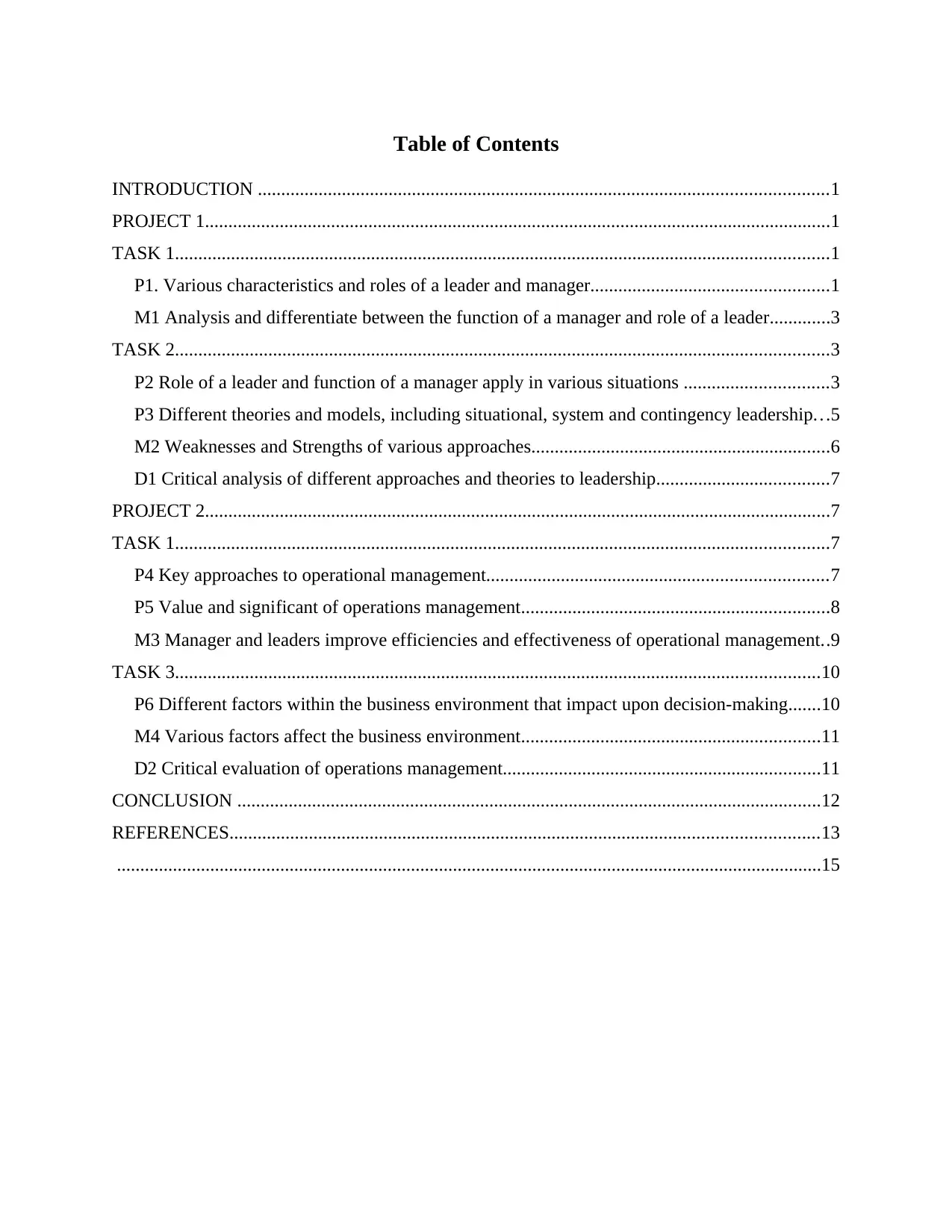
Table of Contents
INTRODUCTION ..........................................................................................................................1
PROJECT 1......................................................................................................................................1
TASK 1............................................................................................................................................1
P1. Various characteristics and roles of a leader and manager...................................................1
M1 Analysis and differentiate between the function of a manager and role of a leader.............3
TASK 2............................................................................................................................................3
P2 Role of a leader and function of a manager apply in various situations ...............................3
P3 Different theories and models, including situational, system and contingency leadership...5
M2 Weaknesses and Strengths of various approaches................................................................6
D1 Critical analysis of different approaches and theories to leadership.....................................7
PROJECT 2......................................................................................................................................7
TASK 1............................................................................................................................................7
P4 Key approaches to operational management.........................................................................7
P5 Value and significant of operations management..................................................................8
M3 Manager and leaders improve efficiencies and effectiveness of operational management..9
TASK 3..........................................................................................................................................10
P6 Different factors within the business environment that impact upon decision-making.......10
M4 Various factors affect the business environment................................................................11
D2 Critical evaluation of operations management....................................................................11
CONCLUSION .............................................................................................................................12
REFERENCES..............................................................................................................................13
.......................................................................................................................................................15
INTRODUCTION ..........................................................................................................................1
PROJECT 1......................................................................................................................................1
TASK 1............................................................................................................................................1
P1. Various characteristics and roles of a leader and manager...................................................1
M1 Analysis and differentiate between the function of a manager and role of a leader.............3
TASK 2............................................................................................................................................3
P2 Role of a leader and function of a manager apply in various situations ...............................3
P3 Different theories and models, including situational, system and contingency leadership...5
M2 Weaknesses and Strengths of various approaches................................................................6
D1 Critical analysis of different approaches and theories to leadership.....................................7
PROJECT 2......................................................................................................................................7
TASK 1............................................................................................................................................7
P4 Key approaches to operational management.........................................................................7
P5 Value and significant of operations management..................................................................8
M3 Manager and leaders improve efficiencies and effectiveness of operational management..9
TASK 3..........................................................................................................................................10
P6 Different factors within the business environment that impact upon decision-making.......10
M4 Various factors affect the business environment................................................................11
D2 Critical evaluation of operations management....................................................................11
CONCLUSION .............................................................................................................................12
REFERENCES..............................................................................................................................13
.......................................................................................................................................................15

⊘ This is a preview!⊘
Do you want full access?
Subscribe today to unlock all pages.

Trusted by 1+ million students worldwide
INTRODUCTION
Management operation design, control, execution of business operations that convert
certain resources into services and goods. It is the function of company that is responsible for
handling procedures of production. It involves controlling, coordinating, managing, organising
and planning all the factors required to supply a business services or goods. It is also defined as a
management function which considers technology, managing people and information about the
firm’s activities (Adhikari, 2012). It is highly important and a significant part of the enterprise
because in this, they can achieve long term and desired objectives in a specific time frame.
This report is based on Starbucks which is a coffee shop based in US, Washington. This
project will determine different roles of leader and functions of manager. Key approaches of
operations management will also be described for Starbucks. Different theories of leadership will
be determined in this study as well. Various factors which impact upon the operational
management and decision-making process of leader and manager will also be identified.
PROJECT 1
TASK 1
P1. Various characteristics and roles of a leader and manager
Manager: They are important and main part of the business entity who manage and
control all activities of company in an effective manner. They have better ability to give better
training and development to their employees. Due to this, they can attend this program and
increase their basic knowledge and skills on particular subjects.
Leader: In each and every organisation, leader is an important part of company who can
motivate and encourage their workers in an effective and efficient manner. They promote their
workforce about doing all activities and functions of organisation.
Role and characteristics of a leader: In an enterprise, leader has different qualities in order to
achieve long term goals of company (Ahmadi and et. al., 2014). They play an essential role in
promoting and encouraging their employees in regards to motivate about business operations and
functions. There are certain characteristics and roles of the leader as follows:
Characteristics:
1
Management operation design, control, execution of business operations that convert
certain resources into services and goods. It is the function of company that is responsible for
handling procedures of production. It involves controlling, coordinating, managing, organising
and planning all the factors required to supply a business services or goods. It is also defined as a
management function which considers technology, managing people and information about the
firm’s activities (Adhikari, 2012). It is highly important and a significant part of the enterprise
because in this, they can achieve long term and desired objectives in a specific time frame.
This report is based on Starbucks which is a coffee shop based in US, Washington. This
project will determine different roles of leader and functions of manager. Key approaches of
operations management will also be described for Starbucks. Different theories of leadership will
be determined in this study as well. Various factors which impact upon the operational
management and decision-making process of leader and manager will also be identified.
PROJECT 1
TASK 1
P1. Various characteristics and roles of a leader and manager
Manager: They are important and main part of the business entity who manage and
control all activities of company in an effective manner. They have better ability to give better
training and development to their employees. Due to this, they can attend this program and
increase their basic knowledge and skills on particular subjects.
Leader: In each and every organisation, leader is an important part of company who can
motivate and encourage their workers in an effective and efficient manner. They promote their
workforce about doing all activities and functions of organisation.
Role and characteristics of a leader: In an enterprise, leader has different qualities in order to
achieve long term goals of company (Ahmadi and et. al., 2014). They play an essential role in
promoting and encouraging their employees in regards to motivate about business operations and
functions. There are certain characteristics and roles of the leader as follows:
Characteristics:
1
Paraphrase This Document
Need a fresh take? Get an instant paraphrase of this document with our AI Paraphraser
Communication: It is one of the important skills which should be present in features of
the leader. In this, they communicate easily with their employees and workforce
regarding operations and success of the organisation. Organisation: It is define the management of all works and activities of enterprise. In the
organisation, leader is main part so they able to organise different activities, programs
and events to their employees with motive of attaining desire goals (Bahmani-Firouzi and
Azizipanah-Abarghooee, 2014).
Roles: Effective decision making: Main role and responsibility of leader is to make effective
judgement regarding the difficult situation which arises in terms of the task allocated and
communication funnel among the team members. Promote and encourage their employees: In Starbucks, there are large number of
employees working with each other. Due to this, they require higher satisfaction and
encouragement from their leaders. In this, they play a significant role in promoting their
workers regarding its works. So, in this, they provide training and development,
incentives as well as other facilities in order to encourage their staff members.
Characteristics and role of a manager: In the organisation, manager is an essential part of them
in order to manage all activities in an effective manner. They play a vital role in the success and
development of company. There are certain features which are present in the managers like:
Characteristics: Versatility: A business manager is usually a mediator in between the higher authorities
and lower division. So, it is highly required for the employer to be stable and versatile in
nature (Bahn, 2013). This creates a positive impact on the environment of workplace and
also helps in establishing a healthy relationship. Team building: It is also the best feature which should be available in the characteristics
of manager in order to build a strong team. This covers encouraging and promoting
collaboration by giving better opportunities for workforces at entire level.
Roles: Hire knowledgeable person: It is identified as the main role of manager in order to
recruit and select talented people who can easily complete all tasks of business. In the
process of hiring, they are responsible for giving training to new candidates so that they
2
the leader. In this, they communicate easily with their employees and workforce
regarding operations and success of the organisation. Organisation: It is define the management of all works and activities of enterprise. In the
organisation, leader is main part so they able to organise different activities, programs
and events to their employees with motive of attaining desire goals (Bahmani-Firouzi and
Azizipanah-Abarghooee, 2014).
Roles: Effective decision making: Main role and responsibility of leader is to make effective
judgement regarding the difficult situation which arises in terms of the task allocated and
communication funnel among the team members. Promote and encourage their employees: In Starbucks, there are large number of
employees working with each other. Due to this, they require higher satisfaction and
encouragement from their leaders. In this, they play a significant role in promoting their
workers regarding its works. So, in this, they provide training and development,
incentives as well as other facilities in order to encourage their staff members.
Characteristics and role of a manager: In the organisation, manager is an essential part of them
in order to manage all activities in an effective manner. They play a vital role in the success and
development of company. There are certain features which are present in the managers like:
Characteristics: Versatility: A business manager is usually a mediator in between the higher authorities
and lower division. So, it is highly required for the employer to be stable and versatile in
nature (Bahn, 2013). This creates a positive impact on the environment of workplace and
also helps in establishing a healthy relationship. Team building: It is also the best feature which should be available in the characteristics
of manager in order to build a strong team. This covers encouraging and promoting
collaboration by giving better opportunities for workforces at entire level.
Roles: Hire knowledgeable person: It is identified as the main role of manager in order to
recruit and select talented people who can easily complete all tasks of business. In the
process of hiring, they are responsible for giving training to new candidates so that they
2
can gain better knowledge about business operations and attain success and growth of
organisation.
Communicate information: In this, manager should communicate the information
regarding tasks, functions, activities and other objects to their staff members (Botton and
et. al., 2013). So, in this, conflicts and misunderstanding automatically reduce at the
workplace.
Comparison between manager and leader:
Manager Leader
They hire knowledgeable and talented persons
in the organisation.
Main role of leader is to provide better training
and development to employees. .
Manager manages and controls all activities as
well as functions of the business entity.
Leader promotes and motivates their
employees about works and tasks.
They create goals of the business organisation. They create vision of company.
M1 Analysis and differentiate between the function of a manager and role of a leader
Function of a manger is to organising, controlling, managing and staffing their employees
in an essential manner. And role of the leader is to make effective decision and promote their
workers about its work. So in this both are important persons in the success and development of
company. Manager of the Starbucks that create its roles which is important for the long term
growth of them. Leader of the business entity that create long term vision in specific time period.
TASK 2
P2 Role of a leader and function of a manager apply in various situations
In the each and every organisation leader and mangers are plays important role in
difficult situation in order to reduce all issues which are present in the business. There are two
situation which is face by business entity at workplace (Burke, 2013). These are recruitment
& selection and decision making, in this condition both are responsible in achieving desire
objectives and goals of them.
Function of manager: There are different functions of manager which are important in those
situations are determined under this:
3
organisation.
Communicate information: In this, manager should communicate the information
regarding tasks, functions, activities and other objects to their staff members (Botton and
et. al., 2013). So, in this, conflicts and misunderstanding automatically reduce at the
workplace.
Comparison between manager and leader:
Manager Leader
They hire knowledgeable and talented persons
in the organisation.
Main role of leader is to provide better training
and development to employees. .
Manager manages and controls all activities as
well as functions of the business entity.
Leader promotes and motivates their
employees about works and tasks.
They create goals of the business organisation. They create vision of company.
M1 Analysis and differentiate between the function of a manager and role of a leader
Function of a manger is to organising, controlling, managing and staffing their employees
in an essential manner. And role of the leader is to make effective decision and promote their
workers about its work. So in this both are important persons in the success and development of
company. Manager of the Starbucks that create its roles which is important for the long term
growth of them. Leader of the business entity that create long term vision in specific time period.
TASK 2
P2 Role of a leader and function of a manager apply in various situations
In the each and every organisation leader and mangers are plays important role in
difficult situation in order to reduce all issues which are present in the business. There are two
situation which is face by business entity at workplace (Burke, 2013). These are recruitment
& selection and decision making, in this condition both are responsible in achieving desire
objectives and goals of them.
Function of manager: There are different functions of manager which are important in those
situations are determined under this:
3
⊘ This is a preview!⊘
Do you want full access?
Subscribe today to unlock all pages.
Trusted by 1+ million students worldwide
Planning: In the situation of recruitment and selection, firstly manager should plan the
schedule of the process and provide better blueprint about how to complete these procedures. In
this they decide to gather all information like; job position, internal and external resources of the
recruitment activity. So in this, manger take better decision in order to hiring talented person
who can easily complete all tasks.
Organising: It is important function of the manger which define how to organising all
programmes such as training, development, conference and other sections to their employees. All
workers are attend this event and increase their skills and knowledge on specific subjects (Cloudt
and Willems, 2011). With the help of effective decision, all workers are easily complete their
works and attain business success and development.
Leading: After hiring talented and skilled person, role and responsibility of managers is
to guide their workforces in these situation in regrades to avoid misunderstanding and delay in
the project. Proper guidelines helps the workers to acquire a clear idea regarding how to
complete all tasks. In this condition manager take better decision in order to accomplish all
process in an effective manner.
Role of leader: There are various role of leader which is important in promoting their workers
about its works and business objectives. All these are determine under this:
Decision making: Above both situations such as recruitment & selection, decision
making etc. in this leader plays essential role in providing better judgements to mangers about
internal and external sources, job position, interview process. This will support the leader to give
better training and development to workers in order to increase their basic skills in an effective
manner.
Encouraging employees: After completing recruitment process, leader promote their
employees with providing motivation tools, leadership theories and other facilities in an
essential manner (Expósito and et. al., 2016). In the situation of decision making they can take
better judgement to motivating their workforces as well as achieving desire objectives in a
specific time period.
Employee Engagement: It is very important part of the organisation in order to establish
effective cooperation among the staff members. In situation of recruitment process, leader
coordinate their all workers by giving incentives, bonus, fair remuneration and other facilities to
them.
4
schedule of the process and provide better blueprint about how to complete these procedures. In
this they decide to gather all information like; job position, internal and external resources of the
recruitment activity. So in this, manger take better decision in order to hiring talented person
who can easily complete all tasks.
Organising: It is important function of the manger which define how to organising all
programmes such as training, development, conference and other sections to their employees. All
workers are attend this event and increase their skills and knowledge on specific subjects (Cloudt
and Willems, 2011). With the help of effective decision, all workers are easily complete their
works and attain business success and development.
Leading: After hiring talented and skilled person, role and responsibility of managers is
to guide their workforces in these situation in regrades to avoid misunderstanding and delay in
the project. Proper guidelines helps the workers to acquire a clear idea regarding how to
complete all tasks. In this condition manager take better decision in order to accomplish all
process in an effective manner.
Role of leader: There are various role of leader which is important in promoting their workers
about its works and business objectives. All these are determine under this:
Decision making: Above both situations such as recruitment & selection, decision
making etc. in this leader plays essential role in providing better judgements to mangers about
internal and external sources, job position, interview process. This will support the leader to give
better training and development to workers in order to increase their basic skills in an effective
manner.
Encouraging employees: After completing recruitment process, leader promote their
employees with providing motivation tools, leadership theories and other facilities in an
essential manner (Expósito and et. al., 2016). In the situation of decision making they can take
better judgement to motivating their workforces as well as achieving desire objectives in a
specific time period.
Employee Engagement: It is very important part of the organisation in order to establish
effective cooperation among the staff members. In situation of recruitment process, leader
coordinate their all workers by giving incentives, bonus, fair remuneration and other facilities to
them.
4
Paraphrase This Document
Need a fresh take? Get an instant paraphrase of this document with our AI Paraphraser
P3 Different theories and models, including situational, system and contingency leadership
Leadership theories: It is an essential and important part of the business development
and success. Starbucks apply this aspects in order to avoiding conflict and other issues which is
face by the employees in the company (leadership Theories, 2012). It is identified as a process
by which individual manipulates others towards achievement of organisation or group objective
(Eyal and et. al., 2014). There are certain styles of leadership such as situational, system and
contingency which are determined under this:
Situational leadership: It is define as the motivation, capability and relationship between leaders
and followers. It is very essential and beneficial part of the company in order to face difficult
situation as well as sort out them. In the Starbucks, there are large number of the employees are
work with each others but some time, it create a conflict situation. So in order to reduce this
issues business entity mainly follow this style effectively.
System leadership: This model was created on the basis of a employees and customers
questionnaires management in order to handles business functions. With the help of this model
company can follow their all systems in a effective or efficient manner. Main purpose of apply
this style is to managed and organised all functions and activities to the employees in an effective
or efficient manner. It is very vital part of the leadership model that define how to achieve long
term goals and desire objectives of business organisation in certain time period.
Contingency: It is define as a behaviour and trait theories do support us in order to
understanding the leadership. This is very essential and important part because it will organise a
corporation, make effective decision, and lead a business success and development in an
effective manner. This theory help the manager and leader In order to identifying needs and
wants of the employees. In the situation of recruitment and selection, this aspects help the
manager buy giving better tanning and development to their workforces with motive of
achieving long term goals and objectives in short period (Hong and et. al., 2015). With the help
of this, manager take better decision to avoid conflict and misunderstanding at the workplace.
Model of leadership: There are three level of models which are determine under this:
Public: It is define as a behaviours or actions that leader of the company that takes to
manipulates different person simultaneously. In this company organise a meeting and
conferences to the employees in order to exchange their problems and ideas.
5
Leadership theories: It is an essential and important part of the business development
and success. Starbucks apply this aspects in order to avoiding conflict and other issues which is
face by the employees in the company (leadership Theories, 2012). It is identified as a process
by which individual manipulates others towards achievement of organisation or group objective
(Eyal and et. al., 2014). There are certain styles of leadership such as situational, system and
contingency which are determined under this:
Situational leadership: It is define as the motivation, capability and relationship between leaders
and followers. It is very essential and beneficial part of the company in order to face difficult
situation as well as sort out them. In the Starbucks, there are large number of the employees are
work with each others but some time, it create a conflict situation. So in order to reduce this
issues business entity mainly follow this style effectively.
System leadership: This model was created on the basis of a employees and customers
questionnaires management in order to handles business functions. With the help of this model
company can follow their all systems in a effective or efficient manner. Main purpose of apply
this style is to managed and organised all functions and activities to the employees in an effective
or efficient manner. It is very vital part of the leadership model that define how to achieve long
term goals and desire objectives of business organisation in certain time period.
Contingency: It is define as a behaviour and trait theories do support us in order to
understanding the leadership. This is very essential and important part because it will organise a
corporation, make effective decision, and lead a business success and development in an
effective manner. This theory help the manager and leader In order to identifying needs and
wants of the employees. In the situation of recruitment and selection, this aspects help the
manager buy giving better tanning and development to their workforces with motive of
achieving long term goals and objectives in short period (Hong and et. al., 2015). With the help
of this, manager take better decision to avoid conflict and misunderstanding at the workplace.
Model of leadership: There are three level of models which are determine under this:
Public: It is define as a behaviours or actions that leader of the company that takes to
manipulates different person simultaneously. In this company organise a meeting and
conferences to the employees in order to exchange their problems and ideas.
5
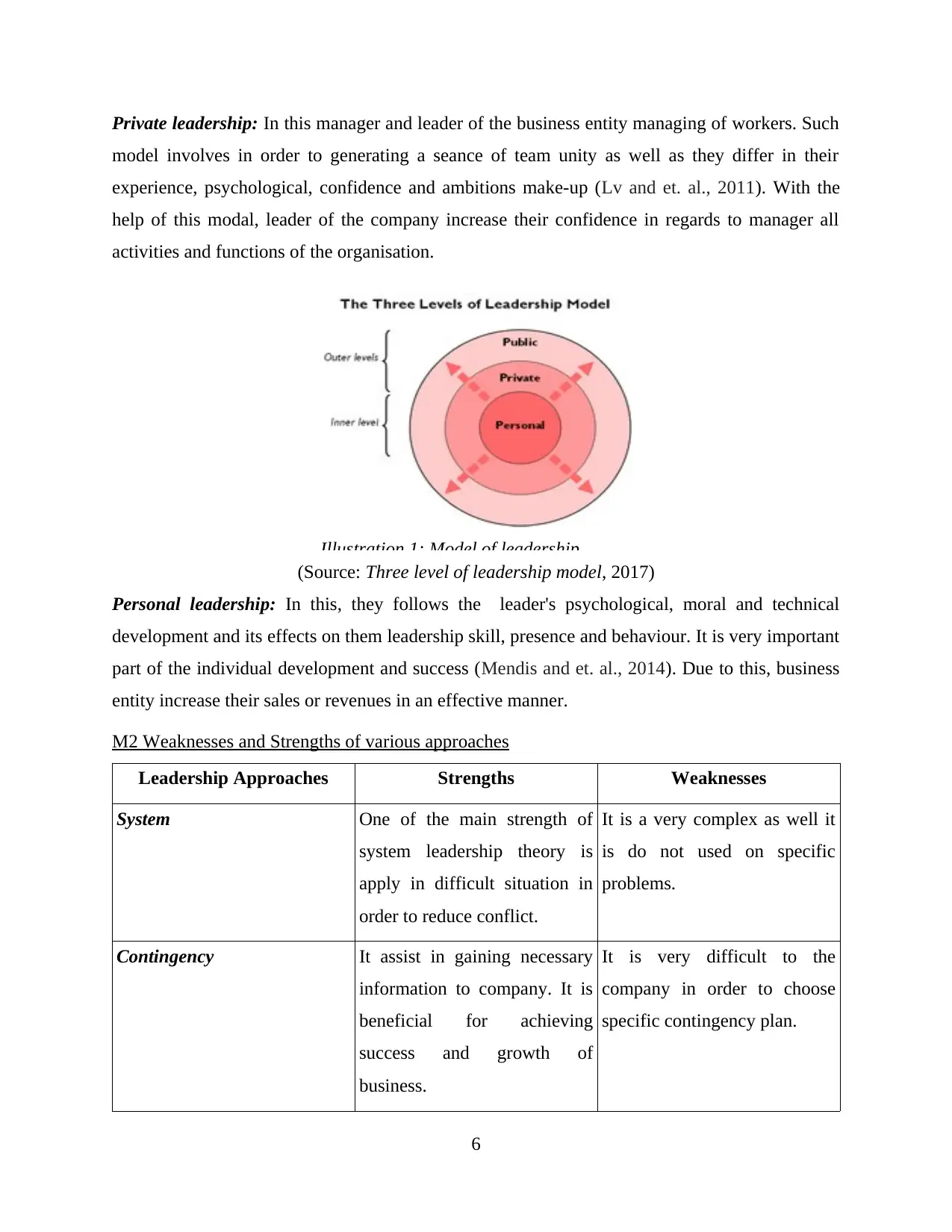
Private leadership: In this manager and leader of the business entity managing of workers. Such
model involves in order to generating a seance of team unity as well as they differ in their
experience, psychological, confidence and ambitions make-up (Lv and et. al., 2011). With the
help of this modal, leader of the company increase their confidence in regards to manager all
activities and functions of the organisation.
(Source: Three level of leadership model, 2017)
Personal leadership: In this, they follows the leader's psychological, moral and technical
development and its effects on them leadership skill, presence and behaviour. It is very important
part of the individual development and success (Mendis and et. al., 2014). Due to this, business
entity increase their sales or revenues in an effective manner.
M2 Weaknesses and Strengths of various approaches
Leadership Approaches Strengths Weaknesses
System One of the main strength of
system leadership theory is
apply in difficult situation in
order to reduce conflict.
It is a very complex as well it
is do not used on specific
problems.
Contingency It assist in gaining necessary
information to company. It is
beneficial for achieving
success and growth of
business.
It is very difficult to the
company in order to choose
specific contingency plan.
6
Illustration 1: Model of leadership
model involves in order to generating a seance of team unity as well as they differ in their
experience, psychological, confidence and ambitions make-up (Lv and et. al., 2011). With the
help of this modal, leader of the company increase their confidence in regards to manager all
activities and functions of the organisation.
(Source: Three level of leadership model, 2017)
Personal leadership: In this, they follows the leader's psychological, moral and technical
development and its effects on them leadership skill, presence and behaviour. It is very important
part of the individual development and success (Mendis and et. al., 2014). Due to this, business
entity increase their sales or revenues in an effective manner.
M2 Weaknesses and Strengths of various approaches
Leadership Approaches Strengths Weaknesses
System One of the main strength of
system leadership theory is
apply in difficult situation in
order to reduce conflict.
It is a very complex as well it
is do not used on specific
problems.
Contingency It assist in gaining necessary
information to company. It is
beneficial for achieving
success and growth of
business.
It is very difficult to the
company in order to choose
specific contingency plan.
6
Illustration 1: Model of leadership
⊘ This is a preview!⊘
Do you want full access?
Subscribe today to unlock all pages.
Trusted by 1+ million students worldwide
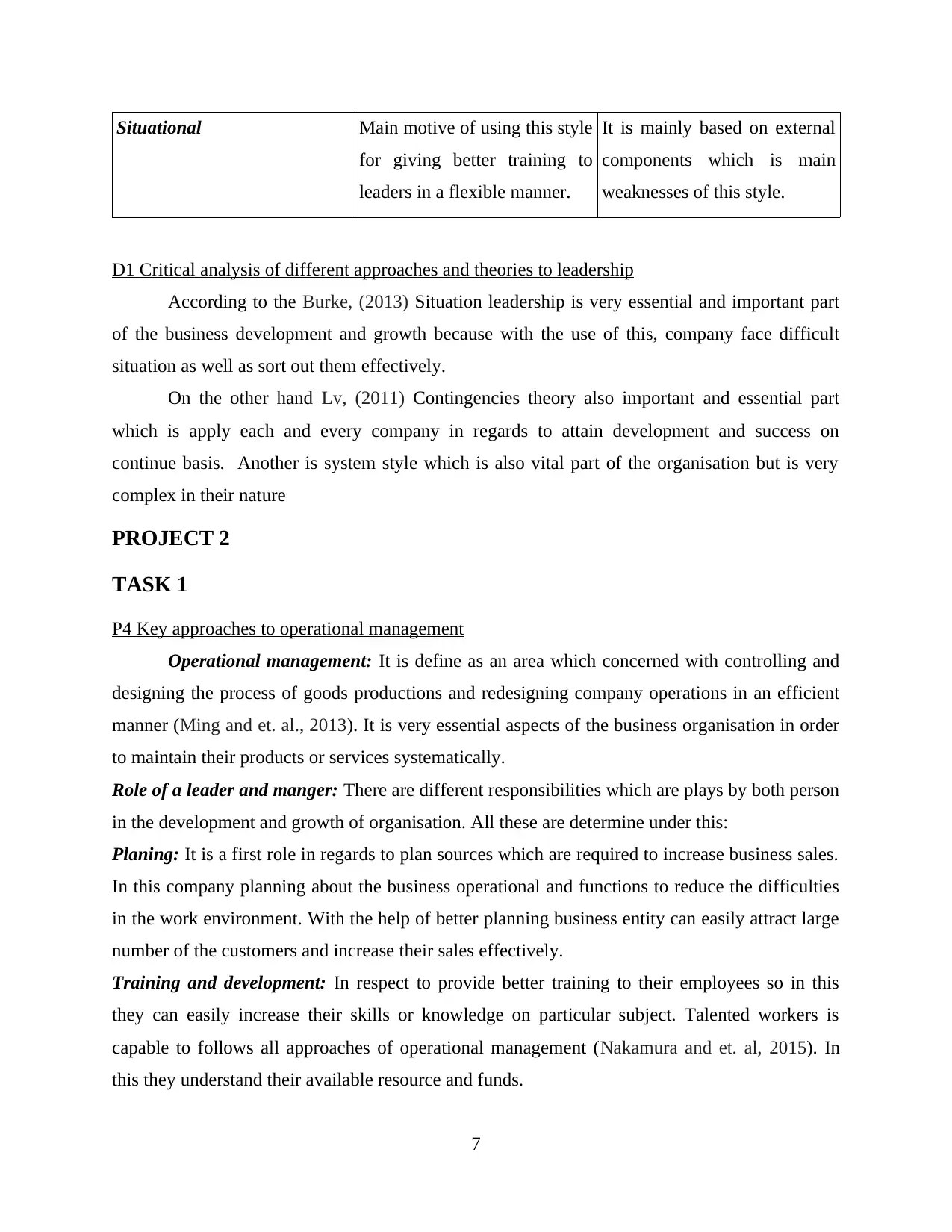
Situational Main motive of using this style
for giving better training to
leaders in a flexible manner.
It is mainly based on external
components which is main
weaknesses of this style.
D1 Critical analysis of different approaches and theories to leadership
According to the Burke, (2013) Situation leadership is very essential and important part
of the business development and growth because with the use of this, company face difficult
situation as well as sort out them effectively.
On the other hand Lv, (2011) Contingencies theory also important and essential part
which is apply each and every company in regards to attain development and success on
continue basis. Another is system style which is also vital part of the organisation but is very
complex in their nature
PROJECT 2
TASK 1
P4 Key approaches to operational management
Operational management: It is define as an area which concerned with controlling and
designing the process of goods productions and redesigning company operations in an efficient
manner (Ming and et. al., 2013). It is very essential aspects of the business organisation in order
to maintain their products or services systematically.
Role of a leader and manger: There are different responsibilities which are plays by both person
in the development and growth of organisation. All these are determine under this:
Planing: It is a first role in regards to plan sources which are required to increase business sales.
In this company planning about the business operational and functions to reduce the difficulties
in the work environment. With the help of better planning business entity can easily attract large
number of the customers and increase their sales effectively.
Training and development: In respect to provide better training to their employees so in this
they can easily increase their skills or knowledge on particular subject. Talented workers is
capable to follows all approaches of operational management (Nakamura and et. al, 2015). In
this they understand their available resource and funds.
7
for giving better training to
leaders in a flexible manner.
It is mainly based on external
components which is main
weaknesses of this style.
D1 Critical analysis of different approaches and theories to leadership
According to the Burke, (2013) Situation leadership is very essential and important part
of the business development and growth because with the use of this, company face difficult
situation as well as sort out them effectively.
On the other hand Lv, (2011) Contingencies theory also important and essential part
which is apply each and every company in regards to attain development and success on
continue basis. Another is system style which is also vital part of the organisation but is very
complex in their nature
PROJECT 2
TASK 1
P4 Key approaches to operational management
Operational management: It is define as an area which concerned with controlling and
designing the process of goods productions and redesigning company operations in an efficient
manner (Ming and et. al., 2013). It is very essential aspects of the business organisation in order
to maintain their products or services systematically.
Role of a leader and manger: There are different responsibilities which are plays by both person
in the development and growth of organisation. All these are determine under this:
Planing: It is a first role in regards to plan sources which are required to increase business sales.
In this company planning about the business operational and functions to reduce the difficulties
in the work environment. With the help of better planning business entity can easily attract large
number of the customers and increase their sales effectively.
Training and development: In respect to provide better training to their employees so in this
they can easily increase their skills or knowledge on particular subject. Talented workers is
capable to follows all approaches of operational management (Nakamura and et. al, 2015). In
this they understand their available resource and funds.
7
Paraphrase This Document
Need a fresh take? Get an instant paraphrase of this document with our AI Paraphraser
Approaches to operational management: There are different types of operational management
which are determine under this:
Just-in-time: It is an essential approach of operational management which is apply by Starbucks
in their company. In this they store packed product and provide quickly as per the buyers needs
and demands. It is very important part of business success and development because in this
company sales automatically increased. This concept reduce the inventory cost, planning
complexity and increase productivity in a systematic manner.
Total quality management: With the use of this approach, company maintain long term relation
with their customers. In this they can ensure buyers satisfaction and loyalty in an effective or
efficient manner (Ren and et. al., 2012). Satisfied employees and customers can achieve long
term goals and objectives in a specific time period.
Six Sigma: It is define as a set of tools and methods for improvement of process. Main motive of
applying this approach is to maintaining product quality and reducing difficulties in a
unsystematic manner. It is mainly emphasis on decreasing the production period and
manufacturing the cost of the products in regards to fulfil needs and wants of the buyers.
MBO: It stand fro management by objective, it is very vital and main part of the business success
and development. In this manager of the company try to enhance their effectiveness and
performance in an effective way. In this approach, leader of the organisation give better direction
to their employees in order to achieve desire objectives. In this, all works are identify their role
and responsibility regarding business development.
Lean production : It is essential and vital methods of the operational management because with
the use of this, company reduce their wastage in an effective manner. So in this performance of
the company is automatically increased in an essential manner. Manager and leader plays
essential role in decreasing wastage of products in the organisations.
P5 Value and significant of operations management
Operation management: It is define as a procedures which is apply by each and every
organisation in order to mange and control all work (Rushton and et. al., 2014). It is very
important part of the company to reduce wastage and increase business performance at large
level. There are certain significant which are determine under this:
Minimizing wastage: Operation management is very important part of the each and every
organisation. With the use of this concept, business entity reduce their wastage in an effective
8
which are determine under this:
Just-in-time: It is an essential approach of operational management which is apply by Starbucks
in their company. In this they store packed product and provide quickly as per the buyers needs
and demands. It is very important part of business success and development because in this
company sales automatically increased. This concept reduce the inventory cost, planning
complexity and increase productivity in a systematic manner.
Total quality management: With the use of this approach, company maintain long term relation
with their customers. In this they can ensure buyers satisfaction and loyalty in an effective or
efficient manner (Ren and et. al., 2012). Satisfied employees and customers can achieve long
term goals and objectives in a specific time period.
Six Sigma: It is define as a set of tools and methods for improvement of process. Main motive of
applying this approach is to maintaining product quality and reducing difficulties in a
unsystematic manner. It is mainly emphasis on decreasing the production period and
manufacturing the cost of the products in regards to fulfil needs and wants of the buyers.
MBO: It stand fro management by objective, it is very vital and main part of the business success
and development. In this manager of the company try to enhance their effectiveness and
performance in an effective way. In this approach, leader of the organisation give better direction
to their employees in order to achieve desire objectives. In this, all works are identify their role
and responsibility regarding business development.
Lean production : It is essential and vital methods of the operational management because with
the use of this, company reduce their wastage in an effective manner. So in this performance of
the company is automatically increased in an essential manner. Manager and leader plays
essential role in decreasing wastage of products in the organisations.
P5 Value and significant of operations management
Operation management: It is define as a procedures which is apply by each and every
organisation in order to mange and control all work (Rushton and et. al., 2014). It is very
important part of the company to reduce wastage and increase business performance at large
level. There are certain significant which are determine under this:
Minimizing wastage: Operation management is very important part of the each and every
organisation. With the use of this concept, business entity reduce their wastage in an effective
8
way. Due to this, they can increase their performance level. This will support the leaders and
manger in order to promote their employees about this works and functions. After that, they
easily complete their all project in allotted time period.
Profit Maximisation: Starbucks use different tools and techniques in respect to maximise profit
and reduce production cost. Operation management support the mangers in regards to encourage
their employees regarding to achieve long term and desire objectives in a particular time period.
In order to increasing profit or revenues., business entity proper guide their workforce to do all
work and complete on time (Singh and et. al., 2011). Manger of the Starbucks use various
techniques in respect to increase sales. So in this profit automatically maximised which means
performance of the firm is increase.
Customer satisfaction: Customer is a main and important part of the business development and
success. In this company provide quality products to their clients in so they are highly satisfied
and attain desire goals in a certain time period. Company give different facilities and services
such as home delivery, attracting packaging and other services to their buyers. All these are
highly attract large number of the clients in an effective manner.
Improving quality standard: Operation management is very vital and essential part that help the
company to improve their quality standard effectively. In the organisation there are different
department such as research and development, they mainly focused on creating various variety in
their beverage that is the require of the buyers. Finance division also plays important role in
managing fixed, overheads and variable cost.
Goodwill increase: Operation management is very important for the company because it will
create the positive and better image in the mind of customers. Providing better satisfaction,
reducing wastage, increasing profit, improving quality standard, all are essential in order to
improving image of the company at market place in clients mind.
M3 Manager and leaders improve efficiencies and effectiveness of operational management
Both manager and leader are important part of the company success and development.
They are responsible for providing effective training and development to their employees. So in
this they can attend this section and increase their skills or knowledge on particular matter
(Stoppato, 2012). They are capable to improve effectiveness and efficiency of operation
management. In this they mainly try to mange, direct and control all work and function of
company with motive of increasing sales and revenues of them. Both are use lean production,
9
manger in order to promote their employees about this works and functions. After that, they
easily complete their all project in allotted time period.
Profit Maximisation: Starbucks use different tools and techniques in respect to maximise profit
and reduce production cost. Operation management support the mangers in regards to encourage
their employees regarding to achieve long term and desire objectives in a particular time period.
In order to increasing profit or revenues., business entity proper guide their workforce to do all
work and complete on time (Singh and et. al., 2011). Manger of the Starbucks use various
techniques in respect to increase sales. So in this profit automatically maximised which means
performance of the firm is increase.
Customer satisfaction: Customer is a main and important part of the business development and
success. In this company provide quality products to their clients in so they are highly satisfied
and attain desire goals in a certain time period. Company give different facilities and services
such as home delivery, attracting packaging and other services to their buyers. All these are
highly attract large number of the clients in an effective manner.
Improving quality standard: Operation management is very vital and essential part that help the
company to improve their quality standard effectively. In the organisation there are different
department such as research and development, they mainly focused on creating various variety in
their beverage that is the require of the buyers. Finance division also plays important role in
managing fixed, overheads and variable cost.
Goodwill increase: Operation management is very important for the company because it will
create the positive and better image in the mind of customers. Providing better satisfaction,
reducing wastage, increasing profit, improving quality standard, all are essential in order to
improving image of the company at market place in clients mind.
M3 Manager and leaders improve efficiencies and effectiveness of operational management
Both manager and leader are important part of the company success and development.
They are responsible for providing effective training and development to their employees. So in
this they can attend this section and increase their skills or knowledge on particular matter
(Stoppato, 2012). They are capable to improve effectiveness and efficiency of operation
management. In this they mainly try to mange, direct and control all work and function of
company with motive of increasing sales and revenues of them. Both are use lean production,
9
⊘ This is a preview!⊘
Do you want full access?
Subscribe today to unlock all pages.
Trusted by 1+ million students worldwide

1 out of 17


Related Documents


Your All-in-One AI-Powered Toolkit for Academic Success.
+13062052269
info@desklib.com
Available 24*7 on WhatsApp / Email
![[object Object]](/_next/static/media/star-bottom.7253800d.svg)
Unlock your academic potential
Copyright © 2020–2026 A2Z Services. All Rights Reserved. Developed and managed by ZUCOL.