Organisations: Leadership and Management Analysis - TESCO
VerifiedAdded on 2020/10/22
|17
|5402
|420
Report
AI Summary
This report provides an in-depth analysis of leadership and management practices within TESCO, a multinational retail organization. It begins by defining the concepts of management and leadership, highlighting their differences, and illustrating their application within the company. The main body delves into leadership theories, specifically focusing on the Trait Leadership Theory and its relevance to TESCO. Additionally, the report examines management development programs used in the retail sector, emphasizing their role in fostering effective leadership. The report concludes by summarizing the key findings and emphasizing the importance of effective leadership and management for organizational success. The analysis covers various aspects of TESCO's operations, including strategy formulation, organizational structure, and employee development, offering insights into how TESCO cultivates and implements leadership principles to achieve its business objectives.
Organisations: Leadership and
Management
Management

Paraphrase This Document
Need a fresh take? Get an instant paraphrase of this document with our AI Paraphraser
Table of Contents
INTRODUCTION...........................................................................................................................3
MAIN BODY...................................................................................................................................3
a) Define concepts of management and leadership and difference between them.................3
b) Analysing leadership theory...............................................................................................7
c) Analysing management development program................................................................11
CONCLUSION..............................................................................................................................13
REFERENCES..............................................................................................................................15
INTRODUCTION...........................................................................................................................3
MAIN BODY...................................................................................................................................3
a) Define concepts of management and leadership and difference between them.................3
b) Analysing leadership theory...............................................................................................7
c) Analysing management development program................................................................11
CONCLUSION..............................................................................................................................13
REFERENCES..............................................................................................................................15
INTRODUCTION
Leadership is regarded as research area and practical skill which encompasses ability of
individual in order to lead or guide employees, teams, people or organisation. This is the process
of social influence in which individual enlist help and support to others in order to achieve goals
and objectives (Arnold, Fletcher and Molyneux, 2012). The responsibility of leadership are
managed by leaders who lead every employees and staff for success of business. Similarly,
management is the art of getting things done through others. It is the activities to set all strategy
of organisation and coordinate efforts and support of employees for accomplishment of
objectives and goals with help of application of different resources like human, financial, natural
and technological. The individual handling management is known as manager who is liable for
managing all activities of business. The given assignment is based on TESCO which was
founded in 1919 at England, United Kingdom founded by Jack Cohen. It is multinational British
general merchandise and groceries retail organisation which is operating business in various
parts of world. There are different products provided by firm such as supermarket, superstore,
hypermarket and convenience shop. It has multiple subsidiaries such as TESCO Bank, TESCO
Mobile, TESCO stores and so on. This assignment covers concept of management and leadership
and their difference. It also highlights leadership theory and management development program
that is used in retail sector which focus on leadership.
Leadership is regarded as research area and practical skill which encompasses ability of
individual in order to lead or guide employees, teams, people or organisation. This is the process
of social influence in which individual enlist help and support to others in order to achieve goals
and objectives (Arnold, Fletcher and Molyneux, 2012). The responsibility of leadership are
managed by leaders who lead every employees and staff for success of business. Similarly,
management is the art of getting things done through others. It is the activities to set all strategy
of organisation and coordinate efforts and support of employees for accomplishment of
objectives and goals with help of application of different resources like human, financial, natural
and technological. The individual handling management is known as manager who is liable for
managing all activities of business. The given assignment is based on TESCO which was
founded in 1919 at England, United Kingdom founded by Jack Cohen. It is multinational British
general merchandise and groceries retail organisation which is operating business in various
parts of world. There are different products provided by firm such as supermarket, superstore,
hypermarket and convenience shop. It has multiple subsidiaries such as TESCO Bank, TESCO
Mobile, TESCO stores and so on. This assignment covers concept of management and leadership
and their difference. It also highlights leadership theory and management development program
that is used in retail sector which focus on leadership.
⊘ This is a preview!⊘
Do you want full access?
Subscribe today to unlock all pages.

Trusted by 1+ million students worldwide
MAIN BODY
a) Define concepts of management and leadership and difference between them
Concept of Management
Management is the process of organising, planning, staffing, controlling, directing and
coordinating work in enterprise. It is used to describe functions of managing people. This is
referred as discipline, practice and body of knowledge. Some of the researcher has described it as
techniques of decision making and leadership whereas other describes it as economic resource
that is factor of productivity or authority of system (Blumenthal and et. al., 2012). The
management concept is described on basis of different terms such as art of getting things done,
management as process, management as discipline, art & science of leadership and decision
making, art for maximum productivity, coordination of material and human resources and group
of managers. Each of terms represent different concept which are described below:
Art of getting things done: Human Relations- Management is regarded as human
relation which is art where things are done from others. TESCO need to carry out directing
functions and work of managing in organisation is done with help of inspiring and cooperating
others. Each and every work is being carried out by help of people or individual working in
business.
Management as process: Managerial Functions- There are number of functions that
need to be carried in TESCO organisation and those are performed by managers for making best
use of material and human resources for achievement of goals and objectives (Bush and Glover,
2012). The functions performed are planning, organising, staffing, coordinating, controlling and
directing. As per Fayol, management means managing to forecast and plan, to organise, to
command, control and to coordinate. This is continuous process for running organisation that
helps in achievement of goals and objectives.
Management as discipline: Body of Knowledge- Management is body of practices,
knowledge and disciplines. The work should be performed in efficient and effective manner. The
manager is liable to work in discipline manner so that goals and objectives can be achieved.
Art & science of leadership and decision making: Leadership and Decision Making-
Management is considered as art and science for effective leadership and decision making. The
decision making quality of manager shows their leadership skills in organisation. Management
a) Define concepts of management and leadership and difference between them
Concept of Management
Management is the process of organising, planning, staffing, controlling, directing and
coordinating work in enterprise. It is used to describe functions of managing people. This is
referred as discipline, practice and body of knowledge. Some of the researcher has described it as
techniques of decision making and leadership whereas other describes it as economic resource
that is factor of productivity or authority of system (Blumenthal and et. al., 2012). The
management concept is described on basis of different terms such as art of getting things done,
management as process, management as discipline, art & science of leadership and decision
making, art for maximum productivity, coordination of material and human resources and group
of managers. Each of terms represent different concept which are described below:
Art of getting things done: Human Relations- Management is regarded as human
relation which is art where things are done from others. TESCO need to carry out directing
functions and work of managing in organisation is done with help of inspiring and cooperating
others. Each and every work is being carried out by help of people or individual working in
business.
Management as process: Managerial Functions- There are number of functions that
need to be carried in TESCO organisation and those are performed by managers for making best
use of material and human resources for achievement of goals and objectives (Bush and Glover,
2012). The functions performed are planning, organising, staffing, coordinating, controlling and
directing. As per Fayol, management means managing to forecast and plan, to organise, to
command, control and to coordinate. This is continuous process for running organisation that
helps in achievement of goals and objectives.
Management as discipline: Body of Knowledge- Management is body of practices,
knowledge and disciplines. The work should be performed in efficient and effective manner. The
manager is liable to work in discipline manner so that goals and objectives can be achieved.
Art & science of leadership and decision making: Leadership and Decision Making-
Management is considered as art and science for effective leadership and decision making. The
decision making quality of manager shows their leadership skills in organisation. Management
Paraphrase This Document
Need a fresh take? Get an instant paraphrase of this document with our AI Paraphraser
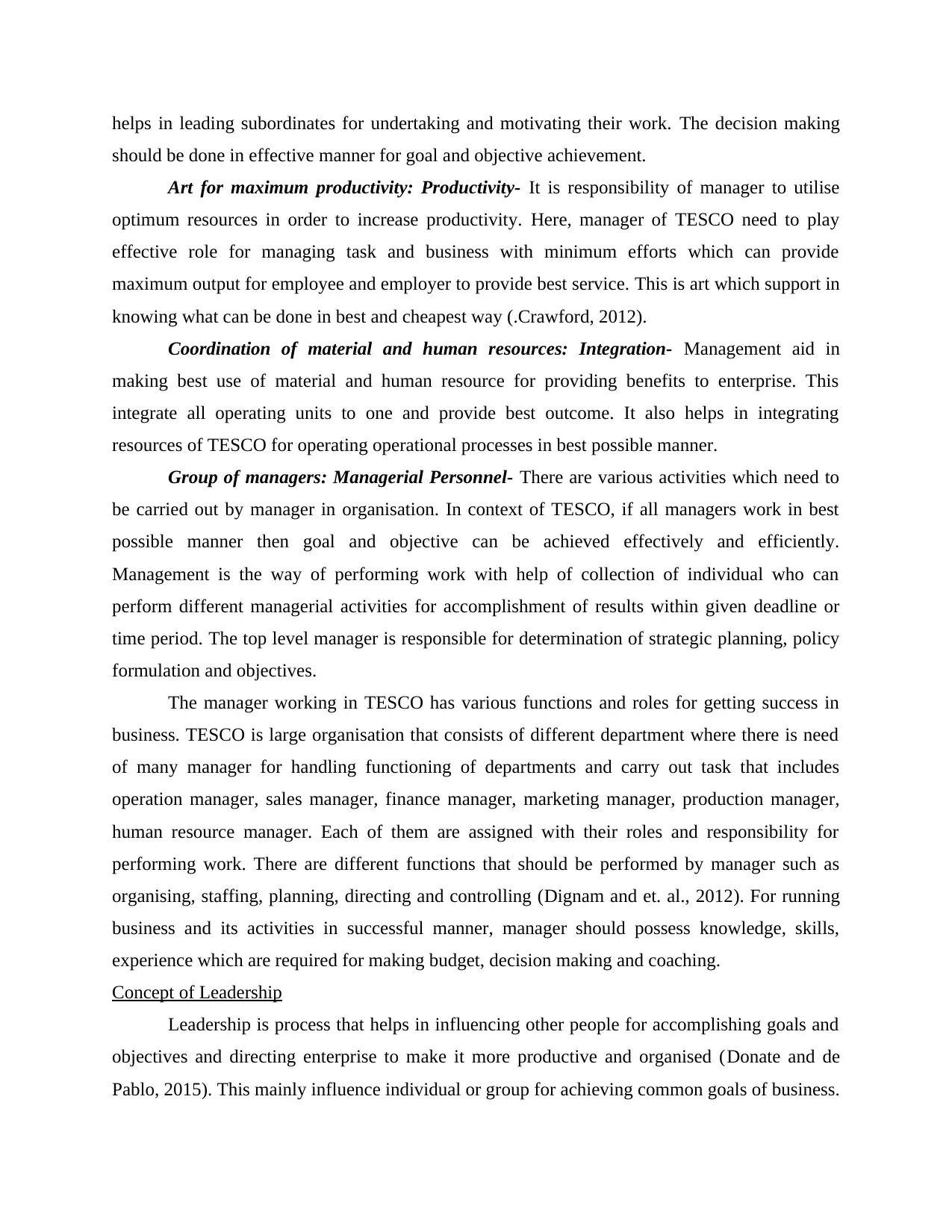
helps in leading subordinates for undertaking and motivating their work. The decision making
should be done in effective manner for goal and objective achievement.
Art for maximum productivity: Productivity- It is responsibility of manager to utilise
optimum resources in order to increase productivity. Here, manager of TESCO need to play
effective role for managing task and business with minimum efforts which can provide
maximum output for employee and employer to provide best service. This is art which support in
knowing what can be done in best and cheapest way (.Crawford, 2012).
Coordination of material and human resources: Integration- Management aid in
making best use of material and human resource for providing benefits to enterprise. This
integrate all operating units to one and provide best outcome. It also helps in integrating
resources of TESCO for operating operational processes in best possible manner.
Group of managers: Managerial Personnel- There are various activities which need to
be carried out by manager in organisation. In context of TESCO, if all managers work in best
possible manner then goal and objective can be achieved effectively and efficiently.
Management is the way of performing work with help of collection of individual who can
perform different managerial activities for accomplishment of results within given deadline or
time period. The top level manager is responsible for determination of strategic planning, policy
formulation and objectives.
The manager working in TESCO has various functions and roles for getting success in
business. TESCO is large organisation that consists of different department where there is need
of many manager for handling functioning of departments and carry out task that includes
operation manager, sales manager, finance manager, marketing manager, production manager,
human resource manager. Each of them are assigned with their roles and responsibility for
performing work. There are different functions that should be performed by manager such as
organising, staffing, planning, directing and controlling (Dignam and et. al., 2012). For running
business and its activities in successful manner, manager should possess knowledge, skills,
experience which are required for making budget, decision making and coaching.
Concept of Leadership
Leadership is process that helps in influencing other people for accomplishing goals and
objectives and directing enterprise to make it more productive and organised (Donate and de
Pablo, 2015). This mainly influence individual or group for achieving common goals of business.
should be done in effective manner for goal and objective achievement.
Art for maximum productivity: Productivity- It is responsibility of manager to utilise
optimum resources in order to increase productivity. Here, manager of TESCO need to play
effective role for managing task and business with minimum efforts which can provide
maximum output for employee and employer to provide best service. This is art which support in
knowing what can be done in best and cheapest way (.Crawford, 2012).
Coordination of material and human resources: Integration- Management aid in
making best use of material and human resource for providing benefits to enterprise. This
integrate all operating units to one and provide best outcome. It also helps in integrating
resources of TESCO for operating operational processes in best possible manner.
Group of managers: Managerial Personnel- There are various activities which need to
be carried out by manager in organisation. In context of TESCO, if all managers work in best
possible manner then goal and objective can be achieved effectively and efficiently.
Management is the way of performing work with help of collection of individual who can
perform different managerial activities for accomplishment of results within given deadline or
time period. The top level manager is responsible for determination of strategic planning, policy
formulation and objectives.
The manager working in TESCO has various functions and roles for getting success in
business. TESCO is large organisation that consists of different department where there is need
of many manager for handling functioning of departments and carry out task that includes
operation manager, sales manager, finance manager, marketing manager, production manager,
human resource manager. Each of them are assigned with their roles and responsibility for
performing work. There are different functions that should be performed by manager such as
organising, staffing, planning, directing and controlling (Dignam and et. al., 2012). For running
business and its activities in successful manner, manager should possess knowledge, skills,
experience which are required for making budget, decision making and coaching.
Concept of Leadership
Leadership is process that helps in influencing other people for accomplishing goals and
objectives and directing enterprise to make it more productive and organised (Donate and de
Pablo, 2015). This mainly influence individual or group for achieving common goals of business.
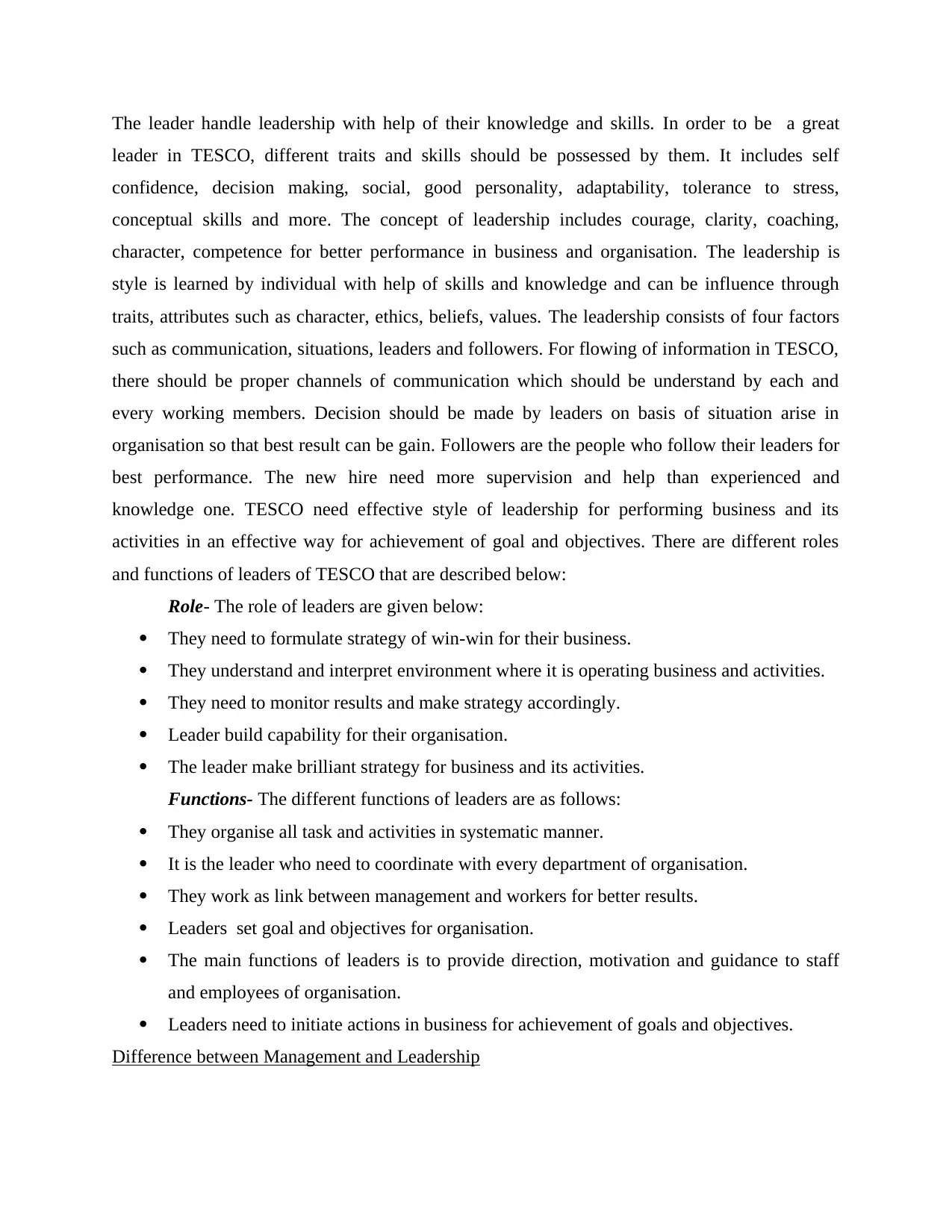
The leader handle leadership with help of their knowledge and skills. In order to be a great
leader in TESCO, different traits and skills should be possessed by them. It includes self
confidence, decision making, social, good personality, adaptability, tolerance to stress,
conceptual skills and more. The concept of leadership includes courage, clarity, coaching,
character, competence for better performance in business and organisation. The leadership is
style is learned by individual with help of skills and knowledge and can be influence through
traits, attributes such as character, ethics, beliefs, values. The leadership consists of four factors
such as communication, situations, leaders and followers. For flowing of information in TESCO,
there should be proper channels of communication which should be understand by each and
every working members. Decision should be made by leaders on basis of situation arise in
organisation so that best result can be gain. Followers are the people who follow their leaders for
best performance. The new hire need more supervision and help than experienced and
knowledge one. TESCO need effective style of leadership for performing business and its
activities in an effective way for achievement of goal and objectives. There are different roles
and functions of leaders of TESCO that are described below:
Role- The role of leaders are given below:
They need to formulate strategy of win-win for their business.
They understand and interpret environment where it is operating business and activities.
They need to monitor results and make strategy accordingly.
Leader build capability for their organisation.
The leader make brilliant strategy for business and its activities.
Functions- The different functions of leaders are as follows:
They organise all task and activities in systematic manner.
It is the leader who need to coordinate with every department of organisation.
They work as link between management and workers for better results.
Leaders set goal and objectives for organisation.
The main functions of leaders is to provide direction, motivation and guidance to staff
and employees of organisation.
Leaders need to initiate actions in business for achievement of goals and objectives.
Difference between Management and Leadership
leader in TESCO, different traits and skills should be possessed by them. It includes self
confidence, decision making, social, good personality, adaptability, tolerance to stress,
conceptual skills and more. The concept of leadership includes courage, clarity, coaching,
character, competence for better performance in business and organisation. The leadership is
style is learned by individual with help of skills and knowledge and can be influence through
traits, attributes such as character, ethics, beliefs, values. The leadership consists of four factors
such as communication, situations, leaders and followers. For flowing of information in TESCO,
there should be proper channels of communication which should be understand by each and
every working members. Decision should be made by leaders on basis of situation arise in
organisation so that best result can be gain. Followers are the people who follow their leaders for
best performance. The new hire need more supervision and help than experienced and
knowledge one. TESCO need effective style of leadership for performing business and its
activities in an effective way for achievement of goal and objectives. There are different roles
and functions of leaders of TESCO that are described below:
Role- The role of leaders are given below:
They need to formulate strategy of win-win for their business.
They understand and interpret environment where it is operating business and activities.
They need to monitor results and make strategy accordingly.
Leader build capability for their organisation.
The leader make brilliant strategy for business and its activities.
Functions- The different functions of leaders are as follows:
They organise all task and activities in systematic manner.
It is the leader who need to coordinate with every department of organisation.
They work as link between management and workers for better results.
Leaders set goal and objectives for organisation.
The main functions of leaders is to provide direction, motivation and guidance to staff
and employees of organisation.
Leaders need to initiate actions in business for achievement of goals and objectives.
Difference between Management and Leadership
⊘ This is a preview!⊘
Do you want full access?
Subscribe today to unlock all pages.
Trusted by 1+ million students worldwide
Management is the discipline for managing all task and activities in efficient and
effective manner. It is referred as art or skills of getting work done from others with their help
and support (Fernández-Muñiz, Montes-Peón and Vázquez-Ordás, 2014). There are various
areas where management is required such as offices, education, hospitality, education, banks and
others. Management requires formal, organised and structured group of individual or people for
performance. The word management is formed of four terms such as man+age+men+t that
means techniques. Management consists of 5M like Materials, Machine, Men, Methods and
Money. Person who is handling all roles and responsibilities of management is called manager
(Difference Between Leadership and Management, 2019).
Leadership is the skill and quality for influencing people for attainment of goals and
objectives willingly and enthusiastically (Goetsch and Davis, 2014). It is considered as most
important component for work performance and is formal as well as informal group. Inspiring
and leading group or individual towards common direction is called leadership. It is also known
as interpersonal procedure which involves person or individual influencing for ensuring
achievement of objectives.
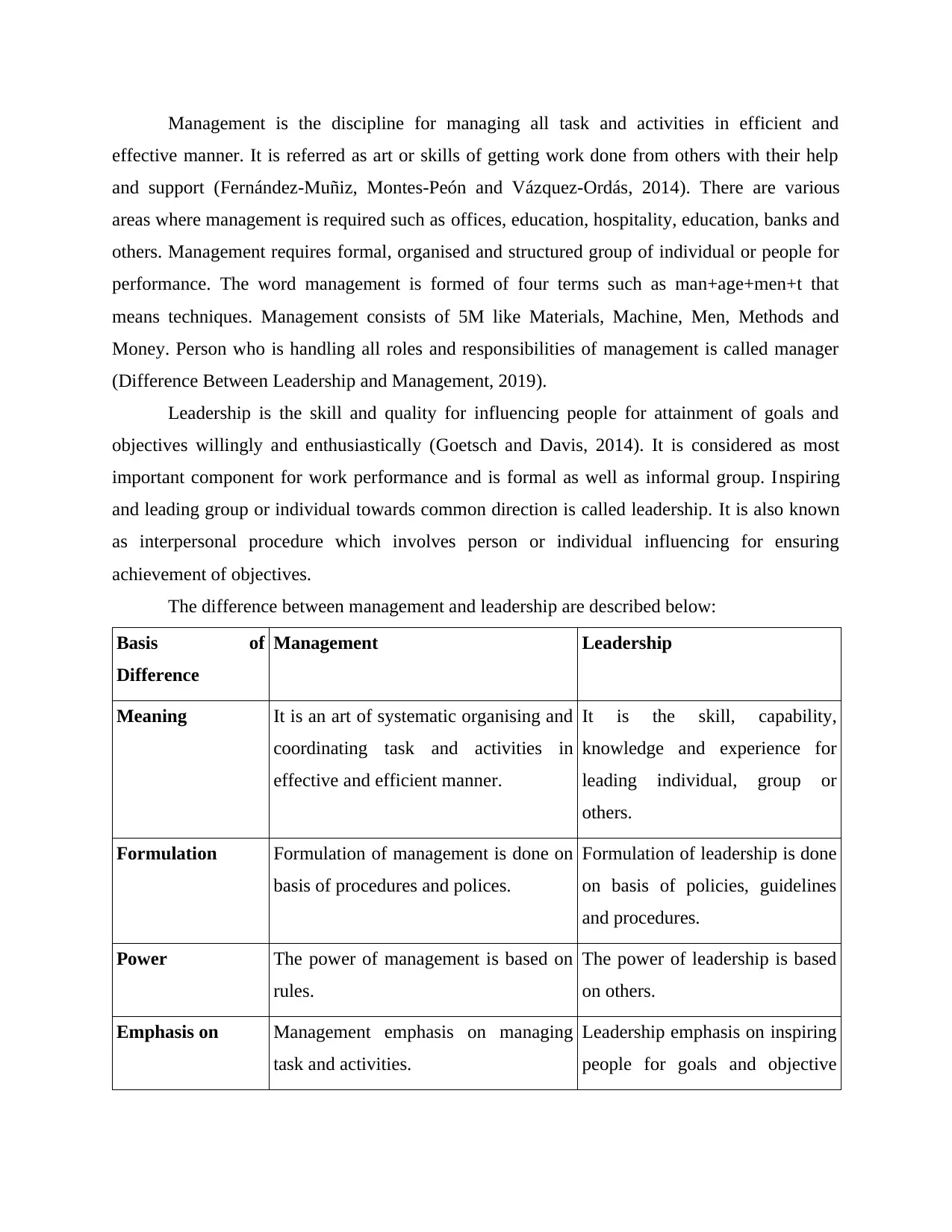
The difference between management and leadership are described below:
Basis of
Difference
Management Leadership
Meaning It is an art of systematic organising and
coordinating task and activities in
effective and efficient manner.
It is the skill, capability,
knowledge and experience for
leading individual, group or
others.
Formulation Formulation of management is done on
basis of procedures and polices.
Formulation of leadership is done
on basis of policies, guidelines
and procedures.
Power The power of management is based on
rules.
The power of leadership is based
on others.
Emphasis on Management emphasis on managing
task and activities.
Leadership emphasis on inspiring
people for goals and objective
effective manner. It is referred as art or skills of getting work done from others with their help
and support (Fernández-Muñiz, Montes-Peón and Vázquez-Ordás, 2014). There are various
areas where management is required such as offices, education, hospitality, education, banks and
others. Management requires formal, organised and structured group of individual or people for
performance. The word management is formed of four terms such as man+age+men+t that
means techniques. Management consists of 5M like Materials, Machine, Men, Methods and
Money. Person who is handling all roles and responsibilities of management is called manager
(Difference Between Leadership and Management, 2019).
Leadership is the skill and quality for influencing people for attainment of goals and
objectives willingly and enthusiastically (Goetsch and Davis, 2014). It is considered as most
important component for work performance and is formal as well as informal group. Inspiring
and leading group or individual towards common direction is called leadership. It is also known
as interpersonal procedure which involves person or individual influencing for ensuring
achievement of objectives.
The difference between management and leadership are described below:
Basis of
Difference
Management Leadership
Meaning It is an art of systematic organising and
coordinating task and activities in
effective and efficient manner.
It is the skill, capability,
knowledge and experience for
leading individual, group or
others.
Formulation Formulation of management is done on
basis of procedures and polices.
Formulation of leadership is done
on basis of policies, guidelines
and procedures.
Power The power of management is based on
rules.
The power of leadership is based
on others.
Emphasis on Management emphasis on managing
task and activities.
Leadership emphasis on inspiring
people for goals and objective
Paraphrase This Document
Need a fresh take? Get an instant paraphrase of this document with our AI Paraphraser
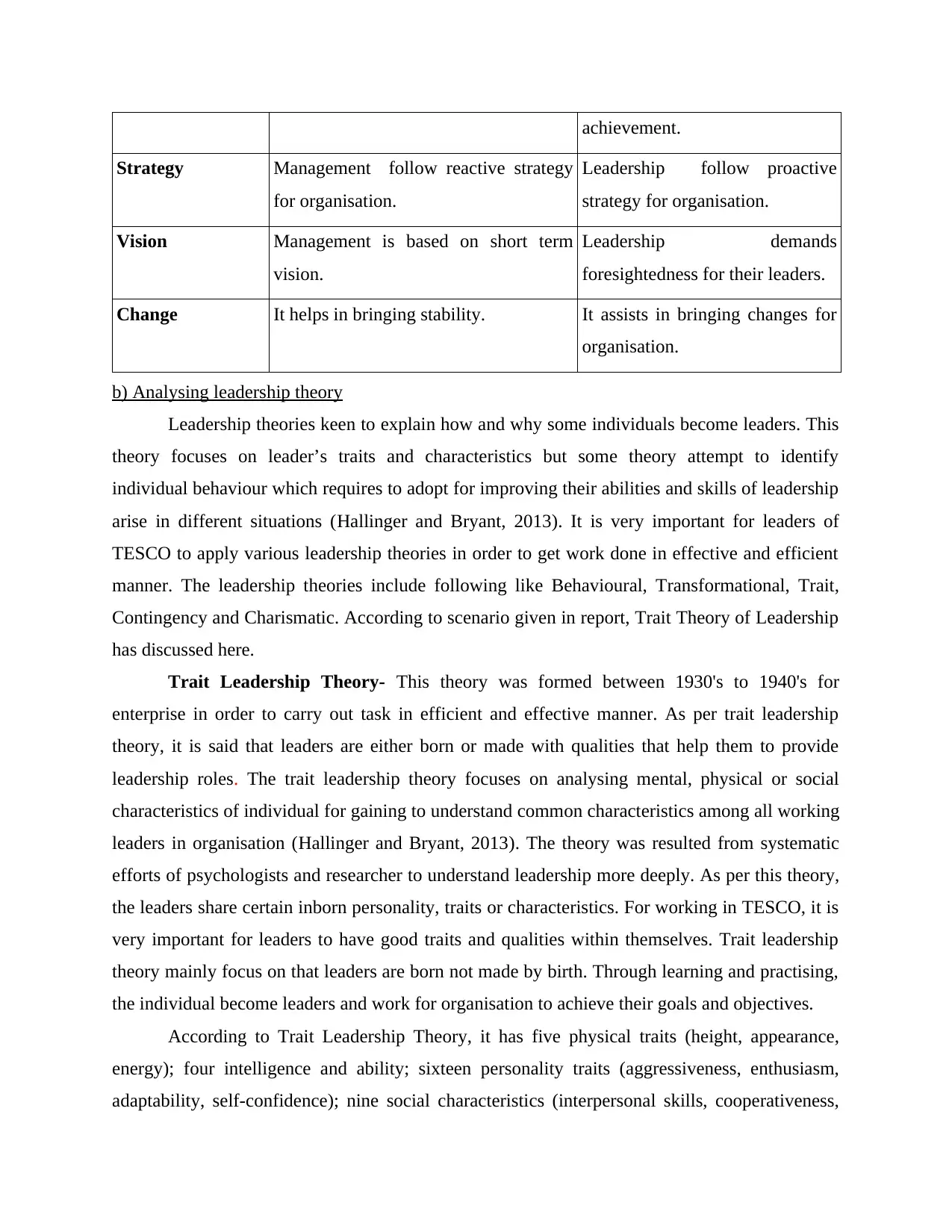
achievement.
Strategy Management follow reactive strategy
for organisation.
Leadership follow proactive
strategy for organisation.
Vision Management is based on short term
vision.
Leadership demands
foresightedness for their leaders.
Change It helps in bringing stability. It assists in bringing changes for
organisation.
b) Analysing leadership theory
Leadership theories keen to explain how and why some individuals become leaders. This
theory focuses on leader’s traits and characteristics but some theory attempt to identify
individual behaviour which requires to adopt for improving their abilities and skills of leadership
arise in different situations (Hallinger and Bryant, 2013). It is very important for leaders of
TESCO to apply various leadership theories in order to get work done in effective and efficient
manner. The leadership theories include following like Behavioural, Transformational, Trait,
Contingency and Charismatic. According to scenario given in report, Trait Theory of Leadership
has discussed here.
Trait Leadership Theory- This theory was formed between 1930's to 1940's for
enterprise in order to carry out task in efficient and effective manner. As per trait leadership
theory, it is said that leaders are either born or made with qualities that help them to provide
leadership roles. The trait leadership theory focuses on analysing mental, physical or social
characteristics of individual for gaining to understand common characteristics among all working
leaders in organisation (Hallinger and Bryant, 2013). The theory was resulted from systematic
efforts of psychologists and researcher to understand leadership more deeply. As per this theory,
the leaders share certain inborn personality, traits or characteristics. For working in TESCO, it is
very important for leaders to have good traits and qualities within themselves. Trait leadership
theory mainly focus on that leaders are born not made by birth. Through learning and practising,
the individual become leaders and work for organisation to achieve their goals and objectives.
According to Trait Leadership Theory, it has five physical traits (height, appearance,
energy); four intelligence and ability; sixteen personality traits (aggressiveness, enthusiasm,
adaptability, self-confidence); nine social characteristics (interpersonal skills, cooperativeness,
Strategy Management follow reactive strategy
for organisation.
Leadership follow proactive
strategy for organisation.
Vision Management is based on short term
vision.
Leadership demands
foresightedness for their leaders.
Change It helps in bringing stability. It assists in bringing changes for
organisation.
b) Analysing leadership theory
Leadership theories keen to explain how and why some individuals become leaders. This
theory focuses on leader’s traits and characteristics but some theory attempt to identify
individual behaviour which requires to adopt for improving their abilities and skills of leadership
arise in different situations (Hallinger and Bryant, 2013). It is very important for leaders of
TESCO to apply various leadership theories in order to get work done in effective and efficient
manner. The leadership theories include following like Behavioural, Transformational, Trait,
Contingency and Charismatic. According to scenario given in report, Trait Theory of Leadership
has discussed here.
Trait Leadership Theory- This theory was formed between 1930's to 1940's for
enterprise in order to carry out task in efficient and effective manner. As per trait leadership
theory, it is said that leaders are either born or made with qualities that help them to provide
leadership roles. The trait leadership theory focuses on analysing mental, physical or social
characteristics of individual for gaining to understand common characteristics among all working
leaders in organisation (Hallinger and Bryant, 2013). The theory was resulted from systematic
efforts of psychologists and researcher to understand leadership more deeply. As per this theory,
the leaders share certain inborn personality, traits or characteristics. For working in TESCO, it is
very important for leaders to have good traits and qualities within themselves. Trait leadership
theory mainly focus on that leaders are born not made by birth. Through learning and practising,
the individual become leaders and work for organisation to achieve their goals and objectives.
According to Trait Leadership Theory, it has five physical traits (height, appearance,
energy); four intelligence and ability; sixteen personality traits (aggressiveness, enthusiasm,
adaptability, self-confidence); nine social characteristics (interpersonal skills, cooperativeness,
administrative ability) and six related with task (initiative, persistence, achievement, drive).
According to psychologist and researcher, various traits of leadership has been identified such as
honesty, integrity, cognitive ability, leadership motivation, self-confidence, drive and so on for
understanding business and activities. Thus, it is not compulsory that all leaders have same traits
as per this theory whereas many non-leaders can possess good quality. The different traits of
TESCO leaders are mentioned below:
Task Competence- In order to work in TESCO as leader, it is very important for them to
be skilled and capable for result achievement. The member of group takes support and aid from
leaders for accomplishment of task and learn things which need to be done (Hallinger and Wang,
2015). There are many competitors of TESCO who work better for their business, so leader need
to work hard and perform their roles and responsibility.
Intelligence and action oriented Judgement- The leaders of TESCO should make
judgement on basis of choices which can move from individual to group. They need to be
intelligent and action oriented towards their goal and objectives for result achievement.
Capacity to Motivate People- Leaders are the person who influence others to perform
task. In order to be good leader in TESCO they should know to motivate and inspire staff and
employees of firm for better work performance.
People's Skills- Leaders of TESCO should possess excellent skills so that they can work
effectively and efficiently. Great leaders can easily interact with team members and others for
getting better outcome.
Decisiveness- The leaders should be able to make decisions and confident in choosing
best alternatives. Many decisions of TESCO need to be made by leaders so that work can be
performed effectively and efficiently.
Perseverance- The leaders should stick to organisation even when things get difficult. It
is the important traits of leaders where they can show their skills during problems or difficulties.
Many unexpected situations arise in enterprise which should be solved by leaders with the help
of traits (Hechanova and Cementina-Olpoc, 2013).
Emotional Stability- It is very important for leaders to control their emotions and avoid
overreactions. Thus, if leaders of TESCO are very sensitive and emotional then effective
decisions cannot be taken by them for business.
According to psychologist and researcher, various traits of leadership has been identified such as
honesty, integrity, cognitive ability, leadership motivation, self-confidence, drive and so on for
understanding business and activities. Thus, it is not compulsory that all leaders have same traits
as per this theory whereas many non-leaders can possess good quality. The different traits of
TESCO leaders are mentioned below:
Task Competence- In order to work in TESCO as leader, it is very important for them to
be skilled and capable for result achievement. The member of group takes support and aid from
leaders for accomplishment of task and learn things which need to be done (Hallinger and Wang,
2015). There are many competitors of TESCO who work better for their business, so leader need
to work hard and perform their roles and responsibility.
Intelligence and action oriented Judgement- The leaders of TESCO should make
judgement on basis of choices which can move from individual to group. They need to be
intelligent and action oriented towards their goal and objectives for result achievement.
Capacity to Motivate People- Leaders are the person who influence others to perform
task. In order to be good leader in TESCO they should know to motivate and inspire staff and
employees of firm for better work performance.
People's Skills- Leaders of TESCO should possess excellent skills so that they can work
effectively and efficiently. Great leaders can easily interact with team members and others for
getting better outcome.
Decisiveness- The leaders should be able to make decisions and confident in choosing
best alternatives. Many decisions of TESCO need to be made by leaders so that work can be
performed effectively and efficiently.
Perseverance- The leaders should stick to organisation even when things get difficult. It
is the important traits of leaders where they can show their skills during problems or difficulties.
Many unexpected situations arise in enterprise which should be solved by leaders with the help
of traits (Hechanova and Cementina-Olpoc, 2013).
Emotional Stability- It is very important for leaders to control their emotions and avoid
overreactions. Thus, if leaders of TESCO are very sensitive and emotional then effective
decisions cannot be taken by them for business.
⊘ This is a preview!⊘
Do you want full access?
Subscribe today to unlock all pages.
Trusted by 1+ million students worldwide
Assertiveness- Leaders should not be aggressive in any situations and be able to assertive.
If any situation arise in TESCO and leaders become aggressive then right decisions cannot be
taken for enterprise.
Understanding followers and Needs- The good leaders should pay attention to group
members and help others for getting success. This type of leader want each and every members
to get success and plays vital role in moving group forward in effective and efficient manner.
Eagerness to accepting responsibility- The good leaders take all roles and responsibility
and do not pass it to others for blaming them. This trait help leader to know about their success
and taking ownership for all fault and mistakes by themselves. There are multiple responsibilities
that are carried out by leaders of TESCO which requires such traits.
Need for Achievement- TESCO leaders should carry this trait within themselves for
carrying out roles and responsibility. This type of leaders help and succeed groups for
achievement of goals and objectives by following their roles and responsibility (Johnston and
Marshall, 2013). The leaders care about other’s success and committed towards helping members
of groups for reaching milestones.
Resolution and Courage- Leaders should show courage towards their roles,
responsibility, work and organisation. They need to be very brave and stick to goals of group
members, individuals and others. Leaders do not hide anything or challenges from employees,
staff, managers who are working in business. This leads in achievement of success of business.
Flexibility and Adaptability- It is considered as most significant trait of this theory. For
operating business and its activities in competitive environment, leaders should be flexible and
adaptable for adoption of any situation arise in business (McCaffery, 2018). Leaders of TESCO
should think out of box and accept changing need and situations of environment quickly.
Creativity- In order to perform task in competitive environment, it is essential for leaders
to be creative. This type of trait is possessed within themselves by leaders and can learn from
other to achieve set objectives.
The advantage and disadvantage of Trait Leadership Theory are described below:
Advantages- The pros or advantage of trait leadership theory are given below:
This is regarded as naturally pleasing theory.
Due to foundation and research, it is known as valid theory.
This theory assist in serving as yardstick against traits of leadership that can be assessed.
If any situation arise in TESCO and leaders become aggressive then right decisions cannot be
taken for enterprise.
Understanding followers and Needs- The good leaders should pay attention to group
members and help others for getting success. This type of leader want each and every members
to get success and plays vital role in moving group forward in effective and efficient manner.
Eagerness to accepting responsibility- The good leaders take all roles and responsibility
and do not pass it to others for blaming them. This trait help leader to know about their success
and taking ownership for all fault and mistakes by themselves. There are multiple responsibilities
that are carried out by leaders of TESCO which requires such traits.
Need for Achievement- TESCO leaders should carry this trait within themselves for
carrying out roles and responsibility. This type of leaders help and succeed groups for
achievement of goals and objectives by following their roles and responsibility (Johnston and
Marshall, 2013). The leaders care about other’s success and committed towards helping members
of groups for reaching milestones.
Resolution and Courage- Leaders should show courage towards their roles,
responsibility, work and organisation. They need to be very brave and stick to goals of group
members, individuals and others. Leaders do not hide anything or challenges from employees,
staff, managers who are working in business. This leads in achievement of success of business.
Flexibility and Adaptability- It is considered as most significant trait of this theory. For
operating business and its activities in competitive environment, leaders should be flexible and
adaptable for adoption of any situation arise in business (McCaffery, 2018). Leaders of TESCO
should think out of box and accept changing need and situations of environment quickly.
Creativity- In order to perform task in competitive environment, it is essential for leaders
to be creative. This type of trait is possessed within themselves by leaders and can learn from
other to achieve set objectives.
The advantage and disadvantage of Trait Leadership Theory are described below:
Advantages- The pros or advantage of trait leadership theory are given below:
This is regarded as naturally pleasing theory.
Due to foundation and research, it is known as valid theory.
This theory assist in serving as yardstick against traits of leadership that can be assessed.
Paraphrase This Document
Need a fresh take? Get an instant paraphrase of this document with our AI Paraphraser
It helps in providing knowledge and detailed understanding of various element of leaders
in leadership process.
Disadvantages- The disadvantage of this theory are described below:
Trait leadership theory is considered as subjective judgement for determining successful
or good leader.
This theory present different physical traits such as weight and height which are based on
situational factors. As such requirements does not provide effective leaders. '
It is very difficult and complex theory of leadership.
Implication of Trait Theory- This theory assist in providing information which is
constructive about leadership which can be applied to all level of organisation and people
(McMurray and et. al., 2012). The manager can easily utilise information from this theory in
order to evaluate various position in business and assessing how to become stronger in
enterprise. This theory help leaders to understand in depth knowledge of identity and ways that
can affect others and business for their success. Also with use of this theory, manager can easily
determine strengths and weaknesses and help in developing qualities of leadership.
c) Analysing management development program
Management development programs is considered as a dynamic system-wide programme
of training which is designed to maximise as well as strengthen the abilities of leadership and
also assure that individuals has knowledge, skills to effectually lead, involve and also develop
their team (Mládková, 2012). It is a great contribution for senior authorities and manager. In
context of TESCO , its manager plays vital role in coordinating as well as managing the task and
procedures which straightly effects its success. Management development programme assists
and support manager and also directly connects with their colleagues or associates crosswise
from different area. The management development program of Tesco focused on leadership
development program that helps in develop and enhancement of qualities and skills of an
individual to enlarge business opportunities. Also, share the challenges and task at the same time
in order to provide their contribution through identifying strategic solution. This is one of the
effectual training programmes for manager as well as leaders so that they can be able to lead,
engage and build the good team for attaining the objectives of company. It can be accomplished
in leadership process.
Disadvantages- The disadvantage of this theory are described below:
Trait leadership theory is considered as subjective judgement for determining successful
or good leader.
This theory present different physical traits such as weight and height which are based on
situational factors. As such requirements does not provide effective leaders. '
It is very difficult and complex theory of leadership.
Implication of Trait Theory- This theory assist in providing information which is
constructive about leadership which can be applied to all level of organisation and people
(McMurray and et. al., 2012). The manager can easily utilise information from this theory in
order to evaluate various position in business and assessing how to become stronger in
enterprise. This theory help leaders to understand in depth knowledge of identity and ways that
can affect others and business for their success. Also with use of this theory, manager can easily
determine strengths and weaknesses and help in developing qualities of leadership.
c) Analysing management development program
Management development programs is considered as a dynamic system-wide programme
of training which is designed to maximise as well as strengthen the abilities of leadership and
also assure that individuals has knowledge, skills to effectually lead, involve and also develop
their team (Mládková, 2012). It is a great contribution for senior authorities and manager. In
context of TESCO , its manager plays vital role in coordinating as well as managing the task and
procedures which straightly effects its success. Management development programme assists
and support manager and also directly connects with their colleagues or associates crosswise
from different area. The management development program of Tesco focused on leadership
development program that helps in develop and enhancement of qualities and skills of an
individual to enlarge business opportunities. Also, share the challenges and task at the same time
in order to provide their contribution through identifying strategic solution. This is one of the
effectual training programmes for manager as well as leaders so that they can be able to lead,
engage and build the good team for attaining the objectives of company. It can be accomplished
through adapting the 4 essential measures to adapt effective style of leadership into the case of
TESCO which are mentioned below:
Employee Engagement- This is considered as an crucial aspects of management
development program is to involve workers and their departments for fulfilling objective of the
company as well as insists them to apply their knowledge, skills and potential to accomplish the
task effectively (Renz, 2016). In case of TESCO, it expend lot of money in engaging their
workers with one another and from their objectives. Employee engagement can be maximised
through strategic directions of leaders and manager. Also, by providing rewards and another
benefits can increase their level of satisfaction.
Manager redefined- This is the important task of manager and leaders and their
accountability to achieve that training programme that is known as MDP which redefine the
leaders and managers roles and responsibilities for accomplishing their objectives. After
measuring the requirements and wants of workers, management of the firm explains the manager
duties and role consequently they has to perform it to attain desirable goals. Redirection is very
compulsory for manager at that time and condition so that it can put their efforts as this is
suitable.
Exercising Influence- This is an essential aspects which is considered as a major task as
well as contribution of manager and leaders. As it effects the functions and works of its workers
by encouraging them through their opinions and views. In context of TESCO, its leaders and
manager motivates their subordinates and perform effectively for achieving the goals of the firm.
Leading change and managing transitions- Changes are considered as an essential
aspect in the development of the company and beating its rivals (Shattock, 2013). In order to
compete with the furious nation TESCO has to use the various new philosophies as well as
concepts which are advantageous for the enhancement and the growth of the business
organisation. While changes executed in the company, workers are not ready to adapt those
changes, this develop hurdles in front of them. Herein, leaders as well as the manager plays
significant role in defining the advantages of organisational improvement by encouraging them
and giving knowledge about benefits of adapting the changes.
All the above training programmes should be advantageous for the middle level manger
where leaders and manager of department work at functional areas, operations programmes
leaders and manage huge projects as well as its time period in different sections or divisions.
TESCO which are mentioned below:
Employee Engagement- This is considered as an crucial aspects of management
development program is to involve workers and their departments for fulfilling objective of the
company as well as insists them to apply their knowledge, skills and potential to accomplish the
task effectively (Renz, 2016). In case of TESCO, it expend lot of money in engaging their
workers with one another and from their objectives. Employee engagement can be maximised
through strategic directions of leaders and manager. Also, by providing rewards and another
benefits can increase their level of satisfaction.
Manager redefined- This is the important task of manager and leaders and their
accountability to achieve that training programme that is known as MDP which redefine the
leaders and managers roles and responsibilities for accomplishing their objectives. After
measuring the requirements and wants of workers, management of the firm explains the manager
duties and role consequently they has to perform it to attain desirable goals. Redirection is very
compulsory for manager at that time and condition so that it can put their efforts as this is
suitable.
Exercising Influence- This is an essential aspects which is considered as a major task as
well as contribution of manager and leaders. As it effects the functions and works of its workers
by encouraging them through their opinions and views. In context of TESCO, its leaders and
manager motivates their subordinates and perform effectively for achieving the goals of the firm.
Leading change and managing transitions- Changes are considered as an essential
aspect in the development of the company and beating its rivals (Shattock, 2013). In order to
compete with the furious nation TESCO has to use the various new philosophies as well as
concepts which are advantageous for the enhancement and the growth of the business
organisation. While changes executed in the company, workers are not ready to adapt those
changes, this develop hurdles in front of them. Herein, leaders as well as the manager plays
significant role in defining the advantages of organisational improvement by encouraging them
and giving knowledge about benefits of adapting the changes.
All the above training programmes should be advantageous for the middle level manger
where leaders and manager of department work at functional areas, operations programmes
leaders and manage huge projects as well as its time period in different sections or divisions.
⊘ This is a preview!⊘
Do you want full access?
Subscribe today to unlock all pages.
Trusted by 1+ million students worldwide

1 out of 17


Related Documents


Your All-in-One AI-Powered Toolkit for Academic Success.
+13062052269
info@desklib.com
Available 24*7 on WhatsApp / Email
![[object Object]](/_next/static/media/star-bottom.7253800d.svg)
Unlock your academic potential
Copyright © 2020–2026 A2Z Services. All Rights Reserved. Developed and managed by ZUCOL.