Analysis of Leadership and Management in Organizational Operations
VerifiedAdded on 2023/01/13
|18
|6339
|64
Report
AI Summary
This report delves into the critical aspects of leadership and management within an organizational context, specifically using Morrison's as a case study. It begins by differentiating between the roles and characteristics of leaders and managers, highlighting their distinct responsibilities and traits. The report then examines how these roles are applied in various situations, referencing Fayol's managerial functions such as planning, organizing, directing, controlling, and coordinating. Furthermore, it explores the application of various leadership theories and approaches, including contingency theory and path-goal theory, within the context of operational management. Key approaches related to operations management are explained, with emphasis on the roles of leaders and managers in achieving business objectives. Finally, the report assesses the impact of factors in the business environment on decision-making and operational management, providing a comprehensive overview of leadership and management in practice.
Management and
operations
operations

Paraphrase This Document
Need a fresh take? Get an instant paraphrase of this document with our AI Paraphraser
Table of Contents
INTRODUCTION...........................................................................................................................1
TASK 1............................................................................................................................................1
P1. Definition addition to comparison of distinct roles and characteristics and leader...............1
TASK 2............................................................................................................................................4
P2. Examining examples about how role of leaders and functions of managers are applied in
different context of situations......................................................................................................4
P3. Application of various theories and approach models...........................................................6
TASK 3............................................................................................................................................8
P4. Explanation of key approaches related to operations management along with role played
by leaders and managers..............................................................................................................8
P5. Explaining importance addition to values of operations management for attaining business
objectives...................................................................................................................................10
TASK 4..........................................................................................................................................12
P6. Assessment of factors in business environment that have impact upon decision-making by
leaders and managers addition to operational management......................................................12
CONCLUSION..............................................................................................................................13
REFERENCES..............................................................................................................................14
INTRODUCTION...........................................................................................................................1
TASK 1............................................................................................................................................1
P1. Definition addition to comparison of distinct roles and characteristics and leader...............1
TASK 2............................................................................................................................................4
P2. Examining examples about how role of leaders and functions of managers are applied in
different context of situations......................................................................................................4
P3. Application of various theories and approach models...........................................................6
TASK 3............................................................................................................................................8
P4. Explanation of key approaches related to operations management along with role played
by leaders and managers..............................................................................................................8
P5. Explaining importance addition to values of operations management for attaining business
objectives...................................................................................................................................10
TASK 4..........................................................................................................................................12
P6. Assessment of factors in business environment that have impact upon decision-making by
leaders and managers addition to operational management......................................................12
CONCLUSION..............................................................................................................................13
REFERENCES..............................................................................................................................14
INTRODUCTION
In organisation, operation management is relative term which is used to increase the
efficiency and productiveness by using different strategies and methods. For corporation and
manufacturing industry, it is require to operate their business and run functions effectively which
can satisfy the customers (Adams, 2016). Leaders and managers are different person who are
playing different role and function in corporation in order to increase productivity and
profitability. To understand about operation management Morrisons is selected company which
deals with retailing sector by providing variety of products and services. This report has covered
number of topics such as difference between role of leader and function of manager, in
situational context the role and function of leader and manager, operation functions where
leaders and managers are playing different role and relationship between leadership and
management which helps to complete the task effectively.
TASK 1
P1. Definition addition to comparison of distinct roles and characteristics and leader
Introduction of task: Management and operation are key business practices through
which huge efficiency level are created within company. The task highlights about organisational
background, definitions of managers and leaders, comparison between leaders and managers on
different basis.
Organisational background
Morrisons is leading company in retail sector of UK. The headquarters of the entity are
situated at England, UK since 1899. It was established by William Morrisons and it was started
as egg as well as butter stall within Rawson Market of England till 2004. Earlier, its main focus
of stores was only North of England and later through takeover of other company that is
Safeway, it enhances its presence in various other locations that are Scotland, South of England
and Wales. The company also produces wide product variety and provides its services to large
customers. There are around 110000 personnels that serves to approx 11 million audiences each
week.
Definitions
Manager: The following are two definitions of manager:
1
In organisation, operation management is relative term which is used to increase the
efficiency and productiveness by using different strategies and methods. For corporation and
manufacturing industry, it is require to operate their business and run functions effectively which
can satisfy the customers (Adams, 2016). Leaders and managers are different person who are
playing different role and function in corporation in order to increase productivity and
profitability. To understand about operation management Morrisons is selected company which
deals with retailing sector by providing variety of products and services. This report has covered
number of topics such as difference between role of leader and function of manager, in
situational context the role and function of leader and manager, operation functions where
leaders and managers are playing different role and relationship between leadership and
management which helps to complete the task effectively.
TASK 1
P1. Definition addition to comparison of distinct roles and characteristics and leader
Introduction of task: Management and operation are key business practices through
which huge efficiency level are created within company. The task highlights about organisational
background, definitions of managers and leaders, comparison between leaders and managers on
different basis.
Organisational background
Morrisons is leading company in retail sector of UK. The headquarters of the entity are
situated at England, UK since 1899. It was established by William Morrisons and it was started
as egg as well as butter stall within Rawson Market of England till 2004. Earlier, its main focus
of stores was only North of England and later through takeover of other company that is
Safeway, it enhances its presence in various other locations that are Scotland, South of England
and Wales. The company also produces wide product variety and provides its services to large
customers. There are around 110000 personnels that serves to approx 11 million audiences each
week.
Definitions
Manager: The following are two definitions of manager:
1
⊘ This is a preview!⊘
Do you want full access?
Subscribe today to unlock all pages.

Trusted by 1+ million students worldwide
According to the viewpoints of Market Business News (2019), manager is the person
who is more reponsible to manage the entity. Manager may be departmental incharge or
incharge of personnel that work in it.
As per Corporate law and legal defination (2019). manager is defined as the person who
have same duties, priviledges, rights as well as obligations as similar to direct and officer
of busienss concern for profit.
Leader: Two definitions of leaders are underneath:
As per Bariso (2018), leader is defined to the person who has followers. In accordance to Verbeek (2017), leader is the human being who posses potentials to
evalaute and forecast policies aloing with influnce people for achieving the determined
strategy (Verbeek, 2017).
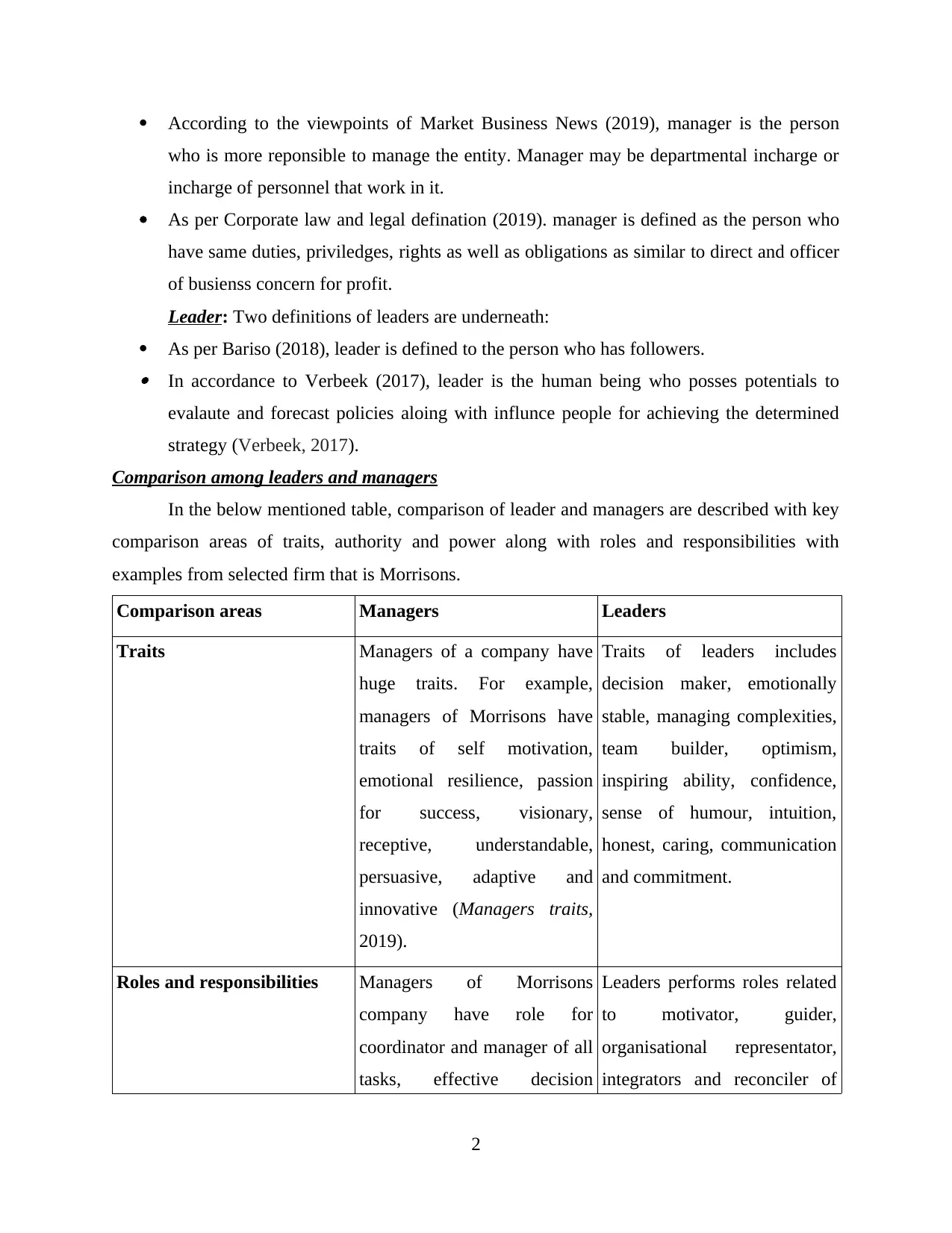
Comparison among leaders and managers
In the below mentioned table, comparison of leader and managers are described with key
comparison areas of traits, authority and power along with roles and responsibilities with
examples from selected firm that is Morrisons.
Comparison areas Managers Leaders
Traits Managers of a company have
huge traits. For example,
managers of Morrisons have
traits of self motivation,
emotional resilience, passion
for success, visionary,
receptive, understandable,
persuasive, adaptive and
innovative (Managers traits,
2019).
Traits of leaders includes
decision maker, emotionally
stable, managing complexities,
team builder, optimism,
inspiring ability, confidence,
sense of humour, intuition,
honest, caring, communication
and commitment.
Roles and responsibilities Managers of Morrisons
company have role for
coordinator and manager of all
tasks, effective decision
Leaders performs roles related
to motivator, guider,
organisational representator,
integrators and reconciler of
2
who is more reponsible to manage the entity. Manager may be departmental incharge or
incharge of personnel that work in it.
As per Corporate law and legal defination (2019). manager is defined as the person who
have same duties, priviledges, rights as well as obligations as similar to direct and officer
of busienss concern for profit.
Leader: Two definitions of leaders are underneath:
As per Bariso (2018), leader is defined to the person who has followers. In accordance to Verbeek (2017), leader is the human being who posses potentials to
evalaute and forecast policies aloing with influnce people for achieving the determined
strategy (Verbeek, 2017).
Comparison among leaders and managers
In the below mentioned table, comparison of leader and managers are described with key
comparison areas of traits, authority and power along with roles and responsibilities with
examples from selected firm that is Morrisons.
Comparison areas Managers Leaders
Traits Managers of a company have
huge traits. For example,
managers of Morrisons have
traits of self motivation,
emotional resilience, passion
for success, visionary,
receptive, understandable,
persuasive, adaptive and
innovative (Managers traits,
2019).
Traits of leaders includes
decision maker, emotionally
stable, managing complexities,
team builder, optimism,
inspiring ability, confidence,
sense of humour, intuition,
honest, caring, communication
and commitment.
Roles and responsibilities Managers of Morrisons
company have role for
coordinator and manager of all
tasks, effective decision
Leaders performs roles related
to motivator, guider,
organisational representator,
integrators and reconciler of
2
Paraphrase This Document
Need a fresh take? Get an instant paraphrase of this document with our AI Paraphraser
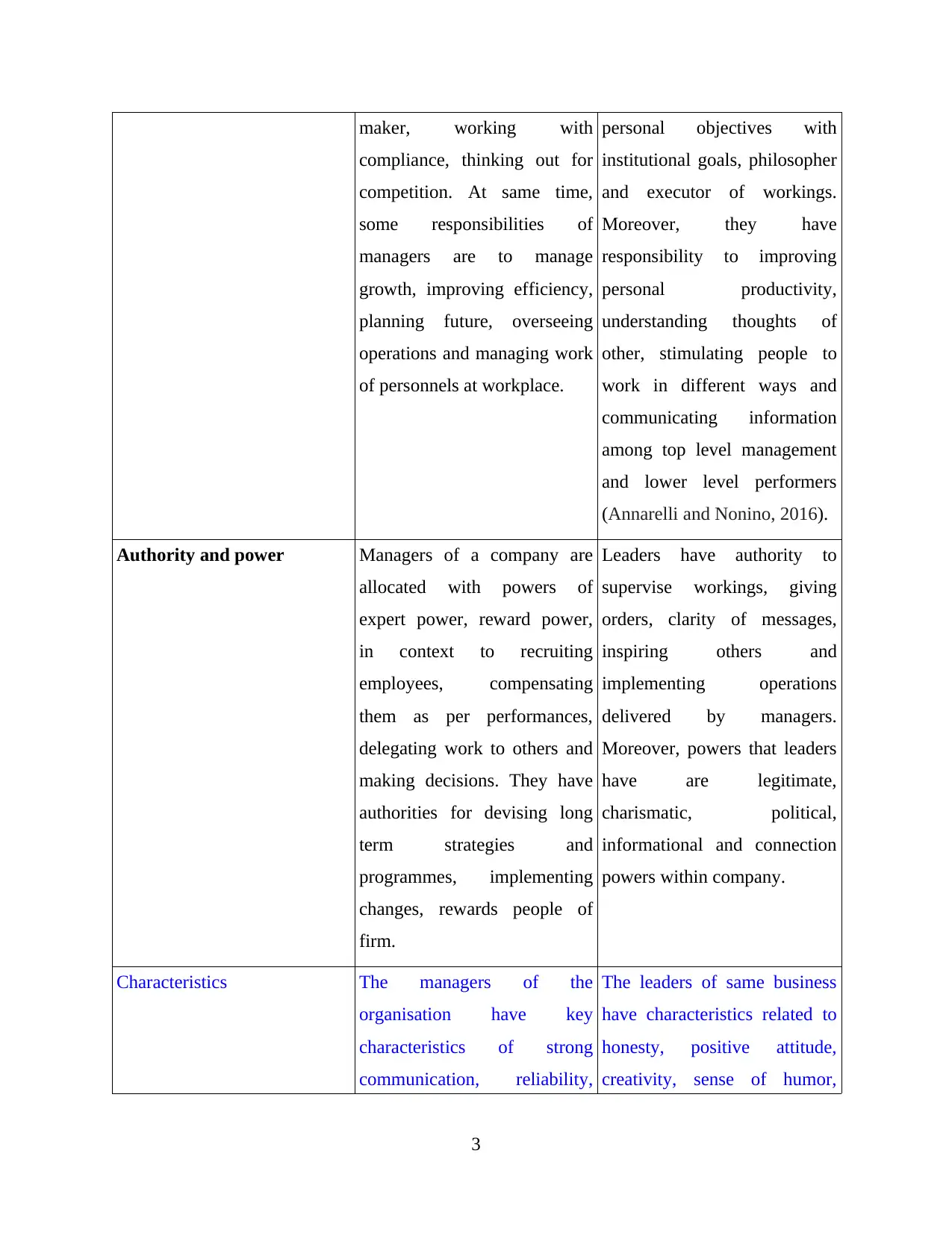
maker, working with
compliance, thinking out for
competition. At same time,
some responsibilities of
managers are to manage
growth, improving efficiency,
planning future, overseeing
operations and managing work
of personnels at workplace.
personal objectives with
institutional goals, philosopher
and executor of workings.
Moreover, they have
responsibility to improving
personal productivity,
understanding thoughts of
other, stimulating people to
work in different ways and
communicating information
among top level management
and lower level performers
(Annarelli and Nonino, 2016).
Authority and power Managers of a company are
allocated with powers of
expert power, reward power,
in context to recruiting
employees, compensating
them as per performances,
delegating work to others and
making decisions. They have
authorities for devising long
term strategies and
programmes, implementing
changes, rewards people of
firm.
Leaders have authority to
supervise workings, giving
orders, clarity of messages,
inspiring others and
implementing operations
delivered by managers.
Moreover, powers that leaders
have are legitimate,
charismatic, political,
informational and connection
powers within company.
Characteristics The managers of the
organisation have key
characteristics of strong
communication, reliability,
The leaders of same business
have characteristics related to
honesty, positive attitude,
creativity, sense of humor,
3
compliance, thinking out for
competition. At same time,
some responsibilities of
managers are to manage
growth, improving efficiency,
planning future, overseeing
operations and managing work
of personnels at workplace.
personal objectives with
institutional goals, philosopher
and executor of workings.
Moreover, they have
responsibility to improving
personal productivity,
understanding thoughts of
other, stimulating people to
work in different ways and
communicating information
among top level management
and lower level performers
(Annarelli and Nonino, 2016).
Authority and power Managers of a company are
allocated with powers of
expert power, reward power,
in context to recruiting
employees, compensating
them as per performances,
delegating work to others and
making decisions. They have
authorities for devising long
term strategies and
programmes, implementing
changes, rewards people of
firm.
Leaders have authority to
supervise workings, giving
orders, clarity of messages,
inspiring others and
implementing operations
delivered by managers.
Moreover, powers that leaders
have are legitimate,
charismatic, political,
informational and connection
powers within company.
Characteristics The managers of the
organisation have key
characteristics of strong
communication, reliability,
The leaders of same business
have characteristics related to
honesty, positive attitude,
creativity, sense of humor,
3
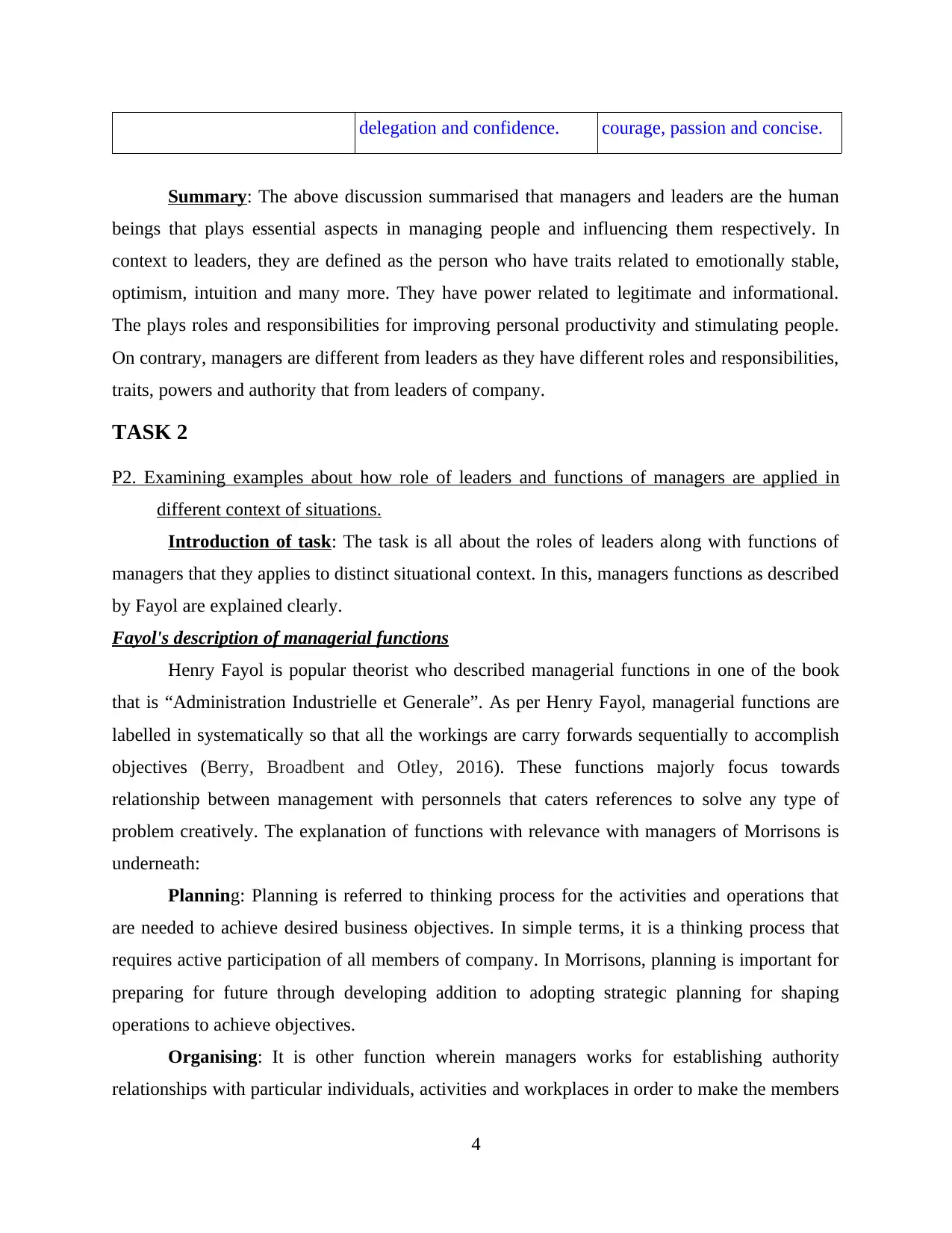
delegation and confidence. courage, passion and concise.
Summary: The above discussion summarised that managers and leaders are the human
beings that plays essential aspects in managing people and influencing them respectively. In
context to leaders, they are defined as the person who have traits related to emotionally stable,
optimism, intuition and many more. They have power related to legitimate and informational.
The plays roles and responsibilities for improving personal productivity and stimulating people.
On contrary, managers are different from leaders as they have different roles and responsibilities,
traits, powers and authority that from leaders of company.
TASK 2
P2. Examining examples about how role of leaders and functions of managers are applied in
different context of situations.
Introduction of task: The task is all about the roles of leaders along with functions of
managers that they applies to distinct situational context. In this, managers functions as described
by Fayol are explained clearly.
Fayol's description of managerial functions
Henry Fayol is popular theorist who described managerial functions in one of the book
that is “Administration Industrielle et Generale”. As per Henry Fayol, managerial functions are
labelled in systematically so that all the workings are carry forwards sequentially to accomplish
objectives (Berry, Broadbent and Otley, 2016). These functions majorly focus towards
relationship between management with personnels that caters references to solve any type of
problem creatively. The explanation of functions with relevance with managers of Morrisons is
underneath:
Planning: Planning is referred to thinking process for the activities and operations that
are needed to achieve desired business objectives. In simple terms, it is a thinking process that
requires active participation of all members of company. In Morrisons, planning is important for
preparing for future through developing addition to adopting strategic planning for shaping
operations to achieve objectives.
Organising: It is other function wherein managers works for establishing authority
relationships with particular individuals, activities and workplaces in order to make the members
4
Summary: The above discussion summarised that managers and leaders are the human
beings that plays essential aspects in managing people and influencing them respectively. In
context to leaders, they are defined as the person who have traits related to emotionally stable,
optimism, intuition and many more. They have power related to legitimate and informational.
The plays roles and responsibilities for improving personal productivity and stimulating people.
On contrary, managers are different from leaders as they have different roles and responsibilities,
traits, powers and authority that from leaders of company.
TASK 2
P2. Examining examples about how role of leaders and functions of managers are applied in
different context of situations.
Introduction of task: The task is all about the roles of leaders along with functions of
managers that they applies to distinct situational context. In this, managers functions as described
by Fayol are explained clearly.
Fayol's description of managerial functions
Henry Fayol is popular theorist who described managerial functions in one of the book
that is “Administration Industrielle et Generale”. As per Henry Fayol, managerial functions are
labelled in systematically so that all the workings are carry forwards sequentially to accomplish
objectives (Berry, Broadbent and Otley, 2016). These functions majorly focus towards
relationship between management with personnels that caters references to solve any type of
problem creatively. The explanation of functions with relevance with managers of Morrisons is
underneath:
Planning: Planning is referred to thinking process for the activities and operations that
are needed to achieve desired business objectives. In simple terms, it is a thinking process that
requires active participation of all members of company. In Morrisons, planning is important for
preparing for future through developing addition to adopting strategic planning for shaping
operations to achieve objectives.
Organising: It is other function wherein managers works for establishing authority
relationships with particular individuals, activities and workplaces in order to make the members
4
⊘ This is a preview!⊘
Do you want full access?
Subscribe today to unlock all pages.
Trusted by 1+ million students worldwide
of group or teams working together(Bryce, 2017). After planning, organising resources are
considered by managers of the chosen production and service firm for the purpose of
implementing actional plans.
Directing: Directing is said to instructing, guiding along with overseeing performances
of personnel for accomplishing planned objectives. It is heart of managerial functions. At
Morrisons, managers understands team members and accordingly provide instructions for
completing works and deals smartly with incompetent personnels.
Controlling: According to the name, it is to control resources as well as teams for
implementing the programme in accordance to set planing and aligning regulations of enterprise.
In other words, controlling is checking errors and making corrective actions on right time.
Managers monitors, controls and make suitable actions for the workings that are going against
the set criteria at workplace of Morrisons.
Coordinating: It is concerned with ensuring that all the workings are going well (Bryson,
2017). Coordinating is integrating activities for ensuring efficient usages of available resources
for succeeding towards objective attainment. In association to Morrison, managers coordinate
team actions for achieves successful outcomes.
Application of functions by using examples related to managers in different situational context
of Morrisons
Time delivering services: The managers of all company performs actions so to deliver
services on time. It is important also to make timely delivery of demanded products and services
in market and to customers for retaining them and making profits (Carter and Price, 2017). But in
context to Morrisons, its huge products and services are not delivered on timely basis to
population. For such purpose, the managers applies their functions in huge ways. For example,
planning function is applied for forecasting scenario that limits delivery and making schedules
on the forecasted results. Then organising function is applied by Morrison managers to collect
required resources, grouping tasks so to delegate responsibilities and makes contacts with
vendors, distributors for delivering essentials on time. In addition, managers also sets standards
or making comparisons for real results and standards in order to implement remedial actions for
the diviational gaps. Further, within coordinating function, it is seen by managers that all
operations, practices and activities are performed in coordinated manner among the different
departments and people for making delivery of components of company on time. At same time,
5
considered by managers of the chosen production and service firm for the purpose of
implementing actional plans.
Directing: Directing is said to instructing, guiding along with overseeing performances
of personnel for accomplishing planned objectives. It is heart of managerial functions. At
Morrisons, managers understands team members and accordingly provide instructions for
completing works and deals smartly with incompetent personnels.
Controlling: According to the name, it is to control resources as well as teams for
implementing the programme in accordance to set planing and aligning regulations of enterprise.
In other words, controlling is checking errors and making corrective actions on right time.
Managers monitors, controls and make suitable actions for the workings that are going against
the set criteria at workplace of Morrisons.
Coordinating: It is concerned with ensuring that all the workings are going well (Bryson,
2017). Coordinating is integrating activities for ensuring efficient usages of available resources
for succeeding towards objective attainment. In association to Morrison, managers coordinate
team actions for achieves successful outcomes.
Application of functions by using examples related to managers in different situational context
of Morrisons
Time delivering services: The managers of all company performs actions so to deliver
services on time. It is important also to make timely delivery of demanded products and services
in market and to customers for retaining them and making profits (Carter and Price, 2017). But in
context to Morrisons, its huge products and services are not delivered on timely basis to
population. For such purpose, the managers applies their functions in huge ways. For example,
planning function is applied for forecasting scenario that limits delivery and making schedules
on the forecasted results. Then organising function is applied by Morrison managers to collect
required resources, grouping tasks so to delegate responsibilities and makes contacts with
vendors, distributors for delivering essentials on time. In addition, managers also sets standards
or making comparisons for real results and standards in order to implement remedial actions for
the diviational gaps. Further, within coordinating function, it is seen by managers that all
operations, practices and activities are performed in coordinated manner among the different
departments and people for making delivery of components of company on time. At same time,
5
Paraphrase This Document
Need a fresh take? Get an instant paraphrase of this document with our AI Paraphraser
this situation affect leader's role such as motivator, organisational representator and executor of
workings when personnels do not work as per the guidances in relation to deliver its valuable
products to customers.
Resolving conflicts: There are more number of people working at Morrisons within
which conflicts arises any time due to huge factors such as cultural differences,
miscommunication and so on. In this case, managers resolves conflicts by properly implementing
their functions. For instance, planning function is adopted for forecasting conditions or
workplace environment that causes conflicts. Further, With organising function, managers
allocate resources including equipments, tools due to which conflict has arised. Moreover,
managers also applies commanding function for providing instructions, coordinates workings
through proper mechanisms. Moreover, managers also control variances and fosters integration
that leads in solving conflicts at workplaces.
Summary: The mentioned explanation summarises that different functions are
implemented by managers in regards to some situation. They applies functions that are described
by Fayol such as planning, organising, controlling, commanding and directing in respect to
different situations.
P3. Application of various theories and approach models
Introduction of task: Leaders of company uses distinct approach models addition to
styles as per pertaining condition. In this task, various leadership theories addition to approaches
are explained and applied in various situational contexts.
Leadership approaches or theories are few aspects that organisational leaders uses in
distinct scenarios (David and David, 2016). At Morrisons, leaders applies following theories and
approaches in different scenarios:
Contingency theory: Contingency leadership theory explains that effectiveness of a
leaders is contingent on the ways their styles to lead other matches the situation. So , it is the
main working of leader to search for what type of style and circumstance they strives in.
At Morrisons, leaders applies one of contingency theory that is Fiedler Model Theory.
The theory is related with either relationship oriented or task oriented which depends of
situation. Moreover, it is rated on the basis of Low along with High LPC rating of firm. In
context to resolving conflict situation, leaders applies concept of relationship oriented wherein
they performs the best through diagnosing situations for managing addition to resolving issues
6
workings when personnels do not work as per the guidances in relation to deliver its valuable
products to customers.
Resolving conflicts: There are more number of people working at Morrisons within
which conflicts arises any time due to huge factors such as cultural differences,
miscommunication and so on. In this case, managers resolves conflicts by properly implementing
their functions. For instance, planning function is adopted for forecasting conditions or
workplace environment that causes conflicts. Further, With organising function, managers
allocate resources including equipments, tools due to which conflict has arised. Moreover,
managers also applies commanding function for providing instructions, coordinates workings
through proper mechanisms. Moreover, managers also control variances and fosters integration
that leads in solving conflicts at workplaces.
Summary: The mentioned explanation summarises that different functions are
implemented by managers in regards to some situation. They applies functions that are described
by Fayol such as planning, organising, controlling, commanding and directing in respect to
different situations.
P3. Application of various theories and approach models
Introduction of task: Leaders of company uses distinct approach models addition to
styles as per pertaining condition. In this task, various leadership theories addition to approaches
are explained and applied in various situational contexts.
Leadership approaches or theories are few aspects that organisational leaders uses in
distinct scenarios (David and David, 2016). At Morrisons, leaders applies following theories and
approaches in different scenarios:
Contingency theory: Contingency leadership theory explains that effectiveness of a
leaders is contingent on the ways their styles to lead other matches the situation. So , it is the
main working of leader to search for what type of style and circumstance they strives in.
At Morrisons, leaders applies one of contingency theory that is Fiedler Model Theory.
The theory is related with either relationship oriented or task oriented which depends of
situation. Moreover, it is rated on the basis of Low along with High LPC rating of firm. In
context to resolving conflict situation, leaders applies concept of relationship oriented wherein
they performs the best through diagnosing situations for managing addition to resolving issues
6
or conflicts between people effectively. The strength of contingency theory is that its application
aspects changes as per situations and it contributes huge in properly structuring organisational
structure. Moreover, it also assist institutions in planning information decision systems. In
contrary, its weaknesses is that it is reactive and complex in nature and various time unable to
handle circumstances that becomes critical for leaders.
The other contingency theory that can be used by managers of Morrisons is Path goal
theory. As per the theory, specific style is opted by leaders and managers of the entity to lead
and manage people to achieve goals. It includes environmental characteristics, behaviour of
leaders and subordinates' Personal characteristics. Task structure addition to work group are
considered as environmental characteristics which states that when leaderships should be chosen
as per the structure of entity. Subordinates characteristics involves perception of abilities along
with locus of control of employees. When personnels feel that they are lacking abilities then
managers must opt directive styles to lead them. Moreover, behaviour of leaders involves various
styles that are or can be used by same managers in distinct situations. It includes four types of
styles such as directive, supportive, participative and achievement oriented styles. The theory is
flexible and can be applied in any situation which is its strength. However, it is characterised as
undemocratic in nature and makes leaders rational in workplace that are its weaknesses.
The another contingency theory is contingency research theory that states that leaders
explains, predicts as well as understands phenomena in various cases so to limit assumptions.
Fundamentally, by using the theory, managers of the company will be able to predict
contingencies and outline guidelines by empirical research. The strength of the contingency
research theory is that it assist in adopting effective style and has dynamic nature. However, its
weakness is that it creates complexities while applying in practical manner.
Situational theory: It is explained as the model that leaders utilises at the duration when
enterprise moulds the aspects that were preferred by them related to existing business condition.
It states that leadership styles changes as per changing situations (Drew, McCallum and
Roggenhofer, 2016). Moreover, it states that in real world, no individual best leadership style
exists. In relevance to Morrisons, leaders opts effective style as per situation. Within it, leaders
finds that manpower do not work properly for delivering or providing demanded products by
external population on time. And to resolve this, leaders applies situational theory wherein they
monitors the workings and finds out main issues for late delivery. As per it, they adopts
7
aspects changes as per situations and it contributes huge in properly structuring organisational
structure. Moreover, it also assist institutions in planning information decision systems. In
contrary, its weaknesses is that it is reactive and complex in nature and various time unable to
handle circumstances that becomes critical for leaders.
The other contingency theory that can be used by managers of Morrisons is Path goal
theory. As per the theory, specific style is opted by leaders and managers of the entity to lead
and manage people to achieve goals. It includes environmental characteristics, behaviour of
leaders and subordinates' Personal characteristics. Task structure addition to work group are
considered as environmental characteristics which states that when leaderships should be chosen
as per the structure of entity. Subordinates characteristics involves perception of abilities along
with locus of control of employees. When personnels feel that they are lacking abilities then
managers must opt directive styles to lead them. Moreover, behaviour of leaders involves various
styles that are or can be used by same managers in distinct situations. It includes four types of
styles such as directive, supportive, participative and achievement oriented styles. The theory is
flexible and can be applied in any situation which is its strength. However, it is characterised as
undemocratic in nature and makes leaders rational in workplace that are its weaknesses.
The another contingency theory is contingency research theory that states that leaders
explains, predicts as well as understands phenomena in various cases so to limit assumptions.
Fundamentally, by using the theory, managers of the company will be able to predict
contingencies and outline guidelines by empirical research. The strength of the contingency
research theory is that it assist in adopting effective style and has dynamic nature. However, its
weakness is that it creates complexities while applying in practical manner.
Situational theory: It is explained as the model that leaders utilises at the duration when
enterprise moulds the aspects that were preferred by them related to existing business condition.
It states that leadership styles changes as per changing situations (Drew, McCallum and
Roggenhofer, 2016). Moreover, it states that in real world, no individual best leadership style
exists. In relevance to Morrisons, leaders opts effective style as per situation. Within it, leaders
finds that manpower do not work properly for delivering or providing demanded products by
external population on time. And to resolve this, leaders applies situational theory wherein they
monitors the workings and finds out main issues for late delivery. As per it, they adopts
7
⊘ This is a preview!⊘
Do you want full access?
Subscribe today to unlock all pages.
Trusted by 1+ million students worldwide
behaviour to act on contingencies, fosters communication, distribution that aids in providing
company's essentials punctual. The theory is easily understandable and applied on various
contexts, emphasizes on flexibility of leaders along with directs the ways in which leaders must
act for gaining effectiveness that are its strength. But on other hand, its weakness is that it
application is ineffective within business environment that are task oriented and only focus on
immediate objectives.
System leadership theory: It is explained as the theory that enables business leaders to
build circumstances in which individual can perform with fuller potentials (Gibson and Parkman,
2018). They can use principles associated with human behaviour for making strategies, social
process, system designing and suitable leadership. Moreover, it is properly applied by Morrisons
leaders towards critical issues or problems in which various departments are involved. For
example, it is applied in situation of late delivering services so to handle various departments
including logistics, supply delivery, operations, customer service and so on. Within it, the theory
will foster coordination between departments and effectively resolving problem. The strength of
it is that it assist in making orderly, sequentially and prompt action plan along with improving
coordination among specialised operations and tasks. In contrary, it causes delaying decision
making, fails to elaborate interdependence of activities and not always properly applied that are
some weaknesses of it.
Trait theory: The another leadership theory which is related to characteristics of wide
number of leaders in both successful as well as unsuccessful aspects and is used basically for
anticipating leadership effectiveness (Heizer, 2016). The main identified traits within leaders are
trustworthy, honesty, creativity, high effort level, energetic, belief on other's ability,
knowledgeable, emotionally mature, strong analytical abilities and many more. As there are huge
conflicts between workforce of Morrisons, for this, trait leadership theory can be applied to get
solutions. With distinct traits, leaders analyses reasons of conflicts and works to resolve them.
They calmly listens both parties or people and makes decisions through negotiations or other
aspect that influences workforce to initiate workings by resolving conflicts. The strength of trait
theory is that it gives understanding and knowledge to leaders for different situations, provides
benchmarks that leaders look to make their leadership effective. Considering the weakness,
application is quite complex and do not accounts changes in personality and development of
8
company's essentials punctual. The theory is easily understandable and applied on various
contexts, emphasizes on flexibility of leaders along with directs the ways in which leaders must
act for gaining effectiveness that are its strength. But on other hand, its weakness is that it
application is ineffective within business environment that are task oriented and only focus on
immediate objectives.
System leadership theory: It is explained as the theory that enables business leaders to
build circumstances in which individual can perform with fuller potentials (Gibson and Parkman,
2018). They can use principles associated with human behaviour for making strategies, social
process, system designing and suitable leadership. Moreover, it is properly applied by Morrisons
leaders towards critical issues or problems in which various departments are involved. For
example, it is applied in situation of late delivering services so to handle various departments
including logistics, supply delivery, operations, customer service and so on. Within it, the theory
will foster coordination between departments and effectively resolving problem. The strength of
it is that it assist in making orderly, sequentially and prompt action plan along with improving
coordination among specialised operations and tasks. In contrary, it causes delaying decision
making, fails to elaborate interdependence of activities and not always properly applied that are
some weaknesses of it.
Trait theory: The another leadership theory which is related to characteristics of wide
number of leaders in both successful as well as unsuccessful aspects and is used basically for
anticipating leadership effectiveness (Heizer, 2016). The main identified traits within leaders are
trustworthy, honesty, creativity, high effort level, energetic, belief on other's ability,
knowledgeable, emotionally mature, strong analytical abilities and many more. As there are huge
conflicts between workforce of Morrisons, for this, trait leadership theory can be applied to get
solutions. With distinct traits, leaders analyses reasons of conflicts and works to resolve them.
They calmly listens both parties or people and makes decisions through negotiations or other
aspect that influences workforce to initiate workings by resolving conflicts. The strength of trait
theory is that it gives understanding and knowledge to leaders for different situations, provides
benchmarks that leaders look to make their leadership effective. Considering the weakness,
application is quite complex and do not accounts changes in personality and development of
8
Paraphrase This Document
Need a fresh take? Get an instant paraphrase of this document with our AI Paraphraser
traits. In addition, it only offers limited guidances to use the traits that leaders have which makes
thing difficult.
Models of leadership
Leadership style: Different leader uses different style to stimulate people for workings
(Kerzner, 2018). Few leadership styles such as autocratic style, Laissez faire and democratic that
are opted by business leaders. In relevance to leaders of Morrisons, they uses democratic style in
which they motivates workforce to participate and share their ideas in decision making. In
context to situations, leaders involve organisational people to provide views so to improve
delivering of goods as soon as possible to customers. With this, huge solutions are generated and
few of them are used for handling the situation. Strengths of it are it connects personnel with
entity, promotes flowing of thoughts, encourage coordination within departments and develop
more potentials in people. On other hand, democratic style has some weaknesses also, it
stimulate morale of people when their views are not consider, delays decision making, creates
workplace procrastination and causes huge uncertain scenarios.
Summary: From the above information, it is summarised that organisational leaders
applies wide theories related to situations. The also applies models of leadership as per
situational contexts. Some of theories including system leadership, trait leadership, contingency
leadership and situational leadership theories are widely implemented in situation such as
conflict resolving along with timely delivering services.
TASK 3
P4. Explanation of key approaches related to operations management along with role played by
leaders and managers.
Introduction to task: There are certain operation management approaches wherein
leaders and managers have different roles. The task highlights about key operations management
approaches and role performed by leaders and managers in each.
Operation management approaches can be states to aspects which help business to initiate
activities through improving efficiency (Lowe, 2019). These approaches encompasses strategies
for maximising operational and production efficacy. Few are discussed as:
Total quality management (TQM) – This can be consider as continuous method which
is used by business corporation to improve the efficiency of organisation by reducing and
9
thing difficult.
Models of leadership
Leadership style: Different leader uses different style to stimulate people for workings
(Kerzner, 2018). Few leadership styles such as autocratic style, Laissez faire and democratic that
are opted by business leaders. In relevance to leaders of Morrisons, they uses democratic style in
which they motivates workforce to participate and share their ideas in decision making. In
context to situations, leaders involve organisational people to provide views so to improve
delivering of goods as soon as possible to customers. With this, huge solutions are generated and
few of them are used for handling the situation. Strengths of it are it connects personnel with
entity, promotes flowing of thoughts, encourage coordination within departments and develop
more potentials in people. On other hand, democratic style has some weaknesses also, it
stimulate morale of people when their views are not consider, delays decision making, creates
workplace procrastination and causes huge uncertain scenarios.
Summary: From the above information, it is summarised that organisational leaders
applies wide theories related to situations. The also applies models of leadership as per
situational contexts. Some of theories including system leadership, trait leadership, contingency
leadership and situational leadership theories are widely implemented in situation such as
conflict resolving along with timely delivering services.
TASK 3
P4. Explanation of key approaches related to operations management along with role played by
leaders and managers.
Introduction to task: There are certain operation management approaches wherein
leaders and managers have different roles. The task highlights about key operations management
approaches and role performed by leaders and managers in each.
Operation management approaches can be states to aspects which help business to initiate
activities through improving efficiency (Lowe, 2019). These approaches encompasses strategies
for maximising operational and production efficacy. Few are discussed as:
Total quality management (TQM) – This can be consider as continuous method which
is used by business corporation to improve the efficiency of organisation by reducing and
9
detecting the errors in manufacturing and supply chain management. Morrisons organisation is
applying this approach to supply the best quality of products and services with the help of
employees. The manager of Morrisons ensures that they are using TQM system to reduce the
omission from operation and supplying process. Moreover, leaders helps to produce more goods
and services at less cost and time which increases profitability.
Just in time - This approach considered as a system which is required in business
organisation to finish production and use resources properly by managing the inventory and
supplying process. It is related with operation management which helps to increase efficiency
and effectiveness by reducing wastages from organisational functions. This approach is applied
by manager of Morrisons in order to save the storage cost, increasing delivery, extra packaging
cost etc. which helps to increase the customer satisfaction. In this, leader's role are as monitoring
the actions which is taken by individuals and suggest them a way to removing any wasting
resources from organisation operation.
Six sigma – This is also a technique which is used in operation management for
improving the process (Nicholas, 2018). The manager of Morrisons uses this technique that gives
opportunities to produce special feature in supplying the products with any detects. With the help
of this, leaders efforts to achieve stable and predictable process by reducing variation process
which gives good results.
Lean management - This is an approach to running by business organisation in order to
support the continuous improvement in supply chain management. The uses of this system is
relating to improving products, services, supply process and customer based which helps to make
continuous improvement. This is effective approach which is applied by manager of Morrison
organisation for improving supply process of products and increase the productivity. Herein,
leaders identify the needs and wants of people about products and supply them with the help of
employees by eliminating not created value.
PART 2
In large retail store such as Morrisons, store manager plays important role in operations
management. The important roles that store manager plays are maintaining entire store image,
ensuring that store meets all the targets as well as earning profits, recruiting candidates for the
store and managing assets of store. Along with these, store manager also have roles in different
operational approaches. In approach of lean management, store management performs role of
10
applying this approach to supply the best quality of products and services with the help of
employees. The manager of Morrisons ensures that they are using TQM system to reduce the
omission from operation and supplying process. Moreover, leaders helps to produce more goods
and services at less cost and time which increases profitability.
Just in time - This approach considered as a system which is required in business
organisation to finish production and use resources properly by managing the inventory and
supplying process. It is related with operation management which helps to increase efficiency
and effectiveness by reducing wastages from organisational functions. This approach is applied
by manager of Morrisons in order to save the storage cost, increasing delivery, extra packaging
cost etc. which helps to increase the customer satisfaction. In this, leader's role are as monitoring
the actions which is taken by individuals and suggest them a way to removing any wasting
resources from organisation operation.
Six sigma – This is also a technique which is used in operation management for
improving the process (Nicholas, 2018). The manager of Morrisons uses this technique that gives
opportunities to produce special feature in supplying the products with any detects. With the help
of this, leaders efforts to achieve stable and predictable process by reducing variation process
which gives good results.
Lean management - This is an approach to running by business organisation in order to
support the continuous improvement in supply chain management. The uses of this system is
relating to improving products, services, supply process and customer based which helps to make
continuous improvement. This is effective approach which is applied by manager of Morrison
organisation for improving supply process of products and increase the productivity. Herein,
leaders identify the needs and wants of people about products and supply them with the help of
employees by eliminating not created value.
PART 2
In large retail store such as Morrisons, store manager plays important role in operations
management. The important roles that store manager plays are maintaining entire store image,
ensuring that store meets all the targets as well as earning profits, recruiting candidates for the
store and managing assets of store. Along with these, store manager also have roles in different
operational approaches. In approach of lean management, store management performs role of
10
⊘ This is a preview!⊘
Do you want full access?
Subscribe today to unlock all pages.
Trusted by 1+ million students worldwide

1 out of 18


Related Documents


Your All-in-One AI-Powered Toolkit for Academic Success.
+13062052269
info@desklib.com
Available 24*7 on WhatsApp / Email
![[object Object]](/_next/static/media/star-bottom.7253800d.svg)
Unlock your academic potential
Copyright © 2020–2026 A2Z Services. All Rights Reserved. Developed and managed by ZUCOL.