Leadership and Management Roles and Operational Strategies Report
VerifiedAdded on 2020/01/23
|13
|4237
|450
Report
AI Summary
This report examines leadership and management principles, using Greggs plc as a case study. It explores the differences between leaders and managers, analyzing their roles and characteristics. The report delves into various leadership styles, including directive, delegating, participative, and authoritative roles, along with relevant theories such as situational, systems, and contingency leadership. It also provides a comparative analysis of leadership and management functions, strengths, weaknesses of different approaches, and critical evaluations of leadership theories. Furthermore, the report addresses operational management, key approaches like Six Sigma and Lean Manufacturing, and the importance of operations management in achieving business objectives. The report highlights the significance of adapting leadership styles to specific situations and the impact of operational strategies on efficiency and customer satisfaction within a business context. This report is contributed by a student to be published on the website Desklib. Desklib is a platform which provides all the necessary AI based study tools for students.
Management and
Operations
Operations

Paraphrase This Document
Need a fresh take? Get an instant paraphrase of this document with our AI Paraphraser
Table of Contents
INTRODUCTION...........................................................................................................................1
TASK 1............................................................................................................................................1
TASK 2............................................................................................................................................4
CONCLUSION................................................................................................................................8
REFERENCES................................................................................................................................9
INTRODUCTION...........................................................................................................................1
TASK 1............................................................................................................................................1
TASK 2............................................................................................................................................4
CONCLUSION................................................................................................................................8
REFERENCES................................................................................................................................9
INTRODUCTION
Management is a task of coordinating and managing operations within an organisation to
work harmoniously towards same goal effectively and efficiently with limited resources
available (Foropon and McLachlin, 2013). It begins with the process of planning and staffing to
organizing and controlling the available resources in the organisation. It includes managing
operations to achieve maximum efficiency to get profits. GREGGS plc is taken as an example
for the report, which specialises in savoury as well as sweet products is the largest bakery chain
in UK. It was started in 1951 by John Gregg in Gosforth, Newcastle upon Tyne.
TASK 1
a) Different roles and characteristics of a leader and a manager
Leaders in the organisation have strong influence on people and have superior position
over others employees but with mutual acceptance. There are some qualities which make a good
leader such as honesty, ability to delegate, effective communication, confidence, creativity,
optimism, commitment towards work and people, etc. Some of these qualities are in born and
some can be developed by training etc (Heizer and et.al., 2009). A leader has many roles in the
organisation to play, some of them are to develop strategies, to listen to the subordinates for any
problems and queries, provide training if required, and be a mentor as well as a guide.
Managers are the one who manages the workforce and guide them to achieve a common
goal and objective. These are selected by the company recruiters and are provided with the
guidelines for how to manage and perform. These are superiors not by people's choice only by
the appointment; therefore it is not necessary to influence all the subordinates. Their role in the
organisation is to perform their responsibilities and functions and to bring all the functions
together to work in unity (Johnston, 2005). If there are different managers for each department, it
might create hindrance in working if they do not communicate properly.
With defined roles in the organisation, a manager only performs as he is asked to and not
beyond his working requirements unlike a leader which encompasses his responsibilities as
provided by his subordinates and not only by the company. The major difference between the
two are that of acceptance, manager might or might not be accepted by the people as their leader
1
Management is a task of coordinating and managing operations within an organisation to
work harmoniously towards same goal effectively and efficiently with limited resources
available (Foropon and McLachlin, 2013). It begins with the process of planning and staffing to
organizing and controlling the available resources in the organisation. It includes managing
operations to achieve maximum efficiency to get profits. GREGGS plc is taken as an example
for the report, which specialises in savoury as well as sweet products is the largest bakery chain
in UK. It was started in 1951 by John Gregg in Gosforth, Newcastle upon Tyne.
TASK 1
a) Different roles and characteristics of a leader and a manager
Leaders in the organisation have strong influence on people and have superior position
over others employees but with mutual acceptance. There are some qualities which make a good
leader such as honesty, ability to delegate, effective communication, confidence, creativity,
optimism, commitment towards work and people, etc. Some of these qualities are in born and
some can be developed by training etc (Heizer and et.al., 2009). A leader has many roles in the
organisation to play, some of them are to develop strategies, to listen to the subordinates for any
problems and queries, provide training if required, and be a mentor as well as a guide.
Managers are the one who manages the workforce and guide them to achieve a common
goal and objective. These are selected by the company recruiters and are provided with the
guidelines for how to manage and perform. These are superiors not by people's choice only by
the appointment; therefore it is not necessary to influence all the subordinates. Their role in the
organisation is to perform their responsibilities and functions and to bring all the functions
together to work in unity (Johnston, 2005). If there are different managers for each department, it
might create hindrance in working if they do not communicate properly.
With defined roles in the organisation, a manager only performs as he is asked to and not
beyond his working requirements unlike a leader which encompasses his responsibilities as
provided by his subordinates and not only by the company. The major difference between the
two are that of acceptance, manager might or might not be accepted by the people as their leader
1
⊘ This is a preview!⊘
Do you want full access?
Subscribe today to unlock all pages.

Trusted by 1+ million students worldwide
but they have to still follow him and a leader is only made by the people on their acceptance
(Olsen and Sætre, 2007).
b) The roles of a leader and functions of a manager in different situations
Directive role- This leadership method is only used very rarely as this involves following
orders by employees and no involvement is considered by the leader (Pansiri and Temtime,
2008). This role enables the leader to work and manage all operations with his due intelligence
where the opinion of his subordinates cannot add value to the decision making process.
Delegating role- A leader while operating and managing all the activities in the firm has
to appropriately delegate work to his subordinates to have a proper channel of communication
and working. Delegation of responsibilities is done in a large organisation such as GREGGS plc,
when the company has a divisional business structure (Ravi, 2008).
Participative role- In the case of usual functioning, a leader generally play a participative
role to include all subordinates and their opinions are considered while taking decisions to make
them feel valuable asset for the company and to motivate them (.Shetach, 2009). Even though the
leader holds the final power to make the decision, the opinions are taken into account to set the
plan of action.
Authoritative role- As a leader in the required situations, authoritative role has to be
performed to have a smooth functioning of the organisation. In GREGGS, as a bakery chain has
to face a tough competition in the market and when the situation requires to increase the
efficiency level to meet increased demand,gets where high level of efficiency is required in case
of exceptional demand, then a leader has to step up to the authoritative role (Söderlund, 2012).
c) Theories and models of leadership approach in different situations
Situational theory- The main basis of this theory is that no style of leadership is
considered as the best style. The most important part in a leadership is to adapt according to the
changing goals and surroundings (Barratt, Choi and Li, 2011). Leadership style can change from
person to person and the people they work with to bring out the best in everyone. This style of
leadership involves behaviours and techniques of one way communication, two way
communication, participative decisions and delegation. In GREGGS a bakery chain, this style of
leadership can be adopted to work with the rapidly changing environment and market conditions.
2
(Olsen and Sætre, 2007).
b) The roles of a leader and functions of a manager in different situations
Directive role- This leadership method is only used very rarely as this involves following
orders by employees and no involvement is considered by the leader (Pansiri and Temtime,
2008). This role enables the leader to work and manage all operations with his due intelligence
where the opinion of his subordinates cannot add value to the decision making process.
Delegating role- A leader while operating and managing all the activities in the firm has
to appropriately delegate work to his subordinates to have a proper channel of communication
and working. Delegation of responsibilities is done in a large organisation such as GREGGS plc,
when the company has a divisional business structure (Ravi, 2008).
Participative role- In the case of usual functioning, a leader generally play a participative
role to include all subordinates and their opinions are considered while taking decisions to make
them feel valuable asset for the company and to motivate them (.Shetach, 2009). Even though the
leader holds the final power to make the decision, the opinions are taken into account to set the
plan of action.
Authoritative role- As a leader in the required situations, authoritative role has to be
performed to have a smooth functioning of the organisation. In GREGGS, as a bakery chain has
to face a tough competition in the market and when the situation requires to increase the
efficiency level to meet increased demand,gets where high level of efficiency is required in case
of exceptional demand, then a leader has to step up to the authoritative role (Söderlund, 2012).
c) Theories and models of leadership approach in different situations
Situational theory- The main basis of this theory is that no style of leadership is
considered as the best style. The most important part in a leadership is to adapt according to the
changing goals and surroundings (Barratt, Choi and Li, 2011). Leadership style can change from
person to person and the people they work with to bring out the best in everyone. This style of
leadership involves behaviours and techniques of one way communication, two way
communication, participative decisions and delegation. In GREGGS a bakery chain, this style of
leadership can be adopted to work with the rapidly changing environment and market conditions.
2
Paraphrase This Document
Need a fresh take? Get an instant paraphrase of this document with our AI Paraphraser
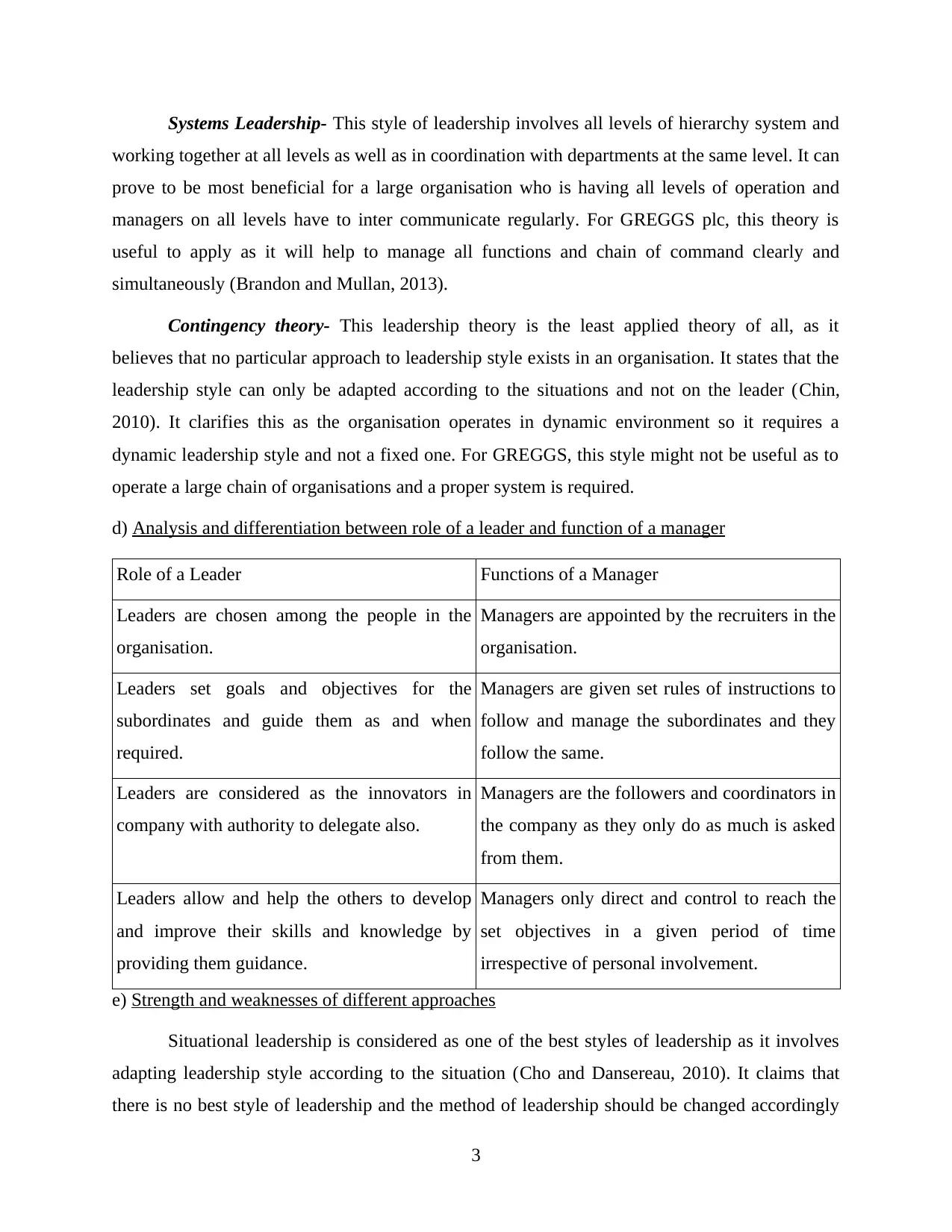
Systems Leadership- This style of leadership involves all levels of hierarchy system and
working together at all levels as well as in coordination with departments at the same level. It can
prove to be most beneficial for a large organisation who is having all levels of operation and
managers on all levels have to inter communicate regularly. For GREGGS plc, this theory is
useful to apply as it will help to manage all functions and chain of command clearly and
simultaneously (Brandon and Mullan, 2013).
Contingency theory- This leadership theory is the least applied theory of all, as it
believes that no particular approach to leadership style exists in an organisation. It states that the
leadership style can only be adapted according to the situations and not on the leader (Chin,
2010). It clarifies this as the organisation operates in dynamic environment so it requires a
dynamic leadership style and not a fixed one. For GREGGS, this style might not be useful as to
operate a large chain of organisations and a proper system is required.
d) Analysis and differentiation between role of a leader and function of a manager
Role of a Leader Functions of a Manager
Leaders are chosen among the people in the
organisation.
Managers are appointed by the recruiters in the
organisation.
Leaders set goals and objectives for the
subordinates and guide them as and when
required.
Managers are given set rules of instructions to
follow and manage the subordinates and they
follow the same.
Leaders are considered as the innovators in
company with authority to delegate also.
Managers are the followers and coordinators in
the company as they only do as much is asked
from them.
Leaders allow and help the others to develop
and improve their skills and knowledge by
providing them guidance.
Managers only direct and control to reach the
set objectives in a given period of time
irrespective of personal involvement.
e) Strength and weaknesses of different approaches
Situational leadership is considered as one of the best styles of leadership as it involves
adapting leadership style according to the situation (Cho and Dansereau, 2010). It claims that
there is no best style of leadership and the method of leadership should be changed accordingly
3
working together at all levels as well as in coordination with departments at the same level. It can
prove to be most beneficial for a large organisation who is having all levels of operation and
managers on all levels have to inter communicate regularly. For GREGGS plc, this theory is
useful to apply as it will help to manage all functions and chain of command clearly and
simultaneously (Brandon and Mullan, 2013).
Contingency theory- This leadership theory is the least applied theory of all, as it
believes that no particular approach to leadership style exists in an organisation. It states that the
leadership style can only be adapted according to the situations and not on the leader (Chin,
2010). It clarifies this as the organisation operates in dynamic environment so it requires a
dynamic leadership style and not a fixed one. For GREGGS, this style might not be useful as to
operate a large chain of organisations and a proper system is required.
d) Analysis and differentiation between role of a leader and function of a manager
Role of a Leader Functions of a Manager
Leaders are chosen among the people in the
organisation.
Managers are appointed by the recruiters in the
organisation.
Leaders set goals and objectives for the
subordinates and guide them as and when
required.
Managers are given set rules of instructions to
follow and manage the subordinates and they
follow the same.
Leaders are considered as the innovators in
company with authority to delegate also.
Managers are the followers and coordinators in
the company as they only do as much is asked
from them.
Leaders allow and help the others to develop
and improve their skills and knowledge by
providing them guidance.
Managers only direct and control to reach the
set objectives in a given period of time
irrespective of personal involvement.
e) Strength and weaknesses of different approaches
Situational leadership is considered as one of the best styles of leadership as it involves
adapting leadership style according to the situation (Cho and Dansereau, 2010). It claims that
there is no best style of leadership and the method of leadership should be changed accordingly
3
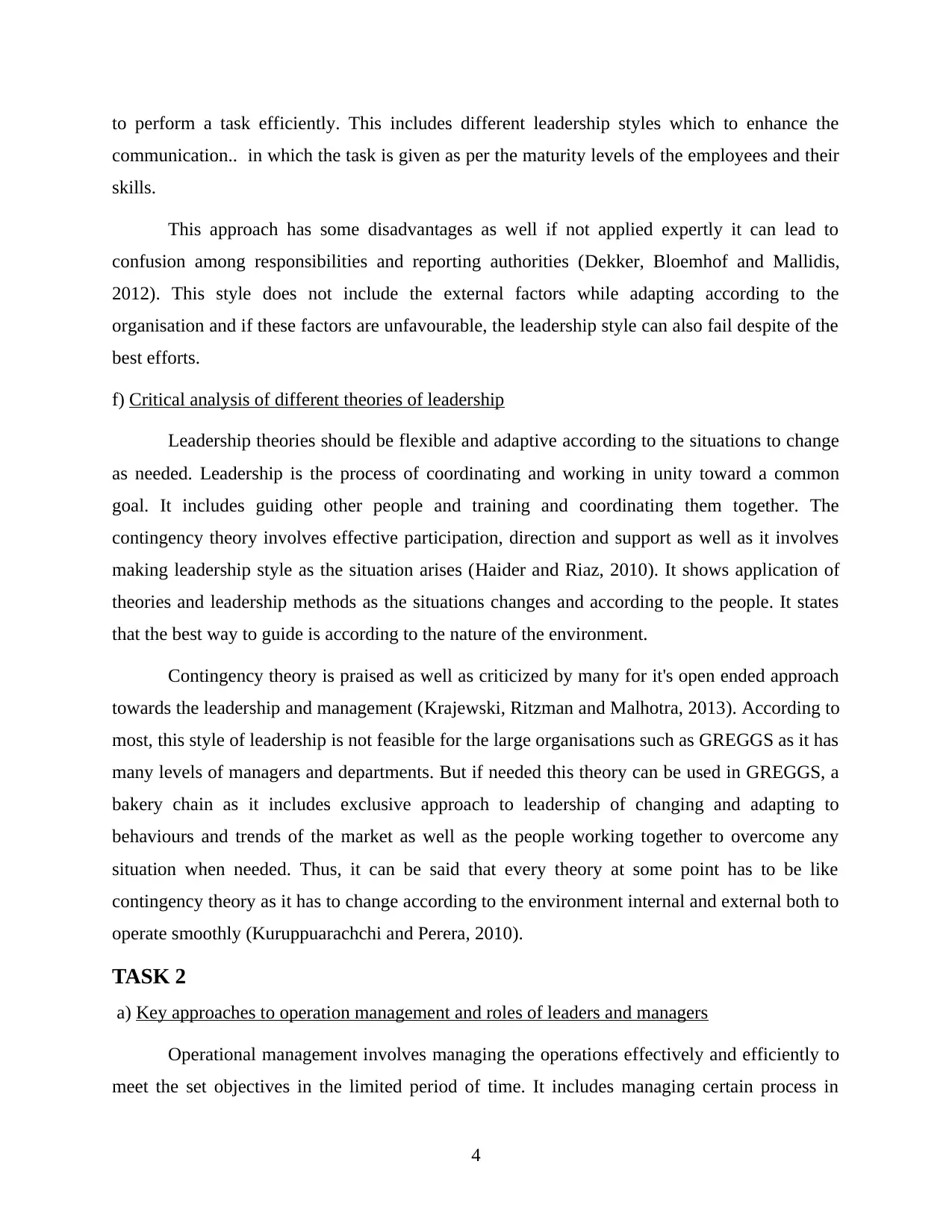
to perform a task efficiently. This includes different leadership styles which to enhance the
communication.. in which the task is given as per the maturity levels of the employees and their
skills.
This approach has some disadvantages as well if not applied expertly it can lead to
confusion among responsibilities and reporting authorities (Dekker, Bloemhof and Mallidis,
2012). This style does not include the external factors while adapting according to the
organisation and if these factors are unfavourable, the leadership style can also fail despite of the
best efforts.
f) Critical analysis of different theories of leadership
Leadership theories should be flexible and adaptive according to the situations to change
as needed. Leadership is the process of coordinating and working in unity toward a common
goal. It includes guiding other people and training and coordinating them together. The
contingency theory involves effective participation, direction and support as well as it involves
making leadership style as the situation arises (Haider and Riaz, 2010). It shows application of
theories and leadership methods as the situations changes and according to the people. It states
that the best way to guide is according to the nature of the environment.
Contingency theory is praised as well as criticized by many for it's open ended approach
towards the leadership and management (Krajewski, Ritzman and Malhotra, 2013). According to
most, this style of leadership is not feasible for the large organisations such as GREGGS as it has
many levels of managers and departments. But if needed this theory can be used in GREGGS, a
bakery chain as it includes exclusive approach to leadership of changing and adapting to
behaviours and trends of the market as well as the people working together to overcome any
situation when needed. Thus, it can be said that every theory at some point has to be like
contingency theory as it has to change according to the environment internal and external both to
operate smoothly (Kuruppuarachchi and Perera, 2010).
TASK 2
a) Key approaches to operation management and roles of leaders and managers
Operational management involves managing the operations effectively and efficiently to
meet the set objectives in the limited period of time. It includes managing certain process in
4
communication.. in which the task is given as per the maturity levels of the employees and their
skills.
This approach has some disadvantages as well if not applied expertly it can lead to
confusion among responsibilities and reporting authorities (Dekker, Bloemhof and Mallidis,
2012). This style does not include the external factors while adapting according to the
organisation and if these factors are unfavourable, the leadership style can also fail despite of the
best efforts.
f) Critical analysis of different theories of leadership
Leadership theories should be flexible and adaptive according to the situations to change
as needed. Leadership is the process of coordinating and working in unity toward a common
goal. It includes guiding other people and training and coordinating them together. The
contingency theory involves effective participation, direction and support as well as it involves
making leadership style as the situation arises (Haider and Riaz, 2010). It shows application of
theories and leadership methods as the situations changes and according to the people. It states
that the best way to guide is according to the nature of the environment.
Contingency theory is praised as well as criticized by many for it's open ended approach
towards the leadership and management (Krajewski, Ritzman and Malhotra, 2013). According to
most, this style of leadership is not feasible for the large organisations such as GREGGS as it has
many levels of managers and departments. But if needed this theory can be used in GREGGS, a
bakery chain as it includes exclusive approach to leadership of changing and adapting to
behaviours and trends of the market as well as the people working together to overcome any
situation when needed. Thus, it can be said that every theory at some point has to be like
contingency theory as it has to change according to the environment internal and external both to
operate smoothly (Kuruppuarachchi and Perera, 2010).
TASK 2
a) Key approaches to operation management and roles of leaders and managers
Operational management involves managing the operations effectively and efficiently to
meet the set objectives in the limited period of time. It includes managing certain process in
4
⊘ This is a preview!⊘
Do you want full access?
Subscribe today to unlock all pages.
Trusted by 1+ million students worldwide
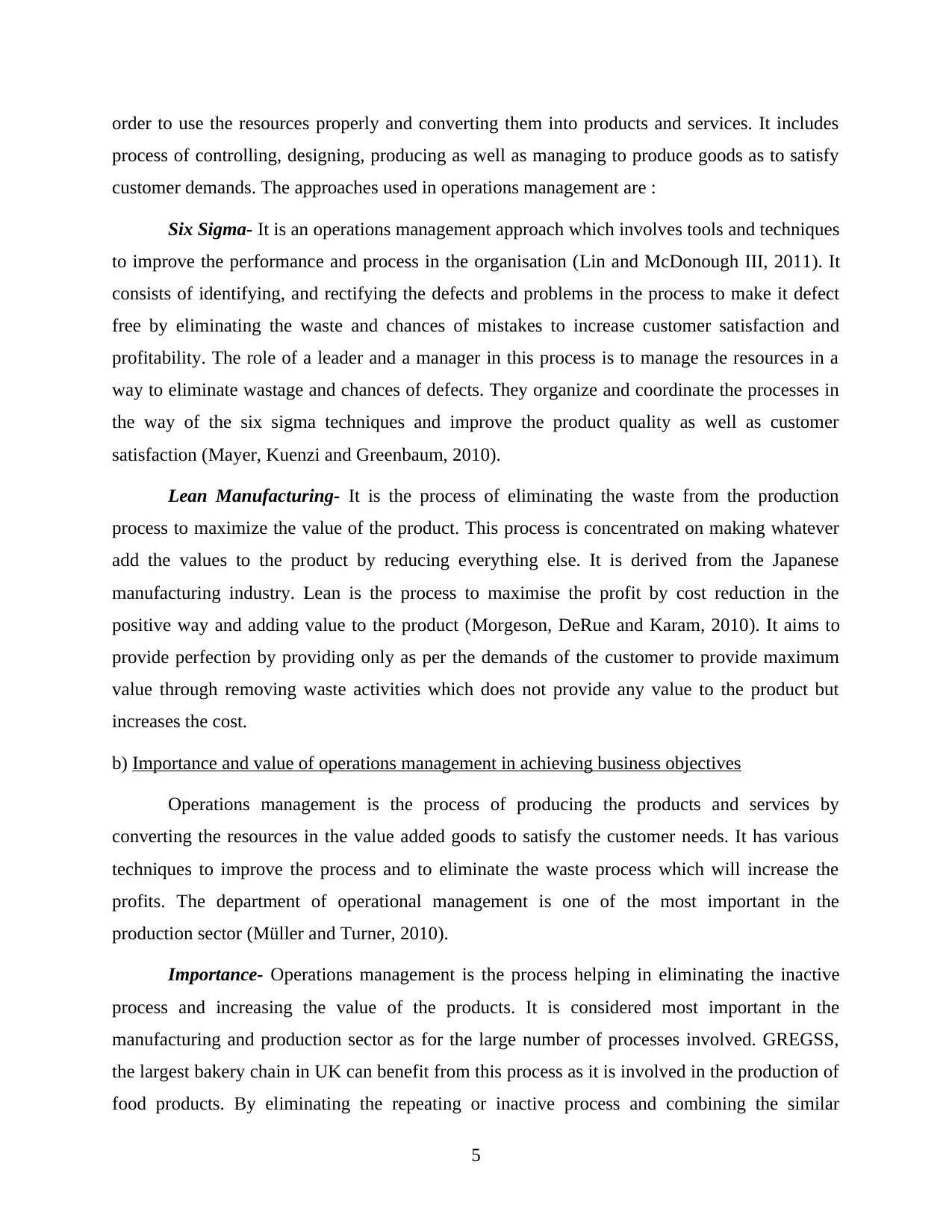
order to use the resources properly and converting them into products and services. It includes
process of controlling, designing, producing as well as managing to produce goods as to satisfy
customer demands. The approaches used in operations management are :
Six Sigma- It is an operations management approach which involves tools and techniques
to improve the performance and process in the organisation (Lin and McDonough III, 2011). It
consists of identifying, and rectifying the defects and problems in the process to make it defect
free by eliminating the waste and chances of mistakes to increase customer satisfaction and
profitability. The role of a leader and a manager in this process is to manage the resources in a
way to eliminate wastage and chances of defects. They organize and coordinate the processes in
the way of the six sigma techniques and improve the product quality as well as customer
satisfaction (Mayer, Kuenzi and Greenbaum, 2010).
Lean Manufacturing- It is the process of eliminating the waste from the production
process to maximize the value of the product. This process is concentrated on making whatever
add the values to the product by reducing everything else. It is derived from the Japanese
manufacturing industry. Lean is the process to maximise the profit by cost reduction in the
positive way and adding value to the product (Morgeson, DeRue and Karam, 2010). It aims to
provide perfection by providing only as per the demands of the customer to provide maximum
value through removing waste activities which does not provide any value to the product but
increases the cost.
b) Importance and value of operations management in achieving business objectives
Operations management is the process of producing the products and services by
converting the resources in the value added goods to satisfy the customer needs. It has various
techniques to improve the process and to eliminate the waste process which will increase the
profits. The department of operational management is one of the most important in the
production sector (Müller and Turner, 2010).
Importance- Operations management is the process helping in eliminating the inactive
process and increasing the value of the products. It is considered most important in the
manufacturing and production sector as for the large number of processes involved. GREGSS,
the largest bakery chain in UK can benefit from this process as it is involved in the production of
food products. By eliminating the repeating or inactive process and combining the similar
5
process of controlling, designing, producing as well as managing to produce goods as to satisfy
customer demands. The approaches used in operations management are :
Six Sigma- It is an operations management approach which involves tools and techniques
to improve the performance and process in the organisation (Lin and McDonough III, 2011). It
consists of identifying, and rectifying the defects and problems in the process to make it defect
free by eliminating the waste and chances of mistakes to increase customer satisfaction and
profitability. The role of a leader and a manager in this process is to manage the resources in a
way to eliminate wastage and chances of defects. They organize and coordinate the processes in
the way of the six sigma techniques and improve the product quality as well as customer
satisfaction (Mayer, Kuenzi and Greenbaum, 2010).
Lean Manufacturing- It is the process of eliminating the waste from the production
process to maximize the value of the product. This process is concentrated on making whatever
add the values to the product by reducing everything else. It is derived from the Japanese
manufacturing industry. Lean is the process to maximise the profit by cost reduction in the
positive way and adding value to the product (Morgeson, DeRue and Karam, 2010). It aims to
provide perfection by providing only as per the demands of the customer to provide maximum
value through removing waste activities which does not provide any value to the product but
increases the cost.
b) Importance and value of operations management in achieving business objectives
Operations management is the process of producing the products and services by
converting the resources in the value added goods to satisfy the customer needs. It has various
techniques to improve the process and to eliminate the waste process which will increase the
profits. The department of operational management is one of the most important in the
production sector (Müller and Turner, 2010).
Importance- Operations management is the process helping in eliminating the inactive
process and increasing the value of the products. It is considered most important in the
manufacturing and production sector as for the large number of processes involved. GREGSS,
the largest bakery chain in UK can benefit from this process as it is involved in the production of
food products. By eliminating the repeating or inactive process and combining the similar
5
Paraphrase This Document
Need a fresh take? Get an instant paraphrase of this document with our AI Paraphraser
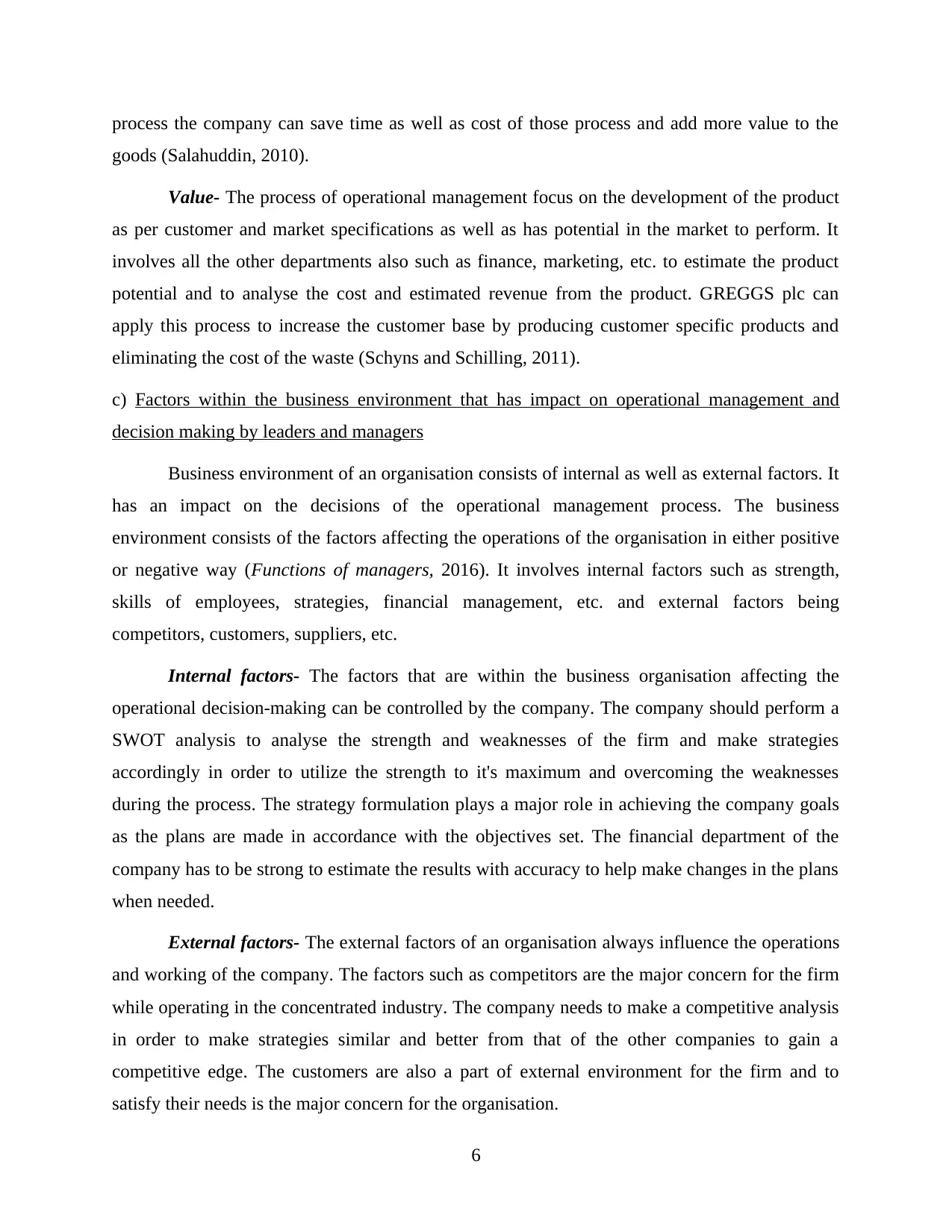
process the company can save time as well as cost of those process and add more value to the
goods (Salahuddin, 2010).
Value- The process of operational management focus on the development of the product
as per customer and market specifications as well as has potential in the market to perform. It
involves all the other departments also such as finance, marketing, etc. to estimate the product
potential and to analyse the cost and estimated revenue from the product. GREGGS plc can
apply this process to increase the customer base by producing customer specific products and
eliminating the cost of the waste (Schyns and Schilling, 2011).
c) Factors within the business environment that has impact on operational management and
decision making by leaders and managers
Business environment of an organisation consists of internal as well as external factors. It
has an impact on the decisions of the operational management process. The business
environment consists of the factors affecting the operations of the organisation in either positive
or negative way (Functions of managers, 2016). It involves internal factors such as strength,
skills of employees, strategies, financial management, etc. and external factors being
competitors, customers, suppliers, etc.
Internal factors- The factors that are within the business organisation affecting the
operational decision-making can be controlled by the company. The company should perform a
SWOT analysis to analyse the strength and weaknesses of the firm and make strategies
accordingly in order to utilize the strength to it's maximum and overcoming the weaknesses
during the process. The strategy formulation plays a major role in achieving the company goals
as the plans are made in accordance with the objectives set. The financial department of the
company has to be strong to estimate the results with accuracy to help make changes in the plans
when needed.
External factors- The external factors of an organisation always influence the operations
and working of the company. The factors such as competitors are the major concern for the firm
while operating in the concentrated industry. The company needs to make a competitive analysis
in order to make strategies similar and better from that of the other companies to gain a
competitive edge. The customers are also a part of external environment for the firm and to
satisfy their needs is the major concern for the organisation.
6
goods (Salahuddin, 2010).
Value- The process of operational management focus on the development of the product
as per customer and market specifications as well as has potential in the market to perform. It
involves all the other departments also such as finance, marketing, etc. to estimate the product
potential and to analyse the cost and estimated revenue from the product. GREGGS plc can
apply this process to increase the customer base by producing customer specific products and
eliminating the cost of the waste (Schyns and Schilling, 2011).
c) Factors within the business environment that has impact on operational management and
decision making by leaders and managers
Business environment of an organisation consists of internal as well as external factors. It
has an impact on the decisions of the operational management process. The business
environment consists of the factors affecting the operations of the organisation in either positive
or negative way (Functions of managers, 2016). It involves internal factors such as strength,
skills of employees, strategies, financial management, etc. and external factors being
competitors, customers, suppliers, etc.
Internal factors- The factors that are within the business organisation affecting the
operational decision-making can be controlled by the company. The company should perform a
SWOT analysis to analyse the strength and weaknesses of the firm and make strategies
accordingly in order to utilize the strength to it's maximum and overcoming the weaknesses
during the process. The strategy formulation plays a major role in achieving the company goals
as the plans are made in accordance with the objectives set. The financial department of the
company has to be strong to estimate the results with accuracy to help make changes in the plans
when needed.
External factors- The external factors of an organisation always influence the operations
and working of the company. The factors such as competitors are the major concern for the firm
while operating in the concentrated industry. The company needs to make a competitive analysis
in order to make strategies similar and better from that of the other companies to gain a
competitive edge. The customers are also a part of external environment for the firm and to
satisfy their needs is the major concern for the organisation.
6
GREGGS plc, a bakery chain operates in a concentrated market instead of being
established for a long time it has to face a competition and to maintain the market position it has
to keep evaluating the external and internal factors of the firm.
d) Ways by which leaders and managers can improve efficiencies of operational management to
meet business objectives
Leaders and managers are the main part of the organisation. An operations manager has
the responsibility to increase the productivity of the organisation and contribute to it's growth.
The operations manager has to manage the procurement, manufacturing, packaging and shipping,
customer support, etc. One of the main responsibilities of the manager is to keep the equipments
upgraded as per the latest technology (Management & Operations, 2017.). It not only includes
production equipments but also the other department systems such as computers and office
equipments. It helps to improve the efficiency level of the company. The managers helps to
coordinate between different departments to work together. The tools necessary for the process
to operate effectively are provided by the managers. The duties of a manager also includes
providing training to the subordinates to improve their skills and efficiency.
e) Ways in which different factors affect business environment and community
Business environment consists of the community in which the organisation operates. The
factors which have an impact on the business environment are responsible for the success of the
business in the long run. The factors affecting the business environment are economic factors,
political factors, social factors, legal factors, environmental and demographic factors, cultural
factors and technological factors.
The economic factors affecting the business environment consists of the interest rates and
taxation policies, inflation and exchange rates, etc. These factors affect the economy as well as
the business organisation.
The social factors are the cultural factors which involves population growth rate, cultural
differences, age distribution. These factors analyse the pattern in which the demand for a product
may arise and the market preferences.
Political factors are related with the government and it's policies in the country. The more
stable government helps to create more stable economy and business environment. It guides the
7
established for a long time it has to face a competition and to maintain the market position it has
to keep evaluating the external and internal factors of the firm.
d) Ways by which leaders and managers can improve efficiencies of operational management to
meet business objectives
Leaders and managers are the main part of the organisation. An operations manager has
the responsibility to increase the productivity of the organisation and contribute to it's growth.
The operations manager has to manage the procurement, manufacturing, packaging and shipping,
customer support, etc. One of the main responsibilities of the manager is to keep the equipments
upgraded as per the latest technology (Management & Operations, 2017.). It not only includes
production equipments but also the other department systems such as computers and office
equipments. It helps to improve the efficiency level of the company. The managers helps to
coordinate between different departments to work together. The tools necessary for the process
to operate effectively are provided by the managers. The duties of a manager also includes
providing training to the subordinates to improve their skills and efficiency.
e) Ways in which different factors affect business environment and community
Business environment consists of the community in which the organisation operates. The
factors which have an impact on the business environment are responsible for the success of the
business in the long run. The factors affecting the business environment are economic factors,
political factors, social factors, legal factors, environmental and demographic factors, cultural
factors and technological factors.
The economic factors affecting the business environment consists of the interest rates and
taxation policies, inflation and exchange rates, etc. These factors affect the economy as well as
the business organisation.
The social factors are the cultural factors which involves population growth rate, cultural
differences, age distribution. These factors analyse the pattern in which the demand for a product
may arise and the market preferences.
Political factors are related with the government and it's policies in the country. The more
stable government helps to create more stable economy and business environment. It guides the
7
⊘ This is a preview!⊘
Do you want full access?
Subscribe today to unlock all pages.
Trusted by 1+ million students worldwide
trades and transaction policies which affects the strategy formulation for an organisation and the
laws to be followed by the firms in the society.
Technological factors are the most affecting feature for the technological companies and
industries. These include changes in technologies, outsourcing decisions for a company (What is
Operations Management?. 2017).
GREGGS, a bakery chain has impact of these factors on the business environment of the
company. The manager of the company has to include all these guiding factors while formulating
the strategies for the different departments in the organisation. These factors are the basic
guiding elements for any business to operate in the community and to be a success in the long
run.
f) Evaluation of operations management and factors that impact business environment of
organisation
Operation management is the area in which company members can do the proper
management so that they can do qualitative work and on the basis of that they can do proper
designing as well as planning in the process of production and the manufacturing of the products.
The employees of Greggs PLC having the responsibility as well as duty that they have to do the
appropriate business operations so that they can improve the productivity along with the
proficiency. The employees have to do the proper utilization of resources which will helps in
obtaining the goals and objectives. Along with this the members of Greggs PLC have to use the
appropriate tools so that they can do the proper operations as well as business activity. The
leaders and managers of the company have to do the appropriate changes according to the needs
and wants of the consumers which will helps in attaining the goals and objectives along with the
maximum profit.
CONCLUSION
From the above report it has been carried out analysis that the employees of GREGGS
PLC have to do the proper operations along with the business activities so that they can attain the
goals and objectives. The leaders and managers have to fulfil their responsibility so that the
company can improve the sales and on the basis of that they can attain the maximum profit.
Leaders are those who attain the responsibility for doing the work and by doing the qualitative
work they can obtain the targets which are decided by the higher authorities of GREGGS PLC.
8
laws to be followed by the firms in the society.
Technological factors are the most affecting feature for the technological companies and
industries. These include changes in technologies, outsourcing decisions for a company (What is
Operations Management?. 2017).
GREGGS, a bakery chain has impact of these factors on the business environment of the
company. The manager of the company has to include all these guiding factors while formulating
the strategies for the different departments in the organisation. These factors are the basic
guiding elements for any business to operate in the community and to be a success in the long
run.
f) Evaluation of operations management and factors that impact business environment of
organisation
Operation management is the area in which company members can do the proper
management so that they can do qualitative work and on the basis of that they can do proper
designing as well as planning in the process of production and the manufacturing of the products.
The employees of Greggs PLC having the responsibility as well as duty that they have to do the
appropriate business operations so that they can improve the productivity along with the
proficiency. The employees have to do the proper utilization of resources which will helps in
obtaining the goals and objectives. Along with this the members of Greggs PLC have to use the
appropriate tools so that they can do the proper operations as well as business activity. The
leaders and managers of the company have to do the appropriate changes according to the needs
and wants of the consumers which will helps in attaining the goals and objectives along with the
maximum profit.
CONCLUSION
From the above report it has been carried out analysis that the employees of GREGGS
PLC have to do the proper operations along with the business activities so that they can attain the
goals and objectives. The leaders and managers have to fulfil their responsibility so that the
company can improve the sales and on the basis of that they can attain the maximum profit.
Leaders are those who attain the responsibility for doing the work and by doing the qualitative
work they can obtain the targets which are decided by the higher authorities of GREGGS PLC.
8
Paraphrase This Document
Need a fresh take? Get an instant paraphrase of this document with our AI Paraphraser

Managers are those person who do the proper management of the business activities and check
that the employees of the company provide the best services to the consumers or not.
9
that the employees of the company provide the best services to the consumers or not.
9
REFERENCES
Journals and Books
Foropon, C. and McLachlin, R., 2013. Metaphors in operations management theory building.
International Journal of Operations & Production Management. 33(2). pp.181-196
Heizer, and et.al., 2009. Operations Management. Pearson Education India.
Johnston, R., 2005. Service operations management: return to roots. International Journal of
Operations & Production Management. 25(12). pp.1278 – 1297.
Olsen, A. K. and Sætre, P., 2007. ERP for SMEs – is proprietary software an alternative?.
Business Process Management Journal. 13(3). pp.379–389.
Pansiri, J. and Temtime, T. Z., 2008. Assessing managerial skills in SMEs for capacity building.
Journal of Management Development. 27(2). pp.251–260.
Ravi, A., 2008. Managing Business Process Flows: Principles Of Operations Management, 2/E.
Pearson Education India.
Shetach, A., 2009. The revised decision-square model (RDSM): A tool for effective decision-
implementation in teams. Team Performance Management. 15(1/2). pp.7–17.
Söderlund, J., 2012. Project management, interdependencies, and time: Insights from Managing
Large Systems by Sayles and Chandler. International Journal of Managing Projects in
Business. 5(4). pp.617–633.
Barratt, M., Choi, T.Y. and Li, M., 2011. Qualitative case studies in operations management:
Trends, research outcomes, and future research implications. Journal of Operations
Management. 29(4). pp.329-342.
Brandon, C.J. and Mullan, P.B., 2013. Teaching medical management and operations
engineering for systems-based practice to radiology residents. Academic radiology. 20(3).
pp.345-350.
Chin, J.L., 2010. Introduction to the special issue on diversity and leadership. American
Psychologist. 65(3). p.150.
Cho, J. and Dansereau, F., 2010. Are transformational leaders fair? A multi-level study of
transformational leadership, justice perceptions, and organizational citizenship behaviors.
The Leadership Quarterly. 21(3). pp.409-421.
Dekker, R., Bloemhof, J. and Mallidis, I., 2012. Operations Research for green logistics–An
overview of aspects, issues, contributions and challenges. European Journal of
Operational Research. 219(3). pp.671-679.
Haider, M.H. and Riaz, A., 2010. Role of transformational and transactional leadership with job
satisfaction and career satisfaction. Business and Economic Horizons. (01). pp.29-38.
Krajewski, L.J., Ritzman, L.P. and Malhotra, M.K., 2013. Operations management: Processes
and supply chains (Vol. 1). New York: Pearson.
Kuruppuarachchi, D. and Perera, H.S.C., 2010. Impact of TQM and technology management on
operations performance. IUP Journal of Operations Management. 9(3). p.23.
Lin, H.E. and McDonough III, E.F., 2011. Investigating the role of leadership and organizational
culture in fostering innovation ambidexterity. IEEE Transactions on engineering
management. 58(3). pp.497-509.
Mayer, D.M., Kuenzi, M. and Greenbaum, R.L., 2010. Examining the link between ethical
leadership and employee misconduct: The mediating role of ethical climate. Journal of
Business Ethics. 95. pp.7-16.
10
Journals and Books
Foropon, C. and McLachlin, R., 2013. Metaphors in operations management theory building.
International Journal of Operations & Production Management. 33(2). pp.181-196
Heizer, and et.al., 2009. Operations Management. Pearson Education India.
Johnston, R., 2005. Service operations management: return to roots. International Journal of
Operations & Production Management. 25(12). pp.1278 – 1297.
Olsen, A. K. and Sætre, P., 2007. ERP for SMEs – is proprietary software an alternative?.
Business Process Management Journal. 13(3). pp.379–389.
Pansiri, J. and Temtime, T. Z., 2008. Assessing managerial skills in SMEs for capacity building.
Journal of Management Development. 27(2). pp.251–260.
Ravi, A., 2008. Managing Business Process Flows: Principles Of Operations Management, 2/E.
Pearson Education India.
Shetach, A., 2009. The revised decision-square model (RDSM): A tool for effective decision-
implementation in teams. Team Performance Management. 15(1/2). pp.7–17.
Söderlund, J., 2012. Project management, interdependencies, and time: Insights from Managing
Large Systems by Sayles and Chandler. International Journal of Managing Projects in
Business. 5(4). pp.617–633.
Barratt, M., Choi, T.Y. and Li, M., 2011. Qualitative case studies in operations management:
Trends, research outcomes, and future research implications. Journal of Operations
Management. 29(4). pp.329-342.
Brandon, C.J. and Mullan, P.B., 2013. Teaching medical management and operations
engineering for systems-based practice to radiology residents. Academic radiology. 20(3).
pp.345-350.
Chin, J.L., 2010. Introduction to the special issue on diversity and leadership. American
Psychologist. 65(3). p.150.
Cho, J. and Dansereau, F., 2010. Are transformational leaders fair? A multi-level study of
transformational leadership, justice perceptions, and organizational citizenship behaviors.
The Leadership Quarterly. 21(3). pp.409-421.
Dekker, R., Bloemhof, J. and Mallidis, I., 2012. Operations Research for green logistics–An
overview of aspects, issues, contributions and challenges. European Journal of
Operational Research. 219(3). pp.671-679.
Haider, M.H. and Riaz, A., 2010. Role of transformational and transactional leadership with job
satisfaction and career satisfaction. Business and Economic Horizons. (01). pp.29-38.
Krajewski, L.J., Ritzman, L.P. and Malhotra, M.K., 2013. Operations management: Processes
and supply chains (Vol. 1). New York: Pearson.
Kuruppuarachchi, D. and Perera, H.S.C., 2010. Impact of TQM and technology management on
operations performance. IUP Journal of Operations Management. 9(3). p.23.
Lin, H.E. and McDonough III, E.F., 2011. Investigating the role of leadership and organizational
culture in fostering innovation ambidexterity. IEEE Transactions on engineering
management. 58(3). pp.497-509.
Mayer, D.M., Kuenzi, M. and Greenbaum, R.L., 2010. Examining the link between ethical
leadership and employee misconduct: The mediating role of ethical climate. Journal of
Business Ethics. 95. pp.7-16.
10
⊘ This is a preview!⊘
Do you want full access?
Subscribe today to unlock all pages.
Trusted by 1+ million students worldwide

1 out of 13


Related Documents


Your All-in-One AI-Powered Toolkit for Academic Success.
+13062052269
info@desklib.com
Available 24*7 on WhatsApp / Email
![[object Object]](/_next/static/media/star-bottom.7253800d.svg)
Unlock your academic potential
Copyright © 2020–2026 A2Z Services. All Rights Reserved. Developed and managed by ZUCOL.