Reflective Essay: Leadership, Knowledge, Learning, and Application
VerifiedAdded on 2022/05/30
|7
|2141
|93
Essay
AI Summary
This reflective essay delves into the multifaceted concept of leadership, emphasizing the critical role of knowledge and learning in achieving organizational success. The essay explores various leadership theories, including single-loop and double-loop learning, and examines how leaders can 'know,' 'go,' and 'show' the path to others. It draws upon real-world examples, such as the leadership styles of Bill Gates, Tim Cook, Martin Luther King Jr., and Steve Jobs, to illustrate the practical application of leadership principles. The essay also highlights the importance of adaptation, charismatic leadership, and transformational leadership in fostering employee engagement and achieving organizational goals. The author emphasizes that successful leaders must possess the ability to envision a path, demonstrate commitment to it, and share their experiences to guide others. References to key concepts like the learning curves theory and the work of scholars like Chris Argyris, Richard Cyert, and James G. March further enrich the analysis. The essay concludes by underscoring the importance of leaders in ensuring organizational sustainability and the development of future leaders.

Reflective Essay 1
Name of the student:
Name of the Institution:
Roll No:
Date of Submission:
Name of the student:
Name of the Institution:
Roll No:
Date of Submission:
Paraphrase This Document
Need a fresh take? Get an instant paraphrase of this document with our AI Paraphraser

Reflective Essay 2
Reflective Essay
Introduction
Leadership is one of the essential elements of a successful organization or society. In any
country or organization, when the leader is strong and is supported by the people, and has the
ability to say and act according to morality, the country becomes successful (Imran, Ilyas and
Aslam, 2016). The following essay looks at how an effective leader doesn't just know the
way, but how they follow the path that they know and how they show the same to others as
well. in the following essay, I will look at some of the theories that are related to
organizational learning and attempt to look at how a leader knows, goes and shows the way
of learning to other people. My aim in the following essay is to understand how leadership
and knowledge are connected, and how this can be evidenced by real-life leaders not just
from organizations, but from society as well.
The wisdom of Leadership and Learning
Knowledge in a leader is an essential trait for the leader to become successful. In terms of an
organization or company, where the primary motive of the company is to become more
profitable and expand as much as possible, the leader becomes the CEO. Therefore,
according to me, the leader must be able to visualise a way for the company to become more
profitable (Berta, Cranley, Dearing, Doghearty, Squires and Estabrooks, 2015). A successful
leader also knows the path from the way that mistakes are made. According to theories by
Chris Argyris and Donald Schön, there are two main types of learning that are common in
leaders (Chandler and Huang, 2015). The first is single-loop learning, where a different set of
actions have been taken to ensure that the same result is not achieved. For example, where
Windows was not successful in the release of Windows 8, Bill Gates, who was at that time
the CEO of Microsoft, decided to take a step back, and revamp some of the issues with
Reflective Essay
Introduction
Leadership is one of the essential elements of a successful organization or society. In any
country or organization, when the leader is strong and is supported by the people, and has the
ability to say and act according to morality, the country becomes successful (Imran, Ilyas and
Aslam, 2016). The following essay looks at how an effective leader doesn't just know the
way, but how they follow the path that they know and how they show the same to others as
well. in the following essay, I will look at some of the theories that are related to
organizational learning and attempt to look at how a leader knows, goes and shows the way
of learning to other people. My aim in the following essay is to understand how leadership
and knowledge are connected, and how this can be evidenced by real-life leaders not just
from organizations, but from society as well.
The wisdom of Leadership and Learning
Knowledge in a leader is an essential trait for the leader to become successful. In terms of an
organization or company, where the primary motive of the company is to become more
profitable and expand as much as possible, the leader becomes the CEO. Therefore,
according to me, the leader must be able to visualise a way for the company to become more
profitable (Berta, Cranley, Dearing, Doghearty, Squires and Estabrooks, 2015). A successful
leader also knows the path from the way that mistakes are made. According to theories by
Chris Argyris and Donald Schön, there are two main types of learning that are common in
leaders (Chandler and Huang, 2015). The first is single-loop learning, where a different set of
actions have been taken to ensure that the same result is not achieved. For example, where
Windows was not successful in the release of Windows 8, Bill Gates, who was at that time
the CEO of Microsoft, decided to take a step back, and revamp some of the issues with

Reflective Essay 3
Windows 8 and come up with a software that was similar, yet also different and aimed to
adapt to the new system of having laptops that could also be used as tablets as well. This was
the primary reason that Windows 10 was extremely successful. The other type of learning is
double loop learning, where the goals and beliefs are re-examined instead of the actions.
When Apple stopped the sale of the iPod Shuffles, they noticed that people were not
interested in having a device just meant for music, when their phones could do the job for
them. The CEO, Tim Cook, re-examined the goal, which would have been to increase their
profits and discontinued the device, thus making them more valuable. Most leaders who have
been described as visionary have been able to look at what they wanted their companies or
societies to become. Martin Luther King Jr, who is a visionary leader in the American Civil
Rights Movement, started his most famous speech with “I have a dream”. This is one of the
examples that show that most leaders who are successful have been able to know the path and
the end result that they are aiming towards (Ortenblad, 2015). It is only when the leader
knows of the path that they are able to convince others to be able to walk the path with them.
If the leaders of Australia or the United States of America or India did not know the way to
make their countries free from British rule, they would not have been successful in ensuring
that the British left. That is the same case, according to me, for all leaders.
However, it is not just knowledge of the path that gets leaders to make something great for
their country, society or their company. Leaders have to be able to go the way themselves
successfully. Gandhi asked for the people to India to fight using non-violence. However, the
people would not have selected the method of non-violence if Gandhi would not have taken
the path himself (Chadwick and Raver, 2016). The saying "Actions speak louder than words"
is extremely apt in this scenario according to me since most people are able to believe
actions, but not words. It is easy to preach of non-violence towards the British and to see that
it was the way that India would gain independence, but going that way would be difficult. In
Windows 8 and come up with a software that was similar, yet also different and aimed to
adapt to the new system of having laptops that could also be used as tablets as well. This was
the primary reason that Windows 10 was extremely successful. The other type of learning is
double loop learning, where the goals and beliefs are re-examined instead of the actions.
When Apple stopped the sale of the iPod Shuffles, they noticed that people were not
interested in having a device just meant for music, when their phones could do the job for
them. The CEO, Tim Cook, re-examined the goal, which would have been to increase their
profits and discontinued the device, thus making them more valuable. Most leaders who have
been described as visionary have been able to look at what they wanted their companies or
societies to become. Martin Luther King Jr, who is a visionary leader in the American Civil
Rights Movement, started his most famous speech with “I have a dream”. This is one of the
examples that show that most leaders who are successful have been able to know the path and
the end result that they are aiming towards (Ortenblad, 2015). It is only when the leader
knows of the path that they are able to convince others to be able to walk the path with them.
If the leaders of Australia or the United States of America or India did not know the way to
make their countries free from British rule, they would not have been successful in ensuring
that the British left. That is the same case, according to me, for all leaders.
However, it is not just knowledge of the path that gets leaders to make something great for
their country, society or their company. Leaders have to be able to go the way themselves
successfully. Gandhi asked for the people to India to fight using non-violence. However, the
people would not have selected the method of non-violence if Gandhi would not have taken
the path himself (Chadwick and Raver, 2016). The saying "Actions speak louder than words"
is extremely apt in this scenario according to me since most people are able to believe
actions, but not words. It is easy to preach of non-violence towards the British and to see that
it was the way that India would gain independence, but going that way would be difficult. In
⊘ This is a preview!⊘
Do you want full access?
Subscribe today to unlock all pages.

Trusted by 1+ million students worldwide

Reflective Essay 4
times of crisis, it is often the CEO of the organization that is expected to show the way. For
example, when Facebook was going through some hard times, it was Mark Zuckerberg who
was expected to show the way by taking a minimal salary so that the other workers, those
who had been severely affected and would lose their jobs, would be able to continue working,
It often depends on the president or prime minister of the country to walk the same path as
that of a poor person, so that they can empathize with the poor of the country (Illeris, 2018).
When the leader goes the way, I feel that it adds to adaptation. According to Richard Cyert
and James G. March, adaptation was a theory where the organization changed its rules and
regulations over time to meet the society’s standards (Jain and Moreno, 2015). For any leader
to be successful, they have to be able to adapt their rules and that of their company to the
societal standards. It could otherwise, lead to protests and government shutdowns, such as
what is happening in the United States of America, under President Donald Trump. In order
to go the way, the leader must also know the way that they are choosing. If there were steps
to success, the first step would be known, and the second step would experience. Most
leaders that are chosen in organizations have experience in the field and in the organization as
well (Walumbwa, Hartnell and Misati, 2017).
The third and final step would be to show the way. This would mean passing on the
knowledge and wealth of information that they have gathered through their experience to
others, so that they can also benefit from it (Hotho, Lyles and Easterby-Smith, 2015). This is
an extremely important step as well since it is the main method by which future generations
can learn from the past and previous mistakes, and thus, ensure that they are not repeated.
Barack Obama, for example, who is the first black president of the United States of America,
shortly after he finished his last term as president, opened a fellowship program for students
all over the world, so that he could pass on information from his experience to other young
leaders, so that they could also be successful leaders. Showing need not just be to the future,
times of crisis, it is often the CEO of the organization that is expected to show the way. For
example, when Facebook was going through some hard times, it was Mark Zuckerberg who
was expected to show the way by taking a minimal salary so that the other workers, those
who had been severely affected and would lose their jobs, would be able to continue working,
It often depends on the president or prime minister of the country to walk the same path as
that of a poor person, so that they can empathize with the poor of the country (Illeris, 2018).
When the leader goes the way, I feel that it adds to adaptation. According to Richard Cyert
and James G. March, adaptation was a theory where the organization changed its rules and
regulations over time to meet the society’s standards (Jain and Moreno, 2015). For any leader
to be successful, they have to be able to adapt their rules and that of their company to the
societal standards. It could otherwise, lead to protests and government shutdowns, such as
what is happening in the United States of America, under President Donald Trump. In order
to go the way, the leader must also know the way that they are choosing. If there were steps
to success, the first step would be known, and the second step would experience. Most
leaders that are chosen in organizations have experience in the field and in the organization as
well (Walumbwa, Hartnell and Misati, 2017).
The third and final step would be to show the way. This would mean passing on the
knowledge and wealth of information that they have gathered through their experience to
others, so that they can also benefit from it (Hotho, Lyles and Easterby-Smith, 2015). This is
an extremely important step as well since it is the main method by which future generations
can learn from the past and previous mistakes, and thus, ensure that they are not repeated.
Barack Obama, for example, who is the first black president of the United States of America,
shortly after he finished his last term as president, opened a fellowship program for students
all over the world, so that he could pass on information from his experience to other young
leaders, so that they could also be successful leaders. Showing need not just be to the future,
Paraphrase This Document
Need a fresh take? Get an instant paraphrase of this document with our AI Paraphraser

Reflective Essay 5
it could also be showing the way to followers, and competitors, so that the followers can go
down the same path that is chosen and the competitors (in the case of a company) can take a
hit to their confidence as well. It is important for the organization to have a leader who is able
to convince the employees that the way they are going and the work that they are doing is for
the benefit of not just the organization, but of themselves as well (Raelin, 2016). This is why
it is essential for the leader who is chosen to have a leadership style that is charismatic and
transformational. According to the Learning Curves Theory by John M. Dutton and Annie
Thomas, leaders in the organization who understand that their employees make errors, and
these errors can be decreased by virtue of experience, and who are thus, willing to show other
employees how to work from their own experience would make the best leaders (Jyoti and
Dev, 2015). Steve Jobs was one such leader. In the earlier days of Apple, he would ensure
that employees in Apple, many of whom did not have his experience, would be benefited
from his experience (Covin and Slevin, 2017). He did this by working directly and talking to
each, and every one of his employees and this would be of immense benefit to the employees,
who might have made a mistake and would benefit from the experience that Jobs had to offer.
Conclusion
I feel that a leader is capable of ensuring that the company can run without him. A successful
leader makes sure that the employees in the organization, or the citizens of the country or
society in which he is the leader are able to work the best that they can and that he can also
benefit from the employees. A leader who is successful and wise will understand that he must
be able to see the path that he has chosen and that it is a path that he is able to go on. He must
then be able to share his experience with the many others in the organization, to ensure that
his wisdom and knowledge are passed on as well.
it could also be showing the way to followers, and competitors, so that the followers can go
down the same path that is chosen and the competitors (in the case of a company) can take a
hit to their confidence as well. It is important for the organization to have a leader who is able
to convince the employees that the way they are going and the work that they are doing is for
the benefit of not just the organization, but of themselves as well (Raelin, 2016). This is why
it is essential for the leader who is chosen to have a leadership style that is charismatic and
transformational. According to the Learning Curves Theory by John M. Dutton and Annie
Thomas, leaders in the organization who understand that their employees make errors, and
these errors can be decreased by virtue of experience, and who are thus, willing to show other
employees how to work from their own experience would make the best leaders (Jyoti and
Dev, 2015). Steve Jobs was one such leader. In the earlier days of Apple, he would ensure
that employees in Apple, many of whom did not have his experience, would be benefited
from his experience (Covin and Slevin, 2017). He did this by working directly and talking to
each, and every one of his employees and this would be of immense benefit to the employees,
who might have made a mistake and would benefit from the experience that Jobs had to offer.
Conclusion
I feel that a leader is capable of ensuring that the company can run without him. A successful
leader makes sure that the employees in the organization, or the citizens of the country or
society in which he is the leader are able to work the best that they can and that he can also
benefit from the employees. A leader who is successful and wise will understand that he must
be able to see the path that he has chosen and that it is a path that he is able to go on. He must
then be able to share his experience with the many others in the organization, to ensure that
his wisdom and knowledge are passed on as well.

Reflective Essay 6
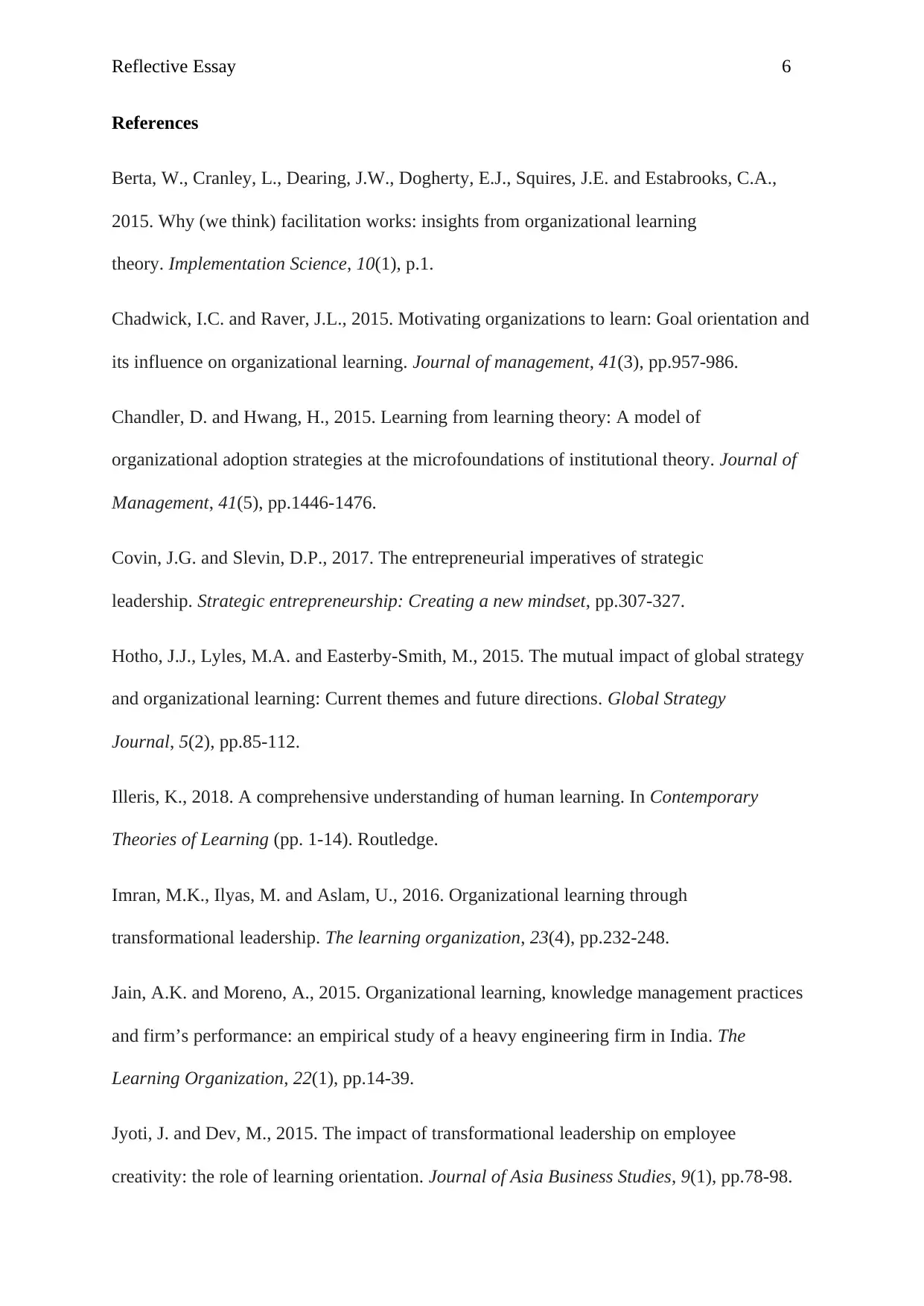
References
Berta, W., Cranley, L., Dearing, J.W., Dogherty, E.J., Squires, J.E. and Estabrooks, C.A.,
2015. Why (we think) facilitation works: insights from organizational learning
theory. Implementation Science, 10(1), p.1.
Chadwick, I.C. and Raver, J.L., 2015. Motivating organizations to learn: Goal orientation and
its influence on organizational learning. Journal of management, 41(3), pp.957-986.
Chandler, D. and Hwang, H., 2015. Learning from learning theory: A model of
organizational adoption strategies at the microfoundations of institutional theory. Journal of
Management, 41(5), pp.1446-1476.
Covin, J.G. and Slevin, D.P., 2017. The entrepreneurial imperatives of strategic
leadership. Strategic entrepreneurship: Creating a new mindset, pp.307-327.
Hotho, J.J., Lyles, M.A. and Easterby‐Smith, M., 2015. The mutual impact of global strategy
and organizational learning: Current themes and future directions. Global Strategy
Journal, 5(2), pp.85-112.
Illeris, K., 2018. A comprehensive understanding of human learning. In Contemporary
Theories of Learning (pp. 1-14). Routledge.
Imran, M.K., Ilyas, M. and Aslam, U., 2016. Organizational learning through
transformational leadership. The learning organization, 23(4), pp.232-248.
Jain, A.K. and Moreno, A., 2015. Organizational learning, knowledge management practices
and firm’s performance: an empirical study of a heavy engineering firm in India. The
Learning Organization, 22(1), pp.14-39.
Jyoti, J. and Dev, M., 2015. The impact of transformational leadership on employee
creativity: the role of learning orientation. Journal of Asia Business Studies, 9(1), pp.78-98.
References
Berta, W., Cranley, L., Dearing, J.W., Dogherty, E.J., Squires, J.E. and Estabrooks, C.A.,
2015. Why (we think) facilitation works: insights from organizational learning
theory. Implementation Science, 10(1), p.1.
Chadwick, I.C. and Raver, J.L., 2015. Motivating organizations to learn: Goal orientation and
its influence on organizational learning. Journal of management, 41(3), pp.957-986.
Chandler, D. and Hwang, H., 2015. Learning from learning theory: A model of
organizational adoption strategies at the microfoundations of institutional theory. Journal of
Management, 41(5), pp.1446-1476.
Covin, J.G. and Slevin, D.P., 2017. The entrepreneurial imperatives of strategic
leadership. Strategic entrepreneurship: Creating a new mindset, pp.307-327.
Hotho, J.J., Lyles, M.A. and Easterby‐Smith, M., 2015. The mutual impact of global strategy
and organizational learning: Current themes and future directions. Global Strategy
Journal, 5(2), pp.85-112.
Illeris, K., 2018. A comprehensive understanding of human learning. In Contemporary
Theories of Learning (pp. 1-14). Routledge.
Imran, M.K., Ilyas, M. and Aslam, U., 2016. Organizational learning through
transformational leadership. The learning organization, 23(4), pp.232-248.
Jain, A.K. and Moreno, A., 2015. Organizational learning, knowledge management practices
and firm’s performance: an empirical study of a heavy engineering firm in India. The
Learning Organization, 22(1), pp.14-39.
Jyoti, J. and Dev, M., 2015. The impact of transformational leadership on employee
creativity: the role of learning orientation. Journal of Asia Business Studies, 9(1), pp.78-98.
⊘ This is a preview!⊘
Do you want full access?
Subscribe today to unlock all pages.

Trusted by 1+ million students worldwide

Reflective Essay 7
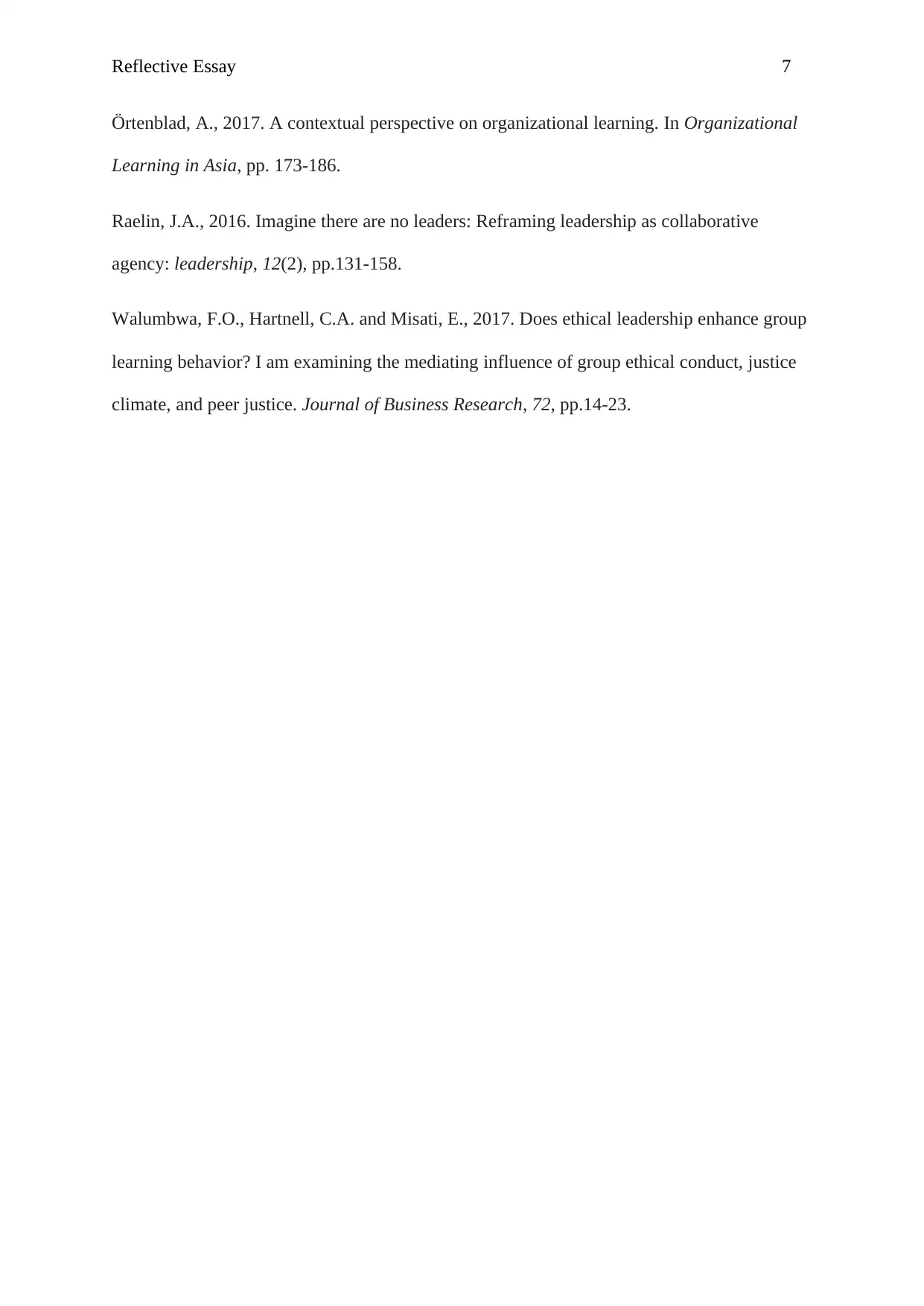
Örtenblad, A., 2017. A contextual perspective on organizational learning. In Organizational
Learning in Asia, pp. 173-186.
Raelin, J.A., 2016. Imagine there are no leaders: Reframing leadership as collaborative
agency: leadership, 12(2), pp.131-158.
Walumbwa, F.O., Hartnell, C.A. and Misati, E., 2017. Does ethical leadership enhance group
learning behavior? I am examining the mediating influence of group ethical conduct, justice
climate, and peer justice. Journal of Business Research, 72, pp.14-23.
Örtenblad, A., 2017. A contextual perspective on organizational learning. In Organizational
Learning in Asia, pp. 173-186.
Raelin, J.A., 2016. Imagine there are no leaders: Reframing leadership as collaborative
agency: leadership, 12(2), pp.131-158.
Walumbwa, F.O., Hartnell, C.A. and Misati, E., 2017. Does ethical leadership enhance group
learning behavior? I am examining the mediating influence of group ethical conduct, justice
climate, and peer justice. Journal of Business Research, 72, pp.14-23.
1 out of 7
Related Documents
Your All-in-One AI-Powered Toolkit for Academic Success.
+13062052269
info@desklib.com
Available 24*7 on WhatsApp / Email
Unlock your academic potential
Copyright © 2020–2026 A2Z Services. All Rights Reserved. Developed and managed by ZUCOL.