HI6005: Transformational Leadership's Effect on Business Outcome
VerifiedAdded on 2023/06/07
|15
|3340
|356
Literature Review
AI Summary
This literature review examines the relationship between transformational leadership and organizational performance, focusing on employee motivation, job satisfaction, self-efficacy, and overall business productivity. It contrasts transformational leadership with transactional leadership, highlighting the former's emphasis on creating an inspiring environment. The review analyzes several studies that support the positive impact of transformational leadership on employee motivation, productivity, and job satisfaction across various industries, including telecommunications and higher education. It also addresses the role of transformational leadership in fostering a competitive edge in a globalized business environment and in enhancing employee self-efficacy. The review identifies a gap in the existing literature, noting the limited exploration of transformational leadership's impact on organizational culture, suggesting a need for further research in this area. This assignment is available on Desklib, a platform providing study tools and resources for students.

Business Research Methodology 1
Business Research Methodology
Name
University
Professor
Date
Business Research Methodology
Name
University
Professor
Date

Paraphrase This Document
Need a fresh take? Get an instant paraphrase of this document with our AI Paraphraser

Business Research Methodology 2
Table of Contents
Introduction......................................................................................................................................3
Project objective..............................................................................................................................3
Project scope....................................................................................................................................4
Literature review..............................................................................................................................4
Introduction..................................................................................................................................4
Transformational Leadership and Employee Motivation............................................................5
Transformational Leadership and Employee Productivity..........................................................5
Transformational Leadership and Job Satisfaction......................................................................6
Transformational Leadership and Competition...........................................................................7
Transformational Leadership and Employee Self-Efficacy........................................................8
Literature Gaps................................................................................................................................9
Conclusion.......................................................................................................................................9
References List..............................................................................................................................11
Appendix........................................................................................................................................14
Table of Contents
Introduction......................................................................................................................................3
Project objective..............................................................................................................................3
Project scope....................................................................................................................................4
Literature review..............................................................................................................................4
Introduction..................................................................................................................................4
Transformational Leadership and Employee Motivation............................................................5
Transformational Leadership and Employee Productivity..........................................................5
Transformational Leadership and Job Satisfaction......................................................................6
Transformational Leadership and Competition...........................................................................7
Transformational Leadership and Employee Self-Efficacy........................................................8
Literature Gaps................................................................................................................................9
Conclusion.......................................................................................................................................9
References List..............................................................................................................................11
Appendix........................................................................................................................................14
Business Research Methodology 3
Introduction
The modern business world elicits concerns for stakeholders to understand the importance of
embracing the appropriate style of leadership to ensure that their organizations remain
productive. Memon (2014) says that organizational management is among the fields of business
that faces a significant impact from the changing world. Technology appears to be one of the
most critical areas that influence the performance of an institution in the modern environment.
Notably, businesses engage in various activities to ensure that they maintain relevance in the
market amidst competition. Employee’s job satisfaction is one of the most deliberated fields of
organizational success and productivity. Many scholars agree that worker’s contentment leads to
the productive working environment and maximum profitability of an institution. Therefore,
Jyoti and Bhau (2015) argue that organizations require enriching their leadership mechanism to
create a climate conducive to work. Thus, there have been several studies conducted to establish
the effectiveness of various leadership models on workers motivation and performance. In the
words of Wahab et al. (2016), the type of leadership adopted by a business determines the level
of interaction between the leader and the follower influencing the engagement level of the
workers with their roles and responsibilities. The purpose of transformative leadership on
employee performance is a critical focus for scholars because the leadership style creates a
friendly environment between the leaders and the workers imperative for institutional
productivity.
Project objective
The objective of this project is to study the relationship between transformational leadership and
organizational performance. Therefore, the researcher will delve into the elements that influence
the business in its path to the realization of productivity. Indeed, aspects dealing with employees
and leaders within a firm have been highlighted to be some of the most critical factors in
Introduction
The modern business world elicits concerns for stakeholders to understand the importance of
embracing the appropriate style of leadership to ensure that their organizations remain
productive. Memon (2014) says that organizational management is among the fields of business
that faces a significant impact from the changing world. Technology appears to be one of the
most critical areas that influence the performance of an institution in the modern environment.
Notably, businesses engage in various activities to ensure that they maintain relevance in the
market amidst competition. Employee’s job satisfaction is one of the most deliberated fields of
organizational success and productivity. Many scholars agree that worker’s contentment leads to
the productive working environment and maximum profitability of an institution. Therefore,
Jyoti and Bhau (2015) argue that organizations require enriching their leadership mechanism to
create a climate conducive to work. Thus, there have been several studies conducted to establish
the effectiveness of various leadership models on workers motivation and performance. In the
words of Wahab et al. (2016), the type of leadership adopted by a business determines the level
of interaction between the leader and the follower influencing the engagement level of the
workers with their roles and responsibilities. The purpose of transformative leadership on
employee performance is a critical focus for scholars because the leadership style creates a
friendly environment between the leaders and the workers imperative for institutional
productivity.
Project objective
The objective of this project is to study the relationship between transformational leadership and
organizational performance. Therefore, the researcher will delve into the elements that influence
the business in its path to the realization of productivity. Indeed, aspects dealing with employees
and leaders within a firm have been highlighted to be some of the most critical factors in
⊘ This is a preview!⊘
Do you want full access?
Subscribe today to unlock all pages.

Trusted by 1+ million students worldwide
Business Research Methodology 4
productivity. Thus, the researcher will embark on understanding how the association of leaders
and followers affect the future of a business.
Project scope
The current study aims at studying the associations between transformational governance model
and the productivity of a business. Therefore, employee’s motivation, job satisfaction,
performance, and self-efficacy will be the mediating factors to organizational productivity.
Indeed, the performance of workers depends on the level of their fulfillment of the environment
in which they work. The project will delve into organizations both medium and large to help
understand the role of transformational leadership in improving workers motivation and job
satisfaction for institutional productivity.
Literature review
Introduction
Transformational leadership and transactional leadership often contradict. According to Wahab
et al. (2016), transactional leaders use rewards to help raise the morale of employees for
organizational benefit. However, transformational leaders emphasize on making sure that they
create an enabling environment to inspire their subjects to perform. Therefore, the objective of
this kind of leaders is to ensure that the atmosphere within the business motivates the workers to
increase their productivity. Indeed, leadership style is of critical importance in the area of
organizational behavior. Undoubtedly, the model of leading dictates the direction that the firm
takes making it imperative for leaders to ensure that they adopt the appropriate means to create
understanding among them and their followers (Memon, 2014). The role of the workers in the
productivity of a business is critical because it places the significant contributions and
retributions that they may have on the success of a firm (Wahab et al., 2016). The progression
from the responsibilities of employees to the roles of leadership and their relationship with the
productivity. Thus, the researcher will embark on understanding how the association of leaders
and followers affect the future of a business.
Project scope
The current study aims at studying the associations between transformational governance model
and the productivity of a business. Therefore, employee’s motivation, job satisfaction,
performance, and self-efficacy will be the mediating factors to organizational productivity.
Indeed, the performance of workers depends on the level of their fulfillment of the environment
in which they work. The project will delve into organizations both medium and large to help
understand the role of transformational leadership in improving workers motivation and job
satisfaction for institutional productivity.
Literature review
Introduction
Transformational leadership and transactional leadership often contradict. According to Wahab
et al. (2016), transactional leaders use rewards to help raise the morale of employees for
organizational benefit. However, transformational leaders emphasize on making sure that they
create an enabling environment to inspire their subjects to perform. Therefore, the objective of
this kind of leaders is to ensure that the atmosphere within the business motivates the workers to
increase their productivity. Indeed, leadership style is of critical importance in the area of
organizational behavior. Undoubtedly, the model of leading dictates the direction that the firm
takes making it imperative for leaders to ensure that they adopt the appropriate means to create
understanding among them and their followers (Memon, 2014). The role of the workers in the
productivity of a business is critical because it places the significant contributions and
retributions that they may have on the success of a firm (Wahab et al., 2016). The progression
from the responsibilities of employees to the roles of leadership and their relationship with the
Paraphrase This Document
Need a fresh take? Get an instant paraphrase of this document with our AI Paraphraser

Business Research Methodology 5
performance are focal points within an organization. This literature review delves into the
transformational leadership to underlie the effectiveness of the style on improving organizational
performance.
Transformational Leadership and Employee Motivation
Management in the contemporary society faces rapid changes. The necessity to develop an active
management style has become increasingly important in all organizations. According to a study
conducted by Sougui et al. (2015) among Telcom engineering companies, the model of
leadership influences employee’s job motivation. The study found that both transformational and
transactional models of leadership are beneficial to employee inspiration and the productivity of
a firm. However, many employees interviewed expressed more support for transformational
leadership as the most effective method for boosting their morale. Another study conducted by
Enkaningsih (2014) found results that were in tandem with the latter when the researcher
concluded that transformational leaders give more impact on the productivity of workers through
empowerment, confidence, and contentment with the managers. The latter study places more
valuables than the earlier one making it more comprehensive in its scope. Therefore,
empowerment and confidence in the leaders achieved wholly or partially; influences the work
environment and affecting the relationship between employees and their leaders. Idris et al.
(2014) also support the idea that transformational leadership creates an atmosphere of motivation
and inspires them to work. The focus of organizational structure and administration appears to be
imperative in helping employees identify and become productive within an organization.
Motivation is the breakpoint that sets the pace for future growth and productivity of a business.
Transformational Leadership and Employee Productivity
Veliu et al. (2017) while assessing the significance of leadership in influencing workers
motivation found several leadership models to have a different impact on employee performance.
performance are focal points within an organization. This literature review delves into the
transformational leadership to underlie the effectiveness of the style on improving organizational
performance.
Transformational Leadership and Employee Motivation
Management in the contemporary society faces rapid changes. The necessity to develop an active
management style has become increasingly important in all organizations. According to a study
conducted by Sougui et al. (2015) among Telcom engineering companies, the model of
leadership influences employee’s job motivation. The study found that both transformational and
transactional models of leadership are beneficial to employee inspiration and the productivity of
a firm. However, many employees interviewed expressed more support for transformational
leadership as the most effective method for boosting their morale. Another study conducted by
Enkaningsih (2014) found results that were in tandem with the latter when the researcher
concluded that transformational leaders give more impact on the productivity of workers through
empowerment, confidence, and contentment with the managers. The latter study places more
valuables than the earlier one making it more comprehensive in its scope. Therefore,
empowerment and confidence in the leaders achieved wholly or partially; influences the work
environment and affecting the relationship between employees and their leaders. Idris et al.
(2014) also support the idea that transformational leadership creates an atmosphere of motivation
and inspires them to work. The focus of organizational structure and administration appears to be
imperative in helping employees identify and become productive within an organization.
Motivation is the breakpoint that sets the pace for future growth and productivity of a business.
Transformational Leadership and Employee Productivity
Veliu et al. (2017) while assessing the significance of leadership in influencing workers
motivation found several leadership models to have a different impact on employee performance.
Business Research Methodology 6
The researchers found that liberal methods of administration including democratic and
transformative leadership positively affect the productivity of employees. The researchers also
recommend transformational leaders attempts to reorder their requirements by surpassing self-
absorption and pushing for higher order requirements to inspire their juniors to perform. Lor and
Hassan (2017) in a study among artisans in Malaysia assessed the effectiveness of transformative
and transactional leaders in improving the productivity of workers. They found out that
transformative leaders significantly and positively inspire the motivation of employees compared
to transactional leaders. Therefore, the leadership model plays a critical role in helping workers
make a significant contribution to the growth and productivity of an organization. Although
leaders have the responsibility to ensure that their minors perform, they must do that in a way
that makes them feel appreciated as a part of the big team of the organization rather than
subordinates. The type of association between the leader and the follower determines the extent
to which the two groups of people within an institution identify with the goals of the
organization. Indeed, it is challenging to underlie the significant contribution of transformational
leadership on institutional performance, but the substantial contribution to employee productivity
suggest that the style will inevitably lead to the maximization of profits. Indeed, the productivity
of workers is tantamount to the performance of a business as it replicates increase in outputs.
Transformational Leadership and Job Satisfaction
Leadership model is significant not only in the business field. Samad et al. researched the impact
of transformational leaders on performance of universities in Australia. The authors
acknowledged that higher education in the country requires effective leadership to realize
productive ends. The researchers found out that the use of transformational leadership helps
higher education institutions achieve their potential by bringing different staffs together under a
common theme and goal. Notably, like any business, universities have several departments and
The researchers found that liberal methods of administration including democratic and
transformative leadership positively affect the productivity of employees. The researchers also
recommend transformational leaders attempts to reorder their requirements by surpassing self-
absorption and pushing for higher order requirements to inspire their juniors to perform. Lor and
Hassan (2017) in a study among artisans in Malaysia assessed the effectiveness of transformative
and transactional leaders in improving the productivity of workers. They found out that
transformative leaders significantly and positively inspire the motivation of employees compared
to transactional leaders. Therefore, the leadership model plays a critical role in helping workers
make a significant contribution to the growth and productivity of an organization. Although
leaders have the responsibility to ensure that their minors perform, they must do that in a way
that makes them feel appreciated as a part of the big team of the organization rather than
subordinates. The type of association between the leader and the follower determines the extent
to which the two groups of people within an institution identify with the goals of the
organization. Indeed, it is challenging to underlie the significant contribution of transformational
leadership on institutional performance, but the substantial contribution to employee productivity
suggest that the style will inevitably lead to the maximization of profits. Indeed, the productivity
of workers is tantamount to the performance of a business as it replicates increase in outputs.
Transformational Leadership and Job Satisfaction
Leadership model is significant not only in the business field. Samad et al. researched the impact
of transformational leaders on performance of universities in Australia. The authors
acknowledged that higher education in the country requires effective leadership to realize
productive ends. The researchers found out that the use of transformational leadership helps
higher education institutions achieve their potential by bringing different staffs together under a
common theme and goal. Notably, like any business, universities have several departments and
⊘ This is a preview!⊘
Do you want full access?
Subscribe today to unlock all pages.
Trusted by 1+ million students worldwide
Business Research Methodology 7
effective leadership of these departments require leaders who understand the needs of their
juniors for them to facilitate a conducive working environment. The attainment of an employee’s
job satisfaction is critical for institutions as highlighted by Long et al. (2014) in their
examination of the association between workers job satisfaction. The authors concluded that the
features of transformational leadership significantly improve the relationship between workers
and their leaders. Therefore, leaders and followers require understanding that realties anchored
under transformational leadership are the catalyst to the satisfaction of workers. The important
element of the goals of the organization involves deliberation from stakeholders, and
transformative leaders view their subjects as the potential of the thriving of the business. Thus,
the leaders ensure that they include everyone in the project of the company. Satisfied employees
are inspired to engender and make a constructive contribution to the performance of a firm.
Transformational Leadership and Competition
The structure of businesses keeps altering in the vibrant world engendering management
challenges and opportunities. The styles of leadership and the purported implication the method
has on empowerment and profitability of an organization keep changing every day. Factors such
as the globalization of the business world engender a situation mandatory for all institutions to
improvise means to conquer the new competitive environment (Devie, Semuel & Siagian, 2015).
Businesses have become a center of concern owing to the widening climate featured by
expanding environment requiring monitoring of the market to ensure that they have global
competitive standards. D’Ortenzio (2012) conducted a study to determine the perception of
employee and leaders towards the changing trends in an institutional framework with the aim of
understanding the important element for effective management and performance. Indeed, there
was a concern among followers and the leaders surrounding the fast-tracking change making
them agree that it is crucial for organizations to establish mechanisms imperative to making
effective leadership of these departments require leaders who understand the needs of their
juniors for them to facilitate a conducive working environment. The attainment of an employee’s
job satisfaction is critical for institutions as highlighted by Long et al. (2014) in their
examination of the association between workers job satisfaction. The authors concluded that the
features of transformational leadership significantly improve the relationship between workers
and their leaders. Therefore, leaders and followers require understanding that realties anchored
under transformational leadership are the catalyst to the satisfaction of workers. The important
element of the goals of the organization involves deliberation from stakeholders, and
transformative leaders view their subjects as the potential of the thriving of the business. Thus,
the leaders ensure that they include everyone in the project of the company. Satisfied employees
are inspired to engender and make a constructive contribution to the performance of a firm.
Transformational Leadership and Competition
The structure of businesses keeps altering in the vibrant world engendering management
challenges and opportunities. The styles of leadership and the purported implication the method
has on empowerment and profitability of an organization keep changing every day. Factors such
as the globalization of the business world engender a situation mandatory for all institutions to
improvise means to conquer the new competitive environment (Devie, Semuel & Siagian, 2015).
Businesses have become a center of concern owing to the widening climate featured by
expanding environment requiring monitoring of the market to ensure that they have global
competitive standards. D’Ortenzio (2012) conducted a study to determine the perception of
employee and leaders towards the changing trends in an institutional framework with the aim of
understanding the important element for effective management and performance. Indeed, there
was a concern among followers and the leaders surrounding the fast-tracking change making
them agree that it is crucial for organizations to establish mechanisms imperative to making
Paraphrase This Document
Need a fresh take? Get an instant paraphrase of this document with our AI Paraphraser

Business Research Methodology 8
institutions remain relevant in the industry. Therefore, leadership style appeared to be among the
best suitable method of ensuring that an organization motivates their workers and maintains their
productivity and competitiveness in the wild market (Kim & Yoon, 2015). Indeed,
transformative leaders are in the frontline in ensuring that they engender a change system in a
business guiding their followers towards maintaining relevance in the dynamic and competitive
market. Competition is among the external factors that affect the productivity of an institution
and critical focus on its implication on business helps leaders make decisive judgments on how
to maintain relevance in the industry.
Transformational Leadership and Employee Self-Efficacy
Self-efficacy among employees is a critical element for organization performance. The ability of
a worker to perform a particular task in an enabling environment helps business trudge on
through the path of success (Abrell et al., 2013). The efficacy of employees depends on the level
of workers relationship with their leaders. Therefore, the environment in which the employees
work influences the level of their effectiveness. Thus, within a firm, leadership model plays a
crucial role in mediating the efficacy of workers and the performance of the business. Aggarwal
and Krishnan (2013) conducted a study and concluded that transformative leaders could help
their followers bolster their motivation at the workplace, and their performance is likely to
augment because of follower-leader engagement. Workers who work to impress their leaders
attract an appeal form them making them more motivated to engage in company activities that
lead to productivity (Caillier, 2016). Thus, under a transformative leader, workers heighten their
efficacy and demonstrate high elements of commitment to the work. Indeed, followers give more
attention to their work and agree with the opinions of their leaders owing to the deliberation
made before concluding on them. Employee’s self-efficacy bolsters their motivation and
productivity implying that it has several retributions to the performance of an organization.
institutions remain relevant in the industry. Therefore, leadership style appeared to be among the
best suitable method of ensuring that an organization motivates their workers and maintains their
productivity and competitiveness in the wild market (Kim & Yoon, 2015). Indeed,
transformative leaders are in the frontline in ensuring that they engender a change system in a
business guiding their followers towards maintaining relevance in the dynamic and competitive
market. Competition is among the external factors that affect the productivity of an institution
and critical focus on its implication on business helps leaders make decisive judgments on how
to maintain relevance in the industry.
Transformational Leadership and Employee Self-Efficacy
Self-efficacy among employees is a critical element for organization performance. The ability of
a worker to perform a particular task in an enabling environment helps business trudge on
through the path of success (Abrell et al., 2013). The efficacy of employees depends on the level
of workers relationship with their leaders. Therefore, the environment in which the employees
work influences the level of their effectiveness. Thus, within a firm, leadership model plays a
crucial role in mediating the efficacy of workers and the performance of the business. Aggarwal
and Krishnan (2013) conducted a study and concluded that transformative leaders could help
their followers bolster their motivation at the workplace, and their performance is likely to
augment because of follower-leader engagement. Workers who work to impress their leaders
attract an appeal form them making them more motivated to engage in company activities that
lead to productivity (Caillier, 2016). Thus, under a transformative leader, workers heighten their
efficacy and demonstrate high elements of commitment to the work. Indeed, followers give more
attention to their work and agree with the opinions of their leaders owing to the deliberation
made before concluding on them. Employee’s self-efficacy bolsters their motivation and
productivity implying that it has several retributions to the performance of an organization.
Business Research Methodology 9
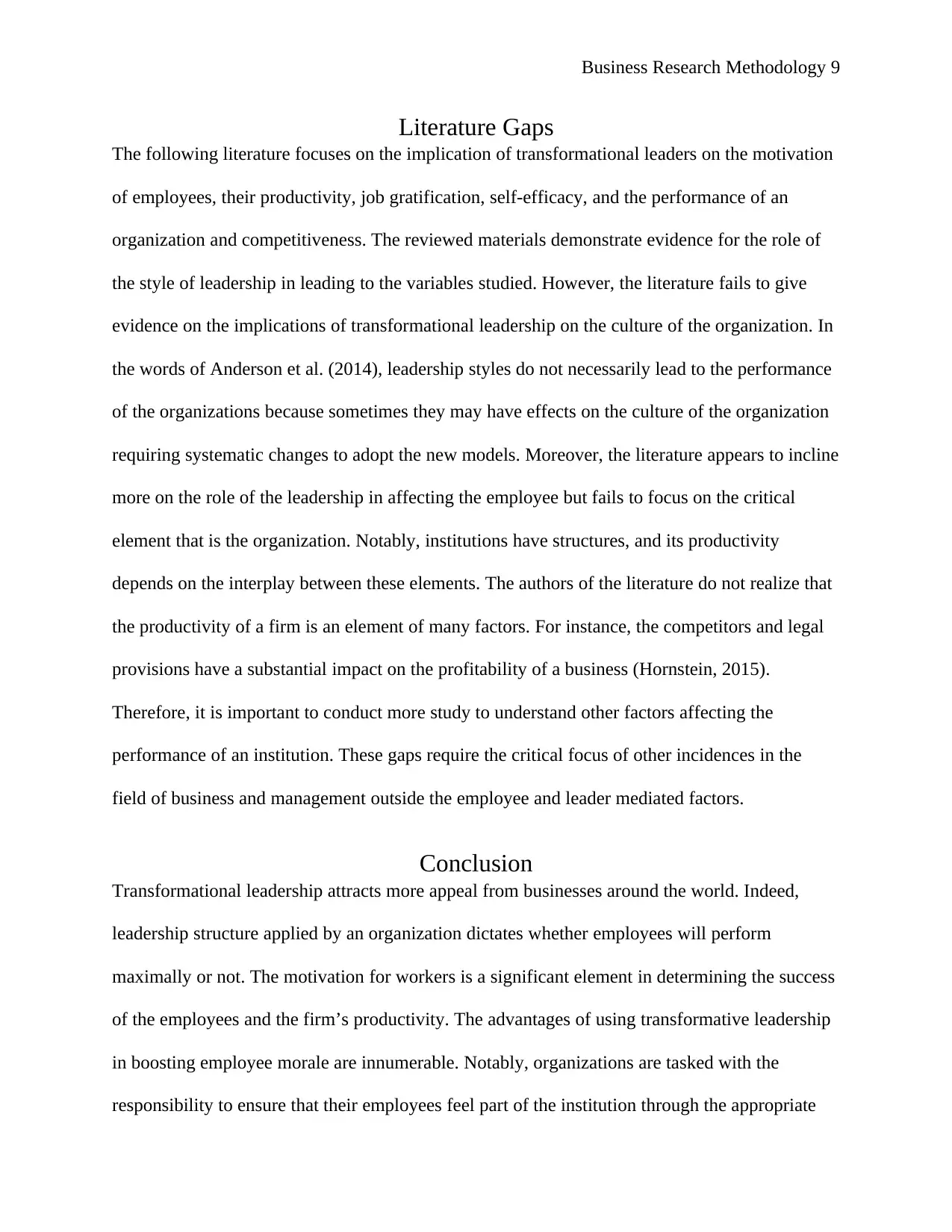
Literature Gaps
The following literature focuses on the implication of transformational leaders on the motivation
of employees, their productivity, job gratification, self-efficacy, and the performance of an
organization and competitiveness. The reviewed materials demonstrate evidence for the role of
the style of leadership in leading to the variables studied. However, the literature fails to give
evidence on the implications of transformational leadership on the culture of the organization. In
the words of Anderson et al. (2014), leadership styles do not necessarily lead to the performance
of the organizations because sometimes they may have effects on the culture of the organization
requiring systematic changes to adopt the new models. Moreover, the literature appears to incline
more on the role of the leadership in affecting the employee but fails to focus on the critical
element that is the organization. Notably, institutions have structures, and its productivity
depends on the interplay between these elements. The authors of the literature do not realize that
the productivity of a firm is an element of many factors. For instance, the competitors and legal
provisions have a substantial impact on the profitability of a business (Hornstein, 2015).
Therefore, it is important to conduct more study to understand other factors affecting the
performance of an institution. These gaps require the critical focus of other incidences in the
field of business and management outside the employee and leader mediated factors.
Conclusion
Transformational leadership attracts more appeal from businesses around the world. Indeed,
leadership structure applied by an organization dictates whether employees will perform
maximally or not. The motivation for workers is a significant element in determining the success
of the employees and the firm’s productivity. The advantages of using transformative leadership
in boosting employee morale are innumerable. Notably, organizations are tasked with the
responsibility to ensure that their employees feel part of the institution through the appropriate
Literature Gaps
The following literature focuses on the implication of transformational leaders on the motivation
of employees, their productivity, job gratification, self-efficacy, and the performance of an
organization and competitiveness. The reviewed materials demonstrate evidence for the role of
the style of leadership in leading to the variables studied. However, the literature fails to give
evidence on the implications of transformational leadership on the culture of the organization. In
the words of Anderson et al. (2014), leadership styles do not necessarily lead to the performance
of the organizations because sometimes they may have effects on the culture of the organization
requiring systematic changes to adopt the new models. Moreover, the literature appears to incline
more on the role of the leadership in affecting the employee but fails to focus on the critical
element that is the organization. Notably, institutions have structures, and its productivity
depends on the interplay between these elements. The authors of the literature do not realize that
the productivity of a firm is an element of many factors. For instance, the competitors and legal
provisions have a substantial impact on the profitability of a business (Hornstein, 2015).
Therefore, it is important to conduct more study to understand other factors affecting the
performance of an institution. These gaps require the critical focus of other incidences in the
field of business and management outside the employee and leader mediated factors.
Conclusion
Transformational leadership attracts more appeal from businesses around the world. Indeed,
leadership structure applied by an organization dictates whether employees will perform
maximally or not. The motivation for workers is a significant element in determining the success
of the employees and the firm’s productivity. The advantages of using transformative leadership
in boosting employee morale are innumerable. Notably, organizations are tasked with the
responsibility to ensure that their employees feel part of the institution through the appropriate
⊘ This is a preview!⊘
Do you want full access?
Subscribe today to unlock all pages.
Trusted by 1+ million students worldwide
Business Research Methodology 10
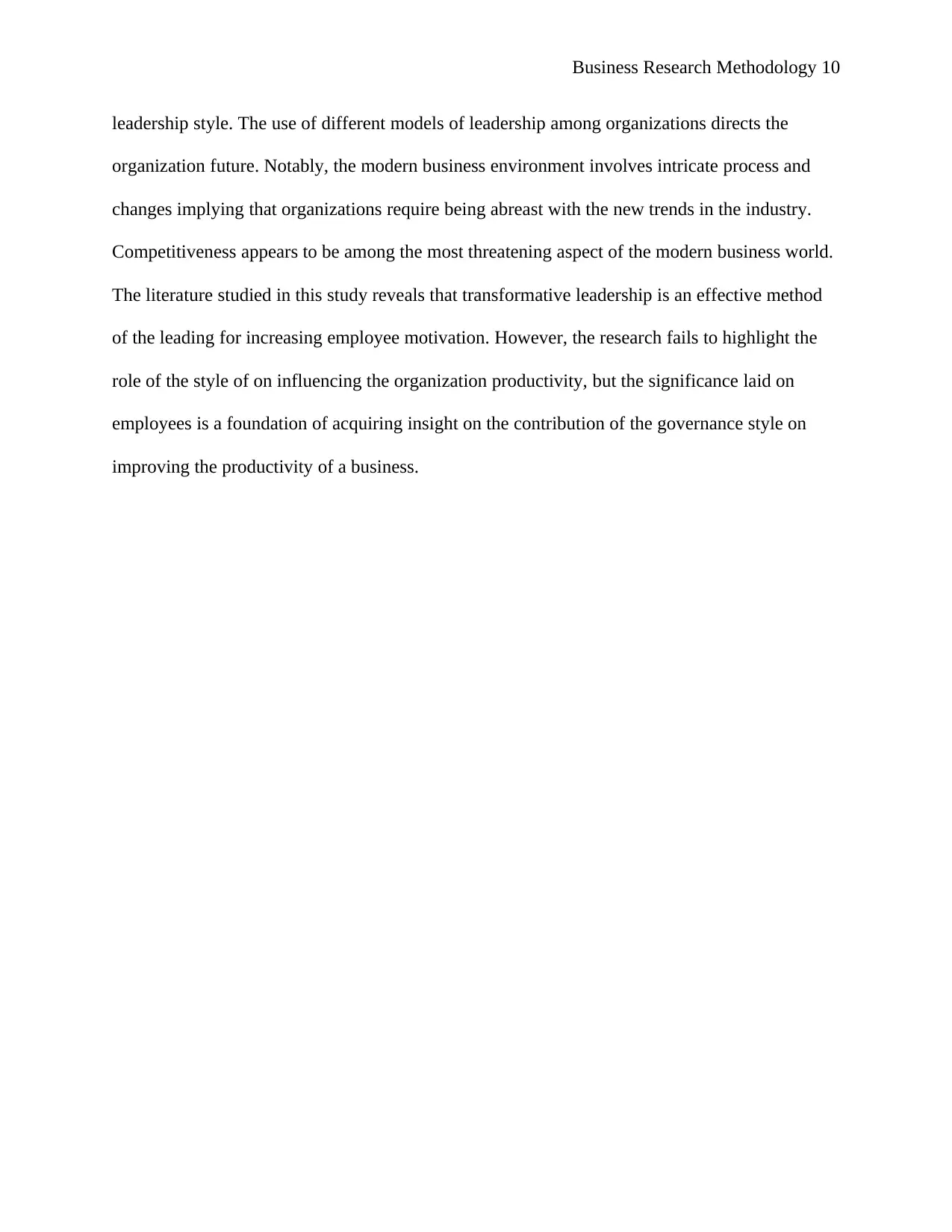
leadership style. The use of different models of leadership among organizations directs the
organization future. Notably, the modern business environment involves intricate process and
changes implying that organizations require being abreast with the new trends in the industry.
Competitiveness appears to be among the most threatening aspect of the modern business world.
The literature studied in this study reveals that transformative leadership is an effective method
of the leading for increasing employee motivation. However, the research fails to highlight the
role of the style of on influencing the organization productivity, but the significance laid on
employees is a foundation of acquiring insight on the contribution of the governance style on
improving the productivity of a business.
leadership style. The use of different models of leadership among organizations directs the
organization future. Notably, the modern business environment involves intricate process and
changes implying that organizations require being abreast with the new trends in the industry.
Competitiveness appears to be among the most threatening aspect of the modern business world.
The literature studied in this study reveals that transformative leadership is an effective method
of the leading for increasing employee motivation. However, the research fails to highlight the
role of the style of on influencing the organization productivity, but the significance laid on
employees is a foundation of acquiring insight on the contribution of the governance style on
improving the productivity of a business.
Paraphrase This Document
Need a fresh take? Get an instant paraphrase of this document with our AI Paraphraser
Business Research Methodology 11
References List
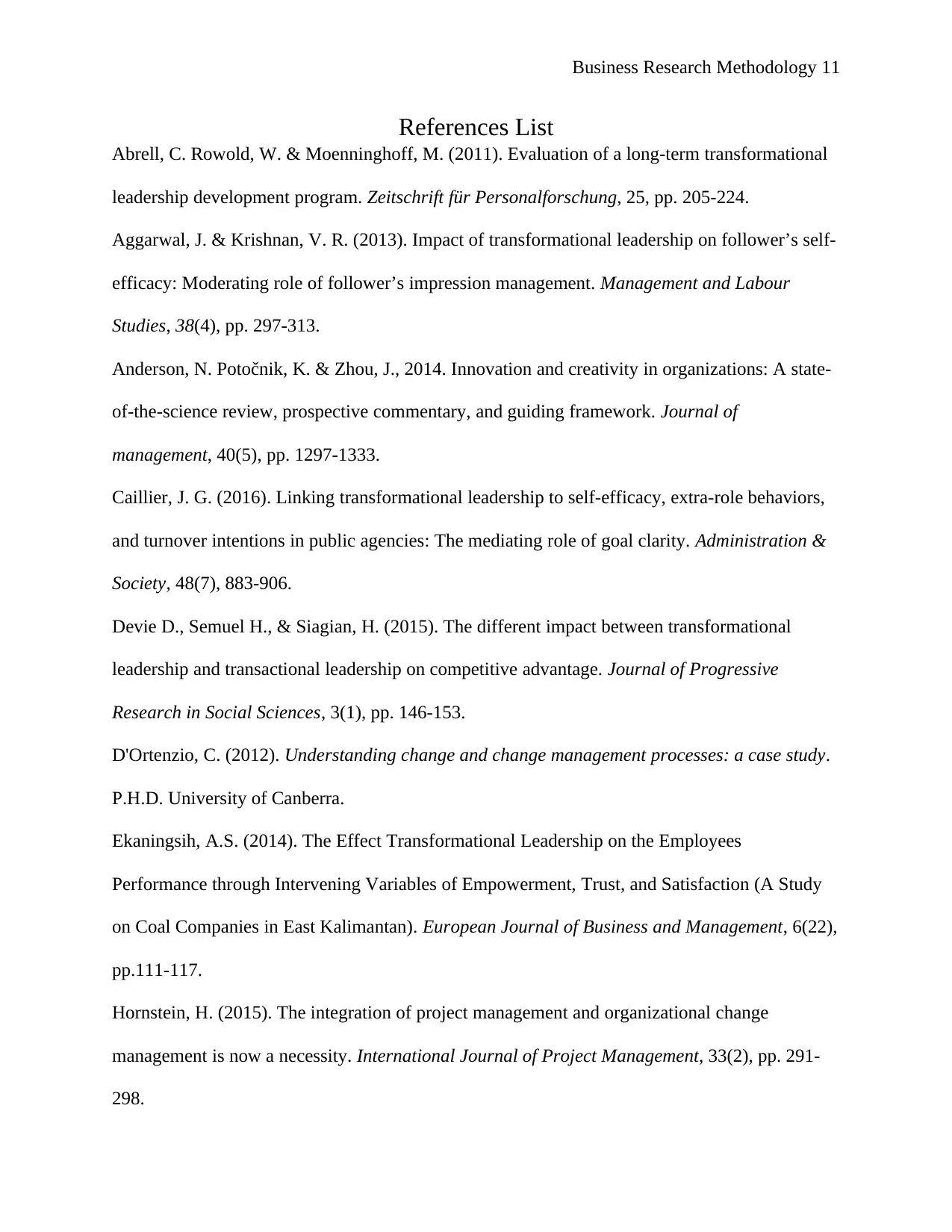
Abrell, C. Rowold, W. & Moenninghoff, M. (2011). Evaluation of a long-term transformational
leadership development program. Zeitschrift für Personalforschung, 25, pp. 205-224.
Aggarwal, J. & Krishnan, V. R. (2013). Impact of transformational leadership on follower’s self-
efficacy: Moderating role of follower’s impression management. Management and Labour
Studies, 38(4), pp. 297-313.
Anderson, N. Potočnik, K. & Zhou, J., 2014. Innovation and creativity in organizations: A state-
of-the-science review, prospective commentary, and guiding framework. Journal of
management, 40(5), pp. 1297-1333.
Caillier, J. G. (2016). Linking transformational leadership to self-efficacy, extra-role behaviors,
and turnover intentions in public agencies: The mediating role of goal clarity. Administration &
Society, 48(7), 883-906.
Devie D., Semuel H., & Siagian, H. (2015). The different impact between transformational
leadership and transactional leadership on competitive advantage. Journal of Progressive
Research in Social Sciences, 3(1), pp. 146-153.
D'Ortenzio, C. (2012). Understanding change and change management processes: a case study.
P.H.D. University of Canberra.
Ekaningsih, A.S. (2014). The Effect Transformational Leadership on the Employees
Performance through Intervening Variables of Empowerment, Trust, and Satisfaction (A Study
on Coal Companies in East Kalimantan). European Journal of Business and Management, 6(22),
pp.111-117.
Hornstein, H. (2015). The integration of project management and organizational change
management is now a necessity. International Journal of Project Management, 33(2), pp. 291-
298.
References List
Abrell, C. Rowold, W. & Moenninghoff, M. (2011). Evaluation of a long-term transformational
leadership development program. Zeitschrift für Personalforschung, 25, pp. 205-224.
Aggarwal, J. & Krishnan, V. R. (2013). Impact of transformational leadership on follower’s self-
efficacy: Moderating role of follower’s impression management. Management and Labour
Studies, 38(4), pp. 297-313.
Anderson, N. Potočnik, K. & Zhou, J., 2014. Innovation and creativity in organizations: A state-
of-the-science review, prospective commentary, and guiding framework. Journal of
management, 40(5), pp. 1297-1333.
Caillier, J. G. (2016). Linking transformational leadership to self-efficacy, extra-role behaviors,
and turnover intentions in public agencies: The mediating role of goal clarity. Administration &
Society, 48(7), 883-906.
Devie D., Semuel H., & Siagian, H. (2015). The different impact between transformational
leadership and transactional leadership on competitive advantage. Journal of Progressive
Research in Social Sciences, 3(1), pp. 146-153.
D'Ortenzio, C. (2012). Understanding change and change management processes: a case study.
P.H.D. University of Canberra.
Ekaningsih, A.S. (2014). The Effect Transformational Leadership on the Employees
Performance through Intervening Variables of Empowerment, Trust, and Satisfaction (A Study
on Coal Companies in East Kalimantan). European Journal of Business and Management, 6(22),
pp.111-117.
Hornstein, H. (2015). The integration of project management and organizational change
management is now a necessity. International Journal of Project Management, 33(2), pp. 291-
298.
Business Research Methodology 12
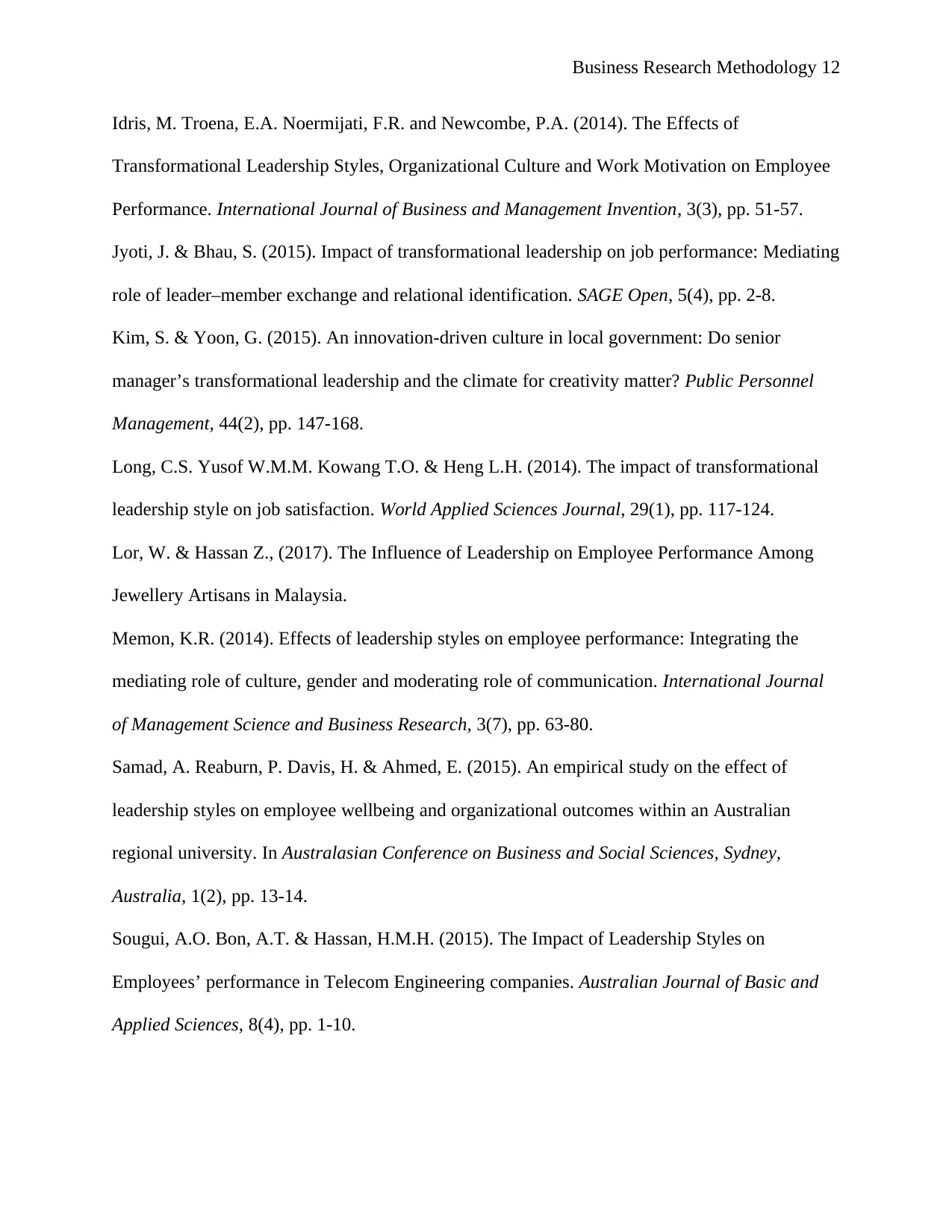
Idris, M. Troena, E.A. Noermijati, F.R. and Newcombe, P.A. (2014). The Effects of
Transformational Leadership Styles, Organizational Culture and Work Motivation on Employee
Performance. International Journal of Business and Management Invention, 3(3), pp. 51-57.
Jyoti, J. & Bhau, S. (2015). Impact of transformational leadership on job performance: Mediating
role of leader–member exchange and relational identification. SAGE Open, 5(4), pp. 2-8.
Kim, S. & Yoon, G. (2015). An innovation-driven culture in local government: Do senior
manager’s transformational leadership and the climate for creativity matter? Public Personnel
Management, 44(2), pp. 147-168.
Long, C.S. Yusof W.M.M. Kowang T.O. & Heng L.H. (2014). The impact of transformational
leadership style on job satisfaction. World Applied Sciences Journal, 29(1), pp. 117-124.
Lor, W. & Hassan Z., (2017). The Influence of Leadership on Employee Performance Among
Jewellery Artisans in Malaysia.
Memon, K.R. (2014). Effects of leadership styles on employee performance: Integrating the
mediating role of culture, gender and moderating role of communication. International Journal
of Management Science and Business Research, 3(7), pp. 63-80.
Samad, A. Reaburn, P. Davis, H. & Ahmed, E. (2015). An empirical study on the effect of
leadership styles on employee wellbeing and organizational outcomes within an Australian
regional university. In Australasian Conference on Business and Social Sciences, Sydney,
Australia, 1(2), pp. 13-14.
Sougui, A.O. Bon, A.T. & Hassan, H.M.H. (2015). The Impact of Leadership Styles on
Employees’ performance in Telecom Engineering companies. Australian Journal of Basic and
Applied Sciences, 8(4), pp. 1-10.
Idris, M. Troena, E.A. Noermijati, F.R. and Newcombe, P.A. (2014). The Effects of
Transformational Leadership Styles, Organizational Culture and Work Motivation on Employee
Performance. International Journal of Business and Management Invention, 3(3), pp. 51-57.
Jyoti, J. & Bhau, S. (2015). Impact of transformational leadership on job performance: Mediating
role of leader–member exchange and relational identification. SAGE Open, 5(4), pp. 2-8.
Kim, S. & Yoon, G. (2015). An innovation-driven culture in local government: Do senior
manager’s transformational leadership and the climate for creativity matter? Public Personnel
Management, 44(2), pp. 147-168.
Long, C.S. Yusof W.M.M. Kowang T.O. & Heng L.H. (2014). The impact of transformational
leadership style on job satisfaction. World Applied Sciences Journal, 29(1), pp. 117-124.
Lor, W. & Hassan Z., (2017). The Influence of Leadership on Employee Performance Among
Jewellery Artisans in Malaysia.
Memon, K.R. (2014). Effects of leadership styles on employee performance: Integrating the
mediating role of culture, gender and moderating role of communication. International Journal
of Management Science and Business Research, 3(7), pp. 63-80.
Samad, A. Reaburn, P. Davis, H. & Ahmed, E. (2015). An empirical study on the effect of
leadership styles on employee wellbeing and organizational outcomes within an Australian
regional university. In Australasian Conference on Business and Social Sciences, Sydney,
Australia, 1(2), pp. 13-14.
Sougui, A.O. Bon, A.T. & Hassan, H.M.H. (2015). The Impact of Leadership Styles on
Employees’ performance in Telecom Engineering companies. Australian Journal of Basic and
Applied Sciences, 8(4), pp. 1-10.
⊘ This is a preview!⊘
Do you want full access?
Subscribe today to unlock all pages.
Trusted by 1+ million students worldwide

1 out of 15


Related Documents


Your All-in-One AI-Powered Toolkit for Academic Success.
+13062052269
info@desklib.com
Available 24*7 on WhatsApp / Email
![[object Object]](/_next/static/media/star-bottom.7253800d.svg)
Unlock your academic potential
Copyright © 2020–2026 A2Z Services. All Rights Reserved. Developed and managed by ZUCOL.