Organisational Behaviour and Leadership Analysis: TESCO Plc Report
VerifiedAdded on 2023/01/07
|14
|4540
|95
Report
AI Summary
This report provides a detailed analysis of organizational behaviour and leadership within TESCO Plc, a prominent British retail company. It begins with an introduction to organizational behaviour and Human Resource Management, emphasizing their importance in enhancing productivity and achieving organizational goals. The main body of the report delves into various theories, including Classical, Neo-Classical, and Modern theories of organization, exploring their implications for TESCO. It also examines theories of diversity, such as Institutional and Resource-Based theories, highlighting their impact on organizational performance. Furthermore, the report covers different leadership theories, including Great Man Theory, Trait Theory, Contingency Theory, Situational Theory, Behavioural Theory, Participative Theories, and Management Theory, discussing their relevance in the context of TESCO. The report emphasizes the importance of teamwork, performance management, and the overall goals of an organization, with critical reflections on the application of these theories within TESCO. The analysis considers the company's structure, subsidiaries, and market position, offering insights into how TESCO can leverage these theories to improve its operations and achieve its objectives. The report concludes by summarizing the key findings and their implications for the organization's future.
1 | P a g e
Organisation
Behaviour & Human
Resource Management
Organisation
Behaviour & Human
Resource Management

Paraphrase This Document
Need a fresh take? Get an instant paraphrase of this document with our AI Paraphraser
2 | P a g e
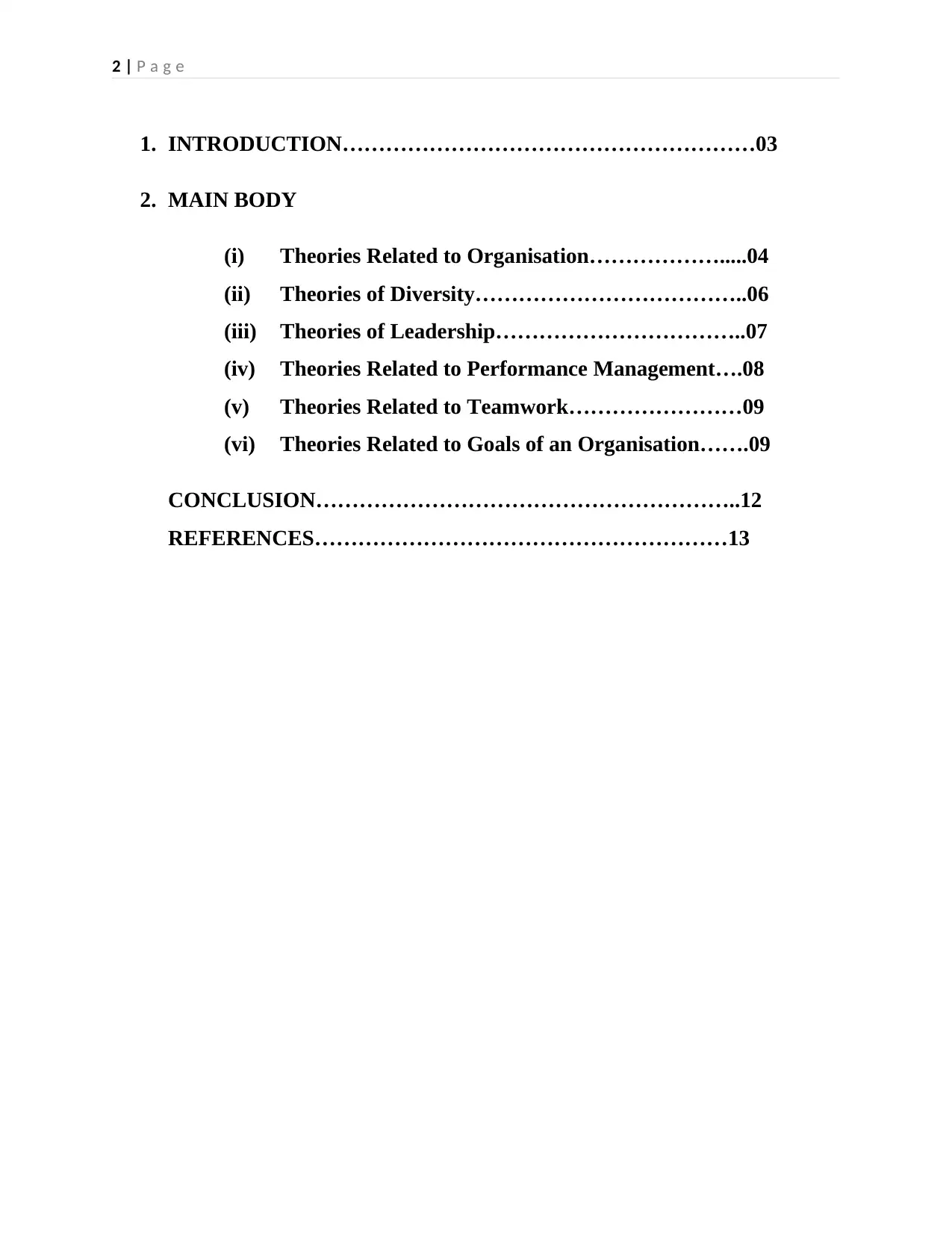
1. INTRODUCTION…………………………………………………03
2. MAIN BODY
(i) Theories Related to Organisation……………….....04
(ii) Theories of Diversity………………………………..06
(iii) Theories of Leadership……………………………..07
(iv) Theories Related to Performance Management….08
(v) Theories Related to Teamwork……………………09
(vi) Theories Related to Goals of an Organisation…….09
CONCLUSION…………………………………………………..12
REFERENCES…………………………………………………13
1. INTRODUCTION…………………………………………………03
2. MAIN BODY
(i) Theories Related to Organisation……………….....04
(ii) Theories of Diversity………………………………..06
(iii) Theories of Leadership……………………………..07
(iv) Theories Related to Performance Management….08
(v) Theories Related to Teamwork……………………09
(vi) Theories Related to Goals of an Organisation…….09
CONCLUSION…………………………………………………..12
REFERENCES…………………………………………………13
3 | P a g e
INTRODUCTION
Organisation Behaviour is the study of human behaviour within the organisation and
the activity which they perform within the entity for attaining the goals on specific time period. It
is necessary at the moment for any of the entity because it certainly helps to enhance the
productivity which is quite essential. On the other side, Human Resource Management is
explained as the process of strategic approach which is used within the organisation for the
purpose of managing the existing as well as newly hired candidate who can contribute in
accomplishing the goals of a company. The main purpose of any of the HRM concept is to
ensure that organisation is able to perform effectively for accomplishing their goals with the help
of talent which is available in the company. In this respective assignment, the chosen
organisation is TESCO Plc which is a British entity. Currently organisation is able to conduct
their business activity in different part of the world due to which they are able to compete even at
a global market. It is conducting its business activity in the retail sector where vast competition
can be easily seen at the moment. The found of the company is Jack Cohen who established the
company in the year 1919. The headquarter of the company is located in Welwyn Garden City,
Hertfordshire, England. Around 6800 shops are bring operated which automatically shows that
how well company is able to perform at international market. In present scenario, around 500000
employees are working with the company who has been contributing successfully in
accomplishing the goals. Some of the popular subsidiary of TESCO plc are Tesco Bank, Tesco
Mobile, Tesco Ireland, Spenhill and many more. As per the data of 2019 the net income of the
company is around £1.320 billion.
In context of the file there are number of topics which will be analysed in detail such as
theories related to organisational behaviour will be analysed. It will also focus that how
formation of different team, and diversified working environment can be helpful within the
whole project. Even equal importance will be given to performance management along with
leadership. As it is said that personal experience matters the most so that organisational
INTRODUCTION
Organisation Behaviour is the study of human behaviour within the organisation and
the activity which they perform within the entity for attaining the goals on specific time period. It
is necessary at the moment for any of the entity because it certainly helps to enhance the
productivity which is quite essential. On the other side, Human Resource Management is
explained as the process of strategic approach which is used within the organisation for the
purpose of managing the existing as well as newly hired candidate who can contribute in
accomplishing the goals of a company. The main purpose of any of the HRM concept is to
ensure that organisation is able to perform effectively for accomplishing their goals with the help
of talent which is available in the company. In this respective assignment, the chosen
organisation is TESCO Plc which is a British entity. Currently organisation is able to conduct
their business activity in different part of the world due to which they are able to compete even at
a global market. It is conducting its business activity in the retail sector where vast competition
can be easily seen at the moment. The found of the company is Jack Cohen who established the
company in the year 1919. The headquarter of the company is located in Welwyn Garden City,
Hertfordshire, England. Around 6800 shops are bring operated which automatically shows that
how well company is able to perform at international market. In present scenario, around 500000
employees are working with the company who has been contributing successfully in
accomplishing the goals. Some of the popular subsidiary of TESCO plc are Tesco Bank, Tesco
Mobile, Tesco Ireland, Spenhill and many more. As per the data of 2019 the net income of the
company is around £1.320 billion.
In context of the file there are number of topics which will be analysed in detail such as
theories related to organisational behaviour will be analysed. It will also focus that how
formation of different team, and diversified working environment can be helpful within the
whole project. Even equal importance will be given to performance management along with
leadership. As it is said that personal experience matters the most so that organisational
⊘ This is a preview!⊘
Do you want full access?
Subscribe today to unlock all pages.

Trusted by 1+ million students worldwide
4 | P a g e
performance will be reflected in the file with the help of critical reflections. Finally, application
of theories will be categorised in the file which will have a direct link to the organisational
behaviour. Understanding of all this mentioned concept can be helpful for obtaining the effective
result.
While discussing it in detail about the above information, they all are equally important
for understanding the concept of organisational behaviour. In simple words, organisational
behaviour covers wider aspects which means that it includes team member, formation of team,
diversity and number of other factors. For example: if company will be able to work by the
formation of different teams, it will be effective in organisational behaviour. Here, management
can easily identify about the behaviour of every individuals who are working within the team. It
can certainly provide the way to improve the performance which is quite necessary within the
concept of organisational behaviour. In the similar manner, performance management is equally
important because it discusses that whether each of the work within the organisation is being
performed as per the requirement or not. It means that whether company is performing for
accomplishing the goals or not. Along with it the concept of leadership is also equally important
because they are the one who helps to identify that whether employees are able to perform their
task as per the requirement or not and if not what are the necessary steps that they must be able
to take so that goals and target can be accomplished. Concept of leadership is crucial within
organisational behaviour because it is said that whenever any of the entity is able to hire effective
leader within the organisation, then there is higher probability that they can work in the favour of
a company by developing the positive mindset. In the similar manner theories of organisational
behaviour is necessary because that will guide to understand about the mindset of the employees
who plays the crucial role within the organisation. Understanding of all this mentioned concept is
important within the project is necessary because it will all the organisation like TESCO to find
out the suitable way in which they can perform their any of the task through which they can
accomplish their goals and target. All of this key factor can allow to complete the project in
specified manner so that chances of making any of the mistake will reduce significantly which
mean that there will be higher probability of understanding the concept in detail which is quite
important in current scenario.
MAIN BODY
performance will be reflected in the file with the help of critical reflections. Finally, application
of theories will be categorised in the file which will have a direct link to the organisational
behaviour. Understanding of all this mentioned concept can be helpful for obtaining the effective
result.
While discussing it in detail about the above information, they all are equally important
for understanding the concept of organisational behaviour. In simple words, organisational
behaviour covers wider aspects which means that it includes team member, formation of team,
diversity and number of other factors. For example: if company will be able to work by the
formation of different teams, it will be effective in organisational behaviour. Here, management
can easily identify about the behaviour of every individuals who are working within the team. It
can certainly provide the way to improve the performance which is quite necessary within the
concept of organisational behaviour. In the similar manner, performance management is equally
important because it discusses that whether each of the work within the organisation is being
performed as per the requirement or not. It means that whether company is performing for
accomplishing the goals or not. Along with it the concept of leadership is also equally important
because they are the one who helps to identify that whether employees are able to perform their
task as per the requirement or not and if not what are the necessary steps that they must be able
to take so that goals and target can be accomplished. Concept of leadership is crucial within
organisational behaviour because it is said that whenever any of the entity is able to hire effective
leader within the organisation, then there is higher probability that they can work in the favour of
a company by developing the positive mindset. In the similar manner theories of organisational
behaviour is necessary because that will guide to understand about the mindset of the employees
who plays the crucial role within the organisation. Understanding of all this mentioned concept is
important within the project is necessary because it will all the organisation like TESCO to find
out the suitable way in which they can perform their any of the task through which they can
accomplish their goals and target. All of this key factor can allow to complete the project in
specified manner so that chances of making any of the mistake will reduce significantly which
mean that there will be higher probability of understanding the concept in detail which is quite
important in current scenario.
MAIN BODY
Paraphrase This Document
Need a fresh take? Get an instant paraphrase of this document with our AI Paraphraser
5 | P a g e
Theories Related to Organisation
Classical Theory of Organisation
According to this theory of organisation, it was considered that an organization is a machine and
all its members are the component of the machine. The people who evolved this theory was of
opinion that if an organization wants to increase its efficiency, it is must that the efficiency of the
people working there must be increased. According to this theory the management of the
company must give emphasis on efficiency. This theory is also known as Structural Theory of
Organisation(Batten, Lončarski and Szilagyi, 2018). As per the writers who have evolved this
theory, this theory is based upon four pillars which are Division of Labour, Scalar and Functional
Process, Structure and Span of Control.
There are various criticisms related to this theory as this theory only emphasized upon the
management of the organisation but did not emphasized upon the decision making process of the
organisation. Also the another criticism regarding this theory is that, the evolvers of this theory
has totally ignored the human behaviour and did not realized that human nature is generally of
complex nature.
Neo-Classical Theory of Organisation
The main emphasis of this theory was upon the physiological and mechanical
variables of organisational functioning. As per this theory, the situation of an
organisation must be viewed in social, economic and technical terms. It was also
stated that as per this theory that an organisation is a social system which is
nothing but the composition of numerous interacting parts(Cherry, 2017). It was
also opined that a human being is independent and his behaviour will be
dependent upon the various social factors. As per this theory, the focus of the
organisation must be upon the teamwork as it enhances the productivity. Also it
should be ensured that there is proper communication in the organization as it is
necessary for the better functioning of the organization. The Neo Classical theory
is different from Classical theory majorly in 3 aspects such as Flat Structure,
Decentralisation and Informal Organisations.
Modern Theory of Organisation
Theories Related to Organisation
Classical Theory of Organisation
According to this theory of organisation, it was considered that an organization is a machine and
all its members are the component of the machine. The people who evolved this theory was of
opinion that if an organization wants to increase its efficiency, it is must that the efficiency of the
people working there must be increased. According to this theory the management of the
company must give emphasis on efficiency. This theory is also known as Structural Theory of
Organisation(Batten, Lončarski and Szilagyi, 2018). As per the writers who have evolved this
theory, this theory is based upon four pillars which are Division of Labour, Scalar and Functional
Process, Structure and Span of Control.
There are various criticisms related to this theory as this theory only emphasized upon the
management of the organisation but did not emphasized upon the decision making process of the
organisation. Also the another criticism regarding this theory is that, the evolvers of this theory
has totally ignored the human behaviour and did not realized that human nature is generally of
complex nature.
Neo-Classical Theory of Organisation
The main emphasis of this theory was upon the physiological and mechanical
variables of organisational functioning. As per this theory, the situation of an
organisation must be viewed in social, economic and technical terms. It was also
stated that as per this theory that an organisation is a social system which is
nothing but the composition of numerous interacting parts(Cherry, 2017). It was
also opined that a human being is independent and his behaviour will be
dependent upon the various social factors. As per this theory, the focus of the
organisation must be upon the teamwork as it enhances the productivity. Also it
should be ensured that there is proper communication in the organization as it is
necessary for the better functioning of the organization. The Neo Classical theory
is different from Classical theory majorly in 3 aspects such as Flat Structure,
Decentralisation and Informal Organisations.
Modern Theory of Organisation
6 | P a g e
As per this theory which has evolved recently in around 1960s, there are two approaches
that are Systems Approach and Contingency Approach. As per the systems approach
the whole organisation should be studied in the totality. This approach states that all the
variables which are dependent upon each other must be analyses in a proper manner. As
per contingency approach the design of the organisation must be in that way so that it
suits that particular organisation because it is not necessary that each of the design will be
appropriately suited to every organisation(Darcy and Manzi, 2017).
Theories of Diversity
Institutional Theory of Diversity: The whole theory, related to organizational theory,
acknowledges that perhaps the social atmosphere contained in an organisation cannot be isolated
in order to evaluate the organisational structure. It should also be recognized, in order to
determine the phenomenon of the company, that even the conduct of workers in companies and
institutions itself has restricting aspects including the laws, legislation, guidelines, policies and
professional and personal norms. Since organisations comply with common norms and rules,
these begin to establish similar institutional framework. Such consistency demonstrates how
businesses are going to comply with the act and begin to gain credibility for the processes. By
displaying credibility in its behaviour, companies show that their goals are and may start to
obtain financial capital from everyone else. In summary, since the laws mandate organisations to
be comprehensive, these should demonstrate to both people inside the organisation and anyone
outside the organisation that they have been compliant with any of these rules and policies. If an
company fails to comply with all applicable laws or rules, its activities may be challenged and
may also be dismissed for breach of the law (Elsmore, 2017).
Resource Based Theory of Diversity: A major objective of a resource-based Diversity
strategic approach is on how well the introduction of change can impact management functions.
There have been several types of resources which companies possess: physical capital, financial
capital , human capital, and corporate capital. Such tools may either support and impede that
activities of the company. Companies are willing to use certain tools in areas that can allow to
improve the performance of a company (Gkorezis and Petridou, 2017). From such a market
viewpoint, organisations that are far mo re multicultural gain competitive edge over
As per this theory which has evolved recently in around 1960s, there are two approaches
that are Systems Approach and Contingency Approach. As per the systems approach
the whole organisation should be studied in the totality. This approach states that all the
variables which are dependent upon each other must be analyses in a proper manner. As
per contingency approach the design of the organisation must be in that way so that it
suits that particular organisation because it is not necessary that each of the design will be
appropriately suited to every organisation(Darcy and Manzi, 2017).
Theories of Diversity
Institutional Theory of Diversity: The whole theory, related to organizational theory,
acknowledges that perhaps the social atmosphere contained in an organisation cannot be isolated
in order to evaluate the organisational structure. It should also be recognized, in order to
determine the phenomenon of the company, that even the conduct of workers in companies and
institutions itself has restricting aspects including the laws, legislation, guidelines, policies and
professional and personal norms. Since organisations comply with common norms and rules,
these begin to establish similar institutional framework. Such consistency demonstrates how
businesses are going to comply with the act and begin to gain credibility for the processes. By
displaying credibility in its behaviour, companies show that their goals are and may start to
obtain financial capital from everyone else. In summary, since the laws mandate organisations to
be comprehensive, these should demonstrate to both people inside the organisation and anyone
outside the organisation that they have been compliant with any of these rules and policies. If an
company fails to comply with all applicable laws or rules, its activities may be challenged and
may also be dismissed for breach of the law (Elsmore, 2017).
Resource Based Theory of Diversity: A major objective of a resource-based Diversity
strategic approach is on how well the introduction of change can impact management functions.
There have been several types of resources which companies possess: physical capital, financial
capital , human capital, and corporate capital. Such tools may either support and impede that
activities of the company. Companies are willing to use certain tools in areas that can allow to
improve the performance of a company (Gkorezis and Petridou, 2017). From such a market
viewpoint, organisations that are far mo re multicultural gain competitive edge over
⊘ This is a preview!⊘
Do you want full access?
Subscribe today to unlock all pages.
Trusted by 1+ million students worldwide
7 | P a g e
organisations which are homogeneous. Cultural diversity inside companies enhances economic
efficiency whenever a development as well as transformation approach is used to show whether
businesses with far more workforce diversity have reported significant rates of turnover and also
that diversity management practises align effectively mostly with strategic orientation, leading to
increased productivity to improved decision making. Entities which are multicultural gain some
benefits over organisations which struggle to enforce policies upon the workforce.
Theories of Leadership
Great Man Theory: As per this theory some people born with certain qualities of
leadership and these qualities are god gifted to them so that they can efficiently show their
leadership skills. It is a traditional theory related to the leadership which states that leadership
skills cannot be developed in a person, either he will born with it or without it(Kitchin, 2017).
Trait Theory: It is the theory that often define a person's character provided by
representatives. For instance, characteristics such as sociability, self-confidence, as well as
emotional strength both are traits which might possibly be connected to good leaders.
Contingency Theory: It is totally based upon the different variables which signifies that
which type of leadership would be required for a particular variable. It states that a single style of
leadership will not be perfect which could be used in each type of situation. The leadership skills
must adopted as per the demanding situation.
Situational Theory of Leadership: This theory of leadership suggests that a leader
should choose and modify his leadership skills as per the situation requires so that his leadership
quality lead to the better productivity of the employees. These leadership styles must be based on
various variables and these various leadership styles would be more appropriate while making
different decisions(MacKie, 2017).
Behavioural Theory: It is just opposite to the Great Man Theories. As per this
behavioural theory of leadership, leaders are made through their actions and they are not born
with the leadership qualities. According to this theory of leadership, a person can become an
effective leader by the way of teaching as well as observation.
organisations which are homogeneous. Cultural diversity inside companies enhances economic
efficiency whenever a development as well as transformation approach is used to show whether
businesses with far more workforce diversity have reported significant rates of turnover and also
that diversity management practises align effectively mostly with strategic orientation, leading to
increased productivity to improved decision making. Entities which are multicultural gain some
benefits over organisations which struggle to enforce policies upon the workforce.
Theories of Leadership
Great Man Theory: As per this theory some people born with certain qualities of
leadership and these qualities are god gifted to them so that they can efficiently show their
leadership skills. It is a traditional theory related to the leadership which states that leadership
skills cannot be developed in a person, either he will born with it or without it(Kitchin, 2017).
Trait Theory: It is the theory that often define a person's character provided by
representatives. For instance, characteristics such as sociability, self-confidence, as well as
emotional strength both are traits which might possibly be connected to good leaders.
Contingency Theory: It is totally based upon the different variables which signifies that
which type of leadership would be required for a particular variable. It states that a single style of
leadership will not be perfect which could be used in each type of situation. The leadership skills
must adopted as per the demanding situation.
Situational Theory of Leadership: This theory of leadership suggests that a leader
should choose and modify his leadership skills as per the situation requires so that his leadership
quality lead to the better productivity of the employees. These leadership styles must be based on
various variables and these various leadership styles would be more appropriate while making
different decisions(MacKie, 2017).
Behavioural Theory: It is just opposite to the Great Man Theories. As per this
behavioural theory of leadership, leaders are made through their actions and they are not born
with the leadership qualities. According to this theory of leadership, a person can become an
effective leader by the way of teaching as well as observation.
Paraphrase This Document
Need a fresh take? Get an instant paraphrase of this document with our AI Paraphraser
8 | P a g e
Participative Theories: According to this theory of leadership the leader should posses
the quality in which he should take the input of other team members in the completion of the
task. These leaders will try to encourage the other employees to work in more efficient manner
and will motivate the team members so that the members of the team can feel that they are
important to the organisation(Ruck, 2017).
Management Theory: As per this theory the leader must control and supervise the work
which has been done by its team members. If the proper management skills will be implemented
while discharging the duties of a leader, a leader can ensure that his team members are working
in a productive manner. In this type of leadership, there will be system of rewards and also
punishment which would be based upon the performance of each team member.
Theories Related to Performance Management
The Goal Setting Theory: The concept was postulated by Edwin Locke in 1968. The
whole theory suggests that the primary objectives set by a staff member play a major role in
encouraging him or her to achieve competitiveness. It is because workers want to pursue certain
objectives. When these targets aren't really accomplished, then either improve their situation or
change the objectives and make it quite practical. If performance increases, it can contribute in
the accomplishment of desired goals of the performance measurement system (Rudani, 2020).
Expectancy Theory: The concept is based on the notion where persons change their
actions in the organisation with the help of the expected satisfaction of the desired objectives.
Individual people alter the activities in a way that is most likely related themselves to accomplish
these objectives. Such concept encompasses the theory of performance evaluation because it is
assumed that success is affected by especially those with special events.
Theories Related to Teamwork
Bruce Tuckman’s Model of Team Stages: A concept of Bruce Tuckman was founded
in 1965 and has already been applied to numerous organisations and situations. To four different
steps of formation, storming, uniformity and efficiency, the whole strategy is mainly linked to as
the root of strong team forming (Srivastava, 2017).
Participative Theories: According to this theory of leadership the leader should posses
the quality in which he should take the input of other team members in the completion of the
task. These leaders will try to encourage the other employees to work in more efficient manner
and will motivate the team members so that the members of the team can feel that they are
important to the organisation(Ruck, 2017).
Management Theory: As per this theory the leader must control and supervise the work
which has been done by its team members. If the proper management skills will be implemented
while discharging the duties of a leader, a leader can ensure that his team members are working
in a productive manner. In this type of leadership, there will be system of rewards and also
punishment which would be based upon the performance of each team member.
Theories Related to Performance Management
The Goal Setting Theory: The concept was postulated by Edwin Locke in 1968. The
whole theory suggests that the primary objectives set by a staff member play a major role in
encouraging him or her to achieve competitiveness. It is because workers want to pursue certain
objectives. When these targets aren't really accomplished, then either improve their situation or
change the objectives and make it quite practical. If performance increases, it can contribute in
the accomplishment of desired goals of the performance measurement system (Rudani, 2020).
Expectancy Theory: The concept is based on the notion where persons change their
actions in the organisation with the help of the expected satisfaction of the desired objectives.
Individual people alter the activities in a way that is most likely related themselves to accomplish
these objectives. Such concept encompasses the theory of performance evaluation because it is
assumed that success is affected by especially those with special events.
Theories Related to Teamwork
Bruce Tuckman’s Model of Team Stages: A concept of Bruce Tuckman was founded
in 1965 and has already been applied to numerous organisations and situations. To four different
steps of formation, storming, uniformity and efficiency, the whole strategy is mainly linked to as
the root of strong team forming (Srivastava, 2017).
9 | P a g e
Belbin’s Theory of team roles: Belbin has drawn up a list of nine positions in which
each squad must have. Such positions include Factory, Resource Investigator, Administrator,
Shaper, evaluator, Team Leader, integrator, Completer-Finisher, and Professional.
Hierarchy of Needs theory by Abraham Maslow: Maslow also developed a hierarchy
of human motivation. The lowest begins with physiological needs which are quite essential. The
very next segment is Safety as well as Security while working within the premises of a company.
The third segment relates to Love / Belonging, an instance of which is parents,
spouse, colleagues. Then, there is Esteem, which means anything like admiration for others. The
final segment is self-actualization, an aspect of which is ethics.
Carl Jung’s Colour theory: Jung 's theory seems to be relatable with colour influences
the human behaviour. This directly indicates that why some of the people has to always face
certain types of problem while working within the premises of a company.
Team Analysis Theory: The idea would be that ultimately every group would fall apart,
so you'll need to understand that situation and according to that re-evaluate should be done so
that it can be identified that what were the main reason behind the occurrence of problem (Wong
and Wong, 2017).
Theories Related to Goals of an Organisation
Goal Setting Theory of Management: Everything just describes the effect of
establishing objectives on organizational commitment. Researcher Edwin Locke showed that
employees that set specific, difficult targets significantly outperformed while those who set
particular, clear chances. Locke suggested five principles of goal-setting: transparency,
difficulty, engagement, input and complexity of the work. Successful objective-setting
principles:
Clarity: A clear, measurable goal is more achievable than one that is poorly defined. In
other words, be specific! The most effective goals have a specific timeline for completion.
Challenge: The goal must have a decent level of difficulty in order to motivate you to
strive toward the goal.
Belbin’s Theory of team roles: Belbin has drawn up a list of nine positions in which
each squad must have. Such positions include Factory, Resource Investigator, Administrator,
Shaper, evaluator, Team Leader, integrator, Completer-Finisher, and Professional.
Hierarchy of Needs theory by Abraham Maslow: Maslow also developed a hierarchy
of human motivation. The lowest begins with physiological needs which are quite essential. The
very next segment is Safety as well as Security while working within the premises of a company.
The third segment relates to Love / Belonging, an instance of which is parents,
spouse, colleagues. Then, there is Esteem, which means anything like admiration for others. The
final segment is self-actualization, an aspect of which is ethics.
Carl Jung’s Colour theory: Jung 's theory seems to be relatable with colour influences
the human behaviour. This directly indicates that why some of the people has to always face
certain types of problem while working within the premises of a company.
Team Analysis Theory: The idea would be that ultimately every group would fall apart,
so you'll need to understand that situation and according to that re-evaluate should be done so
that it can be identified that what were the main reason behind the occurrence of problem (Wong
and Wong, 2017).
Theories Related to Goals of an Organisation
Goal Setting Theory of Management: Everything just describes the effect of
establishing objectives on organizational commitment. Researcher Edwin Locke showed that
employees that set specific, difficult targets significantly outperformed while those who set
particular, clear chances. Locke suggested five principles of goal-setting: transparency,
difficulty, engagement, input and complexity of the work. Successful objective-setting
principles:
Clarity: A clear, measurable goal is more achievable than one that is poorly defined. In
other words, be specific! The most effective goals have a specific timeline for completion.
Challenge: The goal must have a decent level of difficulty in order to motivate you to
strive toward the goal.
⊘ This is a preview!⊘
Do you want full access?
Subscribe today to unlock all pages.
Trusted by 1+ million students worldwide
10 | P a g e
Commitment: Put deliberate effort into meeting this goal. Share your goal with someone
else in order to increase your accountability to meet that goal.
Feedback: Created a system for collecting reports on the advancement towards a target.
If it points out to be really hard to lose 30 pounds in 4 months, it's easier to change the magnitude
of the target throughout the middle of the period rather than throw away fully
Task complexity: If the objective is extremely challenging, be certain to allow oneself
sufficient time to resolve the learning curve required in completing the challenge. In other terms,
if the target is very difficult, definitely give yourself enough support to bring out the best
opportunity to succeed.
Every person should by applying the above-mentioned theories can ensure the success of
any organisation. As these theories ate very helpful in attaining the goals and objectives of the
organisation in a smooth manner. If these above theories will be applied to the working of the
organisation, the work will be done in a systematic manner which will ensure that it is giving the
fruitful result (Zhang, Jiang and Jin, 2020). For instance, a good leader knows that how to take
inputs from the members of his team so that the work which was done by its members is of good
quality. It is also necessary that work which are done in an organisation must be done through
teamwork as many minds working on the same issue will give the more productive and fruitful
results which will be helpful in the growth of the business. There must be pre-set goals and
objectives of the organisation. Having goals in the company or organisation will help in planning
the whole task in such a manner from the initial stage only, which will help in achieving the
goals of the organisation.
Setting a goal is a perfect opportunity to promote success as well as remain inspired.
After all, many others have set deadlines which are unsuccessful in driving us all to do our best.
Because once you help the community live with a task or strive to change the element of the
everyday life, consider deeply about the objectives you created. Make sure that every other
mission represents any some or all of the given principles: transparency, difficulty, dedication
and reviews.
Commitment: Put deliberate effort into meeting this goal. Share your goal with someone
else in order to increase your accountability to meet that goal.
Feedback: Created a system for collecting reports on the advancement towards a target.
If it points out to be really hard to lose 30 pounds in 4 months, it's easier to change the magnitude
of the target throughout the middle of the period rather than throw away fully
Task complexity: If the objective is extremely challenging, be certain to allow oneself
sufficient time to resolve the learning curve required in completing the challenge. In other terms,
if the target is very difficult, definitely give yourself enough support to bring out the best
opportunity to succeed.
Every person should by applying the above-mentioned theories can ensure the success of
any organisation. As these theories ate very helpful in attaining the goals and objectives of the
organisation in a smooth manner. If these above theories will be applied to the working of the
organisation, the work will be done in a systematic manner which will ensure that it is giving the
fruitful result (Zhang, Jiang and Jin, 2020). For instance, a good leader knows that how to take
inputs from the members of his team so that the work which was done by its members is of good
quality. It is also necessary that work which are done in an organisation must be done through
teamwork as many minds working on the same issue will give the more productive and fruitful
results which will be helpful in the growth of the business. There must be pre-set goals and
objectives of the organisation. Having goals in the company or organisation will help in planning
the whole task in such a manner from the initial stage only, which will help in achieving the
goals of the organisation.
Setting a goal is a perfect opportunity to promote success as well as remain inspired.
After all, many others have set deadlines which are unsuccessful in driving us all to do our best.
Because once you help the community live with a task or strive to change the element of the
everyday life, consider deeply about the objectives you created. Make sure that every other
mission represents any some or all of the given principles: transparency, difficulty, dedication
and reviews.
Paraphrase This Document
Need a fresh take? Get an instant paraphrase of this document with our AI Paraphraser
11 | P a g e
Work with your youth ling to set goals that are appropriate and achievable given her
abilities. Begin by letting her set her own goal. Perhaps she wants to get 100% on her next math
test. This goal meets the criteria of being clear, challenging, and is something she has committed
to. Talk together about whether that is an attainable goal. If she routinely gets C’s on math
assignments, achieving a perfect score might be a poor goal. Next, set a clear action plan for
achieving the goal. Consider the complexity of the task and how much time will be needed to be
successful.
As in this project report, the researcher is concerned with Tesco Plc. Tesco for the
betterment of their business must ensure that they adopt the Maslow’s Theory of Leadership so
that the needs of the members can be determined. If the needs of the team members would be
satisfied by Tesco Plc., the workers will work in the more efficient and more productive manner.
It is also necessary for the Tesco Plc. to set their goals and objectives which they want to achieve
so that the employees who are working in the organisation must be having a clarity that what
goals they are expected to achieve and by this they will modify their working techniques in that
appropriate manner only which will be beneficial for the company in order to ensure their
success.
Also it is necessary for Tesco to do all the tasks which they are planning to do through
teamwork only so that the chances become high regarding the completion of the task in the more
efficient manner.
CONCLUSION
After having the detail analysis to the file, it is concluded that the concept of organisation
behaviour is quite important for the better performance of a company. It is said that any of the
entity can perform effectively if their management is able to identify about the behaviour of their
employees who plays the significant role within the organisation. At the same time, it is said that
there is significant role of Human Resource Management because they are the one who can hire
the talent as per the requirement of a company. Even their support to the employees in training
and motivation process can be the crucial for obtaining the favourable result. There are different
types of theory of organisation which are quite effective for the business organisation because it
provides the way that how organisation needs to be managed and how any of the work is to be
performed within the entity for effective result. In the similar manner there are different types of
Work with your youth ling to set goals that are appropriate and achievable given her
abilities. Begin by letting her set her own goal. Perhaps she wants to get 100% on her next math
test. This goal meets the criteria of being clear, challenging, and is something she has committed
to. Talk together about whether that is an attainable goal. If she routinely gets C’s on math
assignments, achieving a perfect score might be a poor goal. Next, set a clear action plan for
achieving the goal. Consider the complexity of the task and how much time will be needed to be
successful.
As in this project report, the researcher is concerned with Tesco Plc. Tesco for the
betterment of their business must ensure that they adopt the Maslow’s Theory of Leadership so
that the needs of the members can be determined. If the needs of the team members would be
satisfied by Tesco Plc., the workers will work in the more efficient and more productive manner.
It is also necessary for the Tesco Plc. to set their goals and objectives which they want to achieve
so that the employees who are working in the organisation must be having a clarity that what
goals they are expected to achieve and by this they will modify their working techniques in that
appropriate manner only which will be beneficial for the company in order to ensure their
success.
Also it is necessary for Tesco to do all the tasks which they are planning to do through
teamwork only so that the chances become high regarding the completion of the task in the more
efficient manner.
CONCLUSION
After having the detail analysis to the file, it is concluded that the concept of organisation
behaviour is quite important for the better performance of a company. It is said that any of the
entity can perform effectively if their management is able to identify about the behaviour of their
employees who plays the significant role within the organisation. At the same time, it is said that
there is significant role of Human Resource Management because they are the one who can hire
the talent as per the requirement of a company. Even their support to the employees in training
and motivation process can be the crucial for obtaining the favourable result. There are different
types of theory of organisation which are quite effective for the business organisation because it
provides the way that how organisation needs to be managed and how any of the work is to be
performed within the entity for effective result. In the similar manner there are different types of
12 | P a g e
theory which has been formed for the business organisation and all of them are result oriented
through which goals and target can be accomplished easily.
In addition to this, there is a performance management concept which is crucial for the
business organisation. As mentioned above in the main body, it helps to identify that whether
task which are being performed within the organisation are as per the requirement of a company
or not. As major motive of any organisation is to accomplish goal within the specific time period.
At the same time, performance management also helps to evaluate the performance of every
employees and if in any of the situation they face any sort of issues then suitable solution can be
provided through which goals can be accomplished. Also, there was a discussion related to
application to the theory related to organisation behaviour and all of those theory are quite result
oriented because it can help to identify about the nature of employees which is quite important in
assigning the task as per their capabilities.
Overall, it is concluded that organisation behaviour is helpful for the business entity but
at the same time it is essential to understand that manager of the company can take huge benefit
for each of the above-mentioned concept. It is because they can identify about the plans and
policies which must be implemented through which goals and target can be accomplished.
Secondly, manager can discuss with other management level person regarding the ways to
change the working style so that positive mindset can be developed in the entity. There are
number of other options which is available with manager through which they can be benefitted
with the help of organisational behaviour such as they can use the effective way to prepare the
teams where each of the employees gets the opportunity to learn something new on a daily basis.
They can hire the employees from diversified environment which can play the crucial role in the
expansion of a business in current situation. Using all of this concept, manager can take the huge
benefit from the concept of organisational behaviour through which goals of TESCO Plc can be
accomplished easily in a short time period.
theory which has been formed for the business organisation and all of them are result oriented
through which goals and target can be accomplished easily.
In addition to this, there is a performance management concept which is crucial for the
business organisation. As mentioned above in the main body, it helps to identify that whether
task which are being performed within the organisation are as per the requirement of a company
or not. As major motive of any organisation is to accomplish goal within the specific time period.
At the same time, performance management also helps to evaluate the performance of every
employees and if in any of the situation they face any sort of issues then suitable solution can be
provided through which goals can be accomplished. Also, there was a discussion related to
application to the theory related to organisation behaviour and all of those theory are quite result
oriented because it can help to identify about the nature of employees which is quite important in
assigning the task as per their capabilities.
Overall, it is concluded that organisation behaviour is helpful for the business entity but
at the same time it is essential to understand that manager of the company can take huge benefit
for each of the above-mentioned concept. It is because they can identify about the plans and
policies which must be implemented through which goals and target can be accomplished.
Secondly, manager can discuss with other management level person regarding the ways to
change the working style so that positive mindset can be developed in the entity. There are
number of other options which is available with manager through which they can be benefitted
with the help of organisational behaviour such as they can use the effective way to prepare the
teams where each of the employees gets the opportunity to learn something new on a daily basis.
They can hire the employees from diversified environment which can play the crucial role in the
expansion of a business in current situation. Using all of this concept, manager can take the huge
benefit from the concept of organisational behaviour through which goals of TESCO Plc can be
accomplished easily in a short time period.
⊘ This is a preview!⊘
Do you want full access?
Subscribe today to unlock all pages.
Trusted by 1+ million students worldwide

1 out of 14


Related Documents


Your All-in-One AI-Powered Toolkit for Academic Success.
+13062052269
info@desklib.com
Available 24*7 on WhatsApp / Email
![[object Object]](/_next/static/media/star-bottom.7253800d.svg)
Unlock your academic potential
Copyright © 2020–2026 A2Z Services. All Rights Reserved. Developed and managed by ZUCOL.