Leadership Styles, Theories, and Their Organizational Impact

Verified

Added on  2020/02/24

|5
|1029
|84
Essay
AI Summary
This essay delves into the multifaceted concept of leadership, exploring its various definitions and significance in today's society. It examines historical definitions and theories, including the three-level model of leadership (Public, Private, and Personal). The essay then focuses on the application of different leadership styles within organizations, such as Autocratic, Participative, Transactional, and Transformational leadership. It discusses the characteristics, advantages, and disadvantages of each style, highlighting how they influence employee motivation, team dynamics, and overall organizational success. Furthermore, the essay emphasizes the importance of effective communication, training, and understanding the strengths and weaknesses of a leader for fostering leadership growth and development. The essay also references key leadership literature to support its arguments, providing a comprehensive overview of the topic.
Document Page
Running head: LEADRESHIP 1
Leadership
Name:
Institution:
Course Code:
tabler-icon-diamond-filled.svg

Paraphrase This Document

Need a fresh take? Get an instant paraphrase of this document with our AI Paraphraser
Document Page
LEADERSHIP 2
Leadership
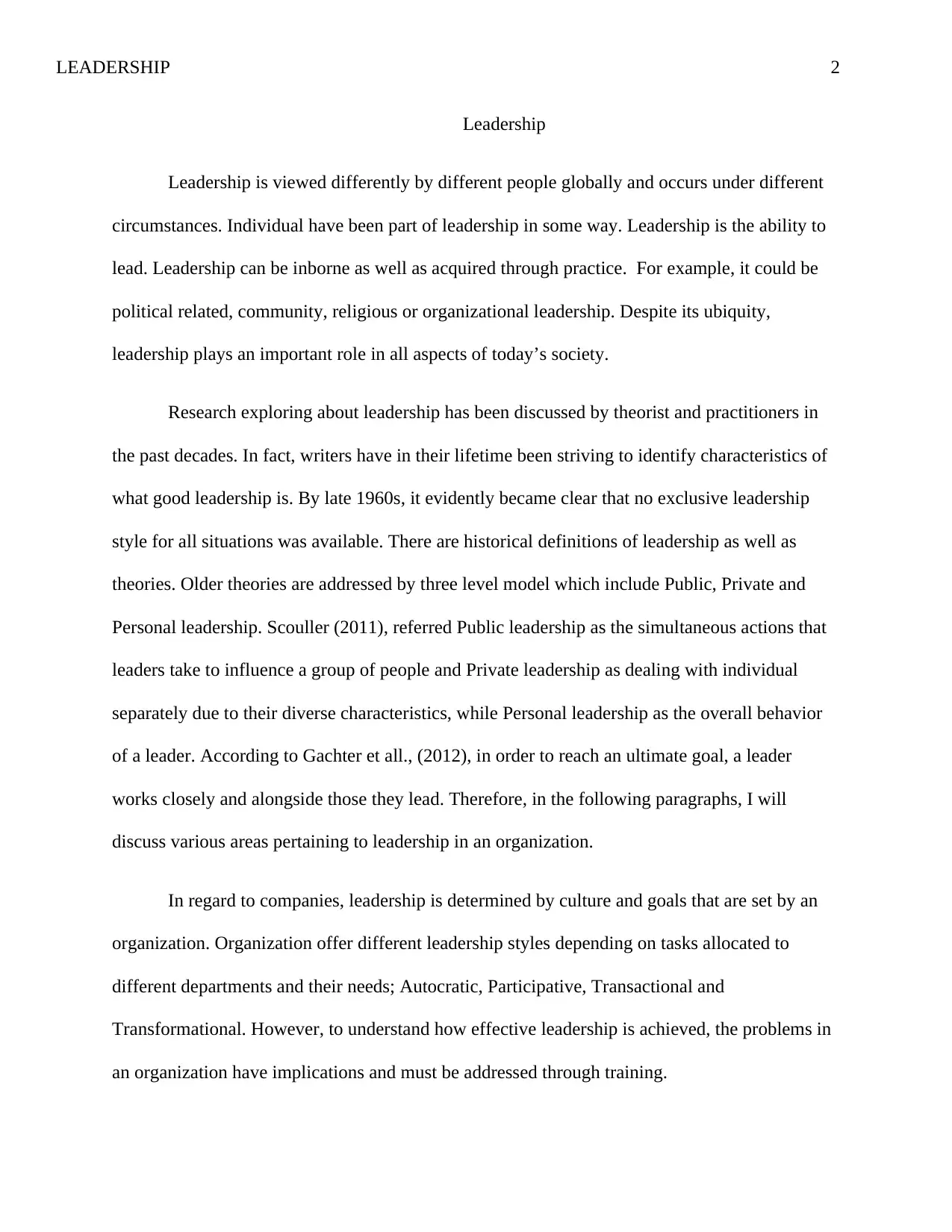
Leadership is viewed differently by different people globally and occurs under different
circumstances. Individual have been part of leadership in some way. Leadership is the ability to
lead. Leadership can be inborne as well as acquired through practice. For example, it could be
political related, community, religious or organizational leadership. Despite its ubiquity,
leadership plays an important role in all aspects of today’s society.
Research exploring about leadership has been discussed by theorist and practitioners in
the past decades. In fact, writers have in their lifetime been striving to identify characteristics of
what good leadership is. By late 1960s, it evidently became clear that no exclusive leadership
style for all situations was available. There are historical definitions of leadership as well as
theories. Older theories are addressed by three level model which include Public, Private and
Personal leadership. Scouller (2011), referred Public leadership as the simultaneous actions that
leaders take to influence a group of people and Private leadership as dealing with individual
separately due to their diverse characteristics, while Personal leadership as the overall behavior
of a leader. According to Gachter et all., (2012), in order to reach an ultimate goal, a leader
works closely and alongside those they lead. Therefore, in the following paragraphs, I will
discuss various areas pertaining to leadership in an organization.
In regard to companies, leadership is determined by culture and goals that are set by an
organization. Organization offer different leadership styles depending on tasks allocated to
different departments and their needs; Autocratic, Participative, Transactional and
Transformational. However, to understand how effective leadership is achieved, the problems in
an organization have implications and must be addressed through training.
Document Page
LEADERSHIP 3
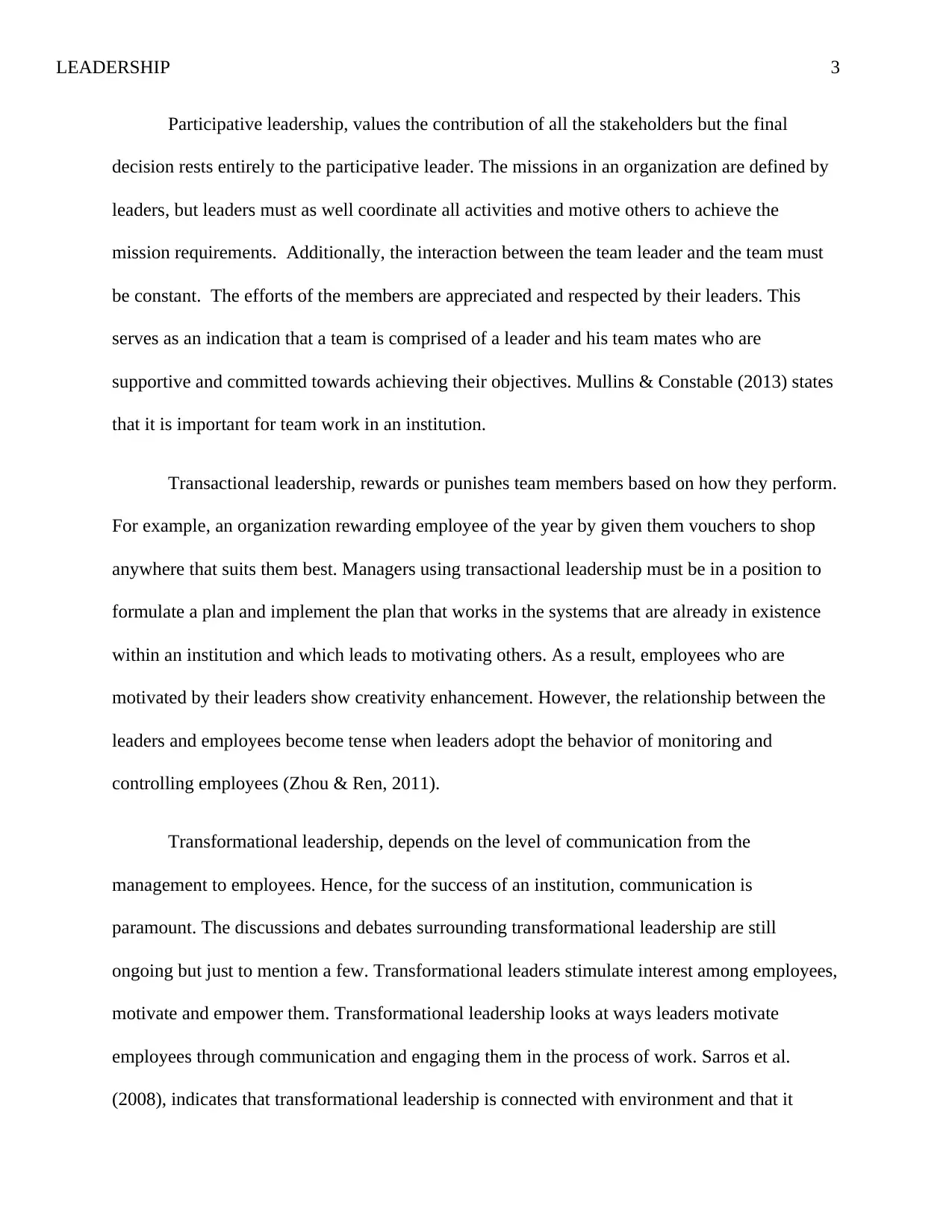
Participative leadership, values the contribution of all the stakeholders but the final
decision rests entirely to the participative leader. The missions in an organization are defined by
leaders, but leaders must as well coordinate all activities and motive others to achieve the
mission requirements. Additionally, the interaction between the team leader and the team must
be constant. The efforts of the members are appreciated and respected by their leaders. This
serves as an indication that a team is comprised of a leader and his team mates who are
supportive and committed towards achieving their objectives. Mullins & Constable (2013) states
that it is important for team work in an institution.
Transactional leadership, rewards or punishes team members based on how they perform.
For example, an organization rewarding employee of the year by given them vouchers to shop
anywhere that suits them best. Managers using transactional leadership must be in a position to
formulate a plan and implement the plan that works in the systems that are already in existence
within an institution and which leads to motivating others. As a result, employees who are
motivated by their leaders show creativity enhancement. However, the relationship between the
leaders and employees become tense when leaders adopt the behavior of monitoring and
controlling employees (Zhou & Ren, 2011).
Transformational leadership, depends on the level of communication from the
management to employees. Hence, for the success of an institution, communication is
paramount. The discussions and debates surrounding transformational leadership are still
ongoing but just to mention a few. Transformational leaders stimulate interest among employees,
motivate and empower them. Transformational leadership looks at ways leaders motivate
employees through communication and engaging them in the process of work. Sarros et al.
(2008), indicates that transformational leadership is connected with environment and that it
Document Page
LEADERSHIP 4
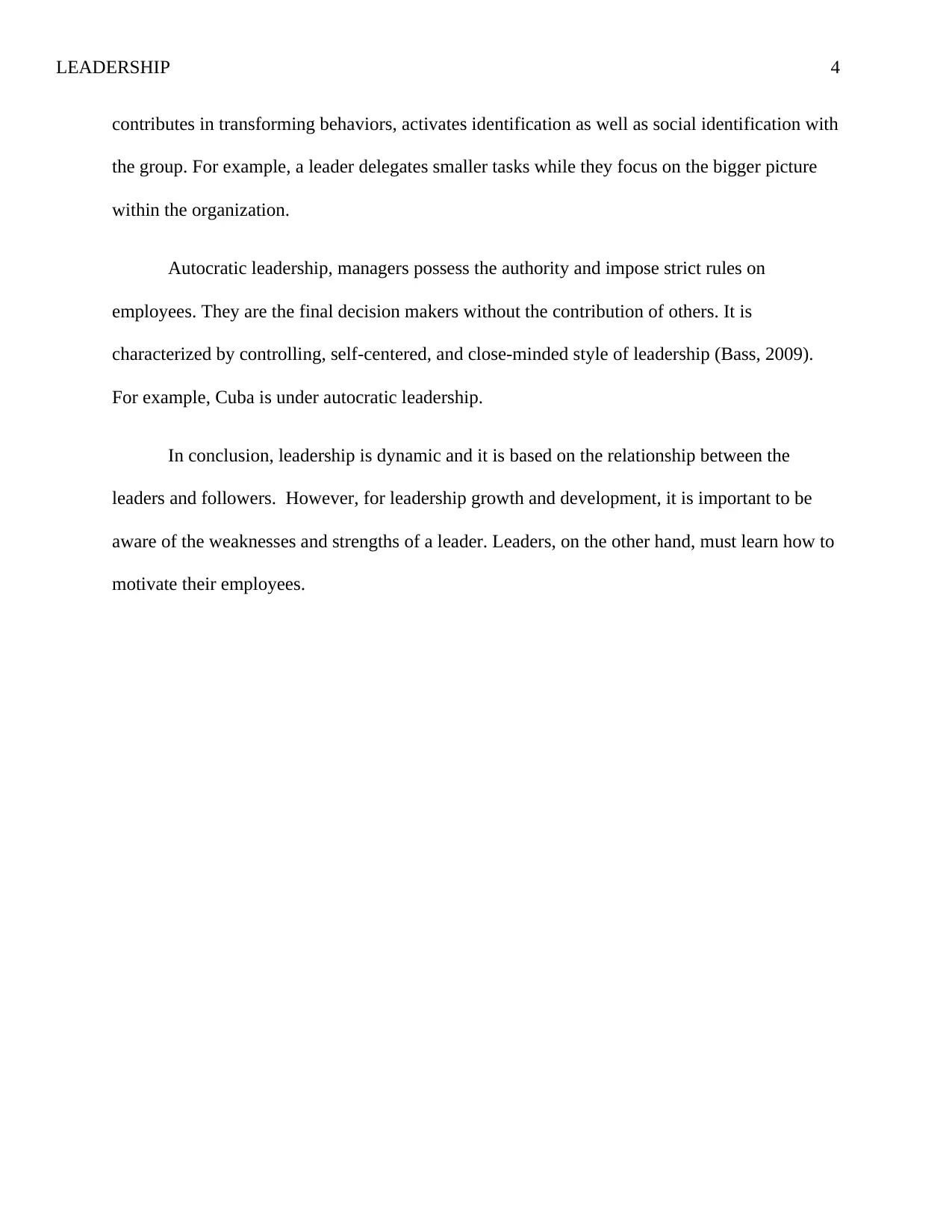
contributes in transforming behaviors, activates identification as well as social identification with
the group. For example, a leader delegates smaller tasks while they focus on the bigger picture
within the organization.
Autocratic leadership, managers possess the authority and impose strict rules on
employees. They are the final decision makers without the contribution of others. It is
characterized by controlling, self-centered, and close-minded style of leadership (Bass, 2009).
For example, Cuba is under autocratic leadership.
In conclusion, leadership is dynamic and it is based on the relationship between the
leaders and followers. However, for leadership growth and development, it is important to be
aware of the weaknesses and strengths of a leader. Leaders, on the other hand, must learn how to
motivate their employees.
tabler-icon-diamond-filled.svg

Paraphrase This Document

Need a fresh take? Get an instant paraphrase of this document with our AI Paraphraser
Document Page
LEADERSHIP 5
References
Bass, B. M., & Bass, R. (2009). The Bass handbook of leadership: Theory, research, and
managerial applications. New York: Simon & Schuster
Gächter, S., Nosenzo, D., Renner, E., & Sefton, M. (2012). Who Makes a Good Leader?
Cooperativeness, Optimism, and LeadingByExample. Economic Inquiry, 50(4), 953-
967.
Mullins, C. and Constable, G. (2013). Leadership and teambuilding in primary care. Oxford:
Radcliffe.
Sarros, J.C., B.K. Cooper and J.C. Santora, 2008. Building a climate for innovation through
transformational leadership and organizational culture. J. Leadership Organ. Stud., 15:
145-158
Scouller, J. (2011). The three levels of leadership: How to develop your leadership presence,
knowhow, and skill. Management Books 2000.
Zhou, J. and R. Ren, 2011. Striving for Creativity: Building Positive Context in the Workplace.
In: Cameron, K.S. and G.M. Spreitzer (Eds.), Ch. 8, the Oxford Handbook of Positive
Organizational Scholarship. Oxford University Press, Oxford
chevron_up_icon
1 out of 5
circle_padding
hide_on_mobile
zoom_out_icon
[object Object]