Leadership in Healthcare: Effective Teams, Values, and Patient Impact
VerifiedAdded on 2020/06/04
|11
|3818
|35
Report
AI Summary
This report delves into the multifaceted aspects of leadership within healthcare settings. It begins by exploring the crucial elements that contribute to effective teamwork, analyzing how individual values and skills enhance team performance. The report then examines the values essential for leaders to cultivate successful healthcare teams, emphasizing the importance of motivation, knowledge, and a healthy work environment. It also investigates the direct impact of team member values on patient outcomes and experiences, highlighting the significance of communication, coordination, and professional diversity in delivering quality care. The report concludes by discussing the personal development of healthcare professionals and how it benefits their careers, offering insights into the continuous improvement required to excel in the field.
Leadership in Health Care
Practice
Practice

Paraphrase This Document
Need a fresh take? Get an instant paraphrase of this document with our AI Paraphraser
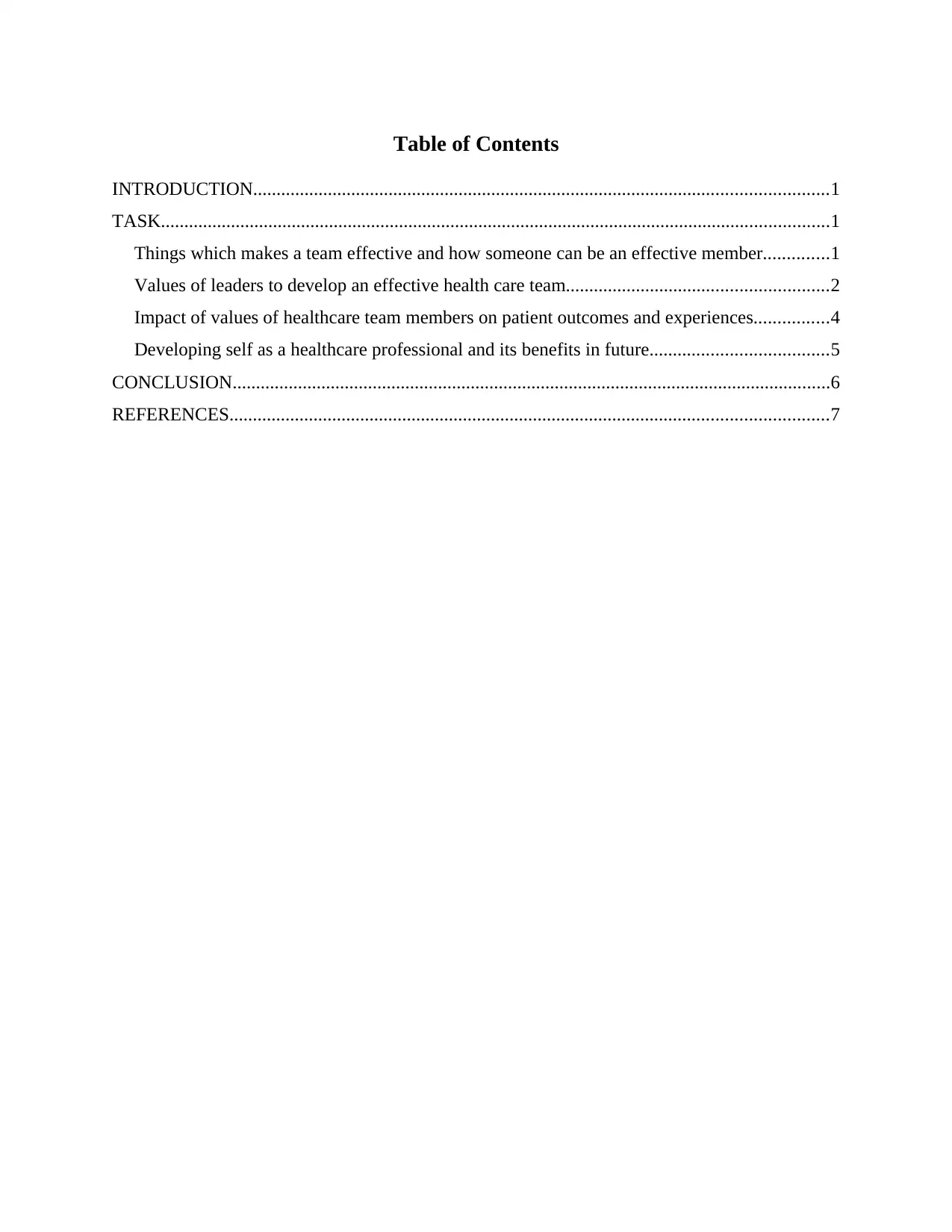
Table of Contents
INTRODUCTION...........................................................................................................................1
TASK...............................................................................................................................................1
Things which makes a team effective and how someone can be an effective member..............1
Values of leaders to develop an effective health care team........................................................2
Impact of values of healthcare team members on patient outcomes and experiences................4
Developing self as a healthcare professional and its benefits in future......................................5
CONCLUSION................................................................................................................................6
REFERENCES................................................................................................................................7
INTRODUCTION...........................................................................................................................1
TASK...............................................................................................................................................1
Things which makes a team effective and how someone can be an effective member..............1
Values of leaders to develop an effective health care team........................................................2
Impact of values of healthcare team members on patient outcomes and experiences................4
Developing self as a healthcare professional and its benefits in future......................................5
CONCLUSION................................................................................................................................6
REFERENCES................................................................................................................................7
INTRODUCTION
In any organisation there is a leader who has various roles and responsibilities which he
has to play in order to help his organisation in reaching the organisational goals and objectives.
They have a team to whom he represent and it is their duty to care of almost all the activities and
operation carried out in the team. These leaders have certain skills and knowledge which they
use in order to motivate the people whop are part of their team (Greer, A.G and et. al., 2010).
The reason behind this is that the success of the business depend on the efforts made by the team
members so for that there motivation level and moral should be high. Whatever action is taken
by the leaders will directly impact the performance of the company so their performance can be
analysed from various leadership theories and styles. Through considering the scenario of the
health care practice effectiveness of leadership will be analysed. With a reflective model and
literature review there will be brief that how I will develop myself as a healthcare professional
and how it will benefit me in my career.
TASK
Things which makes a team effective and how someone can be an effective member.
Every organisation has different operations which they perform in order to reach the
targets which they have set. To make things easier and reduce the work load every operation is
performed in teams. Performing business activities in teams increase the efficiency and also
saves the time. Through it more productivity can be gained thus increasing the profit margins of
the company (Tatlah, Ali and Saeed, 2012). This literature review highlights the ways which can
be adopted to make a health care team effective and how my personal values makes me a
important member of the team.
It is analysed by me that effective teamwork in heath care puts an positive influence on
the patient safety. The importance of effective teams in health care is increasing due to various
factors like increase in the complexity and specialization of care. The other factors are rise in the
number of cases of chronic diseases, shortages in the global workforce, safe working hours
initiatives and etc. There are lots of characteristics which makes a health care team effective
(Spector, 2016). The people who are part of the team has responsibility to ensure that whatever
they are doing yields better results. In the literature it has been analysed that in past there has
been various models which highlights the effective teamwork.
1
In any organisation there is a leader who has various roles and responsibilities which he
has to play in order to help his organisation in reaching the organisational goals and objectives.
They have a team to whom he represent and it is their duty to care of almost all the activities and
operation carried out in the team. These leaders have certain skills and knowledge which they
use in order to motivate the people whop are part of their team (Greer, A.G and et. al., 2010).
The reason behind this is that the success of the business depend on the efforts made by the team
members so for that there motivation level and moral should be high. Whatever action is taken
by the leaders will directly impact the performance of the company so their performance can be
analysed from various leadership theories and styles. Through considering the scenario of the
health care practice effectiveness of leadership will be analysed. With a reflective model and
literature review there will be brief that how I will develop myself as a healthcare professional
and how it will benefit me in my career.
TASK
Things which makes a team effective and how someone can be an effective member.
Every organisation has different operations which they perform in order to reach the
targets which they have set. To make things easier and reduce the work load every operation is
performed in teams. Performing business activities in teams increase the efficiency and also
saves the time. Through it more productivity can be gained thus increasing the profit margins of
the company (Tatlah, Ali and Saeed, 2012). This literature review highlights the ways which can
be adopted to make a health care team effective and how my personal values makes me a
important member of the team.
It is analysed by me that effective teamwork in heath care puts an positive influence on
the patient safety. The importance of effective teams in health care is increasing due to various
factors like increase in the complexity and specialization of care. The other factors are rise in the
number of cases of chronic diseases, shortages in the global workforce, safe working hours
initiatives and etc. There are lots of characteristics which makes a health care team effective
(Spector, 2016). The people who are part of the team has responsibility to ensure that whatever
they are doing yields better results. In the literature it has been analysed that in past there has
been various models which highlights the effective teamwork.
1
⊘ This is a preview!⊘
Do you want full access?
Subscribe today to unlock all pages.

Trusted by 1+ million students worldwide
According to Mickan and Roger, every member of the team should have a common
purpose which includes collective interests. My team has set the goals which is measurable and
are focusing on the team activities. For a team to be effective there is requirement of effective
leader who can set the goals and maintain structure. To be an effective team whatever conflicts
are arising should be addressed with a proper approach so that it does not hamper the team
working in large. There should be a communication channel which make sure that each and ever
message communicated is reached to the every member of the team so that they can know what
all things has to be done and what progress has been made in the organisation. When there will
be proper communication each and every person will know their role which they have to perform
(McColl-Kennedy and et. al., 2012). Those things which has much importance will be done first
and will be on the top of the priority list. There will be equal distribution of the work and through
regular inspection of the performance of the health care team members will yield positive
outcomes thus making the team work effective. A team to be effective it is necessary that all the
task and operations are performed through a strategies and planning after analysing the condition
of the scene.
As analysed by Buykx (2010) at the personal level there is requirement of the of certain
personal values and skills to be an effective team members. Health care is a sector or profession
which is totally different from others as this requires healthcare workers to give their full efforts
to make clients or patients coming in the hospital or health care centre safe and secure. The
operations which which has been allotted to my team is to assist the patients and clients when
they visit the health care centre. So it is my duty to keep record of all the people who are visiting
the place and guide them towards the areas and doctors to whom they have to consult about their
problems. I have a calm nature and prefer to use polite language as it is required by the team that
any person coming should be treated properly (Lampard and Sharbanee, 2015). I always believed
that this is the profession where all the people whether of any category should be treated equally.
So those patients who are in emergency will be given the first treatment. I also ensure that each
patient should know what all treatments he has to be given and what how long the procedure will
be pre-long.
Values of leaders to develop an effective health care team.
A leader is a person who is considered as a driver of the team so for the effectiveness of
any team it is the responsibility of the leader to take certain steps to benefit the organisation. To
2
purpose which includes collective interests. My team has set the goals which is measurable and
are focusing on the team activities. For a team to be effective there is requirement of effective
leader who can set the goals and maintain structure. To be an effective team whatever conflicts
are arising should be addressed with a proper approach so that it does not hamper the team
working in large. There should be a communication channel which make sure that each and ever
message communicated is reached to the every member of the team so that they can know what
all things has to be done and what progress has been made in the organisation. When there will
be proper communication each and every person will know their role which they have to perform
(McColl-Kennedy and et. al., 2012). Those things which has much importance will be done first
and will be on the top of the priority list. There will be equal distribution of the work and through
regular inspection of the performance of the health care team members will yield positive
outcomes thus making the team work effective. A team to be effective it is necessary that all the
task and operations are performed through a strategies and planning after analysing the condition
of the scene.
As analysed by Buykx (2010) at the personal level there is requirement of the of certain
personal values and skills to be an effective team members. Health care is a sector or profession
which is totally different from others as this requires healthcare workers to give their full efforts
to make clients or patients coming in the hospital or health care centre safe and secure. The
operations which which has been allotted to my team is to assist the patients and clients when
they visit the health care centre. So it is my duty to keep record of all the people who are visiting
the place and guide them towards the areas and doctors to whom they have to consult about their
problems. I have a calm nature and prefer to use polite language as it is required by the team that
any person coming should be treated properly (Lampard and Sharbanee, 2015). I always believed
that this is the profession where all the people whether of any category should be treated equally.
So those patients who are in emergency will be given the first treatment. I also ensure that each
patient should know what all treatments he has to be given and what how long the procedure will
be pre-long.
Values of leaders to develop an effective health care team.
A leader is a person who is considered as a driver of the team so for the effectiveness of
any team it is the responsibility of the leader to take certain steps to benefit the organisation. To
2
Paraphrase This Document
Need a fresh take? Get an instant paraphrase of this document with our AI Paraphraser
be a leader of team there are certain qualities which is required. Leader should be motivated,
flexible, creative and etc., if they will be motivated and their moral will be high then only they
can encourage their team to take to put full efforts in whatever things they have given. He
should have deep knowledge about the organisation and should be well versed with the working
style adopted in the health care system (Paterson, Henderson and Trivella, 2010). They have
duty to grow the organisation through the effective working of their so for that they need to
develop an healthy working environment where each and every person who are part of the team
could show their skills with efforts. They have to help teams map their work flow and clarity
roles to improve the functioning of the healthcare centre. It is their responsibility to engage and
involve each member in the decision making process so moral of each and every staff can be
increased. This way they will able to get new ideas and any loophole in the team can be
obstructed out.
As analysed by Flodgren (2011) he uses certain strategies of retention, cooperation and
member loyalty to boost the working efficiency of the employees. Leader should regularly
inspect his team to ensure that everything is going well and if there is any obstacle should be
removed with a proper planning. He conducts regular counselling sessions for the employees to
know what are things which trouble them and what all things can be changed. They should be
flexible in dealing with any kind of circumstances arising in the healthcare centre and according
to it they can adapt. For example; a patient has come to the centre and he is unable to walk so
the leader ensure that he is given a wheelchair or any support system so that he could go to
doctor (Kalyuga, 2011). They should be in regular contact with top level management of the
healthcare centre and make them aware about the performance of the team (Thompson and
Glasø, 2015). They can also ask about certain requirements and changes they want in the team
or in that particular area. Leaders have to set a coordination with the team members to make
sure that whatever messaged delivered by him is obeyed by the team members. He needs to
ensure that every person who is part of the team has understanding of each other so that they can
unite and work with full dedication and those who facing any problem can take help of their
subordinates. Through using his experience he can keep thing on team and will also help him in
developing an effective team.
3
flexible, creative and etc., if they will be motivated and their moral will be high then only they
can encourage their team to take to put full efforts in whatever things they have given. He
should have deep knowledge about the organisation and should be well versed with the working
style adopted in the health care system (Paterson, Henderson and Trivella, 2010). They have
duty to grow the organisation through the effective working of their so for that they need to
develop an healthy working environment where each and every person who are part of the team
could show their skills with efforts. They have to help teams map their work flow and clarity
roles to improve the functioning of the healthcare centre. It is their responsibility to engage and
involve each member in the decision making process so moral of each and every staff can be
increased. This way they will able to get new ideas and any loophole in the team can be
obstructed out.
As analysed by Flodgren (2011) he uses certain strategies of retention, cooperation and
member loyalty to boost the working efficiency of the employees. Leader should regularly
inspect his team to ensure that everything is going well and if there is any obstacle should be
removed with a proper planning. He conducts regular counselling sessions for the employees to
know what are things which trouble them and what all things can be changed. They should be
flexible in dealing with any kind of circumstances arising in the healthcare centre and according
to it they can adapt. For example; a patient has come to the centre and he is unable to walk so
the leader ensure that he is given a wheelchair or any support system so that he could go to
doctor (Kalyuga, 2011). They should be in regular contact with top level management of the
healthcare centre and make them aware about the performance of the team (Thompson and
Glasø, 2015). They can also ask about certain requirements and changes they want in the team
or in that particular area. Leaders have to set a coordination with the team members to make
sure that whatever messaged delivered by him is obeyed by the team members. He needs to
ensure that every person who is part of the team has understanding of each other so that they can
unite and work with full dedication and those who facing any problem can take help of their
subordinates. Through using his experience he can keep thing on team and will also help him in
developing an effective team.
3
Impact of values of healthcare team members on patient outcomes and experiences.
It is the responsibility of the team members who are part of the healthcare centre to take
care of the patient during his or her stay at the centre. It today's context there are rare chances
that patients are looked by just one health professional. Safety of the patients are looked by these
people so effecti8ve teamwork is important for minimizing the adverts activities which are
caused by miscommunication with the other caring for the patient. The team members should
ensure that that with their services patients are satisfied and they should try their efforts to reduce
the hospitalization time and costs (Reeves, Macmillan and Van Soeren, 2010). At the healthcare
centre is observed that there is professional diversity so it should be ensured that this should not
effect their working. So a coordination is required in them and each have to understand their
responsibility towards the patients. If this will happen then their will be less chances of medical
errors on patients.
As stated by Harvey and Kitson (2015), team members response towards any situation
decides the faith of the patients and their family members who are visiting the hospital. It is
necessary that when patient leaves the hospital after treatment should be fully satisfied and there
should be improvement in his health. While he stays in the hospital each and every team should
perform their duties properly and on time (Carlström and Ekman, 2012). When he arrives his
medical history will be taken and the reports will be submitted properly so that whenever the
doctor needs it is available to them. The team members who has been allotted the task to take the
reports should no the significance of those reports so their privacy should be maintained. It is
written in the terms and conditions that no personal and medical information of the patients will
be made public and can only be accessed by the doctors and family members.
As briefed by Hendricks, Cope and Harris (2010) to get better patients outcomes it is
necessary that the team members should have certain skills and knowledge about their field and
the tasks which is performed buy them. If they feel that they are facing difficulty in certain work
or does have that capacity to perform any particular operation so in such scenario they should ask
their leaders to guide them (Hankinson, 2012). In the repose the team leader should conduct or
organise training sessions which will boost the knowledge of the each and every staff and they
will be performing well in whatever they are doing. Those person who are involved in any kind
of healthcare activity should give their best effort and should take the responsibility of the patient
whom he is taking care off. He should have all the details of that patients and should know what
4
It is the responsibility of the team members who are part of the healthcare centre to take
care of the patient during his or her stay at the centre. It today's context there are rare chances
that patients are looked by just one health professional. Safety of the patients are looked by these
people so effecti8ve teamwork is important for minimizing the adverts activities which are
caused by miscommunication with the other caring for the patient. The team members should
ensure that that with their services patients are satisfied and they should try their efforts to reduce
the hospitalization time and costs (Reeves, Macmillan and Van Soeren, 2010). At the healthcare
centre is observed that there is professional diversity so it should be ensured that this should not
effect their working. So a coordination is required in them and each have to understand their
responsibility towards the patients. If this will happen then their will be less chances of medical
errors on patients.
As stated by Harvey and Kitson (2015), team members response towards any situation
decides the faith of the patients and their family members who are visiting the hospital. It is
necessary that when patient leaves the hospital after treatment should be fully satisfied and there
should be improvement in his health. While he stays in the hospital each and every team should
perform their duties properly and on time (Carlström and Ekman, 2012). When he arrives his
medical history will be taken and the reports will be submitted properly so that whenever the
doctor needs it is available to them. The team members who has been allotted the task to take the
reports should no the significance of those reports so their privacy should be maintained. It is
written in the terms and conditions that no personal and medical information of the patients will
be made public and can only be accessed by the doctors and family members.
As briefed by Hendricks, Cope and Harris (2010) to get better patients outcomes it is
necessary that the team members should have certain skills and knowledge about their field and
the tasks which is performed buy them. If they feel that they are facing difficulty in certain work
or does have that capacity to perform any particular operation so in such scenario they should ask
their leaders to guide them (Hankinson, 2012). In the repose the team leader should conduct or
organise training sessions which will boost the knowledge of the each and every staff and they
will be performing well in whatever they are doing. Those person who are involved in any kind
of healthcare activity should give their best effort and should take the responsibility of the patient
whom he is taking care off. He should have all the details of that patients and should know what
4
⊘ This is a preview!⊘
Do you want full access?
Subscribe today to unlock all pages.
Trusted by 1+ million students worldwide
next steps has to be taken in context to his next. It is not the medicines only which cures any
patient thus caring and affection also has certain part in the success of the patients health. But for
the better services it is also compulsory that the team members should also be free from any
mental, physical stress and diseases (Swayne, Duncan and Ginter, 2012). For that each team
members should go for regular check ups so that they can know whether they don't have any
diseases. They should regular engage themselves in the activities which can increase their
knowledge so that better services can be provided to patients of the health care centre. To deliver
better services they should obey and perform their actions according to the instructions and
guidelines given by the team leader and should also give their valuable suggestion to them so
that they a coordination between all their numbers is developed. It is the healthcare professional
who represent the patient at the hospital so they should exercise all the activities through which
they can understanding the patient and develops a relation with the patients.
Developing self as a healthcare professional and its benefits in future.
As analysed Hoare, Mills and Francis (2012) it can be said that to be a healthcare
professional requires full dedication and certain skills. This is a professional which requires hard
work and various knowledge about the psychology of the patient. There are different people
from different background and culture visits the health care centre so to understand and make an
effective communication with them requires that I should develop communication requires. For
that I need to learn various languages of different and their culture. Although I am a new in this
field so I need to put more efforts to see growth in my career I need bring a personal and
professional development plan so that I can groom myself in both the areas and can gain better
results (Traynor, Boland and Buus, 2010). To learn anything I will make sure that I am in regular
contact with my senior and will ask them to guide me on various level so that I can grow myself
and delivers the quality services to the patients. To see hike in my career I need to know myself
for that a self reflection plan can be developed and on the other hand I can take feedback from
the clients who are visiting the healthcare centres.
As briefed by Leggat, Bartram and Stanton (2011) to gain much knowledge about this
field I will try to attend more seminars and lectures on the healthcare profession. As I was give
the duty to check and record the data and medical history of the patient so I need to increase my
efficiency as I am aware of the fact that every day lots of patients visits this centre. To bring
efficiency in the work I am focusing on learning the IT skills which will help me to record the
5
patient thus caring and affection also has certain part in the success of the patients health. But for
the better services it is also compulsory that the team members should also be free from any
mental, physical stress and diseases (Swayne, Duncan and Ginter, 2012). For that each team
members should go for regular check ups so that they can know whether they don't have any
diseases. They should regular engage themselves in the activities which can increase their
knowledge so that better services can be provided to patients of the health care centre. To deliver
better services they should obey and perform their actions according to the instructions and
guidelines given by the team leader and should also give their valuable suggestion to them so
that they a coordination between all their numbers is developed. It is the healthcare professional
who represent the patient at the hospital so they should exercise all the activities through which
they can understanding the patient and develops a relation with the patients.
Developing self as a healthcare professional and its benefits in future.
As analysed Hoare, Mills and Francis (2012) it can be said that to be a healthcare
professional requires full dedication and certain skills. This is a professional which requires hard
work and various knowledge about the psychology of the patient. There are different people
from different background and culture visits the health care centre so to understand and make an
effective communication with them requires that I should develop communication requires. For
that I need to learn various languages of different and their culture. Although I am a new in this
field so I need to put more efforts to see growth in my career I need bring a personal and
professional development plan so that I can groom myself in both the areas and can gain better
results (Traynor, Boland and Buus, 2010). To learn anything I will make sure that I am in regular
contact with my senior and will ask them to guide me on various level so that I can grow myself
and delivers the quality services to the patients. To see hike in my career I need to know myself
for that a self reflection plan can be developed and on the other hand I can take feedback from
the clients who are visiting the healthcare centres.
As briefed by Leggat, Bartram and Stanton (2011) to gain much knowledge about this
field I will try to attend more seminars and lectures on the healthcare profession. As I was give
the duty to check and record the data and medical history of the patient so I need to increase my
efficiency as I am aware of the fact that every day lots of patients visits this centre. To bring
efficiency in the work I am focusing on learning the IT skills which will help me to record the
5
Paraphrase This Document
Need a fresh take? Get an instant paraphrase of this document with our AI Paraphraser
data in computer and present them into various graphics. Those people are not able to speak so I
will ensure that there is someone who will acts as mediator between us so that I can know what
they want to convey (Wong, Cummings and Ducharme, 2013). To know my performance
outcome I will be analysing and evaluating the satisfaction level of the patients and the doctor
under whom I have been performing my duties. I have believed that to grow in any health there
is requirement of the dedication, passion and certain efforts. Each day is new and when I will
learn new things it will give me self satisfaction.
CONCLUSION
From the above it can be analysed that leadership is one of the quality which impacts the
organisation. It is the leader who ensure that which his actions the team members of the
organisation is influenced and work towards in a way to achieve the goals and targets. In the
healthcare segment without a team no task can be carried out as it is the collective effort of the
team members to satisfy the patient. There should be efforts to create new leaders in the
organisation so for that they should have full knowledge about whatever they are doing and how
the staff members in the health care centre can be motivated and managed.
6
will ensure that there is someone who will acts as mediator between us so that I can know what
they want to convey (Wong, Cummings and Ducharme, 2013). To know my performance
outcome I will be analysing and evaluating the satisfaction level of the patients and the doctor
under whom I have been performing my duties. I have believed that to grow in any health there
is requirement of the dedication, passion and certain efforts. Each day is new and when I will
learn new things it will give me self satisfaction.
CONCLUSION
From the above it can be analysed that leadership is one of the quality which impacts the
organisation. It is the leader who ensure that which his actions the team members of the
organisation is influenced and work towards in a way to achieve the goals and targets. In the
healthcare segment without a team no task can be carried out as it is the collective effort of the
team members to satisfy the patient. There should be efforts to create new leaders in the
organisation so for that they should have full knowledge about whatever they are doing and how
the staff members in the health care centre can be motivated and managed.
6
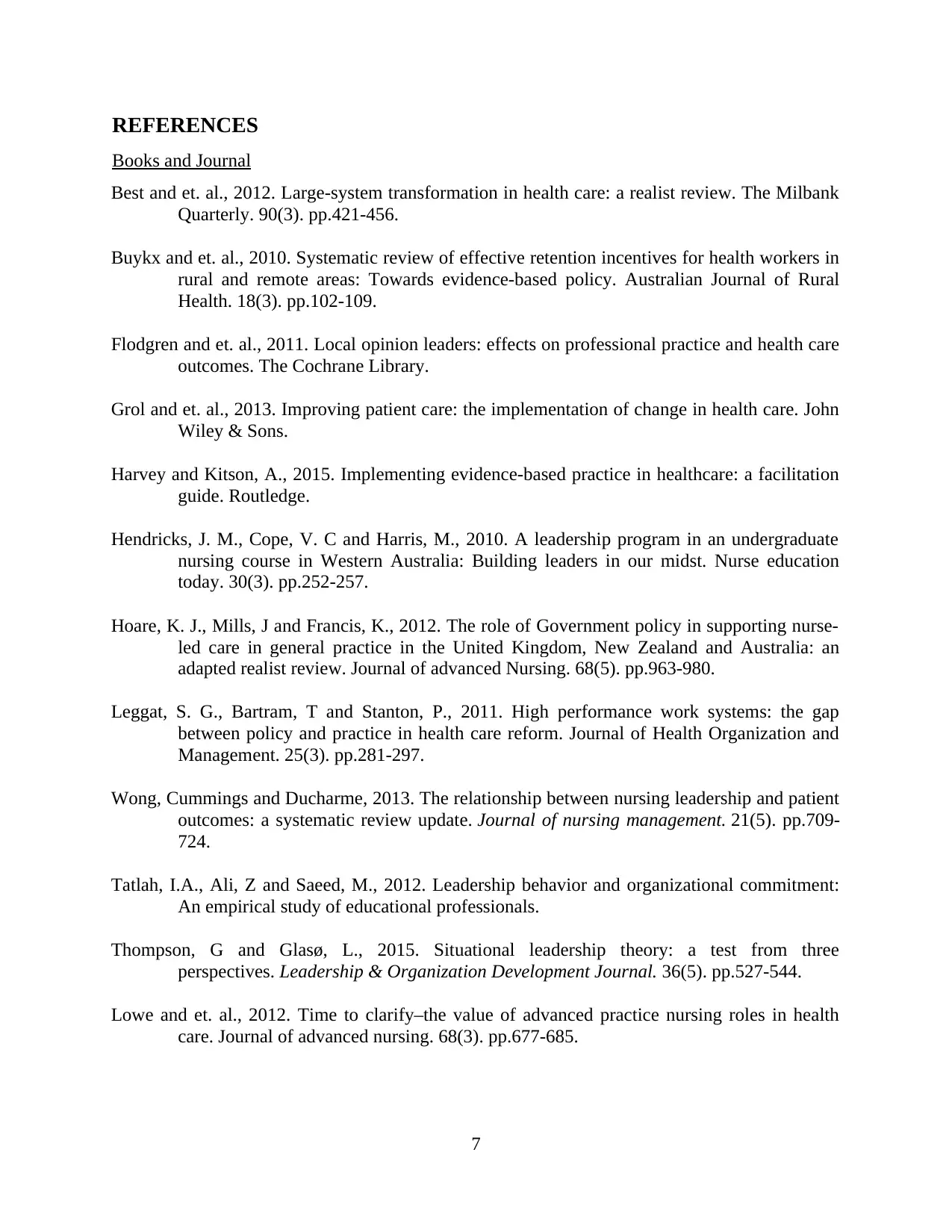
REFERENCES
Books and Journal
Best and et. al., 2012. Large‐system transformation in health care: a realist review. The Milbank
Quarterly. 90(3). pp.421-456.
Buykx and et. al., 2010. Systematic review of effective retention incentives for health workers in
rural and remote areas: Towards evidence‐based policy. Australian Journal of Rural
Health. 18(3). pp.102-109.
Flodgren and et. al., 2011. Local opinion leaders: effects on professional practice and health care
outcomes. The Cochrane Library.
Grol and et. al., 2013. Improving patient care: the implementation of change in health care. John
Wiley & Sons.
Harvey and Kitson, A., 2015. Implementing evidence-based practice in healthcare: a facilitation
guide. Routledge.
Hendricks, J. M., Cope, V. C and Harris, M., 2010. A leadership program in an undergraduate
nursing course in Western Australia: Building leaders in our midst. Nurse education
today. 30(3). pp.252-257.
Hoare, K. J., Mills, J and Francis, K., 2012. The role of Government policy in supporting nurse‐
led care in general practice in the United Kingdom, New Zealand and Australia: an
adapted realist review. Journal of advanced Nursing. 68(5). pp.963-980.
Leggat, S. G., Bartram, T and Stanton, P., 2011. High performance work systems: the gap
between policy and practice in health care reform. Journal of Health Organization and
Management. 25(3). pp.281-297.
Wong, Cummings and Ducharme, 2013. The relationship between nursing leadership and patient
outcomes: a systematic review update. Journal of nursing management. 21(5). pp.709-
724.
Tatlah, I.A., Ali, Z and Saeed, M., 2012. Leadership behavior and organizational commitment:
An empirical study of educational professionals.
Thompson, G and Glasø, L., 2015. Situational leadership theory: a test from three
perspectives. Leadership & Organization Development Journal. 36(5). pp.527-544.
Lowe and et. al., 2012. Time to clarify–the value of advanced practice nursing roles in health
care. Journal of advanced nursing. 68(3). pp.677-685.
7
Books and Journal
Best and et. al., 2012. Large‐system transformation in health care: a realist review. The Milbank
Quarterly. 90(3). pp.421-456.
Buykx and et. al., 2010. Systematic review of effective retention incentives for health workers in
rural and remote areas: Towards evidence‐based policy. Australian Journal of Rural
Health. 18(3). pp.102-109.
Flodgren and et. al., 2011. Local opinion leaders: effects on professional practice and health care
outcomes. The Cochrane Library.
Grol and et. al., 2013. Improving patient care: the implementation of change in health care. John
Wiley & Sons.
Harvey and Kitson, A., 2015. Implementing evidence-based practice in healthcare: a facilitation
guide. Routledge.
Hendricks, J. M., Cope, V. C and Harris, M., 2010. A leadership program in an undergraduate
nursing course in Western Australia: Building leaders in our midst. Nurse education
today. 30(3). pp.252-257.
Hoare, K. J., Mills, J and Francis, K., 2012. The role of Government policy in supporting nurse‐
led care in general practice in the United Kingdom, New Zealand and Australia: an
adapted realist review. Journal of advanced Nursing. 68(5). pp.963-980.
Leggat, S. G., Bartram, T and Stanton, P., 2011. High performance work systems: the gap
between policy and practice in health care reform. Journal of Health Organization and
Management. 25(3). pp.281-297.
Wong, Cummings and Ducharme, 2013. The relationship between nursing leadership and patient
outcomes: a systematic review update. Journal of nursing management. 21(5). pp.709-
724.
Tatlah, I.A., Ali, Z and Saeed, M., 2012. Leadership behavior and organizational commitment:
An empirical study of educational professionals.
Thompson, G and Glasø, L., 2015. Situational leadership theory: a test from three
perspectives. Leadership & Organization Development Journal. 36(5). pp.527-544.
Lowe and et. al., 2012. Time to clarify–the value of advanced practice nursing roles in health
care. Journal of advanced nursing. 68(3). pp.677-685.
7
⊘ This is a preview!⊘
Do you want full access?
Subscribe today to unlock all pages.
Trusted by 1+ million students worldwide
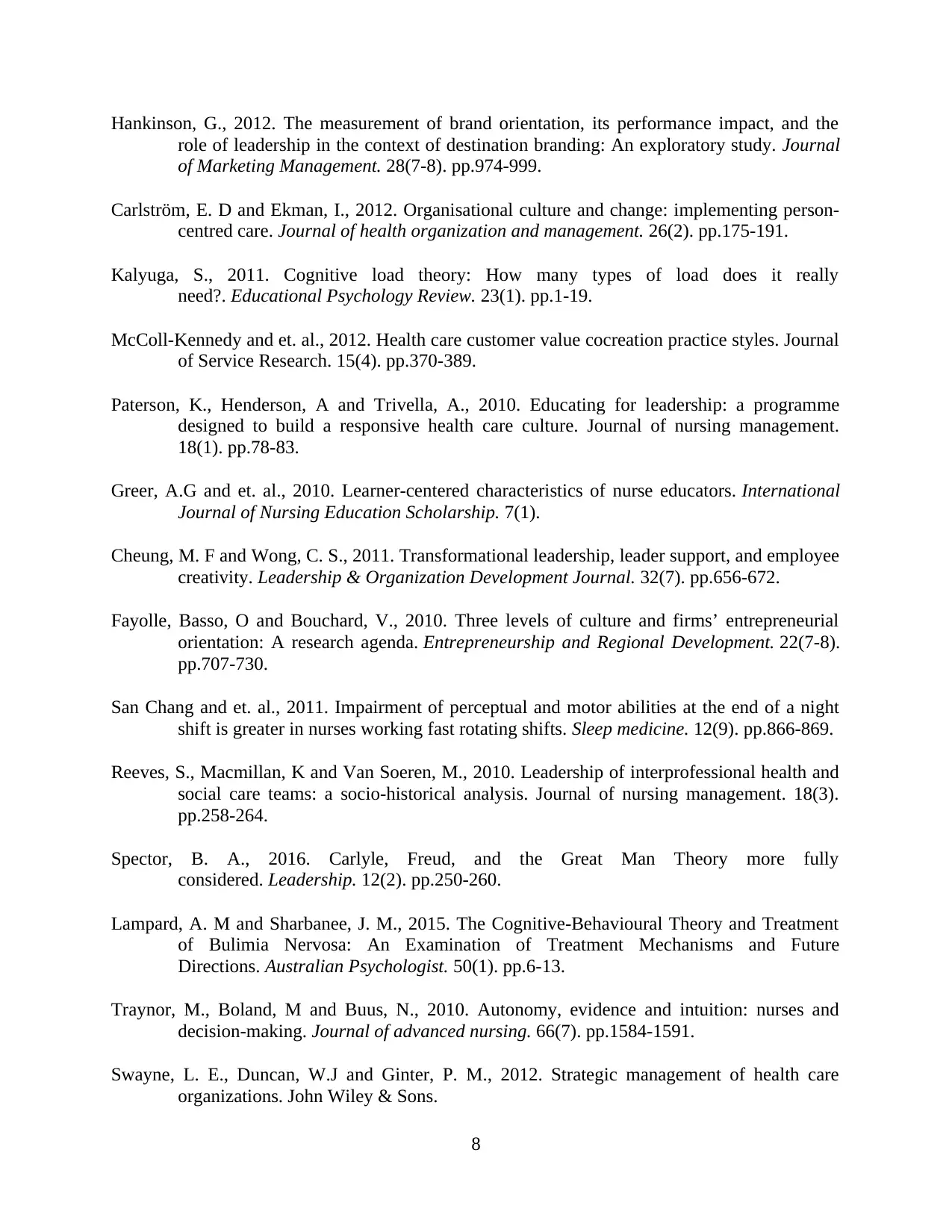
Hankinson, G., 2012. The measurement of brand orientation, its performance impact, and the
role of leadership in the context of destination branding: An exploratory study. Journal
of Marketing Management. 28(7-8). pp.974-999.
Carlström, E. D and Ekman, I., 2012. Organisational culture and change: implementing person-
centred care. Journal of health organization and management. 26(2). pp.175-191.
Kalyuga, S., 2011. Cognitive load theory: How many types of load does it really
need?. Educational Psychology Review. 23(1). pp.1-19.
McColl-Kennedy and et. al., 2012. Health care customer value cocreation practice styles. Journal
of Service Research. 15(4). pp.370-389.
Paterson, K., Henderson, A and Trivella, A., 2010. Educating for leadership: a programme
designed to build a responsive health care culture. Journal of nursing management.
18(1). pp.78-83.
Greer, A.G and et. al., 2010. Learner-centered characteristics of nurse educators. International
Journal of Nursing Education Scholarship. 7(1).
Cheung, M. F and Wong, C. S., 2011. Transformational leadership, leader support, and employee
creativity. Leadership & Organization Development Journal. 32(7). pp.656-672.
Fayolle, Basso, O and Bouchard, V., 2010. Three levels of culture and firms’ entrepreneurial
orientation: A research agenda. Entrepreneurship and Regional Development. 22(7-8).
pp.707-730.
San Chang and et. al., 2011. Impairment of perceptual and motor abilities at the end of a night
shift is greater in nurses working fast rotating shifts. Sleep medicine. 12(9). pp.866-869.
Reeves, S., Macmillan, K and Van Soeren, M., 2010. Leadership of interprofessional health and
social care teams: a socio‐historical analysis. Journal of nursing management. 18(3).
pp.258-264.
Spector, B. A., 2016. Carlyle, Freud, and the Great Man Theory more fully
considered. Leadership. 12(2). pp.250-260.
Lampard, A. M and Sharbanee, J. M., 2015. The Cognitive‐Behavioural Theory and Treatment
of Bulimia Nervosa: An Examination of Treatment Mechanisms and Future
Directions. Australian Psychologist. 50(1). pp.6-13.
Traynor, M., Boland, M and Buus, N., 2010. Autonomy, evidence and intuition: nurses and
decision‐making. Journal of advanced nursing. 66(7). pp.1584-1591.
Swayne, L. E., Duncan, W.J and Ginter, P. M., 2012. Strategic management of health care
organizations. John Wiley & Sons.
8
role of leadership in the context of destination branding: An exploratory study. Journal
of Marketing Management. 28(7-8). pp.974-999.
Carlström, E. D and Ekman, I., 2012. Organisational culture and change: implementing person-
centred care. Journal of health organization and management. 26(2). pp.175-191.
Kalyuga, S., 2011. Cognitive load theory: How many types of load does it really
need?. Educational Psychology Review. 23(1). pp.1-19.
McColl-Kennedy and et. al., 2012. Health care customer value cocreation practice styles. Journal
of Service Research. 15(4). pp.370-389.
Paterson, K., Henderson, A and Trivella, A., 2010. Educating for leadership: a programme
designed to build a responsive health care culture. Journal of nursing management.
18(1). pp.78-83.
Greer, A.G and et. al., 2010. Learner-centered characteristics of nurse educators. International
Journal of Nursing Education Scholarship. 7(1).
Cheung, M. F and Wong, C. S., 2011. Transformational leadership, leader support, and employee
creativity. Leadership & Organization Development Journal. 32(7). pp.656-672.
Fayolle, Basso, O and Bouchard, V., 2010. Three levels of culture and firms’ entrepreneurial
orientation: A research agenda. Entrepreneurship and Regional Development. 22(7-8).
pp.707-730.
San Chang and et. al., 2011. Impairment of perceptual and motor abilities at the end of a night
shift is greater in nurses working fast rotating shifts. Sleep medicine. 12(9). pp.866-869.
Reeves, S., Macmillan, K and Van Soeren, M., 2010. Leadership of interprofessional health and
social care teams: a socio‐historical analysis. Journal of nursing management. 18(3).
pp.258-264.
Spector, B. A., 2016. Carlyle, Freud, and the Great Man Theory more fully
considered. Leadership. 12(2). pp.250-260.
Lampard, A. M and Sharbanee, J. M., 2015. The Cognitive‐Behavioural Theory and Treatment
of Bulimia Nervosa: An Examination of Treatment Mechanisms and Future
Directions. Australian Psychologist. 50(1). pp.6-13.
Traynor, M., Boland, M and Buus, N., 2010. Autonomy, evidence and intuition: nurses and
decision‐making. Journal of advanced nursing. 66(7). pp.1584-1591.
Swayne, L. E., Duncan, W.J and Ginter, P. M., 2012. Strategic management of health care
organizations. John Wiley & Sons.
8
Paraphrase This Document
Need a fresh take? Get an instant paraphrase of this document with our AI Paraphraser
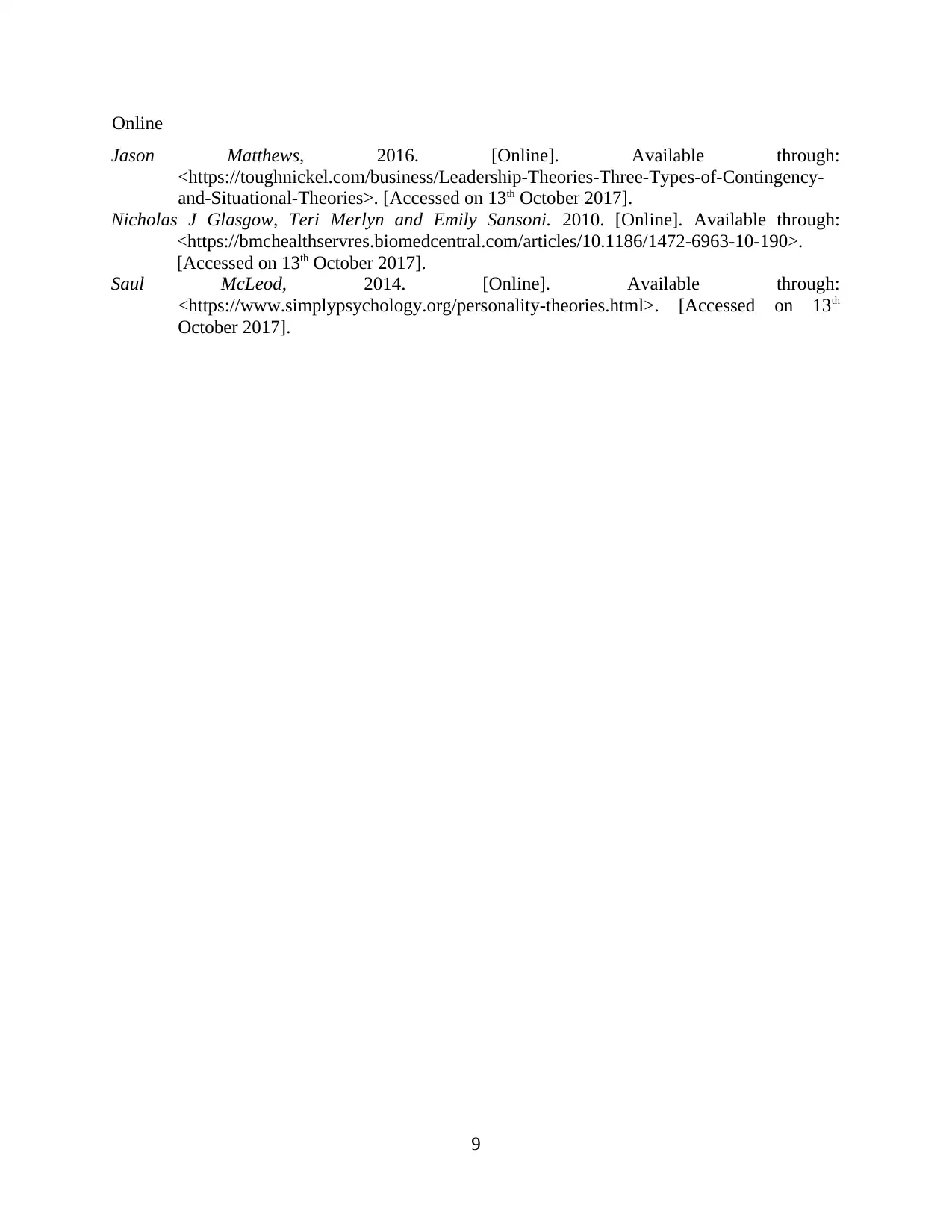
Online
Jason Matthews, 2016. [Online]. Available through:
<https://toughnickel.com/business/Leadership-Theories-Three-Types-of-Contingency-
and-Situational-Theories>. [Accessed on 13th October 2017].
Nicholas J Glasgow, Teri Merlyn and Emily Sansoni. 2010. [Online]. Available through:
<https://bmchealthservres.biomedcentral.com/articles/10.1186/1472-6963-10-190>.
[Accessed on 13th October 2017].
Saul McLeod, 2014. [Online]. Available through:
<https://www.simplypsychology.org/personality-theories.html>. [Accessed on 13th
October 2017].
9
Jason Matthews, 2016. [Online]. Available through:
<https://toughnickel.com/business/Leadership-Theories-Three-Types-of-Contingency-
and-Situational-Theories>. [Accessed on 13th October 2017].
Nicholas J Glasgow, Teri Merlyn and Emily Sansoni. 2010. [Online]. Available through:
<https://bmchealthservres.biomedcentral.com/articles/10.1186/1472-6963-10-190>.
[Accessed on 13th October 2017].
Saul McLeod, 2014. [Online]. Available through:
<https://www.simplypsychology.org/personality-theories.html>. [Accessed on 13th
October 2017].
9

1 out of 11


Related Documents


Your All-in-One AI-Powered Toolkit for Academic Success.
+13062052269
info@desklib.com
Available 24*7 on WhatsApp / Email
![[object Object]](/_next/static/media/star-bottom.7253800d.svg)
Unlock your academic potential
Copyright © 2020–2026 A2Z Services. All Rights Reserved. Developed and managed by ZUCOL.