Leadership Management: Planning Theory and Findings Analysis

Verified

Added on  2020/03/16

|5
|994
|39
Report
AI Summary
This report delves into the core concepts of planning theory, emphasizing rationality and practicality as crucial elements for effective management. It highlights the importance of consistent evaluation and re-planning based on scientific knowledge to achieve positive outcomes. The findings from an interview reveal the significance of time management and future planning in a manager's role. Effective time utilization and adherence to planned schedules are key to successful task completion and stakeholder engagement. The analysis underscores the vital role of planning in achieving success, emphasizing the need for rationality, consciousness, and effective time management. The report also examines the manager's approach to future planning, including evaluation processes for personal and professional development, ultimately aiming to enhance organizational values and achieve benchmark performance levels. The report references several academic sources to support the arguments presented.
Document Page
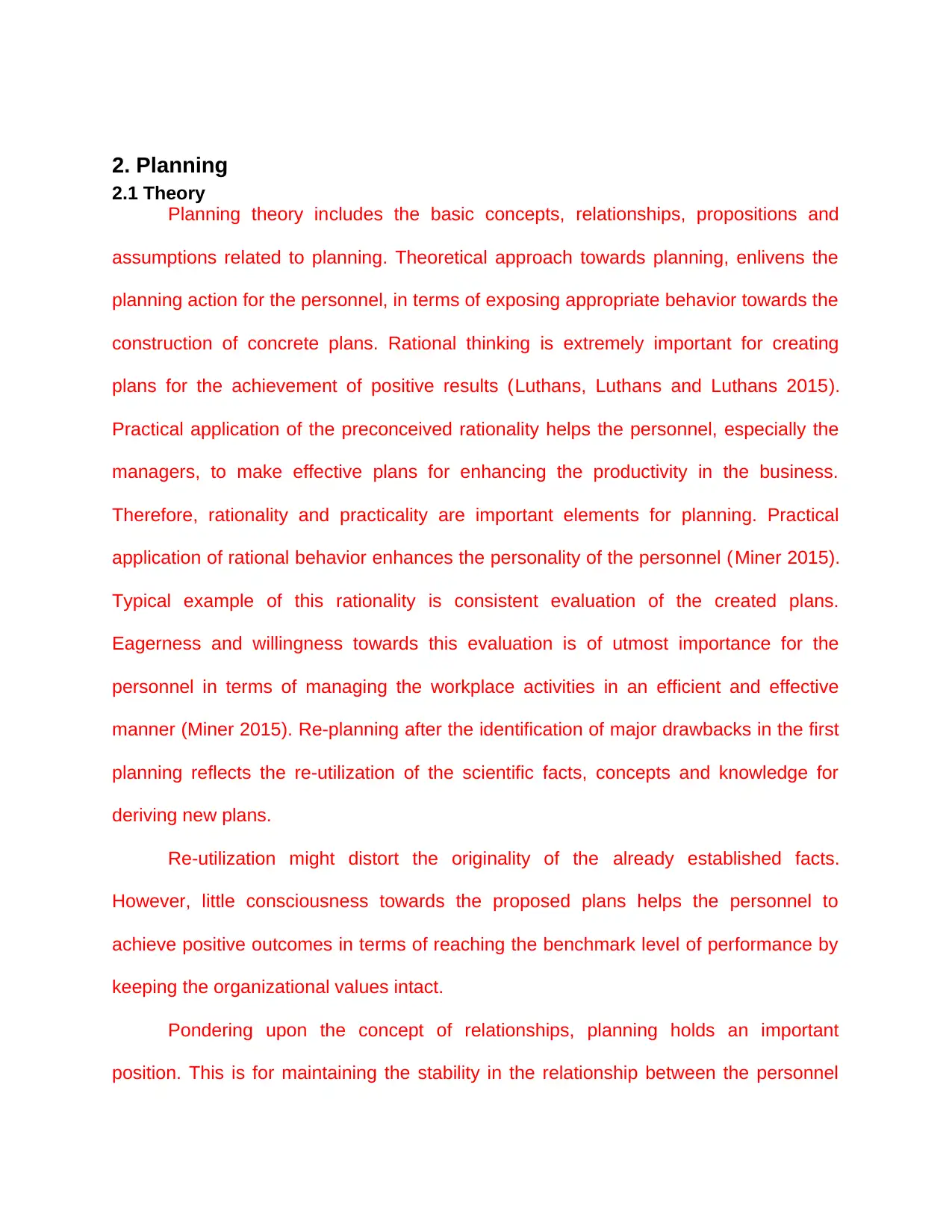
2. Planning
2.1 Theory
Planning theory includes the basic concepts, relationships, propositions and
assumptions related to planning. Theoretical approach towards planning, enlivens the
planning action for the personnel, in terms of exposing appropriate behavior towards the
construction of concrete plans. Rational thinking is extremely important for creating
plans for the achievement of positive results (Luthans, Luthans and Luthans 2015).
Practical application of the preconceived rationality helps the personnel, especially the
managers, to make effective plans for enhancing the productivity in the business.
Therefore, rationality and practicality are important elements for planning. Practical
application of rational behavior enhances the personality of the personnel (Miner 2015).
Typical example of this rationality is consistent evaluation of the created plans.
Eagerness and willingness towards this evaluation is of utmost importance for the
personnel in terms of managing the workplace activities in an efficient and effective
manner (Miner 2015). Re-planning after the identification of major drawbacks in the first
planning reflects the re-utilization of the scientific facts, concepts and knowledge for
deriving new plans.
Re-utilization might distort the originality of the already established facts.
However, little consciousness towards the proposed plans helps the personnel to
achieve positive outcomes in terms of reaching the benchmark level of performance by
keeping the organizational values intact.
Pondering upon the concept of relationships, planning holds an important
position. This is for maintaining the stability in the relationship between the personnel
tabler-icon-diamond-filled.svg

Paraphrase This Document

Need a fresh take? Get an instant paraphrase of this document with our AI Paraphraser
Document Page
(Naylor, Pritchard and Ilgen 2013). This stability helps in the exposure of partnership
working, which is assistance for the achievement of the positive results in terms of
maintaining the efficiency and effectiveness in the business activities.
2.2 Findings
From the findings, two issues can be found out- time management and future
planning. The interviewed manager thinks that time management is very important for
doing the things effectively and efficiently. Making practical utilization of the available
time helps the manager to achieve successful completion of the tasks in hand. Along
with this, he also thinks that planning before starting the tasks is crucial for the
achievement of positive outcomes (Pinder 2014). Scheduling the tasks, according to
their priority in the morning, helps him in managing the workplace activities properly. He
believes that adhering to the planned schedule is vital for getting the best results. He
follows this principle not only for managing the performance of the employees, but also
for organizing meetings with the stakeholders and other business partners.
Maintenance of consistency in this adherence justifies the position awarded to him.
This is not all; he jots down the highlights of the meeting and evaluates his
performance at the end of the day. This helps him to identify the drawbacks, which
needs to be modified for enhancing his personality as a manager. This evaluation
includes a conscious approach towards the pending tasks (Naylor, Pritchard and Ilgen
2013). This consciousness helps him to improve the standard and quality of his
performance (Wagner and Hollenbeck 2014).
Eagerness and willingness are the initial stages towards planning. Presence of
these components helps the personnel to derive best results in the efficient execution of
Document Page
the business activities. Absence of willingness reflects the lackadaisical attitude of the
managers towards maintaining the order and harmony of the workplace.
2.3 Analysis
From the above two segments, it can be concluded that planning is vital in terms
of deriving best results for the achievement of success. However, rationality and
consciousness is required in this planning for reaching to the benchmark level of
performance. One of the typical components of this planning is time management.
Effective management of time helps the manager to execute all the tasks according to
their priority. For this, planning the available time is important (Williams 2015). Effective
and judicious utilization of the available time assists the manager to successfully
complete the tasks and evaluate their effectiveness, appropriateness and feasibility.
Keeping in mind the identified and the specified objectives justifies the designation,
setting a positive example in the minds of the employees (Pinder 2014). Herein, the
traditionalism and the originality of the organizational values attain a positive
connotation.
Along with this, the interviewed manager thinks that future planning helps in
being prepared for the instances, which he might have to encounter in the process of
managing the workplace activities (Luthans, Luthans and Luthans 2015). Evaluation is
the main agent, which helps the manager to envision the place where they would reach
through the execution of the current duties and responsibilities. This includes the
conglomeration of the current position and the future position. As a matter of
specification, in-depth evaluation of the current position helps the manager to think of
Document Page
promotion, which helps in the attainment of personal as well as professional
development (Wagner and Hollenbeck 2014).
tabler-icon-diamond-filled.svg

Paraphrase This Document

Need a fresh take? Get an instant paraphrase of this document with our AI Paraphraser
Document Page
References
Luthans, F., Luthans, B.C. and Luthans, K.W., 2015. Organizational behavior: An
evidence-based approach. IAP.
Miner, J.B., 2015. Organizational behavior 1: Essential theories of motivation and
leadership. Routledge.
Naylor, J.C., Pritchard, R.D. and Ilgen, D.R., 2013. A theory of behavior in
organizations. Academic Press.
Pinder, C.C., 2014. Work motivation in organizational behavior. Psychology Press.
Wagner III, J.A. and Hollenbeck, J.R., 2014. Organizational behavior: Securing
competitive advantage. Routledge.
Williams, C., 2015. Effective management. Cengage Learning.
chevron_up_icon
1 out of 5
circle_padding
hide_on_mobile
zoom_out_icon
[object Object]