HRMM055: Leadership, Management, Power, and Politics at Tesco
VerifiedAdded on 2023/05/28
|12
|2937
|319
Report
AI Summary
This report examines the leadership and management styles at Tesco, focusing on the interplay of power and politics within the organization. It identifies Dave Lewis as a customer-focused leader who emphasizes employee motivation through rewards and democratic leadership. The report explores the importance of democratic leadership in Tesco's management, highlighting its flat structure and decentralized information flow. It discusses the leader's referent power and its impact on reducing office politics, as well as the application of Maslow's hierarchy of needs to enhance employee engagement. The analysis concludes that Tesco's democratic leadership and management styles positively influence the organizational culture, fostering a positive environment and boosting employee motivation, productivity, and profitability. Desklib provides access to similar solved assignments and AI-powered study tools for students.

Managing and organizational

Paraphrase This Document
Need a fresh take? Get an instant paraphrase of this document with our AI Paraphraser
Managing and organizational
Executive summary
In the present scenario, it has been seen that it is important to have proper leadership style in the
company as it can impact the overall culture of the company. It is the responsibility of the leader
to consider the effective leadership style as it can impact the overall process of working in the
workplace. Also, the leader has various authority which should implemented in the right way as
it is one of the reasons related to maintaining the culture of the company. So, in this paper the
discussion will be made on the Tesco Company and various factors related to leadership will be
considered. The objective of the paper is to focus on the concept of leadership and management.
1
Executive summary
In the present scenario, it has been seen that it is important to have proper leadership style in the
company as it can impact the overall culture of the company. It is the responsibility of the leader
to consider the effective leadership style as it can impact the overall process of working in the
workplace. Also, the leader has various authority which should implemented in the right way as
it is one of the reasons related to maintaining the culture of the company. So, in this paper the
discussion will be made on the Tesco Company and various factors related to leadership will be
considered. The objective of the paper is to focus on the concept of leadership and management.
1
Managing and organizational
Table of Contents
Executive summary.........................................................................................................................1
Introduction......................................................................................................................................1
Leadership and management...........................................................................................................1
Leader’s qualities, characteristics and behaviors.........................................................................2
Importance of leadership style as a part of management and identification of the management
style..............................................................................................................................................2
Power and Politics...........................................................................................................................3
Power reference to leadership style.............................................................................................3
Impact of POWER on Office Politics..........................................................................................4
Organizational culture and effectiveness.........................................................................................4
Conclusion.......................................................................................................................................6
References........................................................................................................................................7
Appendix..........................................................................................................................................9
2
Table of Contents
Executive summary.........................................................................................................................1
Introduction......................................................................................................................................1
Leadership and management...........................................................................................................1
Leader’s qualities, characteristics and behaviors.........................................................................2
Importance of leadership style as a part of management and identification of the management
style..............................................................................................................................................2
Power and Politics...........................................................................................................................3
Power reference to leadership style.............................................................................................3
Impact of POWER on Office Politics..........................................................................................4
Organizational culture and effectiveness.........................................................................................4
Conclusion.......................................................................................................................................6
References........................................................................................................................................7
Appendix..........................................................................................................................................9
2
⊘ This is a preview!⊘
Do you want full access?
Subscribe today to unlock all pages.

Trusted by 1+ million students worldwide
Managing and organizational
Introduction
The company selected for the task is Tesco. Tesco is one of the British multinational groceries
and general merchandise retailers. Headquarter of Tesco is in Welwyn Garden City, England,
United Kingdom. It has been analyzed that Tesco is one of the customer oriented company and
it provide products at value for money to its customers so that it can be easy to maintain the
overall quality of the service. The leader of the company is Dave Lewis and from September
2014, he has been the CEO of the company and was born on 12 March, 1965 (Tesco, 2018).
Leadership and management
In the workplace it is important that there should be effective leadership style so that it can be
easy for the employees to give their best towards the activities of the company. It has been
observed that the leadership style considered in the company is related to the customer focused
leadership style. Customer focused leadership is one of the wide approach related with the
customer satisfaction and service and it lead to the loyalty of the customers. In the workplace
Dave Lewis focuses on boosting the overall working pattern of the employees by considering the
objective related to satisfy the customers (Wood,Wrigley and Coe, 2016).
Tesco is one of the companies that run and manage the routine activities by customer focused
leader. Tesco emphasizes on developing the leadership qualities of the employees throughout the
company, from administrators and customer assistants to the board of the directors. Leadership
is related to influencing, motivating and inspiring the people. It is also related with coaching and
developing the people so that it can be easy for them to achieve the goals in the competitive
market. It has been identified that the leader possessed various qualities (Antonakis and Day,
2017).
Leader’s qualities, characteristics and behaviors
One of the qualities of Dave Lewis is related with confidence and it has been seen that he is
confidence towards work and boost the confidence of the employees so that they can be efficient
towards overall activities of the company. Like before taking any decision in the workplace, the
focus is given on maintaining the relation with the customers (Shapiro and Stefkovich, 2016).
To boost the confidence level of the employees and to motivate them the leader focused on
giving rewards and incentives according to performance. By introducing this concept, it has been
3
Introduction
The company selected for the task is Tesco. Tesco is one of the British multinational groceries
and general merchandise retailers. Headquarter of Tesco is in Welwyn Garden City, England,
United Kingdom. It has been analyzed that Tesco is one of the customer oriented company and
it provide products at value for money to its customers so that it can be easy to maintain the
overall quality of the service. The leader of the company is Dave Lewis and from September
2014, he has been the CEO of the company and was born on 12 March, 1965 (Tesco, 2018).
Leadership and management
In the workplace it is important that there should be effective leadership style so that it can be
easy for the employees to give their best towards the activities of the company. It has been
observed that the leadership style considered in the company is related to the customer focused
leadership style. Customer focused leadership is one of the wide approach related with the
customer satisfaction and service and it lead to the loyalty of the customers. In the workplace
Dave Lewis focuses on boosting the overall working pattern of the employees by considering the
objective related to satisfy the customers (Wood,Wrigley and Coe, 2016).
Tesco is one of the companies that run and manage the routine activities by customer focused
leader. Tesco emphasizes on developing the leadership qualities of the employees throughout the
company, from administrators and customer assistants to the board of the directors. Leadership
is related to influencing, motivating and inspiring the people. It is also related with coaching and
developing the people so that it can be easy for them to achieve the goals in the competitive
market. It has been identified that the leader possessed various qualities (Antonakis and Day,
2017).
Leader’s qualities, characteristics and behaviors
One of the qualities of Dave Lewis is related with confidence and it has been seen that he is
confidence towards work and boost the confidence of the employees so that they can be efficient
towards overall activities of the company. Like before taking any decision in the workplace, the
focus is given on maintaining the relation with the customers (Shapiro and Stefkovich, 2016).
To boost the confidence level of the employees and to motivate them the leader focused on
giving rewards and incentives according to performance. By introducing this concept, it has been
3
Paraphrase This Document
Need a fresh take? Get an instant paraphrase of this document with our AI Paraphraser
Managing and organizational
seen that employees are efficient towards the work and offer effective services to the customers
that satisfy the customers (Iqbal, Anwar and Haider, 2015).
Also, the leader emphasizes on considering the democratic leadership style in the company. It
has been analyzed that appointment of Terry as the CEO of Tesco marked the new era. He
considered democratic leadership style in which the employees participate in the decision
process of the company (Ward, 2016). The CEO focuses on appointing the employees so that it
can be easy to manage the overall process of the company. He emphasized on taking opinion and
views from the employees so that they can have positive behavior towards their work
(Cuthbertson, Furseth and Ezell, 2015).
Importance of leadership style as a part of management and identification of
the management style
Democratic leadership style plays an important role in context to the management of the
company. It has been evaluated that in Tesco, the democratic leadership style is present as they
have the flat structure which enable the employees to be a part of achievement. The democratic
leadership style considered by the company boosted the overall motivation level of the
employees and also it enhanced the productivity level of the company in the competitive market.
So, it motivated the employees and enhanced the productivity is the importance in context to
leadership style of management (Bolman and Deal, 2017).
Also, it has been identified that the management style of the company is democratic as their way
of managing is decentralized and also the information is given from the top management to the
subordinates. The employees are also free to speak and can give their opinion in context to the
overall growth of the company (Collinson, 2014).
Power and Politics
Power reference to leadership style
In the workplace it is important for the leader to focus on managing the activities by considering
the authority. It can be stated that in context to the democratic leadership style considered by the
leader, the power relates with the referent power. Referent power focuses on the trust and at the
time of making the decision the leader of Tesco have trust on the employees that they will
consider the right decision (Guardian, 2018). So, Leahy delegated the leadership role to the
4
seen that employees are efficient towards the work and offer effective services to the customers
that satisfy the customers (Iqbal, Anwar and Haider, 2015).
Also, the leader emphasizes on considering the democratic leadership style in the company. It
has been analyzed that appointment of Terry as the CEO of Tesco marked the new era. He
considered democratic leadership style in which the employees participate in the decision
process of the company (Ward, 2016). The CEO focuses on appointing the employees so that it
can be easy to manage the overall process of the company. He emphasized on taking opinion and
views from the employees so that they can have positive behavior towards their work
(Cuthbertson, Furseth and Ezell, 2015).
Importance of leadership style as a part of management and identification of
the management style
Democratic leadership style plays an important role in context to the management of the
company. It has been evaluated that in Tesco, the democratic leadership style is present as they
have the flat structure which enable the employees to be a part of achievement. The democratic
leadership style considered by the company boosted the overall motivation level of the
employees and also it enhanced the productivity level of the company in the competitive market.
So, it motivated the employees and enhanced the productivity is the importance in context to
leadership style of management (Bolman and Deal, 2017).
Also, it has been identified that the management style of the company is democratic as their way
of managing is decentralized and also the information is given from the top management to the
subordinates. The employees are also free to speak and can give their opinion in context to the
overall growth of the company (Collinson, 2014).
Power and Politics
Power reference to leadership style
In the workplace it is important for the leader to focus on managing the activities by considering
the authority. It can be stated that in context to the democratic leadership style considered by the
leader, the power relates with the referent power. Referent power focuses on the trust and at the
time of making the decision the leader of Tesco have trust on the employees that they will
consider the right decision (Guardian, 2018). So, Leahy delegated the leadership role to the
4
Managing and organizational
people in the company so that it can be easy to manage the entire activities in the workplace. The
management of the company empowers the employees and they are considered as the asset of the
company and it helps the company to achieve success.
Also, in this it has been stated that the leader of the company have the authority to empower the
employees so that it can be easy to boost the growth of the company. By having authority or the
power they emphasize on delegating the overall work to the employees so that it can be managed
in a proper manner (Heifetz and Linsky, 2017). By delegating the work, the aim of the leader is
to engage the employees towards the work. To engage the employees towards work, the leader
consider the motivation theory related to Maslow hierarchy of needs in which focus is given on
satisfying the needs of the employees. The leader has the authority to satisfy the needs of the
employees in the workplace. So, they consider the concept of Maslow hierarchy of needs. So, in
context to the democratic style of leadership, the leader has the power to exercise control over
the activities through delegation of work and also by enhancing the employee engagement
(Referenceforbusiness, 2018). By considering these factors the positive impact is also seen on
the overall culture of the company.
Impact of POWER on Office Politics
It can be seen that the leader have the power to delegate the work to the employees and also to
take decisions of the workplace. But, the democratic leadership style considered by the leaders
can involve the employees in the decision making process but the leader will not involve
themselves in the office politics. The office politics arise in the workplace due to favoritism
given by the leaders to the employees, self-interest and also due to avoidance. But it has been
seen that the leader of Tesco do not engage themselves in the office politics. Democratic
leadership is considered by the leader and the power is Referent, so it has been seen that this
power reduces the office politics in the workplace (Renz, 2016). The leader gives chance to
every employee in the workplace and everyone have the chance to share their views and opinion.
Also, the leader has the authority to appraise the employees, so it is also done by analyzing the
overall performance of the employees in the workplace. As democratic leadership style is
considered, the leader do not engage in the office politics and they try to reduce it by giving
chance to every employees to engage themselves in the process of decision making process.
5
people in the company so that it can be easy to manage the entire activities in the workplace. The
management of the company empowers the employees and they are considered as the asset of the
company and it helps the company to achieve success.
Also, in this it has been stated that the leader of the company have the authority to empower the
employees so that it can be easy to boost the growth of the company. By having authority or the
power they emphasize on delegating the overall work to the employees so that it can be managed
in a proper manner (Heifetz and Linsky, 2017). By delegating the work, the aim of the leader is
to engage the employees towards the work. To engage the employees towards work, the leader
consider the motivation theory related to Maslow hierarchy of needs in which focus is given on
satisfying the needs of the employees. The leader has the authority to satisfy the needs of the
employees in the workplace. So, they consider the concept of Maslow hierarchy of needs. So, in
context to the democratic style of leadership, the leader has the power to exercise control over
the activities through delegation of work and also by enhancing the employee engagement
(Referenceforbusiness, 2018). By considering these factors the positive impact is also seen on
the overall culture of the company.
Impact of POWER on Office Politics
It can be seen that the leader have the power to delegate the work to the employees and also to
take decisions of the workplace. But, the democratic leadership style considered by the leaders
can involve the employees in the decision making process but the leader will not involve
themselves in the office politics. The office politics arise in the workplace due to favoritism
given by the leaders to the employees, self-interest and also due to avoidance. But it has been
seen that the leader of Tesco do not engage themselves in the office politics. Democratic
leadership is considered by the leader and the power is Referent, so it has been seen that this
power reduces the office politics in the workplace (Renz, 2016). The leader gives chance to
every employee in the workplace and everyone have the chance to share their views and opinion.
Also, the leader has the authority to appraise the employees, so it is also done by analyzing the
overall performance of the employees in the workplace. As democratic leadership style is
considered, the leader do not engage in the office politics and they try to reduce it by giving
chance to every employees to engage themselves in the process of decision making process.
5
⊘ This is a preview!⊘
Do you want full access?
Subscribe today to unlock all pages.
Trusted by 1+ million students worldwide
Managing and organizational
Organizational culture and effectiveness
It can be stated that influence of the democratic leadership style and management style
considered by Tesco has an influence on the overall culture of the company. By considering this
style, the organizational culture is positive as the employees have the equal opportunity to share
their views and opinion (Tannenbaum and Schmidt, 2017). Equal rights are assigned to the
employees in context to engaging themselves in the activities of the company. In context to
management style, it has been observed that flow of communication is from the top management
to the subordinates. The employees are also free to speak and can give their opinion in context
to the overall growth of the company. So, it boosts the motivation of the employees and creates
positive culture in the workplace. Also, to motivate the employees the company emphasizes on
the motivation theory which is considered for every employee in the workplace (Samantara and
Sharma, 2015).
Also, the leader has a positive behavior towards the activities of the company. It has been seen
that due to positive behavior, he focused on maintaining the positive culture in the workplace.
He guides the team and manages the conflicts with the positive behavior which boost the overall
the positive culture of the company (Tourish, 2014). By having positive behavior towards the
employees they feel motivated and also it maintain the culture of the company.
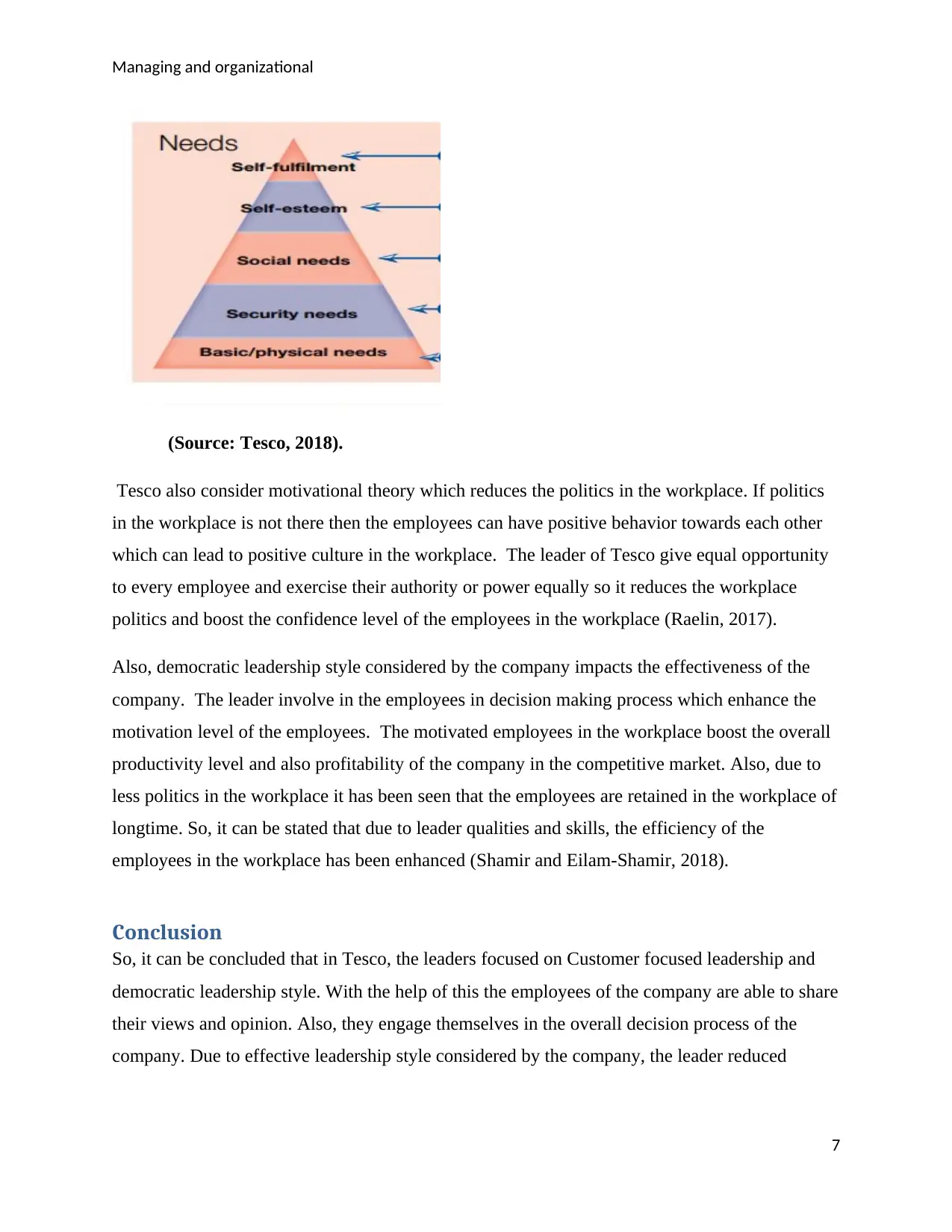
Maslow hierarchy of needs theory is considered by the management in which the first stage is
related with physiological need that emphasizes on the basic needs like food and shelter. The
leader emphasizes on this stage by offering salary to the employees. The next stage is safety and
security need in which the leader emphasizes on maintaining the culture of the company. The
next is social needs in which teamwork is considered. Self-esteem is also one of the step which
focuses on promoting the employees. Tesco emphasizes on 360 degree feedback and appraisal
system which assist in recognizing the contribution of the individual. The last step is self-
fulfillment need in which the company offers personal development plans and also career
progression programs. So, the authority to empower the employees in the workplace is done by
engaging the employees towards work by considering Maslow hierarchy of needs theory (Tesco,
2018). This motivational theory is considered by company as it helps to boost the confidence
level of the employees in the workplace. So, it can be stated that Maslow hierarchy of needs it
one of the effective theory will help to enhance the employee engagement in the workplace.
6
Organizational culture and effectiveness
It can be stated that influence of the democratic leadership style and management style
considered by Tesco has an influence on the overall culture of the company. By considering this
style, the organizational culture is positive as the employees have the equal opportunity to share
their views and opinion (Tannenbaum and Schmidt, 2017). Equal rights are assigned to the
employees in context to engaging themselves in the activities of the company. In context to
management style, it has been observed that flow of communication is from the top management
to the subordinates. The employees are also free to speak and can give their opinion in context
to the overall growth of the company. So, it boosts the motivation of the employees and creates
positive culture in the workplace. Also, to motivate the employees the company emphasizes on
the motivation theory which is considered for every employee in the workplace (Samantara and
Sharma, 2015).
Also, the leader has a positive behavior towards the activities of the company. It has been seen
that due to positive behavior, he focused on maintaining the positive culture in the workplace.
He guides the team and manages the conflicts with the positive behavior which boost the overall
the positive culture of the company (Tourish, 2014). By having positive behavior towards the
employees they feel motivated and also it maintain the culture of the company.
Maslow hierarchy of needs theory is considered by the management in which the first stage is
related with physiological need that emphasizes on the basic needs like food and shelter. The
leader emphasizes on this stage by offering salary to the employees. The next stage is safety and
security need in which the leader emphasizes on maintaining the culture of the company. The
next is social needs in which teamwork is considered. Self-esteem is also one of the step which
focuses on promoting the employees. Tesco emphasizes on 360 degree feedback and appraisal
system which assist in recognizing the contribution of the individual. The last step is self-
fulfillment need in which the company offers personal development plans and also career
progression programs. So, the authority to empower the employees in the workplace is done by
engaging the employees towards work by considering Maslow hierarchy of needs theory (Tesco,
2018). This motivational theory is considered by company as it helps to boost the confidence
level of the employees in the workplace. So, it can be stated that Maslow hierarchy of needs it
one of the effective theory will help to enhance the employee engagement in the workplace.
6
Paraphrase This Document
Need a fresh take? Get an instant paraphrase of this document with our AI Paraphraser
Managing and organizational
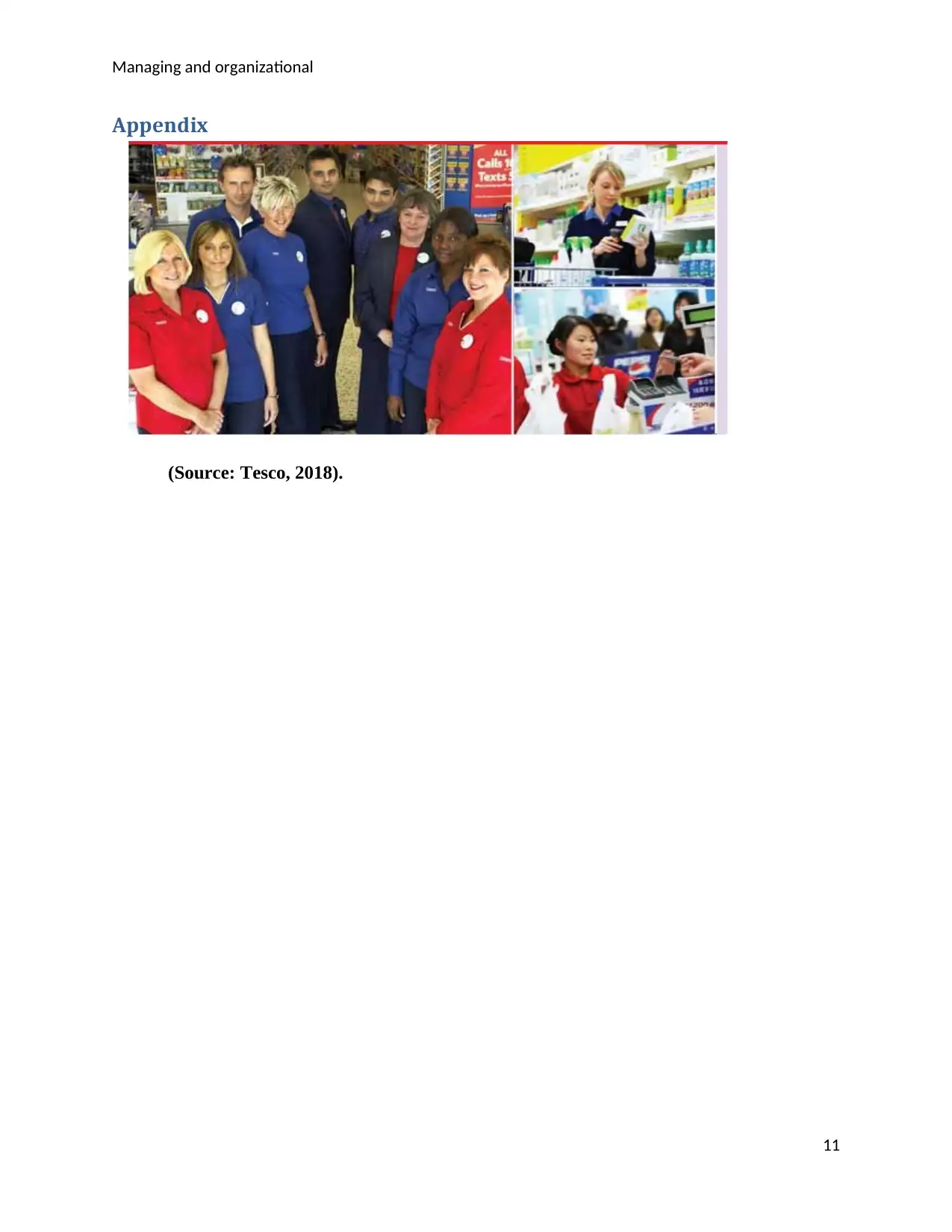
(Source: Tesco, 2018).
Tesco also consider motivational theory which reduces the politics in the workplace. If politics
in the workplace is not there then the employees can have positive behavior towards each other
which can lead to positive culture in the workplace. The leader of Tesco give equal opportunity
to every employee and exercise their authority or power equally so it reduces the workplace
politics and boost the confidence level of the employees in the workplace (Raelin, 2017).
Also, democratic leadership style considered by the company impacts the effectiveness of the
company. The leader involve in the employees in decision making process which enhance the
motivation level of the employees. The motivated employees in the workplace boost the overall
productivity level and also profitability of the company in the competitive market. Also, due to
less politics in the workplace it has been seen that the employees are retained in the workplace of
longtime. So, it can be stated that due to leader qualities and skills, the efficiency of the
employees in the workplace has been enhanced (Shamir and Eilam-Shamir, 2018).
Conclusion
So, it can be concluded that in Tesco, the leaders focused on Customer focused leadership and
democratic leadership style. With the help of this the employees of the company are able to share
their views and opinion. Also, they engage themselves in the overall decision process of the
company. Due to effective leadership style considered by the company, the leader reduced
7
(Source: Tesco, 2018).
Tesco also consider motivational theory which reduces the politics in the workplace. If politics
in the workplace is not there then the employees can have positive behavior towards each other
which can lead to positive culture in the workplace. The leader of Tesco give equal opportunity
to every employee and exercise their authority or power equally so it reduces the workplace
politics and boost the confidence level of the employees in the workplace (Raelin, 2017).
Also, democratic leadership style considered by the company impacts the effectiveness of the
company. The leader involve in the employees in decision making process which enhance the
motivation level of the employees. The motivated employees in the workplace boost the overall
productivity level and also profitability of the company in the competitive market. Also, due to
less politics in the workplace it has been seen that the employees are retained in the workplace of
longtime. So, it can be stated that due to leader qualities and skills, the efficiency of the
employees in the workplace has been enhanced (Shamir and Eilam-Shamir, 2018).
Conclusion
So, it can be concluded that in Tesco, the leaders focused on Customer focused leadership and
democratic leadership style. With the help of this the employees of the company are able to share
their views and opinion. Also, they engage themselves in the overall decision process of the
company. Due to effective leadership style considered by the company, the leader reduced
7

Managing and organizational
politics in the workplace which has led to overall growth of the company in the competitive
market.
8
politics in the workplace which has led to overall growth of the company in the competitive
market.
8
⊘ This is a preview!⊘
Do you want full access?
Subscribe today to unlock all pages.
Trusted by 1+ million students worldwide
Managing and organizational
References
Antonakis, J. and Day, D.V. eds., 2017. The nature of leadership. Sage publications.
Bolman, L.G. and Deal, T.E., 2017. Reframing organizations: Artistry, choice, and leadership.
John Wiley & Sons.
Collinson, D., 2014. Dichotomies, dialectics and dilemmas: New directions for critical leadership
studies?. Leadership, 10(1), pp.36-55.
Cuthbertson, R., Furseth, P.I. and Ezell, S.J., 2015. Tesco and Sainsbury’s: The Need to Turn
Ideas into Action. In Innovating in a Service-Driven Economy (pp. 159-165). Palgrave
Macmillan, London.
Guardian, 2018. Manners maketh management: Tesco bosses told to be nicer to staff. [Online].
Available at: https://www.theguardian.com/business/2016/mar/16/tesco-managers-polite-new-
initiative. [Accessed on 24 December, 2018].
Heifetz, R. and Linsky, M., 2017. Leadership on the Line, With a New Preface: Staying Alive
Through the Dangers of Change. Harvard Business Press.
Iqbal, N., Anwar, S. and Haider, N., 2015. Effect of leadership style on employee
performance. Arabian Journal of Business and Management Review, 5(5), pp.1-6.
Raelin, J.A., 2017. Leadership-as-practice: Theory and application—An editor’s
reflection. Leadership, 13(2), pp.215-221.
Referenceforbusiness, 2018. LEADERSHIP STYLES AND BASES OF POWER. [Online].
Available at: https://www.referenceforbusiness.com/management/Int-Loc/Leadership-Styles-
and-Bases-of-Power.html. [Accessed on 24 December, 2018].
Renz, D.O., 2016. The Jossey-Bass handbook of nonprofit leadership and management. John
Wiley & Sons.
Samantara, R. and Sharma, N., 2015. Talent Management at Tesco: A Case Study. Parikalpana:
KIIT Journal of Management, 11(2),pp.56-81.
9
References
Antonakis, J. and Day, D.V. eds., 2017. The nature of leadership. Sage publications.
Bolman, L.G. and Deal, T.E., 2017. Reframing organizations: Artistry, choice, and leadership.
John Wiley & Sons.
Collinson, D., 2014. Dichotomies, dialectics and dilemmas: New directions for critical leadership
studies?. Leadership, 10(1), pp.36-55.
Cuthbertson, R., Furseth, P.I. and Ezell, S.J., 2015. Tesco and Sainsbury’s: The Need to Turn
Ideas into Action. In Innovating in a Service-Driven Economy (pp. 159-165). Palgrave
Macmillan, London.
Guardian, 2018. Manners maketh management: Tesco bosses told to be nicer to staff. [Online].
Available at: https://www.theguardian.com/business/2016/mar/16/tesco-managers-polite-new-
initiative. [Accessed on 24 December, 2018].
Heifetz, R. and Linsky, M., 2017. Leadership on the Line, With a New Preface: Staying Alive
Through the Dangers of Change. Harvard Business Press.
Iqbal, N., Anwar, S. and Haider, N., 2015. Effect of leadership style on employee
performance. Arabian Journal of Business and Management Review, 5(5), pp.1-6.
Raelin, J.A., 2017. Leadership-as-practice: Theory and application—An editor’s
reflection. Leadership, 13(2), pp.215-221.
Referenceforbusiness, 2018. LEADERSHIP STYLES AND BASES OF POWER. [Online].
Available at: https://www.referenceforbusiness.com/management/Int-Loc/Leadership-Styles-
and-Bases-of-Power.html. [Accessed on 24 December, 2018].
Renz, D.O., 2016. The Jossey-Bass handbook of nonprofit leadership and management. John
Wiley & Sons.
Samantara, R. and Sharma, N., 2015. Talent Management at Tesco: A Case Study. Parikalpana:
KIIT Journal of Management, 11(2),pp.56-81.
9
Paraphrase This Document
Need a fresh take? Get an instant paraphrase of this document with our AI Paraphraser
Managing and organizational
Shamir, B. and Eilam-Shamir, G., 2018. “What’s your story?” A life-stories approach to
authentic leadership development. In Leadership Now: Reflections on the Legacy of Boas
Shamir(pp. 51-76). Emerald Publishing Limited.
Shapiro, J.P. and Stefkovich, J.A., 2016. Ethical leadership and decision making in education:
Applying theoretical perspectives to complex dilemmas. Routledge.
Tannenbaum, R. and Schmidt, W.H., 2017. How to choose a leadership pattern. In Leadership
Perspectives (pp. 75-84). Routledge.
Tesco, 2018. Motivational theory at practice Tesco. [Online]. Available at:
https://is.muni.cz/el/1451/podzim2013/np2330/tesco_15_full.pdf. [Accessed on 24 December,
2018].
Tourish, D., 2014. Leadership, more or less? A processual, communication perspective on the
role of agency in leadership theory. Leadership, 10(1), pp.79-98.
Ward, J., 2016. Keeping the family business healthy: How to plan for continuing growth,
profitability, and family leadership. Springer.
Wood, S., Wrigley, N. and Coe, N.M., 2016. Capital discipline and financial market relations in
retail globalization: insights from the case of Tesco plc. Journal of Economic Geography, 17(1),
pp.31-57.
10
Shamir, B. and Eilam-Shamir, G., 2018. “What’s your story?” A life-stories approach to
authentic leadership development. In Leadership Now: Reflections on the Legacy of Boas
Shamir(pp. 51-76). Emerald Publishing Limited.
Shapiro, J.P. and Stefkovich, J.A., 2016. Ethical leadership and decision making in education:
Applying theoretical perspectives to complex dilemmas. Routledge.
Tannenbaum, R. and Schmidt, W.H., 2017. How to choose a leadership pattern. In Leadership
Perspectives (pp. 75-84). Routledge.
Tesco, 2018. Motivational theory at practice Tesco. [Online]. Available at:
https://is.muni.cz/el/1451/podzim2013/np2330/tesco_15_full.pdf. [Accessed on 24 December,
2018].
Tourish, D., 2014. Leadership, more or less? A processual, communication perspective on the
role of agency in leadership theory. Leadership, 10(1), pp.79-98.
Ward, J., 2016. Keeping the family business healthy: How to plan for continuing growth,
profitability, and family leadership. Springer.
Wood, S., Wrigley, N. and Coe, N.M., 2016. Capital discipline and financial market relations in
retail globalization: insights from the case of Tesco plc. Journal of Economic Geography, 17(1),
pp.31-57.
10
Managing and organizational
Appendix
(Source: Tesco, 2018).
11
Appendix
(Source: Tesco, 2018).
11
⊘ This is a preview!⊘
Do you want full access?
Subscribe today to unlock all pages.
Trusted by 1+ million students worldwide

1 out of 12


Related Documents


Your All-in-One AI-Powered Toolkit for Academic Success.
+13062052269
info@desklib.com
Available 24*7 on WhatsApp / Email
![[object Object]](/_next/static/media/star-bottom.7253800d.svg)
Unlock your academic potential
Copyright © 2020–2026 A2Z Services. All Rights Reserved. Developed and managed by ZUCOL.