Barbados Community College Business Project: Leadership and EI Impact
VerifiedAdded on 2023/04/22
|34
|9721
|328
Project
AI Summary
This business project investigates the mediating role of leadership styles in the relationship between emotional intelligence (EI) and collaboration satisfaction, focusing on perspectives from EI. The project, conducted for The Barbados Community College, examines the theoretical underpinnings of EI, leadership styles (particularly transformational leadership), and collaboration satisfaction. It reviews existing literature to establish a foundation, including the ability and mixed models of EI, the influence of leadership on EI and collaboration, and the role of leadership as a mediator. The project outlines a Gantt chart for the study, detailing planning, evidence review, primary research, data analysis, and finalization. It aims to provide a critical analysis of leadership in relation to EI and collaboration, recommend appropriate leadership styles, and suggest strategies for enhancing workforce efficiency. The project also includes thematic analysis and concludes with recommendations for effective leadership in fostering collaboration and enhancing workforce performance. Appendices include an A3 map and transcripts from research.

Running! head:! BUSINESS! PROJECT! MANAGEMENT
The Mediating Role of Leadership Styles in the Relationship between Emotional Intelligence
and Collaboration Satisfaction – Perspectives from Emotional Intelligence
Name of the Student
Name of the University
Author note
The Mediating Role of Leadership Styles in the Relationship between Emotional Intelligence
and Collaboration Satisfaction – Perspectives from Emotional Intelligence
Name of the Student
Name of the University
Author note

Paraphrase This Document
Need a fresh take? Get an instant paraphrase of this document with our AI Paraphraser
1BUSINESS PROJECT MANAGEMENT
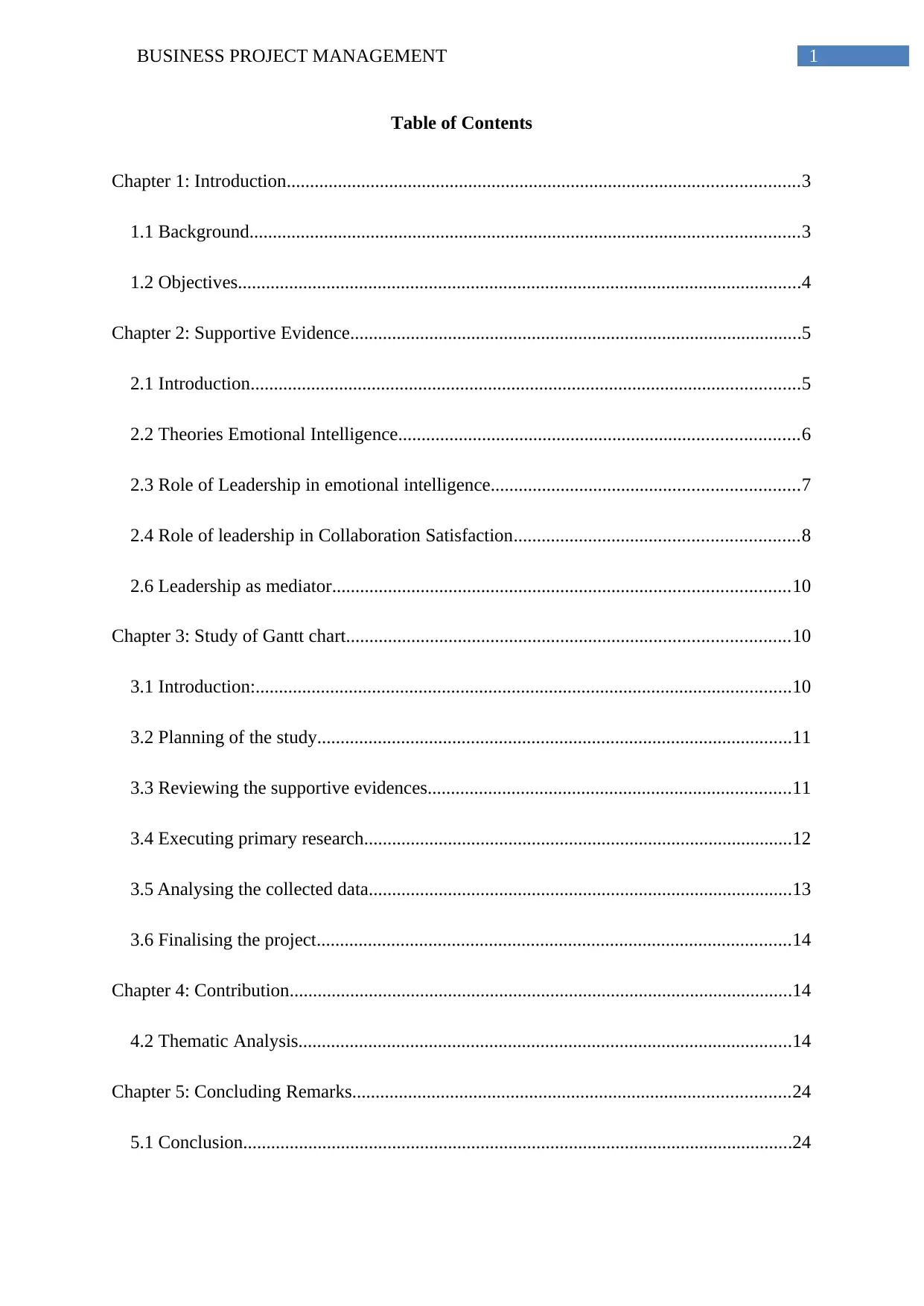
Table of Contents
Chapter 1: Introduction..............................................................................................................3
1.1 Background......................................................................................................................3
1.2 Objectives.........................................................................................................................4
Chapter 2: Supportive Evidence.................................................................................................5
2.1 Introduction......................................................................................................................5
2.2 Theories Emotional Intelligence......................................................................................6
2.3 Role of Leadership in emotional intelligence..................................................................7
2.4 Role of leadership in Collaboration Satisfaction.............................................................8
2.6 Leadership as mediator..................................................................................................10
Chapter 3: Study of Gantt chart...............................................................................................10
3.1 Introduction:...................................................................................................................10
3.2 Planning of the study......................................................................................................11
3.3 Reviewing the supportive evidences..............................................................................11
3.4 Executing primary research............................................................................................12
3.5 Analysing the collected data...........................................................................................13
3.6 Finalising the project......................................................................................................14
Chapter 4: Contribution............................................................................................................14
4.2 Thematic Analysis..........................................................................................................14
Chapter 5: Concluding Remarks..............................................................................................24
5.1 Conclusion......................................................................................................................24
Table of Contents
Chapter 1: Introduction..............................................................................................................3
1.1 Background......................................................................................................................3
1.2 Objectives.........................................................................................................................4
Chapter 2: Supportive Evidence.................................................................................................5
2.1 Introduction......................................................................................................................5
2.2 Theories Emotional Intelligence......................................................................................6
2.3 Role of Leadership in emotional intelligence..................................................................7
2.4 Role of leadership in Collaboration Satisfaction.............................................................8
2.6 Leadership as mediator..................................................................................................10
Chapter 3: Study of Gantt chart...............................................................................................10
3.1 Introduction:...................................................................................................................10
3.2 Planning of the study......................................................................................................11
3.3 Reviewing the supportive evidences..............................................................................11
3.4 Executing primary research............................................................................................12
3.5 Analysing the collected data...........................................................................................13
3.6 Finalising the project......................................................................................................14
Chapter 4: Contribution............................................................................................................14
4.2 Thematic Analysis..........................................................................................................14
Chapter 5: Concluding Remarks..............................................................................................24
5.1 Conclusion......................................................................................................................24
2BUSINESS PROJECT MANAGEMENT
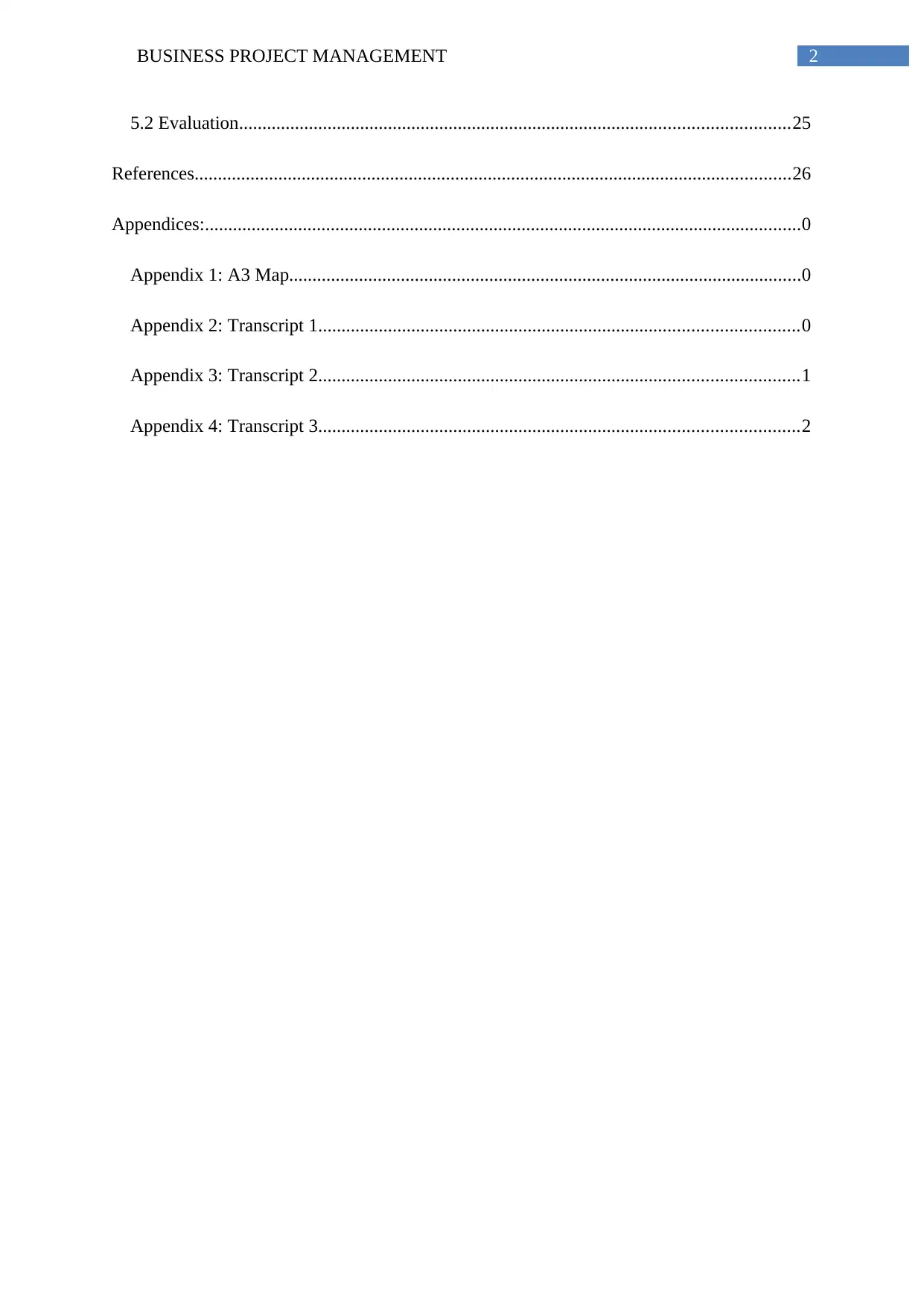
5.2 Evaluation......................................................................................................................25
References................................................................................................................................26
Appendices:................................................................................................................................0
Appendix 1: A3 Map..............................................................................................................0
Appendix 2: Transcript 1.......................................................................................................0
Appendix 3: Transcript 2.......................................................................................................1
Appendix 4: Transcript 3.......................................................................................................2
5.2 Evaluation......................................................................................................................25
References................................................................................................................................26
Appendices:................................................................................................................................0
Appendix 1: A3 Map..............................................................................................................0
Appendix 2: Transcript 1.......................................................................................................0
Appendix 3: Transcript 2.......................................................................................................1
Appendix 4: Transcript 3.......................................................................................................2
⊘ This is a preview!⊘
Do you want full access?
Subscribe today to unlock all pages.

Trusted by 1+ million students worldwide
3BUSINESS PROJECT MANAGEMENT
Chapter 1: Introduction
1.1 Background
In any organisational or institutional operation where the processes are highly
dependent on the coordination and interactive working of multiple groups of the workforce,
the leadership has a major role to control and coordinate the team members. In this situation,
it has been also proven that a leader with strong analytical skills can coordinate and control
the team members better than other leaders who do not have that skill. However, sometimes
very intelligent leaders could fail as well. In accordance with the results in Føllesdal and
Hagtvet (2013), it can be said that most of the time these failures occur because of the
troubles that arise during the developing the operational relationship between the team
members with the higher authority or clients. Therefore, there are more such pieces of
evidence that can prove that in today’s business environment only intellect would not help
leaders to perform great leadership. Here comes the concept of emotional leaders and the
concept of team member satisfaction that are highly interrelated by the ability of a leader to
handle himself of herself as well as to handle the other team members (Rezvani et al. 2016).
Hence, it is very important to find the strategies about how a leader with vision and passion
can achieve a strong team performance by injecting enthusiasm and energy within each of the
team members through guidance, motivation, inspiration, listening, persuading, where
dealing with the emotion is the crucial part of the a successful leadership.
This project is a non-experimental study on leadership style as per the request of the
client The Barbados Community College. The Barbados Community College is located at
'Eyrie', Howells Cross Road, St. Michael, Barbados. As per the last meeting, the client needs
a study to explore the strategic activities needed in effective leadership to act as a mediator
between emotional intelligence and collaboration satisfaction. These are the client
Chapter 1: Introduction
1.1 Background
In any organisational or institutional operation where the processes are highly
dependent on the coordination and interactive working of multiple groups of the workforce,
the leadership has a major role to control and coordinate the team members. In this situation,
it has been also proven that a leader with strong analytical skills can coordinate and control
the team members better than other leaders who do not have that skill. However, sometimes
very intelligent leaders could fail as well. In accordance with the results in Føllesdal and
Hagtvet (2013), it can be said that most of the time these failures occur because of the
troubles that arise during the developing the operational relationship between the team
members with the higher authority or clients. Therefore, there are more such pieces of
evidence that can prove that in today’s business environment only intellect would not help
leaders to perform great leadership. Here comes the concept of emotional leaders and the
concept of team member satisfaction that are highly interrelated by the ability of a leader to
handle himself of herself as well as to handle the other team members (Rezvani et al. 2016).
Hence, it is very important to find the strategies about how a leader with vision and passion
can achieve a strong team performance by injecting enthusiasm and energy within each of the
team members through guidance, motivation, inspiration, listening, persuading, where
dealing with the emotion is the crucial part of the a successful leadership.
This project is a non-experimental study on leadership style as per the request of the
client The Barbados Community College. The Barbados Community College is located at
'Eyrie', Howells Cross Road, St. Michael, Barbados. As per the last meeting, the client needs
a study to explore the strategic activities needed in effective leadership to act as a mediator
between emotional intelligence and collaboration satisfaction. These are the client
Paraphrase This Document
Need a fresh take? Get an instant paraphrase of this document with our AI Paraphraser
4BUSINESS PROJECT MANAGEMENT
requirements as conveyed by the representatives from Barbados Community College a
Tertiary Level Educational Institution:
• Enhance the understanding of the role of leadership as a mediator
• Increase the potentiality of using Emotional Intelligence in Leadership
• Identify the Relationship between Emotional Intelligence and Collaboration
Satisfaction
• Recommending the strategies to enhance workforce efficiency and sustainability
1.2 Objectives
The purpose of this project is to deliver the appropriate solution to the client. As per
the client’s requirements, it has been found that in-depth study on leadership strategies and
emotional intelligence could lead to final desired implications. Hence the aims of these
projects are to examine the theoretical perspectives of Emotional Intelligence and
Collaboration Satisfaction, to understand the role of leadership as a mediator in an
organisational environment, to examine the current deficiency of leadership styles in real
organizations and to recommend appropriate strategies for mediatory leadership.
According to the above-mentioned aims, the objectives of this project are subdivided
into three major divisions’ namely Functional Requirement, Structural Requirement, and
Resource Requirement. Accordingly, the objectives of this project are followings:
Objective 1: Functional requirement
• Critical analysis of leadership in emotional intelligence and collaboration
satisfaction
requirements as conveyed by the representatives from Barbados Community College a
Tertiary Level Educational Institution:
• Enhance the understanding of the role of leadership as a mediator
• Increase the potentiality of using Emotional Intelligence in Leadership
• Identify the Relationship between Emotional Intelligence and Collaboration
Satisfaction
• Recommending the strategies to enhance workforce efficiency and sustainability
1.2 Objectives
The purpose of this project is to deliver the appropriate solution to the client. As per
the client’s requirements, it has been found that in-depth study on leadership strategies and
emotional intelligence could lead to final desired implications. Hence the aims of these
projects are to examine the theoretical perspectives of Emotional Intelligence and
Collaboration Satisfaction, to understand the role of leadership as a mediator in an
organisational environment, to examine the current deficiency of leadership styles in real
organizations and to recommend appropriate strategies for mediatory leadership.
According to the above-mentioned aims, the objectives of this project are subdivided
into three major divisions’ namely Functional Requirement, Structural Requirement, and
Resource Requirement. Accordingly, the objectives of this project are followings:
Objective 1: Functional requirement
• Critical analysis of leadership in emotional intelligence and collaboration
satisfaction
5BUSINESS PROJECT MANAGEMENT
• Recommending the appropriate leadership style for mediating the emotional
intelligence and collaboration satisfaction
Objective 2: Structural requirement
• Theoretical analysis of leadership, in emotional intelligence and collaboration
satisfaction
• Situational analysis primary through data collection
Objective 3: Resource Requirement
• The implementation procedure of mediatory leadership
• Implementation cost for mediatory leadership
Chapter 2: Supportive Evidence
2.1 Introduction
The purpose of this section is to present the supportive pieces of evidence regarding
the major components of this project namely emotional intelligence, leadership styles, and the
collaboration satisfaction. For this, in this section, several pieces of literature including the
research papers, articles, books, published reports have been reviewed. The major pieces of
evidence that this section is going to present is the theoretical understanding of emotional
intelligence, the theoretical understanding of collaboration satisfaction, the role of leadership
in emotional intelligence, the role of leadership in collaboration satisfaction and the role of a
leader as mediator.
• Recommending the appropriate leadership style for mediating the emotional
intelligence and collaboration satisfaction
Objective 2: Structural requirement
• Theoretical analysis of leadership, in emotional intelligence and collaboration
satisfaction
• Situational analysis primary through data collection
Objective 3: Resource Requirement
• The implementation procedure of mediatory leadership
• Implementation cost for mediatory leadership
Chapter 2: Supportive Evidence
2.1 Introduction
The purpose of this section is to present the supportive pieces of evidence regarding
the major components of this project namely emotional intelligence, leadership styles, and the
collaboration satisfaction. For this, in this section, several pieces of literature including the
research papers, articles, books, published reports have been reviewed. The major pieces of
evidence that this section is going to present is the theoretical understanding of emotional
intelligence, the theoretical understanding of collaboration satisfaction, the role of leadership
in emotional intelligence, the role of leadership in collaboration satisfaction and the role of a
leader as mediator.
⊘ This is a preview!⊘
Do you want full access?
Subscribe today to unlock all pages.
Trusted by 1+ million students worldwide
6BUSINESS PROJECT MANAGEMENT
2.2 Theories Emotional Intelligence
Emotional intelligence is one of the major parts of any social as well as professional
interaction in an organization. According to Lopes, Salovey and Straus (2003), emotional
intelligence is a set of psychological attributes or properties namely Self-awareness,
Empathy, Motivation, Self-regulation and Social skill. Arguably these are also the most
common skills which are needed in any workforce management in an organisational
environment. Theory suggests that the leadership style has serious contribution among all
these attributes of Emotional Intelligence.
In organisational context, both scholars and practitioners have recently started to
realise that in the effective operations management the significance of handling emotional
intelligence is a key set of managerial skills, which can contribute to ultimate business
success (Rezvani et al., 2016). Emotional Intelligence theories were generally separated into
two different constructions. Mayer and Salovey (2007), presents these two different
emotional intelligence theories as an ability model and a mixed model. Here, the ability
model of emotional intelligence has the major properties of comprehending and managing
one's own and others' emotions. It has been theorized that this formulation can be facilitated
through the formation of advantageous thoughts and behaviors. It can be also improved
depending on the development of age and experience of individuals (Obradovic et al., 2013).
Unlike the ability model, the mixed model of Emotional Intelligence advocates that pursuit in
a broader perspective through combining several personality traits with social behaviors and
competencies. The study showed that “EI is incorporation of non-cognitive capabilities,
competencies, and skills that influence individual's ability to succeed in coping with
environmental demands and pressures” (Bawafaa, Wong and Laschinger 2015). In a more
specific way, the study clearly states that the application of individual personality can also
contribute to the improvement of Emotional Intelligence. This performance improvement
2.2 Theories Emotional Intelligence
Emotional intelligence is one of the major parts of any social as well as professional
interaction in an organization. According to Lopes, Salovey and Straus (2003), emotional
intelligence is a set of psychological attributes or properties namely Self-awareness,
Empathy, Motivation, Self-regulation and Social skill. Arguably these are also the most
common skills which are needed in any workforce management in an organisational
environment. Theory suggests that the leadership style has serious contribution among all
these attributes of Emotional Intelligence.
In organisational context, both scholars and practitioners have recently started to
realise that in the effective operations management the significance of handling emotional
intelligence is a key set of managerial skills, which can contribute to ultimate business
success (Rezvani et al., 2016). Emotional Intelligence theories were generally separated into
two different constructions. Mayer and Salovey (2007), presents these two different
emotional intelligence theories as an ability model and a mixed model. Here, the ability
model of emotional intelligence has the major properties of comprehending and managing
one's own and others' emotions. It has been theorized that this formulation can be facilitated
through the formation of advantageous thoughts and behaviors. It can be also improved
depending on the development of age and experience of individuals (Obradovic et al., 2013).
Unlike the ability model, the mixed model of Emotional Intelligence advocates that pursuit in
a broader perspective through combining several personality traits with social behaviors and
competencies. The study showed that “EI is incorporation of non-cognitive capabilities,
competencies, and skills that influence individual's ability to succeed in coping with
environmental demands and pressures” (Bawafaa, Wong and Laschinger 2015). In a more
specific way, the study clearly states that the application of individual personality can also
contribute to the improvement of Emotional Intelligence. This performance improvement
Paraphrase This Document
Need a fresh take? Get an instant paraphrase of this document with our AI Paraphraser
7BUSINESS PROJECT MANAGEMENT
through Emotional Intelligence can highly impact the performance of the individual as well
as the corresponding personals of a team. According to Zacher et al. (2014), the
implementation of different Emotional Intelligence perspective, a leader has to consider the
IPD or inter-personal development considering the personality traits. These personality traits,
however, are the result of the shaping of individual cognition from a long working experience
in the professional field.
2.3 Role of Leadership in emotional intelligence
There are many theoretical perspectives about effective leadership styles and
approach, which could help the workers to work efficiently. From the past decade, the
leadership styles and their implementation in an institutional environment have been changed
significantly. Transactional and Transformational leadership are two of the most advanced
leadership styles (Khan, Masrek and Nadzar 2017). However, Transformational leadership is
found as the most balanced approach of collaboration and control with the help of
information sharing, conflict management, and mediatory obligations.
According to Foster and Roche (2014), the pieces of evidence from the case studies
demonstrated that Emotional Intelligence is an underlying factor associated with the
behavioral components of the implemented leadership styles. Different levels of inter-
cardinality can be found from the relationship between Emotional Intelligence and leadership
style in project management has been investigated at different levels. EI behaviors such as
interpersonal skills and empathy are significantly related to transformational leadership in
organizational environment. On the other hand, the relationships between EI and other
leadership behaviors in organizational operation portrays that with higher EI, leader prefers
more open communication as well as highly proactive leadership styles. In the function and
through Emotional Intelligence can highly impact the performance of the individual as well
as the corresponding personals of a team. According to Zacher et al. (2014), the
implementation of different Emotional Intelligence perspective, a leader has to consider the
IPD or inter-personal development considering the personality traits. These personality traits,
however, are the result of the shaping of individual cognition from a long working experience
in the professional field.
2.3 Role of Leadership in emotional intelligence
There are many theoretical perspectives about effective leadership styles and
approach, which could help the workers to work efficiently. From the past decade, the
leadership styles and their implementation in an institutional environment have been changed
significantly. Transactional and Transformational leadership are two of the most advanced
leadership styles (Khan, Masrek and Nadzar 2017). However, Transformational leadership is
found as the most balanced approach of collaboration and control with the help of
information sharing, conflict management, and mediatory obligations.
According to Foster and Roche (2014), the pieces of evidence from the case studies
demonstrated that Emotional Intelligence is an underlying factor associated with the
behavioral components of the implemented leadership styles. Different levels of inter-
cardinality can be found from the relationship between Emotional Intelligence and leadership
style in project management has been investigated at different levels. EI behaviors such as
interpersonal skills and empathy are significantly related to transformational leadership in
organizational environment. On the other hand, the relationships between EI and other
leadership behaviors in organizational operation portrays that with higher EI, leader prefers
more open communication as well as highly proactive leadership styles. In the function and
8BUSINESS PROJECT MANAGEMENT
operational leadership models in an institutional work process, transformational leadership
has gained the most attention because of its implementable relationship with several
psychological factors of Emotional Intelligence (Føllesdal and Hagtvet, 2013). From case
studies of various constructional projects, it has been found that EI competencies may
contribute to certain components of transformational leadership as well (Lam and O'Higgins,
2012). In this discussion, self-aware and self-managed leaders are able to understand their
emotions and regulate their behaviors which is propitious for subordinates' trust and respect
for the leaders. Secondly, leaders with high EI may be more motivated to impact subordinates
and evoke their enthusiasm for challenging tasks. Thirdly, leaders with high empathy may
comprehend subordinates' expectations and achieve them accordingly. Finally, the
competencies to coordinate social interaction and strengthen team management permit
leaders to generate new ideas as well as facilitate collaboration, which contributes to
intellectual stimulation and collaborative promotion. As for original transactional leadership,
found that leaders with elevated EI prefer effective and equitable contingent reward
behaviors. Moreover, EI competency of team management may help leaders to handle
conflicts and correct deviances which are consistent with active management by exception
(Wells and Welty Peachey, 2011). Thus, a relatively significant correlation between active-
transactional leadership and EI could be supposed. Conversely, it has been suggested that
passive-transactional leaders reflect task-oriented desires through inflicting punishment on
subordinates, and this may go against empathy or self-insight of EI.
2.4 Role of leadership in Collaboration Satisfaction
“Collaboration can influence workforce satisfaction”, which is the key motto of any
modern leadership or workforce management style. The triangle of satisfaction clearly states
operational leadership models in an institutional work process, transformational leadership
has gained the most attention because of its implementable relationship with several
psychological factors of Emotional Intelligence (Føllesdal and Hagtvet, 2013). From case
studies of various constructional projects, it has been found that EI competencies may
contribute to certain components of transformational leadership as well (Lam and O'Higgins,
2012). In this discussion, self-aware and self-managed leaders are able to understand their
emotions and regulate their behaviors which is propitious for subordinates' trust and respect
for the leaders. Secondly, leaders with high EI may be more motivated to impact subordinates
and evoke their enthusiasm for challenging tasks. Thirdly, leaders with high empathy may
comprehend subordinates' expectations and achieve them accordingly. Finally, the
competencies to coordinate social interaction and strengthen team management permit
leaders to generate new ideas as well as facilitate collaboration, which contributes to
intellectual stimulation and collaborative promotion. As for original transactional leadership,
found that leaders with elevated EI prefer effective and equitable contingent reward
behaviors. Moreover, EI competency of team management may help leaders to handle
conflicts and correct deviances which are consistent with active management by exception
(Wells and Welty Peachey, 2011). Thus, a relatively significant correlation between active-
transactional leadership and EI could be supposed. Conversely, it has been suggested that
passive-transactional leaders reflect task-oriented desires through inflicting punishment on
subordinates, and this may go against empathy or self-insight of EI.
2.4 Role of leadership in Collaboration Satisfaction
“Collaboration can influence workforce satisfaction”, which is the key motto of any
modern leadership or workforce management style. The triangle of satisfaction clearly states
⊘ This is a preview!⊘
Do you want full access?
Subscribe today to unlock all pages.
Trusted by 1+ million students worldwide
9BUSINESS PROJECT MANAGEMENT
that Result, Progress and Emotion take the three major pillar of satisfaction. Hence the
significance of emotion and consequently the emotional intelligence is not negligible. At the
same time, the theory of collaboration suggests the 8 major aspects of collaborative or
cooperative work process that includes, share, trust, success, support, assistance, exchange,
inspiration and teamwork (Rees et al. 2015).
Transformational leaders, encouraging the subordinates to get involved in creativity
and organizational learning (Kissi et al., 2013), may make a contribution to cost-saving,
quality advancing and schedule accelerating. Transformational leaders can provide
inspirational motivation to enhance subordinates' commitment to the organization. This may
simplify the process of coordinating and controlling, hence increasing other participants'
satisfaction with team efficiency. In addition, transformational leadership positively
influences project team-building (Aga et al., 2016) which can help leaders to solve
interpersonal problems as well as improve social relationships. Specifically, the individual
consideration by the transformational leader can improve subordinates' job satisfaction as
well as elicit a higher level of trust and diminish conflicts in an integrated team (Zhu et al.,
2013). As such, the satisfaction of long, stable relationships in the integrated team can be
perceived by other participants. Finally, subordinates and collaborators will reciprocate with
more passion for risk allocation and profit sharing in the response of a transformational
leader's collaboration promotion in IPD (Ertac and Gurdal, 2012). Active-transactional
leaders can earn trust, satisfaction, commitment, and effort of the subordinates by providing
fair rewards and necessary restrictions. Thus, technological innovations and quality
information flows will be increased, which in turn has positive effects on other participants'
satisfaction with performance contribution and project efficiency. In addition, active-
transactional leaders tend to focus their minds on team discussions via positive rules of
conduct, thus raising the participants' relationship satisfaction.
that Result, Progress and Emotion take the three major pillar of satisfaction. Hence the
significance of emotion and consequently the emotional intelligence is not negligible. At the
same time, the theory of collaboration suggests the 8 major aspects of collaborative or
cooperative work process that includes, share, trust, success, support, assistance, exchange,
inspiration and teamwork (Rees et al. 2015).
Transformational leaders, encouraging the subordinates to get involved in creativity
and organizational learning (Kissi et al., 2013), may make a contribution to cost-saving,
quality advancing and schedule accelerating. Transformational leaders can provide
inspirational motivation to enhance subordinates' commitment to the organization. This may
simplify the process of coordinating and controlling, hence increasing other participants'
satisfaction with team efficiency. In addition, transformational leadership positively
influences project team-building (Aga et al., 2016) which can help leaders to solve
interpersonal problems as well as improve social relationships. Specifically, the individual
consideration by the transformational leader can improve subordinates' job satisfaction as
well as elicit a higher level of trust and diminish conflicts in an integrated team (Zhu et al.,
2013). As such, the satisfaction of long, stable relationships in the integrated team can be
perceived by other participants. Finally, subordinates and collaborators will reciprocate with
more passion for risk allocation and profit sharing in the response of a transformational
leader's collaboration promotion in IPD (Ertac and Gurdal, 2012). Active-transactional
leaders can earn trust, satisfaction, commitment, and effort of the subordinates by providing
fair rewards and necessary restrictions. Thus, technological innovations and quality
information flows will be increased, which in turn has positive effects on other participants'
satisfaction with performance contribution and project efficiency. In addition, active-
transactional leaders tend to focus their minds on team discussions via positive rules of
conduct, thus raising the participants' relationship satisfaction.
Paraphrase This Document
Need a fresh take? Get an instant paraphrase of this document with our AI Paraphraser
10BUSINESS PROJECT MANAGEMENT
2.6 Leadership as a mediator
According to Tyczkowski et al (2015), leaders' self-aware abilities to assess, appraise
and perceive own emotions can help an organization to explore unique opportunities for
maintaining the creativity. It also helps the abilities to recognize other team member’s
unhappiness or disappointment, which could eventually beneficial for solving critical
problems in a creative way. At the same time, the procedure of enhancing creativity can
support leaders to accomplish the higher satisfaction level of other team members with their
contribution to collective and individual performance. When the leaders have self-
management ability equipped with EI, it can drive subordinates to adapt in a rapidly changing
environment. It can also improve efficiency as well as the satisfaction level of other team
members that can consequently facilitate organizational execution of complex change
management procedure (Taliadorou and Pashiardis 2015). The most essential factor is the
leaders' empathy ability that can help to realize other team members underlying requirements
in both mission and relationship as well as settle organizational conflict (Mersino 2013). The
team leaders equipped with emotional ability have better control and coordination over team
management that can be utilized for enhancing subordinates' motivation to execute and
complete the given task by using incentive measures and building continually collaborative
relationships based on mutual economic sharing among participants.
Chapter 3: Study of Gantt chart
3.1 Introduction:
The purpose of this Gantt chart based method is to show the specific activities
sequentially, that were needed to be completed in order to deliver the complete project
successfully. It presents a compact overview of the project procedures as well as the current
progress in the whole process (McCusker and Gunaydin 2015). Presenting the procedures in a
2.6 Leadership as a mediator
According to Tyczkowski et al (2015), leaders' self-aware abilities to assess, appraise
and perceive own emotions can help an organization to explore unique opportunities for
maintaining the creativity. It also helps the abilities to recognize other team member’s
unhappiness or disappointment, which could eventually beneficial for solving critical
problems in a creative way. At the same time, the procedure of enhancing creativity can
support leaders to accomplish the higher satisfaction level of other team members with their
contribution to collective and individual performance. When the leaders have self-
management ability equipped with EI, it can drive subordinates to adapt in a rapidly changing
environment. It can also improve efficiency as well as the satisfaction level of other team
members that can consequently facilitate organizational execution of complex change
management procedure (Taliadorou and Pashiardis 2015). The most essential factor is the
leaders' empathy ability that can help to realize other team members underlying requirements
in both mission and relationship as well as settle organizational conflict (Mersino 2013). The
team leaders equipped with emotional ability have better control and coordination over team
management that can be utilized for enhancing subordinates' motivation to execute and
complete the given task by using incentive measures and building continually collaborative
relationships based on mutual economic sharing among participants.
Chapter 3: Study of Gantt chart
3.1 Introduction:
The purpose of this Gantt chart based method is to show the specific activities
sequentially, that were needed to be completed in order to deliver the complete project
successfully. It presents a compact overview of the project procedures as well as the current
progress in the whole process (McCusker and Gunaydin 2015). Presenting the procedures in a
11BUSINESS PROJECT MANAGEMENT
Gantt chart method includes the presentation of the critical paths, the dependency of each
path to others and the underlying procedures conducted in each critical path. The procedures
of developing the final project include 5 major critical paths namely the planning of the
study, reviewing the supportive pieces of evidence, executing the primary research,
Analysing the collected data and Finalising the project. Within these procedures, some
meetings were held to communicate with clients and the other primary stakeholders of this
project.
3.2 Planning of the study
After inception meeting where the client requirements were enlisted and critically
examined with details, the planning of the study phase began. In this phase, the basic
resources for the project were collected such as the databases, required findings and others. In
this section, the aim and the objectives of this project were structured according to the client
requirements.
Choosing the appropriate research method was the most essential part of this phase.
For these various research methods have been critically analysed to choose the most suitable
one for this project. From the purpose of this project, it was clear that this project had to
collect both the theoretical information about leadership, emotional intelligence and
collaboration satisfaction as well as the practical information for possible interventions of the
appropriate leadership strategy. Hence, a mixed research method was chosen considering
both the primary research and secondary research. Forming the research structure is another
essential task of this phase.
3.3 Reviewing the supportive evidence
After the planning of the study, the second meeting was held with the primary
stakeholders and client in order to get approval for further progress. In this phase, the chosen
Gantt chart method includes the presentation of the critical paths, the dependency of each
path to others and the underlying procedures conducted in each critical path. The procedures
of developing the final project include 5 major critical paths namely the planning of the
study, reviewing the supportive pieces of evidence, executing the primary research,
Analysing the collected data and Finalising the project. Within these procedures, some
meetings were held to communicate with clients and the other primary stakeholders of this
project.
3.2 Planning of the study
After inception meeting where the client requirements were enlisted and critically
examined with details, the planning of the study phase began. In this phase, the basic
resources for the project were collected such as the databases, required findings and others. In
this section, the aim and the objectives of this project were structured according to the client
requirements.
Choosing the appropriate research method was the most essential part of this phase.
For these various research methods have been critically analysed to choose the most suitable
one for this project. From the purpose of this project, it was clear that this project had to
collect both the theoretical information about leadership, emotional intelligence and
collaboration satisfaction as well as the practical information for possible interventions of the
appropriate leadership strategy. Hence, a mixed research method was chosen considering
both the primary research and secondary research. Forming the research structure is another
essential task of this phase.
3.3 Reviewing the supportive evidence
After the planning of the study, the second meeting was held with the primary
stakeholders and client in order to get approval for further progress. In this phase, the chosen
⊘ This is a preview!⊘
Do you want full access?
Subscribe today to unlock all pages.
Trusted by 1+ million students worldwide

1 out of 34


Related Documents


Your All-in-One AI-Powered Toolkit for Academic Success.
+13062052269
info@desklib.com
Available 24*7 on WhatsApp / Email
![[object Object]](/_next/static/media/star-bottom.7253800d.svg)
Unlock your academic potential
Copyright © 2020–2026 A2Z Services. All Rights Reserved. Developed and managed by ZUCOL.