Leadership Development Report: Theories, Practices, and Reflection
VerifiedAdded on 2020/04/07
|8
|2464
|33
Report
AI Summary
This report provides an in-depth analysis of leadership development, exploring various leadership theories such as trait and behavior theories, and different leadership styles, with a particular focus on democratic leadership. The report delves into the characteristics of a democratic leader, discussing the distribution of responsibility, empowering group members, and facilitating group decision-making. It also presents a leadership story and reflection, outlining individual goals, accomplishments, and the skills possessed as a democratic leader. Furthermore, the report addresses potential conflicts, missions, and goals associated with democratic leadership. The conclusion summarizes the key findings, highlighting the importance of motivating, guiding, and influencing team members to achieve both personal and organizational objectives. An action plan is also included for effective implementation of leadership strategies. The report is a comprehensive resource for understanding and applying leadership principles.
Running Header: Leadership Development
Leadership Development
Authors ID:
Authors Name:
Leadership Development
Authors ID:
Authors Name:

Paraphrase This Document
Need a fresh take? Get an instant paraphrase of this document with our AI Paraphraser
Leadership Development
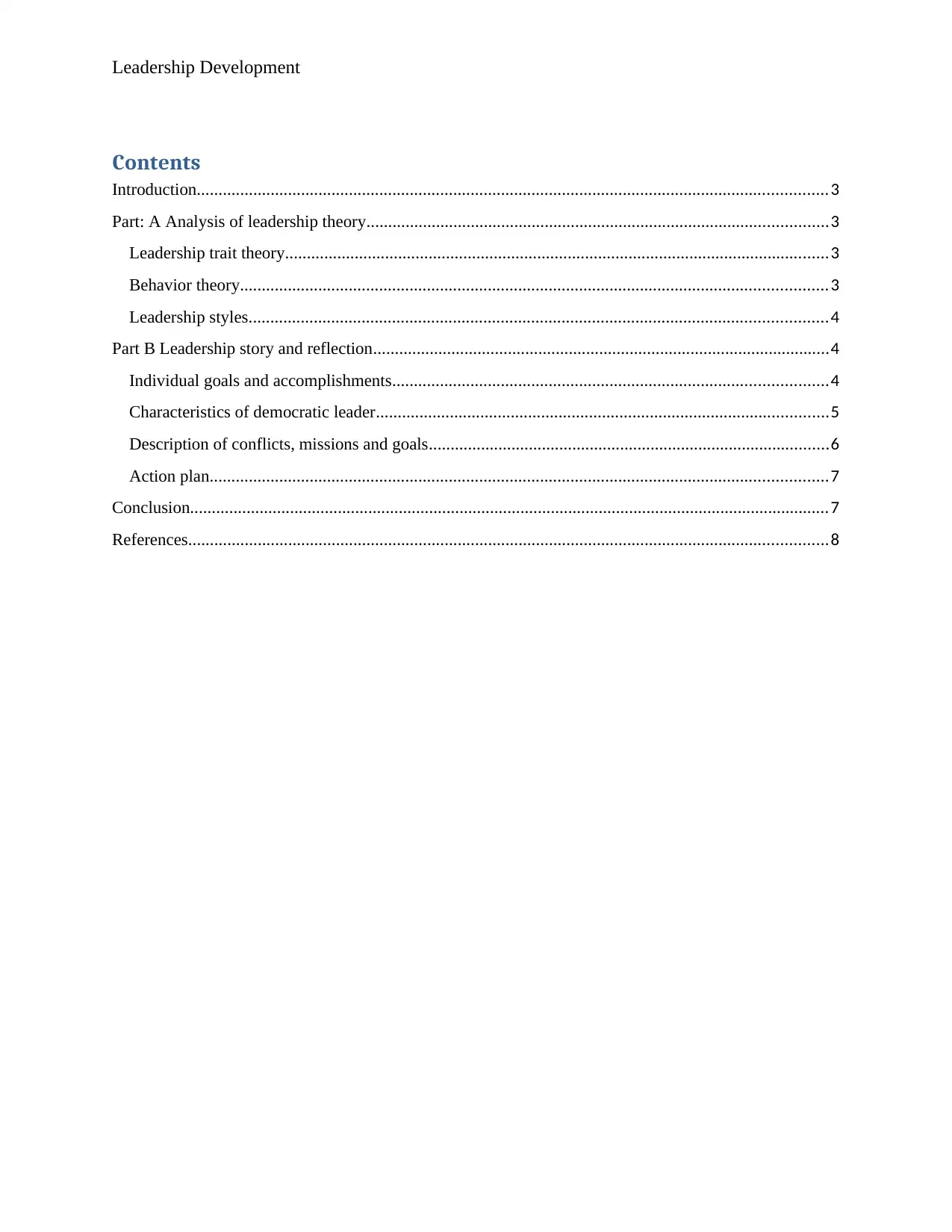
Contents
Introduction.................................................................................................................................................3
Part: A Analysis of leadership theory..........................................................................................................3
Leadership trait theory.............................................................................................................................3
Behavior theory.......................................................................................................................................3
Leadership styles.....................................................................................................................................4
Part B Leadership story and reflection.........................................................................................................4
Individual goals and accomplishments....................................................................................................4
Characteristics of democratic leader........................................................................................................5
Description of conflicts, missions and goals............................................................................................6
Action plan..............................................................................................................................................7
Conclusion...................................................................................................................................................7
References...................................................................................................................................................8
Contents
Introduction.................................................................................................................................................3
Part: A Analysis of leadership theory..........................................................................................................3
Leadership trait theory.............................................................................................................................3
Behavior theory.......................................................................................................................................3
Leadership styles.....................................................................................................................................4
Part B Leadership story and reflection.........................................................................................................4
Individual goals and accomplishments....................................................................................................4
Characteristics of democratic leader........................................................................................................5
Description of conflicts, missions and goals............................................................................................6
Action plan..............................................................................................................................................7
Conclusion...................................................................................................................................................7
References...................................................................................................................................................8
Leadership Development
Introduction
Leadership has been concerned with leading and guiding the individuals and also
motivating the same so as to make them reach r accomplish their desired targets and goals. The
term leadership can also be defined as the ability or an activity of leading a group of individuals
for making them perform the allotted task. The leadership is a broader concept which involves
establishing a clear vision for the team-mates and also sharing the same vision with the other
employees so as to make them follow willingly (Nahavandi, 2016). Coordinating, and
maintaining balance between the conflicting interest of the entire workforce and the
stakeholders. These are some of the operations and functionalities which are required to be
performed by the leader with an efficiency and effectiveness. Leadership is a significant
operation which is executed by the leaders so as to motivate and develop a positive zeal in the
team members and the other employees so as to make them capable enough to perform the tasks
with greater dedication. This will lead in completion of task with greater efficiency and effective
results will be served. The below executed report will be executed on the concept of leadership
and also on the theories and approaches which are being utilized by the leaders.
Part: A Analysis of leadership theory
Leadership trait theory
The concept of trait leadership model has been concerned with the features of various
leaders .i.e. the successful and unsuccessful. The key objective of this approach is predicting the
effectiveness of leadership (Hemlin et al., 2014. The trait theory of leadership has been
concentrated for making identification of the different personality traits and the characteristics
which are then linked to the successful leadership according to the varied scenarios. It has been
observed by Carlyle that the history is shaped by extra-ordinary leaders. Successful leaders are
the personalities which have skills, capabilities, interests and personality traits which are
different from that of the other less affective leaders (Cherry 2017). The below mentioned are
the advantages and strengths of the trait theory:
This is a pleasing theory by nature
The concept is a valid as various researches has been conducted and has made the
concept validated and is also considered as the basic of the theory (O'Boyle, Murray and
Cummins, 2015).
This theory offers a detailed knowledge over the leader element in the leadership process
Behavior theory
The behavioral theories are considered as the approaches which are classified and are
focused on the study of particular behavior of the leaders (James, 2015). In case of the behavioral
theorists, a behavior of the leader is the best predictor of the leadership influences and as the
outcome it is the best factor which defines the success of the leadership. This approach has been
made focused on the behavior focused concept and offers real marketing potential (Komives and
Introduction
Leadership has been concerned with leading and guiding the individuals and also
motivating the same so as to make them reach r accomplish their desired targets and goals. The
term leadership can also be defined as the ability or an activity of leading a group of individuals
for making them perform the allotted task. The leadership is a broader concept which involves
establishing a clear vision for the team-mates and also sharing the same vision with the other
employees so as to make them follow willingly (Nahavandi, 2016). Coordinating, and
maintaining balance between the conflicting interest of the entire workforce and the
stakeholders. These are some of the operations and functionalities which are required to be
performed by the leader with an efficiency and effectiveness. Leadership is a significant
operation which is executed by the leaders so as to motivate and develop a positive zeal in the
team members and the other employees so as to make them capable enough to perform the tasks
with greater dedication. This will lead in completion of task with greater efficiency and effective
results will be served. The below executed report will be executed on the concept of leadership
and also on the theories and approaches which are being utilized by the leaders.
Part: A Analysis of leadership theory
Leadership trait theory
The concept of trait leadership model has been concerned with the features of various
leaders .i.e. the successful and unsuccessful. The key objective of this approach is predicting the
effectiveness of leadership (Hemlin et al., 2014. The trait theory of leadership has been
concentrated for making identification of the different personality traits and the characteristics
which are then linked to the successful leadership according to the varied scenarios. It has been
observed by Carlyle that the history is shaped by extra-ordinary leaders. Successful leaders are
the personalities which have skills, capabilities, interests and personality traits which are
different from that of the other less affective leaders (Cherry 2017). The below mentioned are
the advantages and strengths of the trait theory:
This is a pleasing theory by nature
The concept is a valid as various researches has been conducted and has made the
concept validated and is also considered as the basic of the theory (O'Boyle, Murray and
Cummins, 2015).
This theory offers a detailed knowledge over the leader element in the leadership process
Behavior theory
The behavioral theories are considered as the approaches which are classified and are
focused on the study of particular behavior of the leaders (James, 2015). In case of the behavioral
theorists, a behavior of the leader is the best predictor of the leadership influences and as the
outcome it is the best factor which defines the success of the leadership. This approach has been
made focused on the behavior focused concept and offers real marketing potential (Komives and
⊘ This is a preview!⊘
Do you want full access?
Subscribe today to unlock all pages.

Trusted by 1+ million students worldwide
Leadership Development
Wagner, 2016). Moreover, the main concern behind this approach is changing and understanding
human behaviors. This also increases the some of the traits which are as follows:
Enhances the self-belief
Develops confidence level
Change behaviors
Leadership styles
The concept can be concerned with the manner and the approaches which can be utilized
by the leaders for guiding, monitoring, providing directions and implementing the plans (Bolman
and Deal, 2017). Moreover, it can be termed as the total pattern of explicit and implicit actions
which are executed by the leader. The below mentioned are the major leadership styles:
Autocratic: No advice is taken by the team mates and the leader is the sole decision
maker.
Democratic: Everyone is included and considered as integral part in decisions and the
leaders also consider their feedbacks as significant while decision making (Robertson,
2016).
Laissez-fair: The team mates are allowed to make the decisions and then also the leader
is held responsible for the decisions taken.
Part B Leadership story and reflection
Individual goals and accomplishments
The democratic leadership style has been considered as one of the most effective leadership
styles which comprises and values the collaboration and affirmation of the team mates and the
flowers (Kiboss and Jemiryott, 2014).
Individual goals
Making the working environment comfortable for each and every team mate and also of
the other follower is the prime goal (Gill, 2016).
Making the team mates accomplish the tasks which are allotted and tat to within the
given deadline.
Guiding and diverting the efforts of the team mates in a single direction so as to improve
the performance level.
Motivate and influence positively the team mates to work with more dedication, so as to
perform better.
Accomplishments
Attainment of tasks and allotted projects within the given deadline has been the biggest
accomplishment of mine working tenure.
Wagner, 2016). Moreover, the main concern behind this approach is changing and understanding
human behaviors. This also increases the some of the traits which are as follows:
Enhances the self-belief
Develops confidence level
Change behaviors
Leadership styles
The concept can be concerned with the manner and the approaches which can be utilized
by the leaders for guiding, monitoring, providing directions and implementing the plans (Bolman
and Deal, 2017). Moreover, it can be termed as the total pattern of explicit and implicit actions
which are executed by the leader. The below mentioned are the major leadership styles:
Autocratic: No advice is taken by the team mates and the leader is the sole decision
maker.
Democratic: Everyone is included and considered as integral part in decisions and the
leaders also consider their feedbacks as significant while decision making (Robertson,
2016).
Laissez-fair: The team mates are allowed to make the decisions and then also the leader
is held responsible for the decisions taken.
Part B Leadership story and reflection
Individual goals and accomplishments
The democratic leadership style has been considered as one of the most effective leadership
styles which comprises and values the collaboration and affirmation of the team mates and the
flowers (Kiboss and Jemiryott, 2014).
Individual goals
Making the working environment comfortable for each and every team mate and also of
the other follower is the prime goal (Gill, 2016).
Making the team mates accomplish the tasks which are allotted and tat to within the
given deadline.
Guiding and diverting the efforts of the team mates in a single direction so as to improve
the performance level.
Motivate and influence positively the team mates to work with more dedication, so as to
perform better.
Accomplishments
Attainment of tasks and allotted projects within the given deadline has been the biggest
accomplishment of mine working tenure.
Paraphrase This Document
Need a fresh take? Get an instant paraphrase of this document with our AI Paraphraser
Leadership Development
Best team of the organization was the award which was presented to my team and has
been listed in the accomplishments
Skills
The below presented are the skills which are possessed by me as a democratic leader:
Intelligence
Honesty
Creative
Fairness
Activities and programs
Regular training sessions to all the team mates so as to enhance their skills and
capabilities which in-turn will offer efficiency and effectiveness in tasks.
Interaction programs and communication building activities which will be proven
beneficial in developing communication skills and the team mates will also be able to get
aware of each and every team member (Al-Ababneh, 2013).
Activities related to learning coordination and working with a sense of cooperation which
will enhance and make the team stronger.
These all of the above mentioned are the attributes which has contributed in my leadership style
and had made me leader.
Characteristics of democratic leader
Democratic leadership is concerned with the attempts which are made for developing a
management with the democratic principles (Woods 2017). These principles include equal
participation, self-determination, deliberation etc. The below mentioned are the main features
which define the democratic leader’s main traits:
Distribution of responsibility: The democratic leaders follow a fair sense of equality for
each and every team mates within the team and also for the other employees within the
business corporation (Cleverism 2016). An authority that is leading the team as a
democratic leader makes the distribution of the work and all the responsibilities among
the group and this is done so as to increase and facilitate the participation of the team
members in the process of decision making.
Empowering group members: The leaders are required to motivate and influence the
team members positively (. This will bring enhancement in their performance level and
also a hike in the productivity will be observed. Team members should be empowered by
the leaders at regular time intervals which will aid them in accomplishing their tasks. The
concept of empowerment comprises of providing training sessions to the team members
regarding the skills which are essential while completing the task.
Best team of the organization was the award which was presented to my team and has
been listed in the accomplishments
Skills
The below presented are the skills which are possessed by me as a democratic leader:
Intelligence
Honesty
Creative
Fairness
Activities and programs
Regular training sessions to all the team mates so as to enhance their skills and
capabilities which in-turn will offer efficiency and effectiveness in tasks.
Interaction programs and communication building activities which will be proven
beneficial in developing communication skills and the team mates will also be able to get
aware of each and every team member (Al-Ababneh, 2013).
Activities related to learning coordination and working with a sense of cooperation which
will enhance and make the team stronger.
These all of the above mentioned are the attributes which has contributed in my leadership style
and had made me leader.
Characteristics of democratic leader
Democratic leadership is concerned with the attempts which are made for developing a
management with the democratic principles (Woods 2017). These principles include equal
participation, self-determination, deliberation etc. The below mentioned are the main features
which define the democratic leader’s main traits:
Distribution of responsibility: The democratic leaders follow a fair sense of equality for
each and every team mates within the team and also for the other employees within the
business corporation (Cleverism 2016). An authority that is leading the team as a
democratic leader makes the distribution of the work and all the responsibilities among
the group and this is done so as to increase and facilitate the participation of the team
members in the process of decision making.
Empowering group members: The leaders are required to motivate and influence the
team members positively (. This will bring enhancement in their performance level and
also a hike in the productivity will be observed. Team members should be empowered by
the leaders at regular time intervals which will aid them in accomplishing their tasks. The
concept of empowerment comprises of providing training sessions to the team members
regarding the skills which are essential while completing the task.
Leadership Development
Aiding group decision making process: One of the most significant trait of a
democratic leader is to increase the participation of the team members in decision making
process. This can be done by considering their feedbacks as significant. In other terms the
major role of the team leader is ensuring the democratic deliberation in making group
decisions. This also means that the leaders are expected to act as a facilitator and a
mediator between the group members and they are also required to ensure that a
psychologically healthy and respectful working environment should be developed.
These all of the above mentioned are the features which make and define the actual traits a
democratic team leader and are also considered as very much significant for his leadership style.
Description of conflicts, missions and goals
Conflicts: The process of working in the case of democratic leader can be time
consuming and also expensive as this type of leaders involve and make participation of
each and every team mate. This can sometimes delay the tasks and the projects which are
allotted to the team and can degrade the quality of the team performance. This can be one
of the reasons for the conflict for the democratic leader (Hackman and Johnson, 2013).
Missions and goals: Motivating the team mates positively in such a manner that they are
likely to accomplish the targets and desired goals within the given deadline has been
considered as one of the prime mission and goal of a democratic leader. Moreover,
developing a sense of equality and practicing the same within the team and also in the
organization. Developing the team with a positive sprit so as to enhance the performance
and productivity of the team mates and also of the team as a whole. The main goal is to
make the attainment of the team mates by making use of ethical working practices.
Education and skills: The below mentioned are the skills and the traits which are
required to be possessed by the democratic leader:
a) Honesty: The democratic leaders are expected to be honest with their working
and he should also be transparent with the team mates and also with the
organization. No un-ethical practices should be followed and adopted by the
leader.
b) Intelligence: It is a tough task to manage a team and make them work in such a
manner so that they accomplish the desired targets. And for making this happen,
the democratic leaders are required to be intelligent. They are expected to have a
sharp mind so as they are able to present themselves at the time required.
c) Creativity: The democratic team leaders are required to be creative and
innovative with their ideas so as they will be able to motivate the team mates in
various directions and guiding them to accomplish their targets. Moreover, if the
leader is creative then he will be more into supporting the creative ideas of te
team mates which will also motivate the members and they will work with more
dedication and motivation.
Aiding group decision making process: One of the most significant trait of a
democratic leader is to increase the participation of the team members in decision making
process. This can be done by considering their feedbacks as significant. In other terms the
major role of the team leader is ensuring the democratic deliberation in making group
decisions. This also means that the leaders are expected to act as a facilitator and a
mediator between the group members and they are also required to ensure that a
psychologically healthy and respectful working environment should be developed.
These all of the above mentioned are the features which make and define the actual traits a
democratic team leader and are also considered as very much significant for his leadership style.
Description of conflicts, missions and goals
Conflicts: The process of working in the case of democratic leader can be time
consuming and also expensive as this type of leaders involve and make participation of
each and every team mate. This can sometimes delay the tasks and the projects which are
allotted to the team and can degrade the quality of the team performance. This can be one
of the reasons for the conflict for the democratic leader (Hackman and Johnson, 2013).
Missions and goals: Motivating the team mates positively in such a manner that they are
likely to accomplish the targets and desired goals within the given deadline has been
considered as one of the prime mission and goal of a democratic leader. Moreover,
developing a sense of equality and practicing the same within the team and also in the
organization. Developing the team with a positive sprit so as to enhance the performance
and productivity of the team mates and also of the team as a whole. The main goal is to
make the attainment of the team mates by making use of ethical working practices.
Education and skills: The below mentioned are the skills and the traits which are
required to be possessed by the democratic leader:
a) Honesty: The democratic leaders are expected to be honest with their working
and he should also be transparent with the team mates and also with the
organization. No un-ethical practices should be followed and adopted by the
leader.
b) Intelligence: It is a tough task to manage a team and make them work in such a
manner so that they accomplish the desired targets. And for making this happen,
the democratic leaders are required to be intelligent. They are expected to have a
sharp mind so as they are able to present themselves at the time required.
c) Creativity: The democratic team leaders are required to be creative and
innovative with their ideas so as they will be able to motivate the team mates in
various directions and guiding them to accomplish their targets. Moreover, if the
leader is creative then he will be more into supporting the creative ideas of te
team mates which will also motivate the members and they will work with more
dedication and motivation.
⊘ This is a preview!⊘
Do you want full access?
Subscribe today to unlock all pages.
Trusted by 1+ million students worldwide
Leadership Development
d) Fairness: The democratic leader is expected to behave with a sense of equality
and un-biasedness. No discrimination on any grounds should be followed by the
leaders so as to make the employees feel de-motivated.
Relationship development: The leaders are considered as the representatives who
represent the team members and also the business corporation. They are expected to build
connections with the clients, consumers and all the other stakeholders. And for doing that
they are required to be polite by nature, honest and transparent with their work. These
traits of a democratic leader will help the stakeholders in building trust over them and
there will be development of relations.
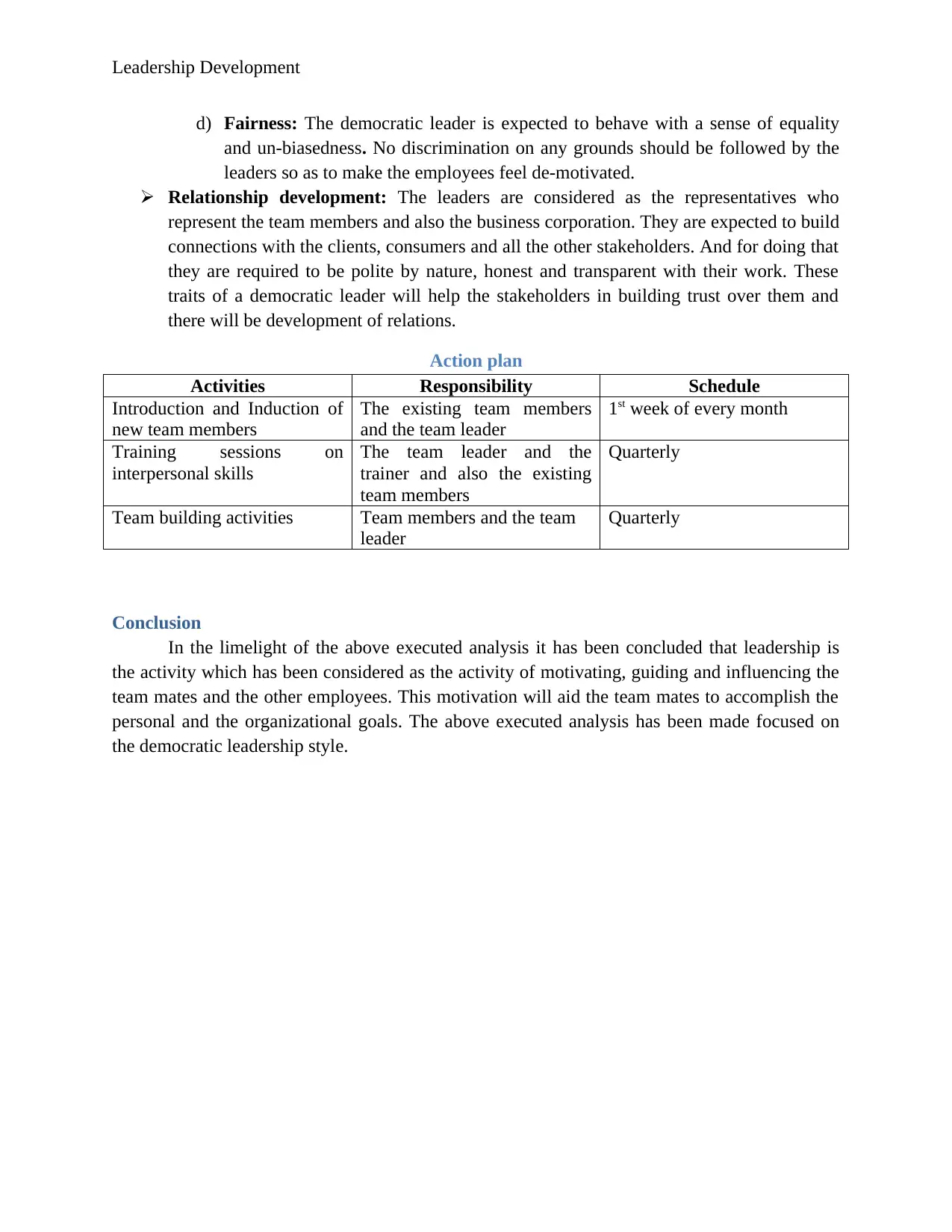
Action plan
Activities Responsibility Schedule
Introduction and Induction of
new team members
The existing team members
and the team leader
1st week of every month
Training sessions on
interpersonal skills
The team leader and the
trainer and also the existing
team members
Quarterly
Team building activities Team members and the team
leader
Quarterly
Conclusion
In the limelight of the above executed analysis it has been concluded that leadership is
the activity which has been considered as the activity of motivating, guiding and influencing the
team mates and the other employees. This motivation will aid the team mates to accomplish the
personal and the organizational goals. The above executed analysis has been made focused on
the democratic leadership style.
d) Fairness: The democratic leader is expected to behave with a sense of equality
and un-biasedness. No discrimination on any grounds should be followed by the
leaders so as to make the employees feel de-motivated.
Relationship development: The leaders are considered as the representatives who
represent the team members and also the business corporation. They are expected to build
connections with the clients, consumers and all the other stakeholders. And for doing that
they are required to be polite by nature, honest and transparent with their work. These
traits of a democratic leader will help the stakeholders in building trust over them and
there will be development of relations.
Action plan
Activities Responsibility Schedule
Introduction and Induction of
new team members
The existing team members
and the team leader
1st week of every month
Training sessions on
interpersonal skills
The team leader and the
trainer and also the existing
team members
Quarterly
Team building activities Team members and the team
leader
Quarterly
Conclusion
In the limelight of the above executed analysis it has been concluded that leadership is
the activity which has been considered as the activity of motivating, guiding and influencing the
team mates and the other employees. This motivation will aid the team mates to accomplish the
personal and the organizational goals. The above executed analysis has been made focused on
the democratic leadership style.
Paraphrase This Document
Need a fresh take? Get an instant paraphrase of this document with our AI Paraphraser
Leadership Development
References
Al-Ababneh, M., 2013. Leadership style of managers in five-star hotels and its relationship with
employees job satisfaction. Journal of Occupational and Organizational Psychology, 3(2), p.94.
Bolman, L.G. and Deal, T.E., 2017. Reframing organizations: Artistry, choice, and leadership.
John Wiley & Sons.
Cherry, K, 2017, What is the trait theory of leadership, Assessed on 24th September 2017,
https://www.verywell.com/what-is-the-trait-theory-of-leadership-2795322.
Cleverism, 2016, Democratic leadership guide: Definition qualities, pros & cons examples,
Assessed on 24th September 2017, https://www.cleverism.com/democratic-leadership-guide/.
Gill, E, 2016, What is democratic/participative leadership? How collaboration can boost
morale, Assessed on 24th September 2017, http://online.stu.edu/democratic-participative-
leadership/.
Hackman, M.Z. and Johnson, C.E., 2013. Leadership: A communication perspective. Waveland
Press.
Hemlin, S., Allwood, C.M., Martin, B. and Mumford, M.D. eds., 2014. Creativity and leadership
in science, technology, and innovation. Routledge.
James, K., 2015. Leadership Special Interest Group: What is leadership?. Canadian Oncology
Nursing Journal/Revue canadienne de soins infirmiers en oncologie, 25(1), pp.114-115.
Kiboss, J.K. and Jemiryott, H.K.S., 2014. Relationship between principals’ leadership styles and
secondary school teachers’ job satisfaction in Nandi South district, Kenya. Journal of Education
and Human Development, 3(2), pp.493-509.
Komives, S.R. and Wagner, W.E., 2016. Leadership for a better world: Understanding the
social change model of leadership development. John Wiley & Sons.
Nahavandi, A., 2016. The Art and Science of Leadership -Global Edition. Pearson.
O'Boyle, I., Murray, D. and Cummins, P. eds., 2015. Leadership in sport. Routledge.
Robertson, J., 2016. Coaching leadership: Building educational leadership capacity through
partnership. New Zealand Council for Educational Research. PO Box 3237, Wellington 6140
New Zealand.
Woods, G, 2017, What are the benefits of behavioral theories, Assessed on 24th September 2017,
http://www.livestrong.com/article/155516-what-are-the-benefits-of-behavioral-theories/.
References
Al-Ababneh, M., 2013. Leadership style of managers in five-star hotels and its relationship with
employees job satisfaction. Journal of Occupational and Organizational Psychology, 3(2), p.94.
Bolman, L.G. and Deal, T.E., 2017. Reframing organizations: Artistry, choice, and leadership.
John Wiley & Sons.
Cherry, K, 2017, What is the trait theory of leadership, Assessed on 24th September 2017,
https://www.verywell.com/what-is-the-trait-theory-of-leadership-2795322.
Cleverism, 2016, Democratic leadership guide: Definition qualities, pros & cons examples,
Assessed on 24th September 2017, https://www.cleverism.com/democratic-leadership-guide/.
Gill, E, 2016, What is democratic/participative leadership? How collaboration can boost
morale, Assessed on 24th September 2017, http://online.stu.edu/democratic-participative-
leadership/.
Hackman, M.Z. and Johnson, C.E., 2013. Leadership: A communication perspective. Waveland
Press.
Hemlin, S., Allwood, C.M., Martin, B. and Mumford, M.D. eds., 2014. Creativity and leadership
in science, technology, and innovation. Routledge.
James, K., 2015. Leadership Special Interest Group: What is leadership?. Canadian Oncology
Nursing Journal/Revue canadienne de soins infirmiers en oncologie, 25(1), pp.114-115.
Kiboss, J.K. and Jemiryott, H.K.S., 2014. Relationship between principals’ leadership styles and
secondary school teachers’ job satisfaction in Nandi South district, Kenya. Journal of Education
and Human Development, 3(2), pp.493-509.
Komives, S.R. and Wagner, W.E., 2016. Leadership for a better world: Understanding the
social change model of leadership development. John Wiley & Sons.
Nahavandi, A., 2016. The Art and Science of Leadership -Global Edition. Pearson.
O'Boyle, I., Murray, D. and Cummins, P. eds., 2015. Leadership in sport. Routledge.
Robertson, J., 2016. Coaching leadership: Building educational leadership capacity through
partnership. New Zealand Council for Educational Research. PO Box 3237, Wellington 6140
New Zealand.
Woods, G, 2017, What are the benefits of behavioral theories, Assessed on 24th September 2017,
http://www.livestrong.com/article/155516-what-are-the-benefits-of-behavioral-theories/.

1 out of 8


Related Documents


Your All-in-One AI-Powered Toolkit for Academic Success.
+13062052269
info@desklib.com
Available 24*7 on WhatsApp / Email
![[object Object]](/_next/static/media/star-bottom.7253800d.svg)
Unlock your academic potential
Copyright © 2020–2026 A2Z Services. All Rights Reserved. Developed and managed by ZUCOL.