Leadership Management: Analysis of Leadership Scenarios Report
VerifiedAdded on 2022/10/10
|11
|2561
|38
Report
AI Summary
This report delves into various leadership scenarios, applying the Hershey Blanchard and Path Goal models to analyze different situations and leadership styles. The report begins with an introduction to the leadership scenarios, followed by a detailed examination of five distinct scenarios. Each scenario presents a unique challenge, and the report suggests appropriate leadership styles, such as participating and supportive leadership, to address these challenges effectively. The report also includes a critical reflection on transformational leadership, discussing its core values, and how it can be implemented in the workplace. The author emphasizes the importance of integrity, honesty, and transparency in leadership and how these values can foster open communication and motivate employees. The report concludes by highlighting the practical applications of the leadership styles and theories discussed.
Running head: LEADERSHIP SCENARIOS
LEADERSHIP SCENARIOS
Name of student
Name of the University
Author Note
LEADERSHIP SCENARIOS
Name of student
Name of the University
Author Note

Paraphrase This Document
Need a fresh take? Get an instant paraphrase of this document with our AI Paraphraser
1LEADERSHIP SCENARIOS
Table of Contents
PART A: Leadership Scenarios.......................................................................................................2
Scenario 1: Hershey Blanchard model............................................................................................2
Scenario 2: Path goal model............................................................................................................4
Scenario 3: Path goal model............................................................................................................5
Scenario 4: Hershey Blanchard model............................................................................................6
Scenario 5: Path Goal model...........................................................................................................7
PART B: Critical reflection.............................................................................................................8
References......................................................................................................................................10
Table of Contents
PART A: Leadership Scenarios.......................................................................................................2
Scenario 1: Hershey Blanchard model............................................................................................2
Scenario 2: Path goal model............................................................................................................4
Scenario 3: Path goal model............................................................................................................5
Scenario 4: Hershey Blanchard model............................................................................................6
Scenario 5: Path Goal model...........................................................................................................7
PART B: Critical reflection.............................................................................................................8
References......................................................................................................................................10
2LEADERSHIP SCENARIOS
PART A: Leadership Scenarios
Scenario 1: Hershey Blanchard model
If one of my employees is underperforming and seems to lack confidence, I will use the
participating leadership style with him. Participating leadership is one in which the leader tries to
create a good relationship with the employees and this leadership style is generally used in case
when the employees lack confidence of doing the tasks. In this style of leadership there is
sharing of decisions and ideas among the leader and the followers such that they can feel that
their decisions is also valued.
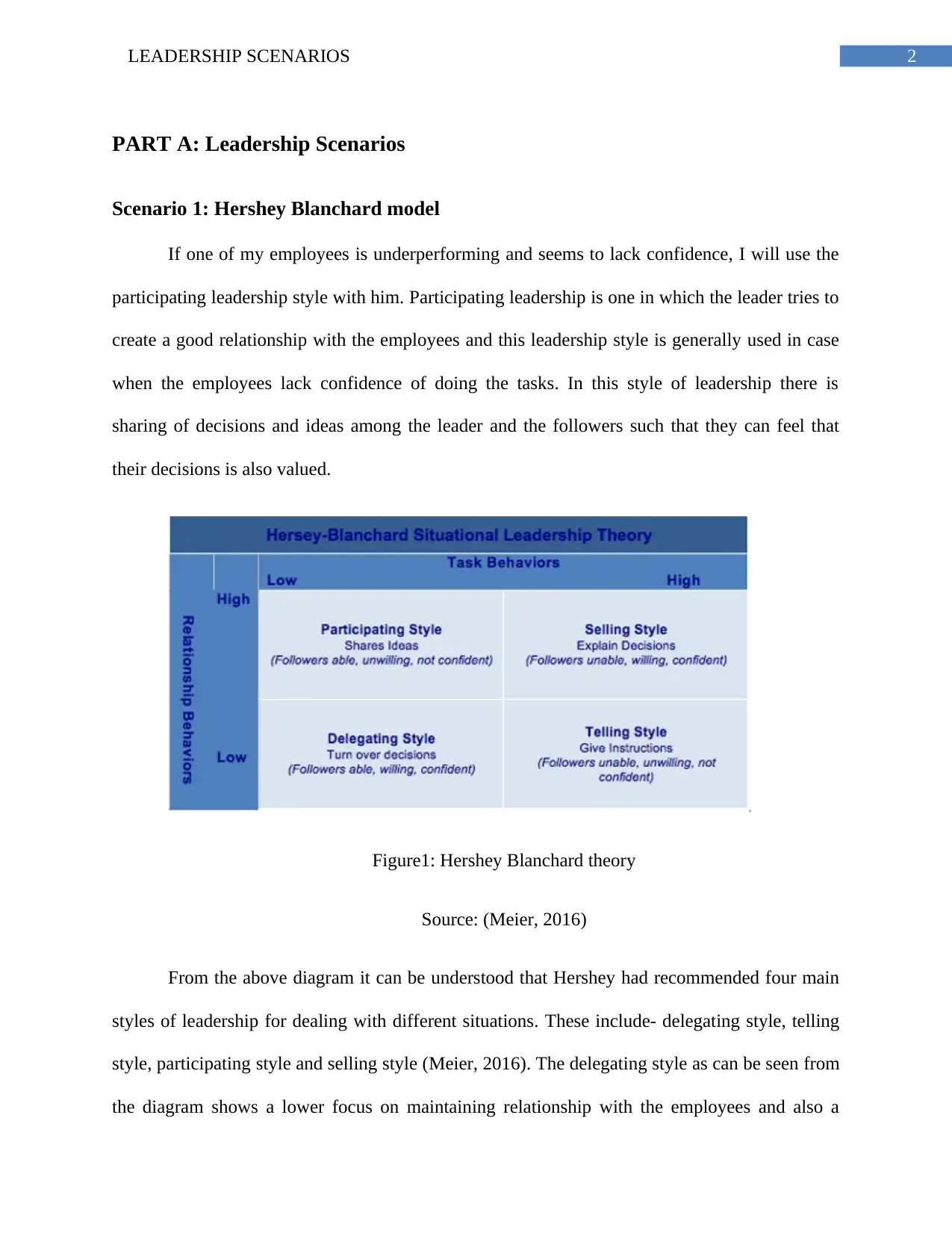
Figure1: Hershey Blanchard theory
Source: (Meier, 2016)
From the above diagram it can be understood that Hershey had recommended four main
styles of leadership for dealing with different situations. These include- delegating style, telling
style, participating style and selling style (Meier, 2016). The delegating style as can be seen from
the diagram shows a lower focus on maintaining relationship with the employees and also a
PART A: Leadership Scenarios
Scenario 1: Hershey Blanchard model
If one of my employees is underperforming and seems to lack confidence, I will use the
participating leadership style with him. Participating leadership is one in which the leader tries to
create a good relationship with the employees and this leadership style is generally used in case
when the employees lack confidence of doing the tasks. In this style of leadership there is
sharing of decisions and ideas among the leader and the followers such that they can feel that
their decisions is also valued.
Figure1: Hershey Blanchard theory
Source: (Meier, 2016)
From the above diagram it can be understood that Hershey had recommended four main
styles of leadership for dealing with different situations. These include- delegating style, telling
style, participating style and selling style (Meier, 2016). The delegating style as can be seen from
the diagram shows a lower focus on maintaining relationship with the employees and also a
⊘ This is a preview!⊘
Do you want full access?
Subscribe today to unlock all pages.

Trusted by 1+ million students worldwide
3LEADERSHIP SCENARIOS
lower focus on task behaviour. Therefore it can be said that this leadership style is used when the
followers are confident, willing and are able. A telling leadership style is used when the leader
has a higher focus on task behaviour but a lower focus on maintaining good relationship with the
employees. This leadership style is therefore used when the leaders take all the decisions, and the
followers are unable, unwilling and not so confident (Thompson & Glasø, 2015). The next
leadership style which is used in this scenario is that of participating where the leader believes in
participating decision making and sharing of ideas by all the followers. In this situation the
followers are able, but are unwilling and lack confidence and therefore the leader adopts this
style. The last leadership as defined by Hershey includes the selling leadership where the leader
is engaged in explaining decisions. The leader gives equal importance to relationship and to task
behaviour.
lower focus on task behaviour. Therefore it can be said that this leadership style is used when the
followers are confident, willing and are able. A telling leadership style is used when the leader
has a higher focus on task behaviour but a lower focus on maintaining good relationship with the
employees. This leadership style is therefore used when the leaders take all the decisions, and the
followers are unable, unwilling and not so confident (Thompson & Glasø, 2015). The next
leadership style which is used in this scenario is that of participating where the leader believes in
participating decision making and sharing of ideas by all the followers. In this situation the
followers are able, but are unwilling and lack confidence and therefore the leader adopts this
style. The last leadership as defined by Hershey includes the selling leadership where the leader
is engaged in explaining decisions. The leader gives equal importance to relationship and to task
behaviour.
Paraphrase This Document
Need a fresh take? Get an instant paraphrase of this document with our AI Paraphraser
4LEADERSHIP SCENARIOS
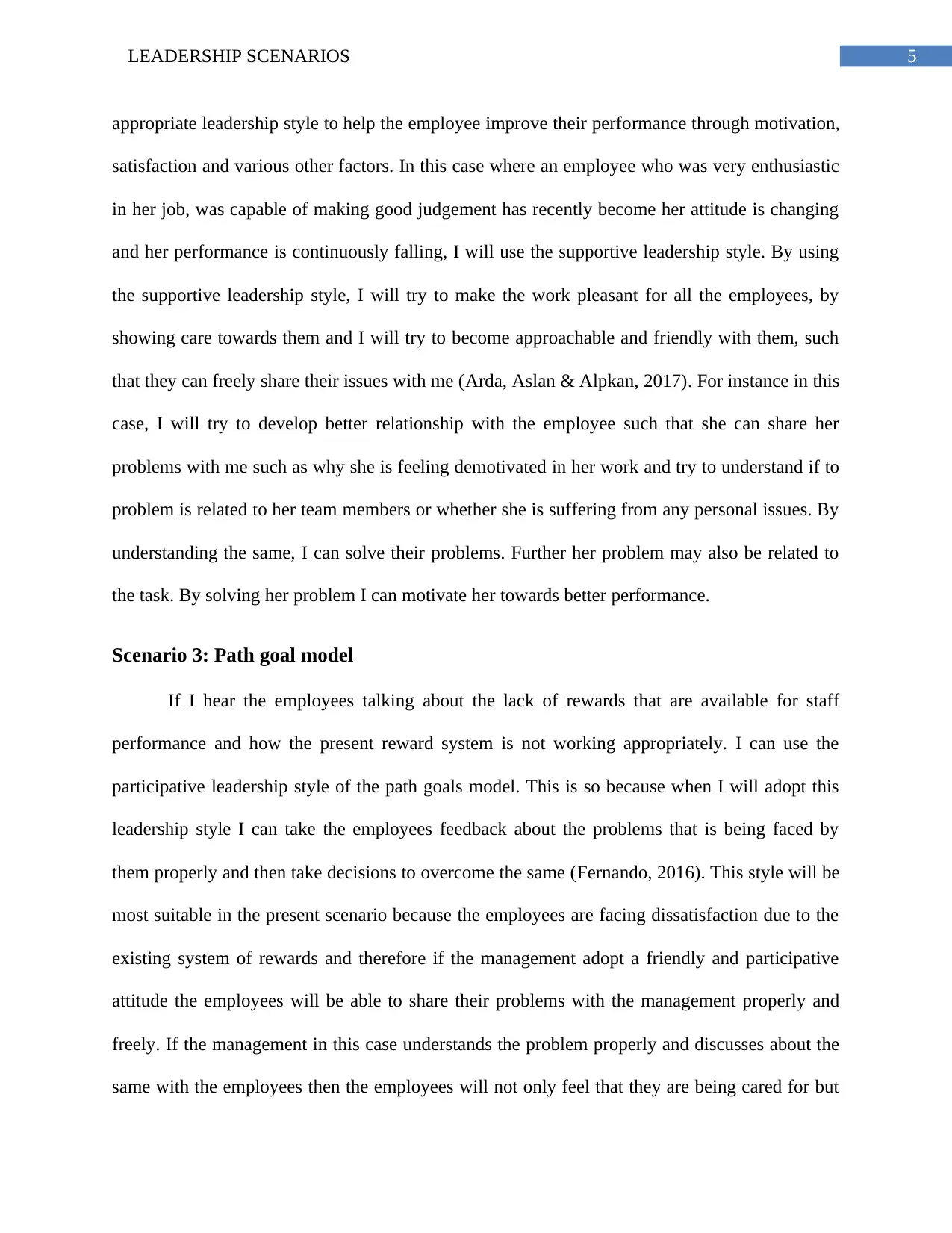
Scenario 2: Path goal model
Figure 2: The path goal model
Source: (Arda, Aslan & Alpkan, 2017)
From the above diagram we can understand in the path goal
model the leader tries to solve the problem or to overcome the same by making overcoming the
obstacle that is being suffered by the employee that is whether it is due to work group, or die to
designing of the task or if it’s because of formal authority system. Then the leader to apply the
Scenario 2: Path goal model
Figure 2: The path goal model
Source: (Arda, Aslan & Alpkan, 2017)
From the above diagram we can understand in the path goal
model the leader tries to solve the problem or to overcome the same by making overcoming the
obstacle that is being suffered by the employee that is whether it is due to work group, or die to
designing of the task or if it’s because of formal authority system. Then the leader to apply the
5LEADERSHIP SCENARIOS
appropriate leadership style to help the employee improve their performance through motivation,
satisfaction and various other factors. In this case where an employee who was very enthusiastic
in her job, was capable of making good judgement has recently become her attitude is changing
and her performance is continuously falling, I will use the supportive leadership style. By using
the supportive leadership style, I will try to make the work pleasant for all the employees, by
showing care towards them and I will try to become approachable and friendly with them, such
that they can freely share their issues with me (Arda, Aslan & Alpkan, 2017). For instance in this
case, I will try to develop better relationship with the employee such that she can share her
problems with me such as why she is feeling demotivated in her work and try to understand if to
problem is related to her team members or whether she is suffering from any personal issues. By
understanding the same, I can solve their problems. Further her problem may also be related to
the task. By solving her problem I can motivate her towards better performance.
Scenario 3: Path goal model
If I hear the employees talking about the lack of rewards that are available for staff
performance and how the present reward system is not working appropriately. I can use the
participative leadership style of the path goals model. This is so because when I will adopt this
leadership style I can take the employees feedback about the problems that is being faced by
them properly and then take decisions to overcome the same (Fernando, 2016). This style will be
most suitable in the present scenario because the employees are facing dissatisfaction due to the
existing system of rewards and therefore if the management adopt a friendly and participative
attitude the employees will be able to share their problems with the management properly and
freely. If the management in this case understands the problem properly and discusses about the
same with the employees then the employees will not only feel that they are being cared for but
appropriate leadership style to help the employee improve their performance through motivation,
satisfaction and various other factors. In this case where an employee who was very enthusiastic
in her job, was capable of making good judgement has recently become her attitude is changing
and her performance is continuously falling, I will use the supportive leadership style. By using
the supportive leadership style, I will try to make the work pleasant for all the employees, by
showing care towards them and I will try to become approachable and friendly with them, such
that they can freely share their issues with me (Arda, Aslan & Alpkan, 2017). For instance in this
case, I will try to develop better relationship with the employee such that she can share her
problems with me such as why she is feeling demotivated in her work and try to understand if to
problem is related to her team members or whether she is suffering from any personal issues. By
understanding the same, I can solve their problems. Further her problem may also be related to
the task. By solving her problem I can motivate her towards better performance.
Scenario 3: Path goal model
If I hear the employees talking about the lack of rewards that are available for staff
performance and how the present reward system is not working appropriately. I can use the
participative leadership style of the path goals model. This is so because when I will adopt this
leadership style I can take the employees feedback about the problems that is being faced by
them properly and then take decisions to overcome the same (Fernando, 2016). This style will be
most suitable in the present scenario because the employees are facing dissatisfaction due to the
existing system of rewards and therefore if the management adopt a friendly and participative
attitude the employees will be able to share their problems with the management properly and
freely. If the management in this case understands the problem properly and discusses about the
same with the employees then the employees will not only feel that they are being cared for but
⊘ This is a preview!⊘
Do you want full access?
Subscribe today to unlock all pages.
Trusted by 1+ million students worldwide
6LEADERSHIP SCENARIOS
will also feel motivated as their views are being considered. The participative leader is one who
will consult with their followers and also take suggestions from his followers such that he can
solve their problems and motivate them for better performance and improved productivity. The
leader will try to create a culture wherein there is free communication between the employees
and the employers such that the employees can share their problems easily (Northouse, 2018).
The employees feel that there is a need to change the present reward system and therefore they
should communicate about the changes the feel have to be made to the communication. By
having free communication and participative leadership style, the leader can make sure that the
employees expectation are met and they are directed and motivated words the goals.
Scenario 4: Hershey Blanchard model
If I overhear my employees discussing about how dissatisfied they are because of the
present reward system and how the present reward system is not working for them, I will try to
adopt the leadership style of participative style will be used because in this style the leader tries
to become a part of the team by building better relationship with each of the member and this
method is totally different from the telling leadership style because in case of telling leadership,
the leader is more authoritative or provides direction to the team members (Meirovich & Gu,
2015). However in this form of leadership that is the participative leadership style the leader tries
to communicate properly with the followers or the employees with the aim of creating better
relationships with them. In this case where the employees are completely dissatisfied with the
present reward system as they feel that they are not being rewarded for their efforts
appropriately, therefore the it is the duty of the leader to enter into a participative decision
making process where the employees can share their views about the reward system and which
reward system they want to be in place and therefore in order to take proper suggestions from the
will also feel motivated as their views are being considered. The participative leader is one who
will consult with their followers and also take suggestions from his followers such that he can
solve their problems and motivate them for better performance and improved productivity. The
leader will try to create a culture wherein there is free communication between the employees
and the employers such that the employees can share their problems easily (Northouse, 2018).
The employees feel that there is a need to change the present reward system and therefore they
should communicate about the changes the feel have to be made to the communication. By
having free communication and participative leadership style, the leader can make sure that the
employees expectation are met and they are directed and motivated words the goals.
Scenario 4: Hershey Blanchard model
If I overhear my employees discussing about how dissatisfied they are because of the
present reward system and how the present reward system is not working for them, I will try to
adopt the leadership style of participative style will be used because in this style the leader tries
to become a part of the team by building better relationship with each of the member and this
method is totally different from the telling leadership style because in case of telling leadership,
the leader is more authoritative or provides direction to the team members (Meirovich & Gu,
2015). However in this form of leadership that is the participative leadership style the leader tries
to communicate properly with the followers or the employees with the aim of creating better
relationships with them. In this case where the employees are completely dissatisfied with the
present reward system as they feel that they are not being rewarded for their efforts
appropriately, therefore the it is the duty of the leader to enter into a participative decision
making process where the employees can share their views about the reward system and which
reward system they want to be in place and therefore in order to take proper suggestions from the
Paraphrase This Document
Need a fresh take? Get an instant paraphrase of this document with our AI Paraphraser
7LEADERSHIP SCENARIOS
employees, participative leadership style is needed by the management. In this scenario, neither
the telling style or the selling style or the delegating style will be effective because the selling
style involves a persuasive method adopted by the management to get sell their decisions to the
employees of the organization. The telling style will also not be followed in this case as the
employees are not ready to listen to anything and they want their suggestions to be heard.
Therefore in this telling style a more directive method is used for taking decisions. Therefore this
method will also not be used in the present scenario.
Scenario 5: Path Goal model
As the general manager of the restaurant which is presently not performing well because
of low morale of staff, and poor retention of staff by the organization although the staff is
competent enough because they have had many years of experience in the same field, I will be
adopting the supportive leadership style in this scenario. This is so because the employees may
not be performing well because they are not getting the attention that they want and because their
expectations are not being met. Therefore I will look after their well-being and needs. Therefore
I will try to be empathetic with them and also friendly such that they can clearly share the
reasons of their lack of motivation with me. I will treat them with respect such that they can feel
confident. I will provide them support whenever they need the same. This leadership style as per
the path goal model is most suitable in case the employees are competent but they do not believe
in their capability presently because of lack of motivation and lack of confidence. Therefore in
this scenario it becomes important to motivate them and improve their confidence by supporting
them such that they can gain their confidence back and their productivity improves. They should
be motivated to achieve the organizational goals. There are various other types of leadership
according to the path goal model such as- achievement oriented leadership, participative
employees, participative leadership style is needed by the management. In this scenario, neither
the telling style or the selling style or the delegating style will be effective because the selling
style involves a persuasive method adopted by the management to get sell their decisions to the
employees of the organization. The telling style will also not be followed in this case as the
employees are not ready to listen to anything and they want their suggestions to be heard.
Therefore in this telling style a more directive method is used for taking decisions. Therefore this
method will also not be used in the present scenario.
Scenario 5: Path Goal model
As the general manager of the restaurant which is presently not performing well because
of low morale of staff, and poor retention of staff by the organization although the staff is
competent enough because they have had many years of experience in the same field, I will be
adopting the supportive leadership style in this scenario. This is so because the employees may
not be performing well because they are not getting the attention that they want and because their
expectations are not being met. Therefore I will look after their well-being and needs. Therefore
I will try to be empathetic with them and also friendly such that they can clearly share the
reasons of their lack of motivation with me. I will treat them with respect such that they can feel
confident. I will provide them support whenever they need the same. This leadership style as per
the path goal model is most suitable in case the employees are competent but they do not believe
in their capability presently because of lack of motivation and lack of confidence. Therefore in
this scenario it becomes important to motivate them and improve their confidence by supporting
them such that they can gain their confidence back and their productivity improves. They should
be motivated to achieve the organizational goals. There are various other types of leadership
according to the path goal model such as- achievement oriented leadership, participative
8LEADERSHIP SCENARIOS
leadership and directive leadership. The directive leadership discuses about clearly explaining
what is expected from the employees and how they will be achieving the same and therefore it
involves clearly defining the roles and responsibilities to the employees in order to avoid role
ambiguity. The participative leadership is used to share ideas and gaols with the employees and
the achievement leadership means creating more challenges for the employees such that they can
achieve the same. He does this by showing confidence in their abilities.
PART B: Critical reflection
Transformational leadership refers to the ability of a leader to lead the employees by
spiritually connecting to them and motivating them and to get extraordinary performance from
them (Ramsey et al., 2017). The leadership theory of transformational leaders is the one that I
found the most interesting of all leadership theories and I will try to make use of the same in
future in my workplace. I would like to be a transformational leader in future because by
adopting the same I will be able to understand the employees in a better way build better
relationship with them and also achieve the organizational goals. By becoming a
transformational leader, I can understand the problem of the employees in a much better way
because I will be empathetic to them and I will also try to create a culture in the organization
where there can be open communication such that the employees can communicate about all
their problems and issues freely with me. This will also help me in solving their problems
immediately such that they can be motivated.
The leadership theory of transformational leadership will be incorporated by me in my
workplace. My core values being a leader will be to work with integrity, honesty and
transparency. I will work with integrity such that the employees will be motivated to work in the
same way and therefore create a culture of integrity in the organization. I will also work honestly
leadership and directive leadership. The directive leadership discuses about clearly explaining
what is expected from the employees and how they will be achieving the same and therefore it
involves clearly defining the roles and responsibilities to the employees in order to avoid role
ambiguity. The participative leadership is used to share ideas and gaols with the employees and
the achievement leadership means creating more challenges for the employees such that they can
achieve the same. He does this by showing confidence in their abilities.
PART B: Critical reflection
Transformational leadership refers to the ability of a leader to lead the employees by
spiritually connecting to them and motivating them and to get extraordinary performance from
them (Ramsey et al., 2017). The leadership theory of transformational leaders is the one that I
found the most interesting of all leadership theories and I will try to make use of the same in
future in my workplace. I would like to be a transformational leader in future because by
adopting the same I will be able to understand the employees in a better way build better
relationship with them and also achieve the organizational goals. By becoming a
transformational leader, I can understand the problem of the employees in a much better way
because I will be empathetic to them and I will also try to create a culture in the organization
where there can be open communication such that the employees can communicate about all
their problems and issues freely with me. This will also help me in solving their problems
immediately such that they can be motivated.
The leadership theory of transformational leadership will be incorporated by me in my
workplace. My core values being a leader will be to work with integrity, honesty and
transparency. I will work with integrity such that the employees will be motivated to work in the
same way and therefore create a culture of integrity in the organization. I will also work honestly
⊘ This is a preview!⊘
Do you want full access?
Subscribe today to unlock all pages.
Trusted by 1+ million students worldwide
9LEADERSHIP SCENARIOS
and transparently such that the employees can clearly understand everything happening in the
workplace and such that they can also follow the same (Deschamps et al., 2016). By having
transparency in the organization, the employees will be able to communicate all their matters
easily to me.
A transformational leader can help in changing the culture and the climate of the
organization thereby changing the beliefs, attitudes and values of the employees of the
organization. They can motivate employees by encouraging and inspiring them. They can also
help in carrying out any change in the organization easily without any resistance from the
employees. Some of these new learning and many more can also be applied by me in my
organization. In case of carrying out any change, I can use transformational leadership style in
order to overcome any resistance to change. It can also help me in changing the climate and the
culture of the organization. These new learning’s can also help me in adapting to changes easily
that can ultimately lead to organizational success. Therefore by adopting transformation
leadership style I can create a culture of open communication in the organization, I will
encourage all the employees to participate in decision making and therefore support innovative
ideas among the employees, I will be able to adapt to changes more easily. I will be able to
motivate all the people towards the organizational goals by sharing the vision with them and I
will take their suggestion and feedback before taking any decision. Therefore in order to become
a successful transformational leader I will also have to improve my emotional intelligence such
that I can take all decisions without being affected emotionally.
and transparently such that the employees can clearly understand everything happening in the
workplace and such that they can also follow the same (Deschamps et al., 2016). By having
transparency in the organization, the employees will be able to communicate all their matters
easily to me.
A transformational leader can help in changing the culture and the climate of the
organization thereby changing the beliefs, attitudes and values of the employees of the
organization. They can motivate employees by encouraging and inspiring them. They can also
help in carrying out any change in the organization easily without any resistance from the
employees. Some of these new learning and many more can also be applied by me in my
organization. In case of carrying out any change, I can use transformational leadership style in
order to overcome any resistance to change. It can also help me in changing the climate and the
culture of the organization. These new learning’s can also help me in adapting to changes easily
that can ultimately lead to organizational success. Therefore by adopting transformation
leadership style I can create a culture of open communication in the organization, I will
encourage all the employees to participate in decision making and therefore support innovative
ideas among the employees, I will be able to adapt to changes more easily. I will be able to
motivate all the people towards the organizational goals by sharing the vision with them and I
will take their suggestion and feedback before taking any decision. Therefore in order to become
a successful transformational leader I will also have to improve my emotional intelligence such
that I can take all decisions without being affected emotionally.
Paraphrase This Document
Need a fresh take? Get an instant paraphrase of this document with our AI Paraphraser
10LEADERSHIP SCENARIOS
References
Arda, Ö. A., Aslan, T., & Alpkan, L. (2017). Review of practical implications in ethical
leadership studies. International Journal of Organizational Leadership, 6, 400-408.
Deschamps, C., Rinfret, N., Lagacé, M. C., & Privé, C. (2016). Transformational leadership and
change: How leaders influence their followers’ motivation through organizational
justice. Journal of Healthcare Management, 61(3), 194-213.
Fernando, M. (2016). The Complexity of Leadership. In Leading Responsibly in the Asian
Century (pp. 53-69). Springer, Cham.
Meier, D. (2016). Situational Leadership Theory as a Foundation for a Blended Learning
Framework. Journal of Education and Practice, 7(10), 25-30.
Meirovich, G., & Gu, J. (2015). Empirical and theoretical validity of Hersey–Blanchard’s
contingency model. Journal of Applied Management and Entrepreneurship, 20(3), 56-73.
Northouse, P. G. (2018). Leadership: Theory and practice. Sage publications.
Ramsey, J. R., Rutti, R. M., Lorenz, M. P., Barakat, L. L., & Sant’anna, A. S. (2017).
Developing global transformational leaders. Journal of World Business, 52(4), 461-473.
Thompson, G., & Glasø, L. (2015). Situational leadership theory: a test from three
perspectives. Leadership & Organization Development Journal, 36(5), 527-544.
References
Arda, Ö. A., Aslan, T., & Alpkan, L. (2017). Review of practical implications in ethical
leadership studies. International Journal of Organizational Leadership, 6, 400-408.
Deschamps, C., Rinfret, N., Lagacé, M. C., & Privé, C. (2016). Transformational leadership and
change: How leaders influence their followers’ motivation through organizational
justice. Journal of Healthcare Management, 61(3), 194-213.
Fernando, M. (2016). The Complexity of Leadership. In Leading Responsibly in the Asian
Century (pp. 53-69). Springer, Cham.
Meier, D. (2016). Situational Leadership Theory as a Foundation for a Blended Learning
Framework. Journal of Education and Practice, 7(10), 25-30.
Meirovich, G., & Gu, J. (2015). Empirical and theoretical validity of Hersey–Blanchard’s
contingency model. Journal of Applied Management and Entrepreneurship, 20(3), 56-73.
Northouse, P. G. (2018). Leadership: Theory and practice. Sage publications.
Ramsey, J. R., Rutti, R. M., Lorenz, M. P., Barakat, L. L., & Sant’anna, A. S. (2017).
Developing global transformational leaders. Journal of World Business, 52(4), 461-473.
Thompson, G., & Glasø, L. (2015). Situational leadership theory: a test from three
perspectives. Leadership & Organization Development Journal, 36(5), 527-544.

1 out of 11


Related Documents


Your All-in-One AI-Powered Toolkit for Academic Success.
+13062052269
info@desklib.com
Available 24*7 on WhatsApp / Email
![[object Object]](/_next/static/media/star-bottom.7253800d.svg)
Unlock your academic potential
Copyright © 2020–2026 A2Z Services. All Rights Reserved. Developed and managed by ZUCOL.