University Leadership Course: Strengths and Weaknesses Self-Assessment
VerifiedAdded on 2020/03/16
|13
|3415
|58
Report
AI Summary
This report provides a critical self-reflection on leadership skills, focusing on the author's strengths and weaknesses. The author identifies emotional intelligence, assertive communication, and competitiveness as key strengths, highlighting their impact on effective leadership. Conversely, the report acknowledges weaknesses in anxiety management, conflict resolution, and innovative behavior. A SMART analysis is employed to address the anxiety and coping skills, conflict management, and innovation. The report emphasizes the importance of these skills for organizational success, providing a comprehensive overview of the author's leadership capabilities and areas for future development, with the goal of enhancing the ability to make strategic decisions, manage conflicts effectively, and foster innovation within a team environment.
Running head: LEADERSHIP
Leadership
Name of the Student
Name of the University
Author Note
Leadership
Name of the Student
Name of the University
Author Note

Paraphrase This Document
Need a fresh take? Get an instant paraphrase of this document with our AI Paraphraser
LEADERSHIP
Table of Contents
Introduction................................................................................................................................2
My strengths of leadership.........................................................................................................2
Emotional intelligence...........................................................................................................2
Assertive Communication......................................................................................................3
Competitiveness.....................................................................................................................3
Leadership Weakness.................................................................................................................5
Anxiety and problem in coping skills....................................................................................5
Lack of Conflict Management...............................................................................................5
Lack of Innovative Behavior..................................................................................................6
SMART Analysis.......................................................................................................................7
Anxiety and Coping Skills.....................................................................................................8
Conflict Management Skill....................................................................................................9
Generation of Innovative Idea..............................................................................................10
References................................................................................................................................11
Table of Contents
Introduction................................................................................................................................2
My strengths of leadership.........................................................................................................2
Emotional intelligence...........................................................................................................2
Assertive Communication......................................................................................................3
Competitiveness.....................................................................................................................3
Leadership Weakness.................................................................................................................5
Anxiety and problem in coping skills....................................................................................5
Lack of Conflict Management...............................................................................................5
Lack of Innovative Behavior..................................................................................................6
SMART Analysis.......................................................................................................................7
Anxiety and Coping Skills.....................................................................................................8
Conflict Management Skill....................................................................................................9
Generation of Innovative Idea..............................................................................................10
References................................................................................................................................11
LEADERSHIP
Introduction
In the organizational context, leadership is a fundamental and essential prerequisite
that aids in optimization of efficiency thereby accounting for achievement of organizational
goals and objectives. The leader posses the necessary attributes for driving the team towards
attainment of the common agenda and fulfilling the projected goals in an appropriate manner.
Further, a leader exerts strong influence over the behaviors of the employees. They set a clear
vision, shares the vision thereby guiding the employees to follow a suitable path for carrying
out the work process satisfactorily. Integrity in actions renders credibility to leadership
quality (Nahavandi 2016). In the following sections, discussions will be made with respect to
my strengths and weaknesses in relation to leadership practices through critical reflection.
My strengths of leadership
Emotional intelligence
Emotional intelligence has been reckoned as an essential attribute in today’s times as
possession of this skill accentuates the chances of success of a particular event. A person
having this skill is likely to be in charge of his own emotions thereby allowing for adept
handling of a demanding situation without losing self-control. The key components that
govern this virtue encompass self-regulation, self-awareness, motivation, empathy and social
skills. Ability of understanding and management of emotions plays pivotal role in achieving
positive outcomes in organizational sector (McCleskey 2014). As per my evaluation, I
believe that emotional intelligence level is quite a bit high for me. I do not let anger get into
my way and try to be calm and patient as much as possible in times of adversity or
challenges. I try to be humble in my approach so that my co-workers do not encounter any
issues in interacting with me. I prefer flexibility in work culture to allow enough scope of
Introduction
In the organizational context, leadership is a fundamental and essential prerequisite
that aids in optimization of efficiency thereby accounting for achievement of organizational
goals and objectives. The leader posses the necessary attributes for driving the team towards
attainment of the common agenda and fulfilling the projected goals in an appropriate manner.
Further, a leader exerts strong influence over the behaviors of the employees. They set a clear
vision, shares the vision thereby guiding the employees to follow a suitable path for carrying
out the work process satisfactorily. Integrity in actions renders credibility to leadership
quality (Nahavandi 2016). In the following sections, discussions will be made with respect to
my strengths and weaknesses in relation to leadership practices through critical reflection.
My strengths of leadership
Emotional intelligence
Emotional intelligence has been reckoned as an essential attribute in today’s times as
possession of this skill accentuates the chances of success of a particular event. A person
having this skill is likely to be in charge of his own emotions thereby allowing for adept
handling of a demanding situation without losing self-control. The key components that
govern this virtue encompass self-regulation, self-awareness, motivation, empathy and social
skills. Ability of understanding and management of emotions plays pivotal role in achieving
positive outcomes in organizational sector (McCleskey 2014). As per my evaluation, I
believe that emotional intelligence level is quite a bit high for me. I do not let anger get into
my way and try to be calm and patient as much as possible in times of adversity or
challenges. I try to be humble in my approach so that my co-workers do not encounter any
issues in interacting with me. I prefer flexibility in work culture to allow enough scope of
⊘ This is a preview!⊘
Do you want full access?
Subscribe today to unlock all pages.

Trusted by 1+ million students worldwide
LEADERSHIP
improvement alongside emphasizing on the superior quality of work. I am very much finicky
about diligently performing a task to suit the purpose and constantly strive for excellence.
Further, I respect values and opinions of others and try to comprehend a situation from
other’s perspective. Moreover, I put in by best efforts to provide change management and
resolve conflicts. Hence, all these endeavors on my part add to my emotional intelligence
quotient helping in harboring of optimal outcomes.
Assertive Communication
Assertive communication refers to standing up for one’s opinions and beliefs, but
carrying it out in a manner without trespassing other’ rights or disrespecting their values. In
leadership practice, assertiveness is considered as a crucial skill that has the potential of
driving success for the organization (Hackman and Johnson 2013). In my professional
pursuit, I try to be assertive in firmly standing in favor of what I strongly believe. Moreover, I
try to safeguard rights of others in my own way so that everyone gets their fair share. I try to
convince others about my thoughts politely and at the same time pay attention so that their
sentiments are not hurt. I refrain from exhibiting aggressiveness in my attitude and remains
aware about the passively accepting what are wrong. I exercise my own rights without
neglecting the rights of others.
Competitiveness
Competitiveness in leadership forms the foundation for streamlining the
organizational efficiency towards attainment of the common goals. Skills of leaders must be
in sync with the core organizational values that strive for adhering to the principles of
innovation, performance excellence, social responsibility, worker involvement in addition to
enhancement of quality of work life. Leadership style often influences the outcomes specific
to competitiveness (Vargas 2015). In my professional practice while working with my
teammates, I try to incorporate necessary adjustments that might be indicative of
improvement alongside emphasizing on the superior quality of work. I am very much finicky
about diligently performing a task to suit the purpose and constantly strive for excellence.
Further, I respect values and opinions of others and try to comprehend a situation from
other’s perspective. Moreover, I put in by best efforts to provide change management and
resolve conflicts. Hence, all these endeavors on my part add to my emotional intelligence
quotient helping in harboring of optimal outcomes.
Assertive Communication
Assertive communication refers to standing up for one’s opinions and beliefs, but
carrying it out in a manner without trespassing other’ rights or disrespecting their values. In
leadership practice, assertiveness is considered as a crucial skill that has the potential of
driving success for the organization (Hackman and Johnson 2013). In my professional
pursuit, I try to be assertive in firmly standing in favor of what I strongly believe. Moreover, I
try to safeguard rights of others in my own way so that everyone gets their fair share. I try to
convince others about my thoughts politely and at the same time pay attention so that their
sentiments are not hurt. I refrain from exhibiting aggressiveness in my attitude and remains
aware about the passively accepting what are wrong. I exercise my own rights without
neglecting the rights of others.
Competitiveness
Competitiveness in leadership forms the foundation for streamlining the
organizational efficiency towards attainment of the common goals. Skills of leaders must be
in sync with the core organizational values that strive for adhering to the principles of
innovation, performance excellence, social responsibility, worker involvement in addition to
enhancement of quality of work life. Leadership style often influences the outcomes specific
to competitiveness (Vargas 2015). In my professional practice while working with my
teammates, I try to incorporate necessary adjustments that might be indicative of
Paraphrase This Document
Need a fresh take? Get an instant paraphrase of this document with our AI Paraphraser
LEADERSHIP
management of complexity of diverse people. I always try to handle situations tactfully so
that there occur no resentment on the minds of my teammates and pay attention to listen what
others have to say with respect to the organizational operation. I prefer dynamic approaches
that might steer positive outcomes rather than adopting conventional methods that might
actually interfere with the process of achieving maximal organizational efficiency. I feel I
attain a certain degree of personal development by means of acquisition of this skill. I feel
oneness with the topic and extremely passionate about driving positive changes. Therefore, I
make efforts to invest in creativity and innovative skills for coping up with the challenges and
ensuing situations relevant to the workplace so that competitive advantage may be gained
over others.
management of complexity of diverse people. I always try to handle situations tactfully so
that there occur no resentment on the minds of my teammates and pay attention to listen what
others have to say with respect to the organizational operation. I prefer dynamic approaches
that might steer positive outcomes rather than adopting conventional methods that might
actually interfere with the process of achieving maximal organizational efficiency. I feel I
attain a certain degree of personal development by means of acquisition of this skill. I feel
oneness with the topic and extremely passionate about driving positive changes. Therefore, I
make efforts to invest in creativity and innovative skills for coping up with the challenges and
ensuing situations relevant to the workplace so that competitive advantage may be gained
over others.
LEADERSHIP
Leadership Weakness
Anxiety and problem in coping skills
As per my personal experience, what I have noticed that I suffer a lot from anxiety
and lack coping skills at the workplace. This increase in anxiety and lack of coping skills can
be consider as one of the principal drawback in my path of leadership. Whenever I am asked
to take any significant steps in the strategic planning, I feel a bit panicked, my heart races, I
fret, I lie awake late in night and I sweat heavily. All these symptoms are markers of anxiety
(Mortensen 2014). Anxiety arises when I feel a strong sense of threat to a particular value. In
this case, anxiety comes in terms of my work, fear of hampering company’s face in the
market or encountering huge loss.
I feel that anxiety is not good for my leadership skills because, anxious leaders are
less likely to take strategic risk than the less anxious leaders. This is because they fear of
encountering loss. Job related anxiety also reduces the attractiveness of big strategic bets of
the company despite having high level of potential to drive significant financial gains
(Sherman et al. 2012). For being anxious, I frequently encounter poor relationship with the
cow-workers. Moreover, high level of anxiety and lack of coping skills have charged me in
the sectors of lower job performance and always nurture a reluctant attitude to take risk.
However, I need to channelize my anxious nature into a positive way. Base level of
anxiety actually aids in performing. The alertness, edginess and unsettled feelings can act as a
driver of energy helping to deliver the best under pressure (Mortensen 2014).
Lack of Conflict Management
Since am new to this profession, another significant drawback, which I think affecting
my leadership is lack of proper conflict management skills. Here lack of conflict management
Leadership Weakness
Anxiety and problem in coping skills
As per my personal experience, what I have noticed that I suffer a lot from anxiety
and lack coping skills at the workplace. This increase in anxiety and lack of coping skills can
be consider as one of the principal drawback in my path of leadership. Whenever I am asked
to take any significant steps in the strategic planning, I feel a bit panicked, my heart races, I
fret, I lie awake late in night and I sweat heavily. All these symptoms are markers of anxiety
(Mortensen 2014). Anxiety arises when I feel a strong sense of threat to a particular value. In
this case, anxiety comes in terms of my work, fear of hampering company’s face in the
market or encountering huge loss.
I feel that anxiety is not good for my leadership skills because, anxious leaders are
less likely to take strategic risk than the less anxious leaders. This is because they fear of
encountering loss. Job related anxiety also reduces the attractiveness of big strategic bets of
the company despite having high level of potential to drive significant financial gains
(Sherman et al. 2012). For being anxious, I frequently encounter poor relationship with the
cow-workers. Moreover, high level of anxiety and lack of coping skills have charged me in
the sectors of lower job performance and always nurture a reluctant attitude to take risk.
However, I need to channelize my anxious nature into a positive way. Base level of
anxiety actually aids in performing. The alertness, edginess and unsettled feelings can act as a
driver of energy helping to deliver the best under pressure (Mortensen 2014).
Lack of Conflict Management
Since am new to this profession, another significant drawback, which I think affecting
my leadership is lack of proper conflict management skills. Here lack of conflict management
⊘ This is a preview!⊘
Do you want full access?
Subscribe today to unlock all pages.
Trusted by 1+ million students worldwide
LEADERSHIP
is inability to resolve conflicts among the employees (Kim, 2014). One of the prominent
leadership quality is helpfulness and guidance but since I lack proper conflict management
skills, I fail to guide my fellow collogues in a proper direction. This lack of conflict
management is taking a toll on the productivity of my employee as most of the time they
remain engrossed in conflict and am too scared or rather say unable to resolve their issues
(Schlaerth, Ensari and Christian 2013). In a team, it is just a matter of time of how differing
opinion clash, giving rise of conflict (Maria-Elena and Laura-Filofteia 2016). Whatever
might be the source of the conflict but I as a leaders fail to address the conflict head on and
work it through. This prevalence of conflict in my organization is hampering the peace of
work. This issue further interferes with the effectiveness and the cohesiveness of the
department.
According to the organizational experts, unresolved conflict prevailing in the
workface leads to the overall decline in the morale of the employees (Gelfand et al.2012).
None of the employees wants to work under an environment of conflict. It is the managers; or
rather say the leaders who must come forward in such scenario. They must also
simultaneously develop necessary skills and help resolve the conflict among the workplace.
Irrespective of the organization, proper conflict resolution training can help to reap of highest
possible benefit in shortest amount of time (De Wit et al. 2012).
Lack of Innovative Behavior
Creativity is the core of the business. I lack the ability to create something new and
innovative business plan. I do not consider myself as a creative thinker when it comes to
business. An innovative leader does not significantly describe a creative thinker who designs
or gives birth to any creative idea. An innovative leader is a one who quickly identifies
innovative ideas generated by any members of the team. However, one can only be an
innovative leader when he is himself innovative (Aryee et al. 2012).
is inability to resolve conflicts among the employees (Kim, 2014). One of the prominent
leadership quality is helpfulness and guidance but since I lack proper conflict management
skills, I fail to guide my fellow collogues in a proper direction. This lack of conflict
management is taking a toll on the productivity of my employee as most of the time they
remain engrossed in conflict and am too scared or rather say unable to resolve their issues
(Schlaerth, Ensari and Christian 2013). In a team, it is just a matter of time of how differing
opinion clash, giving rise of conflict (Maria-Elena and Laura-Filofteia 2016). Whatever
might be the source of the conflict but I as a leaders fail to address the conflict head on and
work it through. This prevalence of conflict in my organization is hampering the peace of
work. This issue further interferes with the effectiveness and the cohesiveness of the
department.
According to the organizational experts, unresolved conflict prevailing in the
workface leads to the overall decline in the morale of the employees (Gelfand et al.2012).
None of the employees wants to work under an environment of conflict. It is the managers; or
rather say the leaders who must come forward in such scenario. They must also
simultaneously develop necessary skills and help resolve the conflict among the workplace.
Irrespective of the organization, proper conflict resolution training can help to reap of highest
possible benefit in shortest amount of time (De Wit et al. 2012).
Lack of Innovative Behavior
Creativity is the core of the business. I lack the ability to create something new and
innovative business plan. I do not consider myself as a creative thinker when it comes to
business. An innovative leader does not significantly describe a creative thinker who designs
or gives birth to any creative idea. An innovative leader is a one who quickly identifies
innovative ideas generated by any members of the team. However, one can only be an
innovative leader when he is himself innovative (Aryee et al. 2012).
Paraphrase This Document
Need a fresh take? Get an instant paraphrase of this document with our AI Paraphraser
LEADERSHIP
This lack of innovation in my thinking approach is affective my leadership quality
negatively. I fail to recognize when my project is not working in harmony as per the financial
demands. Even if I recognize that the project is not working, I get perplexed of putting down
the project all together and introduction a new project as a fresh. I fail to introduce new
project on time as my arsenal of thoughts lack the innovative skills to come up with a new
plan. Even in rare cases, I come up with a new plan, I get scared of implementing the same
because of my high anxious nature. Obviously one team or rather say a company on the large
scale cannot keep going over the same business plan over and over again (Park et al.2014).
There must be certain innovation in order to put the market competitors in a challenging
situation and hence innovation is what important in the leadership quality and which I lack.
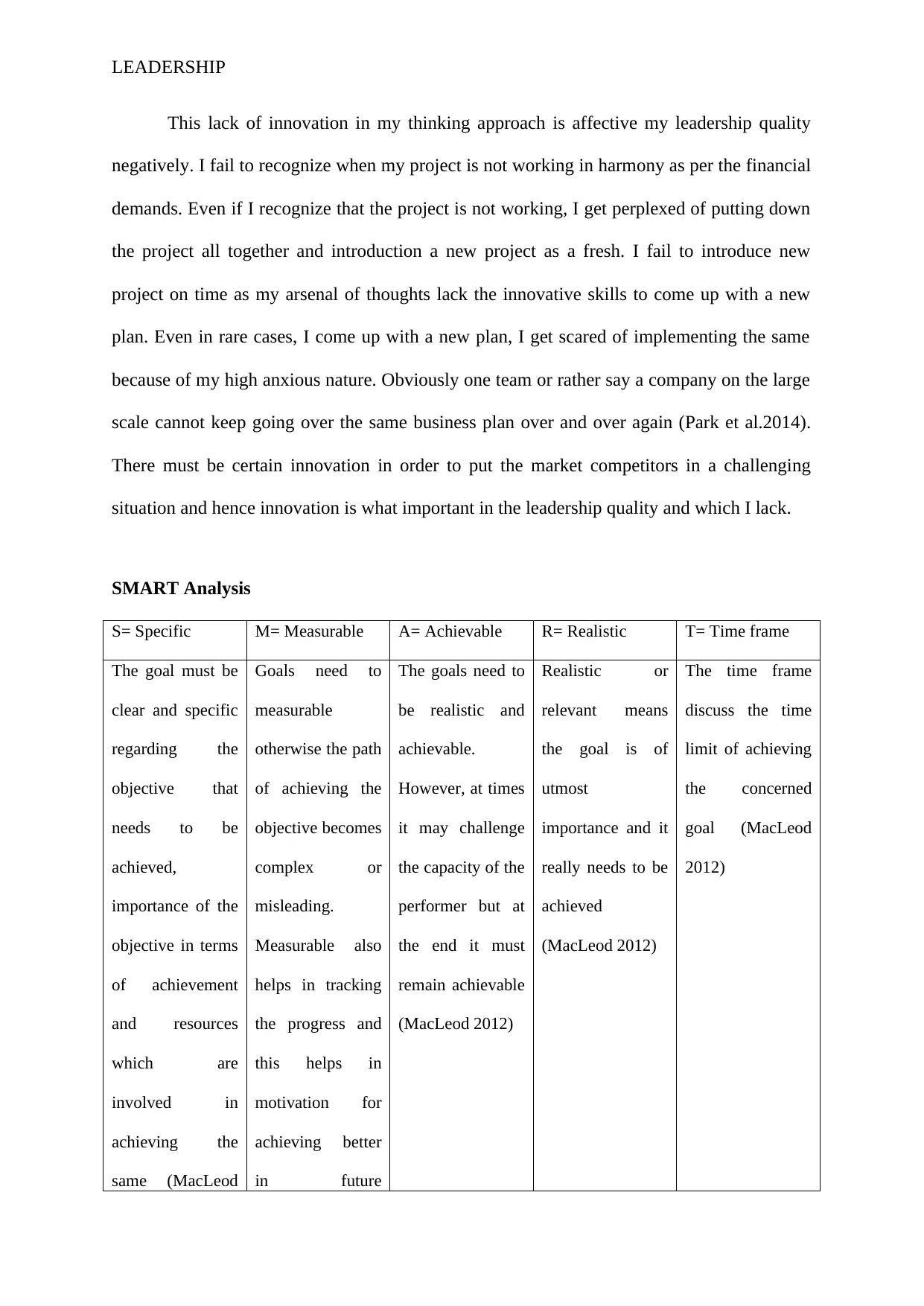
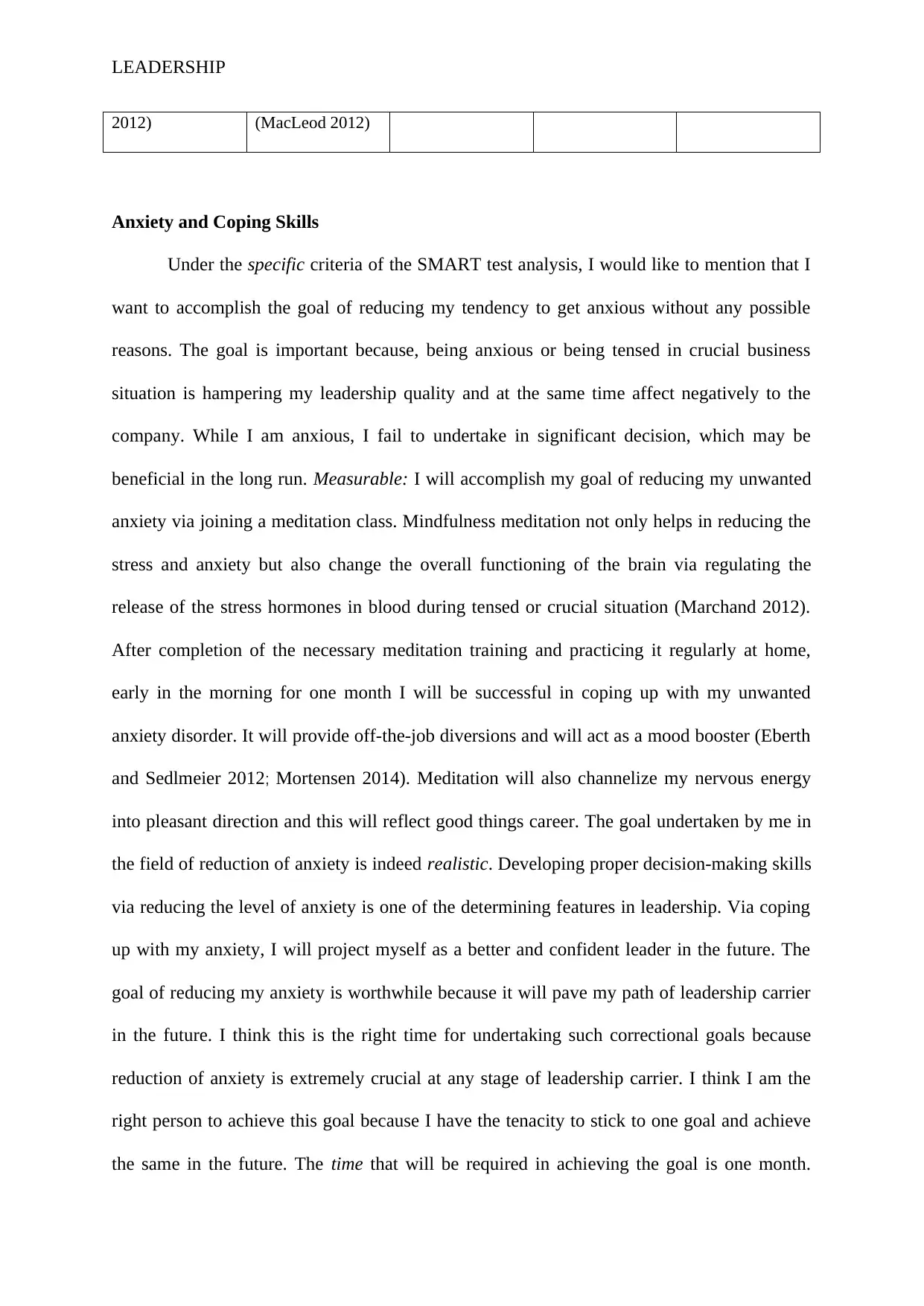
SMART Analysis
S= Specific M= Measurable A= Achievable R= Realistic T= Time frame
The goal must be
clear and specific
regarding the
objective that
needs to be
achieved,
importance of the
objective in terms
of achievement
and resources
which are
involved in
achieving the
same (MacLeod
Goals need to
measurable
otherwise the path
of achieving the
objective becomes
complex or
misleading.
Measurable also
helps in tracking
the progress and
this helps in
motivation for
achieving better
in future
The goals need to
be realistic and
achievable.
However, at times
it may challenge
the capacity of the
performer but at
the end it must
remain achievable
(MacLeod 2012)
Realistic or
relevant means
the goal is of
utmost
importance and it
really needs to be
achieved
(MacLeod 2012)
The time frame
discuss the time
limit of achieving
the concerned
goal (MacLeod
2012)
This lack of innovation in my thinking approach is affective my leadership quality
negatively. I fail to recognize when my project is not working in harmony as per the financial
demands. Even if I recognize that the project is not working, I get perplexed of putting down
the project all together and introduction a new project as a fresh. I fail to introduce new
project on time as my arsenal of thoughts lack the innovative skills to come up with a new
plan. Even in rare cases, I come up with a new plan, I get scared of implementing the same
because of my high anxious nature. Obviously one team or rather say a company on the large
scale cannot keep going over the same business plan over and over again (Park et al.2014).
There must be certain innovation in order to put the market competitors in a challenging
situation and hence innovation is what important in the leadership quality and which I lack.
SMART Analysis
S= Specific M= Measurable A= Achievable R= Realistic T= Time frame
The goal must be
clear and specific
regarding the
objective that
needs to be
achieved,
importance of the
objective in terms
of achievement
and resources
which are
involved in
achieving the
same (MacLeod
Goals need to
measurable
otherwise the path
of achieving the
objective becomes
complex or
misleading.
Measurable also
helps in tracking
the progress and
this helps in
motivation for
achieving better
in future
The goals need to
be realistic and
achievable.
However, at times
it may challenge
the capacity of the
performer but at
the end it must
remain achievable
(MacLeod 2012)
Realistic or
relevant means
the goal is of
utmost
importance and it
really needs to be
achieved
(MacLeod 2012)
The time frame
discuss the time
limit of achieving
the concerned
goal (MacLeod
2012)
LEADERSHIP
2012) (MacLeod 2012)
Anxiety and Coping Skills
Under the specific criteria of the SMART test analysis, I would like to mention that I
want to accomplish the goal of reducing my tendency to get anxious without any possible
reasons. The goal is important because, being anxious or being tensed in crucial business
situation is hampering my leadership quality and at the same time affect negatively to the
company. While I am anxious, I fail to undertake in significant decision, which may be
beneficial in the long run. Measurable: I will accomplish my goal of reducing my unwanted
anxiety via joining a meditation class. Mindfulness meditation not only helps in reducing the
stress and anxiety but also change the overall functioning of the brain via regulating the
release of the stress hormones in blood during tensed or crucial situation (Marchand 2012).
After completion of the necessary meditation training and practicing it regularly at home,
early in the morning for one month I will be successful in coping up with my unwanted
anxiety disorder. It will provide off-the-job diversions and will act as a mood booster (Eberth
and Sedlmeier 2012; Mortensen 2014). Meditation will also channelize my nervous energy
into pleasant direction and this will reflect good things career. The goal undertaken by me in
the field of reduction of anxiety is indeed realistic. Developing proper decision-making skills
via reducing the level of anxiety is one of the determining features in leadership. Via coping
up with my anxiety, I will project myself as a better and confident leader in the future. The
goal of reducing my anxiety is worthwhile because it will pave my path of leadership carrier
in the future. I think this is the right time for undertaking such correctional goals because
reduction of anxiety is extremely crucial at any stage of leadership carrier. I think I am the
right person to achieve this goal because I have the tenacity to stick to one goal and achieve
the same in the future. The time that will be required in achieving the goal is one month.
2012) (MacLeod 2012)
Anxiety and Coping Skills
Under the specific criteria of the SMART test analysis, I would like to mention that I
want to accomplish the goal of reducing my tendency to get anxious without any possible
reasons. The goal is important because, being anxious or being tensed in crucial business
situation is hampering my leadership quality and at the same time affect negatively to the
company. While I am anxious, I fail to undertake in significant decision, which may be
beneficial in the long run. Measurable: I will accomplish my goal of reducing my unwanted
anxiety via joining a meditation class. Mindfulness meditation not only helps in reducing the
stress and anxiety but also change the overall functioning of the brain via regulating the
release of the stress hormones in blood during tensed or crucial situation (Marchand 2012).
After completion of the necessary meditation training and practicing it regularly at home,
early in the morning for one month I will be successful in coping up with my unwanted
anxiety disorder. It will provide off-the-job diversions and will act as a mood booster (Eberth
and Sedlmeier 2012; Mortensen 2014). Meditation will also channelize my nervous energy
into pleasant direction and this will reflect good things career. The goal undertaken by me in
the field of reduction of anxiety is indeed realistic. Developing proper decision-making skills
via reducing the level of anxiety is one of the determining features in leadership. Via coping
up with my anxiety, I will project myself as a better and confident leader in the future. The
goal of reducing my anxiety is worthwhile because it will pave my path of leadership carrier
in the future. I think this is the right time for undertaking such correctional goals because
reduction of anxiety is extremely crucial at any stage of leadership carrier. I think I am the
right person to achieve this goal because I have the tenacity to stick to one goal and achieve
the same in the future. The time that will be required in achieving the goal is one month.
⊘ This is a preview!⊘
Do you want full access?
Subscribe today to unlock all pages.
Trusted by 1+ million students worldwide
LEADERSHIP
However, regular practice of meditation must be maintained for the further refinement of
gaining control over the nerves.
Conflict Management Skill
Specific: I want to achieve the skill of conflict management because; managing
conflicts is one of the key criteria of successful leadership. While working as a team time
may arises that there is a clash of conflict between the employees. I as a leader need to
resolve this so that my teammates work in a peace of mind, without hampering the
productivity. Measurable: In order to revamp my conflict management skill, I will undertake
the help of the Thomas-Kilmann Conflict Mode Instrument (Johnson et al 2012). It can be
defined as a special instrument has been designed to measures person’s behavior in conflict-
oriented situation. Under Thomas-Kilmann Conflict Mode Instrument, the ability to manage
the conflict is measured based on two parameter, assertiveness and cooperativeness (Johnson
et al 2012). After taking the test and interpreting the score, I will simultaneously work on my
trait and will gradually shape up my conflict management skills. Achievable: In order to
achieve the goal, I will diligently give the test via Thomas-Kilmann Conflict Mode
Instrument and will act accordingly. The goal is indeed realistic as performing the Thomas-
Kilmann Conflict Mode Instrument test and simultaneously working on it is a achievable
task. Relevant: It is the right time to work on this as any problem if it is executed at the
neonatal stage then it reduces the complexity of the problem itself. I think I am the right
person for this purpose because I nurture certain promising leadership quality like excellent
communication skills. Time bound: The period for achieving this particular goal is two
months.
Generation of Innovative Idea
Specific: I want to accomplish the goal of ability to generate innovative idea because
without innovative idea the skill of leadership quality cannot flow smoothly. Through this
However, regular practice of meditation must be maintained for the further refinement of
gaining control over the nerves.
Conflict Management Skill
Specific: I want to achieve the skill of conflict management because; managing
conflicts is one of the key criteria of successful leadership. While working as a team time
may arises that there is a clash of conflict between the employees. I as a leader need to
resolve this so that my teammates work in a peace of mind, without hampering the
productivity. Measurable: In order to revamp my conflict management skill, I will undertake
the help of the Thomas-Kilmann Conflict Mode Instrument (Johnson et al 2012). It can be
defined as a special instrument has been designed to measures person’s behavior in conflict-
oriented situation. Under Thomas-Kilmann Conflict Mode Instrument, the ability to manage
the conflict is measured based on two parameter, assertiveness and cooperativeness (Johnson
et al 2012). After taking the test and interpreting the score, I will simultaneously work on my
trait and will gradually shape up my conflict management skills. Achievable: In order to
achieve the goal, I will diligently give the test via Thomas-Kilmann Conflict Mode
Instrument and will act accordingly. The goal is indeed realistic as performing the Thomas-
Kilmann Conflict Mode Instrument test and simultaneously working on it is a achievable
task. Relevant: It is the right time to work on this as any problem if it is executed at the
neonatal stage then it reduces the complexity of the problem itself. I think I am the right
person for this purpose because I nurture certain promising leadership quality like excellent
communication skills. Time bound: The period for achieving this particular goal is two
months.
Generation of Innovative Idea
Specific: I want to accomplish the goal of ability to generate innovative idea because
without innovative idea the skill of leadership quality cannot flow smoothly. Through this
Paraphrase This Document
Need a fresh take? Get an instant paraphrase of this document with our AI Paraphraser
LEADERSHIP
goal, I want to gain the insight of generating innovative ideas, which I can implement in the
future (Lal, Donnelly and Shin 2015). Measurable: In order to achieve the goal, I will read
book that deals with the biography of the innovative leader and centering their ideas and
thought process like Steve Jobs of Apple. By doing this will know how this people have
reacted in complex situation and have come up with new yet innovative plan to uplift the
organization in the financial and global scale. Achievable: The goal is achievable because I
will channelize my leisure tie in reading these books and will simultaneously exercise my
brain to work accordingly. Relevant: The goal is extremely relevant in the current scenario
because, a leader without creative ideas cannot thrive in this competitive. I think I am the
right person to reach this goal as I have all other good criteria that is require to a good leader.
Time Bound: The time frame for this goal is 3 months as detailed analysis of the book and
analyzing of the thoughts are required.
goal, I want to gain the insight of generating innovative ideas, which I can implement in the
future (Lal, Donnelly and Shin 2015). Measurable: In order to achieve the goal, I will read
book that deals with the biography of the innovative leader and centering their ideas and
thought process like Steve Jobs of Apple. By doing this will know how this people have
reacted in complex situation and have come up with new yet innovative plan to uplift the
organization in the financial and global scale. Achievable: The goal is achievable because I
will channelize my leisure tie in reading these books and will simultaneously exercise my
brain to work accordingly. Relevant: The goal is extremely relevant in the current scenario
because, a leader without creative ideas cannot thrive in this competitive. I think I am the
right person to reach this goal as I have all other good criteria that is require to a good leader.
Time Bound: The time frame for this goal is 3 months as detailed analysis of the book and
analyzing of the thoughts are required.
LEADERSHIP
References
Aryee, S., Walumbwa, F.O., Zhou, Q. and Hartnell, C.A., 2012. Transformational leadership,
innovative behavior, and task performance: Test of mediation and moderation
processes. Human Performance, 25(1), pp.1-25.
De Wit, F.R., Greer, L.L. and Jehn, K.A., 2012. The paradox of intragroup conflict: a meta-
analysis.
Eberth, J. and Sedlmeier, P., 2012. The effects of mindfulness meditation: a meta-
analysis. Mindfulness, 3(3), pp.174-189.
Gelfand, M.J., Leslie, L.M., Keller, K. and de Dreu, C., 2012. Conflict cultures in
organizations: How leaders shape conflict cultures and their organizational-level
consequences. Journal of Applied Psychology, 97(6), p.1131.
Hackman, M.Z. and Johnson, C.E., 2013. Leadership: A communication perspective.
Waveland Press.
Johnson, C.A., Thompson, R.C. and Anderson, M.G., THOMAS-KILMANN CONFLICT
MODE INSTRUMENT.
Kim, D.Y., 2014. Conflict management ad leadership.
Lal, S., Donnelly, C. and Shin, J., 2015. Digital storytelling: An innovative tool for practice,
education, and research. Occupational therapy in health care, 29(1), pp.54-62.
MacLeod, L., 2012. Making SMART goals smarter. Physician executive, 38(2), pp.68-72.
References
Aryee, S., Walumbwa, F.O., Zhou, Q. and Hartnell, C.A., 2012. Transformational leadership,
innovative behavior, and task performance: Test of mediation and moderation
processes. Human Performance, 25(1), pp.1-25.
De Wit, F.R., Greer, L.L. and Jehn, K.A., 2012. The paradox of intragroup conflict: a meta-
analysis.
Eberth, J. and Sedlmeier, P., 2012. The effects of mindfulness meditation: a meta-
analysis. Mindfulness, 3(3), pp.174-189.
Gelfand, M.J., Leslie, L.M., Keller, K. and de Dreu, C., 2012. Conflict cultures in
organizations: How leaders shape conflict cultures and their organizational-level
consequences. Journal of Applied Psychology, 97(6), p.1131.
Hackman, M.Z. and Johnson, C.E., 2013. Leadership: A communication perspective.
Waveland Press.
Johnson, C.A., Thompson, R.C. and Anderson, M.G., THOMAS-KILMANN CONFLICT
MODE INSTRUMENT.
Kim, D.Y., 2014. Conflict management ad leadership.
Lal, S., Donnelly, C. and Shin, J., 2015. Digital storytelling: An innovative tool for practice,
education, and research. Occupational therapy in health care, 29(1), pp.54-62.
MacLeod, L., 2012. Making SMART goals smarter. Physician executive, 38(2), pp.68-72.
⊘ This is a preview!⊘
Do you want full access?
Subscribe today to unlock all pages.
Trusted by 1+ million students worldwide

1 out of 13


Related Documents


Your All-in-One AI-Powered Toolkit for Academic Success.
+13062052269
info@desklib.com
Available 24*7 on WhatsApp / Email
![[object Object]](/_next/static/media/star-bottom.7253800d.svg)
Unlock your academic potential
Copyright © 2020–2026 A2Z Services. All Rights Reserved. Developed and managed by ZUCOL.