Leadership and Management for Service Industries: Costa Coffee
VerifiedAdded on 2023/01/10
|11
|2763
|34
Report
AI Summary
This report provides a comprehensive analysis of leadership and management principles within the service industry, with a specific focus on Costa Coffee. The report begins with an introduction to the importance of leadership and management in organizational success, followed by an assessment of classical management theories, including scientific, bureaucratic, and administrative approaches, and their application in a service context. It then explores the roles of leaders and different leadership styles, such as autocratic, democratic, and laissez-faire, within the service sector. The report further reviews the management and leadership styles employed by Costa Coffee, examining participatory and democratic styles. Finally, the report investigates both the internal factors, such as organizational culture and talent management, and external factors, including the economic and legal environment, that influence management styles and organizational structures within the selected industry. The report concludes with a summary of key findings and implications for effective leadership and management in the service sector.

Leadership and Management for Service Industries

Paraphrase This Document
Need a fresh take? Get an instant paraphrase of this document with our AI Paraphraser
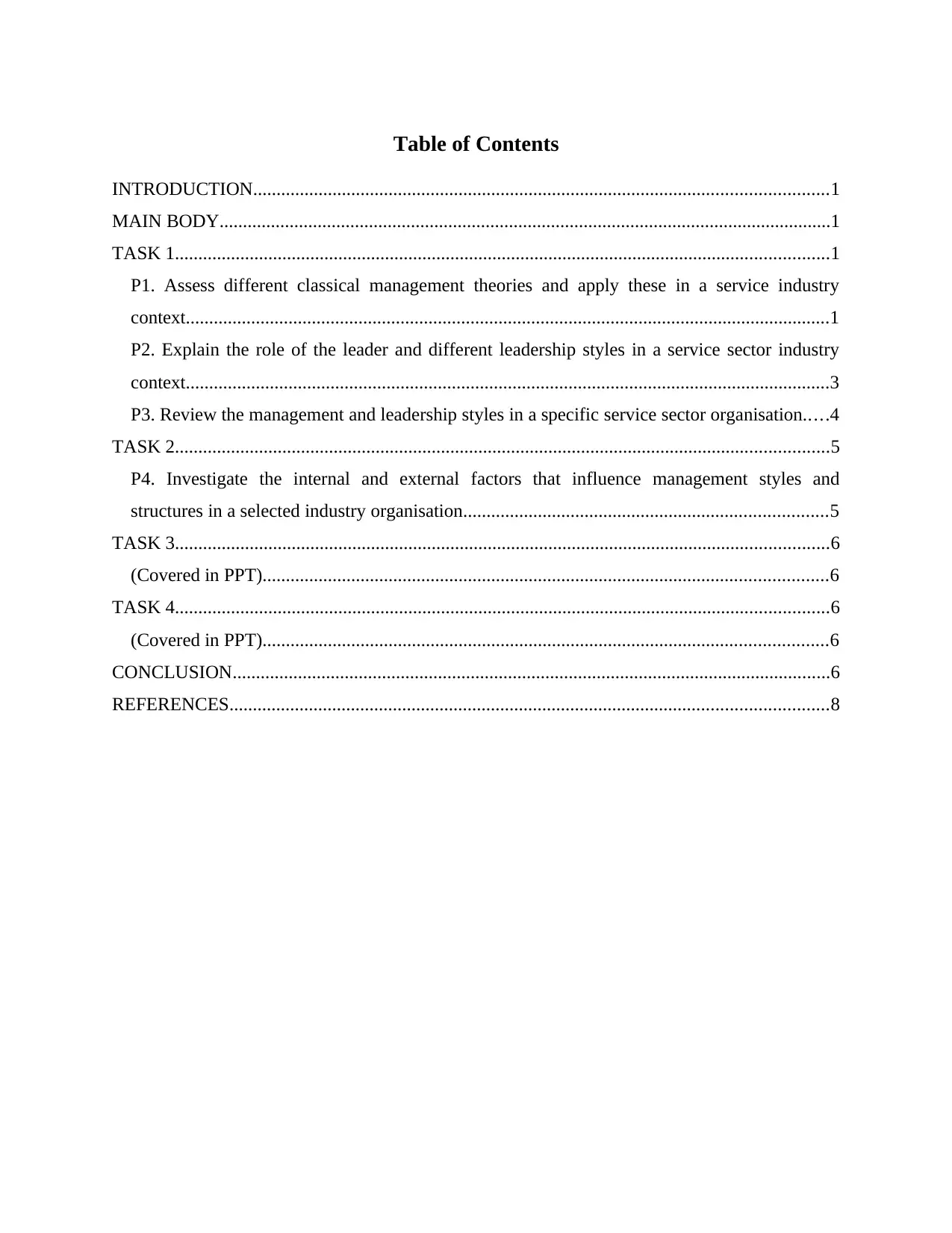
Table of Contents
INTRODUCTION...........................................................................................................................1
MAIN BODY...................................................................................................................................1
TASK 1............................................................................................................................................1
P1. Assess different classical management theories and apply these in a service industry
context..........................................................................................................................................1
P2. Explain the role of the leader and different leadership styles in a service sector industry
context..........................................................................................................................................3
P3. Review the management and leadership styles in a specific service sector organisation.....4
TASK 2............................................................................................................................................5
P4. Investigate the internal and external factors that influence management styles and
structures in a selected industry organisation..............................................................................5
TASK 3............................................................................................................................................6
(Covered in PPT).........................................................................................................................6
TASK 4............................................................................................................................................6
(Covered in PPT).........................................................................................................................6
CONCLUSION................................................................................................................................6
REFERENCES................................................................................................................................8
INTRODUCTION...........................................................................................................................1
MAIN BODY...................................................................................................................................1
TASK 1............................................................................................................................................1
P1. Assess different classical management theories and apply these in a service industry
context..........................................................................................................................................1
P2. Explain the role of the leader and different leadership styles in a service sector industry
context..........................................................................................................................................3
P3. Review the management and leadership styles in a specific service sector organisation.....4
TASK 2............................................................................................................................................5
P4. Investigate the internal and external factors that influence management styles and
structures in a selected industry organisation..............................................................................5
TASK 3............................................................................................................................................6
(Covered in PPT).........................................................................................................................6
TASK 4............................................................................................................................................6
(Covered in PPT).........................................................................................................................6
CONCLUSION................................................................................................................................6
REFERENCES................................................................................................................................8

⊘ This is a preview!⊘
Do you want full access?
Subscribe today to unlock all pages.

Trusted by 1+ million students worldwide
INTRODUCTION
Leadership and management is very important part of business and this support in
performing organisational task and activities in more effective manner. There are different types
of leadership and management style that will lead to providing guidance and support to company
for conducting organisational activities in effective manner (Psomas and Jaca, 2016). Effective
support form leaders and manager will help in increasing employees capability as well as
accomplish desired objectives. Chosen company for this report is Costa Coffee. This
organisation is dealing in restaurant or coffee shop industry and offering its high quality products
or services to different part of the world. Costa coffee was established in year 1971 and founder
of this organisation is Bruno Costa and Sergio Costa. This report will includes different classical
management theories and role of leaders as well as different leadership style is determined.
Leadership and management style is analysed properly. In this different internal and external
factors which influence structure will be identified. Hard and soft skills for leadership and
management is determined properly.
MAIN BODY
TASK 1
P1. Assess different classical management theories and apply these in a service industry context.
The Classical Management Theories
The classical management theory focuses on enhancing employees' output with work
responsibilities. The approach was developed by Tailor, Fayola as well as Max Weber. The
theory entails concepts of scientific management, bureaucracy management, and administrative
management. From its inception, classical management approaches are very imperative in
different ways in establishing successful organizations; hence, are still have influenced
organizations in different ways (Chang, 2016). Fayol instituted fourteen management principles
that illustrate the division of labor. Leaders are supposed to work with employees according to
their abilities. With variation in abilities there are the division of labor. Work is supposed to be
assigned to every employee, according to their skills and areas of expertise.
Scientific Management Approach
Scientific management theory deals with scientific studies, work approaches, instruments,
and performance levels to ensure that output is efficient. According to Kravariti, Foteini, and
1
Leadership and management is very important part of business and this support in
performing organisational task and activities in more effective manner. There are different types
of leadership and management style that will lead to providing guidance and support to company
for conducting organisational activities in effective manner (Psomas and Jaca, 2016). Effective
support form leaders and manager will help in increasing employees capability as well as
accomplish desired objectives. Chosen company for this report is Costa Coffee. This
organisation is dealing in restaurant or coffee shop industry and offering its high quality products
or services to different part of the world. Costa coffee was established in year 1971 and founder
of this organisation is Bruno Costa and Sergio Costa. This report will includes different classical
management theories and role of leaders as well as different leadership style is determined.
Leadership and management style is analysed properly. In this different internal and external
factors which influence structure will be identified. Hard and soft skills for leadership and
management is determined properly.
MAIN BODY
TASK 1
P1. Assess different classical management theories and apply these in a service industry context.
The Classical Management Theories
The classical management theory focuses on enhancing employees' output with work
responsibilities. The approach was developed by Tailor, Fayola as well as Max Weber. The
theory entails concepts of scientific management, bureaucracy management, and administrative
management. From its inception, classical management approaches are very imperative in
different ways in establishing successful organizations; hence, are still have influenced
organizations in different ways (Chang, 2016). Fayol instituted fourteen management principles
that illustrate the division of labor. Leaders are supposed to work with employees according to
their abilities. With variation in abilities there are the division of labor. Work is supposed to be
assigned to every employee, according to their skills and areas of expertise.
Scientific Management Approach
Scientific management theory deals with scientific studies, work approaches, instruments,
and performance levels to ensure that output is efficient. According to Kravariti, Foteini, and
1
Paraphrase This Document
Need a fresh take? Get an instant paraphrase of this document with our AI Paraphraser
Johnston, production is done to get profit, which is very logical. Therefore, organizations would
only hire and maintain employees whose productivity is high and efficient. For those who show
poor productivity, they often let go by the organization. However, the role of management tends
to minimize poor productivity by effecting different functions of management, as discussed
below. Development of the work to be done - Scientific management as an approach which
focuses on the development of the work planning aimed at achieving efficiency
(Armstrong 2016). The definition is practical in diverse organizations that implement
various projects for young children for either growth or charitable purposes. Scientifically select, teach and develop each worker - Scientific management offers
responsibility to leaders to enable them to choose the appropriate scientific plans to train
workers rather than leaving them to learn through the experience. Besides, the same
method applies to any contemporary firm via a series of experiments that end in the
promotion of highly competent employees who are frequently nurtured to manage their
duties effectively.
Bureaucratic Approach
The bureaucratic theory was developed by Max Weber, which is based on the fact that
workers usually struggle to adhere to the rules of their seniors firmly. Besides, they tend to be
loyal and submissive to their leaders, but that is not the most appropriate way, given that it lacks
humanity in it (Ling, Lin and Wu 2016). There are three bases of power which are rational,
position, and expertise. In analytical power leadership depends on the already instituted laws and
is the one that is typically implemented by most organizations. bureaucracy in contemporary
organizations, it is efficient to look at specialization where professionals from different
departments are kept in an institutional database
Administrative Theory
Fayol's Fourteen principles of management emphasized on a list of six primary
management function. The administrative approach principally focuses on the coordination of
the work in the whole organization. The management functions are forecasting, planning,
organizing, commanding, coordinating, and controlling. However, in different categories, a
diverse range of employees are detailed in policy developments, and policies tend to be
successfully passed over to all employees as well as those who are working together with them.
2
only hire and maintain employees whose productivity is high and efficient. For those who show
poor productivity, they often let go by the organization. However, the role of management tends
to minimize poor productivity by effecting different functions of management, as discussed
below. Development of the work to be done - Scientific management as an approach which
focuses on the development of the work planning aimed at achieving efficiency
(Armstrong 2016). The definition is practical in diverse organizations that implement
various projects for young children for either growth or charitable purposes. Scientifically select, teach and develop each worker - Scientific management offers
responsibility to leaders to enable them to choose the appropriate scientific plans to train
workers rather than leaving them to learn through the experience. Besides, the same
method applies to any contemporary firm via a series of experiments that end in the
promotion of highly competent employees who are frequently nurtured to manage their
duties effectively.
Bureaucratic Approach
The bureaucratic theory was developed by Max Weber, which is based on the fact that
workers usually struggle to adhere to the rules of their seniors firmly. Besides, they tend to be
loyal and submissive to their leaders, but that is not the most appropriate way, given that it lacks
humanity in it (Ling, Lin and Wu 2016). There are three bases of power which are rational,
position, and expertise. In analytical power leadership depends on the already instituted laws and
is the one that is typically implemented by most organizations. bureaucracy in contemporary
organizations, it is efficient to look at specialization where professionals from different
departments are kept in an institutional database
Administrative Theory
Fayol's Fourteen principles of management emphasized on a list of six primary
management function. The administrative approach principally focuses on the coordination of
the work in the whole organization. The management functions are forecasting, planning,
organizing, commanding, coordinating, and controlling. However, in different categories, a
diverse range of employees are detailed in policy developments, and policies tend to be
successfully passed over to all employees as well as those who are working together with them.
2
P2. Explain the role of the leader and different leadership styles in a service sector industry
context.
Leaders play crucial role in enhancing performance of employees to carry out business
activities in effective manner (Oshagbemi 2017). There are different role and responsibility of
leaders that will assist in increasing employees performance as well as motivating them to
conduct organisational task in better manner. Different roles of leader as well as leadership styles
is mention below –
Role of leaders
Developing or communication vision – Leaders role is to create vision and
communicate it wht others in order to attain it. The personality of leaders contains an
essential influence regarding their thinking, sensing abilities, and communicating with
other employees. Leaders' traits can influence employees of organizational to
achievement elements such as performance, motivation, and effectiveness.
Directing and mentoring – It is important role of leaders to guide and direct employees
in order to increase their capability and potential to conduct organisational task in better
manner. leaders will influence and motivate employees to work with their full capability
and potential to conduct organisational task in better manner.
Different leadership style
Autocratic leadership style – In this type of leadership style leaders are not taking input
of leader while decision making process. Autocratic leadership style refer as the way in
which leaders are providing information and order to employees in which they have to
conducting organisational activities (Berson 2016). This type of leadership style is
considered to be quite strict and in this only leaders will take important decision and
employees have to follow the instructions that is provided by leaders.
Democratic leadership style – This leadership style in inverse of autocratic leadership as
in this leader are considering inputs or ideas of leader while taking business decision.
This is considered as effective leadership style as well as lead to motivate employees.
when leaders are considering ideas and views of employees in order to develop strategies
and take business decision employees engagement with company will be directly
improve. Leaders will take decision by identifying ideas or suggestion of employees.
3
context.
Leaders play crucial role in enhancing performance of employees to carry out business
activities in effective manner (Oshagbemi 2017). There are different role and responsibility of
leaders that will assist in increasing employees performance as well as motivating them to
conduct organisational task in better manner. Different roles of leader as well as leadership styles
is mention below –
Role of leaders
Developing or communication vision – Leaders role is to create vision and
communicate it wht others in order to attain it. The personality of leaders contains an
essential influence regarding their thinking, sensing abilities, and communicating with
other employees. Leaders' traits can influence employees of organizational to
achievement elements such as performance, motivation, and effectiveness.
Directing and mentoring – It is important role of leaders to guide and direct employees
in order to increase their capability and potential to conduct organisational task in better
manner. leaders will influence and motivate employees to work with their full capability
and potential to conduct organisational task in better manner.
Different leadership style
Autocratic leadership style – In this type of leadership style leaders are not taking input
of leader while decision making process. Autocratic leadership style refer as the way in
which leaders are providing information and order to employees in which they have to
conducting organisational activities (Berson 2016). This type of leadership style is
considered to be quite strict and in this only leaders will take important decision and
employees have to follow the instructions that is provided by leaders.
Democratic leadership style – This leadership style in inverse of autocratic leadership as
in this leader are considering inputs or ideas of leader while taking business decision.
This is considered as effective leadership style as well as lead to motivate employees.
when leaders are considering ideas and views of employees in order to develop strategies
and take business decision employees engagement with company will be directly
improve. Leaders will take decision by identifying ideas or suggestion of employees.
3
⊘ This is a preview!⊘
Do you want full access?
Subscribe today to unlock all pages.
Trusted by 1+ million students worldwide
Laissez faire leadership style – this leaders style can be describe as when employees are
majorly taking decision and leaders are supporting employees with their decision making
process. Laissez faire leadership is considered to be some time effective for organisation.
Through this leadership style contribution of employees in business and decision taking
activities is directly improved. This leadership provide more authority to employees and
it will support in motivating them to attain business goals.
P3. Review the management and leadership styles in a specific service sector organisation.
There are many leadership and management styles that is consider by Costa Coffee while
conducting business activities. It is important for respective company to consider right and
accurate style of management or leadership in order to effectively carry out organisational
operations (Grossman and et. al., 2017). Costa Coffee is a coffee shop which is providing high
quality of drinking and food product for it customers. This is dealing in services sector in which
customer will be majorly influence by the services provided by organisation in order to meet
with the needs of customers. Leadership styles will support respective company in carrying out
different activities of leaders in which they are influencing employees to working according to
the business need. It is essential that the leaders of Costa Coffee organisation is influencing
employees in correct manner so that they are able to provided effective services. Management
style of respective company will assist in managing different activities or resources of business
in correct manner so that desired objective of business could be timely attain. Leadership and
management style for respective company is mention below
Leadership style
Participative leadership style – This leadership style can be describe as the leadership
in which leaders are participating with employees of Costa Coffee company. This is very
effective leadership style as in this leaders and employees that decision together which is
beneficial for organisation and its growth. Employees will also work very effectively and
they are taking decision for organisation (Anning-Dorson 2016). Participative leaders are
participating in each and every activity of business which will provide more information
to employees regarding conducting task. Employees capability and potential to conduct
task will be directly improve as they are able to learn from leaders and analysing how
they work to attain set targets.
4
majorly taking decision and leaders are supporting employees with their decision making
process. Laissez faire leadership is considered to be some time effective for organisation.
Through this leadership style contribution of employees in business and decision taking
activities is directly improved. This leadership provide more authority to employees and
it will support in motivating them to attain business goals.
P3. Review the management and leadership styles in a specific service sector organisation.
There are many leadership and management styles that is consider by Costa Coffee while
conducting business activities. It is important for respective company to consider right and
accurate style of management or leadership in order to effectively carry out organisational
operations (Grossman and et. al., 2017). Costa Coffee is a coffee shop which is providing high
quality of drinking and food product for it customers. This is dealing in services sector in which
customer will be majorly influence by the services provided by organisation in order to meet
with the needs of customers. Leadership styles will support respective company in carrying out
different activities of leaders in which they are influencing employees to working according to
the business need. It is essential that the leaders of Costa Coffee organisation is influencing
employees in correct manner so that they are able to provided effective services. Management
style of respective company will assist in managing different activities or resources of business
in correct manner so that desired objective of business could be timely attain. Leadership and
management style for respective company is mention below
Leadership style
Participative leadership style – This leadership style can be describe as the leadership
in which leaders are participating with employees of Costa Coffee company. This is very
effective leadership style as in this leaders and employees that decision together which is
beneficial for organisation and its growth. Employees will also work very effectively and
they are taking decision for organisation (Anning-Dorson 2016). Participative leaders are
participating in each and every activity of business which will provide more information
to employees regarding conducting task. Employees capability and potential to conduct
task will be directly improve as they are able to learn from leaders and analysing how
they work to attain set targets.
4
Paraphrase This Document
Need a fresh take? Get an instant paraphrase of this document with our AI Paraphraser
Management style
Democratic management style – Manager of Costa Coffee organisation is reaching to
employees in order to understand and collect views of employees. Democratic
management style will be very effective for respective company as in this employees will
be able to provide their suggestion and ideas to managers directly. When manager of
Costa Coffee organisation is considering inputs and suggestion of employees in business
decision making process, employees will feel more valuable to conduct organisational
activities (Lin 2016). In this style of management, manager is responsible to taking
decision by analysing and evaluating the inputs of employees. This will encourages group
member of employees of Costa Coffee and increase their capability to conduct business
task.
TASK 2
P4. Investigate the internal and external factors that influence management styles and structures
in a selected industry organisation
There are various factors and elements which will lead to have impact on management style
or structure of the company. It is essential for Costa Coffee organisation to analyse and evaluate
these factor in order to carry out business activities successfully and attain goals of business.
Internal and external factors which influence management style and structure of company is
mention below –
Internal factors
Internal factors consist of all those factor which in internally relate to business and Costa
Coffee management style and structure will be affected by these factors. It includes different
element related to organisational culture, employees engagement and talent management. Organisational culture – The culture of Costa Coffee company will affect the decision
making process and management style of business (FHKPS 2018). organisational culture
consist of values, attitude and behaviour of business which affect its functioning and
capability of employees. Costa Coffee company have positive and friendly working
culture which will enhance management style and structure in correct manner.
5
Democratic management style – Manager of Costa Coffee organisation is reaching to
employees in order to understand and collect views of employees. Democratic
management style will be very effective for respective company as in this employees will
be able to provide their suggestion and ideas to managers directly. When manager of
Costa Coffee organisation is considering inputs and suggestion of employees in business
decision making process, employees will feel more valuable to conduct organisational
activities (Lin 2016). In this style of management, manager is responsible to taking
decision by analysing and evaluating the inputs of employees. This will encourages group
member of employees of Costa Coffee and increase their capability to conduct business
task.
TASK 2
P4. Investigate the internal and external factors that influence management styles and structures
in a selected industry organisation
There are various factors and elements which will lead to have impact on management style
or structure of the company. It is essential for Costa Coffee organisation to analyse and evaluate
these factor in order to carry out business activities successfully and attain goals of business.
Internal and external factors which influence management style and structure of company is
mention below –
Internal factors
Internal factors consist of all those factor which in internally relate to business and Costa
Coffee management style and structure will be affected by these factors. It includes different
element related to organisational culture, employees engagement and talent management. Organisational culture – The culture of Costa Coffee company will affect the decision
making process and management style of business (FHKPS 2018). organisational culture
consist of values, attitude and behaviour of business which affect its functioning and
capability of employees. Costa Coffee company have positive and friendly working
culture which will enhance management style and structure in correct manner.
5
Talent management – This refers as the employees or staff member of respective
company. It is important for Costa Coffee organisation to retain highly talent workforce
with in organisation (Johnston and Marshall, 2016). This will lead to increase capability
of business and affect management style or respective company. Structure of Costa
Coffee organisation will be based on the strategic talent management.
External factors
This includes all those factors that is not internally related with business and it will have
impact on performance of company. it is important for Costa Coffee organisation to consider
external factors as it will have influence on management style or structure of company. External
factors includes –
Economical environment – This factor consider of economical condition of the country
or economic system of nation. Economical environment factor will lead to have highly
impact on the decision making of management and creating structure of organisation
accordingly.
Legal factor – It includes all laws and legislation which is set by government and its will
have impact over decision making of business (Singh, Grover and Singh, 2017). Legal
legislation related to employment laws, health and safety etc. Will affect the management
style and structure of business.
TASK 3
(Covered in PPT)
TASK 4
(Covered in PPT)
CONCLUSION
From the above report it can be concluded that it is essential for organisation to use of
professional management and leaderships skills for accomplishing goals. There are different
management as well as leadership approaches which can be implemented by an organization to
achieve the set goals in an effective and suitable manner. Leadership style and management style
of company will assist in managing employees of organisation correctly as well as influencing
6
company. It is important for Costa Coffee organisation to retain highly talent workforce
with in organisation (Johnston and Marshall, 2016). This will lead to increase capability
of business and affect management style or respective company. Structure of Costa
Coffee organisation will be based on the strategic talent management.
External factors
This includes all those factors that is not internally related with business and it will have
impact on performance of company. it is important for Costa Coffee organisation to consider
external factors as it will have influence on management style or structure of company. External
factors includes –
Economical environment – This factor consider of economical condition of the country
or economic system of nation. Economical environment factor will lead to have highly
impact on the decision making of management and creating structure of organisation
accordingly.
Legal factor – It includes all laws and legislation which is set by government and its will
have impact over decision making of business (Singh, Grover and Singh, 2017). Legal
legislation related to employment laws, health and safety etc. Will affect the management
style and structure of business.
TASK 3
(Covered in PPT)
TASK 4
(Covered in PPT)
CONCLUSION
From the above report it can be concluded that it is essential for organisation to use of
professional management and leaderships skills for accomplishing goals. There are different
management as well as leadership approaches which can be implemented by an organization to
achieve the set goals in an effective and suitable manner. Leadership style and management style
of company will assist in managing employees of organisation correctly as well as influencing
6
⊘ This is a preview!⊘
Do you want full access?
Subscribe today to unlock all pages.
Trusted by 1+ million students worldwide

them to conduct business task in effective manner. There are internal and external factor of
business which will influence style of management and structure of business. soft skills and hard
skill of individual will lead to have influence over capability to conduct task. Different
organisation have different change management style and leadership for implementing changes.
7
business which will influence style of management and structure of business. soft skills and hard
skill of individual will lead to have influence over capability to conduct task. Different
organisation have different change management style and leadership for implementing changes.
7
Paraphrase This Document
Need a fresh take? Get an instant paraphrase of this document with our AI Paraphraser
REFERENCES
Books and Journals
Anning-Dorson, T., 2016. Organisational culture and leadership as mediators of service
innovation and firm competitiveness: A study of an emerging economy. International
Journal of Innovation Management. 20(07). p.1650064.
Armstrong, M., 2016. Armstrong's handbook of management and leadership for HR: Developing
effective people skills for better leadership and management. Kogan Page Publishers.
Berson, Y., 2016. Leadership lessons from compelling contexts. Emerald Group Publishing.
Chang, Y.Y., 2016. Multilevel transformational leadership and management
innovation. Leadership & Organization Development Journal.
FHKPS, B., 2018. Validation of the service leadership attitude scale in Hong Kong. International
Journal of Child and Adolescent Health. 11(4). pp.467-477.
Grossman, K.A., and et. al., 2017. Media leadership: change management. Journal of the
American College of Radiology. 14(6). pp.848-849.
Johnston, M.W. and Marshall, G.W., 2016. Sales force management: Leadership, innovation,
technology. Routledge.
Lin, W.B., 2016. Correlations of knowledge-sharing intention between different enterprise types
and leadership styles. International Journal of Innovation and Learning. 20(4). pp.437-
460.
Ling, Q., Lin, M. and Wu, X., 2016. The trickle-down effect of servant leadership on frontline
employee service behaviors and performance: A multilevel study of Chinese
hotels. Tourism Management. 52. pp.341-368.
Oshagbemi, T., 2017. Leadership and Management in universities: Britain and Nigeria (Vol.
14). Walter de Gruyter GmbH & Co KG.
Psomas, E.L. and Jaca, C., 2016. The impact of total quality management on service company
performance: evidence from Spain. International Journal of Quality & Reliability
Management.
Singh, B., Grover, S. and Singh, V., 2017. A benchmarking model for Indian service industries
using MICMAC and WISM approach. International Journal of System Assurance
Engineering and Management. 8(2). pp.1266-1281.
8
Books and Journals
Anning-Dorson, T., 2016. Organisational culture and leadership as mediators of service
innovation and firm competitiveness: A study of an emerging economy. International
Journal of Innovation Management. 20(07). p.1650064.
Armstrong, M., 2016. Armstrong's handbook of management and leadership for HR: Developing
effective people skills for better leadership and management. Kogan Page Publishers.
Berson, Y., 2016. Leadership lessons from compelling contexts. Emerald Group Publishing.
Chang, Y.Y., 2016. Multilevel transformational leadership and management
innovation. Leadership & Organization Development Journal.
FHKPS, B., 2018. Validation of the service leadership attitude scale in Hong Kong. International
Journal of Child and Adolescent Health. 11(4). pp.467-477.
Grossman, K.A., and et. al., 2017. Media leadership: change management. Journal of the
American College of Radiology. 14(6). pp.848-849.
Johnston, M.W. and Marshall, G.W., 2016. Sales force management: Leadership, innovation,
technology. Routledge.
Lin, W.B., 2016. Correlations of knowledge-sharing intention between different enterprise types
and leadership styles. International Journal of Innovation and Learning. 20(4). pp.437-
460.
Ling, Q., Lin, M. and Wu, X., 2016. The trickle-down effect of servant leadership on frontline
employee service behaviors and performance: A multilevel study of Chinese
hotels. Tourism Management. 52. pp.341-368.
Oshagbemi, T., 2017. Leadership and Management in universities: Britain and Nigeria (Vol.
14). Walter de Gruyter GmbH & Co KG.
Psomas, E.L. and Jaca, C., 2016. The impact of total quality management on service company
performance: evidence from Spain. International Journal of Quality & Reliability
Management.
Singh, B., Grover, S. and Singh, V., 2017. A benchmarking model for Indian service industries
using MICMAC and WISM approach. International Journal of System Assurance
Engineering and Management. 8(2). pp.1266-1281.
8

1 out of 11


Related Documents


Your All-in-One AI-Powered Toolkit for Academic Success.
+13062052269
info@desklib.com
Available 24*7 on WhatsApp / Email
![[object Object]](/_next/static/media/star-bottom.7253800d.svg)
Unlock your academic potential
Copyright © 2020–2026 A2Z Services. All Rights Reserved. Developed and managed by ZUCOL.