Ethical Leadership and Social Responsibility Report - Assessment
VerifiedAdded on 2019/10/30
|10
|3094
|187
Report
AI Summary
This report delves into the realm of ethical leadership and social responsibility, exploring the author's personal leadership style and its potential impact on interpersonal relationships within a professional setting. The report identifies key characteristics of the author's style, including dependability, fearlessness, honesty, adaptability, and loyalty, while also acknowledging areas for improvement such as self-centeredness and arrogance. It further examines the influence of these traits on future interactions in the workplace, particularly within the context of a managerial role at Woolworths Australia. The report then defines ethical leadership through the 4-V model (vision, values, voice, and virtue) and highlights ethical issues that managers and leaders face, such as providing equal opportunities, ensuring employee health and safety, and addressing workplace harassment. Finally, the report advocates for situational leadership as the preferred approach, emphasizing the importance of adapting leadership styles to suit different situations, thereby fostering employee satisfaction and effective decision-making.
ETHICAL LEADERSHIP
AND SOCIAL
RESPONSIBILITY
1
AND SOCIAL
RESPONSIBILITY
1

Paraphrase This Document
Need a fresh take? Get an instant paraphrase of this document with our AI Paraphraser
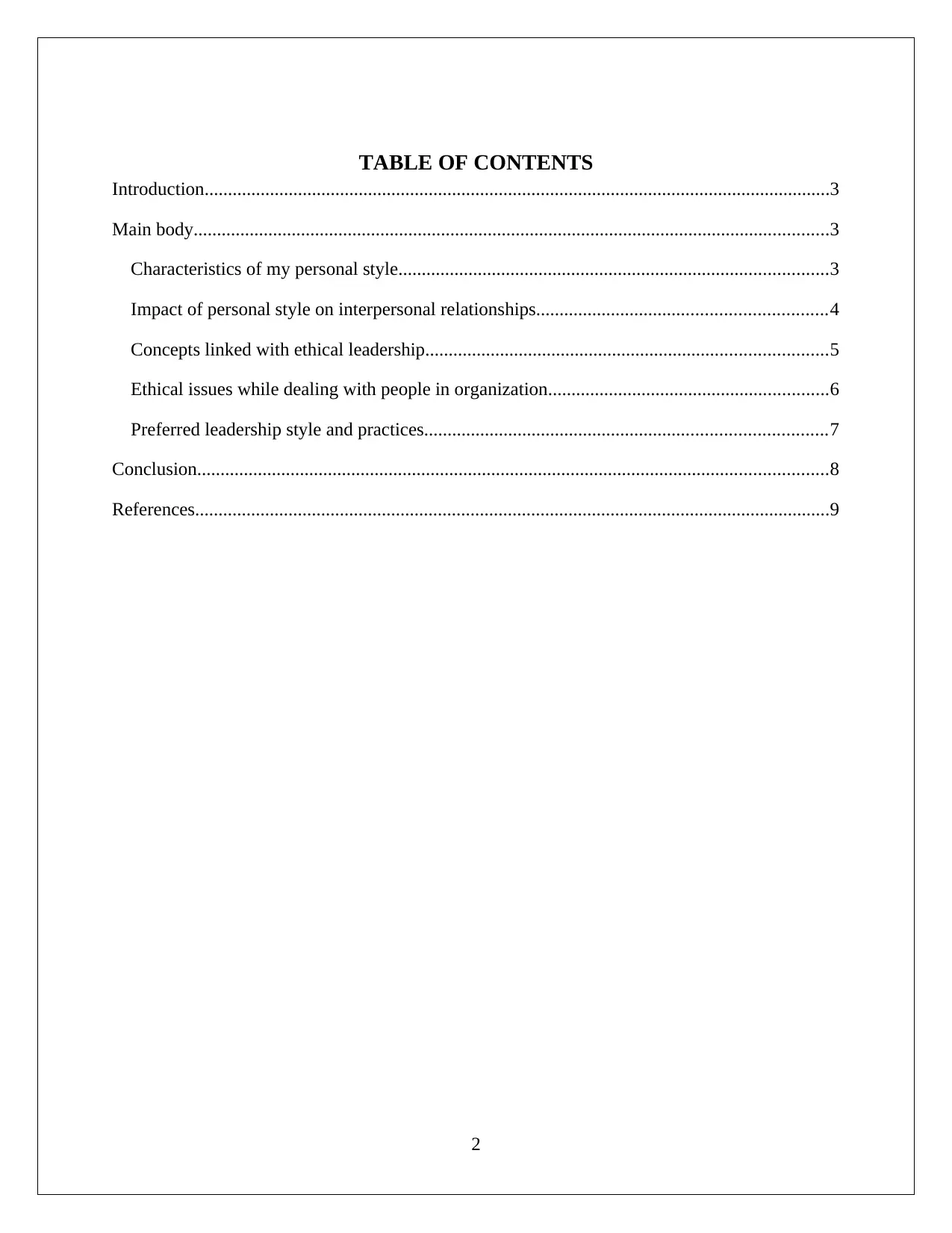
TABLE OF CONTENTS
Introduction......................................................................................................................................3
Main body........................................................................................................................................3
Characteristics of my personal style............................................................................................3
Impact of personal style on interpersonal relationships..............................................................4
Concepts linked with ethical leadership......................................................................................5
Ethical issues while dealing with people in organization............................................................6
Preferred leadership style and practices......................................................................................7
Conclusion.......................................................................................................................................8
References........................................................................................................................................9
2
Introduction......................................................................................................................................3
Main body........................................................................................................................................3
Characteristics of my personal style............................................................................................3
Impact of personal style on interpersonal relationships..............................................................4
Concepts linked with ethical leadership......................................................................................5
Ethical issues while dealing with people in organization............................................................6
Preferred leadership style and practices......................................................................................7
Conclusion.......................................................................................................................................8
References........................................................................................................................................9
2
INTRODUCTION
In today’s corporate world, ethical leadership and accomplishment of social
responsibilities have become crucial to the success of an individual (Zhang et al. 2013).
Furthermore, ethics are important because they support in differentiating between what is right
and what is wrong. On the other hand, organizations are now needed to ensure that their business
practices and operations do not have the negative impact on the people living in the society.
The present study reflects some of the key characteristics of my style. In addition to this,
the impact of personal style on my future interpersonal relationships is also mentioned in this
report. The key ethical issues which can be faced by manager or leaders while dealing with
people in the organization are also highlighted in the present report.
MAIN BODY
Characteristics of my personal style
In near future when I will work as a leader in any particular organization then the
personal style that I will adopt directly influence the entire team. Further, it is necessary for
every individual to ensure that the personal style adopted must be favourable so that individual
can work for the betterment of the team and the organization. Considering my personal style
where I possess some unique attribute which I think must be present in a successful leader.
Dependable is one of the attributes which must be present in a leader as the individual
must take advice from the team members in every of the situation to contribute best to the
organization (Yukl et al. 2013). Therefore, this attribute will support me in near future where I
will prefer to depend on my team members and other individuals within the workplace for
conducting operations. Fearless is the key attribute whether leaders working in the organizations
conduct all the operations without any fear and they prefer to take challenging tasks (Aarons et
al. 2015). So, this also matches with my personal style where I will prefer to take part in the
challenging activities. This attribute will surely assist me to become the successful leader, and I
can easily contribute in the major affairs of the organization. Other key attributes of my personal
style involve honesty, adaptability to change and loyalty towards work that will make me a
successful leader.
On the other hand, I possess some negative attributes which involve self-centred where in
many situations leader consider their personal benefit like at the time of taking the decision and
this is not at all ethical. It is the moral duty of the leader to involve the entire team member while
3
In today’s corporate world, ethical leadership and accomplishment of social
responsibilities have become crucial to the success of an individual (Zhang et al. 2013).
Furthermore, ethics are important because they support in differentiating between what is right
and what is wrong. On the other hand, organizations are now needed to ensure that their business
practices and operations do not have the negative impact on the people living in the society.
The present study reflects some of the key characteristics of my style. In addition to this,
the impact of personal style on my future interpersonal relationships is also mentioned in this
report. The key ethical issues which can be faced by manager or leaders while dealing with
people in the organization are also highlighted in the present report.
MAIN BODY
Characteristics of my personal style
In near future when I will work as a leader in any particular organization then the
personal style that I will adopt directly influence the entire team. Further, it is necessary for
every individual to ensure that the personal style adopted must be favourable so that individual
can work for the betterment of the team and the organization. Considering my personal style
where I possess some unique attribute which I think must be present in a successful leader.
Dependable is one of the attributes which must be present in a leader as the individual
must take advice from the team members in every of the situation to contribute best to the
organization (Yukl et al. 2013). Therefore, this attribute will support me in near future where I
will prefer to depend on my team members and other individuals within the workplace for
conducting operations. Fearless is the key attribute whether leaders working in the organizations
conduct all the operations without any fear and they prefer to take challenging tasks (Aarons et
al. 2015). So, this also matches with my personal style where I will prefer to take part in the
challenging activities. This attribute will surely assist me to become the successful leader, and I
can easily contribute in the major affairs of the organization. Other key attributes of my personal
style involve honesty, adaptability to change and loyalty towards work that will make me a
successful leader.
On the other hand, I possess some negative attributes which involve self-centred where in
many situations leader consider their personal benefit like at the time of taking the decision and
this is not at all ethical. It is the moral duty of the leader to involve the entire team member while
3
⊘ This is a preview!⊘
Do you want full access?
Subscribe today to unlock all pages.

Trusted by 1+ million students worldwide
taking the decision. I will try to work on this area where I will less focus on my personal benefit.
Further, arrogant is also one of the negative attributes of my personal style. In some situations I
am overconfident, and this attribute leads to decline in performance of a leader. Therefore, I will
try to work on all these areas. This will surely support me to become the successful leader, and I
can support my entire team in the proper manner. Apart from this, I need to develop my personal
style which requires team and more efforts.
Impact of personal style on interpersonal relationships
In future, I am looking forward to working as a manager in one of the stores of
Woolworth Australia. It can be expressed that my style traits will have a direct impact on my
interpersonal relationship at the workplace. I usually depend heavily on others for the
accomplishment of tasks and responsibilities. Furthermore, this dependency can affect my
interpersonal relationship at work in both positive and negative aspects. For example, excess
dependency will result in developing my bad image in front of others. People working under me
will start perceiving that I am not capable enough to accomplish task and activities by my own.
On the other hand, limited dependency will result in developing long term and healthy
relationship with others.
I am very loyal and honest regarding carrying out my work and this personal style will
help in enhancing the overall degree of interpersonal relationship at workplace. My honest and
loyalty will support in improving my image and will also encourage others to perceive me as a
great leader. The interpersonal relationship at work is also affected by a leader's overall ability to
adopt changes at frequent intervals (Shin et al. 2015). I am well aware of various tools and
techniques which can help in implementing and managing changes within the organization in the
best possible manner. This characteristic will motivate others to seek for my views and opinions
during situations when they are not able to adopt changes (Brown & Treviño 2014).
Thus, I will be able to develop long term relationship with other staff members through
this personal style. However, it can be critically argued that personal styles such as arrogance can
adversely affect the overall interpersonal relationship at work. A leader or manager needs to
make sure that he/she thinks twice before speaking and during the conversation, he/she should
not adopt arrogant style. It will directly result in creating dissatisfaction among other workers
and will also adversely affect my growth in the organization. Arrogant nature is considered as
4
Further, arrogant is also one of the negative attributes of my personal style. In some situations I
am overconfident, and this attribute leads to decline in performance of a leader. Therefore, I will
try to work on all these areas. This will surely support me to become the successful leader, and I
can support my entire team in the proper manner. Apart from this, I need to develop my personal
style which requires team and more efforts.
Impact of personal style on interpersonal relationships
In future, I am looking forward to working as a manager in one of the stores of
Woolworth Australia. It can be expressed that my style traits will have a direct impact on my
interpersonal relationship at the workplace. I usually depend heavily on others for the
accomplishment of tasks and responsibilities. Furthermore, this dependency can affect my
interpersonal relationship at work in both positive and negative aspects. For example, excess
dependency will result in developing my bad image in front of others. People working under me
will start perceiving that I am not capable enough to accomplish task and activities by my own.
On the other hand, limited dependency will result in developing long term and healthy
relationship with others.
I am very loyal and honest regarding carrying out my work and this personal style will
help in enhancing the overall degree of interpersonal relationship at workplace. My honest and
loyalty will support in improving my image and will also encourage others to perceive me as a
great leader. The interpersonal relationship at work is also affected by a leader's overall ability to
adopt changes at frequent intervals (Shin et al. 2015). I am well aware of various tools and
techniques which can help in implementing and managing changes within the organization in the
best possible manner. This characteristic will motivate others to seek for my views and opinions
during situations when they are not able to adopt changes (Brown & Treviño 2014).
Thus, I will be able to develop long term relationship with other staff members through
this personal style. However, it can be critically argued that personal styles such as arrogance can
adversely affect the overall interpersonal relationship at work. A leader or manager needs to
make sure that he/she thinks twice before speaking and during the conversation, he/she should
not adopt arrogant style. It will directly result in creating dissatisfaction among other workers
and will also adversely affect my growth in the organization. Arrogant nature is considered as
4
Paraphrase This Document
Need a fresh take? Get an instant paraphrase of this document with our AI Paraphraser
one of the worst characteristics of a person, and it is also suggested that the use of this personal
style should be avoided in the best possible manner.
Concepts linked with ethical leadership
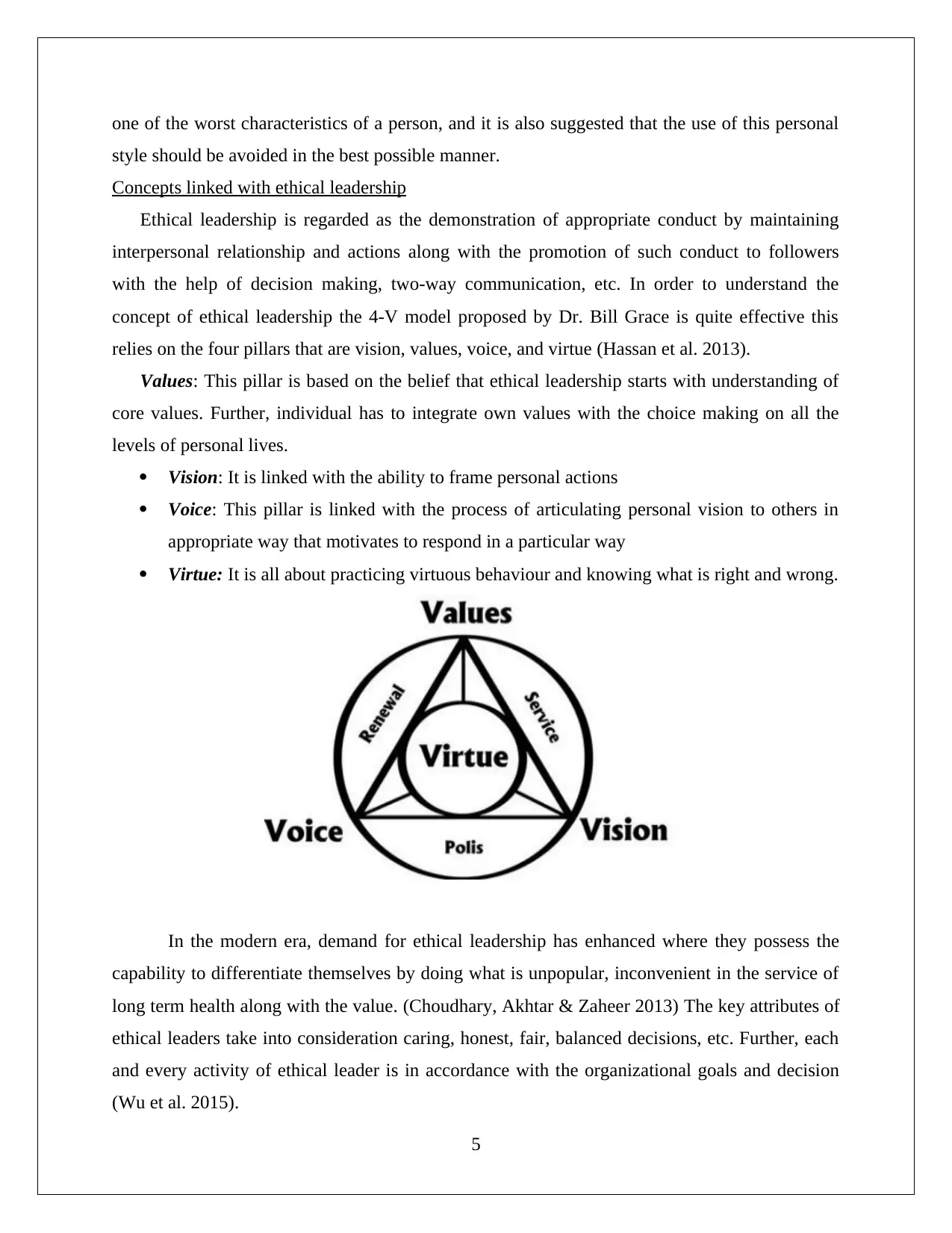
Ethical leadership is regarded as the demonstration of appropriate conduct by maintaining
interpersonal relationship and actions along with the promotion of such conduct to followers
with the help of decision making, two-way communication, etc. In order to understand the
concept of ethical leadership the 4-V model proposed by Dr. Bill Grace is quite effective this
relies on the four pillars that are vision, values, voice, and virtue (Hassan et al. 2013).
Values: This pillar is based on the belief that ethical leadership starts with understanding of
core values. Further, individual has to integrate own values with the choice making on all the
levels of personal lives.
Vision: It is linked with the ability to frame personal actions
Voice: This pillar is linked with the process of articulating personal vision to others in
appropriate way that motivates to respond in a particular way
Virtue: It is all about practicing virtuous behaviour and knowing what is right and wrong.
In the modern era, demand for ethical leadership has enhanced where they possess the
capability to differentiate themselves by doing what is unpopular, inconvenient in the service of
long term health along with the value. (Choudhary, Akhtar & Zaheer 2013) The key attributes of
ethical leaders take into consideration caring, honest, fair, balanced decisions, etc. Further, each
and every activity of ethical leader is in accordance with the organizational goals and decision
(Wu et al. 2015).
5
style should be avoided in the best possible manner.
Concepts linked with ethical leadership
Ethical leadership is regarded as the demonstration of appropriate conduct by maintaining
interpersonal relationship and actions along with the promotion of such conduct to followers
with the help of decision making, two-way communication, etc. In order to understand the
concept of ethical leadership the 4-V model proposed by Dr. Bill Grace is quite effective this
relies on the four pillars that are vision, values, voice, and virtue (Hassan et al. 2013).
Values: This pillar is based on the belief that ethical leadership starts with understanding of
core values. Further, individual has to integrate own values with the choice making on all the
levels of personal lives.
Vision: It is linked with the ability to frame personal actions
Voice: This pillar is linked with the process of articulating personal vision to others in
appropriate way that motivates to respond in a particular way
Virtue: It is all about practicing virtuous behaviour and knowing what is right and wrong.
In the modern era, demand for ethical leadership has enhanced where they possess the
capability to differentiate themselves by doing what is unpopular, inconvenient in the service of
long term health along with the value. (Choudhary, Akhtar & Zaheer 2013) The key attributes of
ethical leaders take into consideration caring, honest, fair, balanced decisions, etc. Further, each
and every activity of ethical leader is in accordance with the organizational goals and decision
(Wu et al. 2015).
5
Any type of biased activity is not at all present within the workplace, and this makes
them successful. They are generally indulged into the practice of making balanced decisions, and
they are most commonly exhibited by patience, humanity, character, social justice, etc. In short,
the concept associated with ethical leadership is quite significant (Ropo et al. 2015).
Considering the framework of ethical leadership I have found that it is necessary for me
to ensure that all my practices are ethical and I have to possess all the attributes that are present
in an ethical leader like honesty, loyalty, ethical decision making. Through this, it will be
possible for me to contribute maximum in the business affairs and all the business practices will
be ethical in every possible manner. Moreover, I have to ensure that the range of decisions that I
will take within the workplace is favourable where it positively affects every individual present
in my team. I have to ensure that my overall practices are ethical and they are contributing to the
growth of the organization which I will work as a leader. Therefore, this directly highlights the
attributes of ethical leaders.
Ethical issues while dealing with people in organization
In simpler terms, ethics can be considered as the set of written and unwritten principles
which guide the behaviour of people working in an organization (Tannenbaum, Weschler &
Massarik 2013). Furthermore, being a manager or leader in a company, one needs to deal with a
large number of ethical issues. For example, offering fair and equal opportunities to people in the
organization is the biggest problem linked with ethics (Palanski, Avey & Jiraporn 2014). A
manager is required to ensure that no form of discrimination is encouraged among the staff
members. At the same time, fair wages and development opportunities are also required to be
provided by the leader or manager. Another ethical issue which a manager can face while dealing
with people at the workplace is linked to health and safety of the employee. A leader or manager
needs to ensure that adequate measures for staff member’s health and safety are taken into
consideration.
Apart from this, a manager also needs to ensure that issues such as workplace harassment
are not encouraged within the business practices. It is the ethical duty of every manager and
leader makes sure that no worker in the organization should be harassed sexually, physically and
mentally. Furthermore, strict actions should be taken against the workers who are indulged in
such kind of practices within the company (Jordan et al. 2013). It can be explained that managing
employee behaviour and working conditions within the organization are the two most important
6
them successful. They are generally indulged into the practice of making balanced decisions, and
they are most commonly exhibited by patience, humanity, character, social justice, etc. In short,
the concept associated with ethical leadership is quite significant (Ropo et al. 2015).
Considering the framework of ethical leadership I have found that it is necessary for me
to ensure that all my practices are ethical and I have to possess all the attributes that are present
in an ethical leader like honesty, loyalty, ethical decision making. Through this, it will be
possible for me to contribute maximum in the business affairs and all the business practices will
be ethical in every possible manner. Moreover, I have to ensure that the range of decisions that I
will take within the workplace is favourable where it positively affects every individual present
in my team. I have to ensure that my overall practices are ethical and they are contributing to the
growth of the organization which I will work as a leader. Therefore, this directly highlights the
attributes of ethical leaders.
Ethical issues while dealing with people in organization
In simpler terms, ethics can be considered as the set of written and unwritten principles
which guide the behaviour of people working in an organization (Tannenbaum, Weschler &
Massarik 2013). Furthermore, being a manager or leader in a company, one needs to deal with a
large number of ethical issues. For example, offering fair and equal opportunities to people in the
organization is the biggest problem linked with ethics (Palanski, Avey & Jiraporn 2014). A
manager is required to ensure that no form of discrimination is encouraged among the staff
members. At the same time, fair wages and development opportunities are also required to be
provided by the leader or manager. Another ethical issue which a manager can face while dealing
with people at the workplace is linked to health and safety of the employee. A leader or manager
needs to ensure that adequate measures for staff member’s health and safety are taken into
consideration.
Apart from this, a manager also needs to ensure that issues such as workplace harassment
are not encouraged within the business practices. It is the ethical duty of every manager and
leader makes sure that no worker in the organization should be harassed sexually, physically and
mentally. Furthermore, strict actions should be taken against the workers who are indulged in
such kind of practices within the company (Jordan et al. 2013). It can be explained that managing
employee behaviour and working conditions within the organization are the two most important
6
⊘ This is a preview!⊘
Do you want full access?
Subscribe today to unlock all pages.
Trusted by 1+ million students worldwide
ethical issues which are being faced by leaders and managers. It is required by managers and
leaders to develop effective policies and practices to deal with the mentioned-above ethical
issues. .
Preferred leadership style and practices
In the modern era, a leader plays a significant role in overall growth and development of
a business enterprise (Sharif & Scandura 2014). Furthermore, the leadership style and practices
adopted by a person has a direct impact on the behaviour of individuals working in an
organization. Nowadays, there are different styles and practices of leadership which can be taken
into consideration by leaders to ensure smooth functioning of all business operations and
activities (Küpers 2016). For example, some leaders adopt the autocratic style of leadership
while performing their role of leader in the organization.
According to this style, leaders do not consider the views and opinions of staff members
in the process of decisions making and strategy formulation. The result of this is that high degree
of dissatisfaction is created among employees and they also start feeling dissatisfied. However, it
can be critically argued that autocratic leadership style is beneficial and efficient in situations
where fast decisions making is required.
On the other hand, some leaders adopt the participative or democratic style of leadership
which encourages suggestions and opinions from other staff members. The result of this is that
leaders can acquire a higher degree of satisfaction among workers with the help of this
leadership style and practices (Shapiro & Stefkovich 2016). The drawback of participative style
is that it can cause a delay in the entire process of decision making as a leader is required to
consider views and opinion of every employee and this is very time-consuming (Rijal 2016).
As per my view, a leader should not restrict him to a particular style of leadership. I
believe that situational leadership is the best practice which can be taken into consideration by
leaders in the long run. The situational style and practice of leadership are the one who
encourages a leader to change leadership style as per changes in the situation. For example in
conditions where fast decision making is required, autocratic style can be adopted by the leader.
On the other hand, to develop satisfaction among workers, in the long run, democratic style can
be chosen. The benefit of using situational leadership is that it assists in carrying out effective
decision making and it also supports in developing strong coordination among all staff members
(Tannenbaum, Weschler & Massarik 2013).
7
leaders to develop effective policies and practices to deal with the mentioned-above ethical
issues. .
Preferred leadership style and practices
In the modern era, a leader plays a significant role in overall growth and development of
a business enterprise (Sharif & Scandura 2014). Furthermore, the leadership style and practices
adopted by a person has a direct impact on the behaviour of individuals working in an
organization. Nowadays, there are different styles and practices of leadership which can be taken
into consideration by leaders to ensure smooth functioning of all business operations and
activities (Küpers 2016). For example, some leaders adopt the autocratic style of leadership
while performing their role of leader in the organization.
According to this style, leaders do not consider the views and opinions of staff members
in the process of decisions making and strategy formulation. The result of this is that high degree
of dissatisfaction is created among employees and they also start feeling dissatisfied. However, it
can be critically argued that autocratic leadership style is beneficial and efficient in situations
where fast decisions making is required.
On the other hand, some leaders adopt the participative or democratic style of leadership
which encourages suggestions and opinions from other staff members. The result of this is that
leaders can acquire a higher degree of satisfaction among workers with the help of this
leadership style and practices (Shapiro & Stefkovich 2016). The drawback of participative style
is that it can cause a delay in the entire process of decision making as a leader is required to
consider views and opinion of every employee and this is very time-consuming (Rijal 2016).
As per my view, a leader should not restrict him to a particular style of leadership. I
believe that situational leadership is the best practice which can be taken into consideration by
leaders in the long run. The situational style and practice of leadership are the one who
encourages a leader to change leadership style as per changes in the situation. For example in
conditions where fast decision making is required, autocratic style can be adopted by the leader.
On the other hand, to develop satisfaction among workers, in the long run, democratic style can
be chosen. The benefit of using situational leadership is that it assists in carrying out effective
decision making and it also supports in developing strong coordination among all staff members
(Tannenbaum, Weschler & Massarik 2013).
7
Paraphrase This Document
Need a fresh take? Get an instant paraphrase of this document with our AI Paraphraser
CONCLUSION
The entire study carried out has supported in knowing about the concept of ethical
leadership where it plays the most significant role in the organization. Further, the key attributes
present in a leader involves honesty, loyalty, dedication towards work, the strength of character,
etc. Moreover, the characteristics of my personal style reflect my key strengths and weaknesses
where it is necessary for me to work on the key areas where my performance lacks, and
improvement is needed. Apart from this, the 4V model of ethical leadership is also effective
where it undertakes the key values such as voice, virtue, values, and vision. These are the key
pillars of this model that needs to be considered by the leader who wants to ethically conduct
business operations.
8
The entire study carried out has supported in knowing about the concept of ethical
leadership where it plays the most significant role in the organization. Further, the key attributes
present in a leader involves honesty, loyalty, dedication towards work, the strength of character,
etc. Moreover, the characteristics of my personal style reflect my key strengths and weaknesses
where it is necessary for me to work on the key areas where my performance lacks, and
improvement is needed. Apart from this, the 4V model of ethical leadership is also effective
where it undertakes the key values such as voice, virtue, values, and vision. These are the key
pillars of this model that needs to be considered by the leader who wants to ethically conduct
business operations.
8
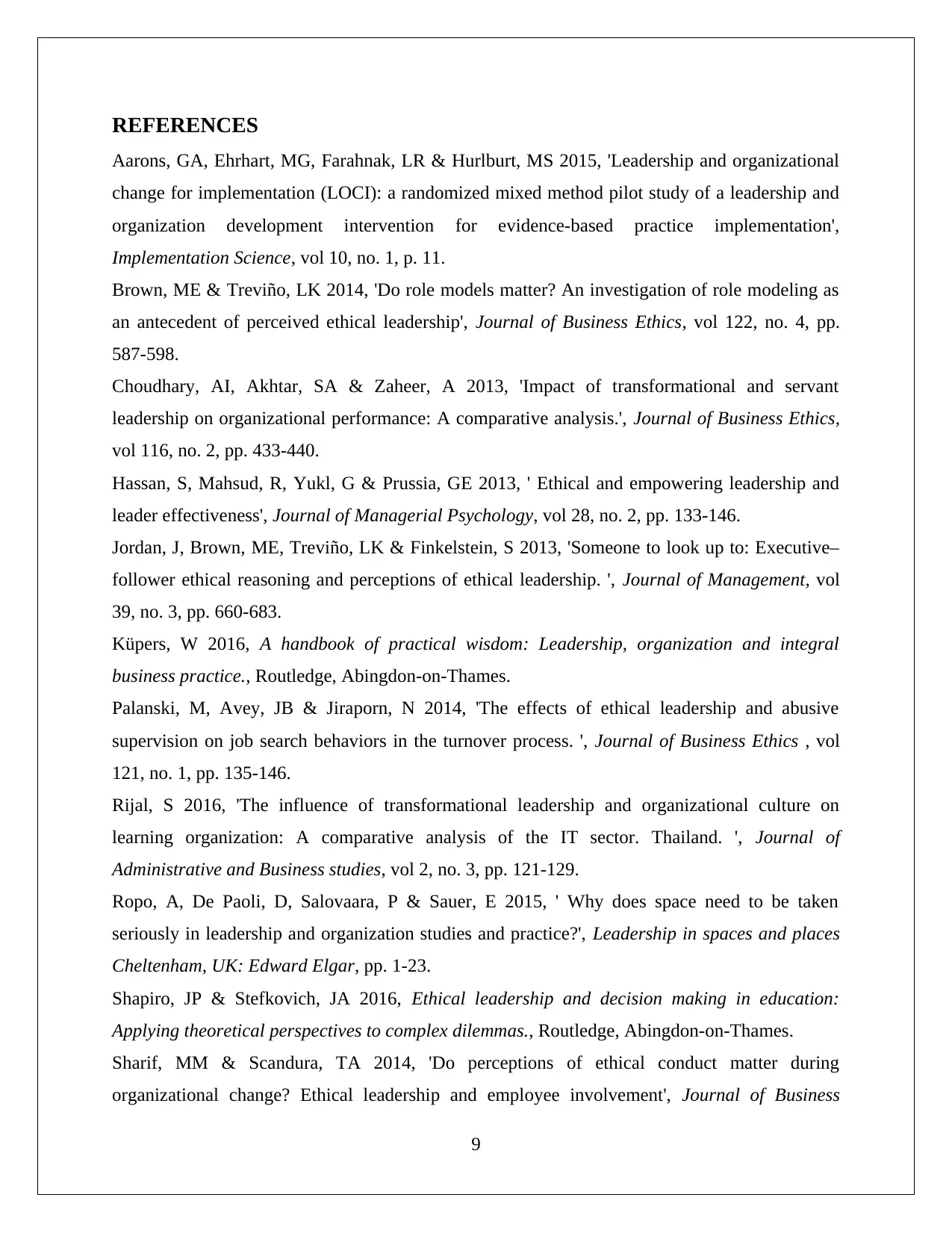
REFERENCES
Aarons, GA, Ehrhart, MG, Farahnak, LR & Hurlburt, MS 2015, 'Leadership and organizational
change for implementation (LOCI): a randomized mixed method pilot study of a leadership and
organization development intervention for evidence-based practice implementation',
Implementation Science, vol 10, no. 1, p. 11.
Brown, ME & Treviño, LK 2014, 'Do role models matter? An investigation of role modeling as
an antecedent of perceived ethical leadership', Journal of Business Ethics, vol 122, no. 4, pp.
587-598.
Choudhary, AI, Akhtar, SA & Zaheer, A 2013, 'Impact of transformational and servant
leadership on organizational performance: A comparative analysis.', Journal of Business Ethics,
vol 116, no. 2, pp. 433-440.
Hassan, S, Mahsud, R, Yukl, G & Prussia, GE 2013, ' Ethical and empowering leadership and
leader effectiveness', Journal of Managerial Psychology, vol 28, no. 2, pp. 133-146.
Jordan, J, Brown, ME, Treviño, LK & Finkelstein, S 2013, 'Someone to look up to: Executive–
follower ethical reasoning and perceptions of ethical leadership. ', Journal of Management, vol
39, no. 3, pp. 660-683.
Küpers, W 2016, A handbook of practical wisdom: Leadership, organization and integral
business practice., Routledge, Abingdon-on-Thames.
Palanski, M, Avey, JB & Jiraporn, N 2014, 'The effects of ethical leadership and abusive
supervision on job search behaviors in the turnover process. ', Journal of Business Ethics , vol
121, no. 1, pp. 135-146.
Rijal, S 2016, 'The influence of transformational leadership and organizational culture on
learning organization: A comparative analysis of the IT sector. Thailand. ', Journal of
Administrative and Business studies, vol 2, no. 3, pp. 121-129.
Ropo, A, De Paoli, D, Salovaara, P & Sauer, E 2015, ' Why does space need to be taken
seriously in leadership and organization studies and practice?', Leadership in spaces and places
Cheltenham, UK: Edward Elgar, pp. 1-23.
Shapiro, JP & Stefkovich, JA 2016, Ethical leadership and decision making in education:
Applying theoretical perspectives to complex dilemmas., Routledge, Abingdon-on-Thames.
Sharif, MM & Scandura, TA 2014, 'Do perceptions of ethical conduct matter during
organizational change? Ethical leadership and employee involvement', Journal of Business
9
Aarons, GA, Ehrhart, MG, Farahnak, LR & Hurlburt, MS 2015, 'Leadership and organizational
change for implementation (LOCI): a randomized mixed method pilot study of a leadership and
organization development intervention for evidence-based practice implementation',
Implementation Science, vol 10, no. 1, p. 11.
Brown, ME & Treviño, LK 2014, 'Do role models matter? An investigation of role modeling as
an antecedent of perceived ethical leadership', Journal of Business Ethics, vol 122, no. 4, pp.
587-598.
Choudhary, AI, Akhtar, SA & Zaheer, A 2013, 'Impact of transformational and servant
leadership on organizational performance: A comparative analysis.', Journal of Business Ethics,
vol 116, no. 2, pp. 433-440.
Hassan, S, Mahsud, R, Yukl, G & Prussia, GE 2013, ' Ethical and empowering leadership and
leader effectiveness', Journal of Managerial Psychology, vol 28, no. 2, pp. 133-146.
Jordan, J, Brown, ME, Treviño, LK & Finkelstein, S 2013, 'Someone to look up to: Executive–
follower ethical reasoning and perceptions of ethical leadership. ', Journal of Management, vol
39, no. 3, pp. 660-683.
Küpers, W 2016, A handbook of practical wisdom: Leadership, organization and integral
business practice., Routledge, Abingdon-on-Thames.
Palanski, M, Avey, JB & Jiraporn, N 2014, 'The effects of ethical leadership and abusive
supervision on job search behaviors in the turnover process. ', Journal of Business Ethics , vol
121, no. 1, pp. 135-146.
Rijal, S 2016, 'The influence of transformational leadership and organizational culture on
learning organization: A comparative analysis of the IT sector. Thailand. ', Journal of
Administrative and Business studies, vol 2, no. 3, pp. 121-129.
Ropo, A, De Paoli, D, Salovaara, P & Sauer, E 2015, ' Why does space need to be taken
seriously in leadership and organization studies and practice?', Leadership in spaces and places
Cheltenham, UK: Edward Elgar, pp. 1-23.
Shapiro, JP & Stefkovich, JA 2016, Ethical leadership and decision making in education:
Applying theoretical perspectives to complex dilemmas., Routledge, Abingdon-on-Thames.
Sharif, MM & Scandura, TA 2014, 'Do perceptions of ethical conduct matter during
organizational change? Ethical leadership and employee involvement', Journal of Business
9
⊘ This is a preview!⊘
Do you want full access?
Subscribe today to unlock all pages.
Trusted by 1+ million students worldwide
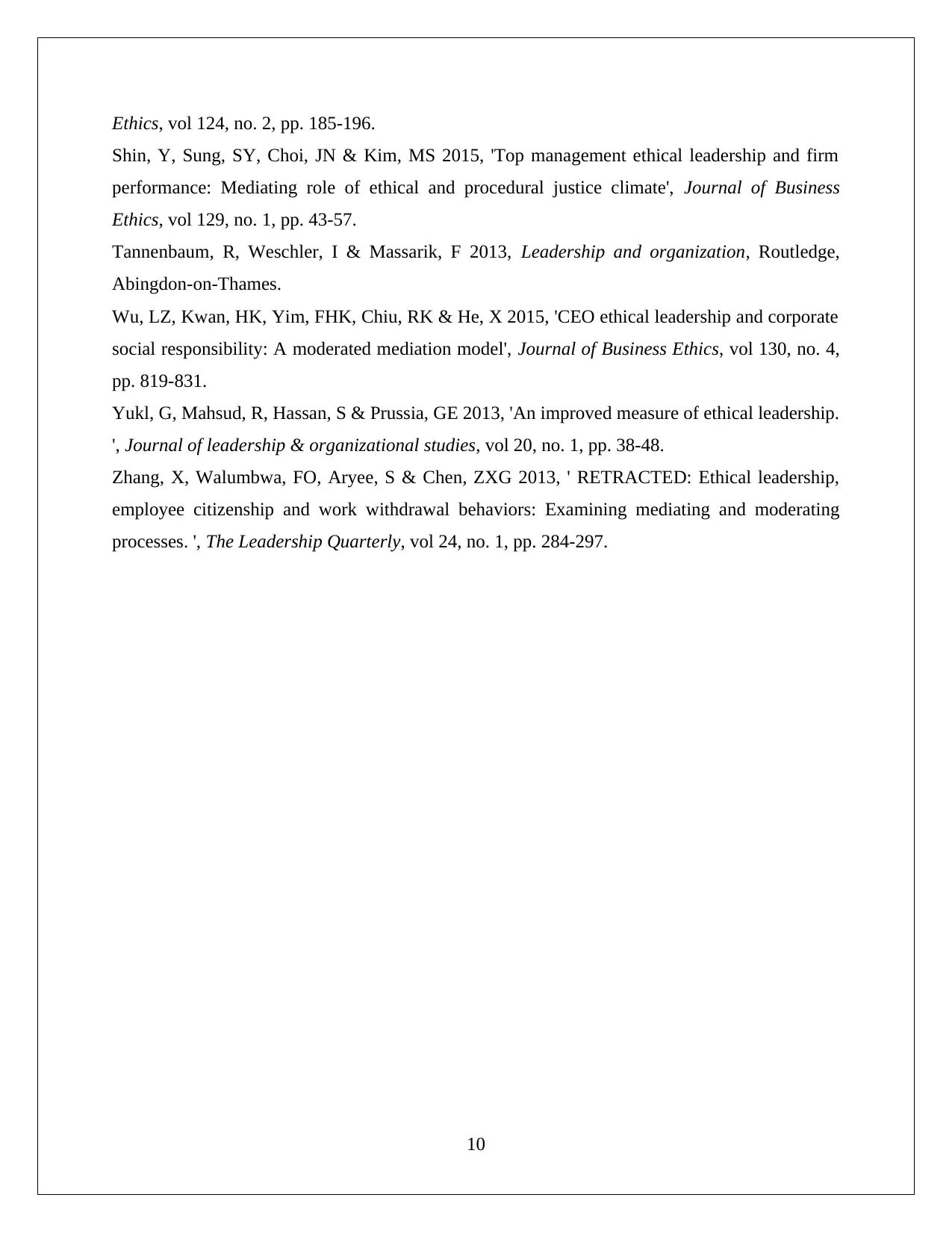
Ethics, vol 124, no. 2, pp. 185-196.
Shin, Y, Sung, SY, Choi, JN & Kim, MS 2015, 'Top management ethical leadership and firm
performance: Mediating role of ethical and procedural justice climate', Journal of Business
Ethics, vol 129, no. 1, pp. 43-57.
Tannenbaum, R, Weschler, I & Massarik, F 2013, Leadership and organization, Routledge,
Abingdon-on-Thames.
Wu, LZ, Kwan, HK, Yim, FHK, Chiu, RK & He, X 2015, 'CEO ethical leadership and corporate
social responsibility: A moderated mediation model', Journal of Business Ethics, vol 130, no. 4,
pp. 819-831.
Yukl, G, Mahsud, R, Hassan, S & Prussia, GE 2013, 'An improved measure of ethical leadership.
', Journal of leadership & organizational studies, vol 20, no. 1, pp. 38-48.
Zhang, X, Walumbwa, FO, Aryee, S & Chen, ZXG 2013, ' RETRACTED: Ethical leadership,
employee citizenship and work withdrawal behaviors: Examining mediating and moderating
processes. ', The Leadership Quarterly, vol 24, no. 1, pp. 284-297.
10
Shin, Y, Sung, SY, Choi, JN & Kim, MS 2015, 'Top management ethical leadership and firm
performance: Mediating role of ethical and procedural justice climate', Journal of Business
Ethics, vol 129, no. 1, pp. 43-57.
Tannenbaum, R, Weschler, I & Massarik, F 2013, Leadership and organization, Routledge,
Abingdon-on-Thames.
Wu, LZ, Kwan, HK, Yim, FHK, Chiu, RK & He, X 2015, 'CEO ethical leadership and corporate
social responsibility: A moderated mediation model', Journal of Business Ethics, vol 130, no. 4,
pp. 819-831.
Yukl, G, Mahsud, R, Hassan, S & Prussia, GE 2013, 'An improved measure of ethical leadership.
', Journal of leadership & organizational studies, vol 20, no. 1, pp. 38-48.
Zhang, X, Walumbwa, FO, Aryee, S & Chen, ZXG 2013, ' RETRACTED: Ethical leadership,
employee citizenship and work withdrawal behaviors: Examining mediating and moderating
processes. ', The Leadership Quarterly, vol 24, no. 1, pp. 284-297.
10

1 out of 10


Related Documents


Your All-in-One AI-Powered Toolkit for Academic Success.
+13062052269
info@desklib.com
Available 24*7 on WhatsApp / Email
![[object Object]](/_next/static/media/star-bottom.7253800d.svg)
Unlock your academic potential
Copyright © 2020–2026 A2Z Services. All Rights Reserved. Developed and managed by ZUCOL.