Leadership Style and Behavior Analysis: Banking Sector Report
VerifiedAdded on 2020/04/15
|12
|2418
|39
Report
AI Summary
This report delves into the analysis of leadership styles and behaviors within the banking sector, examining their impact on employee performance. It begins by exploring various leadership styles, including authoritative, persuasive, consultative, and democratic approaches, and discusses the factors influencing their selection and effectiveness in different workplace situations. The report then evaluates individual leadership qualities and potential, aligning them with the Tannenbaum and Schmidt Model of situational leadership. Through self-assessment and feedback analysis, the report identifies areas for improvement, such as a tendency towards persuasive leadership and underuse of democratic approaches. Finally, it recommends specific actions to enhance individual leadership behavior, including setting objectives, seeking feedback, and promoting broader situational awareness to foster effective team dynamics and achieve organizational goals within the banking sector.
Running head: LEADERSHIP BEHAVIOUR ANALYSIS
Development of Individual Leadership Style and Behavior
Name of the University:
Name of the Student:
Authors Note:
Development of Individual Leadership Style and Behavior
Name of the University:
Name of the Student:
Authors Note:

Paraphrase This Document
Need a fresh take? Get an instant paraphrase of this document with our AI Paraphraser
1LEADERSHIP BEHAVIOUR ANALYSIS
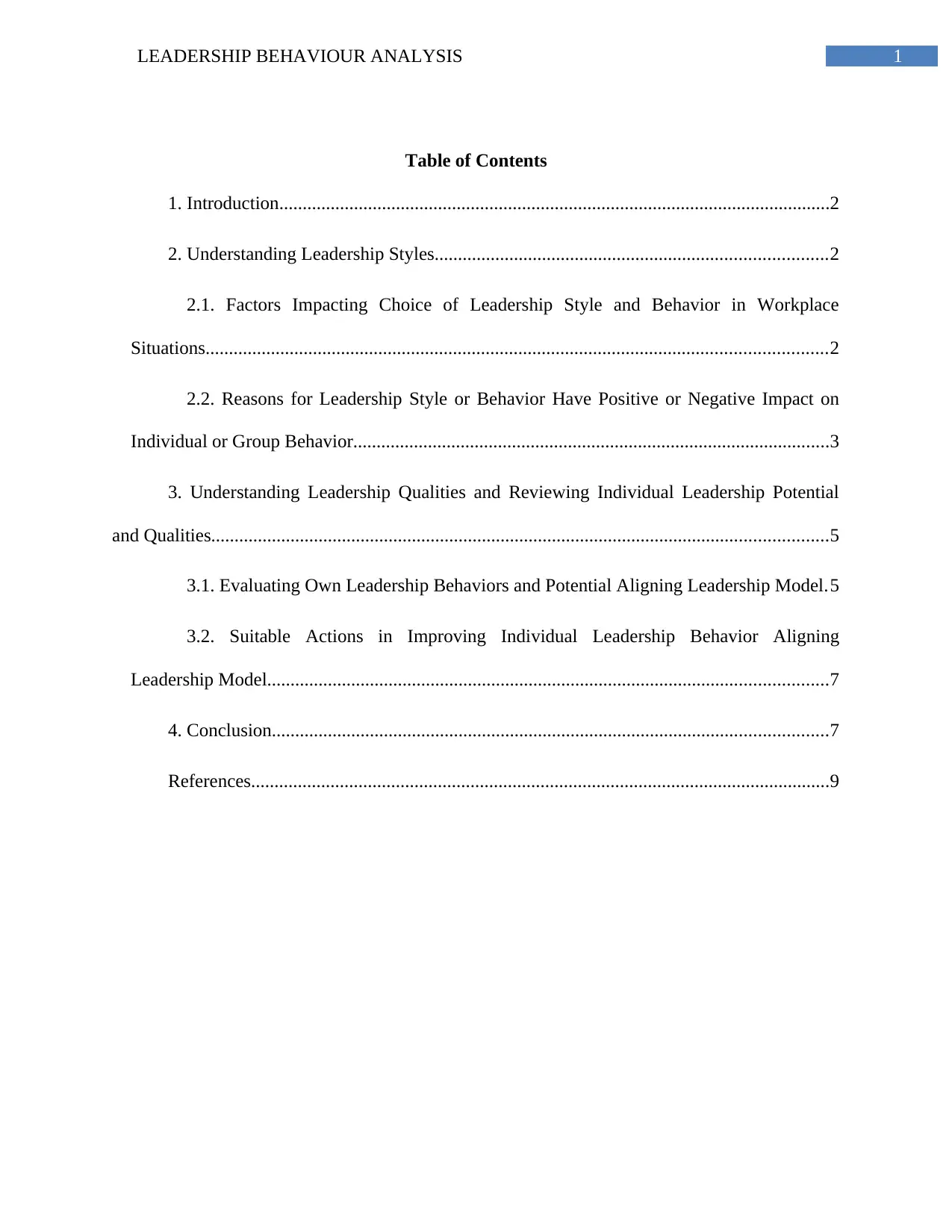
Table of Contents
1. Introduction......................................................................................................................2
2. Understanding Leadership Styles....................................................................................2
2.1. Factors Impacting Choice of Leadership Style and Behavior in Workplace
Situations.....................................................................................................................................2
2.2. Reasons for Leadership Style or Behavior Have Positive or Negative Impact on
Individual or Group Behavior......................................................................................................3
3. Understanding Leadership Qualities and Reviewing Individual Leadership Potential
and Qualities....................................................................................................................................5
3.1. Evaluating Own Leadership Behaviors and Potential Aligning Leadership Model.5
3.2. Suitable Actions in Improving Individual Leadership Behavior Aligning
Leadership Model........................................................................................................................7
4. Conclusion.......................................................................................................................7
References............................................................................................................................9
Table of Contents
1. Introduction......................................................................................................................2
2. Understanding Leadership Styles....................................................................................2
2.1. Factors Impacting Choice of Leadership Style and Behavior in Workplace
Situations.....................................................................................................................................2
2.2. Reasons for Leadership Style or Behavior Have Positive or Negative Impact on
Individual or Group Behavior......................................................................................................3
3. Understanding Leadership Qualities and Reviewing Individual Leadership Potential
and Qualities....................................................................................................................................5
3.1. Evaluating Own Leadership Behaviors and Potential Aligning Leadership Model.5
3.2. Suitable Actions in Improving Individual Leadership Behavior Aligning
Leadership Model........................................................................................................................7
4. Conclusion.......................................................................................................................7
References............................................................................................................................9
2LEADERSHIP BEHAVIOUR ANALYSIS
1. Introduction
In the current years, leadership strategies follow most effective new approaches in
managing employees along with organizations. Leadership styles are practiced by individuals as
it has drastic impact on employee performance. Distinct leadership styles are employed that can
fit with employees based on empowerment, directions and decision making power (Antoniadis
and House 2013). The objective of this paper is to recognize the individual leadership style
factors that impact leadership styles and its impact on banking sector employee behavior. The
paper will also explain the impact of individual leadership styles on the workforce. Moreover,
based on the leadership model analysis used by the individual within banking sector certain
actions will be recommended that can enhance leadership behavior of employees within the
sector.
2. Understanding Leadership Styles
2.1. Factors Impacting Choice of Leadership Style and Behavior in Workplace Situations
Every situation is distinct and a leadership style is implemented within a situation will not be
applicable in another. The leader must employ judgment in deciding suitable leadership style
required in each situation (Bormann and Abrahamson 2014). A situational initiative to leadership
recognizes four leadership styles including:
Persuasive
Authoritative
Consultative
Democratic
1. Introduction
In the current years, leadership strategies follow most effective new approaches in
managing employees along with organizations. Leadership styles are practiced by individuals as
it has drastic impact on employee performance. Distinct leadership styles are employed that can
fit with employees based on empowerment, directions and decision making power (Antoniadis
and House 2013). The objective of this paper is to recognize the individual leadership style
factors that impact leadership styles and its impact on banking sector employee behavior. The
paper will also explain the impact of individual leadership styles on the workforce. Moreover,
based on the leadership model analysis used by the individual within banking sector certain
actions will be recommended that can enhance leadership behavior of employees within the
sector.
2. Understanding Leadership Styles
2.1. Factors Impacting Choice of Leadership Style and Behavior in Workplace Situations
Every situation is distinct and a leadership style is implemented within a situation will not be
applicable in another. The leader must employ judgment in deciding suitable leadership style
required in each situation (Bormann and Abrahamson 2014). A situational initiative to leadership
recognizes four leadership styles including:
Persuasive
Authoritative
Consultative
Democratic
⊘ This is a preview!⊘
Do you want full access?
Subscribe today to unlock all pages.

Trusted by 1+ million students worldwide
3LEADERSHIP BEHAVIOUR ANALYSIS
In context of key frontline supervisory leadership role in banking sector leadership is
segmented in two manners. The first being the day of working within banking sector that
encompass directing training individual groups and work and another one is increasing response
to emergency situations (Carter and Greer 2013). Aspects common to both situations that can
impact leadership style and behavior that can be used include individuals involved and
competence level, task nature, supervision level required by task, the place where tasks must be
performed, the way task is performed and associated priority level.
In case of an emergency certain factors that must be considered includes:
Time available for task accomplishment
Nature and level of involved risks
In a situation of routine aspects of job working patterns and activities might be predictable
fairly and so several styles and behaviors can be suitable based on points mentioned above.
However, democratic consultative and perusable leadership styles might be employed in equal
measure (Tyson 2013). In such context authoritative style might be used when discipline and
performance issues arise.
2.2. Reasons for Leadership Style or Behavior Have Positive or Negative Impact on
Individual or Group Behavior
Employed leadership style should address situation needs along with taking into
consideration concerned individuals; a leader must understand that both negative and positive
impacts must be considered (Hinojosa et al. 2014). In deciding appropriate leadership style for a
situation, the leader must remain aware of likely unintended consequences in consideration to
team if style is unsuitable for a situation or associated people.
In context of key frontline supervisory leadership role in banking sector leadership is
segmented in two manners. The first being the day of working within banking sector that
encompass directing training individual groups and work and another one is increasing response
to emergency situations (Carter and Greer 2013). Aspects common to both situations that can
impact leadership style and behavior that can be used include individuals involved and
competence level, task nature, supervision level required by task, the place where tasks must be
performed, the way task is performed and associated priority level.
In case of an emergency certain factors that must be considered includes:
Time available for task accomplishment
Nature and level of involved risks
In a situation of routine aspects of job working patterns and activities might be predictable
fairly and so several styles and behaviors can be suitable based on points mentioned above.
However, democratic consultative and perusable leadership styles might be employed in equal
measure (Tyson 2013). In such context authoritative style might be used when discipline and
performance issues arise.
2.2. Reasons for Leadership Style or Behavior Have Positive or Negative Impact on
Individual or Group Behavior
Employed leadership style should address situation needs along with taking into
consideration concerned individuals; a leader must understand that both negative and positive
impacts must be considered (Hinojosa et al. 2014). In deciding appropriate leadership style for a
situation, the leader must remain aware of likely unintended consequences in consideration to
team if style is unsuitable for a situation or associated people.
Paraphrase This Document
Need a fresh take? Get an instant paraphrase of this document with our AI Paraphraser
4LEADERSHIP BEHAVIOUR ANALYSIS
Authoritative leadership style involves leaders to make every decision and indicate the
team the things that can be suitable in time focused risk sensitive conditions, specifically where
the team are not trained properly and does not have understanding of a situation. Positives of
effective implementation of this style include speed of action, purpose clarity and doubt removal
considering the aspects needed of individuals and teams (Johnston and Marshall 2016). In
improper implementation certain negative behavior of employees can arise such as confidence
loss, de-motivation, issues with morale and team that does not participate actively and stays
relied on the leader (Roueche, Baker III and Rose 2014).
Persuasive leadership style involves salesmanship in which leader sells decisions and
objectives to team through explaining decision reasons. In such scenario, the manager might
attain positives like being observed by team to identify their importance and indicating concern
for them along with attaining “buy in” from individuals and team (Kroll and Vogel 2014). If
implemented inappropriately, this leadership style can reveal negative results as not all leaders
attain ability to sell decisions convincingly and implementation of this style might make leaders
appear weak in case they constantly try to justify or sell their decisions.
Democrative style facilitates the leaders to make the team develop and decide actions that
might be suitable for a team that performs at high level (Tyssen, Wald and Spieth 2013).
Leadership functions can be shared with the group and individuals that has increased
consideration in decision making along with implementation of procedures and actions.
Advantages of such style encompass securing team commitment to decisions along with their
implementation that can facilitate team and individual development with enhanced morale
(Lussier and Achua 2015). Disadvantages of improper implementation of this style considers that
in constitution of unclear team roles, this can result in communication failures. There can also be
Authoritative leadership style involves leaders to make every decision and indicate the
team the things that can be suitable in time focused risk sensitive conditions, specifically where
the team are not trained properly and does not have understanding of a situation. Positives of
effective implementation of this style include speed of action, purpose clarity and doubt removal
considering the aspects needed of individuals and teams (Johnston and Marshall 2016). In
improper implementation certain negative behavior of employees can arise such as confidence
loss, de-motivation, issues with morale and team that does not participate actively and stays
relied on the leader (Roueche, Baker III and Rose 2014).
Persuasive leadership style involves salesmanship in which leader sells decisions and
objectives to team through explaining decision reasons. In such scenario, the manager might
attain positives like being observed by team to identify their importance and indicating concern
for them along with attaining “buy in” from individuals and team (Kroll and Vogel 2014). If
implemented inappropriately, this leadership style can reveal negative results as not all leaders
attain ability to sell decisions convincingly and implementation of this style might make leaders
appear weak in case they constantly try to justify or sell their decisions.
Democrative style facilitates the leaders to make the team develop and decide actions that
might be suitable for a team that performs at high level (Tyssen, Wald and Spieth 2013).
Leadership functions can be shared with the group and individuals that has increased
consideration in decision making along with implementation of procedures and actions.
Advantages of such style encompass securing team commitment to decisions along with their
implementation that can facilitate team and individual development with enhanced morale
(Lussier and Achua 2015). Disadvantages of improper implementation of this style considers that
in constitution of unclear team roles, this can result in communication failures. There can also be
5LEADERSHIP BEHAVIOUR ANALYSIS
a likely responsible ability solution if no individual is responsible for making decisions (Tate and
Yang 2015).
As an individual, the role in the banking sector is one of the major tasks that the person is
involved in evaluation of the command skills of people those act as “initial incident
commanders”. The results of current evaluations have signified vita training needs for the
personnel group and the individual have implemented a consultation process among the group
and senior management for recognizing suitable ways to correct such situation (Wallace, de
Chernatony and Buil 2013).
3. Understanding Leadership Qualities and Reviewing Individual Leadership Potential and
Qualities
3.1. Evaluating Own Leadership Behaviors and Potential Aligning Leadership Model
In the first day of the course a self assessment task was carried out by the individual that
identified leadership styles aligning “The Tannenbaum and Schmidt Model” of situational
leadership (Carter 2013). Evaluation of individual results from evaluation evidence of underuse
of democratic style along with an intention to favor persuasive leadership style was recognized.
This revealed that consultative and authoritative styles remain in accordance with the
individual’s peers in the course.
In such situation, the individual accepts the evaluation results in consideration to
persuasive style and is identified that it is likely that application of democratic leadership style
can be ignored (Van Wart 2017). The individual therefore needs to recognize practical ways in
addressing concerns raised to make sure that the individual regularly implements suitable
leadership style to certain situations and employees involved. The individual must regularly
a likely responsible ability solution if no individual is responsible for making decisions (Tate and
Yang 2015).
As an individual, the role in the banking sector is one of the major tasks that the person is
involved in evaluation of the command skills of people those act as “initial incident
commanders”. The results of current evaluations have signified vita training needs for the
personnel group and the individual have implemented a consultation process among the group
and senior management for recognizing suitable ways to correct such situation (Wallace, de
Chernatony and Buil 2013).
3. Understanding Leadership Qualities and Reviewing Individual Leadership Potential and
Qualities
3.1. Evaluating Own Leadership Behaviors and Potential Aligning Leadership Model
In the first day of the course a self assessment task was carried out by the individual that
identified leadership styles aligning “The Tannenbaum and Schmidt Model” of situational
leadership (Carter 2013). Evaluation of individual results from evaluation evidence of underuse
of democratic style along with an intention to favor persuasive leadership style was recognized.
This revealed that consultative and authoritative styles remain in accordance with the
individual’s peers in the course.
In such situation, the individual accepts the evaluation results in consideration to
persuasive style and is identified that it is likely that application of democratic leadership style
can be ignored (Van Wart 2017). The individual therefore needs to recognize practical ways in
addressing concerns raised to make sure that the individual regularly implements suitable
leadership style to certain situations and employees involved. The individual must regularly
⊘ This is a preview!⊘
Do you want full access?
Subscribe today to unlock all pages.
Trusted by 1+ million students worldwide
6LEADERSHIP BEHAVIOUR ANALYSIS
evaluate his persuasive style in consideration to democratic and consultative styles (Christensen,
Mackey and Whetten 2014).
Comments attained from someone managed by the individual in relation to his leadership
style are that attaining set targets, the individual is prone to not associating them in case such
targets change that might result in suggesting real under use of consultative leadership style. A
co-workers with whom the individual works closely has suggested that he indicates a tendency
towards tunnel vision that might correspond to implied support towards persuasive style along
with the individual’s desire to make people listen to made decisions (Deinert et al. 2015). Line
manager of the individual has commented positively on the individual’s capability to use several
leadership styles as per situational requirements and the manager identified persuasive style
preference in the individual through evaluating self-assessment task (Ward 2016).
The existing management culture in the banking sector is relied on results attained
against previously agreed yearly personal development reviews (Northouse 2015). The reality of
such situation is that such service tends to value output volume over the results quality along
with old management consultant favorite 80/20 rule is generally misquoted. Till the results are
attained and no personal issues take place, the applied leadership style is not relevant. From the
individual personal observations, authoritative style is highly prevalent in service in several
situations that might be because of increased workloads, capacity issues and time pressures
(Epitropaki and Martin 2013). Such factors result in a situation in which authoritative style turns
out to be attractive as considering face value this seems quick and simple.
evaluate his persuasive style in consideration to democratic and consultative styles (Christensen,
Mackey and Whetten 2014).
Comments attained from someone managed by the individual in relation to his leadership
style are that attaining set targets, the individual is prone to not associating them in case such
targets change that might result in suggesting real under use of consultative leadership style. A
co-workers with whom the individual works closely has suggested that he indicates a tendency
towards tunnel vision that might correspond to implied support towards persuasive style along
with the individual’s desire to make people listen to made decisions (Deinert et al. 2015). Line
manager of the individual has commented positively on the individual’s capability to use several
leadership styles as per situational requirements and the manager identified persuasive style
preference in the individual through evaluating self-assessment task (Ward 2016).
The existing management culture in the banking sector is relied on results attained
against previously agreed yearly personal development reviews (Northouse 2015). The reality of
such situation is that such service tends to value output volume over the results quality along
with old management consultant favorite 80/20 rule is generally misquoted. Till the results are
attained and no personal issues take place, the applied leadership style is not relevant. From the
individual personal observations, authoritative style is highly prevalent in service in several
situations that might be because of increased workloads, capacity issues and time pressures
(Epitropaki and Martin 2013). Such factors result in a situation in which authoritative style turns
out to be attractive as considering face value this seems quick and simple.
Paraphrase This Document
Need a fresh take? Get an instant paraphrase of this document with our AI Paraphraser
7LEADERSHIP BEHAVIOUR ANALYSIS
3.2. Suitable Actions in Improving Individual Leadership Behavior Aligning Leadership
Model
The suitable actions for improving individual behavior are explained under:
Recognizing traits
Setting objectives
Consulting
Involving more personnel earlier
Considering persuasive style and under using democratic style
Attaining regular feedback from someone the individual manages and works with along
with the line manager
Setting of target and informing
Considering tunnel vision and giving preference to persuasive leadership style
Ensuring broader situational awareness along with regular open team meetings that can
facilitate two way communication
4. Conclusion
The objective of this paper is to recognize the factors that impact leadership styles and its
impact on banking sector Bahrain employee behavior. It is gathered from the paper that in
banking sector Bahrain the leader strongly believes in teamwork to be most common approach to
work that impacts choice of leadership style. Certain employees that wish to instill employees
self learning management work importance can work better as transformational leaders. From
the leadership model analysis of Banking sector Bahrain, it has been gathered that it is dealing
with issues regarding project implementation and making such issues manageable will
3.2. Suitable Actions in Improving Individual Leadership Behavior Aligning Leadership
Model
The suitable actions for improving individual behavior are explained under:
Recognizing traits
Setting objectives
Consulting
Involving more personnel earlier
Considering persuasive style and under using democratic style
Attaining regular feedback from someone the individual manages and works with along
with the line manager
Setting of target and informing
Considering tunnel vision and giving preference to persuasive leadership style
Ensuring broader situational awareness along with regular open team meetings that can
facilitate two way communication
4. Conclusion
The objective of this paper is to recognize the factors that impact leadership styles and its
impact on banking sector Bahrain employee behavior. It is gathered from the paper that in
banking sector Bahrain the leader strongly believes in teamwork to be most common approach to
work that impacts choice of leadership style. Certain employees that wish to instill employees
self learning management work importance can work better as transformational leaders. From
the leadership model analysis of Banking sector Bahrain, it has been gathered that it is dealing
with issues regarding project implementation and making such issues manageable will
8LEADERSHIP BEHAVIOUR ANALYSIS
necessitate the company’s leadership model to get restructured that will increase the control level
on team work.
necessitate the company’s leadership model to get restructured that will increase the control level
on team work.
⊘ This is a preview!⊘
Do you want full access?
Subscribe today to unlock all pages.
Trusted by 1+ million students worldwide
9LEADERSHIP BEHAVIOUR ANALYSIS
References
Antonakis, J. and House, R.J., 2013. The full-range leadership theory: The way forward.
In Transformational and Charismatic Leadership: The Road Ahead 10th Anniversary
Edition (pp. 3-33). Emerald Group Publishing Limited.
Bormann, L. and Abrahamson, K., 2014. Do staff nurse perceptions of nurse leadership
behaviors influence staff nurse job satisfaction? The case of a hospital applying for Magnet®
designation. Journal of Nursing Administration, 44(4), pp.219-225.
Carter, S.M. and Greer, C.R., 2013. Strategic leadership: Values, styles, and organizational
performance. Journal of Leadership & Organizational Studies, 20(4), pp.375-393.
Carter, S.M., 2013. Strategic leadership: Values, styles, and organizational performance. Journal
of Leadership & Organizational Studies, 20(4), pp.375-393.
Christensen, L.J., Mackey, A. and Whetten, D., 2014. Taking responsibility for corporate social
responsibility: The role of leaders in creating, implementing, sustaining, or avoiding socially
responsible firm behaviors. The Academy of Management Perspectives, 28(2), pp.164-178.
Deinert, A., Homan, A.C., Boer, D., Voelpel, S.C. and Gutermann, D., 2015. Transformational
leadership sub-dimensions and their link to leaders' personality and performance. The Leadership
Quarterly, 26(6), pp.1095-1120.
Epitropaki, O. and Martin, R., 2013. Transformational–transactional leadership and upward
influence: The role of relative leader–member exchanges (RLMX) and perceived organizational
support (POS). The Leadership Quarterly, 24(2), pp.299-315.
References
Antonakis, J. and House, R.J., 2013. The full-range leadership theory: The way forward.
In Transformational and Charismatic Leadership: The Road Ahead 10th Anniversary
Edition (pp. 3-33). Emerald Group Publishing Limited.
Bormann, L. and Abrahamson, K., 2014. Do staff nurse perceptions of nurse leadership
behaviors influence staff nurse job satisfaction? The case of a hospital applying for Magnet®
designation. Journal of Nursing Administration, 44(4), pp.219-225.
Carter, S.M. and Greer, C.R., 2013. Strategic leadership: Values, styles, and organizational
performance. Journal of Leadership & Organizational Studies, 20(4), pp.375-393.
Carter, S.M., 2013. Strategic leadership: Values, styles, and organizational performance. Journal
of Leadership & Organizational Studies, 20(4), pp.375-393.
Christensen, L.J., Mackey, A. and Whetten, D., 2014. Taking responsibility for corporate social
responsibility: The role of leaders in creating, implementing, sustaining, or avoiding socially
responsible firm behaviors. The Academy of Management Perspectives, 28(2), pp.164-178.
Deinert, A., Homan, A.C., Boer, D., Voelpel, S.C. and Gutermann, D., 2015. Transformational
leadership sub-dimensions and their link to leaders' personality and performance. The Leadership
Quarterly, 26(6), pp.1095-1120.
Epitropaki, O. and Martin, R., 2013. Transformational–transactional leadership and upward
influence: The role of relative leader–member exchanges (RLMX) and perceived organizational
support (POS). The Leadership Quarterly, 24(2), pp.299-315.
Paraphrase This Document
Need a fresh take? Get an instant paraphrase of this document with our AI Paraphraser
10LEADERSHIP BEHAVIOUR ANALYSIS
Hinojosa, A.S., McCauley, K.D., Randolph-Seng, B. and Gardner, W.L., 2014. Leader and
follower attachment styles: Implications for authentic leader–follower relationships. The
Leadership Quarterly, 25(3), pp.595-610.
Johnston, M.W. and Marshall, G.W., 2016. Sales force management: Leadership, innovation,
technology. Routledge.
Kroll, A. and Vogel, D., 2014. The PSM–leadership fit: A model of performance information
use. Public Administration, 92(4), pp.974-991.
Lussier, R.N. and Achua, C.F., 2015. Leadership: Theory, application, & skill development.
Nelson Education.
Northouse, P.G., 2015. Leadership: Theory and practice. Sage publications.
Onorato, M., 2013. Transformational leadership style in the educational sector: An empirical
study of corporate managers and educational leaders. Academy of Educational Leadership
Journal, 17(1), p.33.
Roueche, P.E., Baker III, G.A. and Rose, R.R., 2014. Shared vision: Transformational
leadership in American community colleges. Rowman & Littlefield.
Tate, G. and Yang, L., 2015. Female leadership and gender equity: Evidence from plant
closure. Journal of Financial Economics, 117(1), pp.77-97.
Tyssen, A.K., 2013. Leadership in temporary organizations: A review of leadership theories and
a research agenda. Project Management Journal, 44(6), pp.52-67.
Hinojosa, A.S., McCauley, K.D., Randolph-Seng, B. and Gardner, W.L., 2014. Leader and
follower attachment styles: Implications for authentic leader–follower relationships. The
Leadership Quarterly, 25(3), pp.595-610.
Johnston, M.W. and Marshall, G.W., 2016. Sales force management: Leadership, innovation,
technology. Routledge.
Kroll, A. and Vogel, D., 2014. The PSM–leadership fit: A model of performance information
use. Public Administration, 92(4), pp.974-991.
Lussier, R.N. and Achua, C.F., 2015. Leadership: Theory, application, & skill development.
Nelson Education.
Northouse, P.G., 2015. Leadership: Theory and practice. Sage publications.
Onorato, M., 2013. Transformational leadership style in the educational sector: An empirical
study of corporate managers and educational leaders. Academy of Educational Leadership
Journal, 17(1), p.33.
Roueche, P.E., Baker III, G.A. and Rose, R.R., 2014. Shared vision: Transformational
leadership in American community colleges. Rowman & Littlefield.
Tate, G. and Yang, L., 2015. Female leadership and gender equity: Evidence from plant
closure. Journal of Financial Economics, 117(1), pp.77-97.
Tyssen, A.K., 2013. Leadership in temporary organizations: A review of leadership theories and
a research agenda. Project Management Journal, 44(6), pp.52-67.
11LEADERSHIP BEHAVIOUR ANALYSIS
Tyssen, A.K., Wald, A. and Spieth, P., 2013. Leadership in temporary organizations: A review of
leadership theories and a research agenda. Project Management Journal, 44(6), pp.52-67.
Van Wart, M., 2017. Leadership in public organizations: An introduction. Taylor & Francis.
Wallace, E., de Chernatony, L. and Buil, I., 2013. Building bank brands: How leadership
behavior influences employee commitment. Journal of Business Research, 66(2), pp.165-171.
Ward, J., 2016. Keeping the family business healthy: How to plan for continuing growth,
profitability, and family leadership. Springer.
Tyssen, A.K., Wald, A. and Spieth, P., 2013. Leadership in temporary organizations: A review of
leadership theories and a research agenda. Project Management Journal, 44(6), pp.52-67.
Van Wart, M., 2017. Leadership in public organizations: An introduction. Taylor & Francis.
Wallace, E., de Chernatony, L. and Buil, I., 2013. Building bank brands: How leadership
behavior influences employee commitment. Journal of Business Research, 66(2), pp.165-171.
Ward, J., 2016. Keeping the family business healthy: How to plan for continuing growth,
profitability, and family leadership. Springer.
⊘ This is a preview!⊘
Do you want full access?
Subscribe today to unlock all pages.
Trusted by 1+ million students worldwide

1 out of 12


Related Documents


Your All-in-One AI-Powered Toolkit for Academic Success.
+13062052269
info@desklib.com
Available 24*7 on WhatsApp / Email
![[object Object]](/_next/static/media/star-bottom.7253800d.svg)
Unlock your academic potential
Copyright © 2020–2026 A2Z Services. All Rights Reserved. Developed and managed by ZUCOL.