Analysis of Leadership Styles: Transformational, Gender & Inspiration

Verified

Added on  2022/08/24

|4
|570
|17
Essay
AI Summary
This essay provides an analysis of different leadership styles, focusing on transformational leadership, gender-specific leadership, and the qualities of an inspirational leader. It references studies on transformational leadership in nursing, organizational leadership across the United States, and the impact of gender on leadership styles. The author identifies Nelson Mandela as a key inspirational leader, citing his role in the anti-apartheid movement and his fight against racial discrimination. The essay draws upon research articles to support its analysis of leadership dynamics in various contexts, including healthcare and organizational settings. Desklib offers a platform to explore similar solved assignments and past papers.
Document Page
Running Head: LEADERSHIP STYLE
Leadership style
Name of the Student:
Name of the University:
Author Note:
tabler-icon-diamond-filled.svg

Paraphrase This Document

Need a fresh take? Get an instant paraphrase of this document with our AI Paraphraser
Document Page
1LEADERSHIP STYLE
The first source stresses on the leadership role of the doctor in the different nursing
development from their various degrees. The first source mainly highlights the transitional
leadership roles in the domain of the healthcare sector. The need of the effective leadership styles
will be existing in different high priority areas. The need of the effective leadership style will
lead to the different forms of the dynamic practices that will lead to the most precipitating factor
as the professional form of leadership in the organizational dynamics. This source has helped me
to analyze the role of the transitional leadership in the complex roles played by the organization.
(Marshall & Broome, 2017).
The second source deals with the organizational leadership in the context of the various
qualitative cases across the entire geographical area of United States. This type of leadership can
be referred to as the area specific leadership. This form of leadership will result in the different
stable form of the financial flexibility patterns that will be used to enhance the workforce
development that will aid the organizational culture that will be supportive of the different
decision making processes of the implementation of the business strategies (Duggan,2015).
The third article is based on the leadership role that is played by the women in the
different fields. This type of leadership is also referred to as the gender specific leadership style.
The article explains that the women are improving their fields in the different roles of their
leadership styles. The different perspective of the social role theory will review the different
democratic styles of the men and women that will affect the different organizational form of
leadership in the organizational context.(Eagly & Johannesen‐Schmidt 2001).
According to me the most inspirational leader is Nelson Mandela. He is the most
motivational leader according to me because Nelson Mandela has become the symbol of the
struggles of the people against the injustice practices. The anti-apartheid movement has made
Document Page
2LEADERSHIP STYLE
Mandela a more prominent leader. Mandel fought against the racial discrimination measures and
became the head of the ANC and worked hand in hand with the then President.
Document Page
3LEADERSHIP STYLE
References
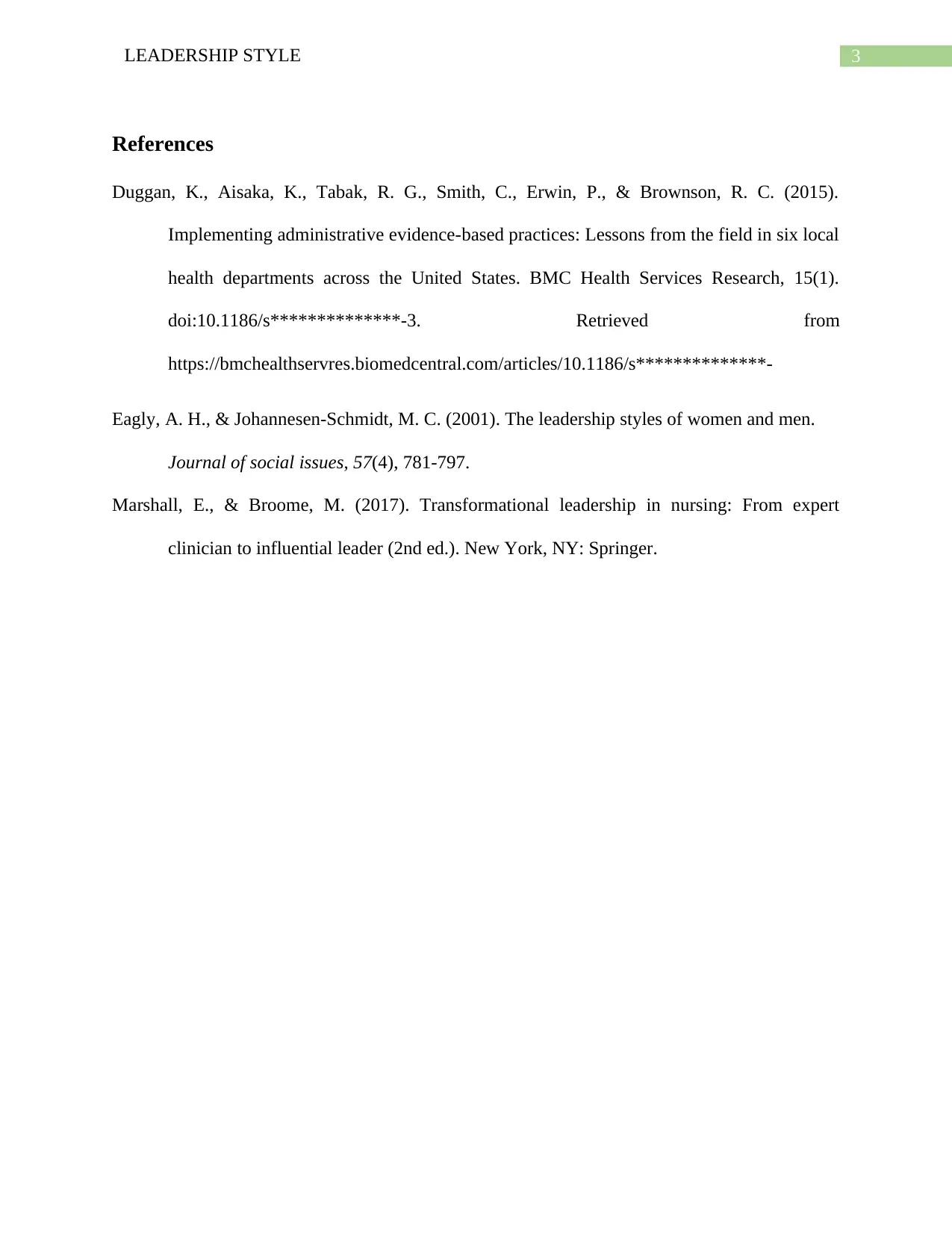
Duggan, K., Aisaka, K., Tabak, R. G., Smith, C., Erwin, P., & Brownson, R. C. (2015).
Implementing administrative evidence-based practices: Lessons from the field in six local
health departments across the United States. BMC Health Services Research, 15(1).
doi:10.1186/s**************-3. Retrieved from
https://bmchealthservres.biomedcentral.com/articles/10.1186/s**************-
Eagly, A. H., & Johannesen‐Schmidt, M. C. (2001). The leadership styles of women and men.
Journal of social issues, 57(4), 781-797.
Marshall, E., & Broome, M. (2017). Transformational leadership in nursing: From expert
clinician to influential leader (2nd ed.). New York, NY: Springer.
chevron_up_icon
1 out of 4
circle_padding
hide_on_mobile
zoom_out_icon
[object Object]